×

Bolivia🇧🇴 | beachesCopacabana BeachLake Titicaca shore, Isla del Sol boats, pedal boats, trout grills, Cerro Calvario | things to do and best time to go

Explore Teatro Gran MariscalExplore Cochabamba

Backpacking in Copacabana Beach
🏆 Top pickbeach ranked #1
By Johan Kruseman 🇳🇱 | Updated October 19, 2026

Copacabana Beach is not a sea beach. It sits on Lake Titicaca, at about 3,800 meters, in the west of Bolivia on the Peruvian border, a short ride from the Peru crossing at Kasani. The sand is coarse and gray-brown, the water is cold enough to make wading a dare, and nobody comes here to surf. Skip the swim. Spend your time on the pedal boats, the trout grills along the waterfront and the climb up Cerro Calvario. Crowds thicken on weekends and during the August fiesta, and litter collects near the jetty. I once packed for a beach day with sunscreen and a towel, then missed the last boat to Isla del Sol because I assumed the schedule matched the posted one. I learned to check departures that morning. Budget hostels and set-lunch spots line the streets behind the shore. Carry cash in bolivianos, since ATMs here are few and sometimes empty.

Discover everything you want to know in the 📖 Bolivia Travel Guide.


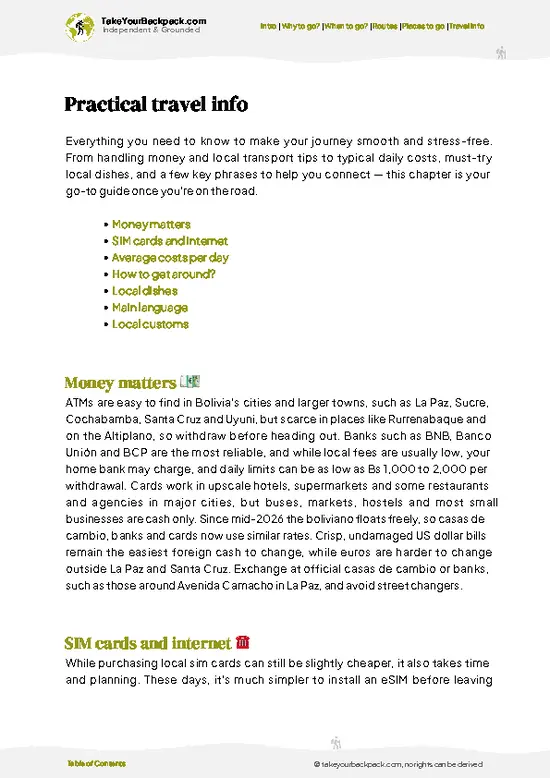
example page 0 from our offline Travel Guide for Bolivia
example page 1 from our offline Travel Guide for Bolivia
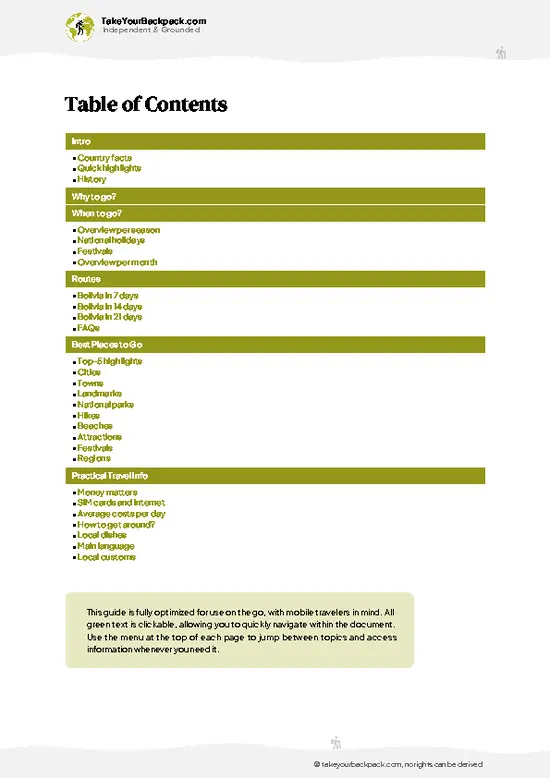
example page 2 from our offline Travel Guide for Bolivia
example page 3 from our offline Travel Guide for Bolivia
example page 4 from our offline Travel Guide for Bolivia
example page 5 from our offline Travel Guide for Bolivia
example page 6 from our offline Travel Guide for Bolivia
example page 7 from our offline Travel Guide for Bolivia
Loading the map 🌍
CLICK TO FILTER
cities
towns
landmarks
national parks
hikes
beaches
attractions
festivals
regions
SHOW COUNTRY’S BESTSHOW ALL

✨ Why go?
Ranked #1 beach in Bolivia
What makes this beach worth visiting

Copacabana Beach earns its stop as the Bolivian gateway on the road from Peru to La Paz, and most people arrive tired from the border. The waterfront gives you somewhere flat and easy to walk, with trout grilled on the lakefront served at stalls within a few steps of the sand. Dorm beds and simple rooms are cheap, and the traveler crowd is relaxed and easy to talk to over a plate of fish. The second reason is the water itself. The beach is the departure point for boats to Isla del Sol, the Inca-linked island where hikers walk ridge trails above blue water, so the shore doubles as a launch pad. Many people use it as a two or three night base for that crossing, then carry on toward La Paz. The third pull is the evening. Sunsets over the lake draw people to the shore, and the stretch near the … read more 👉
Copacabana Beach earns its stop as the Bolivian gateway on the road from Peru to La Paz, and most people arrive tired from the border. The waterfront gives you somewhere flat and easy to walk, with trout grilled on the lakefront served at stalls within a few steps of the sand. Dorm beds and simple rooms are cheap, and the traveler crowd is relaxed and easy to talk to over a plate of fish. The second reason is the water itself. The beach is the departure point for boats to Isla del Sol, the Inca-linked island where hikers walk ridge trails above blue water, so the shore doubles as a launch pad. Many people use it as a two or three night base for that crossing, then carry on toward La Paz. The third pull is the evening. Sunsets over the lake draw people to the shore, and the stretch near the Cerro Calvario hill path fills with travelers heading up to watch the light fade. It is a pause that connects routes, with enough atmosphere to justify staying.

💡 HighlightsKey sights and experiences for travelers

  1. Cathedral of Copacabana (Basílica de Nuestra Señora de Copacabana): This white Moorish-style basilica with tiled domes holds the Dark Virgin of the Lake, a 16th-century carved statue and the reason pilgrims arrive from across the Andes. Go in the morning, when locals queue to see her. On weekends, families bring decorated cars and trucks to be blessed with beer and flowers in the plaza out front.
  2. Cerro Calvario sunset hike: A stone stairway with the Stations of the Cross climbs about 150 meters above town in 30 to 40 minutes at 3,800 meters of altitude, so walk slowly. At the top you get the whole bay, the fishing boats below and the Andean light fading over Lake Titicaca. Locals burn candles and leave offerings at the summit. Bring water and a headlamp for the descent.
  3. Boat trip to Isla del
… read more 👉
  1. Cathedral of Copacabana (Basílica de Nuestra Señora de Copacabana): This white Moorish-style basilica with tiled domes holds the Dark Virgin of the Lake, a 16th-century carved statue and the reason pilgrims arrive from across the Andes. Go in the morning, when locals queue to see her. On weekends, families bring decorated cars and trucks to be blessed with beer and flowers in the plaza out front.
  2. Cerro Calvario sunset hike: A stone stairway with the Stations of the Cross climbs about 150 meters above town in 30 to 40 minutes at 3,800 meters of altitude, so walk slowly. At the top you get the whole bay, the fishing boats below and the Andean light fading over Lake Titicaca. Locals burn candles and leave offerings at the summit. Bring water and a headlamp for the descent.
  3. Boat trip to Isla del Sol: Boats leave the beachfront dock for the island, birthplace of the sun in Inca belief. Take a morning departure, hike the ridge trail between the northern and southern ends (roughly 3 to 4 hours) and pay the small entry fees at the trail checkpoints, which add up to a few dollars. The Inca stairway at Yumani and the terraced hillsides make the effort worthwhile.
  4. Pedal boats and rowboats on the bay: The cheap swan-shaped and plain pedal boats lined up on the sand are ridiculous, and that is the fun. Paddle out over water that is cold year-round, with the hills of the peninsula framing the shore. Swimming is for the brave, but wading and splashing in the shallows is easy.
  5. Trout dinners along the waterfront: Lake trout (trucha) grilled or fried is the local specialty, served on the main beachfront strip with rice and potatoes in simple stalls and restaurants. Eat a plate for a modest price, then end the evening with a hot api morado or a singani-based drink as the street lights up. Night here is low-key, with strolls and food rather than clubs.
Most visitors rush past the Horca del Inca, a set of ancient stone pillars on a hill a short walk from town, where Inca-era astronomers are said to have tracked the solstice.
Spotted a mistake or missing something? Contact us.

Things to do around Copacabana Beach

Ratings based on Tripadvisor reviews. When you book through this link, you support our work at no extra cost to you.

🌤️ When to go?Seasonal considerations and timing

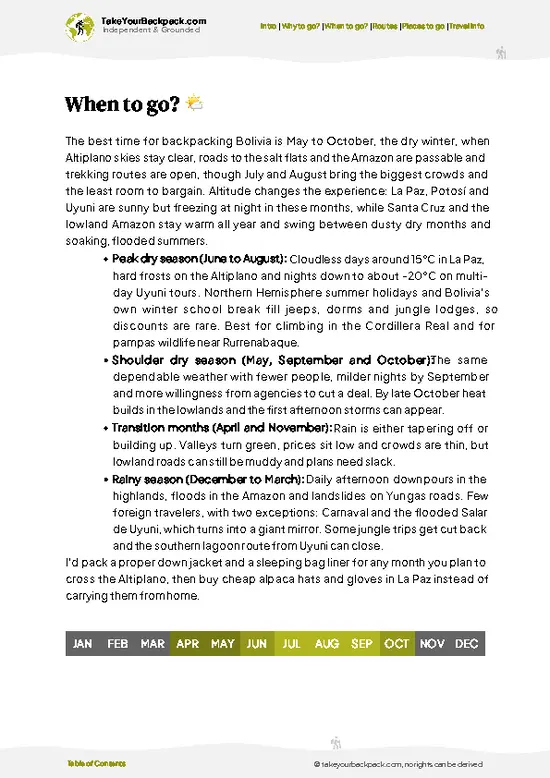
  • Dry Season (May to September): Sunny days of 15 to 19°C (59 to 66°F) at 3,810 meters, with nights that drop to around 0 to 3°C (32 to 37°F). Skies are reliably blue over Lake Titicaca and daylight runs roughly 11 to 12 hours. This is also the busiest stretch, and room rates climb.
  • Wet Season (December to March): Afternoon downpours and cloud, with highs of 15 to 17°C (59 to 63°F) and milder nights near 4 to 6°C (39 to 43°F). Crowds thin, prices soften, and boats to Isla del Sol still run most days.
  • Shoulder Months (April, October, November): Fewer people, mostly dry mornings and a few showers. Good value on beds.
  • Festivals: Semana Santa (March or April) fills the town with pilgrims, and the Fiesta de la Virgen de la Candelaria around February 2 brings dancing, brass bands and doubled prices.
Book … read more 👉
  • Dry Season (May to September): Sunny days of 15 to 19°C (59 to 66°F) at 3,810 meters, with nights that drop to around 0 to 3°C (32 to 37°F). Skies are reliably blue over Lake Titicaca and daylight runs roughly 11 to 12 hours. This is also the busiest stretch, and room rates climb.
  • Wet Season (December to March): Afternoon downpours and cloud, with highs of 15 to 17°C (59 to 63°F) and milder nights near 4 to 6°C (39 to 43°F). Crowds thin, prices soften, and boats to Isla del Sol still run most days.
  • Shoulder Months (April, October, November): Fewer people, mostly dry mornings and a few showers. Good value on beds.
  • Festivals: Semana Santa (March or April) fills the town with pilgrims, and the Fiesta de la Virgen de la Candelaria around February 2 brings dancing, brass bands and doubled prices.
Book ahead for Easter week and early August, and carry cash since ATMs sometimes run dry on festival weekends.


source: climatestotravel.comJANJanuary: fair for travelingFEBFebruary: fair for travelingMARMarch: fair for travelingAPRApril: highly recommended for travelingMAYMay: highly recommended for travelingJUNJune: excellent for travelingJULJuly: excellent for travelingAUGAugust: excellent for travelingSEPSeptember: highly recommended for travelingOCTOctober: highly recommended for travelingNOVNovember: fair for travelingDECDecember: fair for traveling
bolivia-beach-copacabana-beach
© Google |

✈️ The backpacker research shortcutBolivia Travel Guide

An offline-friendly backpacking guide with optimized travel routes, ranked highlights, transport advice, and the best areas to stay.
example page 0 from our offline Travel Guide for Bolivia
example page 1 from our offline Travel Guide for Bolivia
example page 2 from our offline Travel Guide for Bolivia
example page 3 from our offline Travel Guide for Bolivia
example page 4 from our offline Travel Guide for Bolivia
example page 5 from our offline Travel Guide for Bolivia
example page 6 from our offline Travel Guide for Bolivia
example page 7 from our offline Travel Guide for Bolivia
The digital guide (262 pages) contains:
✅ 76 highlights, ranked by travel appeal
✅ Optimized 7, 14 & 21-day travel routes
✅ Cities, national parks, landmarks, beaches
✅ How to get around
✅ Offline-friendly for travel without Wi-Fi
👉 Click to see all 30+ guide features

📅 Plan smarter in minutes, not weeks
✅ Month by month travel advice
✅ Festivals & national holidays
✅ Budget expectations

🗺️ Go to the right places, skip the overrated ones
✅ Honest pros & cons of destinations
✅ Top hikes, parks & viewpoints
✅ Lesser-known places most travelers miss
✅ Clear “worth it vs skip it” guidance

🛏️ Travel smoothly without rookie mistakes
✅ Best areas to stay
✅ Transport systems explained simply
✅ Common scams & safety advice
✅ SIM cards, money & practical tips

🌍 Understand the country, not just visit it
✅ Culture & traditions
✅ 52 Essential phrases & customs
✅ Festivals worth planning around
✅ Traveler-friendly historical context
✅ Insights that make places more meaningful

📱 Built for real travel conditions
✅ Fully downloadable PDF
✅ Works completely offline
✅ Optimized for phone use
✅ Useful in remote areas & buses
✅ Everything in one place
Stop searching, start planning
Get instant access to your full guide. 30‑day money-back guarantee.
+ Add another guide for just

By proceeding you agree to our terms.
Sent to your inbox immediately after payment • 100% Secure Checkout
Best Backpacking Travel Advisor 2025 tourism awardBest Backpacking
Travel Advisor
2025
What others say about Take Your Backpack Guides:
⭐⭐⭐⭐⭐
Fantastic, amazing amount of information!
⭐⭐⭐⭐⭐
My goodness this is amazing, it's what I've been looking for hats off too you!
⭐⭐⭐⭐⭐
I think this is absolutely BRILLIANT
⭐⭐⭐⭐
Very complete and informative. It's still missing places, but I gotta to commend you
⭐⭐⭐⭐⭐
This is truly amazing, thank you, can't wait to explore it with my kids!
⭐⭐⭐⭐⭐
Awesome resource, thank you!
⭐⭐⭐⭐⭐
This is amazing! Can't wait to explore the ones I haven't seen
⭐⭐⭐⭐
I love this! Well done, great idea.
⭐⭐⭐⭐⭐
Thanks for taking the time to make this gem!
⭐⭐⭐⭐⭐
This might be the best website I've ever seen.
⭐⭐⭐⭐⭐
Congratulations, and thank you so much for your work; it's incredibly valuable.
⭐⭐⭐⭐
In all seriousness I think you did a great job pointing out the important spots
⭐⭐⭐⭐⭐
10/10 very good
⭐⭐⭐⭐⭐
As someone who's only just starting to visit regularly this is awesome, thank you.
⭐⭐⭐⭐
Thank you very much! I'm going to visit my dad, it's going to be very useful!
⭐⭐⭐⭐⭐
This is really cool! We'll be travelling for the first time and this definitely come in handy.
⭐⭐⭐⭐⭐
You are now our minister of culture, congratulations 👨‍💼
⭐⭐⭐⭐⭐
Just wanted to tell you that this is a pearl! Going to follow your recommendations.
⭐⭐⭐⭐⭐
This is so cool. I'll definitely be using the resource for my travels soon.
⭐⭐⭐⭐⭐
This is very impressive! Good work.
⭐⭐⭐⭐⭐
This is an amazing and informative site. Very well done!

🛏️ Where to stay?Best areas and accommodation options

The streets climbing from the waterfront toward Calle 6 de Agosto and the lakeside strip are where most backpackers sleep. Dorm beds run roughly US$6 to 12 a night, with simple private rooms at US$15 to 30.
The lower town between the main street and the shore is the easiest base. You can walk to the beach, the boat dock for Isla del Sol, the trout grills and the bus offices in under ten minutes, and it is where solo travelers cross paths in common rooms and rooftop terraces. Evenings stay lively without being rowdy, and the main drag is well lit and busy until late.
The slopes behind the town, toward … read more 👉
The streets climbing from the waterfront toward Calle 6 de Agosto and the lakeside strip are where most backpackers sleep. Dorm beds run roughly US$6 to 12 a night, with simple private rooms at US$15 to 30.
The lower town between the main street and the shore is the easiest base. You can walk to the beach, the boat dock for Isla del Sol, the trout grills and the bus offices in under ten minutes, and it is where solo travelers cross paths in common rooms and rooftop terraces. Evenings stay lively without being rowdy, and the main drag is well lit and busy until late.
The slopes behind the town, toward the Calvario hill, are quieter and cheaper. Rooms there often have lake views, but the climb at this altitude is steep, so expect to be out of breath on arrival. They suit anyone who wants sleep over socializing.
The lakefront stretch north of the dock has a few more relaxed guesthouses with lake-facing balconies, a bit pricier at US$20 to 40. For a social atmosphere, choose the lower town. Spend your first night at that elevation somewhere close to the water so you can rest easily.

🛡️ SafetyTraveler Safety Guide

Copacabana Beach is calm and easy, with a small-town feel and few real hazards. The lake has no tides, no rips and only gentle lapping waves, but the water is cold (roughly 10 to 14°C or 50 to 57°F), so most people wade or paddle rather than swim far. On the water, the pedal boats and small motorboats are the main traffic near the shore.
The sun is the real concern. At nearly 3,800 meters the UV is intense even on cool days, and burns arrive fast, so bring a hat, high SPF and sunglasses. Altitude itself can cause headaches on your first day, so move slowly and drink water.
Weather shifts quickly: clear mornings often give way to wind and cloud by afternoon, and lake squalls can delay boats. Petty theft is uncommon but happens, so keep a bag within sight while you sit on the sand. Evenings are … read more 👉
Copacabana Beach is calm and easy, with a small-town feel and few real hazards. The lake has no tides, no rips and only gentle lapping waves, but the water is cold (roughly 10 to 14°C or 50 to 57°F), so most people wade or paddle rather than swim far. On the water, the pedal boats and small motorboats are the main traffic near the shore.
The sun is the real concern. At nearly 3,800 meters the UV is intense even on cool days, and burns arrive fast, so bring a hat, high SPF and sunglasses. Altitude itself can cause headaches on your first day, so move slowly and drink water.
Weather shifts quickly: clear mornings often give way to wind and cloud by afternoon, and lake squalls can delay boats. Petty theft is uncommon but happens, so keep a bag within sight while you sit on the sand. Evenings are cold and the waterfront is generally fine to walk, though after dark a taxi or companion is smart on the unlit upper streets.

FAQFrequently asked questions about Copacabana Beach

Buses from La Paz take about 3.5 to 4 hours and cost roughly US$4 to 8, with a short ferry crossing at the Strait of Tiquina (a few cents extra, paid separately). From Puno in Peru, direct tourist buses via the Kasani border take around 3.5 to 4 hours and cost US$8 to 15, and many travelers also come from Cusco on a day or overnight connection. The town sits just a few minutes by foot from the beach.
Copacabana Beach works for gentle wading and a quick dip, but the lake is cold at roughly 10 to 14°C (50 to 57°F), so long swims are rare. Kayaks and pedal boats rent for around US$3 to 6 an hour, and there is no real surf. Snorkeling is not a draw here, though the clear water around Isla del Sol, a 1 to 2 hour boat ride away, is more appealing for paddling.
Yes, Copacabana Beach is open to all with no entry fee, and you can walk along the shore at any hour. You only pay for extras like pedal boats (about US$3 to 6 per hour), kayaks or lunch at the lakefront trout stalls (US$3 to 6 per meal). Boats to Isla del Sol, about 1 to 2 hours away, cost around US$3 to 5 each way plus a separate island entry fee of roughly US$2 to 3.
⚠️ Things can change over time, so always validate details locally before you go.

More places to explore across Bolivia

Copacabana Beach isn’t the only highlight in Bolivia. Explore all what Bolivia has to offer.
Country photo of Bolivia

We 💚 feedbackKey takeaways before you go

Copacabana Beach suits travelers moving between Peru and La Paz who want a few easy days of fish dinners, hill walks and a boat trip, plus anyone happy to treat it as a lakeside base rather than a swimming destination. I would stay two nights, climb Cerro Calvario at dusk and book the island boat the day before.

✈️ When did I visit Bolivia?
Bolivia I visited during my half year trip through South and Central America back in 2003

✍️ Help improve this page!
The information on this page is based on my own backpacking experience in Bolivia, supplemented with up-to-date research and feedback from other travelers. Travel details can change, so if you notice anything outdated or incomplete, feel free to let me know.


🙋‍♂️ Give feedback

👋 Meet the founderWho’s Behind Take Your Backpack?

Johan, backpacker and founder of TakeYourBackpackHi, I’m Johan (Netherlands 🇳🇱), the creator of TakeYourBackpack. Over the past 3 decades, I’ve backpacked through 90+ countries across six continents, gaining extensive experience with independent travel, long-term trips, and overland routes.

This site is built on a combination of firsthand travel experience and carefully curated insights from other backpackers. Many guides are based on places I’ve personally visited, while others bring together tips, observations, and practical advice shared by trusted travelers I’ve met along the way.

The goal is to provide realistic, experience-driven guidance — not generic itineraries — so you can explore destinations with better context, clearer expectations, and more confidence.