×

Bolivia🇧🇴 | national parksMadidi National ParkRurrenabaque access, Chalalán lodge, macaw clay licks, Tuichi River | things to do and best time to go

Explore Noel Kempff Mercado National ParkExplore Sajama National Park

Backpacking in Madidi
🏆 Top picknational park ranked #1
By Johan Kruseman 🇳🇱 | Updated October 19, 2026

Most routes into Madidi National Park run through Rurrenabaque, where river boats leave straight for the jungle and community lodges handle permits, guides and meals in one booking. The park sits in the northwest of Bolivia, west of Rurrenabaque, and drops from Andean peaks to steamy Amazon lowland, so one trip covers cloud forest, rivers and rainforest with jaguars, tapirs and macaws. Trails are guided, short and flat near the lodges. Crowds? Almost none. I still hear the dawn roar of howler monkeys rolling through the canopy, a sound like wind in a tunnel, and it hijacked my whole morning. Costs bite in three places. Flights from La Paz get canceled in bad weather, so leave a spare day at both ends. Cheap agency tours often cut guide quality and nights, so book a community lodge directly and compare what is included. Park entry is often charged separately, so ask. Bring cash in bolivianos for Rurrenabaque, since ATMs there fail.

Discover everything you want to know in the 📖 Bolivia Travel Guide.


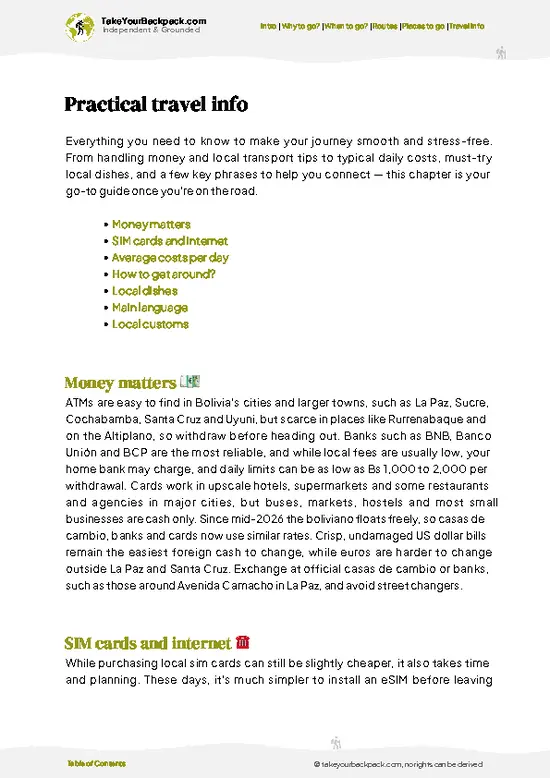
example page 0 from our offline Travel Guide for Bolivia
example page 1 from our offline Travel Guide for Bolivia
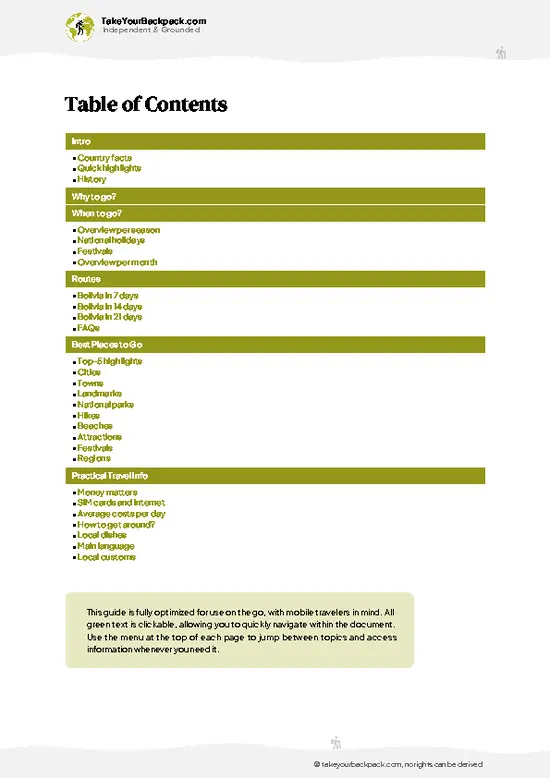
example page 2 from our offline Travel Guide for Bolivia
example page 3 from our offline Travel Guide for Bolivia
example page 4 from our offline Travel Guide for Bolivia
example page 5 from our offline Travel Guide for Bolivia
example page 6 from our offline Travel Guide for Bolivia
example page 7 from our offline Travel Guide for Bolivia
Loading the map 🌍
CLICK TO FILTER
cities
towns
landmarks
national parks
hikes
beaches
attractions
festivals
regions
SHOW COUNTRY’S BESTSHOW ALL

✨ Why go?
Ranked #1 national park in Bolivia
Why visitors keep coming back

Madidi National Park rewards backpackers who want wild Amazon without a fortune or an expedition permit. Entry is organized, which sounds restrictive until you see the payoff: guides who read tracks, hear a tinamou from fifty meters and know where the tapirs wade at dusk. Park rules require a guide, so self-guided wandering is out, but you still choose your own pace by picking the lodge, the length of stay and how far upriver you go.

The biggest draw is range. The park climbs from lowland jungle near the Tuichi River to Andean peaks above 5,000 meters, and it is regularly called one of the most biodiverse protected areas on Earth. A single trip can include spectacled bears in the highlands, giant otters in oxbow lakes and macaws at clay licks.

The community-owned model matters too. At Chalalán … read more 👉
Madidi National Park rewards backpackers who want wild Amazon without a fortune or an expedition permit. Entry is organized, which sounds restrictive until you see the payoff: guides who read tracks, hear a tinamou from fifty meters and know where the tapirs wade at dusk. Park rules require a guide, so self-guided wandering is out, but you still choose your own pace by picking the lodge, the length of stay and how far upriver you go.

The biggest draw is range. The park climbs from lowland jungle near the Tuichi River to Andean peaks above 5,000 meters, and it is regularly called one of the most biodiverse protected areas on Earth. A single trip can include spectacled bears in the highlands, giant otters in oxbow lakes and macaws at clay licks.

The community-owned model matters too. At Chalalán Ecolodge and San Miguel del Bala, your money goes to Indigenous families who run the lodges, so a night in a thatched cabin pays for local schooling rather than a tour company in the capital. Rurrenabaque has hostels, hammock bars and cheap meals for the days either side.

💡 HighlightsTop highlights of Madidi

  1. Laguna Chalalán: A calm oxbow lake ringed by forest, a short paddle from Chalalán Ecolodge. Dawn brings capuchin monkeys in the trees, hoatzins hissing in the reeds and sometimes a caiman slipping off a log. Paddling a wooden canoe here is the quietest hour of the trip.
  2. Tuichi River: The park’s main artery, run by motorized canoe from Rurrenabaque. Sandbars hold capybaras and turtles, kingfishers dart along the banks, and the walls close in as the river enters the forest. Plan on long hours in the boat.
  3. San Miguel del Bala: A Tacana community lodge on the Beni River, reached by a short boat ride from Rurrenabaque. Guides explain medicinal plants and forest life, and it is the easiest introduction if your time is tight.
  4. Chalalán Ecolodge: Community-run since the late 1990s, with thatched cabins,
… read more 👉
  1. Laguna Chalalán: A calm oxbow lake ringed by forest, a short paddle from Chalalán Ecolodge. Dawn brings capuchin monkeys in the trees, hoatzins hissing in the reeds and sometimes a caiman slipping off a log. Paddling a wooden canoe here is the quietest hour of the trip.
  2. Tuichi River: The park’s main artery, run by motorized canoe from Rurrenabaque. Sandbars hold capybaras and turtles, kingfishers dart along the banks, and the walls close in as the river enters the forest. Plan on long hours in the boat.
  3. San Miguel del Bala: A Tacana community lodge on the Beni River, reached by a short boat ride from Rurrenabaque. Guides explain medicinal plants and forest life, and it is the easiest introduction if your time is tight.
  4. Chalalán Ecolodge: Community-run since the late 1990s, with thatched cabins, a network of marked jungle paths and guides from the nearby Quechua-Tacana village of San José de Uchupiamonas. Night walks here turn up tarantulas, frogs and glowing fungus.
  5. Clay licks (collpas): Macaws and parrots gather at exposed riverbank clay to eat minerals, usually in the early morning. The noise arrives before the color does, a screeching cloud of red, green and blue.
  6. Jaguar and tapir territory: Madidi holds jaguars, pumas, tapirs and peccaries. Sightings are rare, but fresh tracks on muddy trails are common, and a guide will point them out. Quiet groups and night outings raise your odds.
  7. Apolo and the Andean cloud forest: The high, remote side of the park, approached from the Apolo area. Mossy cloud forest, orchids and spectacled bear habitat make it a serious option for experienced, self-reliant travelers with extra days.
For a first visit, Chalalán Ecolodge gives you the best mix of forest walks, lake paddling and wildlife with a clear community story behind it.
Spotted a mistake or missing something? Contact us.

Things to do near Madidi National Park

Ratings based on Tripadvisor reviews. When you book through this link, you support our work at no extra cost to you.

🌤️ When to go?Best time to explore Madidi

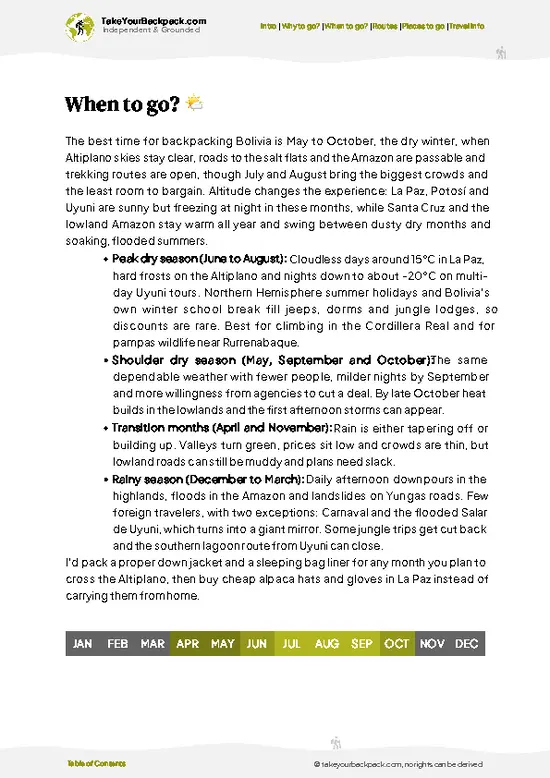
  • Dry Season (May to October): Trails firm up and river travel is easiest. Days run 25 to 32°C (77 to 90°F), and nights in the lowlands can drop to 12 to 18°C (54 to 64°F) during cold fronts called surazos. Daylight is close to 11 to 12 hours. This is peak season for Rurrenabaque lodges and Madidi tours, so prices climb and boats fill up.
  • Wet Season (November to March): Expect 28 to 33°C (82 to 91°F), heavy humidity and downpours that turn trails to mud and can delay flights and boats. Lodges drop rates, crowds nearly vanish, and birdlife and frogs are at their loudest. Some trekking routes close.
  • Shoulder Months (April and early November): Rain tapers off or begins, mosquitoes are thick, and discounts are easy to get without much loss of access.
Book Rurrenabaque flights or buses with a spare … read more 👉
  • Dry Season (May to October): Trails firm up and river travel is easiest. Days run 25 to 32°C (77 to 90°F), and nights in the lowlands can drop to 12 to 18°C (54 to 64°F) during cold fronts called surazos. Daylight is close to 11 to 12 hours. This is peak season for Rurrenabaque lodges and Madidi tours, so prices climb and boats fill up.
  • Wet Season (November to March): Expect 28 to 33°C (82 to 91°F), heavy humidity and downpours that turn trails to mud and can delay flights and boats. Lodges drop rates, crowds nearly vanish, and birdlife and frogs are at their loudest. Some trekking routes close.
  • Shoulder Months (April and early November): Rain tapers off or begins, mosquitoes are thick, and discounts are easy to get without much loss of access.
Book Rurrenabaque flights or buses with a spare day before your onward connection, since rain and fog cause cancellations year-round.


source: climatestotravel.comJANJanuary: fair for travelingFEBFebruary: fair for travelingMARMarch: fair for travelingAPRApril: fair for travelingMAYMay: highly recommended for travelingJUNJune: excellent for travelingJULJuly: excellent for travelingAUGAugust: excellent for travelingSEPSeptember: excellent for travelingOCTOctober: highly recommended for travelingNOVNovember: fair for travelingDECDecember: fair for traveling
bolivia-national-park-madidi-national-park
© Google | Maria Jose Hueves

✈️ The backpacker research shortcutBolivia Travel Guide

An offline-friendly backpacking guide with optimized travel routes, ranked highlights, transport advice, and the best areas to stay.
example page 0 from our offline Travel Guide for Bolivia
example page 1 from our offline Travel Guide for Bolivia
example page 2 from our offline Travel Guide for Bolivia
example page 3 from our offline Travel Guide for Bolivia
example page 4 from our offline Travel Guide for Bolivia
example page 5 from our offline Travel Guide for Bolivia
example page 6 from our offline Travel Guide for Bolivia
example page 7 from our offline Travel Guide for Bolivia
The digital guide (262 pages) contains:
✅ 76 highlights, ranked by travel appeal
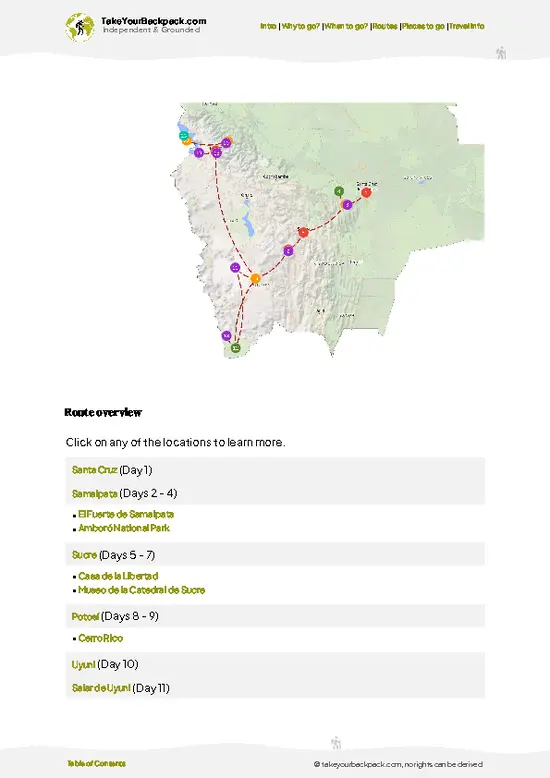
✅ Optimized 7, 14 & 21-day travel routes
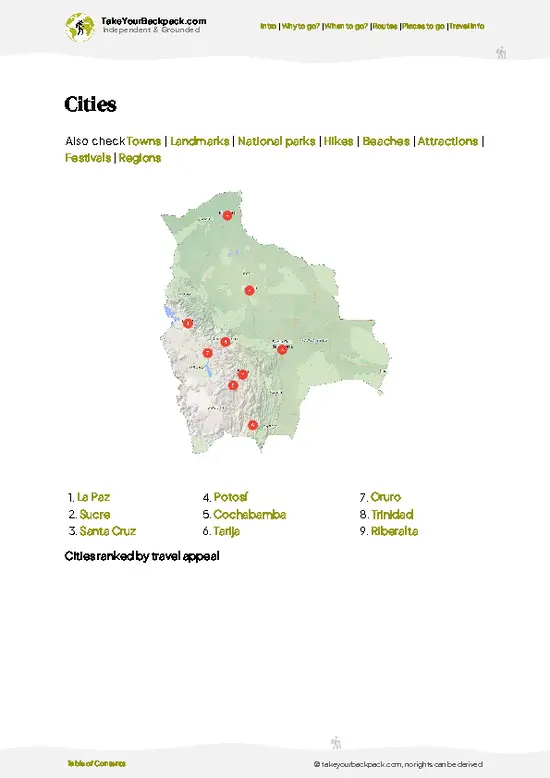
✅ Cities, national parks, landmarks, beaches
✅ How to get around
✅ Offline-friendly for travel without Wi-Fi
👉 Click to see all 30+ guide features

📅 Plan smarter in minutes, not weeks
✅ Month by month travel advice
✅ Festivals & national holidays
✅ Budget expectations

🗺️ Go to the right places, skip the overrated ones
✅ Honest pros & cons of destinations
✅ Top hikes, parks & viewpoints
✅ Lesser-known places most travelers miss
✅ Clear “worth it vs skip it” guidance

🛏️ Travel smoothly without rookie mistakes
✅ Best areas to stay
✅ Transport systems explained simply
✅ Common scams & safety advice
✅ SIM cards, money & practical tips

🌍 Understand the country, not just visit it
✅ Culture & traditions
✅ 52 Essential phrases & customs
✅ Festivals worth planning around
✅ Traveler-friendly historical context
✅ Insights that make places more meaningful

📱 Built for real travel conditions
✅ Fully downloadable PDF
✅ Works completely offline
✅ Optimized for phone use
✅ Useful in remote areas & buses
✅ Everything in one place
Stop searching, start planning
Get instant access to your full guide. 30‑day money-back guarantee.
+ Add another guide for just

By proceeding you agree to our terms.
Sent to your inbox immediately after payment • 100% Secure Checkout
Best Backpacking Travel Advisor 2025 tourism awardBest Backpacking
Travel Advisor
2025
What others say about Take Your Backpack Guides:
⭐⭐⭐⭐⭐
Fantastic, amazing amount of information!
⭐⭐⭐⭐⭐
My goodness this is amazing, it's what I've been looking for hats off too you!
⭐⭐⭐⭐⭐
I think this is absolutely BRILLIANT
⭐⭐⭐⭐
Very complete and informative. It's still missing places, but I gotta to commend you
⭐⭐⭐⭐⭐
This is truly amazing, thank you, can't wait to explore it with my kids!
⭐⭐⭐⭐⭐
Awesome resource, thank you!
⭐⭐⭐⭐⭐
This is amazing! Can't wait to explore the ones I haven't seen
⭐⭐⭐⭐
I love this! Well done, great idea.
⭐⭐⭐⭐⭐
Thanks for taking the time to make this gem!
⭐⭐⭐⭐⭐
This might be the best website I've ever seen.
⭐⭐⭐⭐⭐
Congratulations, and thank you so much for your work; it's incredibly valuable.
⭐⭐⭐⭐
In all seriousness I think you did a great job pointing out the important spots
⭐⭐⭐⭐⭐
10/10 very good
⭐⭐⭐⭐⭐
As someone who's only just starting to visit regularly this is awesome, thank you.
⭐⭐⭐⭐
Thank you very much! I'm going to visit my dad, it's going to be very useful!
⭐⭐⭐⭐⭐
This is really cool! We'll be travelling for the first time and this definitely come in handy.
⭐⭐⭐⭐⭐
You are now our minister of culture, congratulations 👨‍💼
⭐⭐⭐⭐⭐
Just wanted to tell you that this is a pearl! Going to follow your recommendations.
⭐⭐⭐⭐⭐
This is so cool. I'll definitely be using the resource for my travels soon.
⭐⭐⭐⭐⭐
This is very impressive! Good work.
⭐⭐⭐⭐⭐
This is an amazing and informative site. Very well done!

🛏️ Where to stay?How to pick the right area

The standard base for Madidi National Park is Rurrenabaque, a river town on the Beni where nearly every tour departs. Inside the park, you stay in community-run eco-lodges, which are the real draw: Chalalán (Tacana community of San José de Uchupiamonas, about 5 to 6 hours upriver by boat), San Miguel del Bala (just 1 hour upriver, outside the main park boundary). Chalalán runs roughly US$100 to 150 per person per day with guiding and meals included, and it sits beside a lake with good trails. San Miguel del Bala is cheaper and works for short trips. Mapajo is a similar community lodge on the Quiquibey … read more 👉
The standard base for Madidi National Park is Rurrenabaque, a river town on the Beni where nearly every tour departs. Inside the park, you stay in community-run eco-lodges, which are the real draw: Chalalán (Tacana community of San José de Uchupiamonas, about 5 to 6 hours upriver by boat), San Miguel del Bala (just 1 hour upriver, outside the main park boundary). Chalalán runs roughly US$100 to 150 per person per day with guiding and meals included, and it sits beside a lake with good trails. San Miguel del Bala is cheaper and works for short trips. Mapajo is a similar community lodge on the Quiquibey River in the neighboring Pilón Lajas reserve. Most visitors book a 3 day, 2 night package from Rurrenabaque for around US$90 to 150 per person, covering jungle lodging, meals and guides. In Rurrenabaque itself, hostels cost US$7 to 15 for a dorm bed or US$20 to 45 for a private room, many with hammocks and small pools. Apolo, on the western side, is a quieter access point with basic guesthouses and Madidi treks that few travelers use. Rurrenabaque is reached by flight from La Paz or by a long, rough bus ride of 15 to 20 hours.

👛 Costs (as of 19 October 2026)Money, prices, and spending tips

Budget about US$85 per day for Madidi National Park when joining a community lodge package, though shorter trips from Rurrenabaque can cost less. Prices are paid in bolivianos, and cards are rarely accepted outside town.
CategoryBudget RangeLocal Reality
Park entrance feeUS$15 to 20Foreign visitors pay a park fee, usually bundled into tour prices.
Accommodation (high season)US$7 to 15Dorm bed in Rurrenabaque; jungle lodges are bundled into packages, often US$30 to 50 per night each.
Accommodation (low season)US$5 to 12Discounts are common from December to March.
Guide and tourUS$30 to 50Per day on multi-day packages of US$90 to 150 for three days, including guide and boat.
Local transportUS$3 to 10Moto-taxis in town cost about US$1 to 2; boat transfers are included in tours.
Food and suppliesUS$8
… read more 👉
Budget about US$85 per day for Madidi National Park when joining a community lodge package, though shorter trips from Rurrenabaque can cost less. Prices are paid in bolivianos, and cards are rarely accepted outside town.
CategoryBudget RangeLocal Reality
Park entrance feeUS$15 to 20Foreign visitors pay a park fee, usually bundled into tour prices.
Accommodation (high season)US$7 to 15Dorm bed in Rurrenabaque; jungle lodges are bundled into packages, often US$30 to 50 per night each.
Accommodation (low season)US$5 to 12Discounts are common from December to March.
Guide and tourUS$30 to 50Per day on multi-day packages of US$90 to 150 for three days, including guide and boat.
Local transportUS$3 to 10Moto-taxis in town cost about US$1 to 2; boat transfers are included in tours.
Food and suppliesUS$8 to 15Set lunches in town cost US$3 to 5; lodge meals are included in packages.
Total Daily BudgetUS$63 to 110Roughly US$85 on a typical mid-range package day.
⚠️ Prices can change and everyone travels differently, so take this as a rough guide. Hope it helps you plan your adventure!

🥾 TrailsBest hikes in Madidi national park

Madidi National Park is hiked on guided forest paths radiating from lodges rather than one long trail system, so your options depend on which lodge you pick. Terrain in the lowlands is flat to gently rolling, muddy after rain, with roots, creek crossings and plenty of humidity. Distances are short, but pace is slow because you stop for birds and monkeys.
  • Chalalán lodge paths: Marked loops of an hour to half a day lead to forest viewpoints, a canopy-level lookout and Laguna Chalalán. Easy to moderate, mostly flat, with a few muddy climbs.
  • Night walks: Short loops of one to two hours near camp, easy
… read more 👉
Madidi National Park is hiked on guided forest paths radiating from lodges rather than one long trail system, so your options depend on which lodge you pick. Terrain in the lowlands is flat to gently rolling, muddy after rain, with roots, creek crossings and plenty of humidity. Distances are short, but pace is slow because you stop for birds and monkeys.
  • Chalalán lodge paths: Marked loops of an hour to half a day lead to forest viewpoints, a canopy-level lookout and Laguna Chalalán. Easy to moderate, mostly flat, with a few muddy climbs.
  • Night walks: Short loops of one to two hours near camp, easy but wet and dark. Expect frogs, insects, spiders and glowing fungus. Bring a headlamp and sleeves.
  • San Miguel del Bala walks: Guided medicinal plant walks of two to three hours near the lodge. Easy, slow and educational.
  • Tuichi River day outings: Boat rides combined with short landings for sandbar walks and riverside tracks. Easy, though you sit a lot.
  • Apolo highlands: Multi-day trekking in cloud forest and higher terrain with steep, slippery climbs and cooler nights. Demanding, and best arranged with a specialist operator.
Wildlife is the reason to walk. Common sightings include squirrel monkeys, capuchins, howlers, macaws, toucans, caimans and capybaras. Jaguars, tapirs and giant otters need luck and patience. Go early, because activity peaks at dawn and fades by midday.

Getting there is easy by backpacker standards. Travelers reach Rurrenabaque by flight or long road journey, then continue by boat to the park. Public transport does not enter Madidi itself, so lodge transfers by river are part of the package. Independent entry without a guide is not allowed. The park entrance fee is normally collected alongside lodge or tour bookings, so confirm what your package covers before you pay.

Crowds are light. Even in busy months you will share paths with a handful of other groups at most, and the forest soon swallows the sound of voices. Dry months bring firmer ground and clearer river travel, while the wet months mean mud, more insects and occasional cancellations. Bring waterproof bags, long sleeves, sturdy shoes and insect repellent.
⚠️ Hiking info can sometimes be outdated or inaccurate. Before you hit the trail, check the latest conditions with locals. If you do spot anything that's off, I'd love to hear from you, so I can update it for fellow travelers.

🛡️ SafetyScams, Hazards, and Annoyances

Madidi National Park is straightforward with a guide, and entry without one is not realistic. Heat and humidity are the main strain, so walk slowly, drink plenty of water and wear light long sleeves against mosquitoes, sandflies and biting ants. Trails are muddy and roots are slippery, so bring boots with grip, and expect stream crossings after rain. River boats can be delayed by floods or low water. Wildlife like jaguars, peccaries, caimans and snakes is seen rarely and is not aggressive if left alone. Keep to the trail, shake out boots, look before putting a hand on a trunk, and keep your distance from any animal. Yellow fever vaccination is advised, and many travelers start antimalarials after speaking with a doctor. Rurrenabaque has few pharmacies, so bring insect repellent with DEET, … read more 👉
Madidi National Park is straightforward with a guide, and entry without one is not realistic. Heat and humidity are the main strain, so walk slowly, drink plenty of water and wear light long sleeves against mosquitoes, sandflies and biting ants. Trails are muddy and roots are slippery, so bring boots with grip, and expect stream crossings after rain. River boats can be delayed by floods or low water. Wildlife like jaguars, peccaries, caimans and snakes is seen rarely and is not aggressive if left alone. Keep to the trail, shake out boots, look before putting a hand on a trunk, and keep your distance from any animal. Yellow fever vaccination is advised, and many travelers start antimalarials after speaking with a doctor. Rurrenabaque has few pharmacies, so bring insect repellent with DEET, a basic first-aid kit and any medication. First-timers often underpack dry socks and waterproof bags for electronics.

FAQCommon questions from travelers

Plan three days and two nights for Madidi National Park, which is the standard package from Rurrenabaque. That gives you enough time for a boat ride, night walks and a morning of wildlife watching, and costs around US$90 to 150. Stays of four to five days reach deeper lodges such as Chalalán, about 5 to 6 hours upriver.
Visiting Madidi National Park without a car is the normal way to do it, because no road reaches the lodges. You fly or take a bus to Rurrenabaque (about 45 minutes by air from La Paz, or 15 to 20 hours by road), then travel upriver by motorized canoe. Tour operators arrange boats and guides, so you only need a pack.
Madidi National Park charges an entrance fee for foreign visitors, typically about US$15 to 20, and visits require a licensed guide. Operators in Rurrenabaque and community lodges such as Chalalán usually bundle the fee into packages. Bring your passport and a little cash in bolivianos, as there are few card machines along the route.
⚠️ Things can change over time, so always validate details locally before you go.

Other Bolivian national parks near Madidi

Explore more nearby:


💡 Not sure where to go next?
Create a personalized itinerary for Bolivia including Madidi and the places that fit your trip.

Generate my itinerary

👉 Discover all national parks

Or checkout all Bolivia has to offer (think cities, towns, villages, national parks, hikes, beaches, festivals)
Country photo of Bolivia

We 💚 feedbackWhat to keep in mind

Travelers often pick the cheapest Rurrenabaque agency, then spend half their jungle days on a boat with a rushed guide. Book a community lodge such as Chalalán directly, and ask how many nights are actually in the forest. I would add a spare day at the end for flight delays, and I would pack a headlamp for night walks, since lodge lighting is minimal.

✈️ When did I visit Bolivia?
Bolivia I visited during my half year trip through South and Central America back in 2003

✍️ Help improve this page!
The information on this page is based on my own backpacking experience in Bolivia, supplemented with up-to-date research and feedback from other travelers. Travel details can change, so if you notice anything outdated or incomplete, feel free to let me know.


🙋‍♂️ Give feedback

👋 Meet the founderWho’s Behind Take Your Backpack?

Johan, backpacker and founder of TakeYourBackpackHi, I’m Johan (Netherlands 🇳🇱), the creator of TakeYourBackpack. Over the past 3 decades, I’ve backpacked through 90+ countries across six continents, gaining extensive experience with independent travel, long-term trips, and overland routes.

This site is built on a combination of firsthand travel experience and carefully curated insights from other backpackers. Many guides are based on places I’ve personally visited, while others bring together tips, observations, and practical advice shared by trusted travelers I’ve met along the way.

The goal is to provide realistic, experience-driven guidance — not generic itineraries — so you can explore destinations with better context, clearer expectations, and more confidence.