×

Bolivia🇧🇴 | townsSan Ignacio de VelascoJesuit mission, colonial plaza, Chiquitania region | things to do and best time to go

Explore VillazónExplore Puerto Quijarro

Backpacking in San Ignacio de Velasco
🌟 Highlighttown ranked #7
By Johan Kruseman 🇳🇱 | Updated May 26, 2026

Most people talk about San Ignacio de Velasco for the Jesuit mission church, as if you’ll spend days dissecting baroque woodwork. You won’t. What actually matters here is rhythm: the slow, warm, slightly dusty pace that resets your brain between Bolivia’s big-ticket sights and the wild Chiquitania beyond.

San Ignacio sits in eastern Bolivia, in Santa Cruz department, on the loose overland line between Santa Cruz de la Sierra and the Brazilian border. For backpackers it’s a mellow pause, not a headline act: a walkable plaza, a handsome mission complex, a lagoon where evenings smell like wet earth and grilled meat. Buses are long and bumpy but straightforward; once in town you walk everywhere. It’s cheaper and calmer than Santa Cruz, less polished than nearby San José de Chiquitos, and social in a low-key way—simple hostels, a couple of bars, easy to chat with locals, harder to find a big backpacker crowd.

Discover everything you want to know in the 📖 Bolivia Travel Guide.


Get your Bolivia guide
82 ranked highlights, routes & tips, works offline (350 pages)
Loading the map 🌍
CLICK TO FILTER
cities
towns
landmarks
national parks
hikes
beaches
attractions
festivals
regions
SHOW COUNTRY’S BESTSHOW ALL

✨ Why go?
Ranked #7 town in Bolivia
Reasons people choose to visit here

San Ignacio de Velasco is a strategic waypoint for backpackers exploring Bolivia’s wild side. Nestled in the Chiquitania region, it serves as a launchpad for nearby hikes and cultural sites. The walkable streets are lined with small-scale hostels and guesthouses, where you can find a cozy bed and a friendly chat. The local food scene is a treat; think hearty stews and freshly made empanadas that fuel your adventures.

Travelers often linger here for a few days, soaking in the laid-back vibe and connecting with fellow slow travelers and hikers. The atmosphere is social but not overwhelming, perfect for those who appreciate a balance of quiet reflection and community. Whether you’re a solo adventurer or part of a small group, San Ignacio offers a genuine taste of Bolivian life, making it more … read more 👉
San Ignacio de Velasco is a strategic waypoint for backpackers exploring Bolivia’s wild side. Nestled in the Chiquitania region, it serves as a launchpad for nearby hikes and cultural sites. The walkable streets are lined with small-scale hostels and guesthouses, where you can find a cozy bed and a friendly chat. The local food scene is a treat; think hearty stews and freshly made empanadas that fuel your adventures.

Travelers often linger here for a few days, soaking in the laid-back vibe and connecting with fellow slow travelers and hikers. The atmosphere is social but not overwhelming, perfect for those who appreciate a balance of quiet reflection and community. Whether you’re a solo adventurer or part of a small group, San Ignacio offers a genuine taste of Bolivian life, making it more than just a stopover—it’s a chance to recharge before diving deeper into the natural beauty that surrounds you.
Want to include San Ignacio de Velasco in your Bolivia route?
Create a personalized Bolivia itinerary that includes San Ignacio de Velasco and the places that fit your trip — based on your travel style, budget, and available time. Get your route in seconds.

Generate my trip

💡 HighlightsKey sights and experiences for travelers

  1. Iglesia Jesuítica de San Ignacio — The big mission church that still anchors town life: lovely colonial woodwork, carved altarpieces, and a real sense of the Jesuit-Chiquitano fusion you came for. Don’t miss the acoustics during a service or a local concert.
  2. Plaza Central — The heartbeat of San Ignacio: benches, shade trees, the municipal buildings and shops around it. It’s the best place to watch everyday life, grab a coffee, or plan a walking route through town.
  3. Casa de la Cultura (Centro Cultural Municipal) — Small but active: rotating exhibits, community events, and sometimes live music or dance. Good place to catch local crafts and ask about upcoming festivals or workshops.
  4. Museo Parroquial / Museo Regional — Modest museum space attached to the church or parish that stores old religious
read more 👉
  1. Iglesia Jesuítica de San Ignacio — The big mission church that still anchors town life: lovely colonial woodwork, carved altarpieces, and a real sense of the Jesuit-Chiquitano fusion you came for. Don’t miss the acoustics during a service or a local concert.
  2. Plaza Central — The heartbeat of San Ignacio: benches, shade trees, the municipal buildings and shops around it. It’s the best place to watch everyday life, grab a coffee, or plan a walking route through town.
  3. Casa de la Cultura (Centro Cultural Municipal) — Small but active: rotating exhibits, community events, and sometimes live music or dance. Good place to catch local crafts and ask about upcoming festivals or workshops.
  4. Museo Parroquial / Museo Regional — Modest museum space attached to the church or parish that stores old religious paintings, liturgical objects and mission history; the sort of spot where a local guide gives priceless context.
  5. Mercado Central — A no-frills market where you can sample regional produce, street food and meet vendors. Eat cheaply, practice Spanish, and buy fresh fruit for day trips out of town.
  6. Talleres de talla y dorado — Small artisan workshops where local woodcarvers and gilders work on altarpieces and restorations. Watching a craftsman repaint or carve is a tiny, hands-on window into Chiquitano baroque traditions.
  7. Casco histórico y fachadas coloniales — The network of streets around the plaza has colorful, low-rise colonial houses, old balconies and murals. It’s quiet and photogenic—best explored slowly on foot.
  8. Parque y paseo riverside (small local parks) — Green pockets and riverside paths used by families in the evening; simple, peaceful spots to cool off and see how locals unwind.
  9. Feria y actividad ganadera (market days) — On market/livestock days the town fills with traders and animals; it’s noisy, chaotic and totally authentic if you want to see rural Bolivian commerce in action.
  10. Iglesias y capillas menores — Scattered little chapels and neighborhood churches that each have their own patron saint and local devotion—great if you’re into vernacular religious culture and quiet, off-the-beaten-path stops.
A few great day trips outside San Ignacio de Velasco are the nearby Jesuit mission towns of San Rafael de Velasco, San Miguel de Velasco and Santa Ana de Velasco — my personal favorite for a day trip is San Rafael de Velasco because its church and surrounding village feel especially intact and photogenic.
Spotted a mistake or missing something? Contact us.

🏘️ NeighborhoodsNeighborhood guide to San Ignacio de Velasco

San Ignacio de Velasco is a charming Bolivian town that offers a blend of culture, nature, and adventure. Here’s how to navigate its neighborhoods for the best backpacking experience.

Centro Histórico: This is the heart of San Ignacio. The vibe is lively, with local markets and cafes spilling onto the streets. It’s walkable, making it easy to explore on foot. Prices for food and lodging are reasonable, perfect for budget travelers. Nightlife is modest but enjoyable, with a few bars where you can mingle with locals. Ideal for short stays, you can soak in the town’s essence quickly.

La Plaza: Surrounding the main square, this area is a hub of activity. The scent of fresh empanadas wafts through the air, inviting you to linger. It’s slightly quieter than Centro but still vibrant. Accommodations … read more 👉
San Ignacio de Velasco is a charming Bolivian town that offers a blend of culture, nature, and adventure. Here’s how to navigate its neighborhoods for the best backpacking experience.

Centro Histórico: This is the heart of San Ignacio. The vibe is lively, with local markets and cafes spilling onto the streets. It’s walkable, making it easy to explore on foot. Prices for food and lodging are reasonable, perfect for budget travelers. Nightlife is modest but enjoyable, with a few bars where you can mingle with locals. Ideal for short stays, you can soak in the town’s essence quickly.

La Plaza: Surrounding the main square, this area is a hub of activity. The scent of fresh empanadas wafts through the air, inviting you to linger. It’s slightly quieter than Centro but still vibrant. Accommodations here are affordable, and you can find transport options to nearby attractions. Great for longer stays, as you can enjoy the local rhythm while having easy access to amenities.

El Barrio Norte: This neighborhood offers a more residential feel, with fewer tourists. It’s a bit farther from the main attractions, but the trade-off is a peaceful atmosphere. Prices drop here, making it budget-friendly. Walkability is decent, but you might need to rely on local transport for longer distances. Perfect for those looking to immerse themselves in daily life for an extended period.

Each area has its unique charm, so choose based on your vibe and travel style.

⌛️ 1 daySeeing the highlights in 24 hours

San Ignacio de Velasco is a slice of Bolivia that feels like a well-kept secret. Nestled in the lush lowlands, it’s a town where the air is thick with the scent of tropical flowers and the sounds of life buzz around you. The vibrant culture, steeped in history and indigenous traditions, invites you to explore beyond the usual tourist spots.

Start your morning at the Plaza 2 de Febrero, where locals gather for breakfast. Grab a hearty salteña from a nearby vendor; the flaky pastry filled with savory goodness is a must-try. As you savor your snack, take in the colonial architecture that surrounds you, the sun casting warm light on the pastel-colored buildings. Afterward, stroll through the nearby San Ignacio Mission, a stunning reminder of the Jesuit influence in the region. The intricate carvings … read more 👉
San Ignacio de Velasco is a slice of Bolivia that feels like a well-kept secret. Nestled in the lush lowlands, it’s a town where the air is thick with the scent of tropical flowers and the sounds of life buzz around you. The vibrant culture, steeped in history and indigenous traditions, invites you to explore beyond the usual tourist spots.

Start your morning at the Plaza 2 de Febrero, where locals gather for breakfast. Grab a hearty salteña from a nearby vendor; the flaky pastry filled with savory goodness is a must-try. As you savor your snack, take in the colonial architecture that surrounds you, the sun casting warm light on the pastel-colored buildings. Afterward, stroll through the nearby San Ignacio Mission, a stunning reminder of the Jesuit influence in the region. The intricate carvings and peaceful atmosphere make it a perfect spot for reflection.

In the afternoon, head to the Mercado Municipal. This bustling market is often overlooked by tourists, but it’s where you’ll find the heart of local life. The vibrant stalls overflow with fresh produce, handmade crafts, and the occasional llama figurine. Engage with the vendors; their stories add depth to your experience. Afterward, take a leisurely walk through the residential neighborhoods, where you can witness daily life unfold—children playing, families gathering, and the aroma of home-cooked meals wafting through the air.

As evening approaches, make your way to the Río San Ignacio. The sunset here is a spectacle, with the sky painted in hues of orange and pink reflecting off the water. Find a quiet spot to sit, perhaps with a local beer in hand, and soak in the tranquility. This day in San Ignacio de Velasco isn’t just about seeing; it’s about feeling the pulse of a town that thrives on community and culture.
Turn your San Ignacio de Velasco visit into an Bolivia adventure
Build a complete Bolivia route with San Ignacio de Velasco, hidden gems, must-see destinations, and realistic travel times included.

Generate my trip

🌤️ When to go?When to go for the best experience


  • Weather: The dry season from May to September offers clear skies and minimal rain, making trails less slippery and river crossings safer. The wet season (October to April) floods paths and turns the landscape lush but challenging.

  • Temperature: Daytime highs hover around 25-30°C (77-86°F) in the dry season, comfortable for hiking without overheating. Nights can dip to 10-15°C (50-59°F), so pack layers. The wet season is warmer but muggy, pushing 30-35°C (86-95°F).

  • Daylight Hours: Roughly 11-12 hours year-round, but the dry season’s clearer skies mean you’ll get more usable daylight for exploring without the threat of sudden storms.

  • Crowds: Tourist numbers peak during the dry season, especially July and August, when locals and international visitors converge for festivals and wildlife
read more 👉

  • Weather: The dry season from May to September offers clear skies and minimal rain, making trails less slippery and river crossings safer. The wet season (October to April) floods paths and turns the landscape lush but challenging.

  • Temperature: Daytime highs hover around 25-30°C (77-86°F) in the dry season, comfortable for hiking without overheating. Nights can dip to 10-15°C (50-59°F), so pack layers. The wet season is warmer but muggy, pushing 30-35°C (86-95°F).

  • Daylight Hours: Roughly 11-12 hours year-round, but the dry season’s clearer skies mean you’ll get more usable daylight for exploring without the threat of sudden storms.

  • Crowds: Tourist numbers peak during the dry season, especially July and August, when locals and international visitors converge for festivals and wildlife spotting. The wet season is quieter, offering solitude but fewer services.

  • Seasonal Activities: The dry season is prime for trekking and birdwatching, with trails accessible and wildlife active. The wet season brings vibrant greenery and river adventures but can limit overland travel.

  • Price Fluctuations: Accommodation and tours cost more during the dry season’s peak months due to demand. The wet season offers lower prices but expect some closures and reduced options.


Pro-tip: Aim for late May or early September—enjoy the dry season’s perks with fewer crowds and better deals, plus that crisp morning air that makes every step feel earned.


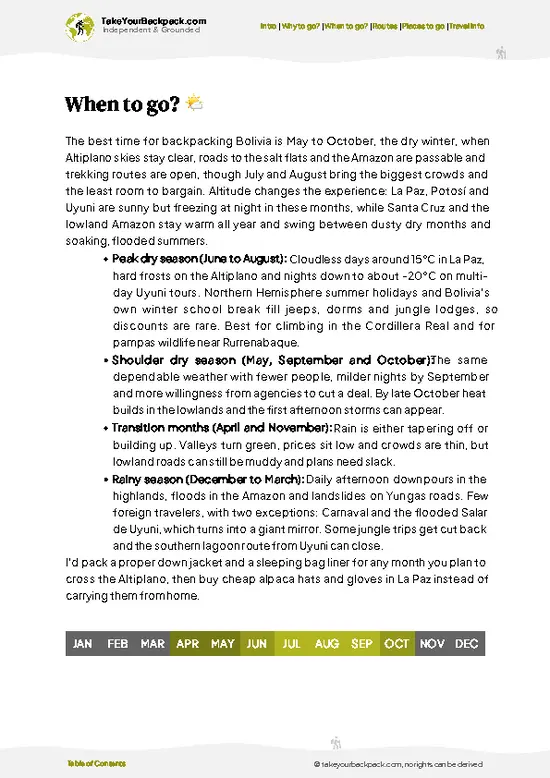
source: climatestotravel.comJANJanuary: fair for travelingFEBFebruary: fair for travelingMARMarch: fair for travelingAPRApril: fair for travelingMAYMay: highly recommended for travelingJUNJune: excellent for travelingJULJuly: excellent for travelingAUGAugust: excellent for travelingSEPSeptember: highly recommended for travelingOCTOctober: fair for travelingNOVNovember: fair for travelingDECDecember: fair for traveling
when-to-go

✈️ The backpacker research shortcutBolivia Travel Guide

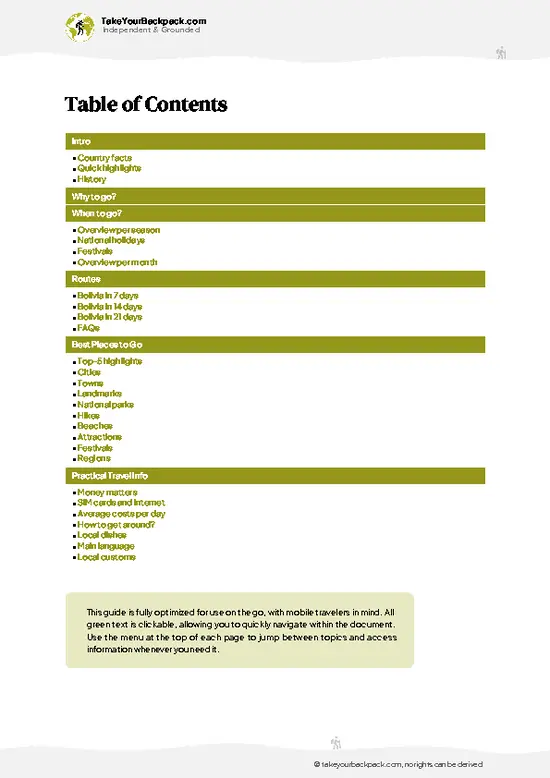
An offline-friendly backpacking guide with optimized travel routes, ranked highlights, transport advice, and the best areas to stay.
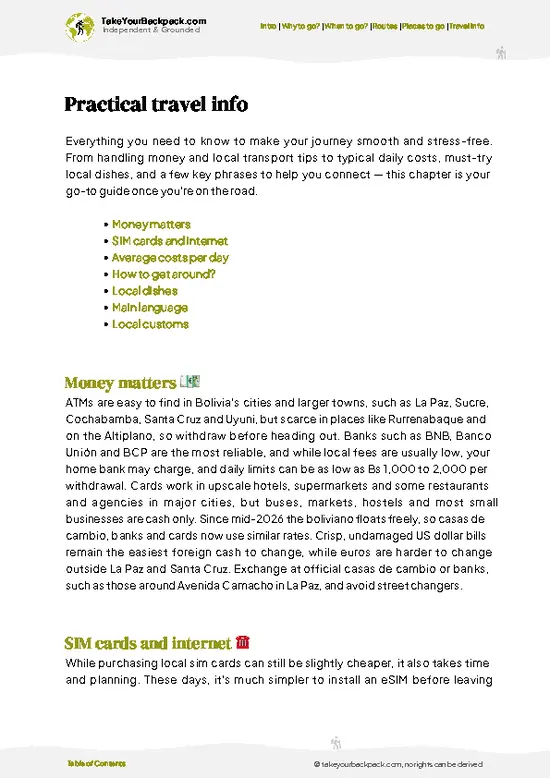
example page 0 from our offline Travel Guide for Bolivia
example page 1 from our offline Travel Guide for Bolivia
example page 2 from our offline Travel Guide for Bolivia
example page 3 from our offline Travel Guide for Bolivia
example page 4 from our offline Travel Guide for Bolivia
example page 5 from our offline Travel Guide for Bolivia
example page 6 from our offline Travel Guide for Bolivia
example page 7 from our offline Travel Guide for Bolivia
The digital guide (350 pages) contains:
82 highlights, ranked by travel appeal
Optimized 7, 14 & 21-day travel routes
Cities, national parks, landmarks, beaches
How to get around
Offline-friendly for travel without Wi-Fi
👉 Click to see all 30+ guide features

📅 Plan smarter in minutes, not weeks
Month by month travel advice
Festivals & national holidays
Budget expectations

🗺️ Go to the right places, skip the overrated ones
Honest pros & cons of destinations
Top hikes, parks & viewpoints
Lesser-known places most travelers miss
Clear “worth it vs skip it” guidance

🛏️ Travel smoothly without rookie mistakes
Best areas to stay
Transport systems explained simply
Common scams & safety advice
SIM cards, money & practical tips

🌍 Understand the country, not just visit it
Culture & traditions
52 Essential phrases & customs
Festivals worth planning around
Traveler-friendly historical context
Insights that make places more meaningful

📱 Built for real travel conditions
Fully downloadable PDF
Works completely offline
Optimized for phone use
Useful in remote areas & buses
Everything in one place
Save weeks of stressful planning
Get instant access to your full guide. 30‑day money-back guarantee.


By proceeding you agree to our terms.
Sent to your inbox immediately after payment • 100% Secure Checkout
Best Backpacking Travel Advisor 2025 tourism awardBest Backpacking
Travel Advisor
2025
What others say about Take Your Backpack Guides:
⭐⭐⭐⭐⭐
Fantastic, amazing amount of information!
⭐⭐⭐⭐⭐
My goodness this is amazing, it's what I've been looking for hats off too you!
⭐⭐⭐⭐⭐
I think this is absolutely BRILLIANT
⭐⭐⭐⭐
Very complete and informative. It's still missing places, but I gotta to commend you
⭐⭐⭐⭐⭐
This is truly amazing, thank you, can't wait to explore it with my kids!
⭐⭐⭐⭐⭐
Awesome resource, thank you!
⭐⭐⭐⭐⭐
This is amazing! Can't wait to explore the ones I haven't seen
⭐⭐⭐⭐
I love this! Well done, great idea.
⭐⭐⭐⭐⭐
Thanks for taking the time to make this gem!
⭐⭐⭐⭐⭐
This might be the best website I've ever seen.
⭐⭐⭐⭐⭐
Congratulations, and thank you so much for your work; it's incredibly valuable.
⭐⭐⭐⭐
In all seriousness I think you did a great job pointing out the important spots
⭐⭐⭐⭐⭐
10/10 very good
⭐⭐⭐⭐⭐
As someone who's only just starting to visit regularly this is awesome, thank you.
⭐⭐⭐⭐
Thank you very much! I'm going to visit my dad, it's going to be very useful!
⭐⭐⭐⭐⭐
This is really cool! We'll be travelling for the first time and this definitely come in handy.
⭐⭐⭐⭐⭐
You are now our minister of culture, congratulations 👨‍💼
⭐⭐⭐⭐⭐
Just wanted to tell you that this is a pearl! Going to follow your recommendations.
⭐⭐⭐⭐⭐
This is so cool. I'll definitely be using the resource for my travels soon.
⭐⭐⭐⭐⭐
This is very impressive! Good work.
⭐⭐⭐⭐⭐
This is an amazing and informative site. Very well done!

🛏️ Where to stay?Best areas and accommodation options

San Ignacio de Velasco’s heart for backpackers beats strongest around the central plaza and the adjacent streets. This area is your best bet for safety and social energy—streets here are lively but not overwhelming, with a steady hum of locals and travelers mingling in open-air cafés and markets. The light filters through leafy trees, casting dappled shadows on colonial facades, creating a relaxed atmosphere that invites lingering conversations.

Compared to the quieter, more residential outskirts, staying near the plaza means you’re never far from the pulse of the town. Hostels cluster here, … read more 👉
San Ignacio de Velasco’s heart for backpackers beats strongest around the central plaza and the adjacent streets. This area is your best bet for safety and social energy—streets here are lively but not overwhelming, with a steady hum of locals and travelers mingling in open-air cafés and markets. The light filters through leafy trees, casting dappled shadows on colonial facades, creating a relaxed atmosphere that invites lingering conversations.

Compared to the quieter, more residential outskirts, staying near the plaza means you’re never far from the pulse of the town. Hostels cluster here, offering budget-friendly beds and a built-in social scene. You’ll find communal spaces where travelers swap stories over shared meals or plan excursions to the nearby Jesuit missions. The scent of fresh bread and strong coffee drifts through the air, grounding you in the everyday rhythms of San Ignacio.

Venture too far from this hub, and you risk losing that easy access to both safety and social connection. The outskirts can feel isolated, with fewer options for meeting fellow backpackers or grabbing a late snack. Stick close to the center to unlock the town’s genuine warmth without sacrificing convenience or comfort.

🚌 Getting aroundMoving around without the hassle

San Ignacio de Velasco moves at its own rhythm—less a clockwork town and more a place where time stretches and contracts with the sun and the chatter of locals. The streets don’t hum with the urgency of a metropolis; instead, they pulse with a laid-back, almost improvisational flow. You’ll notice how the light filters through the canopy of trees lining the main avenues, casting dappled shadows that invite slow strolls rather than rushed commutes. Here, schedules are suggestions, not laws, and the scent of fresh earth and wood smoke lingers in the air, grounding you in the moment. To navigate this town like a local, you’ll want to embrace its blend of predictability and spontaneity—knowing the main transit options and their quirks will save you time and frustration, letting you soak in the … read more 👉
San Ignacio de Velasco moves at its own rhythm—less a clockwork town and more a place where time stretches and contracts with the sun and the chatter of locals. The streets don’t hum with the urgency of a metropolis; instead, they pulse with a laid-back, almost improvisational flow. You’ll notice how the light filters through the canopy of trees lining the main avenues, casting dappled shadows that invite slow strolls rather than rushed commutes. Here, schedules are suggestions, not laws, and the scent of fresh earth and wood smoke lingers in the air, grounding you in the moment. To navigate this town like a local, you’ll want to embrace its blend of predictability and spontaneity—knowing the main transit options and their quirks will save you time and frustration, letting you soak in the atmosphere rather than fight it.


  • Walking: The heart of San Ignacio de Velasco is compact enough to explore on foot, with most key spots reachable within 20 minutes. Walking lets you catch the subtle details—the cracked paint on colonial buildings, the distant bark of dogs, the occasional waft of cooking fires. It’s free, flexible, and the best way to sync with the town’s unhurried pace.


  • Local Buses (Micros): These minibuses run roughly from 6:00 AM to 8:00 PM, with fares around 2-3 BOB (Bolivianos). They’re slow and often crowded, but they cover the main routes between neighborhoods and the bus terminal. Don’t expect strict timetables—buses leave when full, so patience is your best companion.


  • Shared Taxis: Shared taxis operate on fixed routes but leave only when full, usually between 7:00 AM and 7:00 PM. They cost about 5-7 BOB and offer a faster, more comfortable ride than buses. The trade-off is waiting time, which can be unpredictable, but they’re a solid choice if you want to cover longer distances without splurging on private rides.


  • Motorcycle Taxis: These are the wild cards—fast, nimble, and perfect for short hops or squeezing through narrow streets. Prices vary but expect around 3-5 BOB for typical rides. They’re not the safest option if you’re carrying heavy gear, but they’re unbeatable for quick errands or when the sun starts to dip and you want to catch the last light.

👛 Costs (as of 13 February 2026)Travel costs and budget guide for San Ignacio de Velasco

Backpacking through San Ignacio de Velasco, Bolivia, means embracing a slower pace where costs stay low but the experience feels rich and real. Here’s what you can expect to spend daily as an independent traveler navigating this off-the-beaten-path town.
  • Dorm Accommodation: Dorm beds in basic hostels hover around $5 to $10 USD per night. These places are simple, often with shared bathrooms and a fan or two, but they offer a chance to meet other travelers and soak in the local vibe without breaking the bank.
  • Meals: Eating local is both a treat and a bargain. Street food or small local eateries serve hearty plates for $2 to $5 USD. Expect staples like rice, beans, grilled meat, and fresh fruit. If you opt for something more tourist-oriented or a café, prices can creep up to $7 or $8.
  • Local
read more 👉
Backpacking through San Ignacio de Velasco, Bolivia, means embracing a slower pace where costs stay low but the experience feels rich and real. Here’s what you can expect to spend daily as an independent traveler navigating this off-the-beaten-path town.
  • Dorm Accommodation: Dorm beds in basic hostels hover around $5 to $10 USD per night. These places are simple, often with shared bathrooms and a fan or two, but they offer a chance to meet other travelers and soak in the local vibe without breaking the bank.
  • Meals: Eating local is both a treat and a bargain. Street food or small local eateries serve hearty plates for $2 to $5 USD. Expect staples like rice, beans, grilled meat, and fresh fruit. If you opt for something more tourist-oriented or a café, prices can creep up to $7 or $8.
  • Local Transport: Getting around town is cheap and straightforward. Shared taxis or minibuses cost about $0.50 to $1 per ride. For longer trips to nearby attractions, expect to pay around $3 to $5. Walking is often the best way to absorb the atmosphere and save money.
  • Basic Activities/Entry Fees: Many natural and cultural sites around San Ignacio have low or no entry fees. When there is a charge, it’s usually between $1 and $3. Guided tours or special excursions can push this higher, but independent exploration keeps costs minimal.
  • Miscellaneous Expenses: Budget around $1 to $3 for things like bottled water, snacks, or occasional treats. Internet cafes or SIM cards for data are affordable, generally under $5 for a decent package.

All told, you’re looking at roughly $10 to $20 USD per day to cover the essentials without skimping on comfort or experience. San Ignacio’s charm is in its simplicity—spending less here means more time soaking in the warm light filtering through the trees and less time worrying about your wallet.
⚠️ Prices can change and everyone travels differently, so take this as a rough guide. Hope it helps you plan your adventure!

🚌 Day tripsWhere to go beyond the main area

San Ignacio de Velasco is a backpacker’s dream base, offering a gateway to the wild beauty of Bolivia’s eastern lowlands. The town itself buzzes with life, from the scent of street food wafting through the air to the vibrant colors of local markets. Here are some day trips that will elevate your experience.

1. Parque Nacional Kaa-Iya
This sprawling national park is a paradise for wildlife enthusiasts. Expect a bumpy ride—about two hours from San Ignacio—but the payoff is worth it. You’ll encounter jaguars, capybaras, and a symphony of birds. Bring a packed lunch; the park’s remote beauty is best enjoyed in the wild. Aim for the dry season (May to October) for easier access and clearer skies. A common mistake? Underestimating the need for plenty of water and sunscreen.


2. Laguna de los read more 👉
San Ignacio de Velasco is a backpacker’s dream base, offering a gateway to the wild beauty of Bolivia’s eastern lowlands. The town itself buzzes with life, from the scent of street food wafting through the air to the vibrant colors of local markets. Here are some day trips that will elevate your experience.

1. Parque Nacional Kaa-Iya
This sprawling national park is a paradise for wildlife enthusiasts. Expect a bumpy ride—about two hours from San Ignacio—but the payoff is worth it. You’ll encounter jaguars, capybaras, and a symphony of birds. Bring a packed lunch; the park’s remote beauty is best enjoyed in the wild. Aim for the dry season (May to October) for easier access and clearer skies. A common mistake? Underestimating the need for plenty of water and sunscreen.


2. Laguna de los Cañones
Just an hour away, this stunning lagoon is a hidden treasure. The turquoise waters are surrounded by dramatic cliffs, perfect for a refreshing dip after a hike. Bring a hammock and chill under the trees. The best time to visit is during the dry season, when the water is at its clearest. Budget around $10 for transport and snacks. Many first-timers miss the chance to explore the trails around the lagoon, which offer breathtaking views.


3. Valle de los Cañones
A short drive from town, this valley is a geological wonder. The colorful rock formations create a surreal landscape that feels like stepping onto another planet. The trip takes about 45 minutes, and you can easily spend half a day wandering through the canyons. Bring a camera; the light here is magical, especially at sunrise or sunset. Budget around $15 for transport and snacks. Don’t forget to wear sturdy shoes; the terrain can be tricky.


4. San José de Chiquitos
This charming town is about an hour’s drive and offers a glimpse into the Jesuit missions of the 18th century. The architecture is striking, and the local culture is rich. Spend a few hours exploring the churches and enjoying local cuisine. The best time to visit is during the cooler months (May to August). Budget around $10 for transport. A common mistake is rushing through; take your time to soak in the atmosphere.
👉 Explore San José de Chiquitos
Want to know what more Bolivia offers?
The Bolivia Travel Guide describes 82 highlights, from cities to national parks, from beaches to hikes

Get the Travel Guide -

🛡️ SafetyStaying Safe: What Travelers Should Know

San Ignacio de Velasco is generally safe, but a few practical tips can enhance your experience. Stick to well-lit areas at night, especially around the plaza where locals gather. It’s vibrant and lively, but keep your belongings close; petty theft can happen in crowded spots.

Solo travelers should embrace the friendly atmosphere but remain aware of their surroundings. Engage with locals, but be cautious of overly eager guides offering unsolicited help—sometimes, they expect a tip for their “services.”

Common annoyances include the occasional street vendor who might be a bit pushy. A polite but firm “no, gracias” usually does the trick. Overall, a relaxed demeanor and a little street smarts will help you navigate this charming town with ease. Enjoy the warmth of the people and the rich culture; it’s worth the effort.

Other Bolivian towns near San Ignacio de Velasco

Explore more nearby:


💡 Not sure where to go next?
Create a personalized itinerary for Bolivia including San Ignacio de Velasco and the places that fit your trip.

Generate my itinerary

👉 Discover all towns

Or checkout all Bolivia has to offer (think cities, towns, villages, national parks, hikes, beaches, festivals)
Country photo of Bolivia

We 💚 feedbackParting advice and final tips

San Ignacio de Velasco is a slice of Bolivia that feels like stepping into a living postcard. The vibrant local culture, with its lively markets and warm people, makes every moment feel rich. But be ready for the heat; it can be relentless. Hydration is key. Embrace the sweat, and you’ll find that the charm of this town is worth every drop. It’s a place that rewards those who dive in.

✈️ When did I visit Bolivia?
Bolivia I visited during my half year trip through South and Central America back in 2003

✍️ Help improve this page!
The information on this page is based on my own backpacking experience in Bolivia, supplemented with up-to-date research and feedback from other travelers. Travel details can change, so if you notice anything outdated or incomplete, feel free to let me know.


🙋‍♂️ Give feedback

👋 Meet the founderWho’s Behind Take Your Backpack?

Johan, backpacker and founder of TakeYourBackpackHi, I’m Johan (Netherlands 🇳🇱), the creator of TakeYourBackpack. Over the past decade, I’ve backpacked through 80+ countries across six continents, gaining extensive experience with independent travel, long-term trips, and overland routes.

This site is built on a combination of firsthand travel experience and carefully curated insights from other backpackers. Many guides are based on places I’ve personally visited, while others bring together tips, observations, and practical advice shared by trusted travelers I’ve met along the way.

The goal is to provide realistic, experience-driven guidance — not generic itineraries — so you can explore destinations with better context, clearer expectations, and more confidence.

Get full Bolivia guide •
Instant download • 82 highlights • Full Offline guide