×

Bosnia and Herzegovina🇧🇦 | best citiesThe Must-See 4 cities in Bosnia and Herzegovina

Cities in Bosnia and Herzegovina are compact, loud with church bells and the call to prayer, and smell of charcoal grills and strong coffee poured from copper pots. Expect steep valleys, river gorges and stone lanes polished by centuries of feet. The Ottoman-influenced south and center feel Mediterranean and Eastern, while the north and the Republika Srpska side lean more Central European, with wide boulevards and quieter evenings. Prices stay low, with a meal costing about 8 to 15 KM (roughly US$4.50 to 8.50). Buses are slow on winding roads, and summer tour groups crowd the best-known lanes, so independent travelers do well choosing by mood and pace.

By Johan Kruseman 🇳🇱 | Updated October 18, 2026
Explore the best towns in Bosnia and Herzegovina

Why go?Key Factors That Shape the Experience

Few countries stack so many layers into such small urban spaces. Ottoman, Austro-Hungarian and Yugoslav eras sit within a few hundred meters of each other, so one walk can pass a stone mosque, a pastel imperial facade and a concrete socialist block. The mountainous geography explains why. Cities grew in narrow river valleys and along old trade routes, which gives them dense centers, hillside neighborhoods and a constant backdrop of ridges. The 1990s war left its mark too, in bullet-pocked walls, memorial plaques and museums that tell the story plainly. These are part of daily life, so expect conversations that can turn serious.

Travelers should know that public transport is limited. Buses connect main towns, but the rail network is thin and schedules are sparse, with journeys often taking … read more 👉
Few countries stack so many layers into such small urban spaces. Ottoman, Austro-Hungarian and Yugoslav eras sit within a few hundred meters of each other, so one walk can pass a stone mosque, a pastel imperial facade and a concrete socialist block. The mountainous geography explains why. Cities grew in narrow river valleys and along old trade routes, which gives them dense centers, hillside neighborhoods and a constant backdrop of ridges. The 1990s war left its mark too, in bullet-pocked walls, memorial plaques and museums that tell the story plainly. These are part of daily life, so expect conversations that can turn serious.

Travelers should know that public transport is limited. Buses connect main towns, but the rail network is thin and schedules are sparse, with journeys often taking longer than the distance suggests. Nightlife is lively but concentrated in a few places, and smaller towns go quiet early. The country is also very affordable compared with neighboring Croatia, though cash is still widely needed, especially in cafes and small guesthouses. Coffee is a ritual and unhurried, so plan for slow mornings rather than packed schedules. Come for atmosphere, history and food, not for polished efficiency.
Behind the Scenes of Selection
The list of best cities in Bosnia and Herzegovina is created based on culture, vibe, attractions, transport ease, and local charm. If you feel a city is missing in this list, please let us know.

When to go?Seasonal Guide to Visiting

Best months for city travel: May, June, September and early October are the best months, with daytime highs around 18 to 27°C, long light and far fewer tour groups than July and August. Streets smell of grilled meat and linden in late spring, and stone lanes are comfortable to walk without the afternoon glare.
Summer heat and crowds: July and August can reach 32 to 38°C, especially in the southern, Herzegovina region, where stone streets hold heat well into the evening. Cities there empty at midday and come alive after sunset. Accommodation prices rise by roughly 20 to 40 percent in peak weeks, and day-trip crowds thicken the busiest old quarters. Northern and central cities are slightly cooler, around 28 to 32°C.
Winter and shoulder cold: November to March brings grey skies, damp air and temperatures … read more 👉
Best months for city travel: May, June, September and early October are the best months, with daytime highs around 18 to 27°C, long light and far fewer tour groups than July and August. Streets smell of grilled meat and linden in late spring, and stone lanes are comfortable to walk without the afternoon glare.
Summer heat and crowds: July and August can reach 32 to 38°C, especially in the southern, Herzegovina region, where stone streets hold heat well into the evening. Cities there empty at midday and come alive after sunset. Accommodation prices rise by roughly 20 to 40 percent in peak weeks, and day-trip crowds thicken the busiest old quarters. Northern and central cities are slightly cooler, around 28 to 32°C.
Winter and shoulder cold: November to March brings grey skies, damp air and temperatures from -5 to 8°C in the central and northern valleys, with snow common in January and February. Smoke from coal and wood heating can hang in basin cities, particularly in the capital region. The upside is low prices, empty cafes with warm stoves and good winter markets in December. Rain peaks in autumn and spring, often 80 to 110 mm a month in the central mountains, so a light waterproof is useful from April to June and in October. Some seasonal museums and rural attractions shorten hours outside summer.

city hoppingPlanning Your Route Efficiently

How long a multi-city trip takes: A trip linking several cities in Bosnia and Herzegovina needs 7 to 10 days, and a slower pace of 10 to 14 days gives room for rain, late buses and long coffees.
Regions and direction: Group the center and the south together, since they sit along the main Sarajevo to Mostar corridor, then add the northwest or the Republika Srpska side as a separate loop. Traveling south to north, or the reverse, works better than zigzagging. The road between the central hub and the southern region takes about 2 to 3 hours by bus or train, and routes toward the north or west often take 4 to 6 hours with winding mountain sections. Expect hairpin bends, tunnels and valley views through the window.
Time per stop and common mistakes: Plan 2 to 3 nights in a larger center and 1 to … read more 👉
How long a multi-city trip takes: A trip linking several cities in Bosnia and Herzegovina needs 7 to 10 days, and a slower pace of 10 to 14 days gives room for rain, late buses and long coffees.
Regions and direction: Group the center and the south together, since they sit along the main Sarajevo to Mostar corridor, then add the northwest or the Republika Srpska side as a separate loop. Traveling south to north, or the reverse, works better than zigzagging. The road between the central hub and the southern region takes about 2 to 3 hours by bus or train, and routes toward the north or west often take 4 to 6 hours with winding mountain sections. Expect hairpin bends, tunnels and valley views through the window.
Time per stop and common mistakes: Plan 2 to 3 nights in a larger center and 1 to 2 nights elsewhere. The most common mistake is trying to cover too many places by bus in a short time, then losing half the day at stations. Another is assuming trains run frequently. Check schedules a day ahead, and book a seat on summer weekends. Do not rely on a tight connection, since delays at border-region crossings and mountain roads are normal. Travel in the morning, when buses are fuller and cooler, and keep afternoons for arriving, walking and eating.

The ListHighly Recommended cities of Bosnia and Herzegovina

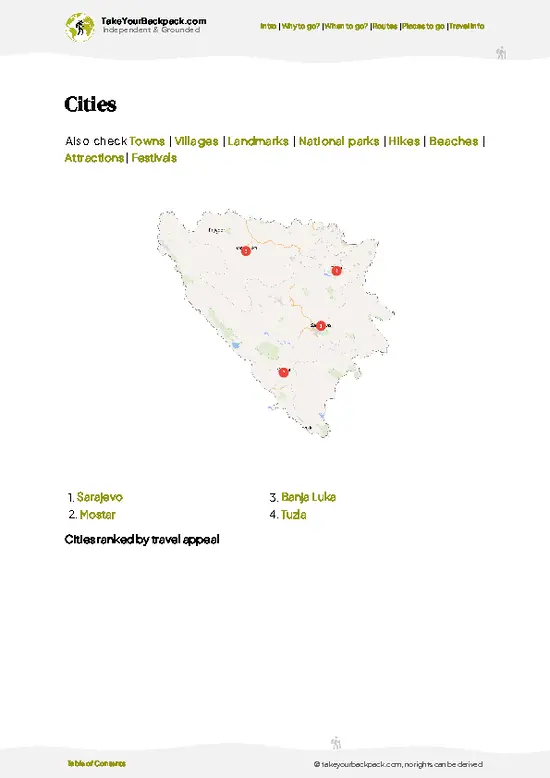
1 Sarajevo

bazaar streets, mosque minarets, hillside neighborhoods

Trace layers of history from Ottoman alleys to Austro-Hungarian facades, pausing for burek or strong coffee in bustling local haunts.

bosnia-and-herzegovina-city-sarajevo
© Google | Miodrag Davidović

2 Mostar

stone bridge, Ottoman quarter, riverside terraces

Cross the iconic arch above emerald water, wander narrow lanes lined with artisan stalls, and linger over coffee beside the Neretva.

bosnia-and-herzegovina-city-mostar
© Google | Nemesis&İkarus

3 Banja Luka

tree-lined boulevards, fortress views, thermal springs

Stroll leafy avenues and relax in public baths, then watch daily life unfold from the ramparts overlooking the Vrbas River.

bosnia-and-herzegovina-city-banja-luka
© Google | Boris Veriš

4 Tuzla

salt lakes, industrial heritage, open-air squares

Swim in city-center lakes formed by ancient salt deposits and explore a working-class city shaped by mining and modern student life.

Loading the map 🌍

Expert viewExpert Commentary on cities

How many cities to visit: Three to four cities is the right number for most trips of a week to ten days. Distances look short on the map, but mountain roads and slow buses eat hours, and the best moments come from lingering in a square at dusk when the call to prayer mixes with clinking cups. Fewer stops mean more time for those evenings.
Choosing between kinds of cities: History-minded travelers should favor the capital-style centers, where museums, tunnels and memorials give context to the 1990s war. Those after atmosphere and photography should pick the Ottoman-era stone towns, accepting the summer crowds. Travelers seeking calmer streets, river swims and cheap food do better in smaller northern and western towns, where cafes fill with locals rather than day-trippers. Each choice changes … read more 👉
How many cities to visit: Three to four cities is the right number for most trips of a week to ten days. Distances look short on the map, but mountain roads and slow buses eat hours, and the best moments come from lingering in a square at dusk when the call to prayer mixes with clinking cups. Fewer stops mean more time for those evenings.
Choosing between kinds of cities: History-minded travelers should favor the capital-style centers, where museums, tunnels and memorials give context to the 1990s war. Those after atmosphere and photography should pick the Ottoman-era stone towns, accepting the summer crowds. Travelers seeking calmer streets, river swims and cheap food do better in smaller northern and western towns, where cafes fill with locals rather than day-trippers. Each choice changes the feel of a trip, so mix one big center with one quiet town.
What it costs: A budget traveler can manage on about 50 to 80 KM a day (US$28 to 45), covering a hostel dorm at 20 to 35 KM, a burek or ćevapi meal at 5 to 12 KM and local transport. Mid-range travelers should plan 100 to 160 KM (US$55 to 90) for a private room, sit-down dinners and a taxi or two. Museum entries typically cost 5 to 15 KM, walking tours often run 15 to 30 KM, and intercity buses are usually 10 to 25 KM per leg. Carry cash in small notes, because small guesthouses and cafes often skip cards. The payoff is a full plate of grilled meat and flatbread for less than a coffee in Western Europe.
Safety and cultural notes: City centers are generally safe, with petty theft the main risk in crowded old quarters, so keep a zipped bag. Landmines remain in some rural areas outside cities, so stay on marked paths if hiking, and never step into abandoned buildings or overgrown ground off the road. Dress modestly in mosques and churches, remove shoes where asked, and cover shoulders. Ask before photographing people. Politics and the war are sensitive topics. Listen first, and avoid taking sides, as locals will respond with warmth to curiosity rather than opinions. During Ramadan, some cafes close by day but fill after sunset, so eat early or wait for the evening meal, when tables overflow with soup, bread and sweet pastries.

✈️ The backpacker research shortcutBosnia and Herzegovina Travel Guide

An offline-friendly backpacking guide with optimized travel routes, ranked highlights, transport advice, and the best areas to stay.
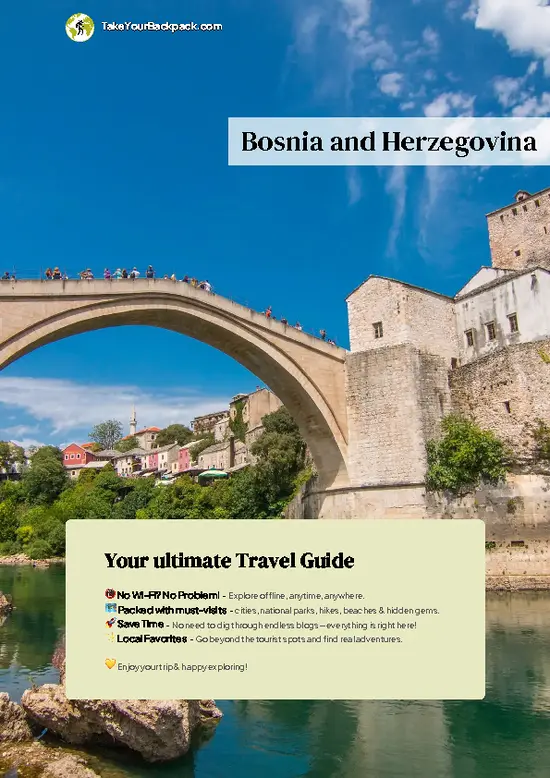
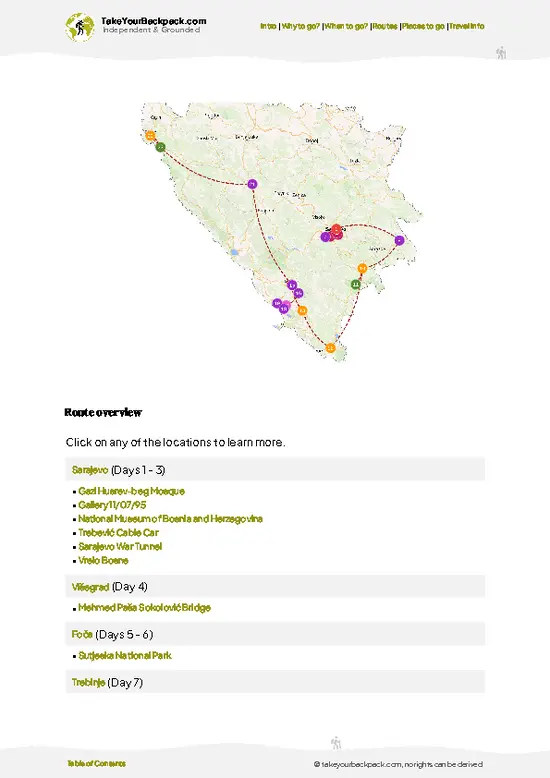
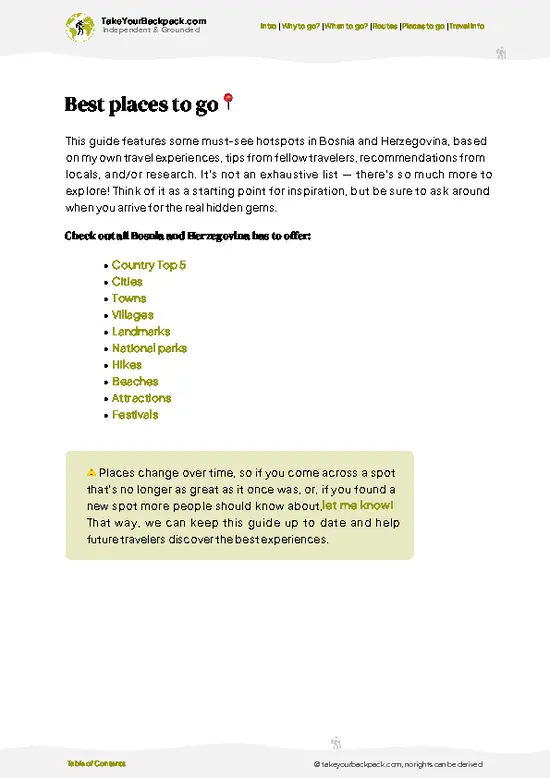
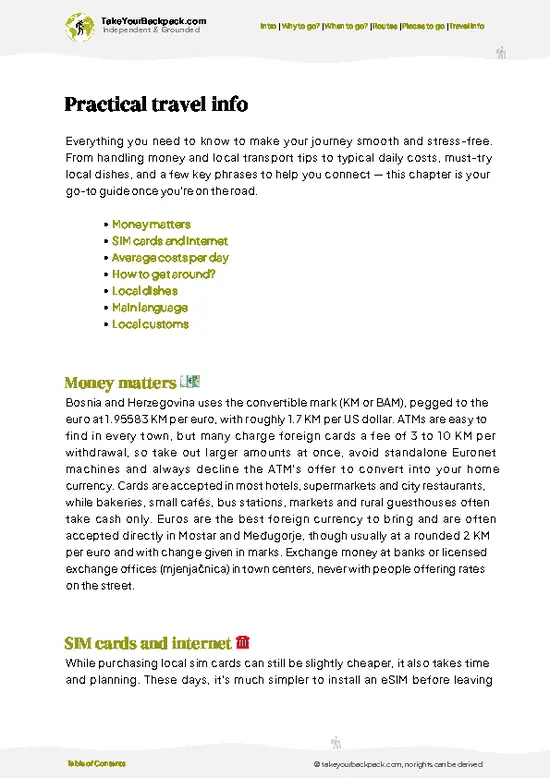
example page 0 from our offline Travel Guide for Bosnia and Herzegovina
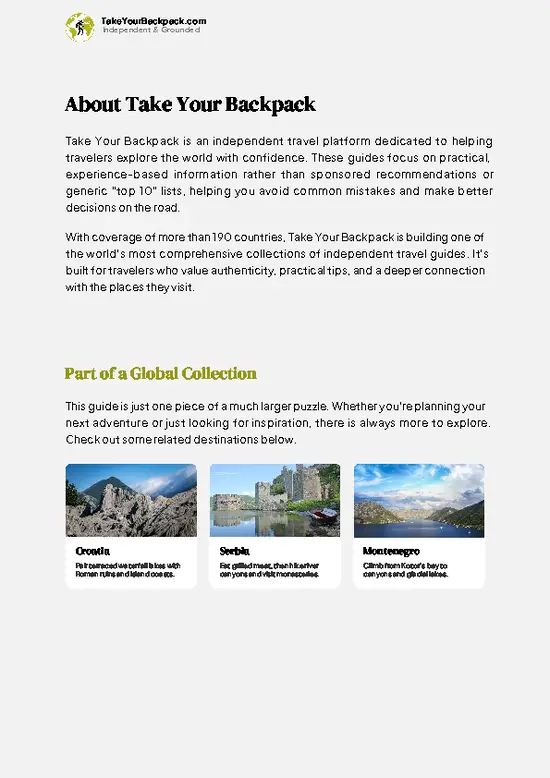
example page 1 from our offline Travel Guide for Bosnia and Herzegovina
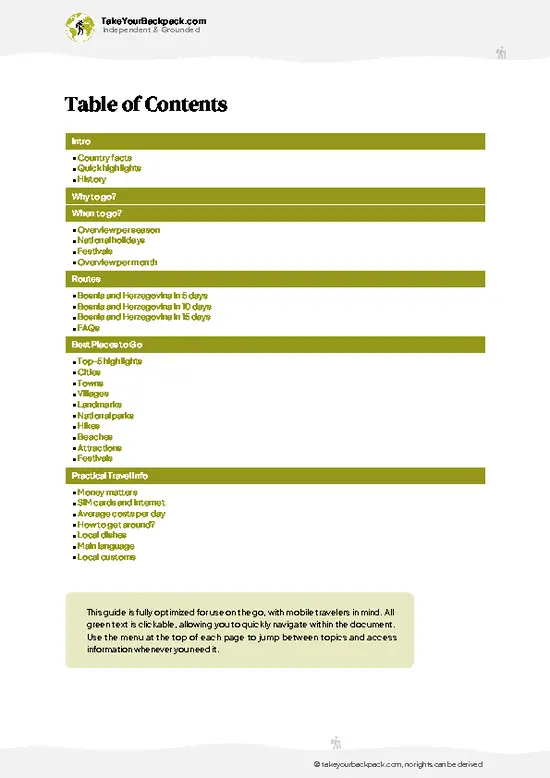
example page 2 from our offline Travel Guide for Bosnia and Herzegovina
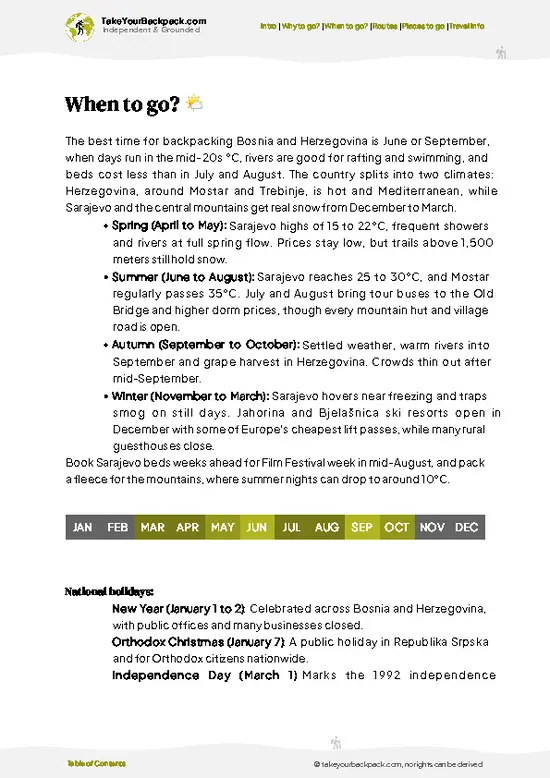
example page 3 from our offline Travel Guide for Bosnia and Herzegovina
example page 4 from our offline Travel Guide for Bosnia and Herzegovina
example page 5 from our offline Travel Guide for Bosnia and Herzegovina
example page 6 from our offline Travel Guide for Bosnia and Herzegovina
example page 7 from our offline Travel Guide for Bosnia and Herzegovina
The digital guide (311 pages) contains:
✅ 82 highlights, ranked by travel appeal
✅ Optimized 5, 10 & 15-day travel routes
✅ Cities, national parks, landmarks, beaches
✅ How to get around
✅ Offline-friendly for travel without Wi-Fi
👉 Click to see all 30+ guide features

📅 Plan smarter in minutes, not weeks
✅ Month by month travel advice
✅ Festivals & national holidays
✅ Budget expectations

🗺️ Go to the right places, skip the overrated ones
✅ Honest pros & cons of destinations
✅ Top hikes, parks & viewpoints
✅ Lesser-known places most travelers miss
✅ Clear “worth it vs skip it” guidance

🛏️ Travel smoothly without rookie mistakes
✅ Best areas to stay
✅ Transport systems explained simply
✅ Common scams & safety advice
✅ SIM cards, money & practical tips

🌍 Understand the country, not just visit it
✅ Culture & traditions
✅ 52 Essential phrases & customs
✅ Festivals worth planning around
✅ Traveler-friendly historical context
✅ Insights that make places more meaningful

📱 Built for real travel conditions
✅ Fully downloadable PDF
✅ Works completely offline
✅ Optimized for phone use
✅ Useful in remote areas & buses
✅ Everything in one place
Stop searching, start planning
Get instant access to your full guide. 30‑day money-back guarantee.
+ Add another guide for just

By proceeding you agree to our terms.
Sent to your inbox immediately after payment • 100% Secure Checkout
Best Backpacking Travel Advisor 2025 tourism awardBest Backpacking
Travel Advisor
2025
What others say about Take Your Backpack Guides:
⭐⭐⭐⭐⭐
Fantastic, amazing amount of information!
⭐⭐⭐⭐⭐
My goodness this is amazing, it's what I've been looking for hats off too you!
⭐⭐⭐⭐⭐
I think this is absolutely BRILLIANT
⭐⭐⭐⭐
Very complete and informative. It's still missing places, but I gotta to commend you
⭐⭐⭐⭐⭐
This is truly amazing, thank you, can't wait to explore it with my kids!
⭐⭐⭐⭐⭐
Awesome resource, thank you!
⭐⭐⭐⭐⭐
This is amazing! Can't wait to explore the ones I haven't seen
⭐⭐⭐⭐
I love this! Well done, great idea.
⭐⭐⭐⭐⭐
Thanks for taking the time to make this gem!
⭐⭐⭐⭐⭐
This might be the best website I've ever seen.
⭐⭐⭐⭐⭐
Congratulations, and thank you so much for your work; it's incredibly valuable.
⭐⭐⭐⭐
In all seriousness I think you did a great job pointing out the important spots
⭐⭐⭐⭐⭐
10/10 very good
⭐⭐⭐⭐⭐
As someone who's only just starting to visit regularly this is awesome, thank you.
⭐⭐⭐⭐
Thank you very much! I'm going to visit my dad, it's going to be very useful!
⭐⭐⭐⭐⭐
This is really cool! We'll be travelling for the first time and this definitely come in handy.
⭐⭐⭐⭐⭐
You are now our minister of culture, congratulations 👨‍💼
⭐⭐⭐⭐⭐
Just wanted to tell you that this is a pearl! Going to follow your recommendations.
⭐⭐⭐⭐⭐
This is so cool. I'll definitely be using the resource for my travels soon.
⭐⭐⭐⭐⭐
This is very impressive! Good work.
⭐⭐⭐⭐⭐
This is an amazing and informative site. Very well done!

🛏️ Where to stay?Where to Stay: Bosnia and Herzegovina Edition

Bosnia and Herzegovina has plenty of hostels and guesthouses, with dorm beds usually running 20 to 35 KM (about €10 to 18) and private rooms in family-run pansions from roughly 50 KM (about €25). In Sarajevo, Baščaršija and the surrounding Old Town hold the densest cluster of hostels, putting you within walking distance of the main sights and the bars, though the streets stay noisy late and the lanes climbing the hillsides are steep, while Marijin Dvor is calmer, better connected by tram and a 20-minute walk from the old center. In Mostar, the area around the Old Town near the bridge has the most budget beds and the liveliest evenings, but the quieter streets on the west bank often give you … read more 👉
Bosnia and Herzegovina has plenty of hostels and guesthouses, with dorm beds usually running 20 to 35 KM (about €10 to 18) and private rooms in family-run pansions from roughly 50 KM (about €25). In Sarajevo, Baščaršija and the surrounding Old Town hold the densest cluster of hostels, putting you within walking distance of the main sights and the bars, though the streets stay noisy late and the lanes climbing the hillsides are steep, while Marijin Dvor is calmer, better connected by tram and a 20-minute walk from the old center. In Mostar, the area around the Old Town near the bridge has the most budget beds and the liveliest evenings, but the quieter streets on the west bank often give you more space for the money and an easy 10 to 15-minute walk in.

If you enjoy meeting fellow travelers, consider choosing hostels with high ratings for atmosphere. On the other hand, if you prefer having your own space, a hotel might be a better option.

Bosnia and HerzegovinaExplore Beyond This Category

👋 Meet the founderWho’s Behind Take Your Backpack?

Johan, backpacker and founder of TakeYourBackpackHi, I’m Johan (Netherlands 🇳🇱), the creator of TakeYourBackpack. Over the past 3 decades, I’ve backpacked through 90+ countries across six continents, gaining extensive experience with independent travel, long-term trips, and overland routes.

This site is built on a combination of firsthand travel experience and carefully curated insights from other backpackers. Many guides are based on places I’ve personally visited, while others bring together tips, observations, and practical advice shared by trusted travelers I’ve met along the way.

The goal is to provide realistic, experience-driven guidance — not generic itineraries — so you can explore destinations with better context, clearer expectations, and more confidence.