×

Bosnia and Herzegovina🇧🇦 | best hikesThe Must-See 6 hikes in Bosnia and Herzegovina

Hikes in Bosnia and Herzegovina mean limestone scree that clatters underfoot, beech forest that smells of wet leaves, and the sudden bark of a shepherd’s dog across a karst meadow. The Dinaric Alps run through the center and south, with rough, high routes that see few hikers and few signs. The north and east trade drama for river canyons and forested ridges, often reached by one bus a day. Costs stay low, with huts and guesthouses at US$15 to 40, but access is slow, so independent travel needs patience. Expect empty trails, spartan comfort and plenty of coffee at the end.

By Johan Kruseman 🇳🇱 | Updated October 18, 2026
Explore the best beaches in Bosnia and Herzegovina

Why go?Key Factors That Shape the Experience

Bosnia and Herzegovina rewards hikers because mountains and rivers cover most of the country, yet organized trail culture is thin. Trails are often marked by red-and-white paint blazes on rock, and some fade into grass or beech woods. Walking here means thinking for yourself, with paths still used by shepherds and villagers. Do not expect the huts, cable cars and dense signage of the Alps.

The 1990s war left a hard legacy. Some forests and rural slopes still hold landmines, so staying on marked trails and well-worn tracks is a firm rule, never a suggestion. Mine-awareness signs, a red triangle with a skull, mean stop and turn back.

Culture shapes the walking too. Villages offer strong coffee, soft flatbread and plum brandy, and hosts often press food on you. Mosques, Orthodox churches and … read more 👉
Bosnia and Herzegovina rewards hikers because mountains and rivers cover most of the country, yet organized trail culture is thin. Trails are often marked by red-and-white paint blazes on rock, and some fade into grass or beech woods. Walking here means thinking for yourself, with paths still used by shepherds and villagers. Do not expect the huts, cable cars and dense signage of the Alps.

The 1990s war left a hard legacy. Some forests and rural slopes still hold landmines, so staying on marked trails and well-worn tracks is a firm rule, never a suggestion. Mine-awareness signs, a red triangle with a skull, mean stop and turn back.

Culture shapes the walking too. Villages offer strong coffee, soft flatbread and plum brandy, and hosts often press food on you. Mosques, Orthodox churches and Catholic chapels sit within a few valleys of each other, so dress modestly in settlements. Public transport is sparse and slow, so many hikers rent a car or arrange transfers. The reward is quiet: long ridgelines with the only sound being cowbells and wind.
Evaluating the Top Choices
The list of best hikes in Bosnia and Herzegovina is created based on scenery, challenge, trail quality, landmarks, and overall enjoyment. If you feel a hike is missing in this list, please let us know.

When to go?Seasonal Guide to Visiting

Best months and weather: June to September is the best window for hikes in Bosnia and Herzegovina, because snow has left the high Dinaric ridges, the days are long, and mountain passes are open. Highland valleys sit at around 18 to 28°C in July and August, while ridges above 2,000 m can drop to 5 to 10°C at dawn. Afternoon thunderstorms roll in over limestone peaks, so start early and be down by mid-afternoon.
Shoulder seasons: May and October carry real risk and real calm. In May, snow patches linger above 1,800 m, streams run loud and meadows smell of wet grass and wildflowers. October brings amber beech forest and crisp air, but days shorten and nights go near freezing. Lower hills and canyon trails in the north and Herzegovina stay walkable into November.
Winter, crowds and prices: From … read more 👉
Best months and weather: June to September is the best window for hikes in Bosnia and Herzegovina, because snow has left the high Dinaric ridges, the days are long, and mountain passes are open. Highland valleys sit at around 18 to 28°C in July and August, while ridges above 2,000 m can drop to 5 to 10°C at dawn. Afternoon thunderstorms roll in over limestone peaks, so start early and be down by mid-afternoon.
Shoulder seasons: May and October carry real risk and real calm. In May, snow patches linger above 1,800 m, streams run loud and meadows smell of wet grass and wildflowers. October brings amber beech forest and crisp air, but days shorten and nights go near freezing. Lower hills and canyon trails in the north and Herzegovina stay walkable into November.
Winter, crowds and prices: From December to March, heavy snow closes high trails and some mountain roads, and avalanche risk rises. Huts and small guesthouses may shut or take only bookings. July and August are the busiest weeks, yet trails stay quiet compared with the Alps. Rafting and canyon towns fill and prices rise about 10 to 25 percent, with rooms at US$25 to 60. Herzegovina in midsummer can pass 35°C in the valleys, so walk at sunrise.

hike hoppingPlanning Your Route Efficiently

How long and where to start: A trip combining several hikes in Bosnia and Herzegovina needs 8 to 14 days, including travel days and one or two slack days for weather. Sarajevo is the natural hub, with the most bus links, car rental and airport connections. Mostar works as the southern anchor.
Grouping and direction: Cluster by region. The central and southern Dinarics sit within 1.5 to 3 hours of Sarajevo by road, and the Herzegovina valleys lie around 2 to 3 hours from the capital through Konjic. The northwest and the Una river area need their own block, often 5 to 7 hours from Sarajevo by road. A sensible direction runs from the highlands to the lowlands. Start in the high mountains while legs are fresh and the weather holds, then move south toward the warm stone towns and river valleys for … read more 👉
How long and where to start: A trip combining several hikes in Bosnia and Herzegovina needs 8 to 14 days, including travel days and one or two slack days for weather. Sarajevo is the natural hub, with the most bus links, car rental and airport connections. Mostar works as the southern anchor.
Grouping and direction: Cluster by region. The central and southern Dinarics sit within 1.5 to 3 hours of Sarajevo by road, and the Herzegovina valleys lie around 2 to 3 hours from the capital through Konjic. The northwest and the Una river area need their own block, often 5 to 7 hours from Sarajevo by road. A sensible direction runs from the highlands to the lowlands. Start in the high mountains while legs are fresh and the weather holds, then move south toward the warm stone towns and river valleys for the easier days.
Pacing and mistakes: Allow 1 to 3 days per hiking stop, plus a half day for buses and transfers. Mountain roads are winding and slow, so 100 km often takes 2 to 3 hours. The common mistake is trying to stack too many bases in a week, when one base with day hikes saves hours. Another is trusting bus timetables, as rural services can be one or two a day and sometimes skip Sundays. Hire a car or book a transfer for remote trailheads, and keep a buffer day before flights.

The ListHighly Recommended hikes of Bosnia and Herzegovina

1 Via Dinarica

long-distance route, cross-border trails, diverse ecosystems

Follow a transnational path linking varied landscapes, requiring logistical planning and offering exposure to the region’s full natural spectrum.

2 Čvrsnica Mountain Trail

karst terrain, Hajdučka Vrata arch, steep canyons

Navigate rugged limestone paths past dramatic rock formations and deep gorges, encountering rare endemic flora along the route.

3 Bjelašnica

alpine plateau, wartime relics, exposed ridges

Traverse open highlands shaped by harsh winters and history, with panoramic views and unpredictable weather demanding solid preparation.

bosnia-and-herzegovina-hike-bjelasnica
© Google |

4 Jahorina

rolling hills, ski infrastructure, wildflower meadows

Experience a mix of open slopes and wooded sections, with well-marked paths and seasonal changes shaping the hiking experience.

bosnia-and-herzegovina-hike-jahorina
© Google |

5 Vlašić

shepherd settlements, grassy plateaus, livestock trails

Walk through open pastures dotted with seasonal huts, encountering pastoral traditions and expansive views across central Bosnia.

bosnia-and-herzegovina-hike-vlasic
© Google |

6 Igman

dense forest, World War II sites, gentle gradients

Follow forested trails past historical landmarks and meadows, ideal for relaxed trekking and accessible year-round exploration.

Loading the map 🌍

Expert viewExpert Commentary on hikes

How many hikes to plan: Three to five hikes is the number I advise for a first trip. That gives you enough variety, from high limestone ridges to a canyon or river valley, without spending your whole trip on switchbacks and rural bus delays. Each good hike needs a rest or travel day around it, since trailheads are remote and roads are slow. The payoff is sitting on a ridge with no other walkers in sight.
Which kind for which traveler: Strong, self-sufficient walkers should prioritize high mountain routes, where paint blazes fade, ground is rocky and navigation matters. Beginners and families do better with river valleys, forest paths and waterfall walks, which are shorter, shadier and easier to reach from towns. Travelers who care about culture should pick routes that pass old villages and … read more 👉
How many hikes to plan: Three to five hikes is the number I advise for a first trip. That gives you enough variety, from high limestone ridges to a canyon or river valley, without spending your whole trip on switchbacks and rural bus delays. Each good hike needs a rest or travel day around it, since trailheads are remote and roads are slow. The payoff is sitting on a ridge with no other walkers in sight.
Which kind for which traveler: Strong, self-sufficient walkers should prioritize high mountain routes, where paint blazes fade, ground is rocky and navigation matters. Beginners and families do better with river valleys, forest paths and waterfall walks, which are shorter, shadier and easier to reach from towns. Travelers who care about culture should pick routes that pass old villages and stone bridges, where a coffee stop is part of the day. Photographers should choose dawn starts for soft light on bare rock.
What it costs: Budget US$30 to 50 a day for a frugal backpacker: dorm or guesthouse US$12 to 25, meals US$8 to 15, local buses US$3 to 12. Add a local guide for remote or unmarked routes at roughly US$60 to 120 a day, and a hired car or transfer at US$40 to 80 a day for hard-to-reach trailheads. National park and reserve entry fees are usually small, around US$2 to 8. Plan US$250 to 500 for a one-week hiking trip, excluding flights. Carry cash in convertible marks, because small guesthouses and huts often do not take cards.
Safety on the trail: The main hazard is landmines. Stay on marked trails, on well-used tracks and on paths that locals clearly walk, and never step into abandoned fields or forest edges. Check current local mine-action maps and ask guesthouse hosts before heading out. Mountain weather can turn quickly, with fog, cold wind and thunderstorms over open limestone. Carry a paper map or offline GPS track, at least 2 liters of water, a rain layer and a charged phone. Mobile signal fades in valleys. Summer heat in Herzegovina is harsh, so start at sunrise.
Culture and courtesy: Dress modestly in villages, particularly around mosques and churches. Accept a coffee or a plate of cheese and bread when offered, as turning hospitality down can seem rude. Dogs guarding flocks can be loud, so stay calm, keep your distance and walk wide around them. Ask before camping on private land. Wild camping is common but requires permission from the landowner in many areas. Pack out all trash.

✈️ The backpacker research shortcutBosnia and Herzegovina Travel Guide

An offline-friendly backpacking guide with optimized travel routes, ranked highlights, transport advice, and the best areas to stay.
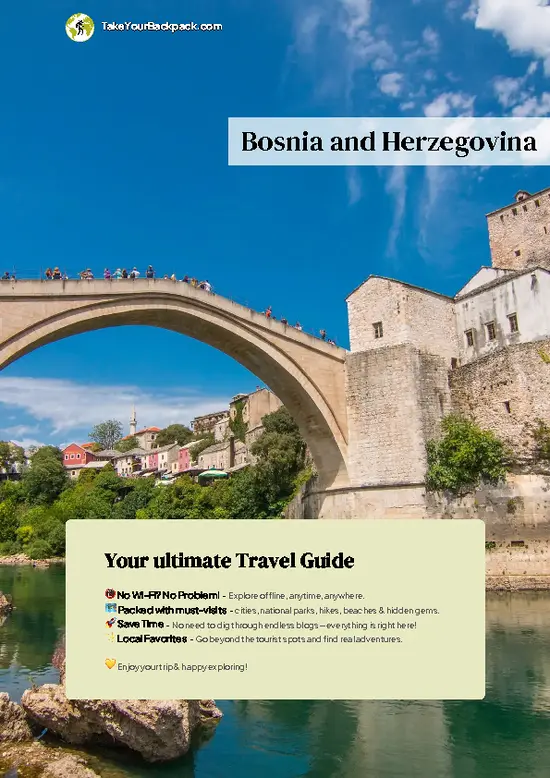
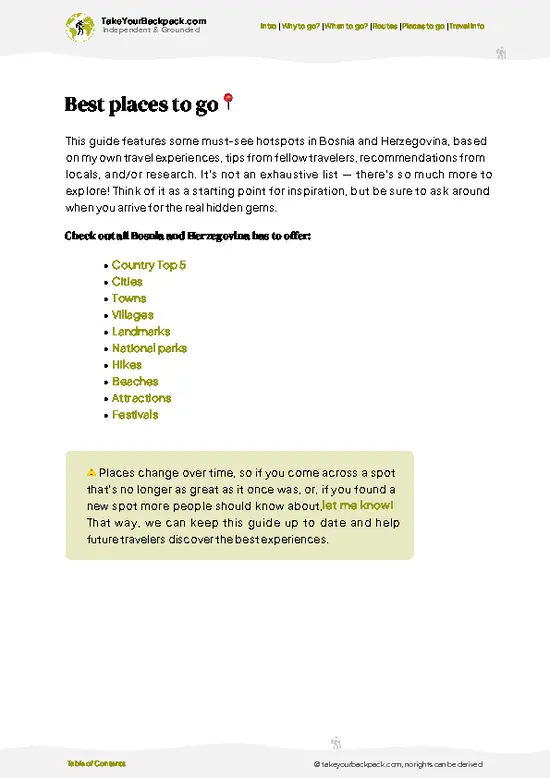
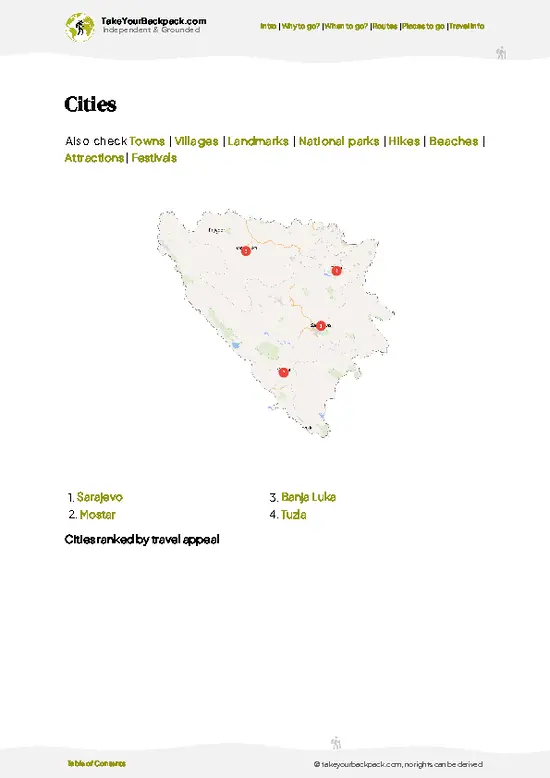
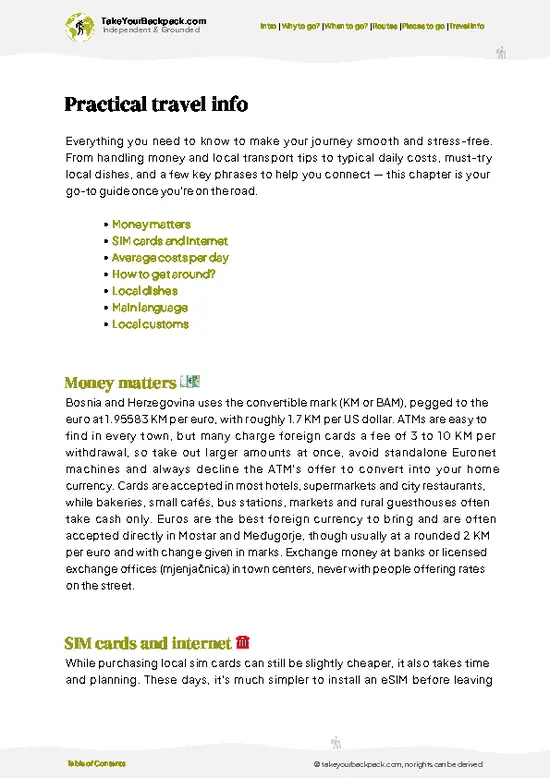
example page 0 from our offline Travel Guide for Bosnia and Herzegovina
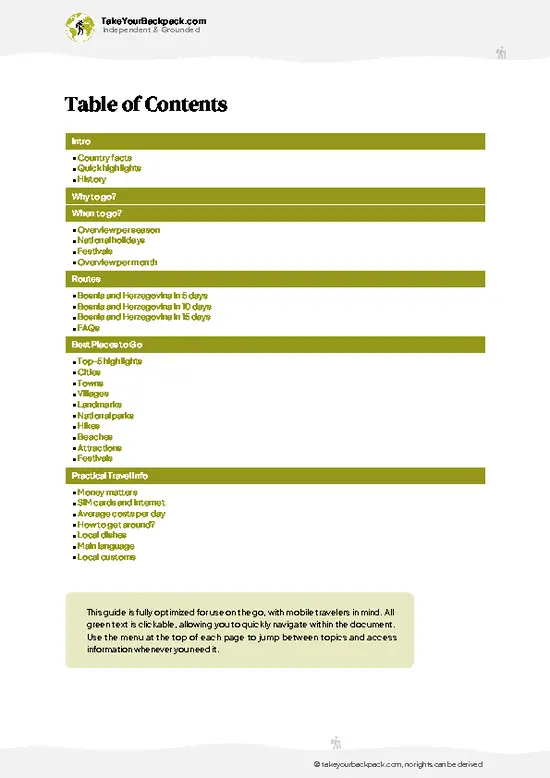
example page 1 from our offline Travel Guide for Bosnia and Herzegovina
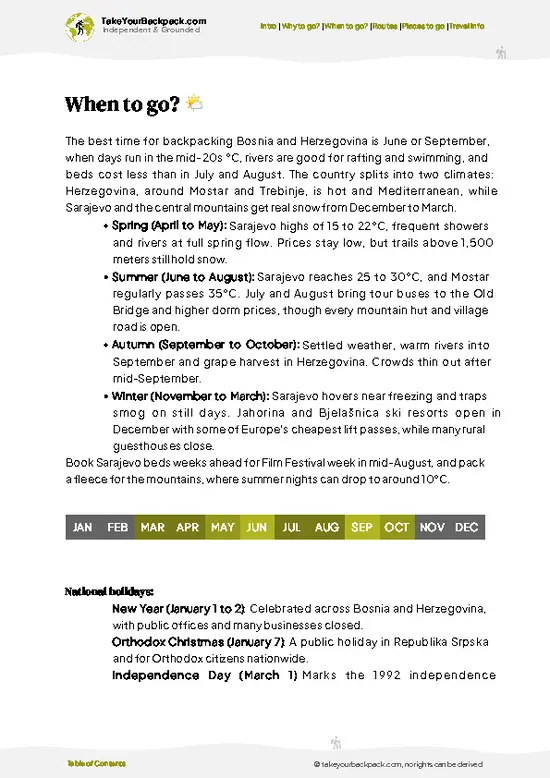
example page 2 from our offline Travel Guide for Bosnia and Herzegovina
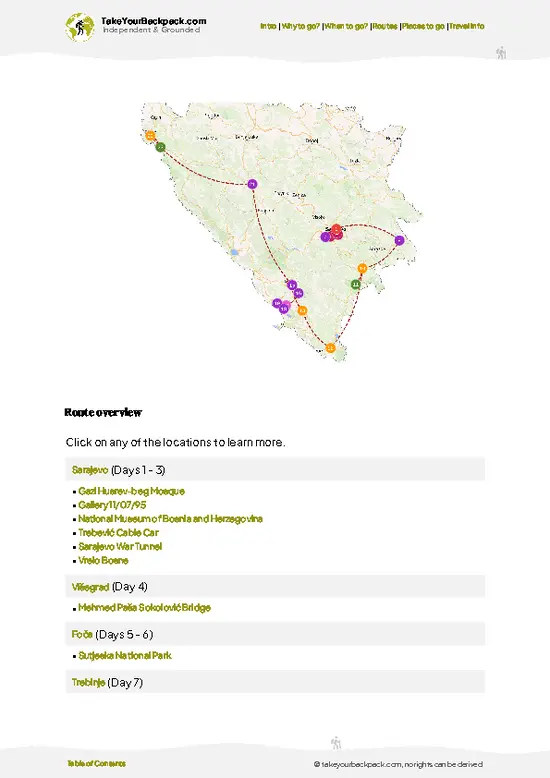
example page 3 from our offline Travel Guide for Bosnia and Herzegovina
example page 4 from our offline Travel Guide for Bosnia and Herzegovina
example page 5 from our offline Travel Guide for Bosnia and Herzegovina
example page 6 from our offline Travel Guide for Bosnia and Herzegovina
example page 7 from our offline Travel Guide for Bosnia and Herzegovina
The digital guide (311 pages) contains:
✅ 82 highlights, ranked by travel appeal
✅ Optimized 5, 10 & 15-day travel routes
✅ Cities, national parks, landmarks, beaches
✅ How to get around
✅ Offline-friendly for travel without Wi-Fi
👉 Click to see all 30+ guide features

📅 Plan smarter in minutes, not weeks
✅ Month by month travel advice
✅ Festivals & national holidays
✅ Budget expectations

🗺️ Go to the right places, skip the overrated ones
✅ Honest pros & cons of destinations
✅ Top hikes, parks & viewpoints
✅ Lesser-known places most travelers miss
✅ Clear “worth it vs skip it” guidance

🛏️ Travel smoothly without rookie mistakes
✅ Best areas to stay
✅ Transport systems explained simply
✅ Common scams & safety advice
✅ SIM cards, money & practical tips

🌍 Understand the country, not just visit it
✅ Culture & traditions
✅ 52 Essential phrases & customs
✅ Festivals worth planning around
✅ Traveler-friendly historical context
✅ Insights that make places more meaningful

📱 Built for real travel conditions
✅ Fully downloadable PDF
✅ Works completely offline
✅ Optimized for phone use
✅ Useful in remote areas & buses
✅ Everything in one place
Stop searching, start planning
Get instant access to your full guide. 30‑day money-back guarantee.
+ Add another guide for just

By proceeding you agree to our terms.
Sent to your inbox immediately after payment • 100% Secure Checkout
Best Backpacking Travel Advisor 2025 tourism awardBest Backpacking
Travel Advisor
2025
What others say about Take Your Backpack Guides:
⭐⭐⭐⭐⭐
Fantastic, amazing amount of information!
⭐⭐⭐⭐⭐
My goodness this is amazing, it's what I've been looking for hats off too you!
⭐⭐⭐⭐⭐
I think this is absolutely BRILLIANT
⭐⭐⭐⭐
Very complete and informative. It's still missing places, but I gotta to commend you
⭐⭐⭐⭐⭐
This is truly amazing, thank you, can't wait to explore it with my kids!
⭐⭐⭐⭐⭐
Awesome resource, thank you!
⭐⭐⭐⭐⭐
This is amazing! Can't wait to explore the ones I haven't seen
⭐⭐⭐⭐
I love this! Well done, great idea.
⭐⭐⭐⭐⭐
Thanks for taking the time to make this gem!
⭐⭐⭐⭐⭐
This might be the best website I've ever seen.
⭐⭐⭐⭐⭐
Congratulations, and thank you so much for your work; it's incredibly valuable.
⭐⭐⭐⭐
In all seriousness I think you did a great job pointing out the important spots
⭐⭐⭐⭐⭐
10/10 very good
⭐⭐⭐⭐⭐
As someone who's only just starting to visit regularly this is awesome, thank you.
⭐⭐⭐⭐
Thank you very much! I'm going to visit my dad, it's going to be very useful!
⭐⭐⭐⭐⭐
This is really cool! We'll be travelling for the first time and this definitely come in handy.
⭐⭐⭐⭐⭐
You are now our minister of culture, congratulations 👨‍💼
⭐⭐⭐⭐⭐
Just wanted to tell you that this is a pearl! Going to follow your recommendations.
⭐⭐⭐⭐⭐
This is so cool. I'll definitely be using the resource for my travels soon.
⭐⭐⭐⭐⭐
This is very impressive! Good work.
⭐⭐⭐⭐⭐
This is an amazing and informative site. Very well done!

🛏️ Where to stay?Where to Stay: Bosnia and Herzegovina Edition

Bosnia and Herzegovina has plenty of hostels and guesthouses, with dorm beds usually running 20 to 35 KM (about €10 to 18) and private rooms in family-run pansions from roughly 50 KM (about €25). In Sarajevo, Baščaršija and the surrounding Old Town hold the densest cluster of hostels, putting you within walking distance of the main sights and the bars, though the streets stay noisy late and the lanes climbing the hillsides are steep, while Marijin Dvor is calmer, better connected by tram and a 20-minute walk from the old center. In Mostar, the area around the Old Town near the bridge has the most budget beds and the liveliest evenings, but the quieter streets on the west bank often give you … read more 👉
Bosnia and Herzegovina has plenty of hostels and guesthouses, with dorm beds usually running 20 to 35 KM (about €10 to 18) and private rooms in family-run pansions from roughly 50 KM (about €25). In Sarajevo, Baščaršija and the surrounding Old Town hold the densest cluster of hostels, putting you within walking distance of the main sights and the bars, though the streets stay noisy late and the lanes climbing the hillsides are steep, while Marijin Dvor is calmer, better connected by tram and a 20-minute walk from the old center. In Mostar, the area around the Old Town near the bridge has the most budget beds and the liveliest evenings, but the quieter streets on the west bank often give you more space for the money and an easy 10 to 15-minute walk in.

If you enjoy meeting fellow travelers, consider choosing hostels with high ratings for atmosphere. On the other hand, if you prefer having your own space, a hotel might be a better option.

Bosnia and HerzegovinaExplore Beyond This Category

👋 Meet the founderWho’s Behind Take Your Backpack?

Johan, backpacker and founder of TakeYourBackpackHi, I’m Johan (Netherlands 🇳🇱), the creator of TakeYourBackpack. Over the past 3 decades, I’ve backpacked through 90+ countries across six continents, gaining extensive experience with independent travel, long-term trips, and overland routes.

This site is built on a combination of firsthand travel experience and carefully curated insights from other backpackers. Many guides are based on places I’ve personally visited, while others bring together tips, observations, and practical advice shared by trusted travelers I’ve met along the way.

The goal is to provide realistic, experience-driven guidance — not generic itineraries — so you can explore destinations with better context, clearer expectations, and more confidence.