×

Bosnia and Herzegovina🇧🇦 | best villagesThe Must-See 2 villages in Bosnia and Herzegovina

Villages in Bosnia and Herzegovina come as stone, wood or whitewash, depending on which valley you drop into. In the Herzegovina south, limestone houses sit in hot, dry light, with fig trees, the smell of wild sage and the clack of shutters at noon. Central and northern Bosnia turns green and damp, with plum orchards, timber minarets and woodsmoke curling over slate roofs. Costs stay low everywhere, but access differs: the south has tour-bus crowds in summer, while the mountain hamlets need patient bus changes or a rental car. Independent travelers who like quiet should aim for the highlands and river canyons.

By Johan Kruseman 🇳🇱 | Updated October 18, 2026
Explore the best landmarks in Bosnia and Herzegovina

Why go?Key Factors That Shape the Experience

Bosnia and Herzegovina packs four centuries of Ottoman rule, Habsburg administration and Yugoslav-era life into steep, folded terrain, and villages show every layer. Mosques, Orthodox and Catholic churches often stand within a few kilometers of each other, so a single day can bring a muezzin’s call, church bells and the clink of coffee cups on copper trays. The Dinaric mountains kept many settlements isolated, which preserved dry-stone walls, wooden shingle roofs and hand-built mills beside cold, loud rivers.

Before choosing the country for villages, know that public transport is thin. Buses link towns, but rural connections can run once or twice a day, and some stop on weekends. Roads are narrow and winding, so a 60 km hop can take two hours. Signage in remote areas can be sparse. Guesthouses … read more 👉
Bosnia and Herzegovina packs four centuries of Ottoman rule, Habsburg administration and Yugoslav-era life into steep, folded terrain, and villages show every layer. Mosques, Orthodox and Catholic churches often stand within a few kilometers of each other, so a single day can bring a muezzin’s call, church bells and the clink of coffee cups on copper trays. The Dinaric mountains kept many settlements isolated, which preserved dry-stone walls, wooden shingle roofs and hand-built mills beside cold, loud rivers.

Before choosing the country for villages, know that public transport is thin. Buses link towns, but rural connections can run once or twice a day, and some stop on weekends. Roads are narrow and winding, so a 60 km hop can take two hours. Signage in remote areas can be sparse. Guesthouses are usually family homes, where breakfast means warm bread, kajmak, honey and strong coffee, and where you should have cash in convertible marks (KM), since card machines are unreliable. The 1990s war left landmines in some rural areas, so stay on marked paths and paved tracks. The reward is a country where hosts still insist you eat before you leave, and where few places feel packaged.
Evaluating the Top Choices
The list of best villages in Bosnia and Herzegovina is created based on authenticity, scenic beauty, community spirit, traditions, and overall character. If you feel a village is missing in this list, please let us know.

When to go?Seasonal Guide to Visiting

Best months and why: May to June and September to early October are the best months for villages in Bosnia and Herzegovina, with daytime highs of 18 to 27°C, long clear light and open guesthouses without the July crowds. In spring, meadows are loud with streams and orchards in blossom. In autumn, the smell of woodsmoke, ripe quince and roasting peppers hangs over the valleys.
Summer and regional differences: July and August push Herzegovina past 35°C, and stone lanes hold the heat well into the evening. Near the south’s popular sights, day-trip crowds arrive from late morning, and room prices can rise 20 to 40 percent. The mountain and canyon villages of central and northern Bosnia stay cooler, usually 24 to 30°C, which makes them better for hiking then. Afternoon thunderstorms do happen at … read more 👉
Best months and why: May to June and September to early October are the best months for villages in Bosnia and Herzegovina, with daytime highs of 18 to 27°C, long clear light and open guesthouses without the July crowds. In spring, meadows are loud with streams and orchards in blossom. In autumn, the smell of woodsmoke, ripe quince and roasting peppers hangs over the valleys.
Summer and regional differences: July and August push Herzegovina past 35°C, and stone lanes hold the heat well into the evening. Near the south’s popular sights, day-trip crowds arrive from late morning, and room prices can rise 20 to 40 percent. The mountain and canyon villages of central and northern Bosnia stay cooler, usually 24 to 30°C, which makes them better for hiking then. Afternoon thunderstorms do happen at altitude.
Winter and shoulder risks: From December to February, highland villages see snow, with temperatures often below 0°C and nights far colder. Some roads become slow, smaller guesthouses may close, and buses can be cut back. Spring rains in April can turn dirt tracks to mud. Prices are lowest in winter, but only travelers with a car and flexible plans will find it comfortable.

village hoppingPlanning Your Route Efficiently

How many days to allow: A trip combining several villages in Bosnia and Herzegovina works best in 7 to 12 days, because roads are slow and each stop needs room to breathe. Sarajevo is the natural hub for central Bosnia, while Mostar anchors the Herzegovina south.
Grouping regions and direction: Cluster by valley. The Herzegovina villages sit within about 1 to 2 hours of Mostar, and central Bosnia lies 2 to 3 hours north by road. A sensible direction is Sarajevo, then Mostar, then back north, or the reverse if arriving from Dubrovnik or Split. Buses cover the main routes between larger towns, but the last leg into a village usually needs a taxi, a pre-arranged pickup from your host or a rental car. Border crossings with Croatia can add 30 minutes to 2 hours in summer.
Pacing and planning mistakes: … read more 👉
How many days to allow: A trip combining several villages in Bosnia and Herzegovina works best in 7 to 12 days, because roads are slow and each stop needs room to breathe. Sarajevo is the natural hub for central Bosnia, while Mostar anchors the Herzegovina south.
Grouping regions and direction: Cluster by valley. The Herzegovina villages sit within about 1 to 2 hours of Mostar, and central Bosnia lies 2 to 3 hours north by road. A sensible direction is Sarajevo, then Mostar, then back north, or the reverse if arriving from Dubrovnik or Split. Buses cover the main routes between larger towns, but the last leg into a village usually needs a taxi, a pre-arranged pickup from your host or a rental car. Border crossings with Croatia can add 30 minutes to 2 hours in summer.
Pacing and planning mistakes: Allow half a day to one night per village. Most travelers underestimate the winding roads, planning three stops in a day and arriving in the dark on narrow lanes. Pick one base per region and use short loops instead. Check bus times in advance, since services thin out on Sundays. Leave a buffer afternoon after any mountain crossing, because rain, fog or roadworks can easily add an hour.

The ListHighly Recommended villages of Bosnia and Herzegovina

1 Počitelj

stone fortifications, hillside dwellings, Ottoman-era mosque

Climb narrow lanes past weathered homes and discover layered architecture, with panoramic views over the Neretva River and traces of centuries-old settlement.

bosnia-and-herzegovina-city-pocitelj
© Google | Mirko Popovic

2 Lukomir

stone houses, traditional culture, canyon edge

Reach Bosnia’s highest village perched above a dramatic drop, where daily life and ancient customs persist amid mountain isolation.

bosnia-and-herzegovina-city-lukomir
© Google | Vaclav J.
Loading the map 🌍

Expert viewExpert Commentary on villages

How many villages to visit: Plan on four to six villages over a one to two week trip. That count leaves time to sit on a terrace while a pot of coffee stews on a stove, rather than jumping from car to photo and back. Each village needs at least an evening and a morning to show its rhythm: church bells, a tractor starting up, the smell of fresh bread. More than that and the long, winding roads eat the trip.
Choosing the kind that suits you: For hikers, prioritize highland and canyon settlements where trails start at the guesthouse gate and rivers run cold and loud. For history and architecture, choose the old Ottoman-era stone villages of Herzegovina, where lanes are narrow and the limestone glows at dusk. For quiet and food, pick small farming villages in central and northern Bosnia, where … read more 👉
How many villages to visit: Plan on four to six villages over a one to two week trip. That count leaves time to sit on a terrace while a pot of coffee stews on a stove, rather than jumping from car to photo and back. Each village needs at least an evening and a morning to show its rhythm: church bells, a tractor starting up, the smell of fresh bread. More than that and the long, winding roads eat the trip.
Choosing the kind that suits you: For hikers, prioritize highland and canyon settlements where trails start at the guesthouse gate and rivers run cold and loud. For history and architecture, choose the old Ottoman-era stone villages of Herzegovina, where lanes are narrow and the limestone glows at dusk. For quiet and food, pick small farming villages in central and northern Bosnia, where hosts serve homemade cheese, pies baked under a metal lid with embers on top, and plum brandy. Travelers without a car should favor villages on or near a bus line, as getting stranded on a Sunday is a real risk.
What it costs: Expect US$25 to 45 a day (roughly 45 to 80 KM) on a backpacker budget. Guesthouse rooms or dorm beds run about 25 to 60 KM per person, with breakfast often included. Dinner with a generous home-cooked spread costs 12 to 25 KM. Local buses are typically 5 to 20 KM per leg, while a taxi for the last stretch into a village can be 20 to 50 KM. Entry fees at small heritage sites and mills are usually 2 to 10 KM, and a local guide for a half-day walk is around 50 to 120 KM. Cash is king, so carry small notes in marks.
Safety and etiquette: The biggest rural hazard is leftover landmines from the 1990s conflict. Stay on paved roads, marked trails and well-used paths, and heed red mine-warning signs. Ask your host before wandering into overgrown hillsides. Remove your shoes when entering a home, and dress modestly when visiting a mosque or church. Many hosts do not drink alcohol, and some villages are strictly Muslim, so ask before opening a bottle. Greet people with a nod or a simple “dobar dan.” Refusing food or coffee can seem rude, so accept a small cup. Roads are narrow with blind bends and sometimes livestock, so avoid driving after dark. Mountain weather turns fast, so carry a rain layer even on warm mornings.

✈️ The backpacker research shortcutBosnia and Herzegovina Travel Guide

An offline-friendly backpacking guide with optimized travel routes, ranked highlights, transport advice, and the best areas to stay.
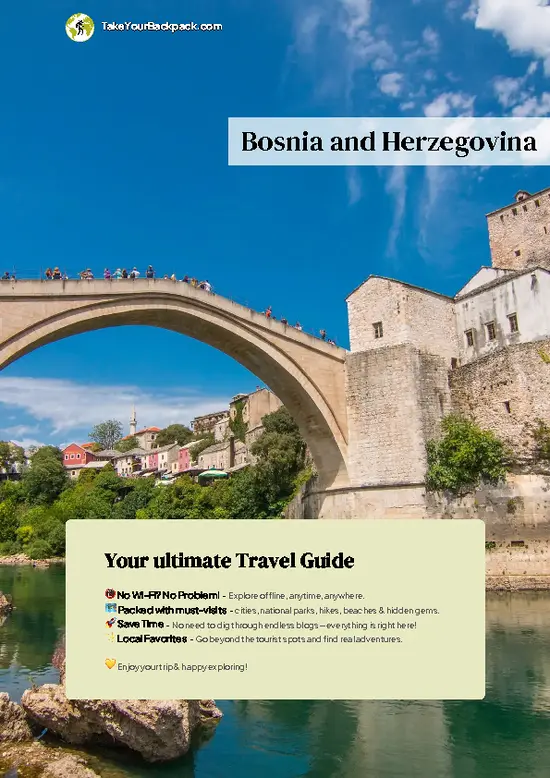
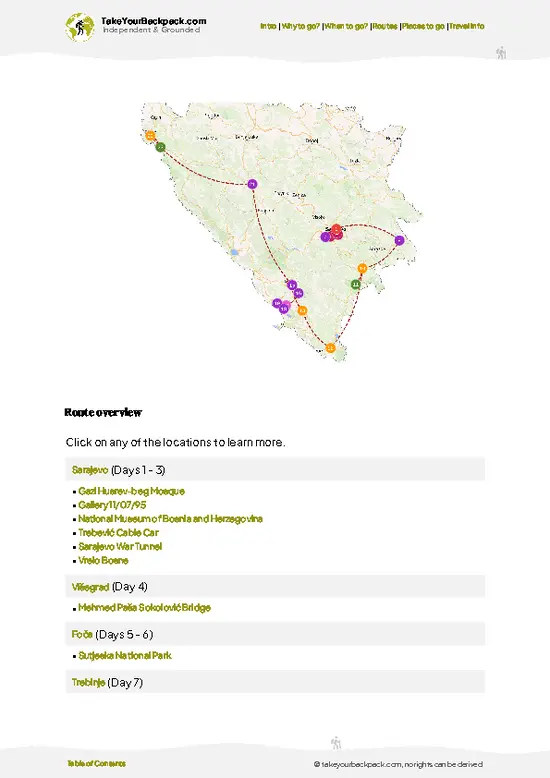
example page 0 from our offline Travel Guide for Bosnia and Herzegovina
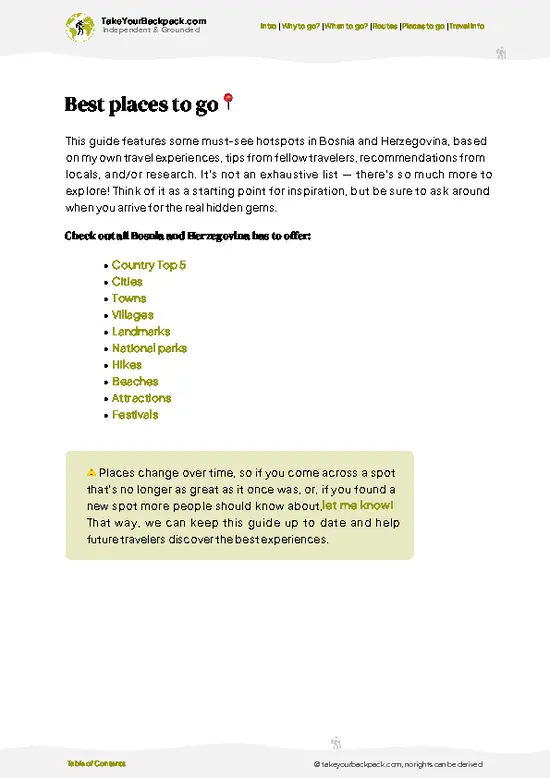
example page 1 from our offline Travel Guide for Bosnia and Herzegovina
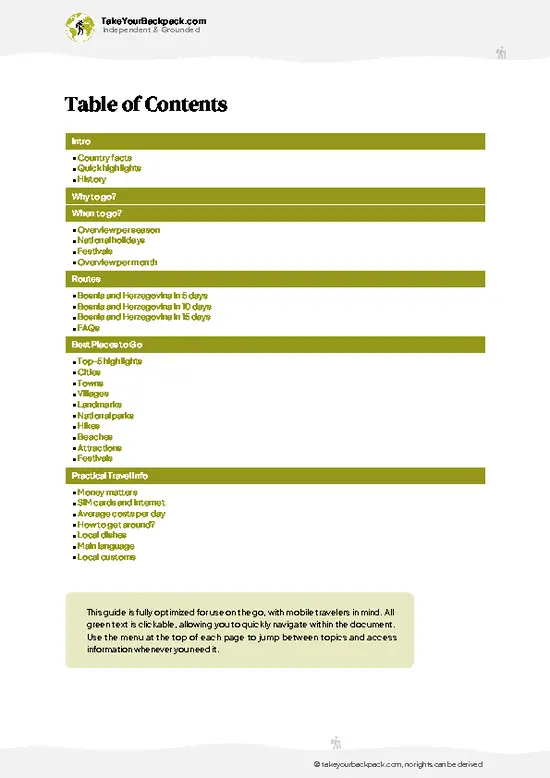
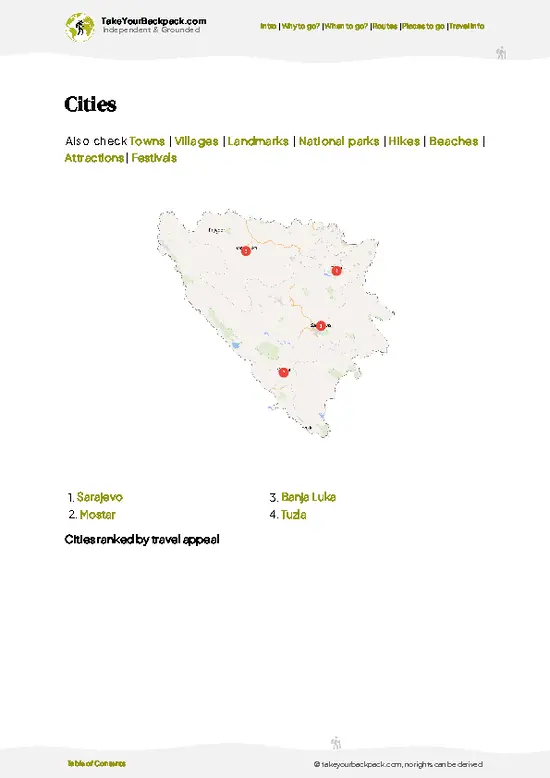
example page 2 from our offline Travel Guide for Bosnia and Herzegovina
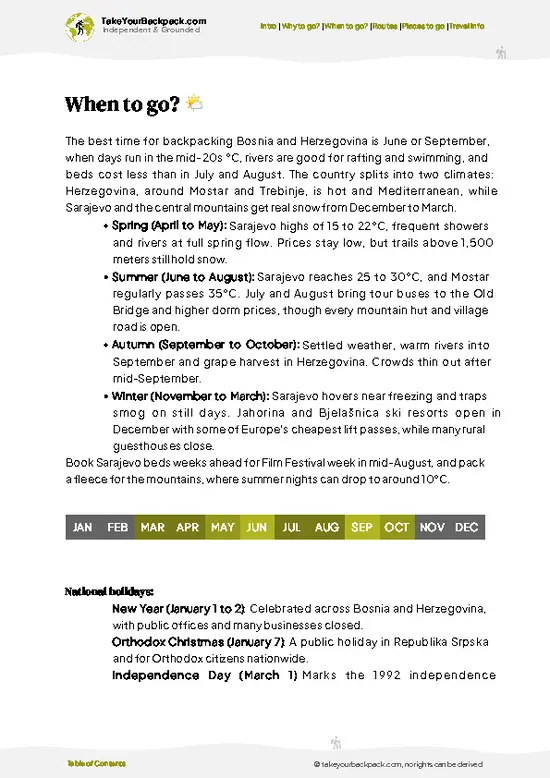
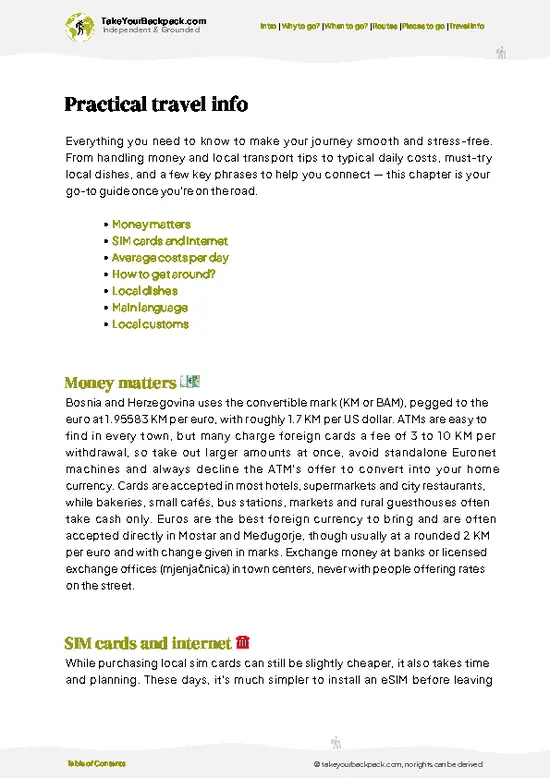
example page 3 from our offline Travel Guide for Bosnia and Herzegovina
example page 4 from our offline Travel Guide for Bosnia and Herzegovina
example page 5 from our offline Travel Guide for Bosnia and Herzegovina
example page 6 from our offline Travel Guide for Bosnia and Herzegovina
example page 7 from our offline Travel Guide for Bosnia and Herzegovina
The digital guide (311 pages) contains:
✅ 82 highlights, ranked by travel appeal
✅ Optimized 5, 10 & 15-day travel routes
✅ Cities, national parks, landmarks, beaches
✅ How to get around
✅ Offline-friendly for travel without Wi-Fi
👉 Click to see all 30+ guide features

📅 Plan smarter in minutes, not weeks
✅ Month by month travel advice
✅ Festivals & national holidays
✅ Budget expectations

🗺️ Go to the right places, skip the overrated ones
✅ Honest pros & cons of destinations
✅ Top hikes, parks & viewpoints
✅ Lesser-known places most travelers miss
✅ Clear “worth it vs skip it” guidance

🛏️ Travel smoothly without rookie mistakes
✅ Best areas to stay
✅ Transport systems explained simply
✅ Common scams & safety advice
✅ SIM cards, money & practical tips

🌍 Understand the country, not just visit it
✅ Culture & traditions
✅ 52 Essential phrases & customs
✅ Festivals worth planning around
✅ Traveler-friendly historical context
✅ Insights that make places more meaningful

📱 Built for real travel conditions
✅ Fully downloadable PDF
✅ Works completely offline
✅ Optimized for phone use
✅ Useful in remote areas & buses
✅ Everything in one place
Stop searching, start planning
Get instant access to your full guide. 30‑day money-back guarantee.
+ Add another guide for just

By proceeding you agree to our terms.
Sent to your inbox immediately after payment • 100% Secure Checkout
Best Backpacking Travel Advisor 2025 tourism awardBest Backpacking
Travel Advisor
2025
What others say about Take Your Backpack Guides:
⭐⭐⭐⭐⭐
Fantastic, amazing amount of information!
⭐⭐⭐⭐⭐
My goodness this is amazing, it's what I've been looking for hats off too you!
⭐⭐⭐⭐⭐
I think this is absolutely BRILLIANT
⭐⭐⭐⭐
Very complete and informative. It's still missing places, but I gotta to commend you
⭐⭐⭐⭐⭐
This is truly amazing, thank you, can't wait to explore it with my kids!
⭐⭐⭐⭐⭐
Awesome resource, thank you!
⭐⭐⭐⭐⭐
This is amazing! Can't wait to explore the ones I haven't seen
⭐⭐⭐⭐
I love this! Well done, great idea.
⭐⭐⭐⭐⭐
Thanks for taking the time to make this gem!
⭐⭐⭐⭐⭐
This might be the best website I've ever seen.
⭐⭐⭐⭐⭐
Congratulations, and thank you so much for your work; it's incredibly valuable.
⭐⭐⭐⭐
In all seriousness I think you did a great job pointing out the important spots
⭐⭐⭐⭐⭐
10/10 very good
⭐⭐⭐⭐⭐
As someone who's only just starting to visit regularly this is awesome, thank you.
⭐⭐⭐⭐
Thank you very much! I'm going to visit my dad, it's going to be very useful!
⭐⭐⭐⭐⭐
This is really cool! We'll be travelling for the first time and this definitely come in handy.
⭐⭐⭐⭐⭐
You are now our minister of culture, congratulations 👨‍💼
⭐⭐⭐⭐⭐
Just wanted to tell you that this is a pearl! Going to follow your recommendations.
⭐⭐⭐⭐⭐
This is so cool. I'll definitely be using the resource for my travels soon.
⭐⭐⭐⭐⭐
This is very impressive! Good work.
⭐⭐⭐⭐⭐
This is an amazing and informative site. Very well done!

🛏️ Where to stay?Where to Base Yourself

Bosnia and Herzegovina has plenty of hostels and guesthouses, with dorm beds usually running 20 to 35 KM (about €10 to 18) and private rooms in family-run pansions from roughly 50 KM (about €25). In Sarajevo, Baščaršija and the surrounding Old Town hold the densest cluster of hostels, putting you within walking distance of the main sights and the bars, though the streets stay noisy late and the lanes climbing the hillsides are steep, while Marijin Dvor is calmer, better connected by tram and a 20-minute walk from the old center. In Mostar, the area around the Old Town near the bridge has the most budget beds and the liveliest evenings, but the quieter streets on the west bank often give you … read more 👉
Bosnia and Herzegovina has plenty of hostels and guesthouses, with dorm beds usually running 20 to 35 KM (about €10 to 18) and private rooms in family-run pansions from roughly 50 KM (about €25). In Sarajevo, Baščaršija and the surrounding Old Town hold the densest cluster of hostels, putting you within walking distance of the main sights and the bars, though the streets stay noisy late and the lanes climbing the hillsides are steep, while Marijin Dvor is calmer, better connected by tram and a 20-minute walk from the old center. In Mostar, the area around the Old Town near the bridge has the most budget beds and the liveliest evenings, but the quieter streets on the west bank often give you more space for the money and an easy 10 to 15-minute walk in.

If you enjoy meeting fellow travelers, consider choosing hostels with high ratings for atmosphere. On the other hand, if you prefer having your own space, a hotel might be a better option.

Bosnia and HerzegovinaExpand Your Journey

👋 Meet the founderWho’s Behind Take Your Backpack?

Johan, backpacker and founder of TakeYourBackpackHi, I’m Johan (Netherlands 🇳🇱), the creator of TakeYourBackpack. Over the past 3 decades, I’ve backpacked through 90+ countries across six continents, gaining extensive experience with independent travel, long-term trips, and overland routes.

This site is built on a combination of firsthand travel experience and carefully curated insights from other backpackers. Many guides are based on places I’ve personally visited, while others bring together tips, observations, and practical advice shared by trusted travelers I’ve met along the way.

The goal is to provide realistic, experience-driven guidance — not generic itineraries — so you can explore destinations with better context, clearer expectations, and more confidence.