×

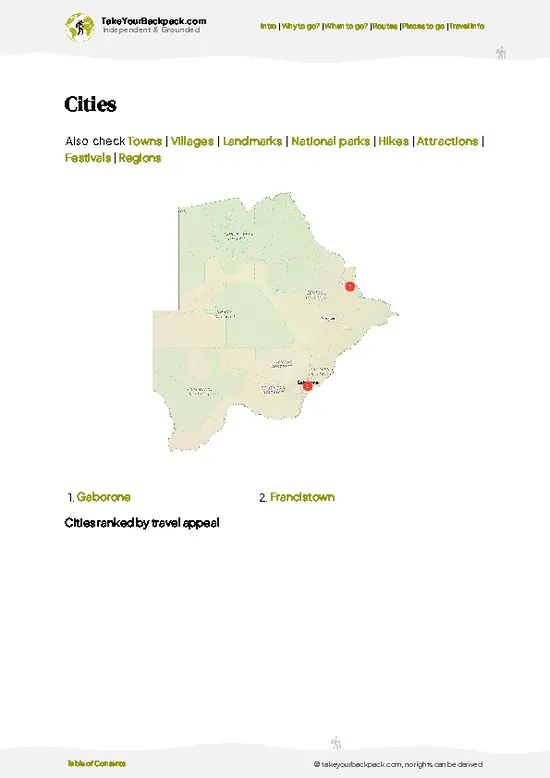
Botswana🇧🇼 | citiesFrancistownNorthern crossroads, railway heritage, Tati gold history, minibus-and-market center | things to do and best time to go

Explore National Museum and Art GalleryExplore Gaborone

Backpacking in Francistown
👍 Recommendedcity ranked #2
By Johan Kruseman 🇳🇱 | Updated October 22, 2026

Francistown is not on many bucket lists, and the reason most people stop here is the road: it sits where the main route from Gaborone and Bulawayo meets the highway toward Nata, Maun and the Okavango. Overlooked is how useful that makes it. It is Botswana’s second city, in the northeast, with real supermarkets, ATMs, fuel and car repair, which the long stretches beyond it lack. Expect a working mining and trading town, flat and spread out, with little polish. Distances between sights are too long for walking, so experienced travelers use cheap local combis and taxis, which are the town’s normal transport, instead of waiting for a tourist shuttle that does not exist. Shops close early on Saturday afternoons and mostly on Sundays, so stock up in advance. Compared with Gaborone, Francistown is smaller, slower and more relaxed, but it has far fewer museums and a thinner restaurant scene.

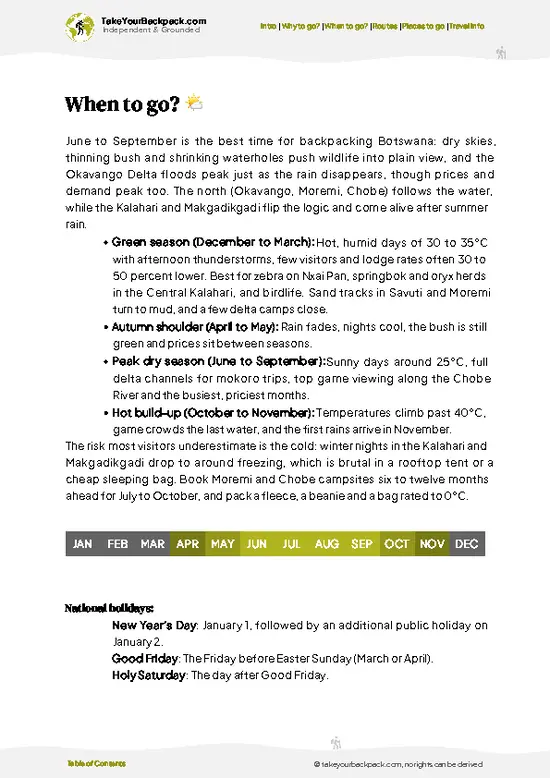
Discover everything you want to know in the 📖 Botswana Travel Guide.


example page 0 from our offline Travel Guide for Botswana
example page 1 from our offline Travel Guide for Botswana
example page 2 from our offline Travel Guide for Botswana
example page 3 from our offline Travel Guide for Botswana
example page 4 from our offline Travel Guide for Botswana
example page 5 from our offline Travel Guide for Botswana
example page 6 from our offline Travel Guide for Botswana
example page 7 from our offline Travel Guide for Botswana
Loading the map 🌍
CLICK TO FILTER
cities
towns
villages
landmarks
national parks
hikes
attractions
festivals
regions
SHOW COUNTRY’S BESTSHOW ALL

✨ Why go?
Ranked #2 city in Botswana
The unique appeal for travelers

Francistown earns its place on a route as a northern gateway. Buses and combis fan out from here to Maun, Kasane, Nata and the Zimbabwe border at Ramokgwebana, so a night here breaks up a long haul without costing much time. Stock up before the remote north: it has full-size supermarkets, banks and pharmacies, and you can sort out SIM cards, cash and camping supplies in one afternoon. The town also suits travelers who like a base with a lived-in feel, where mining history and the Kalanga community give conversations more texture than a resort strip would. Hostels are few, so most backpackers use budget guesthouses and lodges, which are fine for a night or two. Nightlife exists, mostly in local bars and braai spots, and it is low-key and social. Treat it as a practical one or two night stop, not a destination to spend a week.

💡 HighlightsThe experiences that define the visit

  1. Francistown Railway Station and Railway Heritage: The railway reached Francistown in the 1890s and made the town the hub of the north, and the old station area still shows it. Look at the colonial-era station buildings and the old locomotive display nearby. Free to look from outside, 30 to 45 minutes, best in the morning when the light is soft and the street is quiet.
  2. Supa Ngwao Museum: Housed in a former colonial school building, it covers the gold rush, the railway, and the local Kalanga and Ndebele communities, with a small gallery of traditional objects and local art. Entry runs about US$1 to 3, and it takes 1 to 1.5 hours. Go in the morning on a weekday, since opening hours are short.
  3. Tati Siding and Gold Rush Remnants: The 1860s gold discovery on the Tati River is the reason Francistown
… read more 👉
  1. Francistown Railway Station and Railway Heritage: The railway reached Francistown in the 1890s and made the town the hub of the north, and the old station area still shows it. Look at the colonial-era station buildings and the old locomotive display nearby. Free to look from outside, 30 to 45 minutes, best in the morning when the light is soft and the street is quiet.
  2. Supa Ngwao Museum: Housed in a former colonial school building, it covers the gold rush, the railway, and the local Kalanga and Ndebele communities, with a small gallery of traditional objects and local art. Entry runs about US$1 to 3, and it takes 1 to 1.5 hours. Go in the morning on a weekday, since opening hours are short.
  3. Tati Siding and Gold Rush Remnants: The 1860s gold discovery on the Tati River is the reason Francistown exists, and a few old mine workings and markers still survive on its edges. It suits history readers more than casual visitors. Plan on 1 to 2 hours, mostly free, and go with a local driver or guide who knows where the access tracks are.
  4. Francistown Main Mall and Blue Jacket Street: This is the working center of the north, where traders, minibus crews, and shoppers all meet. Watch the street food stalls, try a plate of pap with stewed beef (roughly US$2 to 4), and pick up a local SIM card. Allow 1 to 2 hours, best before noon when stalls are fully set up.
  5. Kgotla at Monarch: The traditional community meeting ground gives a clear picture of how village-style governance still works alongside the modern town. It is free, but ask permission before taking photos or sitting in on any gathering. Allow 30 to 45 minutes, usually best on weekday mornings.
  6. Francistown Sports Complex and Local Football: Botswana Premier League matches here bring out a loud, friendly crowd, which is a quick way to meet locals. Tickets are typically around US$2 to 5, and a match lasts about 2 hours. Check fixtures at the gate or locally, as matches are usually on weekend afternoons.
  7. Tati River Walks at Dusk: The riverbank greenery on the town edge offers a quiet stroll with birdlife, including hornbills and weavers. Free, 1 hour, best in the cool hour before dark. Walk in a group and stay on open paths.
Francistown works best as a base for Makgadikgadi Pans, Nata Bird Sanctuary, and the Tsodilo Hills area, which are best explored as longer day trips or overnight add-ons from the city. Together, the sights above fill roughly one full day, or a relaxed day and a half if you add the museum and a match.
Spotted a mistake or missing something? Contact us.

🏘️ NeighborhoodsUnderstanding the local layout

Francistown is Botswana’s second city, and its areas are compact enough that you can see most of them in a day or two. Distances look short on a map, but the heat and the lack of shaded pavement make walking longer than it seems, so an experienced traveler plans outdoor stops for the morning and takes a short taxi ride for anything farther.
  • City Centre (Blue Jacket Street area): This is the commercial core, built around the long Blue Jacket Street, which is named for the Blue Jacket mine era. Banks, ATMs, pharmacies, supermarkets and shopping centers sit within a few blocks, which is why it works as your errand base. Most of it is walkable, and it is busiest on weekday mornings and Saturday mornings, then quiet by evening.
  • Main Mall and bus rank area: Minibuses, combis and long-distance coaches
… read more 👉
Francistown is Botswana’s second city, and its areas are compact enough that you can see most of them in a day or two. Distances look short on a map, but the heat and the lack of shaded pavement make walking longer than it seems, so an experienced traveler plans outdoor stops for the morning and takes a short taxi ride for anything farther.
  • City Centre (Blue Jacket Street area): This is the commercial core, built around the long Blue Jacket Street, which is named for the Blue Jacket mine era. Banks, ATMs, pharmacies, supermarkets and shopping centers sit within a few blocks, which is why it works as your errand base. Most of it is walkable, and it is busiest on weekday mornings and Saturday mornings, then quiet by evening.
  • Main Mall and bus rank area: Minibuses, combis and long-distance coaches gather here, so the streets are loud, crowded and full of hawkers selling airtime, fruit and snacks. Cheap grilled meat and fat cakes are easy to find. It is fine in daylight; do your business here early, since departures thin out later in the day.
  • Tati River and Francistown Museum side: The small museum and the old Tati Concession Company history are the main reason to head here. It is a quiet, low-key area, best covered with a taxi in one direction because shade is scarce.
  • Satellite and Phase suburbs: Residential areas with mid-range guesthouses, local bars and restaurants that cater to residents, not visitors. Distances are too long for walking, so taxis are the norm, and nights are calm.
  • Tati Siding and Marang road: Stretching toward the A1 and the Tati River, this is where lodges and fuel stops line the road. It suits those with their own vehicle rather than people on foot.

⌛️ 1 dayWhat you can realistically do in a day

8:00 AM: Supa Ngwao Museum
Start here, and do not skip it. The galleries explain the 1860s gold rush, the railway, and the Kalanga and Ndebele communities in one compact space, which makes everything else in town make sense. Give it 1.5 hours, then walk or take a short taxi ride into the center.

10:00 AM: Railway Station Area
Walk the old station buildings and the rail yard edges to see why the town grew where it did. Look but do not photograph active rail infrastructure without checking first. Twenty to thirty minutes is enough before heading to the nearby shopping streets.

11:00 AM: Main Mall and Blue Jacket Street
This is the town at work. Wander past market stalls, cell phone sellers, and tailors, and stop for a cheap plate of pap and stew at a street stand. Buy a SIM card and cash here … read more 👉
8:00 AM: Supa Ngwao Museum
Start here, and do not skip it. The galleries explain the 1860s gold rush, the railway, and the Kalanga and Ndebele communities in one compact space, which makes everything else in town make sense. Give it 1.5 hours, then walk or take a short taxi ride into the center.

10:00 AM: Railway Station Area
Walk the old station buildings and the rail yard edges to see why the town grew where it did. Look but do not photograph active rail infrastructure without checking first. Twenty to thirty minutes is enough before heading to the nearby shopping streets.

11:00 AM: Main Mall and Blue Jacket Street
This is the town at work. Wander past market stalls, cell phone sellers, and tailors, and stop for a cheap plate of pap and stew at a street stand. Buy a SIM card and cash here if needed. Walk slowly and keep your bag in front of you in the busiest sections.

1:00 PM: Lunch and a Rest
Midday heat is strongest, so find a shaded café or guesthouse courtyard and recharge. This is also a good time to confirm onward transport for the next day at the bus rank.

3:00 PM: Kgotla at Monarch
Fewer visitors come to this part of town, and that is the point. The kgotla is where the community still gathers to discuss local matters. Ask before stepping in or taking pictures, greet people politely, and spend about 40 minutes watching daily life. A taxi takes you there from the center.

5:00 PM: Tati River Walk
Head to the riverbank as the day cools and the light softens. Birds are active, the paths are easy, and you can unwind before dinner. Keep to open paths and head back before dark.

7:00 PM: Dinner in the Center
Finish with grilled meat and a cold drink at a local braai spot, where the evening crowd is mostly residents rather than visitors.

🌤️ When to go?When to go for the best experience

Francistown is most comfortable from May to August, when days are dry and sunny at roughly 22 to 27°C (72 to 81°F) and nights drop to about 5 to 10°C (41 to 50°F), so bring a fleece for early mornings.
  • Cool Dry Season (May to August): Daylight lasts about 11 hours, skies are mostly clear and crowds are modest. Lodge rates tick up slightly around July school holidays.
  • Hot Season (September to November): Heat builds to 32 to 38°C (90 to 100°F) before the rains arrive, and dust hangs over the roads. Cheaper rooms are easier to find, but midday outdoor plans become punishing.
  • Rainy Season (December to March): Afternoon thunderstorms arrive with highs near 30 to 34°C (86 to 93°F) and humid evenings. Roads can flood, the bush turns green, and daylight stretches to around 13.5 hours.
  • Late Rains (April):
… read more 👉
Francistown is most comfortable from May to August, when days are dry and sunny at roughly 22 to 27°C (72 to 81°F) and nights drop to about 5 to 10°C (41 to 50°F), so bring a fleece for early mornings.
  • Cool Dry Season (May to August): Daylight lasts about 11 hours, skies are mostly clear and crowds are modest. Lodge rates tick up slightly around July school holidays.
  • Hot Season (September to November): Heat builds to 32 to 38°C (90 to 100°F) before the rains arrive, and dust hangs over the roads. Cheaper rooms are easier to find, but midday outdoor plans become punishing.
  • Rainy Season (December to March): Afternoon thunderstorms arrive with highs near 30 to 34°C (86 to 93°F) and humid evenings. Roads can flood, the bush turns green, and daylight stretches to around 13.5 hours.
  • Late Rains (April): Humidity falls and temperatures ease to around 26 to 30°C (79 to 86°F), with quieter streets and softer prices.
If you plan to continue to the Makgadikgadi Pans or Nata, aim for the dry months, since access is easier then.


source: climatestotravel.comJANJanuary: fair for travelingFEBFebruary: fair for travelingMARMarch: fair for travelingAPRApril: fair for travelingMAYMay: highly recommended for travelingJUNJune: excellent for travelingJULJuly: excellent for travelingAUGAugust: excellent for travelingSEPSeptember: excellent for travelingOCTOctober: highly recommended for travelingNOVNovember: fair for travelingDECDecember: fair for traveling
when-to-go

✈️ The backpacker research shortcutBotswana Travel Guide

An offline-friendly backpacking guide with optimized travel routes, ranked highlights, transport advice, and the best areas to stay.
example page 0 from our offline Travel Guide for Botswana
example page 1 from our offline Travel Guide for Botswana
example page 2 from our offline Travel Guide for Botswana
example page 3 from our offline Travel Guide for Botswana
example page 4 from our offline Travel Guide for Botswana
example page 5 from our offline Travel Guide for Botswana
example page 6 from our offline Travel Guide for Botswana
example page 7 from our offline Travel Guide for Botswana
The digital guide (172 pages) contains:
✅ 38 highlights, ranked by travel appeal
✅ Optimized 5, 10 & 15-day travel routes
✅ Cities, national parks, landmarks, beaches
✅ How to get around
✅ Offline-friendly for travel without Wi-Fi
👉 Click to see all 30+ guide features

📅 Plan smarter in minutes, not weeks
✅ Month by month travel advice
✅ Festivals & national holidays
✅ Budget expectations

🗺️ Go to the right places, skip the overrated ones
✅ Honest pros & cons of destinations
✅ Top hikes, parks & viewpoints
✅ Lesser-known places most travelers miss
✅ Clear “worth it vs skip it” guidance

🛏️ Travel smoothly without rookie mistakes
✅ Best areas to stay
✅ Transport systems explained simply
✅ Common scams & safety advice
✅ SIM cards, money & practical tips

🌍 Understand the country, not just visit it
✅ Culture & traditions
✅ 52 Essential phrases & customs
✅ Festivals worth planning around
✅ Traveler-friendly historical context
✅ Insights that make places more meaningful

📱 Built for real travel conditions
✅ Fully downloadable PDF
✅ Works completely offline
✅ Optimized for phone use
✅ Useful in remote areas & buses
✅ Everything in one place
Stop searching, start planning
Get instant access to your full guide. 30‑day money-back guarantee.
+ Add another guide for just

By proceeding you agree to our terms.
Sent to your inbox immediately after payment • 100% Secure Checkout
Best Backpacking Travel Advisor 2025 tourism awardBest Backpacking
Travel Advisor
2025
What others say about Take Your Backpack Guides:
⭐⭐⭐⭐⭐
Fantastic, amazing amount of information!
⭐⭐⭐⭐⭐
My goodness this is amazing, it's what I've been looking for hats off too you!
⭐⭐⭐⭐⭐
I think this is absolutely BRILLIANT
⭐⭐⭐⭐
Very complete and informative. It's still missing places, but I gotta to commend you
⭐⭐⭐⭐⭐
This is truly amazing, thank you, can't wait to explore it with my kids!
⭐⭐⭐⭐⭐
Awesome resource, thank you!
⭐⭐⭐⭐⭐
This is amazing! Can't wait to explore the ones I haven't seen
⭐⭐⭐⭐
I love this! Well done, great idea.
⭐⭐⭐⭐⭐
Thanks for taking the time to make this gem!
⭐⭐⭐⭐⭐
This might be the best website I've ever seen.
⭐⭐⭐⭐⭐
Congratulations, and thank you so much for your work; it's incredibly valuable.
⭐⭐⭐⭐
In all seriousness I think you did a great job pointing out the important spots
⭐⭐⭐⭐⭐
10/10 very good
⭐⭐⭐⭐⭐
As someone who's only just starting to visit regularly this is awesome, thank you.
⭐⭐⭐⭐
Thank you very much! I'm going to visit my dad, it's going to be very useful!
⭐⭐⭐⭐⭐
This is really cool! We'll be travelling for the first time and this definitely come in handy.
⭐⭐⭐⭐⭐
You are now our minister of culture, congratulations 👨‍💼
⭐⭐⭐⭐⭐
Just wanted to tell you that this is a pearl! Going to follow your recommendations.
⭐⭐⭐⭐⭐
This is so cool. I'll definitely be using the resource for my travels soon.
⭐⭐⭐⭐⭐
This is very impressive! Good work.
⭐⭐⭐⭐⭐
This is an amazing and informative site. Very well done!

🛏️ Where to stay?How to pick the right area

The city centre and the nearby suburbs around it are the best bases for a budget stay in Francistown. Dedicated hostels are scarce here, so you will mostly find small guesthouses, backpacker-friendly lodges and basic rooms, with private rooms often priced around US$25 to 50 and a few dorm beds at the lower end where they exist.
The central area works well because the bus rank, banks, supermarkets and ATMs are within walking distance, which saves taxi money and makes early departures easier. Evenings are quiet, though some streets near the rank and bars can be noisy at weekends, so ask for a room … read more 👉
The city centre and the nearby suburbs around it are the best bases for a budget stay in Francistown. Dedicated hostels are scarce here, so you will mostly find small guesthouses, backpacker-friendly lodges and basic rooms, with private rooms often priced around US$25 to 50 and a few dorm beds at the lower end where they exist.
The central area works well because the bus rank, banks, supermarkets and ATMs are within walking distance, which saves taxi money and makes early departures easier. Evenings are quiet, though some streets near the rank and bars can be noisy at weekends, so ask for a room away from the street. After dark, walking short distances on lit main roads is normal, but a taxi is the better choice for anything longer.
The suburbs such as Satellite and the residential areas toward the A1 offer calmer nights and often include parking, a garden and a kitchen, which suits self-caterers and people with a rental car. The trade-off is distance, since you will rely on taxis or combis for most trips. Book ahead around school holidays and mining-industry conferences, when rooms fill with business travelers, and confirm that your accommodation has working air conditioning or fans between October and March.

🚌 Getting aroundHow to get around Francistown

A shared combi or minibus ride inside Francistown costs about US$0.40 to 0.70, paid in cash to the conductor in pula, ideally in small notes. Taxis are unmetered in many cases, so agree the fare before getting in. The city center is walkable, but suburbs are spread out, the sun is strong, and public transport thins out after dark, so most backpackers combine walking with short shared rides.
  • Walking: Free and practical within the center around Blue Jacket Street, where banks, shops and the bus rank sit close together. Pavements are uneven in places and shade is sparse, so go early and carry water, since the afternoon heat is the main obstacle rather than any danger.
  • Combis and minibuses: Cost roughly US$0.40 to 0.70 for city hops and run from early morning until around dusk. They follow set routes,
… read more 👉
A shared combi or minibus ride inside Francistown costs about US$0.40 to 0.70, paid in cash to the conductor in pula, ideally in small notes. Taxis are unmetered in many cases, so agree the fare before getting in. The city center is walkable, but suburbs are spread out, the sun is strong, and public transport thins out after dark, so most backpackers combine walking with short shared rides.
  • Walking: Free and practical within the center around Blue Jacket Street, where banks, shops and the bus rank sit close together. Pavements are uneven in places and shade is sparse, so go early and carry water, since the afternoon heat is the main obstacle rather than any danger.
  • Combis and minibuses: Cost roughly US$0.40 to 0.70 for city hops and run from early morning until around dusk. They follow set routes, fill before leaving, and display no printed timetable. Ask the conductor or a fellow passenger where to get off, since stops are informal.
  • Taxis: Short trips in town usually cost US$2 to 5, and rides to the airport or outer suburbs run higher at roughly US$5 to 10. Because fares are negotiated, confirm the price before you start; your guesthouse can usually call a reliable driver, and this is the safest option after dark.
  • Long-distance buses and coaches: Francistown is a hub on the A1, with services to Gaborone (about 5 to 6 hours, roughly US$15 to 20), Nata, Maun (roughly 5 to 6 hours) and onward to Bulawayo in Zimbabwe. Departures concentrate in the morning and thin out by mid-afternoon, which is why you should arrive at the rank early. Coaches generally leave when full, so patience matters.
  • Hired car: Not essential for the center, but useful for reaching lodges, Tati Siding or side roads, with rental starting around US$45 to 70 a day. Drive carefully on the A1, since livestock and donkeys wander onto the road, especially at dusk, so avoid driving after dark.

👛 Costs (as of 22 October 2026)Money, prices, and spending tips

Francistown costs backpackers about US$60 per day, making it a moderate stop by regional standards. Dormitory beds are rare, so the figures below reflect budget guesthouse beds and shared rooms, with most spending going to accommodation and meals. You pay in pula, though US dollars are well understood as a benchmark.
CategoryBudget RangeLocal Reality
Dorm or budget bed (high season, May to Aug)US$25 to 35Few hostels exist, so expect a basic guesthouse room or shared bed.
Dorm or budget bed (off-season)US$18 to 28Rates ease in the hot and rainy months, especially midweek.
MealsUS$10 to 15Street grills and takeaways cost US$1 to 6, while sit-down meals cost more.
Local transportUS$2 to 6Combis cost under US$1 per ride; taxis add a few dollars.
City transport passUS$0None exists; you pay per ride in
… read more 👉
Francistown costs backpackers about US$60 per day, making it a moderate stop by regional standards. Dormitory beds are rare, so the figures below reflect budget guesthouse beds and shared rooms, with most spending going to accommodation and meals. You pay in pula, though US dollars are well understood as a benchmark.
CategoryBudget RangeLocal Reality
Dorm or budget bed (high season, May to Aug)US$25 to 35Few hostels exist, so expect a basic guesthouse room or shared bed.
Dorm or budget bed (off-season)US$18 to 28Rates ease in the hot and rainy months, especially midweek.
MealsUS$10 to 15Street grills and takeaways cost US$1 to 6, while sit-down meals cost more.
Local transportUS$2 to 6Combis cost under US$1 per ride; taxis add a few dollars.
City transport passUS$0None exists; you pay per ride in cash.
Basic activities and entry feesUS$3 to 8The museum and local sites charge small fees, and many sights are free.
MiscellaneousUS$5 to 10Water, airtime, snacks and the occasional drink.
Total Daily BudgetUS$55 to 70About US$60 at a comfortable budget pace.
Buy groceries at the supermarkets in the center and cook at your guesthouse to cut food costs noticeably.
⚠️ Prices can change and everyone travels differently, so take this as a rough guide. Hope it helps you plan your adventure!

🚌 Day tripsBest day trips from Francistown

Francistown works best as a transit base, and the most rewarding day trips head out along the A1 and the roads to the pans and the Zimbabwe border.
Tati Siding and Old Gold Fields: The old Tati settlement, a short drive from the city, preserves the story of southern Africa’s first modern gold rush in the 1860s. Count on 20 to 30 minutes each way and about US$10 to 25 by taxi, or less if you share the ride. Go in the dry season, since sandy tracks become slippery after rain, and take water because there are few services.

Nata Bird Sanctuary: About 190 km northwest along the A1, this community-run sanctuary on the edge of Sua Pan is best after the rains, when flamingos and pelicans can gather. Combis to Nata take roughly 2 to 3 hours and cost around US$6 to 10, and entry fees are low. Many first-timers … read more 👉
Francistown works best as a transit base, and the most rewarding day trips head out along the A1 and the roads to the pans and the Zimbabwe border.
Tati Siding and Old Gold Fields: The old Tati settlement, a short drive from the city, preserves the story of southern Africa’s first modern gold rush in the 1860s. Count on 20 to 30 minutes each way and about US$10 to 25 by taxi, or less if you share the ride. Go in the dry season, since sandy tracks become slippery after rain, and take water because there are few services.

Nata Bird Sanctuary: About 190 km northwest along the A1, this community-run sanctuary on the edge of Sua Pan is best after the rains, when flamingos and pelicans can gather. Combis to Nata take roughly 2 to 3 hours and cost around US$6 to 10, and entry fees are low. Many first-timers underestimate the transfers, so leave early to ensure you can return the same day.

Bulawayo, Zimbabwe: Bulawayo lies roughly 200 km southwest via the Ramokgwebana border and offers colonial-era architecture, a good museum and cheap markets. Buses take around 3 to 4 hours with border time, with fares near US$8 to 15. You need visa arrangements and passport checks sorted beforehand, and a day return is tight, so start at dawn.

Domboshaba Ruins: These 17th to 19th century stone-walled ruins sit on a hill near Tutume, about 120 km west. A hire car or taxi is the realistic option at roughly US$50 to 80 return, and the walk to the top is short but sunny. Visit early on a dry-season morning and bring water.

🍲 FoodLocal Cuisine & Drinks

Francistown’s food scene leans on northern Botswana staples, and the clearest local flavor is mopane worms, dried or cooked in a spicy tomato sauce, which taste smoky and slightly nutty. Seswaa, slow-cooked shredded beef served with bogobe (sorghum or maize porridge), is common at family gatherings and casual restaurants, and here you may also find morogo greens beside it. Close to the Zimbabwe border, sadza and relish-style stews appear on menus more often than in the south.
For budget meals, head to the Main Mall area and the stalls around the bus rank, where grilled meat, fat cakes (deep-fried dough) and roasted corn cost about US$1 to 3. Casual local restaurants and takeaways in the center serve plates of meat, pap and cabbage for roughly US$3 to 6. Supermarkets in the center are the best … read more 👉
Francistown’s food scene leans on northern Botswana staples, and the clearest local flavor is mopane worms, dried or cooked in a spicy tomato sauce, which taste smoky and slightly nutty. Seswaa, slow-cooked shredded beef served with bogobe (sorghum or maize porridge), is common at family gatherings and casual restaurants, and here you may also find morogo greens beside it. Close to the Zimbabwe border, sadza and relish-style stews appear on menus more often than in the south.
For budget meals, head to the Main Mall area and the stalls around the bus rank, where grilled meat, fat cakes (deep-fried dough) and roasted corn cost about US$1 to 3. Casual local restaurants and takeaways in the center serve plates of meat, pap and cabbage for roughly US$3 to 6. Supermarkets in the center are the best option for self-catering and fresh fruit.
For drinks, try Chibuku, the cloudy sorghum beer sold in cartons, which is sour, thick and cheap at roughly US$1. Local beer such as St Louis is widely available, and shebeens and bars fill with regulars on Friday evenings. It is polite to greet people before ordering.

🛡️ SafetyStaying Safe: What Travelers Should Know

Francistown is broadly safe for backpackers, and most problems are petty and avoidable. Daylight in the center is relaxed, but the area around the bus rank and Main Mall deserves some awareness, since pickpocketing and bag snatching happen in crowds, so keep your phone and wallet in front pockets and your daypack on your front. Avoid walking after dark outside well-lit main streets, and take a taxi arranged through your guesthouse instead. Solo travelers, including women, generally report few issues in daytime, though unsolicited attention can occur around bars at night, and a firm, polite refusal works. Taxis are often unmetered, so agree the fare first to avoid inflated prices. Do not leave valuables visible in a parked car. Drivers should watch for donkeys and cattle on the A1, especially … read more 👉
Francistown is broadly safe for backpackers, and most problems are petty and avoidable. Daylight in the center is relaxed, but the area around the bus rank and Main Mall deserves some awareness, since pickpocketing and bag snatching happen in crowds, so keep your phone and wallet in front pockets and your daypack on your front. Avoid walking after dark outside well-lit main streets, and take a taxi arranged through your guesthouse instead. Solo travelers, including women, generally report few issues in daytime, though unsolicited attention can occur around bars at night, and a firm, polite refusal works. Taxis are often unmetered, so agree the fare first to avoid inflated prices. Do not leave valuables visible in a parked car. Drivers should watch for donkeys and cattle on the A1, especially at dusk. Tap water in town is usually treated, but many travelers stick to bottled water to be safe.

FAQFrequently asked questions about Francistown

Two days is enough for Francistown itself, with a third if you add Tati Siding or the Domboshaba Ruins. The city has a small museum, shopping streets around Blue Jacket Street and a transport hub role rather than a long list of sights. Most backpackers stay one night on the way between Gaborone (5 to 6 hours by bus) and Maun or Nata.
Francistown is generally safe for solo backpackers, especially during the day in the center. Pickpocketing around the bus rank and Main Mall is the main risk, so keep valuables close. After dark, use a taxi arranged by your guesthouse, which costs around US$2 to 5 for short trips, instead of walking.
Francistown is known as Botswana’s second city and the main hub of the north, sitting on the A1 route toward Nata, Maun and Zimbabwe. It grew from a 1860s gold rush at Tati and now serves as a commercial and transport center. Travelers know it for its museum, local markets, and the base it offers for visiting Tati Siding or Bulawayo, about 3 to 4 hours away.
⚠️ Things can change over time, so always validate details locally before you go.

More places to explore across Botswana

Francistown isn’t the only highlight in Botswana. Explore all what Botswana has to offer.
Country photo of Botswana

We 💚 feedbackSumming up the experience

Francistown is easy to misjudge: travelers arrive on a late bus, treat it as a throwaway stop and then scramble for cash and supplies on Sunday. Get it right by arriving in daylight, withdrawing money and shopping for the north on a weekday, and giving the museum an hour. I would book a guesthouse ahead and skip rushing on.

✍️ Help improve this page!
The information on this page is based on in-depth research, insights shared by experienced travelers, and feedback from the local travel community in Botswana. While every effort is made to keep the information accurate and current, conditions can change — so if you spot anything incorrect or outdated, please get in touch.


🙋‍♂️ Give feedback

👋 Meet the founderWho’s Behind Take Your Backpack?

Johan, backpacker and founder of TakeYourBackpackHi, I’m Johan (Netherlands 🇳🇱), the creator of TakeYourBackpack. Over the past 3 decades, I’ve backpacked through 90+ countries across six continents, gaining extensive experience with independent travel, long-term trips, and overland routes.

This site is built on a combination of firsthand travel experience and carefully curated insights from other backpackers. Many guides are based on places I’ve personally visited, while others bring together tips, observations, and practical advice shared by trusted travelers I’ve met along the way.

The goal is to provide realistic, experience-driven guidance — not generic itineraries — so you can explore destinations with better context, clearer expectations, and more confidence.