×

Botswana🇧🇼 | best citiesExplore the 2 Best cities in Botswana

Cities in Botswana are small, spread out and mostly young. Few have more than 250,000 residents, and most grew after independence in 1966 around mining, government or cattle trade. The southeast holds the capital and the bulk of the population, with malls, buses and the country’s best-connected services. The north is organized around safari access, so towns there are priced for fly-in clients and feel more transient. The west and Kalahari are quieter, with long gaps between settlements. For backpacking or independent travel, expect moderate to high costs, little street life after dark and distances that need planning.

By Johan Kruseman 🇳🇱 | Updated October 23, 2026
Explore the best towns in Botswana

Why go?Key Factors That Shape the Experience

Botswana is a poor fit for travelers who want dense historic centers, and a reasonable one for those who want to see how a stable, sparsely populated country functions. Only about 2.4 million people live here, and most of the land is Kalahari sand, so settlements follow water and the railway line along the eastern edge, plus the Okavango and Chobe river systems in the north. There are no old walled quarters or colonial grids. Towns are modern, low-rise and car-oriented, a result of rapid post-independence growth funded largely by diamond revenue.

That revenue explains the solid infrastructure: paved main roads, reliable mobile coverage, clean supermarkets and a functioning administration. It also explains the prices. Botswana follows a high-value, low-volume tourism policy, so lodging and … read more 👉
Botswana is a poor fit for travelers who want dense historic centers, and a reasonable one for those who want to see how a stable, sparsely populated country functions. Only about 2.4 million people live here, and most of the land is Kalahari sand, so settlements follow water and the railway line along the eastern edge, plus the Okavango and Chobe river systems in the north. There are no old walled quarters or colonial grids. Towns are modern, low-rise and car-oriented, a result of rapid post-independence growth funded largely by diamond revenue.

That revenue explains the solid infrastructure: paved main roads, reliable mobile coverage, clean supermarkets and a functioning administration. It also explains the prices. Botswana follows a high-value, low-volume tourism policy, so lodging and park access cost more than in neighboring countries.

Before choosing Botswana for its cities, know that public transport between them is limited to buses and minibuses called combis, and that within cities walking is often impractical because of distances. Setswana and English are both widely spoken, which eases daily life. Cities here work best as bases for supplies, onward travel and a look at everyday Batswana life, rather than as destinations with a long list of sights.
Behind the Scenes of Selection
The list of best cities in Botswana is created based on culture, vibe, attractions, transport ease, and local charm. If you feel a city is missing in this list, please let us know.

When to go?Timing Your Visit for the Best Experience

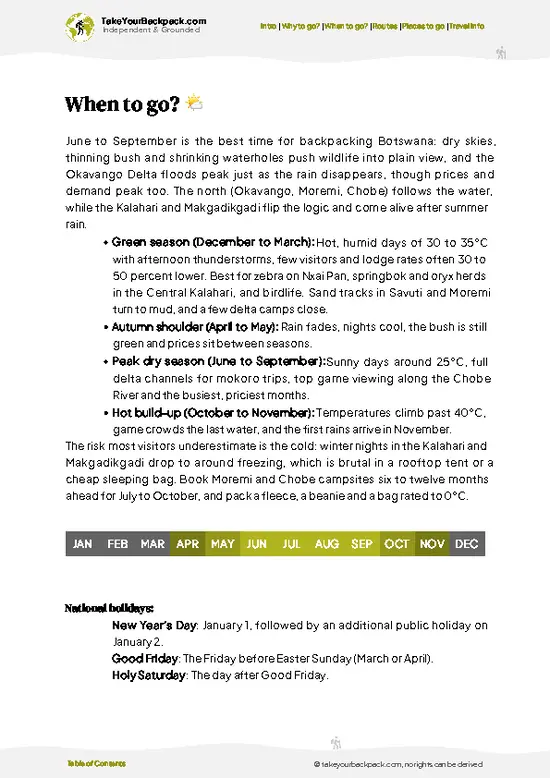
Best months: May to September is the best period for Botswana’s cities because days are dry, sunny and mild, usually 22 to 28°C, and the heat and humidity of the rainy season are absent. Rain is almost nil between June and August.
Shoulder seasons: April to May and September to October are good for travelers who want lower prices with workable weather. April still carries some green after the rains, while October climbs fast, often passing 35°C in the southeast and Kalahari. Nights in the dry months can fall close to freezing in the southwest and central regions, with June and July dropping to 0 to 5°C, so a warm layer matters more than people expect.
Wet season: November to March brings afternoon thunderstorms and summer highs of 32 to 38°C. Annual rainfall runs roughly 450 mm in the southeast … read more 👉
Best months: May to September is the best period for Botswana’s cities because days are dry, sunny and mild, usually 22 to 28°C, and the heat and humidity of the rainy season are absent. Rain is almost nil between June and August.
Shoulder seasons: April to May and September to October are good for travelers who want lower prices with workable weather. April still carries some green after the rains, while October climbs fast, often passing 35°C in the southeast and Kalahari. Nights in the dry months can fall close to freezing in the southwest and central regions, with June and July dropping to 0 to 5°C, so a warm layer matters more than people expect.
Wet season: November to March brings afternoon thunderstorms and summer highs of 32 to 38°C. Annual rainfall runs roughly 450 mm in the southeast and over 600 mm in the far north around Chobe, with the Kalahari in the southwest much drier. Roads in the north can flood or turn to mud, and some dirt routes become impassable. Accommodation can be cheaper, sometimes by 20 to 40 percent, especially in northern towns tied to safari trade.
Peak pricing: July to October is peak season in the north, when safari demand fills rooms and raises rates. Southern and government-oriented cities see less seasonal swing, though December holidays bring local travel and busy buses.

city hoppingOptimizing Your Multi-Stop Itinerary

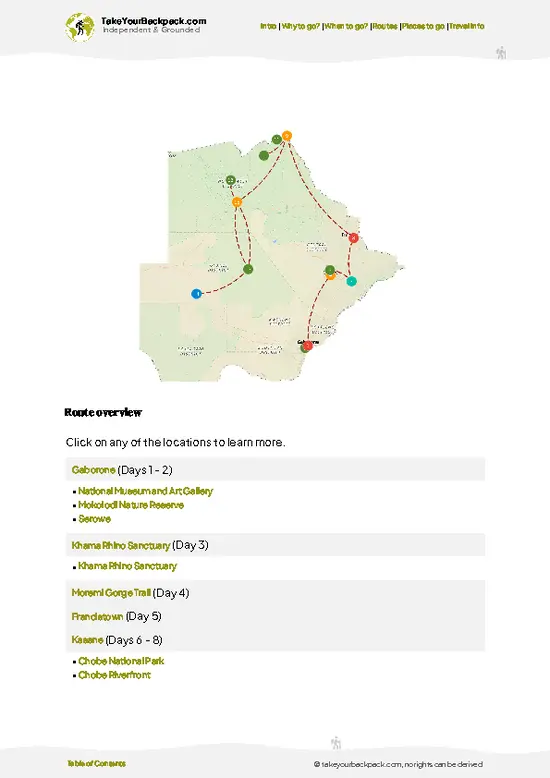
Trip length: A trip linking several cities in Botswana needs 10 to 14 days, because the distances are long and the buses are slow. The country’s population sits in two clusters, the southeast corridor near the South African border and the northern gateway towns around the Okavango and Chobe areas, with the Kalahari in between.
Direction and transport: Travel from south to north, or the reverse, along the A1 highway, which is paved and carries buses, combis and a rail line with limited service. The run from the southeast to Francistown is about 4 to 5 hours by road, and onward to Maun or Kasane takes another 5 to 7 hours. Flights cover the long gaps between the south and the north in about 1.5 to 2 hours. Travelers in the west go via Ghanzi, where distances between fuel and services stretch … read more 👉
Trip length: A trip linking several cities in Botswana needs 10 to 14 days, because the distances are long and the buses are slow. The country’s population sits in two clusters, the southeast corridor near the South African border and the northern gateway towns around the Okavango and Chobe areas, with the Kalahari in between.
Direction and transport: Travel from south to north, or the reverse, along the A1 highway, which is paved and carries buses, combis and a rail line with limited service. The run from the southeast to Francistown is about 4 to 5 hours by road, and onward to Maun or Kasane takes another 5 to 7 hours. Flights cover the long gaps between the south and the north in about 1.5 to 2 hours. Travelers in the west go via Ghanzi, where distances between fuel and services stretch beyond 200 km.
Time per stop: One to two nights suits most stops, since cities here are compact and easy to cover. Add a buffer day on either side of any northern leg to allow for delayed buses.
Common mistakes: Planning too many stops is the main error, because a 300 km transfer on a combi can consume most of a day. Travelers also underestimate departure times, as combis often leave only when full, and many services thin out after midday. Book seats early, travel in the morning and keep Sundays for rest, when services reduce.

The ListHighly Recommended cities of Botswana

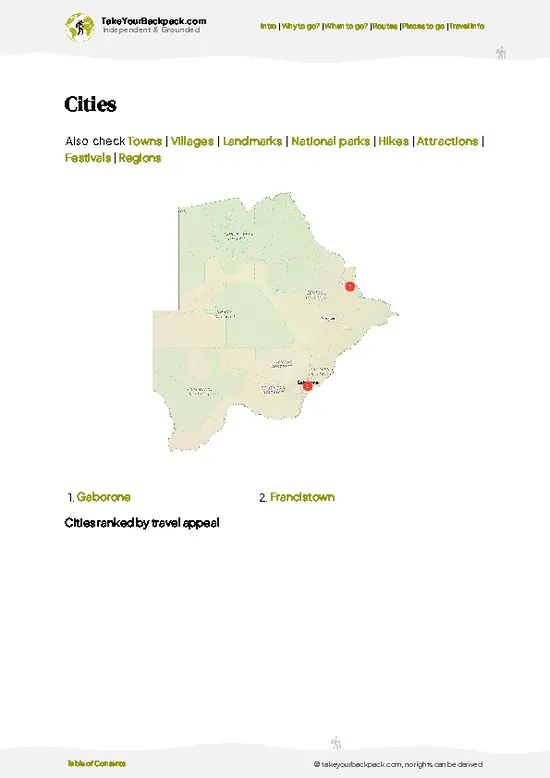
1 Gaborone

Planned capital, Three Dikgosi statues, city game reserve, Kgale Hill views

Climb a ridge above the rooftops, spot giraffe and zebra inside the city limits, and read Botswana’s independence story in bronze and museum galleries.

2 Francistown

Northern crossroads, railway heritage, Tati gold history, minibus-and-market center

Stock up on fuel, cash and groceries, then trace the gold rush and railway story through a small museum, an old station and street stalls.

Loading the map 🌍

Expert viewTips and Advice from Travelers

How many cities: Two or three cities is the sensible number for most backpackers in Botswana. Distances are large and transfers eat whole days, so adding a fourth usually means more time on a bus than in a place. Two cities with a few extra nights each give you a clear read on the country, one in the south for services and one in the north for onward travel.
Choosing between kinds: The southeast urban centers suit travelers who want cheaper food, supermarkets, banks and a look at everyday Botswana. The northern gateway towns suit those whose real goal is the Okavango or Chobe, because that is where safari bookings, mokoro trips and park transfers are organized. Smaller Kalahari towns suit self-drivers who want space and quiet. Choose by purpose: if you plan on wildlife, base yourself in the … read more 👉
How many cities: Two or three cities is the sensible number for most backpackers in Botswana. Distances are large and transfers eat whole days, so adding a fourth usually means more time on a bus than in a place. Two cities with a few extra nights each give you a clear read on the country, one in the south for services and one in the north for onward travel.
Choosing between kinds: The southeast urban centers suit travelers who want cheaper food, supermarkets, banks and a look at everyday Botswana. The northern gateway towns suit those whose real goal is the Okavango or Chobe, because that is where safari bookings, mokoro trips and park transfers are organized. Smaller Kalahari towns suit self-drivers who want space and quiet. Choose by purpose: if you plan on wildlife, base yourself in the north and keep the southern cities short. If you want culture and low-key local life, spend more time in the south.
What it costs: Expect roughly US$45 to 80 a day on a lean independent budget, covering a dorm bed or basic guesthouse (US$15 to 40, or P200 to 550), local meals (US$4 to 10) and combis. Mid-range travelers should plan on US$90 to 150. Intercity combis cost about P60 to 250 depending on distance, and a taxi inside a city usually runs P40 to 100 because ranks are spread out. Museums and cultural sites charge small entry fees, often under P100. The big expenses are park fees and safari add-ons, which can run US$50 to 150 a day, so keep them separate from city spending.
Why transport is the main cost: Public transport is cheap but thin, because the population is small and services follow fixed routes. Experienced travelers pre-book northern flights or shuttles during peak months and carry cash in pula for combis, since card machines are rare outside shops and lodges.
Safety: Botswana is among the more stable and peaceful countries in Africa, but petty theft and phone snatching occur, especially around bus stations and after dark. Walking at night is discouraged in most cities because of poor lighting and few pedestrians, so use a taxi arranged through your guesthouse. Keep valuables out of sight on combis.
Cultural considerations: Greet before asking for anything, usually with “Dumela” (hello). Handshakes are common, and polite conversation matters more than speed. Dress modestly in towns, with covered shoulders and knees being the norm in everyday settings. Ask before photographing people, and never photograph military sites or government buildings. Tipping is not mandatory in basic eateries but 10 percent is appreciated in restaurants.

✈️ The backpacker research shortcutBotswana Travel Guide

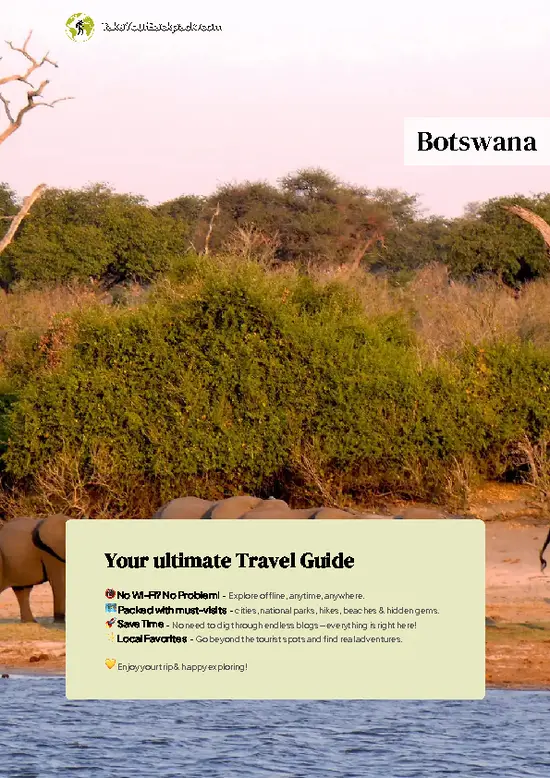
An offline-friendly backpacking guide with optimized travel routes, ranked highlights, transport advice, and the best areas to stay.
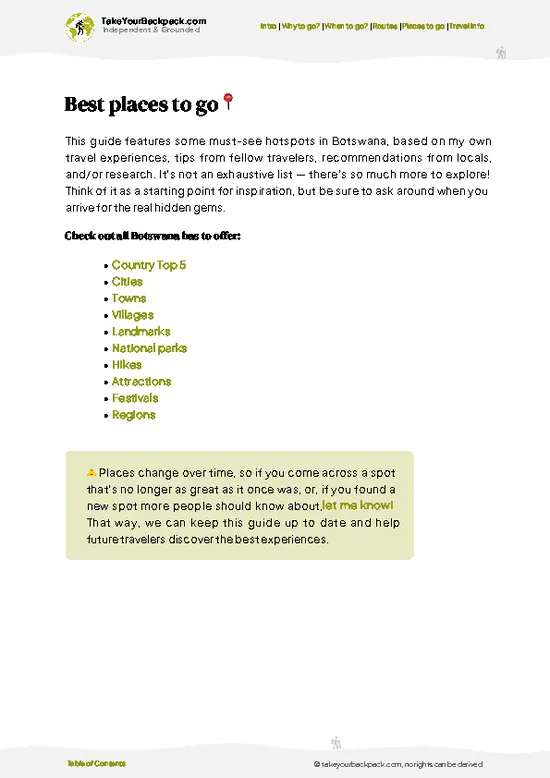
example page 0 from our offline Travel Guide for Botswana
example page 1 from our offline Travel Guide for Botswana
example page 2 from our offline Travel Guide for Botswana
example page 3 from our offline Travel Guide for Botswana
example page 4 from our offline Travel Guide for Botswana
example page 5 from our offline Travel Guide for Botswana
example page 6 from our offline Travel Guide for Botswana
example page 7 from our offline Travel Guide for Botswana
The digital guide (172 pages) contains:
✅ 38 highlights, ranked by travel appeal
✅ Optimized 5, 10 & 15-day travel routes
✅ Cities, national parks, landmarks, beaches
✅ How to get around
✅ Offline-friendly for travel without Wi-Fi
👉 Click to see all 30+ guide features

📅 Plan smarter in minutes, not weeks
✅ Month by month travel advice
✅ Festivals & national holidays
✅ Budget expectations

🗺️ Go to the right places, skip the overrated ones
✅ Honest pros & cons of destinations
✅ Top hikes, parks & viewpoints
✅ Lesser-known places most travelers miss
✅ Clear “worth it vs skip it” guidance

🛏️ Travel smoothly without rookie mistakes
✅ Best areas to stay
✅ Transport systems explained simply
✅ Common scams & safety advice
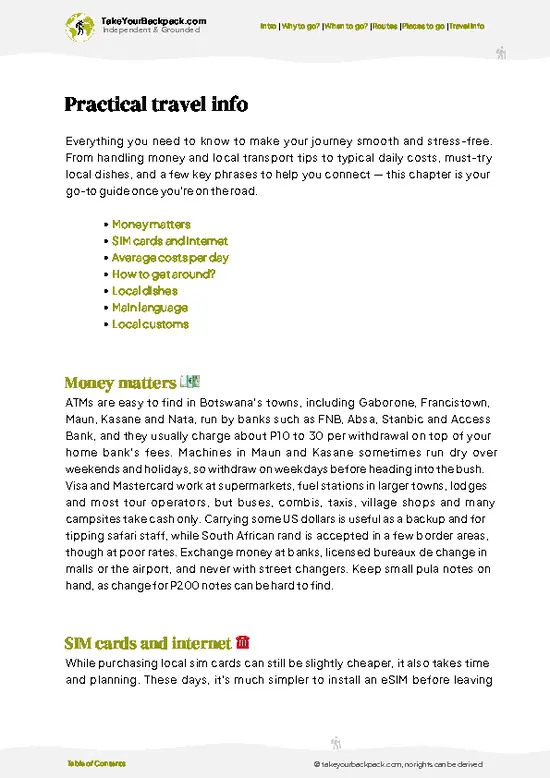
✅ SIM cards, money & practical tips

🌍 Understand the country, not just visit it
✅ Culture & traditions
✅ 52 Essential phrases & customs
✅ Festivals worth planning around
✅ Traveler-friendly historical context
✅ Insights that make places more meaningful

📱 Built for real travel conditions
✅ Fully downloadable PDF
✅ Works completely offline
✅ Optimized for phone use
✅ Useful in remote areas & buses
✅ Everything in one place
Stop searching, start planning
Get instant access to your full guide. 30‑day money-back guarantee.
+ Add another guide for just

By proceeding you agree to our terms.
Sent to your inbox immediately after payment • 100% Secure Checkout
Best Backpacking Travel Advisor 2025 tourism awardBest Backpacking
Travel Advisor
2025
What others say about Take Your Backpack Guides:
⭐⭐⭐⭐⭐
Fantastic, amazing amount of information!
⭐⭐⭐⭐⭐
My goodness this is amazing, it's what I've been looking for hats off too you!
⭐⭐⭐⭐⭐
I think this is absolutely BRILLIANT
⭐⭐⭐⭐
Very complete and informative. It's still missing places, but I gotta to commend you
⭐⭐⭐⭐⭐
This is truly amazing, thank you, can't wait to explore it with my kids!
⭐⭐⭐⭐⭐
Awesome resource, thank you!
⭐⭐⭐⭐⭐
This is amazing! Can't wait to explore the ones I haven't seen
⭐⭐⭐⭐
I love this! Well done, great idea.
⭐⭐⭐⭐⭐
Thanks for taking the time to make this gem!
⭐⭐⭐⭐⭐
This might be the best website I've ever seen.
⭐⭐⭐⭐⭐
Congratulations, and thank you so much for your work; it's incredibly valuable.
⭐⭐⭐⭐
In all seriousness I think you did a great job pointing out the important spots
⭐⭐⭐⭐⭐
10/10 very good
⭐⭐⭐⭐⭐
As someone who's only just starting to visit regularly this is awesome, thank you.
⭐⭐⭐⭐
Thank you very much! I'm going to visit my dad, it's going to be very useful!
⭐⭐⭐⭐⭐
This is really cool! We'll be travelling for the first time and this definitely come in handy.
⭐⭐⭐⭐⭐
You are now our minister of culture, congratulations 👨‍💼
⭐⭐⭐⭐⭐
Just wanted to tell you that this is a pearl! Going to follow your recommendations.
⭐⭐⭐⭐⭐
This is so cool. I'll definitely be using the resource for my travels soon.
⭐⭐⭐⭐⭐
This is very impressive! Good work.
⭐⭐⭐⭐⭐
This is an amazing and informative site. Very well done!

🛏️ Where to stay?Accommodation Highlights

True hostels are rare in Botswana, so budget travelers mostly stay at backpacker lodges and campsites, with camping or a dorm bed running about BWP 150 to 400 (US$11 to 30) a night. Maun has the widest choice, especially riverside lodges in Matlapaneng along the Thamalakane River, which are close to Okavango Delta mokoro and flight operators and have a social bar scene but sit 10 to 15 minutes by road from town shops. Kasane lines its budget lodges along the Chobe riverfront, a short ride from the national park gate and quiet after dark, while Gaborone offers few backpacker beds and mostly suburban guesthouses in leafy areas like The Village, which are safe and calm but rely on taxis for nightlife. … read more 👉
True hostels are rare in Botswana, so budget travelers mostly stay at backpacker lodges and campsites, with camping or a dorm bed running about BWP 150 to 400 (US$11 to 30) a night. Maun has the widest choice, especially riverside lodges in Matlapaneng along the Thamalakane River, which are close to Okavango Delta mokoro and flight operators and have a social bar scene but sit 10 to 15 minutes by road from town shops. Kasane lines its budget lodges along the Chobe riverfront, a short ride from the national park gate and quiet after dark, while Gaborone offers few backpacker beds and mostly suburban guesthouses in leafy areas like The Village, which are safe and calm but rely on taxis for nightlife.

If you enjoy meeting fellow travelers, consider choosing hostels with high ratings for atmosphere. On the other hand, if you prefer having your own space, a hotel might be a better option.

BotswanaSee More of Botswana

👋 Meet the founderWho’s Behind Take Your Backpack?

Johan, backpacker and founder of TakeYourBackpackHi, I’m Johan (Netherlands 🇳🇱), the creator of TakeYourBackpack. Over the past 3 decades, I’ve backpacked through 90+ countries across six continents, gaining extensive experience with independent travel, long-term trips, and overland routes.

This site is built on a combination of firsthand travel experience and carefully curated insights from other backpackers. Many guides are based on places I’ve personally visited, while others bring together tips, observations, and practical advice shared by trusted travelers I’ve met along the way.

The goal is to provide realistic, experience-driven guidance — not generic itineraries — so you can explore destinations with better context, clearer expectations, and more confidence.