

×

Brazil🇧🇷 | townsParatyTidal cobblestones, colonial doors, bay boats, car-free center | things to do and best time to go

Explore Ouro PretoExplore Piranhas

Backpacking in Paraty
🏆 Top picktown ranked #1
By Johan Kruseman 🇳🇱 | Updated October 19, 2026

Paraty suits slow travelers who like walking, boats and old stone streets. It frustrates anyone chasing nightlife or a long checklist. The town beach is muddy and not worth your time, because the good sand and clear water sit across the bay. Paraty lies on the Costa Verde in Brazil’s Rio de Janeiro state, southwest of Rio, with the Serra da Bocaina rising behind it. The historic center is closed to cars because the stones are uneven and the sea floods them at high tide, so bring sandals that can get wet. Boat trips are pushed hard on the quay. Skip the big schooner packages and take a water taxi or a small-group boat to one beach. Small hostels make meeting people easy. A glass of cachaça with a pastel from a street stand cost me pocket change. Spend your first day walking the old center in the morning, then sit on the quay at dusk.

Discover everything you want to know in the 📖 Brazil Travel Guide.


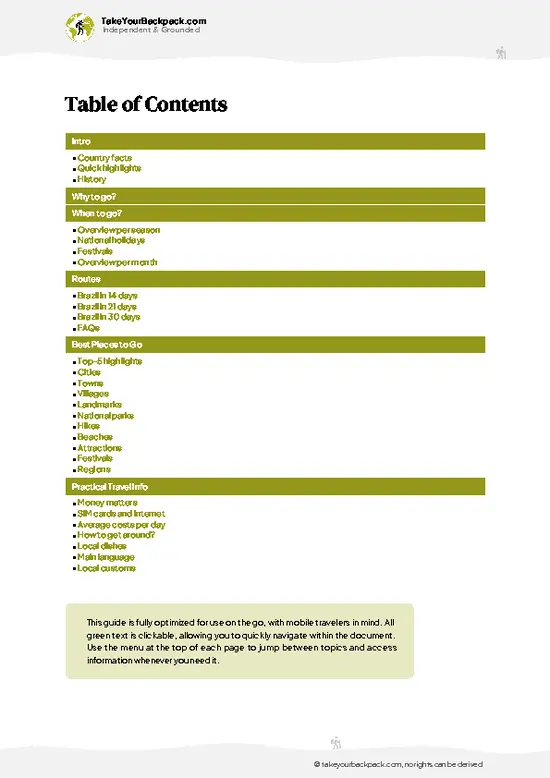
example page 0 from our offline Travel Guide for Brazil
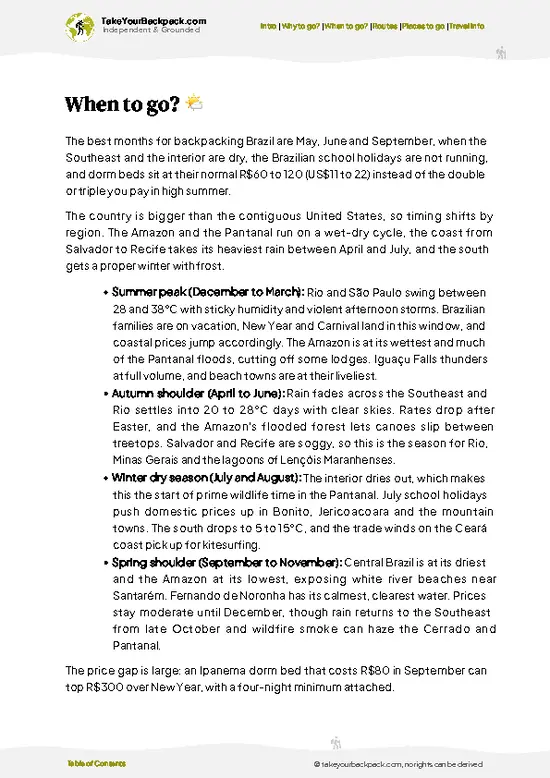
example page 1 from our offline Travel Guide for Brazil
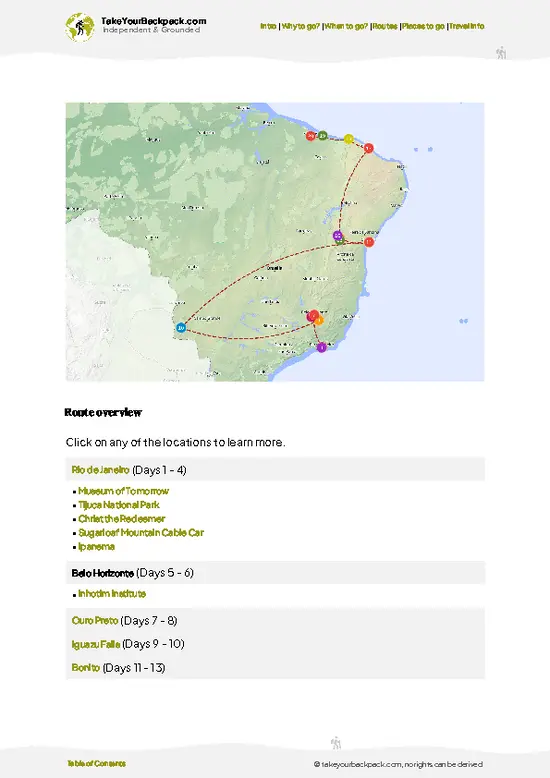
example page 2 from our offline Travel Guide for Brazil
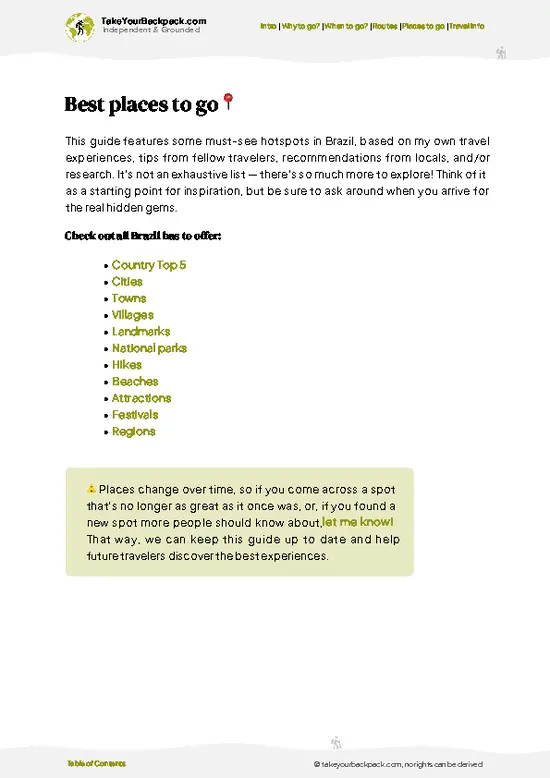
example page 3 from our offline Travel Guide for Brazil
example page 4 from our offline Travel Guide for Brazil
example page 5 from our offline Travel Guide for Brazil
example page 6 from our offline Travel Guide for Brazil
example page 7 from our offline Travel Guide for Brazil
Loading the map 🌍
CLICK TO FILTER
cities
towns
villages
landmarks
national parks
hikes
beaches
attractions
festivals
regions
SHOW COUNTRY’S BESTSHOW ALL

✨ Why go?
Ranked #1 town in Brazil
What makes it a must-see town

Paraty works because everything you came for sits within a short walk or a short boat ride. The Centro Histórico is a grid of whitewashed colonial houses and uneven stones, and you can see all of it in a morning without a bus. Then the water takes over: small boats leave the quay for islands and coves, and the Saco do Mamanguá fjord-like inlet is best explored by kayak. Inland, old gold-route trails and cachaça distilleries give you something to do when it rains, which on this coast is often.

Most backpackers stay two to four nights, and many extend once they find a hostel with a good hammock and a cheap kitchen. The evenings are social but gentle: live music in the old streets, a few bars, and nobody pushing a club night. Solo travelers meet people easily at breakfast tables and on shared … read more 👉
Paraty works because everything you came for sits within a short walk or a short boat ride. The Centro Histórico is a grid of whitewashed colonial houses and uneven stones, and you can see all of it in a morning without a bus. Then the water takes over: small boats leave the quay for islands and coves, and the Saco do Mamanguá fjord-like inlet is best explored by kayak. Inland, old gold-route trails and cachaça distilleries give you something to do when it rains, which on this coast is often.

Most backpackers stay two to four nights, and many extend once they find a hostel with a good hammock and a cheap kitchen. The evenings are social but gentle: live music in the old streets, a few bars, and nobody pushing a club night. Solo travelers meet people easily at breakfast tables and on shared boat trips. Hikers and beach lovers get the most from it. If you need big-city energy or a packed schedule, Paraty is better as a short stop than a base.

💡 HighlightsWhat this place is best known for

  1. Centro Histórico: The old center is the reason people come, and it is a compact grid of colonial houses with their doors and window frames painted in blues, yellows and reds. The irregular stones were laid to slow carriages and let seawater drain, and the streets still flood at spring tides. Walk it early, before the day-trippers arrive, and again after dark when it is lit and quieter. Free, 2 to 3 hours.
  2. Igreja de Santa Rita dos Pardos Libertos: Built in the early 1700s for freed mixed-race people, this small yellow church faces the water and houses a modest sacred art museum. It is the one to pick if you want to see how the town’s social history shows in its buildings. Entry is around US$1 to 2, and 30 minutes is enough. Mornings are best.
  3. Igreja de Nossa Senhora dos Remédios: The parish church,
… read more 👉
  1. Centro Histórico: The old center is the reason people come, and it is a compact grid of colonial houses with their doors and window frames painted in blues, yellows and reds. The irregular stones were laid to slow carriages and let seawater drain, and the streets still flood at spring tides. Walk it early, before the day-trippers arrive, and again after dark when it is lit and quieter. Free, 2 to 3 hours.
  2. Igreja de Santa Rita dos Pardos Libertos: Built in the early 1700s for freed mixed-race people, this small yellow church faces the water and houses a modest sacred art museum. It is the one to pick if you want to see how the town’s social history shows in its buildings. Entry is around US$1 to 2, and 30 minutes is enough. Mornings are best.
  3. Igreja de Nossa Senhora dos Remédios: The parish church, the largest in town, was built over decades and finished in the 1800s. It stands at the edge of the center with a wide square in front. The interior is plain, and the setting is the draw. Free or a small donation, 20 to 30 minutes, with late afternoon light best.
  4. Forte Defensor Perpétuo: Rebuilt in the early 1800s on a hill above the bay, this fort protected the gold port from attack. It now holds a small museum and a library, and the views over the bay and the old roofs are the real prize. Entry is typically US$1 to 2. Plan 45 minutes, and go in the morning when it is cooler.
  5. Casa da Cultura de Paraty: This restored colonial house in the center runs exhibitions on the town’s history, its caiçara and Indigenous communities and its art. It is a useful way to make sense of what you have just walked past. Expect US$3 to 5 and about an hour. Visit in the midday heat or on a rainy afternoon.
Outside town, the beaches of Trindade, the sheltered Praia do Sono, the Saco do Mamanguá inlet and the waterfalls of the Serra da Bocaina all work as day trips. Start with the Centro Histórico on the first morning, because the quiet hours before the crowds are the only time the stones and façades feel like a lived-in town.
Spotted a mistake or missing something? Contact us.

Things to do around Paraty

Ratings based on Tripadvisor reviews. When you book through this link, you support our work at no extra cost to you.

🏘️ NeighborhoodsWhere things are and how it's laid out

Paraty splits into three areas that matter, and you can cover all of them on foot in a day.
  • Centro Histórico: The colonial grid of rounded cobblestones is the reason you came. The stones are laid deliberately uneven so tidal flooding drains through the streets, which is why the center is car-free and why flip-flops beat wheeled luggage. Walk it early, before 9am, when the day-trippers haven’t arrived. The restaurants on the main drags (Rua do Comércio, Rua da Lapa) are pricey for what they serve, so eat elsewhere. Evenings bring live music in bars and a good crowd along Rua do Comércio, and it stays lively until about midnight.
  • Beira-Rio and the bus station side: West of the old center, the town turns ordinary. This is where locals buy groceries and eat prato feito lunches at a fraction of the
… read more 👉
Paraty splits into three areas that matter, and you can cover all of them on foot in a day.
  • Centro Histórico: The colonial grid of rounded cobblestones is the reason you came. The stones are laid deliberately uneven so tidal flooding drains through the streets, which is why the center is car-free and why flip-flops beat wheeled luggage. Walk it early, before 9am, when the day-trippers haven’t arrived. The restaurants on the main drags (Rua do Comércio, Rua da Lapa) are pricey for what they serve, so eat elsewhere. Evenings bring live music in bars and a good crowd along Rua do Comércio, and it stays lively until about midnight.
  • Beira-Rio and the bus station side: West of the old center, the town turns ordinary. This is where locals buy groceries and eat prato feito lunches at a fraction of the center’s prices. The rodoviária sits here, ten to fifteen minutes on foot from the old town. Little to see, but it is the smart place to eat cheaply.
  • Pontal: The neighborhood north of the old center, across the river, faces the bay along Praia do Pontal. Quiet, flat and easy to walk, it suits a late-afternoon stroll to watch the fishing boats. Skip the boat-trip touts at the main waterfront and book at the dock, where you can compare prices and see which boat you’ll board.
  • Beach areas (Jabaquara, Praia do Forte): Paraty’s town beach is muddy and not worth a swim. Better sand lies a short bus ride away, so go there instead.

⌛️ 1 day1-day itinerary for Paraty

This is a walking day in the historic center, built around the tides and the cobblestones, with a boat in the middle and a slow evening to close.
8:00 AM: Breakfast at a padaria near Praça da Matriz
Start with pão de queijo and a strong coffee, a few reais’ worth (under US$3), at a plain neighborhood bakery rather than a pousada buffet. The streets are empty now, so you can photograph the whitewashed colonial facades without crowds. Walk five minutes toward the water.
9:00 AM: Igreja de Santa Rita and the Historic Center
The yellow-and-white church from 1722 sits near the waterfront, and the small sacred art museum inside costs about US$2. The big stones in the streets were laid with a center channel on purpose, so high tides flood the grid and wash it out. Wander the grid slowly, then head to … read more 👉
This is a walking day in the historic center, built around the tides and the cobblestones, with a boat in the middle and a slow evening to close.
8:00 AM: Breakfast at a padaria near Praça da Matriz
Start with pão de queijo and a strong coffee, a few reais’ worth (under US$3), at a plain neighborhood bakery rather than a pousada buffet. The streets are empty now, so you can photograph the whitewashed colonial facades without crowds. Walk five minutes toward the water.
9:00 AM: Igreja de Santa Rita and the Historic Center
The yellow-and-white church from 1722 sits near the waterfront, and the small sacred art museum inside costs about US$2. The big stones in the streets were laid with a center channel on purpose, so high tides flood the grid and wash it out. Wander the grid slowly, then head to the pier.
11:00 AM: Schooner or boat trip from the Cais
Boats for the bay islands leave from the harbor around late morning. Pick a shorter loop of about 4 to 5 hours (roughly US$20 to 30) with two swim stops, and bring a towel and cash for the lunch stop. The water is calm and green, and you sleep better after salt and sun.
4:00 PM: Back ashore, Forte Defensor Perpétuo
A taxi or a 25 to 30 minute walk takes you to the hilltop fort above Pontal beach. It is a small, quiet place, not on most boat itineraries, with a modest cannon deck and a cheap entry fee (about US$1 to 2). The view over the bay and the roofs makes up for the sweaty climb.
6:00 PM: Ride to Praia do Pontal
Walk down to the fishing boats and grab a cold beer from a kiosk, around US$2 to 3. Locals gather here for sundown, with none of the center’s souvenir pressure.
8:00 PM: Dinner and cachaça in the center
Head back over the bridge for a prato feito or grilled fish at a simple restaurant on a side street, about US$8 to 14. Finish with a small glass of local cachaça, the drink this town built its fame on, and listen to the live music drifting from the squares.

🌤️ When to go?Seasonal considerations and timing

May to September is the sweet spot for Paraty, with dry, sunny days of 20 to 27°C (68 to 81°F) and cool evenings near 15°C (59°F).
  • Dry Season (May to September): Lowest humidity and the best hiking and boat conditions. Daylight lasts about 11 hours in June and July. Prices climb around the July school holidays and the Flip literary festival.
  • Summer (December to March): Hot and sticky at 28 to 34°C (82 to 93°F), with heavy afternoon storms. Beaches and boat trips are packed from Christmas to Carnival, and beds cost the most. Daylight stretches to about 13 hours.
  • Shoulder Months (April, October, November): Warm, mostly sunny, with fewer people and lower prices. Showers appear but rarely last. These are good months for the schooner trips and the coastal trails.
  • Festivals: Holy Week processions and
… read more 👉
May to September is the sweet spot for Paraty, with dry, sunny days of 20 to 27°C (68 to 81°F) and cool evenings near 15°C (59°F).
  • Dry Season (May to September): Lowest humidity and the best hiking and boat conditions. Daylight lasts about 11 hours in June and July. Prices climb around the July school holidays and the Flip literary festival.
  • Summer (December to March): Hot and sticky at 28 to 34°C (82 to 93°F), with heavy afternoon storms. Beaches and boat trips are packed from Christmas to Carnival, and beds cost the most. Daylight stretches to about 13 hours.
  • Shoulder Months (April, October, November): Warm, mostly sunny, with fewer people and lower prices. Showers appear but rarely last. These are good months for the schooner trips and the coastal trails.
  • Festivals: Holy Week processions and the Cachaça festival in August fill town with Brazilian visitors. Book ahead then.
For lower prices and quiet cobblestones, aim for a Tuesday to Thursday stay in the shoulder months.


source: climatestotravel.comJANJanuary: good for travelingFEBFebruary: good for travelingMARMarch: good for travelingAPRApril: highly recommended for travelingMAYMay: highly recommended for travelingJUNJune: excellent for travelingJULJuly: excellent for travelingAUGAugust: excellent for travelingSEPSeptember: highly recommended for travelingOCTOctober: highly recommended for travelingNOVNovember: good for travelingDECDecember: good for traveling

✈️ The backpacker research shortcutBrazil Travel Guide

An offline-friendly backpacking guide with optimized travel routes, ranked highlights, transport advice, and the best areas to stay.
example page 0 from our offline Travel Guide for Brazil
example page 1 from our offline Travel Guide for Brazil
example page 2 from our offline Travel Guide for Brazil
example page 3 from our offline Travel Guide for Brazil
example page 4 from our offline Travel Guide for Brazil
example page 5 from our offline Travel Guide for Brazil
example page 6 from our offline Travel Guide for Brazil
example page 7 from our offline Travel Guide for Brazil
The digital guide (410 pages) contains:
✅ 146 highlights, ranked by travel appeal
✅ Optimized 14, 21 & 30-day travel routes
✅ Cities, national parks, landmarks, beaches
✅ How to get around
✅ Offline-friendly for travel without Wi-Fi
👉 Click to see all 30+ guide features

📅 Plan smarter in minutes, not weeks
✅ Month by month travel advice
✅ Festivals & national holidays
✅ Budget expectations

🗺️ Go to the right places, skip the overrated ones
✅ Honest pros & cons of destinations
✅ Top hikes, parks & viewpoints
✅ Lesser-known places most travelers miss
✅ Clear “worth it vs skip it” guidance

🛏️ Travel smoothly without rookie mistakes
✅ Best areas to stay
✅ Transport systems explained simply
✅ Common scams & safety advice
✅ SIM cards, money & practical tips

🌍 Understand the country, not just visit it
✅ Culture & traditions
✅ 52 Essential phrases & customs
✅ Festivals worth planning around
✅ Traveler-friendly historical context
✅ Insights that make places more meaningful

📱 Built for real travel conditions
✅ Fully downloadable PDF
✅ Works completely offline
✅ Optimized for phone use
✅ Useful in remote areas & buses
✅ Everything in one place
Stop searching, start planning
Get instant access to your full guide. 30‑day money-back guarantee.
+ Add another guide for just

By proceeding you agree to our terms.
Sent to your inbox immediately after payment • 100% Secure Checkout
Best Backpacking Travel Advisor 2025 tourism awardBest Backpacking
Travel Advisor
2025
What others say about Take Your Backpack Guides:
⭐⭐⭐⭐⭐
Fantastic, amazing amount of information!
⭐⭐⭐⭐⭐
My goodness this is amazing, it's what I've been looking for hats off too you!
⭐⭐⭐⭐⭐
I think this is absolutely BRILLIANT
⭐⭐⭐⭐
Very complete and informative. It's still missing places, but I gotta to commend you
⭐⭐⭐⭐⭐
This is truly amazing, thank you, can't wait to explore it with my kids!
⭐⭐⭐⭐⭐
Awesome resource, thank you!
⭐⭐⭐⭐⭐
This is amazing! Can't wait to explore the ones I haven't seen
⭐⭐⭐⭐
I love this! Well done, great idea.
⭐⭐⭐⭐⭐
Thanks for taking the time to make this gem!
⭐⭐⭐⭐⭐
This might be the best website I've ever seen.
⭐⭐⭐⭐⭐
Congratulations, and thank you so much for your work; it's incredibly valuable.
⭐⭐⭐⭐
In all seriousness I think you did a great job pointing out the important spots
⭐⭐⭐⭐⭐
10/10 very good
⭐⭐⭐⭐⭐
As someone who's only just starting to visit regularly this is awesome, thank you.
⭐⭐⭐⭐
Thank you very much! I'm going to visit my dad, it's going to be very useful!
⭐⭐⭐⭐⭐
This is really cool! We'll be travelling for the first time and this definitely come in handy.
⭐⭐⭐⭐⭐
You are now our minister of culture, congratulations 👨‍💼
⭐⭐⭐⭐⭐
Just wanted to tell you that this is a pearl! Going to follow your recommendations.
⭐⭐⭐⭐⭐
This is so cool. I'll definitely be using the resource for my travels soon.
⭐⭐⭐⭐⭐
This is very impressive! Good work.
⭐⭐⭐⭐⭐
This is an amazing and informative site. Very well done!

🛏️ Where to stay?Best areas to stay in Brazil

The best area for a budget bed in Paraty is the edge of the historic center and the streets just west of it. Hostels and simple guesthouses cluster here, and dorm beds cost roughly US$12 to 25 a night in the low season, rising sharply around holidays and the Flip festival.
The edge of the old town gives you a short walk to the main bars and the dock, and the streets are quiet enough for sleeping by midnight. Rooms right on the main cobbled streets can hear live music and late-night chatter, so ask for a back room or one facing a courtyard. Evening foot traffic keeps those streets reasonably safe, … read more 👉
The best area for a budget bed in Paraty is the edge of the historic center and the streets just west of it. Hostels and simple guesthouses cluster here, and dorm beds cost roughly US$12 to 25 a night in the low season, rising sharply around holidays and the Flip festival.
The edge of the old town gives you a short walk to the main bars and the dock, and the streets are quiet enough for sleeping by midnight. Rooms right on the main cobbled streets can hear live music and late-night chatter, so ask for a back room or one facing a courtyard. Evening foot traffic keeps those streets reasonably safe, and the lighting is good.
West of the center, toward the bus station and the neighborhood of Beira-Rio, prices are lower and the atmosphere is residential. You can walk to the old town in 10 to 15 minutes, and the rodoviária is close, which suits early departures to Rio or São Paulo with a heavy pack. It is quieter at night, and the walk back after dark follows well-used roads. Some solo travelers prefer to take a short taxi after 10pm.
Book ahead for New Year, Carnival, Holy Week and July, when the cheapest beds disappear weeks in advance. Outside those dates, you can usually walk in and choose. Staying at the beaches near Trindade makes sense for a few days of hammocks and camping, but transport back to town is limited.

🚌 Getting aroundGetting around like a local

Walking is the easiest way to get around Paraty, because the colonial center is flat, compact and closed to most cars. Wheeled bags suffer on the rounded stones, so pack light. Beyond town, local buses and boats do the rest, though schedules thin out in the evening and on Sundays.
  • Walking: Free, and it covers the historic center, the river-side market area and the waterfront. Crossing from the bus station to the old town takes 10 to 15 minutes. Skip taxis for anything inside the center, since they can’t drive on most of its streets.
  • Local bus: Services run to Trindade, Laranjeiras and Paraty-Mirim, usually costing US$1 to 3 each way. Services leave from the rodoviária, and trips to Trindade take about 40 to 50 minutes. Buses are infrequent, so check the last departure back, which often leaves
… read more 👉
Walking is the easiest way to get around Paraty, because the colonial center is flat, compact and closed to most cars. Wheeled bags suffer on the rounded stones, so pack light. Beyond town, local buses and boats do the rest, though schedules thin out in the evening and on Sundays.
  • Walking: Free, and it covers the historic center, the river-side market area and the waterfront. Crossing from the bus station to the old town takes 10 to 15 minutes. Skip taxis for anything inside the center, since they can’t drive on most of its streets.
  • Local bus: Services run to Trindade, Laranjeiras and Paraty-Mirim, usually costing US$1 to 3 each way. Services leave from the rodoviária, and trips to Trindade take about 40 to 50 minutes. Buses are infrequent, so check the last departure back, which often leaves by the early evening, before you head out for the beach.
  • Taxi and app rides: US$4 to 8 gets you to the bus station or the nearby neighborhoods, and US$15 to 25 to Trindade. Settle the fare before you get in, because meters are rare. Splitting a taxi among three or four people makes distant beaches cheaper and faster than the bus.
  • Bicycle: Rentals cost US$6 to 10 per day and suit the flat roads toward Pontal and nearby beaches. The cobbles in the center punish thin tires, so park the bike and walk there. Hills past the edge of town are steep, so skip the longer trips in midday heat.
  • Boat: Schooner tours and water taxis leave from the dock and from Praia do Jabaquara, costing US$15 to 30 for a shared day trip with several stops. Water taxis to some beaches cost US$5 to 10 each way. Go in the morning, when the sea is calmer, and pay only after you confirm the stops and the return time.
Long-distance buses to Rio de Janeiro take about 4 to 5 hours (US$14 to 22), and to São Paulo about 6 hours (US$20 to 30). Book ahead in high season, because the afternoon departures fill up on Fridays and holidays.

👛 Costs (as of 19 October 2026)Typical daily expenses

Paraty costs a backpacker about US$48 to 84 a day, and the total below counts a high-season dorm bed. Prices jump around New Year, Carnival and the August Cachaça festival, and you pay everything in reais, with cards accepted in most restaurants and hostels.
CategoryBudget RangeLocal Reality
Dorm accommodationUS$16 to 28 (high season); US$11 to 18 (low season)Dorms with breakfast are the norm. Beds in the historic center cost the most, and prices climb sharply on holiday weekends.
MealsUS$14 to 22Per-kilo lunch buffets run US$7 to 11 and fill you up. Dinner on the cobbled streets is pricier, while a pastel or tapioca crepe from a stand is under US$4.
Local transportUS$1 to 6The center is walkable and costs nothing. A city bus to Pontal or to the beaches costs roughly US$1 to 1.50, and a taxi across
… read more 👉
Paraty costs a backpacker about US$48 to 84 a day, and the total below counts a high-season dorm bed. Prices jump around New Year, Carnival and the August Cachaça festival, and you pay everything in reais, with cards accepted in most restaurants and hostels.
CategoryBudget RangeLocal Reality
Dorm accommodationUS$16 to 28 (high season); US$11 to 18 (low season)Dorms with breakfast are the norm. Beds in the historic center cost the most, and prices climb sharply on holiday weekends.
MealsUS$14 to 22Per-kilo lunch buffets run US$7 to 11 and fill you up. Dinner on the cobbled streets is pricier, while a pastel or tapioca crepe from a stand is under US$4.
Local transportUS$1 to 6The center is walkable and costs nothing. A city bus to Pontal or to the beaches costs roughly US$1 to 1.50, and a taxi across town about US$4 to 8.
Basic activities/entry feesUS$12 to 18Church visits are cheap, and a shared schooner trip with lunch off the Cais runs US$17 to 25. Walking the old cobbled streets and the waterfront is free.
Miscellaneous expensesUS$5 to 10Covers a beer or caipirinha (US$3 to 6), water, sunscreen, bug spray and a SIM card or laundry.
Total Daily BudgetUS$48 to 84The midpoint is about US$66 a day, with the low end needing self-catering and a free day or two on foot.
Buy lunch at a per-kilo buffet and make dinner a lighter snack or a hostel-kitchen meal, which can save US$6 to 10 a day.
⚠️ Prices can change and everyone travels differently, so take this as a rough guide. Hope it helps you plan your adventure!

🚌 Day tripsBest day trips from Paraty

Paraty works well as a base, since buses, boats and trails leave from the center and every trip below returns the same day.
Trindade:
This fishing village has a string of beaches and natural rock pools, with a lively, laid-back feel. Buses take about 40 to 50 minutes and cost US$1 to 3 each way, so a day costs US$15 to 30 with lunch. Go on a weekday between April and October, and check the last bus back, which first-timers regularly miss.

Paraty-Mirim:
A quiet bay with a small colonial church and calm water, reached by a 30 to 40 minute bus or taxi ride. Costs run US$10 to 20 including a simple fish lunch. It is a calmer alternative to Trindade, best on weekdays outside the summer holidays.

Schooner Island Tour:
Shared schooners leave from the dock for about five hours on the Bay of Paraty, … read more 👉
Paraty works well as a base, since buses, boats and trails leave from the center and every trip below returns the same day.
Trindade:
This fishing village has a string of beaches and natural rock pools, with a lively, laid-back feel. Buses take about 40 to 50 minutes and cost US$1 to 3 each way, so a day costs US$15 to 30 with lunch. Go on a weekday between April and October, and check the last bus back, which first-timers regularly miss.

Paraty-Mirim:
A quiet bay with a small colonial church and calm water, reached by a 30 to 40 minute bus or taxi ride. Costs run US$10 to 20 including a simple fish lunch. It is a calmer alternative to Trindade, best on weekdays outside the summer holidays.

Schooner Island Tour:
Shared schooners leave from the dock for about five hours on the Bay of Paraty, stopping at islands for swimming and snorkeling. Expect US$15 to 30, lunch not included. Dry months from May to September give clearer water, and a morning start avoids afternoon storms.

Pico do Pão de Açúcar Trail:
A steep trail with wide views over the Saco do Mamanguá, reached by a 30 to 40 minute ride to Paraty-Mirim and a short boat ride to Praia do Cruzeiro. The climb takes 1 to 2 hours each way, and the trail itself is free. Start early, bring water, and avoid hot afternoons.

🛡️ SafetySafety Tips and Common Scams in Paraty

Paraty is among the calmer towns on the Brazilian coast, and most problems are petty. Bag snatching and phone theft can happen in crowded evenings around the main bars and at festival times, so keep your phone in a front pocket and avoid leaving valuables on a beach towel or table. Stick to the lit streets of the center after dark, and take a short taxi if you’re returning from the outskirts or the bus station area late at night. Solo travelers generally have an easy time here, including women, though a late walk along the quieter riverside stretches is better done in company. Tour touts at the waterfront may quote inflated prices for schooner trips, so compare at the dock before paying. Taxis without meters should agree a fare upfront. The old streets flood at the highest tides, so watch … read more 👉
Paraty is among the calmer towns on the Brazilian coast, and most problems are petty. Bag snatching and phone theft can happen in crowded evenings around the main bars and at festival times, so keep your phone in a front pocket and avoid leaving valuables on a beach towel or table. Stick to the lit streets of the center after dark, and take a short taxi if you’re returning from the outskirts or the bus station area late at night. Solo travelers generally have an easy time here, including women, though a late walk along the quieter riverside stretches is better done in company. Tour touts at the waterfront may quote inflated prices for schooner trips, so compare at the dock before paying. Taxis without meters should agree a fare upfront. The old streets flood at the highest tides, so watch for water in the morning and check your path. On trails, go with water and a charged phone, and avoid beaches with strong surf.

FAQCommon questions from travelers

Paraty is worth a proper visit, not a pass-through stop. The cobblestoned Historic Center (closed to cars, with streets that flood at high tide), the Saco do Mamanguá fjord and waterfall-fed swimming holes such as Pedra Branca all reward more than a quick look. Most backpackers who rush through in a few hours end up wishing they had stayed a night, since the center empties of day-trippers by early evening and gets far quieter and prettier.
Two to three nights suits Paraty well. Day one covers the Historic Center, the Santa Rita church and the waterfront, day two works for a schooner or boat trip to islands and beaches (US$15 to 30 for a shared trip), and a third day adds Trindade beach or the Cachaça distilleries along the Estrada Parati-Cunha. Add a fourth night only if you want to hike the old Gold Trail (Caminho do Ouro) or settle on a beach.
Paraty can be done as a day trip from Rio de Janeiro or São Paulo, but it is a long haul. Buses from Rio take roughly 4 to 5 hours each way (about US$15 to 25 one way) and from São Paulo about 6 to 7 hours, which leaves little time on the ground. A better plan is to stay at least one night, so you see the Historic Center after the tour groups leave and can still make a morning boat trip.
⚠️ Things can change over time, so always validate details locally before you go.

Other Brazilian towns near Paraty

Explore more nearby:

  • Ubatuba—Tamar turtles, Itamambuca surf, Atlantic forest coves, coastal buses| 44 km away
  • Ilhabela—Island ferry, rainforest waterfalls, Castelhanos, channel beaches| 94 km away
  • Campos do Jordão—Mountain cool, araucaria forest, chairlift views, fondue| 105 km away

💡 Not sure where to go next?
Create a personalized itinerary for Brazil including Paraty and the places that fit your trip.

Generate my itinerary

👉 Discover all towns

Or checkout all Brazil has to offer (think cities, towns, villages, national parks, hikes, beaches, festivals)
Country photo of Brazil

We 💚 feedbackKey takeaways before you go

Paraty is best for travelers who like to walk, swim and linger over a long lunch, and it works especially well for solo travelers and couples who want an easy social scene without a party. If you need nightlife or a packed schedule, it will feel small. I would book at least three nights and spend one full day on a boat to a quiet beach.

✈️ When did I visit Brazil?
Call it good timing or luck, but I was able to celebrate Carnaval in Rio de Janeiro in February 2022, after a round trip in the north and east coast.

✍️ Help improve this page!
The information on this page is based on my own backpacking experience in Brazil, supplemented with up-to-date research and feedback from other travelers. Travel details can change, so if you notice anything outdated or incomplete, feel free to let me know.


🙋‍♂️ Give feedback

👋 Meet the founderWho’s Behind Take Your Backpack?

Johan, backpacker and founder of TakeYourBackpackHi, I’m Johan (Netherlands 🇳🇱), the creator of TakeYourBackpack. Over the past 3 decades, I’ve backpacked through 90+ countries across six continents, gaining extensive experience with independent travel, long-term trips, and overland routes.

This site is built on a combination of firsthand travel experience and carefully curated insights from other backpackers. Many guides are based on places I’ve personally visited, while others bring together tips, observations, and practical advice shared by trusted travelers I’ve met along the way.

The goal is to provide realistic, experience-driven guidance — not generic itineraries — so you can explore destinations with better context, clearer expectations, and more confidence.