×

Burkina Faso🇧🇫 | national parksArly National ParkDry-season elephants, Arly river hippos, roan antelope, Pama gateway | things to do and best time to go

Explore Nazinga Game RanchExplore Deux Balés National Park

Backpacking in Arly
🏆 Top picknational park ranked #2
By Johan Kruseman 🇳🇱 | Updated October 22, 2026

Dust hangs gold behind the 4x4 as a warthog bolts across the track and a line of baboons watches from a termite mound, the engine ticking in the heat. Arly National Park sits in the southeast of Burkina Faso, on the Benin border, and forms part of the larger W-Arly-Pendjari complex. The good: elephants gather at the waterholes in the dry season, and hippos wallow in the Pendjari River. Roan antelope, kob and buffaloes are common, and the park has few other visitors, so you may share a viewpoint with no one. The bad: there is no real hiking culture. Walks are guided and short, and wandering alone is not allowed. Public transport stops at the edge of the park, so you need a vehicle or a driver to get around. The roads are rough, and the rainy months turn them to mud. Skip it if you want trail mileage. Go for the animals, the silence and the lazy hippo pools at dusk.

Discover everything you want to know in the 📖 Burkina Faso Travel Guide.
Safety warning

The current risk level for Burkina Faso is high. Check the advice before going.


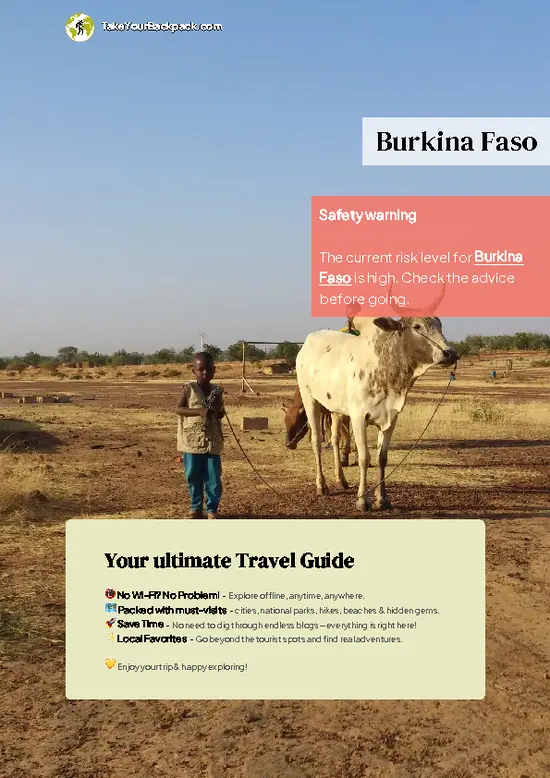
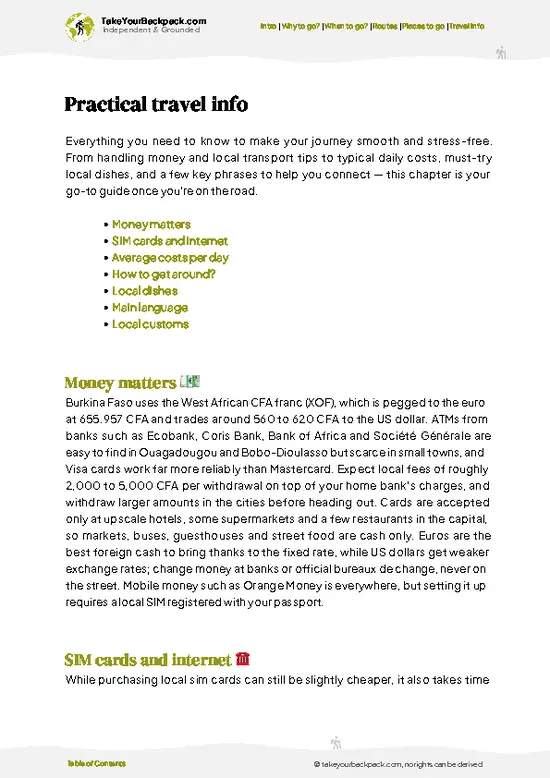
example page 0 from our offline Travel Guide for Burkina Faso
example page 1 from our offline Travel Guide for Burkina Faso
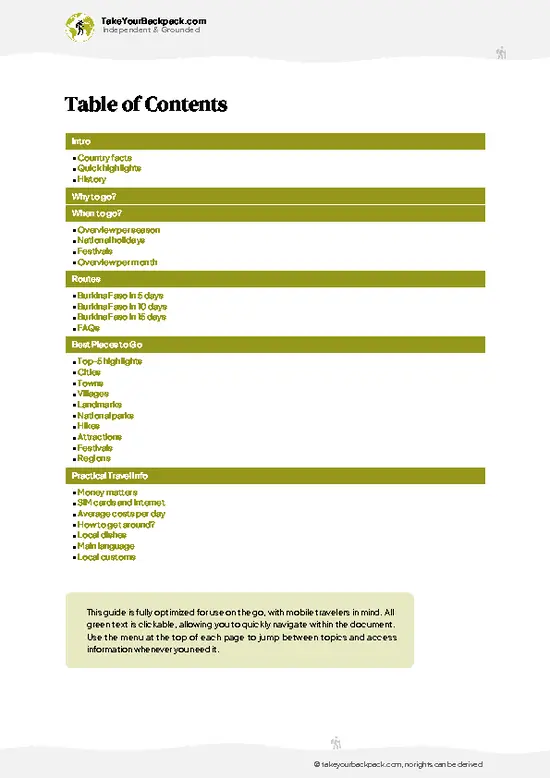
example page 2 from our offline Travel Guide for Burkina Faso
example page 3 from our offline Travel Guide for Burkina Faso
example page 4 from our offline Travel Guide for Burkina Faso
example page 5 from our offline Travel Guide for Burkina Faso
example page 6 from our offline Travel Guide for Burkina Faso
example page 7 from our offline Travel Guide for Burkina Faso
Loading the map 🌍
CLICK TO FILTER
cities
towns
villages
landmarks
national parks
hikes
attractions
festivals
regions
SHOW COUNTRY’S BESTSHOW ALL

✨ Why go?
Ranked #2 national park in Burkina Faso
What sets this place apart

Arly National Park suits travelers who want wildlife without a convoy of minibuses. You can reach the area by public transport and arrange a ranger-led drive on the spot, so there is no need to book a package tour months ahead. That independence is the main draw. Most of the park is large, empty savanna woodland where you might share a waterhole with elephants and not see another vehicle all day.
The second reason is the wildlife mix. Arly sits within the W-Arly-Pendjari complex, one of the largest protected areas in West Africa, so animals move across a wide landscape. Roan antelope, western hartebeest, waterbuck, buffalo and baboons are regular sightings, and lions live here though they are hard to find. Hippos laze in the Arly river pools, and the birdlife along the water is good.
It is also … read more 👉
Arly National Park suits travelers who want wildlife without a convoy of minibuses. You can reach the area by public transport and arrange a ranger-led drive on the spot, so there is no need to book a package tour months ahead. That independence is the main draw. Most of the park is large, empty savanna woodland where you might share a waterhole with elephants and not see another vehicle all day.
The second reason is the wildlife mix. Arly sits within the W-Arly-Pendjari complex, one of the largest protected areas in West Africa, so animals move across a wide landscape. Roan antelope, western hartebeest, waterbuck, buffalo and baboons are regular sightings, and lions live here though they are hard to find. Hippos laze in the Arly river pools, and the birdlife along the water is good.
It is also a counterweight to the capital and the cities. After days of dust and motorbike traffic, a night near Pama with the sounds of the bush is a different Burkina Faso, one most visitors never reach.

💡 HighlightsMust-see experiences and standout moments

  1. Elephants at the dry-season waterholes: this is what the park is known for. As pools shrink, herds gather at the remaining water, and you can watch them from a vehicle at close range, often with calves in tow.
  2. Hippo pools on the Arly river: the river holds hippos that grunt and surface through the day, and crocodiles sun themselves on the banks. Dusk is the most active time, when hippos leave the water to graze.
  3. Roan antelope and western hartebeest: these big, pale antelopes are easy to pick out in the open woodland. Roan are the showpiece, with their curved horns and bold face markings, and they are harder to find elsewhere in the region.
  4. Lions and other predators: lions are present but elusive. A sighting is a bonus rather than something to plan around, though fresh tracks on dusty tracks are
… read more 👉
  1. Elephants at the dry-season waterholes: this is what the park is known for. As pools shrink, herds gather at the remaining water, and you can watch them from a vehicle at close range, often with calves in tow.
  2. Hippo pools on the Arly river: the river holds hippos that grunt and surface through the day, and crocodiles sun themselves on the banks. Dusk is the most active time, when hippos leave the water to graze.
  3. Roan antelope and western hartebeest: these big, pale antelopes are easy to pick out in the open woodland. Roan are the showpiece, with their curved horns and bold face markings, and they are harder to find elsewhere in the region.
  4. Lions and other predators: lions are present but elusive. A sighting is a bonus rather than something to plan around, though fresh tracks on dusty tracks are a thrill for any tracker.
  5. Sudanian savanna woodland: the landscape itself is worth a slow drive. Tall grasses, shea and combretum trees and rocky outcrops change color through the year, green after the rains and golden once the grass dries.
  6. Birdwatching along the river: herons, kingfishers, fish eagles and hornbills cluster along the water. Bring binoculars, and plan an early start when activity peaks.
  7. Pama gateway and the surrounding villages: the nearby town gives you a base, a local market and a chance to meet the guides who know the park best. Stop for a drink before heading out.
Elephants at the waterholes and the Arly river hippo pools fit well into one day, with an early drive to the waterholes and an evening at the river.
Spotted a mistake or missing something? Contact us.

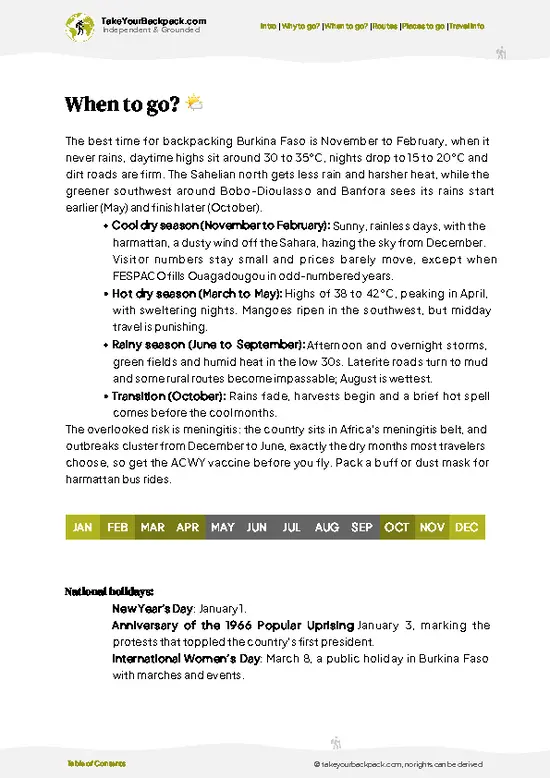
🌤️ When to go?Seasonal considerations and timing

  • Cool Dry Season (November to February): Arly’s most comfortable window for walking. Days reach 30 to 35°C (86 to 95°F), nights drop to 15 to 20°C (59 to 68°F), and the Harmattan wind can leave a dusty haze that dulls photos. Daylight runs roughly 11 to 12 hours.
  • Hot Dry Season (March to May): Animals gather at the Arly and Pendjari rivers and the remaining pools, so sightings peak. Afternoons hit 38 to 43°C (100 to 109°F), so walk at dawn and rest midday.
  • Rainy Season (June to October): Highs of 28 to 33°C (82 to 91°F), tall grass, muddy tracks and flooded crossings. Some park roads close, wildlife hides in the vegetation, and lodges often cut rates.
  • Crowds and Prices: Visitors are always few, mostly Burkinabe and regional groups, and rates rise only slightly from December to April.
Aim for February … read more 👉
  • Cool Dry Season (November to February): Arly’s most comfortable window for walking. Days reach 30 to 35°C (86 to 95°F), nights drop to 15 to 20°C (59 to 68°F), and the Harmattan wind can leave a dusty haze that dulls photos. Daylight runs roughly 11 to 12 hours.
  • Hot Dry Season (March to May): Animals gather at the Arly and Pendjari rivers and the remaining pools, so sightings peak. Afternoons hit 38 to 43°C (100 to 109°F), so walk at dawn and rest midday.
  • Rainy Season (June to October): Highs of 28 to 33°C (82 to 91°F), tall grass, muddy tracks and flooded crossings. Some park roads close, wildlife hides in the vegetation, and lodges often cut rates.
  • Crowds and Prices: Visitors are always few, mostly Burkinabe and regional groups, and rates rise only slightly from December to April.
Aim for February or March, when the grass is low and the water holes are still active, and confirm the current security situation locally before booking.


source: climatestotravel.comJANJanuary: excellent for travelingFEBFebruary: excellent for travelingMARMarch: highly recommended for travelingAPRApril: good for travelingMAYMay: fair for travelingJUNJune: below average for travelingJULJuly: below average for travelingAUGAugust: below average for travelingSEPSeptember: fair for travelingOCTOctober: good for travelingNOVNovember: highly recommended for travelingDECDecember: excellent for traveling
when-to-go

✈️ The backpacker research shortcutBurkina Faso Travel Guide

An offline-friendly backpacking guide with optimized travel routes, ranked highlights, transport advice, and the best areas to stay.
example page 0 from our offline Travel Guide for Burkina Faso
example page 1 from our offline Travel Guide for Burkina Faso
example page 2 from our offline Travel Guide for Burkina Faso
example page 3 from our offline Travel Guide for Burkina Faso
example page 4 from our offline Travel Guide for Burkina Faso
example page 5 from our offline Travel Guide for Burkina Faso
example page 6 from our offline Travel Guide for Burkina Faso
example page 7 from our offline Travel Guide for Burkina Faso
The digital guide (273 pages) contains:
✅ 63 highlights, ranked by travel appeal
✅ Optimized 5, 10 & 15-day travel routes
✅ Cities, national parks, landmarks, beaches
✅ How to get around
✅ Offline-friendly for travel without Wi-Fi
👉 Click to see all 30+ guide features

📅 Plan smarter in minutes, not weeks
✅ Month by month travel advice
✅ Festivals & national holidays
✅ Budget expectations

🗺️ Go to the right places, skip the overrated ones
✅ Honest pros & cons of destinations
✅ Top hikes, parks & viewpoints
✅ Lesser-known places most travelers miss
✅ Clear “worth it vs skip it” guidance

🛏️ Travel smoothly without rookie mistakes
✅ Best areas to stay
✅ Transport systems explained simply
✅ Common scams & safety advice
✅ SIM cards, money & practical tips

🌍 Understand the country, not just visit it
✅ Culture & traditions
✅ 52 Essential phrases & customs
✅ Festivals worth planning around
✅ Traveler-friendly historical context
✅ Insights that make places more meaningful

📱 Built for real travel conditions
✅ Fully downloadable PDF
✅ Works completely offline
✅ Optimized for phone use
✅ Useful in remote areas & buses
✅ Everything in one place
Stop searching, start planning
Get instant access to your full guide. 30‑day money-back guarantee.
+ Add another guide for just

By proceeding you agree to our terms.
Sent to your inbox immediately after payment • 100% Secure Checkout
Best Backpacking Travel Advisor 2025 tourism awardBest Backpacking
Travel Advisor
2025
What others say about Take Your Backpack Guides:
⭐⭐⭐⭐⭐
Fantastic, amazing amount of information!
⭐⭐⭐⭐⭐
My goodness this is amazing, it's what I've been looking for hats off too you!
⭐⭐⭐⭐⭐
I think this is absolutely BRILLIANT
⭐⭐⭐⭐
Very complete and informative. It's still missing places, but I gotta to commend you
⭐⭐⭐⭐⭐
This is truly amazing, thank you, can't wait to explore it with my kids!
⭐⭐⭐⭐⭐
Awesome resource, thank you!
⭐⭐⭐⭐⭐
This is amazing! Can't wait to explore the ones I haven't seen
⭐⭐⭐⭐
I love this! Well done, great idea.
⭐⭐⭐⭐⭐
Thanks for taking the time to make this gem!
⭐⭐⭐⭐⭐
This might be the best website I've ever seen.
⭐⭐⭐⭐⭐
Congratulations, and thank you so much for your work; it's incredibly valuable.
⭐⭐⭐⭐
In all seriousness I think you did a great job pointing out the important spots
⭐⭐⭐⭐⭐
10/10 very good
⭐⭐⭐⭐⭐
As someone who's only just starting to visit regularly this is awesome, thank you.
⭐⭐⭐⭐
Thank you very much! I'm going to visit my dad, it's going to be very useful!
⭐⭐⭐⭐⭐
This is really cool! We'll be travelling for the first time and this definitely come in handy.
⭐⭐⭐⭐⭐
You are now our minister of culture, congratulations 👨‍💼
⭐⭐⭐⭐⭐
Just wanted to tell you that this is a pearl! Going to follow your recommendations.
⭐⭐⭐⭐⭐
This is so cool. I'll definitely be using the resource for my travels soon.
⭐⭐⭐⭐⭐
This is very impressive! Good work.
⭐⭐⭐⭐⭐
This is an amazing and informative site. Very well done!

🛏️ Where to stay?Choosing the right base

Most backpackers sleep in Diapaga or Pama, the nearest towns, since accommodation inside Arly National Park is very limited. The park’s main entrance and ranger post sit near Arly village, and a few basic lodges and campsites stand at the edge of the reserve. Expect simple rooms with a fan, cold-water showers and sometimes a bucket.

Pama is the usual base on the northern side. It has a handful of small guesthouses and auberges at roughly €10 to 25 a night, plus a market for water, bread and tinned food. Diapaga, to the north, has similar budget rooms and slightly more transport links. Fada N’Gourma, … read more 👉
Most backpackers sleep in Diapaga or Pama, the nearest towns, since accommodation inside Arly National Park is very limited. The park’s main entrance and ranger post sit near Arly village, and a few basic lodges and campsites stand at the edge of the reserve. Expect simple rooms with a fan, cold-water showers and sometimes a bucket.

Pama is the usual base on the northern side. It has a handful of small guesthouses and auberges at roughly €10 to 25 a night, plus a market for water, bread and tinned food. Diapaga, to the north, has similar budget rooms and slightly more transport links. Fada N’Gourma, the regional capital, offers more choice, including mid-range hotels at about €25 to 50 and a better range of supplies, and it works well for a night before or after the park.

Camping is possible at some park-run spots near the entrance, but bring your own tent, sleeping pad and water filter. Book ahead for lodges in the dry months, since rooms are few. Hiring a guide and vehicle through your lodge or the park office is usually necessary, so ask about that when you arrange your stay.

👛 Costs (as of 22 October 2026)What things cost and how to budget

Arly National Park costs roughly €3 to 8 a day for a backpacker once you add guide and vehicle costs, and the total daily budget here is about €75. Entrance is modest, but the main expense is arranging transport inside the reserve. Travelers pay in West African CFA francs, and prices in the table are approximate.
CategoryBudget RangeLocal Reality
Entrance Fee€3 to 8Paid at the park office or ranger post, with a separate small fee for a vehicle.
Guide and Ranger€10 to 20A guide is usually required for game drives or walks, and tips are appreciated.
Accommodation (High Season)€10 to 25Basic rooms with a fan in Pama or Diapaga, and simple lodges near the entrance.
Accommodation (Low Season)€8 to 18Rates ease off in the rains, but access is harder.
Local Transport€15 to 30Bus to Fada N’Gourma or Pama,
… read more 👉
Arly National Park costs roughly €3 to 8 a day for a backpacker once you add guide and vehicle costs, and the total daily budget here is about €75. Entrance is modest, but the main expense is arranging transport inside the reserve. Travelers pay in West African CFA francs, and prices in the table are approximate.
CategoryBudget RangeLocal Reality
Entrance Fee€3 to 8Paid at the park office or ranger post, with a separate small fee for a vehicle.
Guide and Ranger€10 to 20A guide is usually required for game drives or walks, and tips are appreciated.
Accommodation (High Season)€10 to 25Basic rooms with a fan in Pama or Diapaga, and simple lodges near the entrance.
Accommodation (Low Season)€8 to 18Rates ease off in the rains, but access is harder.
Local Transport€15 to 30Bus to Fada N’Gourma or Pama, then a motorbike taxi or shared 4x4 hire to the park.
Food and Water€6 to 12Rice, grilled chicken, beans and sauce at local eateries, plus bottled or filtered water.
Total Daily Budget€44 to 95About €75 on a typical high-season day.
⚠️ Prices can change and everyone travels differently, so take this as a rough guide. Hope it helps you plan your adventure!

🥾 TrailsHiking Arly national park: highlights and difficulty

Arly National Park is a place for drives and short guided walks rather than marked long-distance trails, and visitors typically go out with a ranger or guide. There are no named, signposted routes, so you follow park tracks that start at the main gate near Pama and loop through woodland, past waterholes and along the Arly river.
  • Morning game drive: the usual outing runs from the gate through open woodland to the main waterholes. Expect several hours of slow driving and stops to watch elephants, antelope and baboons. Easy for any fitness level.
  • River circuit: tracks follow the Arly river to hippo
… read more 👉
Arly National Park is a place for drives and short guided walks rather than marked long-distance trails, and visitors typically go out with a ranger or guide. There are no named, signposted routes, so you follow park tracks that start at the main gate near Pama and loop through woodland, past waterholes and along the Arly river.
  • Morning game drive: the usual outing runs from the gate through open woodland to the main waterholes. Expect several hours of slow driving and stops to watch elephants, antelope and baboons. Easy for any fitness level.
  • River circuit: tracks follow the Arly river to hippo pools and shaded banks. Good for birds, crocodiles and a late-afternoon pause. Easy, though tracks can be bumpy.
  • Guided bush walk: where a ranger allows it, short walks of an hour or two let you read tracks, dung and plants up close. Moderate in the heat, flat to gently rolling ground, with an armed ranger always beside you.
  • Terrain: flat to rolling savanna, laterite tracks, rocky patches and seasonal streams. Some tracks turn muddy or impassable in the rains.
  • Wildlife: elephants, hippos, roan antelope, hartebeest, waterbuck, buffalo, warthogs, baboons and many birds. Lions and leopards live here but are rarely seen.
Public transport helps you reach the area but not the park interior. Buses run from Ouagadougou toward the east, with onward connections to Pama, and from there you need a vehicle or a guide arranged locally to enter the park. A sturdy 4x4 is the practical choice inside, since tracks are rough and signage is minimal. Crowds are essentially absent, so you often have a waterhole to yourself. An entry fee and a guide fee are paid at the gate, usually modest by safari standards, and payment is in cash. Bring plenty of water, a hat, long light sleeves and binoculars. Dry-season mornings are cool, and midday is hot and slow for animals.
⚠️ Hiking info can sometimes be outdated or inaccurate. Before you hit the trail, check the latest conditions with locals. If you do spot anything that's off, I'd love to hear from you, so I can update it for fellow travelers.

🛡️ SafetyTraveler Safety Guide

Arly is quiet and sparsely visited, so the main concern is the region’s security situation, which can change quickly. Check current government travel advice and ask in Fada N’Gourma or Pama before heading out, and use a registered guide or park ranger for any trip inside the boundaries.

Heat is the everyday hazard. From March to May, drink at least 3 to 4 liters a day, wear a hat and light long sleeves, and start walks at first light. Rainy-season tracks turn to mud and can cut off sections of the park, so a 4x4 matters then.

Elephants, buffalo, hippos and crocodiles live here. Keep your distance, never approach a hippo at dusk, and stay away from river edges. Follow your ranger’s lead if animals appear. Bring a first-aid kit, malaria prophylaxis, insect repellent, offline maps and extra … read more 👉
Arly is quiet and sparsely visited, so the main concern is the region’s security situation, which can change quickly. Check current government travel advice and ask in Fada N’Gourma or Pama before heading out, and use a registered guide or park ranger for any trip inside the boundaries.

Heat is the everyday hazard. From March to May, drink at least 3 to 4 liters a day, wear a hat and light long sleeves, and start walks at first light. Rainy-season tracks turn to mud and can cut off sections of the park, so a 4x4 matters then.

Elephants, buffalo, hippos and crocodiles live here. Keep your distance, never approach a hippo at dusk, and stay away from river edges. Follow your ranger’s lead if animals appear. Bring a first-aid kit, malaria prophylaxis, insect repellent, offline maps and extra fuel, as help is far away and mobile coverage is patchy.

FAQFrequently asked questions about Arly

Plan on 2 to 3 days for Arly National Park, which gives you time for at least one dawn and one dusk game drive. Reaching it from Ouagadougou takes about a day by road, so add travel days at each end. The dry months from February to April reward even a short stay with the best wildlife viewing.
Visiting Arly National Park without your own car is possible but slow. You can take a bus from Ouagadougou to Fada N’Gourma, continue to Pama or Diapaga by minibus, and then hire a motorbike or 4x4 with a guide, which costs roughly €25 to 60 a day. Inside the reserve, a vehicle is essential because distances are long and tracks are rough.
Yes, Arly National Park charges an entrance fee, typically around €3 to 8 per person, with an extra charge for vehicles and a guide of roughly €10 to 20 a day. You pay at the park office or ranger post near the entrance, in West African CFA francs. Bring cash, a passport copy and any letter or permit your lodge advises, since cards are not accepted.
⚠️ Things can change over time, so always validate details locally before you go.

Other Burkinabé national parks near Arly

Explore more nearby:

  • Singou Reserve—Singou waterholes, granite outcrops, near-zero crowds, east Burkina| 39 km away
  • Pô National Park—borderland wilderness, mixed woodland, antelope species, remote access| 53 km away
  • W National Park—Tapoa River pools, remote border park, armed-ranger walks, big cat tracks| 104 km away

💡 Not sure where to go next?
Create a personalized itinerary for Burkina Faso including Arly and the places that fit your trip.

Generate my itinerary

👉 Discover all national parks

Or checkout all Burkina Faso has to offer (think cities, towns, villages, national parks, hikes, beaches, festivals)
Country photo of Burkina Faso

We 💚 feedbackFinal thoughts on exploring Arly

Arly National Park deserves two nights at least. One night gets you a single game drive and a lot of dust, while two or three let you catch both a dawn waterhole and a dusk at the river without rushing. I would bring binoculars, spare water and a patient mindset, and skip trying to cram it into a day from the road.

✍️ Help improve this page!
The information on this page is based on in-depth research, insights shared by experienced travelers, and feedback from the local travel community in Burkina Faso. While every effort is made to keep the information accurate and current, conditions can change — so if you spot anything incorrect or outdated, please get in touch.


🙋‍♂️ Give feedback

👋 Meet the founderWho’s Behind Take Your Backpack?

Johan, backpacker and founder of TakeYourBackpackHi, I’m Johan (Netherlands 🇳🇱), the creator of TakeYourBackpack. Over the past 3 decades, I’ve backpacked through 90+ countries across six continents, gaining extensive experience with independent travel, long-term trips, and overland routes.

This site is built on a combination of firsthand travel experience and carefully curated insights from other backpackers. Many guides are based on places I’ve personally visited, while others bring together tips, observations, and practical advice shared by trusted travelers I’ve met along the way.

The goal is to provide realistic, experience-driven guidance — not generic itineraries — so you can explore destinations with better context, clearer expectations, and more confidence.