×

Burkina Faso🇧🇫 | national parksSingou ReserveSingou waterholes, granite outcrops, near-zero crowds, east Burkina | things to do and best time to go

Explore W National ParkExplore Bam

Backpacking in Singou Reserve
👌 Worth visitingnational park ranked #5
By Johan Kruseman 🇳🇱 | Updated October 22, 2026

Singou Reserve is one of the few places in West Africa where you can see elephants without a big safari budget or a convoy of jeeps. It sits in the east of Burkina Faso, in the Centre-Est and Est regions, south-east of Fada N’Gourma, and forms part of the W-Arly-Pendjari complex. Elephants are the draw, along with roan antelope, hippos and baboons. Skip the idea of lions on demand; they exist but are rarely seen. Roads are rough and there is no public transport inside, so you need a vehicle and a guide, which is why you hire locally rather than self-drive. Crowds are close to zero, so quiet is the norm. Facilities are basic. A first day could mean arriving by midday, taking a late-afternoon game drive to a waterhole, and watching elephants come in at dusk.

Discover everything you want to know in the 📖 Burkina Faso Travel Guide.
Safety warning

The current risk level for Burkina Faso is high. Check the advice before going.


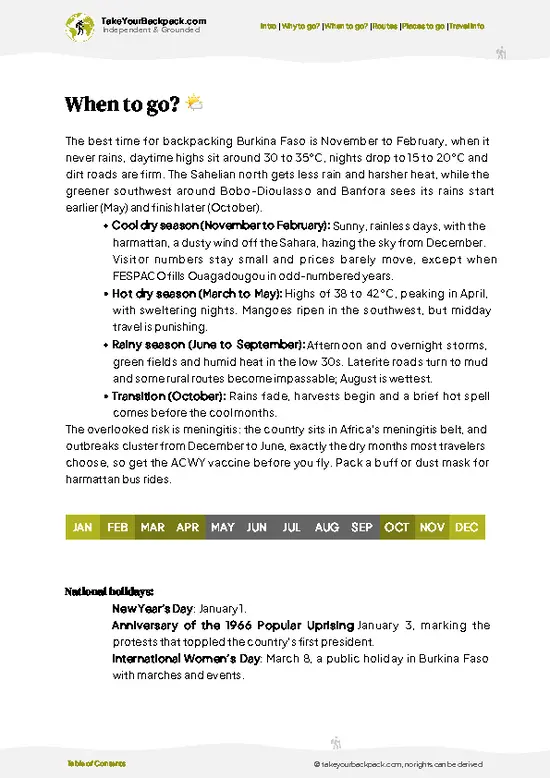
example page 0 from our offline Travel Guide for Burkina Faso
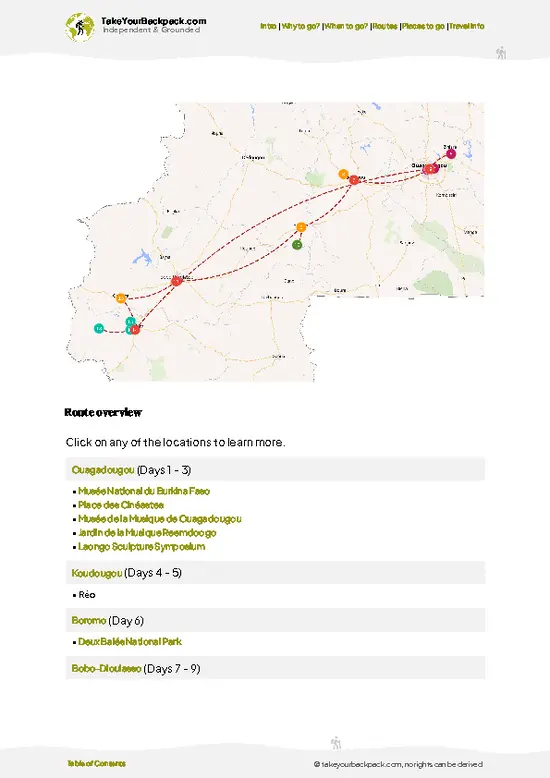
example page 1 from our offline Travel Guide for Burkina Faso
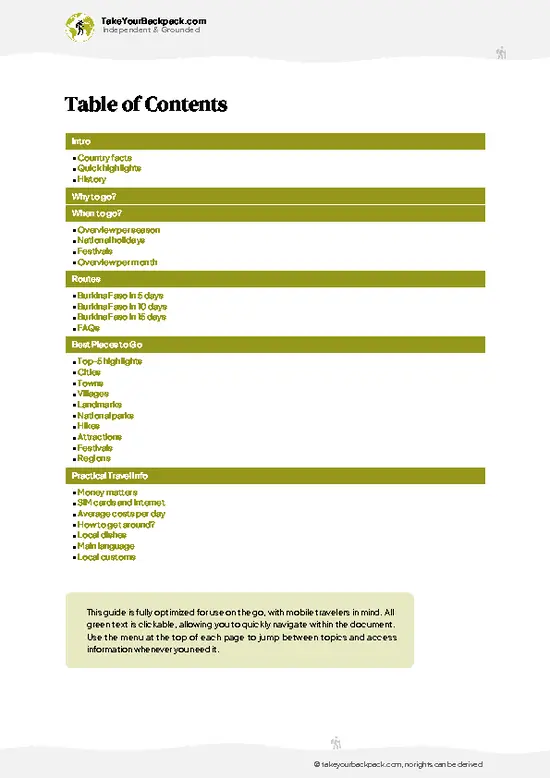
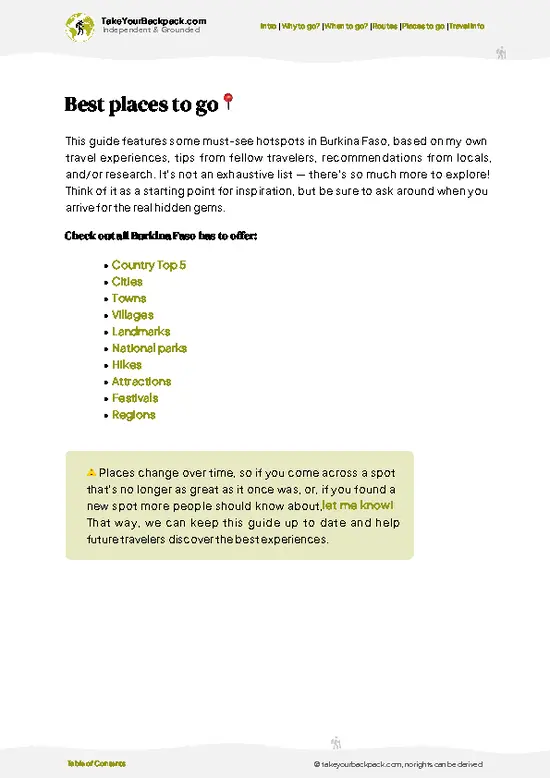
example page 2 from our offline Travel Guide for Burkina Faso
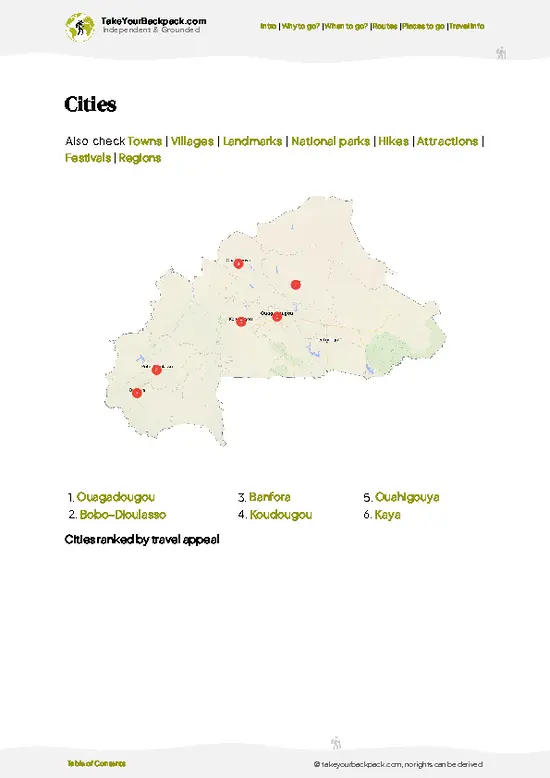
example page 3 from our offline Travel Guide for Burkina Faso
example page 4 from our offline Travel Guide for Burkina Faso
example page 5 from our offline Travel Guide for Burkina Faso
example page 6 from our offline Travel Guide for Burkina Faso
example page 7 from our offline Travel Guide for Burkina Faso
Loading the map 🌍
CLICK TO FILTER
cities
towns
villages
landmarks
national parks
hikes
attractions
festivals
regions
SHOW COUNTRY’S BESTSHOW ALL

✨ Why go?
Ranked #5 national park in Burkina Faso
Why visitors keep coming back

Singou Reserve suits backpackers who like wild places without a tour-bus crowd. The main reason is the elephants: the reserve holds one of the larger populations in the country, and the dry season pushes them to the Singou River and its waterholes, where a patient morning or evening drive often turns them up. A second reason is the sheer emptiness. You may share a track with nobody else, and the guide-led drives and walks feel personal rather than scripted. Savanna woodland, rocky outcrops and gallery forest give the park real variety, and birders get plenty to log. It is not a self-guided park: you will need a guide, and a sturdy vehicle for the sandy, uneven tracks. That limit also keeps the place calm, and it rewards travelers who can put up with simple comforts, long dusty rides and slow … read more 👉
Singou Reserve suits backpackers who like wild places without a tour-bus crowd. The main reason is the elephants: the reserve holds one of the larger populations in the country, and the dry season pushes them to the Singou River and its waterholes, where a patient morning or evening drive often turns them up. A second reason is the sheer emptiness. You may share a track with nobody else, and the guide-led drives and walks feel personal rather than scripted. Savanna woodland, rocky outcrops and gallery forest give the park real variety, and birders get plenty to log. It is not a self-guided park: you will need a guide, and a sturdy vehicle for the sandy, uneven tracks. That limit also keeps the place calm, and it rewards travelers who can put up with simple comforts, long dusty rides and slow days in return for wildlife that is not performing for anyone.

💡 HighlightsDon't-miss highlights and experiences

  1. Elephants at the Singou waterholes: The reserve’s signature sight. In the dry season herds gather near water in the late afternoon, and a quiet approach by vehicle gets you surprisingly close.
  2. Singou River: The reserve’s lifeline. Its pools hold hippos and draw crocodiles, antelope and a lot of birds along the banks.
  3. Roan antelope and kob: Large, pale-faced roan antelope graze the open woodland, often alongside kob and hartebeest, making early drives productive.
  4. Gallery forest along the watercourses: Shade, monkeys and hornbills turn up here, a cooler contrast with the dry savanna around it.
  5. Rocky outcrops and viewpoints: Low granite rises give a long view across the flat woodland, useful for spotting animal movement and for photos at dusk.
  6. Birdwatching: Expect raptors, rollers, bee-eaters, storks
… read more 👉
  1. Elephants at the Singou waterholes: The reserve’s signature sight. In the dry season herds gather near water in the late afternoon, and a quiet approach by vehicle gets you surprisingly close.
  2. Singou River: The reserve’s lifeline. Its pools hold hippos and draw crocodiles, antelope and a lot of birds along the banks.
  3. Roan antelope and kob: Large, pale-faced roan antelope graze the open woodland, often alongside kob and hartebeest, making early drives productive.
  4. Gallery forest along the watercourses: Shade, monkeys and hornbills turn up here, a cooler contrast with the dry savanna around it.
  5. Rocky outcrops and viewpoints: Low granite rises give a long view across the flat woodland, useful for spotting animal movement and for photos at dusk.
  6. Birdwatching: Expect raptors, rollers, bee-eaters, storks and others around water, with the best light at first dawn.
  7. Baboons and green monkeys: Troops are easy to find along tracks and near trees, and a good fallback when larger animals hide.
  8. Guided walking safaris: With a ranger, tracking on foot shows dung, footprints and small details a vehicle misses, and the quiet is total.
Start with the elephants at the Singou waterholes on your first late afternoon, because that is when herds are most likely to come in to drink and the light is best for seeing them.
Spotted a mistake or missing something? Contact us.

🌤️ When to go?When to go for the best experience

  • Cool Dry Season (November to February): Days run 30 to 35°C (86 to 95°F) with cool nights near 16 to 20°C (61 to 68°F). Harmattan haze softens the light and dust can hang in the air. Roads are firm and daylight lasts roughly 11 to 12 hours.
  • Hot Dry Season (March to May): Animals gather at the Singou River and the remaining pools, so sightings of elephants and antelope are at their best. Afternoons reach 38 to 43°C (100 to 109°F), so walk at dawn and rest midday.
  • Rainy Season (June to October): Highs of 28 to 33°C (82 to 91°F), heavy downpours, tall grass and flooded tracks. Wildlife scatters, and some tracks close. Lodges often cut rates or shut.
Crowds are small year-round, and December to February is the busiest and priciest stretch, so book a vehicle and guide ahead then.

source: climatestotravel.comJANJanuary: excellent for travelingFEBFebruary: excellent for travelingMARMarch: highly recommended for travelingAPRApril: good for travelingMAYMay: good for travelingJUNJune: fair for travelingJULJuly: below average for travelingAUGAugust: below average for travelingSEPSeptember: fair for travelingOCTOctober: good for travelingNOVNovember: excellent for travelingDECDecember: excellent for traveling
when-to-go

✈️ The backpacker research shortcutBurkina Faso Travel Guide

An offline-friendly backpacking guide with optimized travel routes, ranked highlights, transport advice, and the best areas to stay.
example page 0 from our offline Travel Guide for Burkina Faso
example page 1 from our offline Travel Guide for Burkina Faso
example page 2 from our offline Travel Guide for Burkina Faso
example page 3 from our offline Travel Guide for Burkina Faso
example page 4 from our offline Travel Guide for Burkina Faso
example page 5 from our offline Travel Guide for Burkina Faso
example page 6 from our offline Travel Guide for Burkina Faso
example page 7 from our offline Travel Guide for Burkina Faso
The digital guide (273 pages) contains:
✅ 63 highlights, ranked by travel appeal
✅ Optimized 5, 10 & 15-day travel routes
✅ Cities, national parks, landmarks, beaches
✅ How to get around
✅ Offline-friendly for travel without Wi-Fi
👉 Click to see all 30+ guide features

📅 Plan smarter in minutes, not weeks
✅ Month by month travel advice
✅ Festivals & national holidays
✅ Budget expectations

🗺️ Go to the right places, skip the overrated ones
✅ Honest pros & cons of destinations
✅ Top hikes, parks & viewpoints
✅ Lesser-known places most travelers miss
✅ Clear “worth it vs skip it” guidance

🛏️ Travel smoothly without rookie mistakes
✅ Best areas to stay
✅ Transport systems explained simply
✅ Common scams & safety advice
✅ SIM cards, money & practical tips

🌍 Understand the country, not just visit it
✅ Culture & traditions
✅ 52 Essential phrases & customs
✅ Festivals worth planning around
✅ Traveler-friendly historical context
✅ Insights that make places more meaningful

📱 Built for real travel conditions
✅ Fully downloadable PDF
✅ Works completely offline
✅ Optimized for phone use
✅ Useful in remote areas & buses
✅ Everything in one place
Stop searching, start planning
Get instant access to your full guide. 30‑day money-back guarantee.
+ Add another guide for just

By proceeding you agree to our terms.
Sent to your inbox immediately after payment • 100% Secure Checkout
Best Backpacking Travel Advisor 2025 tourism awardBest Backpacking
Travel Advisor
2025
What others say about Take Your Backpack Guides:
⭐⭐⭐⭐⭐
Fantastic, amazing amount of information!
⭐⭐⭐⭐⭐
My goodness this is amazing, it's what I've been looking for hats off too you!
⭐⭐⭐⭐⭐
I think this is absolutely BRILLIANT
⭐⭐⭐⭐
Very complete and informative. It's still missing places, but I gotta to commend you
⭐⭐⭐⭐⭐
This is truly amazing, thank you, can't wait to explore it with my kids!
⭐⭐⭐⭐⭐
Awesome resource, thank you!
⭐⭐⭐⭐⭐
This is amazing! Can't wait to explore the ones I haven't seen
⭐⭐⭐⭐
I love this! Well done, great idea.
⭐⭐⭐⭐⭐
Thanks for taking the time to make this gem!
⭐⭐⭐⭐⭐
This might be the best website I've ever seen.
⭐⭐⭐⭐⭐
Congratulations, and thank you so much for your work; it's incredibly valuable.
⭐⭐⭐⭐
In all seriousness I think you did a great job pointing out the important spots
⭐⭐⭐⭐⭐
10/10 very good
⭐⭐⭐⭐⭐
As someone who's only just starting to visit regularly this is awesome, thank you.
⭐⭐⭐⭐
Thank you very much! I'm going to visit my dad, it's going to be very useful!
⭐⭐⭐⭐⭐
This is really cool! We'll be travelling for the first time and this definitely come in handy.
⭐⭐⭐⭐⭐
You are now our minister of culture, congratulations 👨‍💼
⭐⭐⭐⭐⭐
Just wanted to tell you that this is a pearl! Going to follow your recommendations.
⭐⭐⭐⭐⭐
This is so cool. I'll definitely be using the resource for my travels soon.
⭐⭐⭐⭐⭐
This is very impressive! Good work.
⭐⭐⭐⭐⭐
This is an amazing and informative site. Very well done!

🛏️ Where to stay?Best areas to stay in Burkina Faso

There is no village inside Singou Reserve, so you sleep either at a lodge at the edge of the reserve or in a town a few hours away. Arly and Singou-area ecolodges and campements near the park gates are the most practical bases, with simple bungalows or rooms with fans for roughly €20 to 45 a night, and some allow camping for about €5 to 10 if you bring your own tent. Meals are usually served on site and cost around €4 to 8. Staying close matters because dawn is the best time to see animals and guides leave early.
The regional town of Fada N’Gourma, roughly two to three hours by road to the west, … read more 👉
There is no village inside Singou Reserve, so you sleep either at a lodge at the edge of the reserve or in a town a few hours away. Arly and Singou-area ecolodges and campements near the park gates are the most practical bases, with simple bungalows or rooms with fans for roughly €20 to 45 a night, and some allow camping for about €5 to 10 if you bring your own tent. Meals are usually served on site and cost around €4 to 8. Staying close matters because dawn is the best time to see animals and guides leave early.
The regional town of Fada N’Gourma, roughly two to three hours by road to the west, has budget guesthouses at €10 to 25 a night, markets, fuel, cash machines and bus links to Ouagadougou. Stock up on cash, water and snacks there, since supplies near the reserve are limited. Tenkodogo and Diapaga are smaller options in the area if you are coming from other directions. Self-sufficient travelers can ask the reserve management about camping spots, but a guide or ranger is normally required.

👛 Costs (as of 22 October 2026)Typical daily expenses

A realistic daily budget for Singou Reserve is about €55 to 95 per person when you share a vehicle and guide. Prices are paid in local currency and cash is essential, since cards are rarely accepted near the reserve.
CategoryBudget RangeLocal Reality
Entrance and guide€8 to 15Entry plus a mandatory ranger or guide, paid at the gate.
Accommodation (high season)€15 to 30Basic lodge rooms or camping; rainy season rates are lower.
Vehicle and fuel share€20 to 30Safari-style drives need a 4x4, often rented with a driver and split among a group.
Local transport€5 to 8Bus to Fada N’Gourma and then shared taxis or motorbike rides toward the reserve.
Food and water€7 to 12Rice, grilled chicken or fish and sauces at lodges; bottled water adds up in the heat.
Total Daily Budget€55 to 95About €75 for most travelers.
⚠️ Prices can change and everyone travels differently, so take this as a rough guide. Hope it helps you plan your adventure!

🥾 TrailsWhere to hike in Singou Reserve: trails for every level

Singou Reserve is explored with a ranger on short drives and walks rather than a network of marked hiking routes, so most visitors build their day around waterholes and tracks. Typical outings run two to four hours, usually at dawn or in the late afternoon when animals are active.
  • Waterhole walks: Rangers lead you on foot or by vehicle to pools along the Singou River, usually two to three hours, easy and flat, with elephants, hippos and antelope the main sightings.
  • Savanna woodland tracks: Sandy, uneven tracks wind through open woodland and past rocky outcrops, best by 4x4, with roan antelope, kob,
… read more 👉
Singou Reserve is explored with a ranger on short drives and walks rather than a network of marked hiking routes, so most visitors build their day around waterholes and tracks. Typical outings run two to four hours, usually at dawn or in the late afternoon when animals are active.
  • Waterhole walks: Rangers lead you on foot or by vehicle to pools along the Singou River, usually two to three hours, easy and flat, with elephants, hippos and antelope the main sightings.
  • Savanna woodland tracks: Sandy, uneven tracks wind through open woodland and past rocky outcrops, best by 4x4, with roan antelope, kob, baboons and plenty of birds.
  • Gallery forest strolls: Short, shaded walks beside watercourses with monkeys and hornbills, easy and gentle, a good midday option when the savanna is hot.
  • Guided tracking walks: Longer ranger-led walks of half a morning, moderate because of heat and loose ground, focused on tracks, dung and close observation rather than distance.
Terrain is flat to gently rolling, with little shade in the open, so carry plenty of water, a hat and sturdy shoes. Dry season is when animals concentrate at water and visibility is best; the rains make tracks slow and sometimes impassable. Getting to the reserve is the hard part: there is no regular public transport to the gate, so most travelers go by hired vehicle or a car with a driver from the regional town of Fada N’Gourma. Crowds are minimal, often just a handful of visitors. An entrance fee and a mandatory guide fee apply, paid in local currency at the park entrance, and both are modest by safari standards. Check the current regional security situation before you travel, since conditions in eastern Burkina Faso can change.
⚠️ Hiking info can sometimes be outdated or inaccurate. Before you hit the trail, check the latest conditions with locals. If you do spot anything that's off, I'd love to hear from you, so I can update it for fellow travelers.

🛡️ SafetySafety Tips and Common Scams in Singou Reserve

Singou Reserve is a managed wildlife area, but the region’s security situation shifts, so check current government travel advice and local guidance before going, and travel with a guide or ranger as required. On the ground, the main daily hazards are heat and dehydration. Carry at least 3 liters of water per person, wear a hat and long light layers, and start walks at first light. Elephants, buffalo and hippos live here. Keep your distance, stay quiet, never walk between a calf and its mother, and stay away from river banks. Tracks are sandy or laterite and can flood in the rainy season, so use a high-clearance vehicle and tell someone your route. Tsetse flies and mosquitoes are common, so bring repellent and discuss malaria prevention with a doctor. Mobile signal is patchy, and first-time … read more 👉
Singou Reserve is a managed wildlife area, but the region’s security situation shifts, so check current government travel advice and local guidance before going, and travel with a guide or ranger as required. On the ground, the main daily hazards are heat and dehydration. Carry at least 3 liters of water per person, wear a hat and long light layers, and start walks at first light. Elephants, buffalo and hippos live here. Keep your distance, stay quiet, never walk between a calf and its mother, and stay away from river banks. Tracks are sandy or laterite and can flood in the rainy season, so use a high-clearance vehicle and tell someone your route. Tsetse flies and mosquitoes are common, so bring repellent and discuss malaria prevention with a doctor. Mobile signal is patchy, and first-time visitors often underestimate how far the nearest clinic is.

FAQFrequently asked questions about Singou Reserve

Plan two to three days for Singou Reserve. That allows a full dawn and late-afternoon drive on two separate days, with one more for travel. Getting there from Ouagadougou takes roughly 5 to 7 hours by road, so a single overnight rarely feels worth it.
Visiting Singou Reserve without a car is possible but slow. Take a bus from Ouagadougou to Fada N’Gourma (roughly 3 to 4 hours), then a shared taxi or motorbike toward the park gate. Once inside, the tracks are too long to walk safely, so you need to hire a vehicle and guide at the lodge for about €20 to 35 a day.
Singou Reserve charges an entrance fee, usually in the range of €3 to 8, and a ranger or guide is typically required for about €5 to 15 a day. Pay in cash at the gate or through your lodge. Vehicle fees and camping charges are separate, so carry small bills.
⚠️ Things can change over time, so always validate details locally before you go.

Other Burkinabé national parks near Singou Reserve

Explore more nearby:

  • Arly National Park—Dry-season elephants, Arly river hippos, roan antelope, Pama gateway| 39 km away
  • Pô National Park—borderland wilderness, mixed woodland, antelope species, remote access| 91 km away
  • W National Park—Tapoa River pools, remote border park, armed-ranger walks, big cat tracks| 131 km away

💡 Not sure where to go next?
Create a personalized itinerary for Burkina Faso including Singou Reserve and the places that fit your trip.

Generate my itinerary

👉 Discover all national parks

Or checkout all Burkina Faso has to offer (think cities, towns, villages, national parks, hikes, beaches, festivals)
Country photo of Burkina Faso

We 💚 feedbackWhat to keep in mind

Singou Reserve works best as the wild chapter of an eastern loop, paired with Fada N’Gourma for supplies and a bed on the way in, then a push toward the Pendjari side of the same ecosystem if borders and conditions allow. I would bring your own food, extra water and a spare day, and keep the first afternoon drive for elephants.

✍️ Help improve this page!
The information on this page is based on in-depth research, insights shared by experienced travelers, and feedback from the local travel community in Burkina Faso. While every effort is made to keep the information accurate and current, conditions can change — so if you spot anything incorrect or outdated, please get in touch.


🙋‍♂️ Give feedback

👋 Meet the founderWho’s Behind Take Your Backpack?

Johan, backpacker and founder of TakeYourBackpackHi, I’m Johan (Netherlands 🇳🇱), the creator of TakeYourBackpack. Over the past 3 decades, I’ve backpacked through 90+ countries across six continents, gaining extensive experience with independent travel, long-term trips, and overland routes.

This site is built on a combination of firsthand travel experience and carefully curated insights from other backpackers. Many guides are based on places I’ve personally visited, while others bring together tips, observations, and practical advice shared by trusted travelers I’ve met along the way.

The goal is to provide realistic, experience-driven guidance — not generic itineraries — so you can explore destinations with better context, clearer expectations, and more confidence.