×

Burkina Faso🇧🇫 | national parksW National ParkTapoa River pools, remote border park, armed-ranger walks, big cat tracks | things to do and best time to go

Explore Pô National ParkExplore Singou Reserve

Backpacking in W
🏆 Top picknational park ranked #1
By Johan Kruseman 🇳🇱 | Updated October 22, 2026

W National Park gets almost no visitors, so you can watch elephants at a waterhole with nobody else in sight. It lies in the southeast of Burkina Faso, part of a cross-border reserve shared with Niger and Benin. Reaching it takes effort. Public transport stops well short of the gate and the tracks inside are for vehicles, so hire a 4x4 with a driver in Ouagadougou instead of expecting to hitch in. Walking is limited to short, ranger-led outings, because lions and buffalo share the bush. Skip the wet months: grass grows tall, tracks turn to mud and animals vanish. The dry months are worth the trip, when game gathers at the Tapoa River and the savanna thins out. Facilities are basic and the vibe is quiet and remote. A good first day starts with a drive from the Tapoa entrance to the river pools at dawn, then a ranger-guided walk once the animals settle in the shade.

Discover everything you want to know in the 📖 Burkina Faso Travel Guide.
Safety warning

The current risk level for Burkina Faso is high. Check the advice before going.


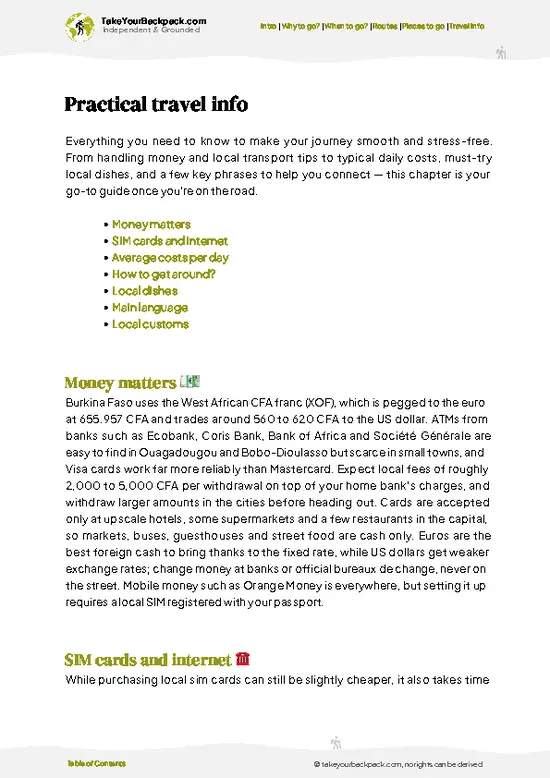
example page 0 from our offline Travel Guide for Burkina Faso
example page 1 from our offline Travel Guide for Burkina Faso
example page 2 from our offline Travel Guide for Burkina Faso
example page 3 from our offline Travel Guide for Burkina Faso
example page 4 from our offline Travel Guide for Burkina Faso
example page 5 from our offline Travel Guide for Burkina Faso
example page 6 from our offline Travel Guide for Burkina Faso
example page 7 from our offline Travel Guide for Burkina Faso
Loading the map 🌍
CLICK TO FILTER
cities
towns
villages
landmarks
national parks
hikes
attractions
festivals
regions
SHOW COUNTRY’S BESTSHOW ALL

✨ Why go?
Ranked #1 national park in Burkina Faso
Why visitors keep coming back

W National Park suits independent travelers who want wild Africa without a safari crowd. The main reason is that this is one of the last places in the region where elephants, buffalo and hippos can be seen in the same morning, and you may be the only vehicle on the track. The second reason is the Tapoa River, which keeps pools through the dry months and pulls animals toward a few predictable spots. That makes watching easy for a self-organized trip, since you spend hours at one waterhole instead of racing between sightings. A third pull is simple solitude. Nothing here is packaged: no ticketed viewing platforms, no convoys, no souvenir stalls. You bring food, a driver and patience, and the park supplies the rest. Tours are not required, but a local ranger is, and that is a good thing. Rangers … read more 👉
W National Park suits independent travelers who want wild Africa without a safari crowd. The main reason is that this is one of the last places in the region where elephants, buffalo and hippos can be seen in the same morning, and you may be the only vehicle on the track. The second reason is the Tapoa River, which keeps pools through the dry months and pulls animals toward a few predictable spots. That makes watching easy for a self-organized trip, since you spend hours at one waterhole instead of racing between sightings. A third pull is simple solitude. Nothing here is packaged: no ticketed viewing platforms, no convoys, no souvenir stalls. You bring food, a driver and patience, and the park supplies the rest. Tours are not required, but a local ranger is, and that is a good thing. Rangers read tracks and know where lions rest, which saves you days of guessing. Come with modest comfort expectations and a camera with a long lens.

💡 HighlightsPlaces and moments you shouldn't skip

  1. Tapoa River pools: The river is the park’s anchor in the dry months. Hippos crowd the deeper pools, crocodiles lie along the banks, and the surrounding gallery forest draws monkeys and birds. Sit still for an hour and the scene changes constantly.
  2. Elephant herds: Elephants are the headline animal here and the reason most people make the long journey. Dry-season sightings cluster near water in the late afternoon, and the herds are wary, so keep your distance and engine off.
  3. Buffalo and antelope on the savanna: Open grassland holds buffalo, roan antelope, hartebeest, waterbuck and kob. Herds move through at dawn, and the flat terrain gives clear views from a vehicle roof.
  4. Ranger-led bush walks: Walking with an armed ranger turns tracks, dung and bent grass into stories. You see less from a distance
… read more 👉
  1. Tapoa River pools: The river is the park’s anchor in the dry months. Hippos crowd the deeper pools, crocodiles lie along the banks, and the surrounding gallery forest draws monkeys and birds. Sit still for an hour and the scene changes constantly.
  2. Elephant herds: Elephants are the headline animal here and the reason most people make the long journey. Dry-season sightings cluster near water in the late afternoon, and the herds are wary, so keep your distance and engine off.
  3. Buffalo and antelope on the savanna: Open grassland holds buffalo, roan antelope, hartebeest, waterbuck and kob. Herds move through at dawn, and the flat terrain gives clear views from a vehicle roof.
  4. Ranger-led bush walks: Walking with an armed ranger turns tracks, dung and bent grass into stories. You see less from a distance than from a vehicle, but you hear and smell much more.
  5. Baboons and patas monkeys: Olive baboon troops and fast-running patas monkeys are common along tracks and around river crossings. They are easy first sightings and good for beginners with cameras.
  6. Birdlife around the water: Herons, storks, kingfishers and raptors work the river margins, and the gallery forest adds forest species you will not see on the open plain. Mornings are best, before heat flattens activity.
  7. Lion and leopard tracking: Big cats are present but secretive, and sightings are a bonus rather than a promise. Rangers point out fresh pugmarks and kill sites, which is satisfying even without a sighting.
The Tapoa River pools and the elephant herds combine well in one day, with the pools at first light and a late-afternoon drive to find elephants coming down to drink.
Spotted a mistake or missing something? Contact us.

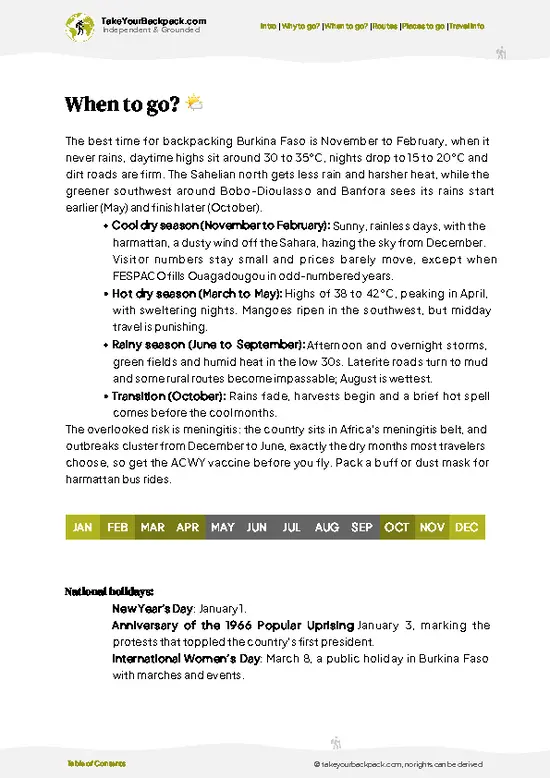
🌤️ When to go?When to go for the best experience

  • Cool Dry Season (November to February): Daytime highs run 30 to 35°C (86 to 95°F), nights drop to 15 to 20°C (59 to 68°F) when the Harmattan wind blows. Grass is still tall early on, so animals hide, and haze flattens distant views.
  • Hot Dry Season (March to May): Best for wildlife. Highs reach 38 to 43°C (100 to 109°F), grass is burned off, and elephants, buffalo and hippos crowd the remaining water on the Mekrou and Niger rivers. Midday is too hot to walk, so you move at dawn and dusk.
  • Rainy Season (June to October): Expect 28 to 33°C (82 to 91°F), heavy storms, flooded tracks and tall grass. Many roads close and lodges may shut, though prices drop and the landscape turns green.
  • Daylight and crowds: Days stay close to 11 to 13 hours all year. Visitor numbers are low in every season, with a small
… read more 👉
  • Cool Dry Season (November to February): Daytime highs run 30 to 35°C (86 to 95°F), nights drop to 15 to 20°C (59 to 68°F) when the Harmattan wind blows. Grass is still tall early on, so animals hide, and haze flattens distant views.
  • Hot Dry Season (March to May): Best for wildlife. Highs reach 38 to 43°C (100 to 109°F), grass is burned off, and elephants, buffalo and hippos crowd the remaining water on the Mekrou and Niger rivers. Midday is too hot to walk, so you move at dawn and dusk.
  • Rainy Season (June to October): Expect 28 to 33°C (82 to 91°F), heavy storms, flooded tracks and tall grass. Many roads close and lodges may shut, though prices drop and the landscape turns green.
  • Daylight and crowds: Days stay close to 11 to 13 hours all year. Visitor numbers are low in every season, with a small peak from December to April when rates for guides and vehicles are highest.
Aim for February or March, after the Harmattan haze thins but before the worst heat.


source: climatestotravel.comJANJanuary: excellent for travelingFEBFebruary: highly recommended for travelingMARMarch: good for travelingAPRApril: fair for travelingMAYMay: fair for travelingJUNJune: below average for travelingJULJuly: below average for travelingAUGAugust: below average for travelingSEPSeptember: below average for travelingOCTOctober: fair for travelingNOVNovember: highly recommended for travelingDECDecember: excellent for traveling
when-to-go

✈️ The backpacker research shortcutBurkina Faso Travel Guide

An offline-friendly backpacking guide with optimized travel routes, ranked highlights, transport advice, and the best areas to stay.
example page 0 from our offline Travel Guide for Burkina Faso
example page 1 from our offline Travel Guide for Burkina Faso
example page 2 from our offline Travel Guide for Burkina Faso
example page 3 from our offline Travel Guide for Burkina Faso
example page 4 from our offline Travel Guide for Burkina Faso
example page 5 from our offline Travel Guide for Burkina Faso
example page 6 from our offline Travel Guide for Burkina Faso
example page 7 from our offline Travel Guide for Burkina Faso
The digital guide (273 pages) contains:
✅ 63 highlights, ranked by travel appeal
✅ Optimized 5, 10 & 15-day travel routes
✅ Cities, national parks, landmarks, beaches
✅ How to get around
✅ Offline-friendly for travel without Wi-Fi
👉 Click to see all 30+ guide features

📅 Plan smarter in minutes, not weeks
✅ Month by month travel advice
✅ Festivals & national holidays
✅ Budget expectations

🗺️ Go to the right places, skip the overrated ones
✅ Honest pros & cons of destinations
✅ Top hikes, parks & viewpoints
✅ Lesser-known places most travelers miss
✅ Clear “worth it vs skip it” guidance

🛏️ Travel smoothly without rookie mistakes
✅ Best areas to stay
✅ Transport systems explained simply
✅ Common scams & safety advice
✅ SIM cards, money & practical tips

🌍 Understand the country, not just visit it
✅ Culture & traditions
✅ 52 Essential phrases & customs
✅ Festivals worth planning around
✅ Traveler-friendly historical context
✅ Insights that make places more meaningful

📱 Built for real travel conditions
✅ Fully downloadable PDF
✅ Works completely offline
✅ Optimized for phone use
✅ Useful in remote areas & buses
✅ Everything in one place
Stop searching, start planning
Get instant access to your full guide. 30‑day money-back guarantee.
+ Add another guide for just

By proceeding you agree to our terms.
Sent to your inbox immediately after payment • 100% Secure Checkout
Best Backpacking Travel Advisor 2025 tourism awardBest Backpacking
Travel Advisor
2025
What others say about Take Your Backpack Guides:
⭐⭐⭐⭐⭐
Fantastic, amazing amount of information!
⭐⭐⭐⭐⭐
My goodness this is amazing, it's what I've been looking for hats off too you!
⭐⭐⭐⭐⭐
I think this is absolutely BRILLIANT
⭐⭐⭐⭐
Very complete and informative. It's still missing places, but I gotta to commend you
⭐⭐⭐⭐⭐
This is truly amazing, thank you, can't wait to explore it with my kids!
⭐⭐⭐⭐⭐
Awesome resource, thank you!
⭐⭐⭐⭐⭐
This is amazing! Can't wait to explore the ones I haven't seen
⭐⭐⭐⭐
I love this! Well done, great idea.
⭐⭐⭐⭐⭐
Thanks for taking the time to make this gem!
⭐⭐⭐⭐⭐
This might be the best website I've ever seen.
⭐⭐⭐⭐⭐
Congratulations, and thank you so much for your work; it's incredibly valuable.
⭐⭐⭐⭐
In all seriousness I think you did a great job pointing out the important spots
⭐⭐⭐⭐⭐
10/10 very good
⭐⭐⭐⭐⭐
As someone who's only just starting to visit regularly this is awesome, thank you.
⭐⭐⭐⭐
Thank you very much! I'm going to visit my dad, it's going to be very useful!
⭐⭐⭐⭐⭐
This is really cool! We'll be travelling for the first time and this definitely come in handy.
⭐⭐⭐⭐⭐
You are now our minister of culture, congratulations 👨‍💼
⭐⭐⭐⭐⭐
Just wanted to tell you that this is a pearl! Going to follow your recommendations.
⭐⭐⭐⭐⭐
This is so cool. I'll definitely be using the resource for my travels soon.
⭐⭐⭐⭐⭐
This is very impressive! Good work.
⭐⭐⭐⭐⭐
This is an amazing and informative site. Very well done!

🛏️ Where to stay?Choosing the right base

No place inside the Burkina Faso section of W National Park suits backpackers well, so most people sleep just outside the boundary. The park’s main entrance is near Kabougou, and basic campements and ecolodges sit around Diapaga and Kantchari, with simple rooms usually €10 to 25 a night. Check ahead, because many places run on solar power and fill when a tour group arrives. Some lodges near the entrance offer a bungalow or tent, plus meals cooked on request, at roughly €20 to 40 including breakfast.

Diapaga is the practical base. It has a market, fuel, small guesthouses and a few eateries serving … read more 👉
No place inside the Burkina Faso section of W National Park suits backpackers well, so most people sleep just outside the boundary. The park’s main entrance is near Kabougou, and basic campements and ecolodges sit around Diapaga and Kantchari, with simple rooms usually €10 to 25 a night. Check ahead, because many places run on solar power and fill when a tour group arrives. Some lodges near the entrance offer a bungalow or tent, plus meals cooked on request, at roughly €20 to 40 including breakfast.

Diapaga is the practical base. It has a market, fuel, small guesthouses and a few eateries serving rice, grilled chicken and sauces, plus a bus connection toward Fada N’Gourma. Fada N’Gourma, the regional capital, offers the widest choice, from budget hotels at €12 to 25 up to mid-range rooms with air conditioning around €35 to 55. It is the sensible place to stock up on water, cash and snacks before heading to the park.

Camping is possible in some areas with ranger approval if you carry your own tent, stove and water. Plan to arrange a guide and vehicle for park access in advance. Since the park spans Burkina Faso, Niger and Benin, some travelers also use lodges on the Benin side, but the Burkina side is simpler for border logistics.

👛 Costs (as of 22 October 2026)Typical daily expenses

A realistic budget for W National Park is about €65 to 120 per day, including a guide and vehicle share. Prices below are converted to euros, though you pay in West African CFA francs, and the park is the costly part of a Burkina trip because guides and fuel add up quickly.
CategoryBudget RangeLocal Reality
Entrance fee€3 to 8Paid at the park post near the entrance, with a separate small fee for a vehicle.
Guide or ranger€10 to 20Usually required for any visit and arranged at the entrance or through a lodge.
Accommodation (high season)€10 to 30Basic campement rooms in Diapaga or near the entrance. Low season often runs €8 to 20.
Vehicle and fuel€30 to 40A 4x4 with driver for game drives, cheaper when split among several people.
Local transport€5 to 10Buses from Fada N’Gourma to Diapaga, then motorbike
… read more 👉
A realistic budget for W National Park is about €65 to 120 per day, including a guide and vehicle share. Prices below are converted to euros, though you pay in West African CFA francs, and the park is the costly part of a Burkina trip because guides and fuel add up quickly.
CategoryBudget RangeLocal Reality
Entrance fee€3 to 8Paid at the park post near the entrance, with a separate small fee for a vehicle.
Guide or ranger€10 to 20Usually required for any visit and arranged at the entrance or through a lodge.
Accommodation (high season)€10 to 30Basic campement rooms in Diapaga or near the entrance. Low season often runs €8 to 20.
Vehicle and fuel€30 to 40A 4x4 with driver for game drives, cheaper when split among several people.
Local transport€5 to 10Buses from Fada N’Gourma to Diapaga, then motorbike taxis or shared rides onward.
Food and water€7 to 12Rice, grilled chicken and sauce at local eateries, plus bottled water that costs more near the park.
Total Daily Budget€65 to 120A typical day for one traveler during the dry season.
⚠️ Prices can change and everyone travels differently, so take this as a rough guide. Hope it helps you plan your adventure!

🥾 TrailsWhere to hike in W: trails for every level

W National Park rewards walkers who accept that this is a drive-and-walk park rather than a network of marked trails. There are no signposted, named routes, so the walks people actually do start from the Tapoa entrance area or from a stop on a vehicle track, with a ranger leading on foot.
  • River-edge walks: Short outings along the Tapoa River, usually one to two hours, over flat, sandy ground and through gallery forest. Easy underfoot, with hippos, crocodiles, monkeys and birds as the main sights.
  • Savanna walks: Slow loops across open grass and light woodland, typically two to three hours. Terrain
… read more 👉
W National Park rewards walkers who accept that this is a drive-and-walk park rather than a network of marked trails. There are no signposted, named routes, so the walks people actually do start from the Tapoa entrance area or from a stop on a vehicle track, with a ranger leading on foot.
  • River-edge walks: Short outings along the Tapoa River, usually one to two hours, over flat, sandy ground and through gallery forest. Easy underfoot, with hippos, crocodiles, monkeys and birds as the main sights.
  • Savanna walks: Slow loops across open grass and light woodland, typically two to three hours. Terrain is flat with occasional dry stream beds. Expect antelope, warthogs, buffalo tracks and the chance of elephants, which is why the ranger sets the pace.
  • Waterhole watching: Short walks from the vehicle to a hide-free vantage point near a dry-season pool. Mostly sitting, quiet and downwind, and productive in the late afternoon.
  • Difficulty: Low in terms of gradient, but the heat is the real challenge in the hot dry months. Start early, carry plenty of water, wear closed shoes and long, neutral-colored clothing against thorns and tsetse flies.
Getting there is the hard part. Buses run from Ouagadougou toward the southeast, but the last stretch to the gate needs a hired vehicle, ideally a 4x4 with a driver who knows the park. The park is quiet, with very few other visitors. An entrance charge is collected at the gate in local currency, with additional fees for a vehicle and a ranger. Bring your own food and fuel, as supplies near the gate are limited.
⚠️ Hiking info can sometimes be outdated or inaccurate. Before you hit the trail, check the latest conditions with locals. If you do spot anything that's off, I'd love to hear from you, so I can update it for fellow travelers.

🛡️ SafetyTraveler Safety Guide

W National Park is generally manageable if you go with a local guide, which is normally required anyway. The bigger issue is the wider region: security conditions in parts of eastern Burkina Faso have been unstable, so check current government travel advice and local information before heading out, and avoid traveling after dark. Inside the park, heat is the everyday hazard. In March to May, carry at least 3 to 4 liters of water per person, wear a hat and long light layers, and walk only at dawn and late afternoon. Elephants, buffalo, hippos and lions live here, and a guide will keep you on safe tracks and at distance. Stay in the vehicle or with your ranger, never approach a water edge where hippos or crocodiles sit, and keep quiet near herds. Rainy-season roads turn to mud, so a 4x4 is needed. … read more 👉
W National Park is generally manageable if you go with a local guide, which is normally required anyway. The bigger issue is the wider region: security conditions in parts of eastern Burkina Faso have been unstable, so check current government travel advice and local information before heading out, and avoid traveling after dark. Inside the park, heat is the everyday hazard. In March to May, carry at least 3 to 4 liters of water per person, wear a hat and long light layers, and walk only at dawn and late afternoon. Elephants, buffalo, hippos and lions live here, and a guide will keep you on safe tracks and at distance. Stay in the vehicle or with your ranger, never approach a water edge where hippos or crocodiles sit, and keep quiet near herds. Rainy-season roads turn to mud, so a 4x4 is needed. Mobile signal is patchy, so tell someone your route, carry a power bank, and bring malaria prevention and a basic first-aid kit.

FAQTraveler FAQ

W National Park needs two to three days for a rewarding visit. One full day of game drives at dawn and dusk is the minimum, and a second day lets you add a river or waterhole trip along the Mekrou or Niger. Add a day of travel from Fada N’Gourma or Diapaga, which sit roughly 2 to 4 hours away depending on road conditions.
Visiting W National Park without your own car is possible but needs planning. Buses run from Ouagadougou to Fada N’Gourma (about 3 to 4 hours), then onward to Diapaga, but nothing runs inside the park. You will need to hire a 4x4 and driver, roughly €30 to 40 a day, through a lodge or a guide in Diapaga.
Yes, W National Park charges an entrance fee and expects you to take a guide. Expect about €3 to 8 for entry plus a vehicle fee, and €10 to 20 a day for a ranger or guide. You pay in cash at the park post near the entrance, so bring small notes of local currency from Fada N’Gourma or Diapaga.
⚠️ Things can change over time, so always validate details locally before you go.

Other Burkinabé national parks near W

Explore more nearby:

  • Pô National Park—borderland wilderness, mixed woodland, antelope species, remote access| 102 km away
  • Arly National Park—Dry-season elephants, Arly river hippos, roan antelope, Pama gateway| 104 km away
  • Singou Reserve—Singou waterholes, granite outcrops, near-zero crowds, east Burkina| 131 km away

💡 Not sure where to go next?
Create a personalized itinerary for Burkina Faso including W and the places that fit your trip.

Generate my itinerary

👉 Discover all national parks

Or checkout all Burkina Faso has to offer (think cities, towns, villages, national parks, hikes, beaches, festivals)
Country photo of Burkina Faso

We 💚 feedbackWhat to keep in mind

W National Park is best given three nights: one to settle in, one for the river and elephants, and one to catch whatever the rangers promised on the first day. A single day wastes the long drive. Pack binoculars, a big water supply and snacks, and ask your ranger for the best waterhole at dusk.

✍️ Help improve this page!
The information on this page is based on in-depth research, insights shared by experienced travelers, and feedback from the local travel community in Burkina Faso. While every effort is made to keep the information accurate and current, conditions can change — so if you spot anything incorrect or outdated, please get in touch.


🙋‍♂️ Give feedback

👋 Meet the founderWho’s Behind Take Your Backpack?

Johan, backpacker and founder of TakeYourBackpackHi, I’m Johan (Netherlands 🇳🇱), the creator of TakeYourBackpack. Over the past 3 decades, I’ve backpacked through 90+ countries across six continents, gaining extensive experience with independent travel, long-term trips, and overland routes.

This site is built on a combination of firsthand travel experience and carefully curated insights from other backpackers. Many guides are based on places I’ve personally visited, while others bring together tips, observations, and practical advice shared by trusted travelers I’ve met along the way.

The goal is to provide realistic, experience-driven guidance — not generic itineraries — so you can explore destinations with better context, clearer expectations, and more confidence.