×

Burkina Faso🇧🇫 | best national parksDiscover the 7 Best national parks Across Burkina Faso

Burkina Faso does not offer East African safari spectacle, and anyone arriving with that picture should adjust. The national parks are dry-savanna reserves where elephants, hippos, antelope and baboons are the realistic targets, and sightings take patience. The east holds the largest, wildlife-rich protected areas, but security conditions there make it a poor choice for independent travelers. The south and west are the practical options: smaller, quieter, cheaper, and reachable from Ouagadougou or Bobo-Dioulasso. Expect almost no other tourists, basic facilities and entry costs far below those of Kenya or Tanzania. Backpacking here means arranging your own transport and a ranger guide.

By Johan Kruseman 🇳🇱 | Updated October 23, 2026
Explore the best hikes in Burkina Faso

Why go?Why Travelers Love These Spots

Burkina Faso suits quiet, low-cost wildlife viewing in West African savanna, and it suits little else in this category. It is landlocked and mostly flat, with a Sudanian savanna in the south and Sahel scrub in the north. That gives open woodland and seasonal waterholes rather than dense forest or vast plains, so animals are visible mainly when water is scarce.
The country is part of the cross-border W-Arly-Pendjari complex shared with Benin and Niger, one of the last large strongholds for West African elephants and lions. That status matters for conservation. For a visitor it matters less, because the largest blocks sit in the east, where armed insurgency has led many foreign governments to advise against travel.
Infrastructure is thin. Tracks are unpaved, park gates have no public transport, … read more 👉
Burkina Faso suits quiet, low-cost wildlife viewing in West African savanna, and it suits little else in this category. It is landlocked and mostly flat, with a Sudanian savanna in the south and Sahel scrub in the north. That gives open woodland and seasonal waterholes rather than dense forest or vast plains, so animals are visible mainly when water is scarce.
The country is part of the cross-border W-Arly-Pendjari complex shared with Benin and Niger, one of the last large strongholds for West African elephants and lions. That status matters for conservation. For a visitor it matters less, because the largest blocks sit in the east, where armed insurgency has led many foreign governments to advise against travel.
Infrastructure is thin. Tracks are unpaved, park gates have no public transport, fuel stops are far apart and visitor facilities are simple. A 4x4 and a ranger guide are the norm, not an upgrade.
Before choosing Burkina Faso for its parks, accept three things. Wildlife density is lower than in southern or eastern Africa. Conditions change quickly, so current security information has to drive the plan. And the draw is atmosphere and solitude, since you will often be the only visitors. If you want guaranteed big-cat sightings, go elsewhere.
Why These Made the Cut
The list of best national parks in Burkina Faso is created based on landscapes, wildlife, adventure opportunities, facilities, and overall experience. If you feel a national park is missing in this list, please let us know.

When to go?Seasonal Guide to Visiting

Best months: December to February: The best months for national parks in Burkina Faso are December to February, when the rains have ended, tracks are passable and animals concentrate at the few remaining waterholes. Daytime highs run about 30 to 35°C, with nights of 15 to 20°C, cool enough for a dawn drive to feel pleasant.
Shoulder months and the hot season: November is a good start, with grass still tall in places but roads drying out. March to May is the hottest stretch, with highs of 38 to 42°C and in the Sahel sometimes more. Viewing at waterholes improves, but midday heat makes walking tiring and not worth the discomfort. Aim for the first two hours after sunrise and the last two before dusk.
Harmattan haze: From December to February the harmattan wind carries Saharan dust south. Visibility … read more 👉
Best months: December to February: The best months for national parks in Burkina Faso are December to February, when the rains have ended, tracks are passable and animals concentrate at the few remaining waterholes. Daytime highs run about 30 to 35°C, with nights of 15 to 20°C, cool enough for a dawn drive to feel pleasant.
Shoulder months and the hot season: November is a good start, with grass still tall in places but roads drying out. March to May is the hottest stretch, with highs of 38 to 42°C and in the Sahel sometimes more. Viewing at waterholes improves, but midday heat makes walking tiring and not worth the discomfort. Aim for the first two hours after sunrise and the last two before dusk.
Harmattan haze: From December to February the harmattan wind carries Saharan dust south. Visibility drops, photos turn flat and grey, and throats get dry. It is a nuisance, not a reason to skip these months, but pack a scarf and expect muted skies.
Rainy season: skip it: From June to September the south and west receive roughly 900 to 1,100 mm of rain, the north far less, around 300 to 500 mm. Dirt tracks turn to mud, rivers rise, vegetation hides animals, and some park sectors become unreachable. It is not worth the time for wildlife viewing. Because visitor numbers are tiny all year, crowds are never a factor, and fees do not move with the season.

national park hoppingSuggested Travel Strategies

Plan on 7 to 10 days: A trip combining several national parks in Burkina Faso needs 7 to 10 days, because slow roads and park access eat far more time than the map suggests. Fewer than 6 days turns the trip into a series of drives.
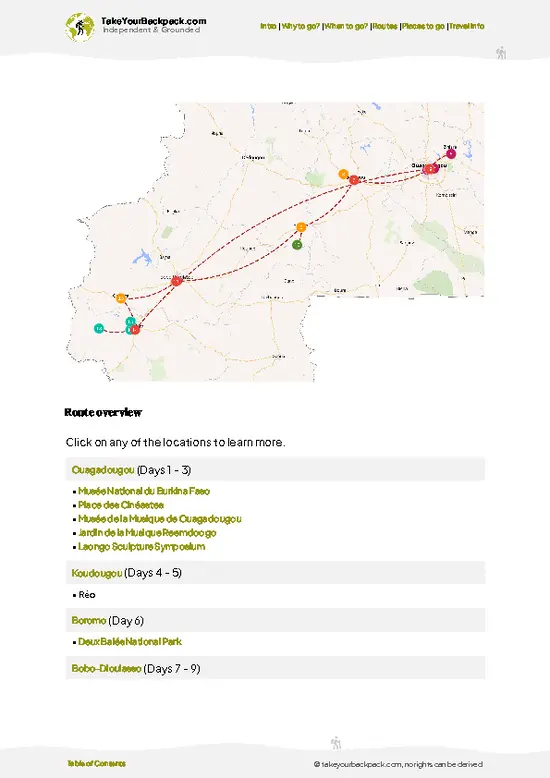
Which regions pair well: The south and west cluster sensibly around Ouagadougou and Bobo-Dioulasso. Ouagadougou to Bobo-Dioulasso is roughly 360 km and takes 5 to 6 hours by bus, with Boromo about halfway. The southern area toward Po is around 2 to 3 hours from the capital by road. A loop works best: start in Ouagadougou, head south, then travel west along the main highway and finish in Bobo-Dioulasso, which has the better onward links toward Mali and Côte d’Ivoire. The east, around Fada N’Gourma (3 to 4 hours from Ouagadougou), should not be built into an independent … read more 👉
Plan on 7 to 10 days: A trip combining several national parks in Burkina Faso needs 7 to 10 days, because slow roads and park access eat far more time than the map suggests. Fewer than 6 days turns the trip into a series of drives.
Which regions pair well: The south and west cluster sensibly around Ouagadougou and Bobo-Dioulasso. Ouagadougou to Bobo-Dioulasso is roughly 360 km and takes 5 to 6 hours by bus, with Boromo about halfway. The southern area toward Po is around 2 to 3 hours from the capital by road. A loop works best: start in Ouagadougou, head south, then travel west along the main highway and finish in Bobo-Dioulasso, which has the better onward links toward Mali and Côte d’Ivoire. The east, around Fada N’Gourma (3 to 4 hours from Ouagadougou), should not be built into an independent itinerary under current security conditions.
Time per stop: Allow 1 to 2 nights at each park. One night covers a dawn and a dusk drive. A third night rarely adds sightings.
Planning mistakes: The commonest error is relying on public buses to reach park gates. Buses stop in towns, and the last 20 to 60 km usually need a hired 4x4, motorbike or arranged pickup, so book it ahead. Another is cramming three parks into four days. Choose two and add a city day for rest. Finally, driving after dark is a poor idea: livestock, unlit trucks and checkpoints make night travel slow and risky.

The ListThe Best national parks of Burkina Faso

1 W National Park

Tapoa River pools, remote border park, armed-ranger walks, big cat tracks

Reach the Tapoa pools at dawn to see hippos and crocodiles, then follow a ranger on foot to read buffalo trails and fresh pugmarks.

2 Arly National Park

Dry-season elephants, Arly river hippos, roan antelope, Pama gateway

Drive through shea and combretum woodland to waterholes where elephant herds gather with calves, then watch hippos leave the Arly river to graze at dusk.

3 Mare aux Hippopotames

Pirogue hippos, Bala fishers, biosphere reserve, reed shoreline

Paddle out at dawn or late afternoon with a local guide, listening for snorts as hippo families surface among reeds beside the fishing village of Bala.

burkina-faso-national-park-mare-aux-hippopotames
© Google |

4 Kaboré Tambi National Park

Closest safari to capital, waterhole elephants, ranger walks, baboon troops

Join a ranger on foot through open woodland, reading tracks and dung, then settle by a shrinking dry-season pool where elephants come to drink and bathe.

5 Nazinga Game Ranch

Elephant ponds, observation towers, Sissili river, Kassena villages

Wait on a raised platform at dusk as elephants and roan antelope take turns at the ponds, then pass painted mud-walled compounds on the road back toward Po.

6 Singou Reserve

Singou waterholes, granite outcrops, near-zero crowds, east Burkina

Climb a low granite rise for long views over flat woodland, then drop to the Singou River where elephants arrive in the late afternoon.

7 Deux Balés National Park

Black Volta banks, gallery forest, Boromo access, riverside birds

Follow sandy tracks with a guide from Boromo to riverbank woodland, where colobus move overhead and elephants leave tracks near the Mouhoun in the dry months.

Loading the map 🌍

Expert viewExpert Commentary on national parks

How many parks: two: Two parks is the right number for most backpackers. Each needs a long approach on poor roads, a hired vehicle and a guide, so a third park mostly adds driving and cost without adding new species. Two lets you compare a western woodland setting with a southern one and still leave time to recover. A single park is fine if your budget is tight.
Which kind to prioritize: For first-timers and budget travelers, pick the smaller, accessible parks in the west and south. They are cheaper to reach, quieter, and your chances of elephants or hippos are reasonable in the dry season. Experienced Africa travelers who want big-landscape wildlife may be tempted by the eastern complex, but it is not worth the risk under current conditions, whatever the guidebook says. Skip any park you cannot … read more 👉
How many parks: two: Two parks is the right number for most backpackers. Each needs a long approach on poor roads, a hired vehicle and a guide, so a third park mostly adds driving and cost without adding new species. Two lets you compare a western woodland setting with a southern one and still leave time to recover. A single park is fine if your budget is tight.
Which kind to prioritize: For first-timers and budget travelers, pick the smaller, accessible parks in the west and south. They are cheaper to reach, quieter, and your chances of elephants or hippos are reasonable in the dry season. Experienced Africa travelers who want big-landscape wildlife may be tempted by the eastern complex, but it is not worth the risk under current conditions, whatever the guidebook says. Skip any park you cannot reach in daylight.
What it costs: Budget US$40 to 70 a day including food, simple lodging and shared transport, and US$120 to 200 a day if you hire a private 4x4 with a driver alone. Foreign visitor entry and a ranger guide usually come to about 10,000 to 25,000 CFA francs (roughly US$17 to 42) per visit. Add vehicle charges, often 40,000 to 100,000 CFA francs (US$67 to 165) a day, which is the cost that surprises people. Share it with other travelers and the total halves. Carry cash in CFA francs, since cards are rarely accepted at gates and ATMs are scarce outside the big towns.
Delays and hidden costs: Fuel and drivers are not available on a whim. Arrange transport and guide the day before, and confirm the price in writing or by message, including the return leg. Waiting at a gate for a ranger who has not been told you are coming can burn half a day. Bring water, snacks and a spare liter of fuel allowance, because park lodging often has limited food.
Safety and conduct: Many foreign governments advise against travel to large parts of Burkina Faso, particularly the east and north. Check your government’s current advisory and local guidance immediately before booking, and be ready to drop a park from the plan. Stay in daylight, avoid unofficial tracks, and register at checkpoints.
Cultural manners: Ask before photographing people, villages or officials, and never photograph military or police. Dress modestly, especially in Muslim areas. Agree on ranger tips (a few thousand CFA francs is normal) rather than guessing. Buy supplies in the nearest village market to put money into local hands.

✈️ The backpacker research shortcutBurkina Faso Travel Guide

An offline-friendly backpacking guide with optimized travel routes, ranked highlights, transport advice, and the best areas to stay.
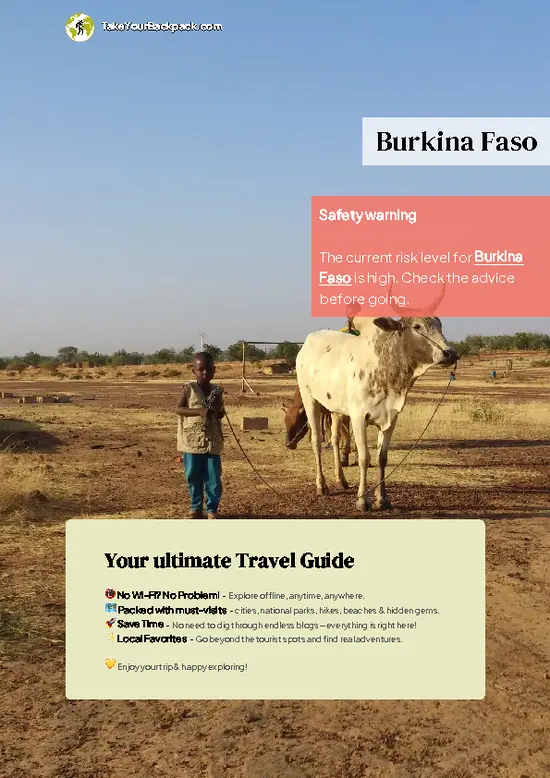
example page 0 from our offline Travel Guide for Burkina Faso
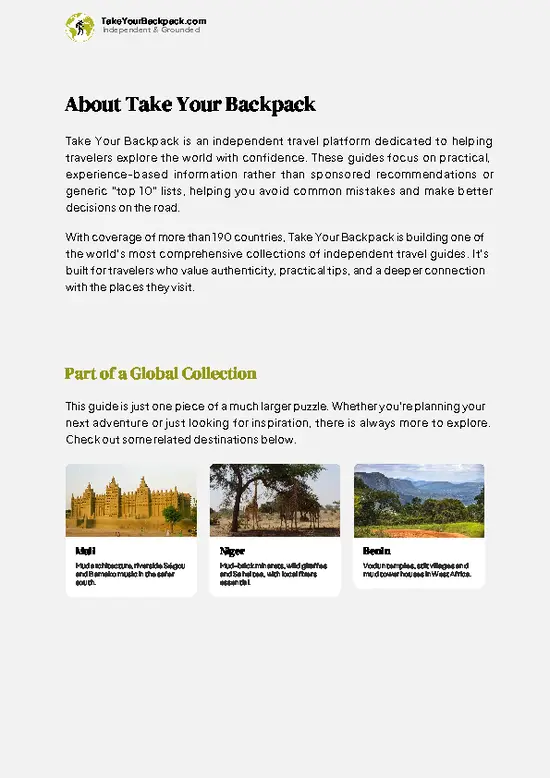
example page 1 from our offline Travel Guide for Burkina Faso
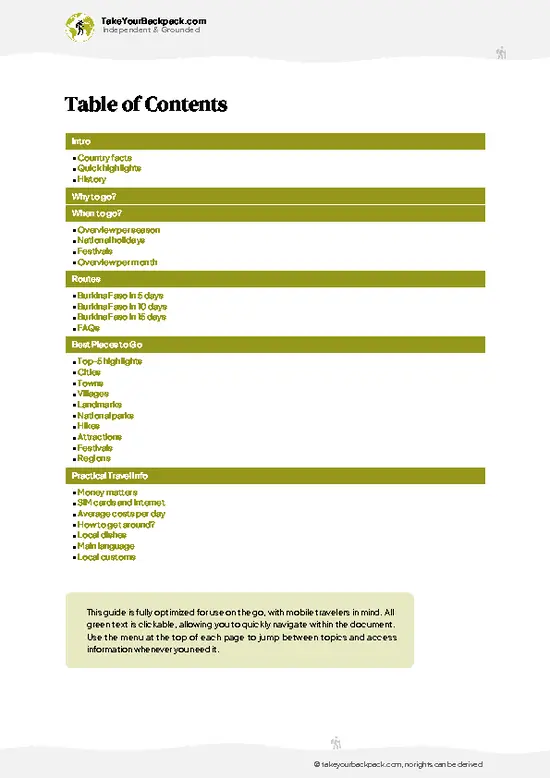
example page 2 from our offline Travel Guide for Burkina Faso
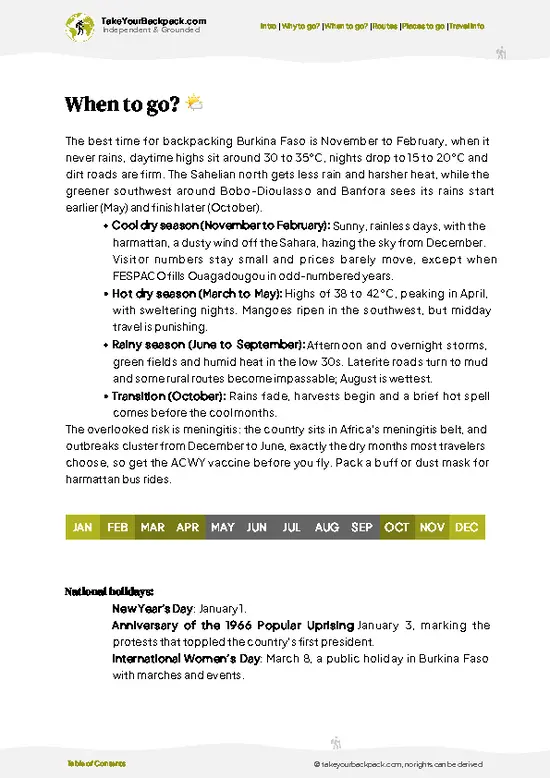
example page 3 from our offline Travel Guide for Burkina Faso
example page 4 from our offline Travel Guide for Burkina Faso
example page 5 from our offline Travel Guide for Burkina Faso
example page 6 from our offline Travel Guide for Burkina Faso
example page 7 from our offline Travel Guide for Burkina Faso
The digital guide (273 pages) contains:
✅ 63 highlights, ranked by travel appeal
✅ Optimized 5, 10 & 15-day travel routes
✅ Cities, national parks, landmarks, beaches
✅ How to get around
✅ Offline-friendly for travel without Wi-Fi
👉 Click to see all 30+ guide features

📅 Plan smarter in minutes, not weeks
✅ Month by month travel advice
✅ Festivals & national holidays
✅ Budget expectations

🗺️ Go to the right places, skip the overrated ones
✅ Honest pros & cons of destinations
✅ Top hikes, parks & viewpoints
✅ Lesser-known places most travelers miss
✅ Clear “worth it vs skip it” guidance

🛏️ Travel smoothly without rookie mistakes
✅ Best areas to stay
✅ Transport systems explained simply
✅ Common scams & safety advice
✅ SIM cards, money & practical tips

🌍 Understand the country, not just visit it
✅ Culture & traditions
✅ 52 Essential phrases & customs
✅ Festivals worth planning around
✅ Traveler-friendly historical context
✅ Insights that make places more meaningful

📱 Built for real travel conditions
✅ Fully downloadable PDF
✅ Works completely offline
✅ Optimized for phone use
✅ Useful in remote areas & buses
✅ Everything in one place
Stop searching, start planning
Get instant access to your full guide. 30‑day money-back guarantee.
+ Add another guide for just

By proceeding you agree to our terms.
Sent to your inbox immediately after payment • 100% Secure Checkout
Best Backpacking Travel Advisor 2025 tourism awardBest Backpacking
Travel Advisor
2025
What others say about Take Your Backpack Guides:
⭐⭐⭐⭐⭐
Fantastic, amazing amount of information!
⭐⭐⭐⭐⭐
My goodness this is amazing, it's what I've been looking for hats off too you!
⭐⭐⭐⭐⭐
I think this is absolutely BRILLIANT
⭐⭐⭐⭐
Very complete and informative. It's still missing places, but I gotta to commend you
⭐⭐⭐⭐⭐
This is truly amazing, thank you, can't wait to explore it with my kids!
⭐⭐⭐⭐⭐
Awesome resource, thank you!
⭐⭐⭐⭐⭐
This is amazing! Can't wait to explore the ones I haven't seen
⭐⭐⭐⭐
I love this! Well done, great idea.
⭐⭐⭐⭐⭐
Thanks for taking the time to make this gem!
⭐⭐⭐⭐⭐
This might be the best website I've ever seen.
⭐⭐⭐⭐⭐
Congratulations, and thank you so much for your work; it's incredibly valuable.
⭐⭐⭐⭐
In all seriousness I think you did a great job pointing out the important spots
⭐⭐⭐⭐⭐
10/10 very good
⭐⭐⭐⭐⭐
As someone who's only just starting to visit regularly this is awesome, thank you.
⭐⭐⭐⭐
Thank you very much! I'm going to visit my dad, it's going to be very useful!
⭐⭐⭐⭐⭐
This is really cool! We'll be travelling for the first time and this definitely come in handy.
⭐⭐⭐⭐⭐
You are now our minister of culture, congratulations 👨‍💼
⭐⭐⭐⭐⭐
Just wanted to tell you that this is a pearl! Going to follow your recommendations.
⭐⭐⭐⭐⭐
This is so cool. I'll definitely be using the resource for my travels soon.
⭐⭐⭐⭐⭐
This is very impressive! Good work.
⭐⭐⭐⭐⭐
This is an amazing and informative site. Very well done!

🛏️ Where to stay?Top Areas to Stay

Backpacker hostels with dorms barely exist in Burkina Faso, so budget travel here means simple auberges, church-run mission guesthouses and basic hotels at roughly 8,000 to 20,000 CFA (US$13 to 33) a night, almost all of them in the two cities still realistic for visitors. In Ouagadougou, the city center around the cathedral and the big avenues puts you near markets, maquis bars and live music but is noisy and dusty. Zone du Bois and Ouaga 2000 are quieter, greener and better guarded, at the cost of higher prices and a taxi ride for everything, while in Bobo-Dioulasso the cheap rooms cluster near the Grand Marché and the train station, walkable to the old Kibidwé quarter and the evening music … read more 👉
Backpacker hostels with dorms barely exist in Burkina Faso, so budget travel here means simple auberges, church-run mission guesthouses and basic hotels at roughly 8,000 to 20,000 CFA (US$13 to 33) a night, almost all of them in the two cities still realistic for visitors. In Ouagadougou, the city center around the cathedral and the big avenues puts you near markets, maquis bars and live music but is noisy and dusty. Zone du Bois and Ouaga 2000 are quieter, greener and better guarded, at the cost of higher prices and a taxi ride for everything, while in Bobo-Dioulasso the cheap rooms cluster near the Grand Marché and the train station, walkable to the old Kibidwé quarter and the evening music scene.

If you enjoy meeting fellow travelers, consider choosing hostels with high ratings for atmosphere. On the other hand, if you prefer having your own space, a hotel might be a better option.

Burkina FasoDiscover the Country

👋 Meet the founderWho’s Behind Take Your Backpack?

Johan, backpacker and founder of TakeYourBackpackHi, I’m Johan (Netherlands 🇳🇱), the creator of TakeYourBackpack. Over the past 3 decades, I’ve backpacked through 90+ countries across six continents, gaining extensive experience with independent travel, long-term trips, and overland routes.

This site is built on a combination of firsthand travel experience and carefully curated insights from other backpackers. Many guides are based on places I’ve personally visited, while others bring together tips, observations, and practical advice shared by trusted travelers I’ve met along the way.

The goal is to provide realistic, experience-driven guidance — not generic itineraries — so you can explore destinations with better context, clearer expectations, and more confidence.