×

Cabo Verde🇨🇻 | regionsSantiagoCidade Velha ruins, Praia plateau, Serra Malagueta highlands, Tarrafal bay | things to do and best time to go

Explore São VicenteExplore Cidade Velha

Backpacking in Santiago
👌 Worth visitingregion ranked #4
By Johan Kruseman 🇳🇱 | Updated October 22, 2026

Most people come to Santiago for Cidade Velha, the first European colonial town in the tropics, and for Praia, the capital, where the island’s energy sits. What gets overlooked is the interior: the Serra Malagueta and the valley farms around Assomada feel like another country from the beach resorts of other islands. Santiago lies in the south of Cabo Verde, the largest island of the archipelago, with Praia at its southern tip. The choice is between staying in Praia and riding out each day, or sleeping in Tarrafal. Praia is cheaper in time and gives you the best transport links, while Tarrafal costs a long shared-van ride but pays you back with a calm bay and a quieter pace. For most backpackers, Praia first, Tarrafal second wins. Before you go, carry small euro notes and change them for escudos at the airport or a bank, since cards are patchy outside the capital.

Discover everything you want to know in the 📖 Cabo Verde Travel Guide.


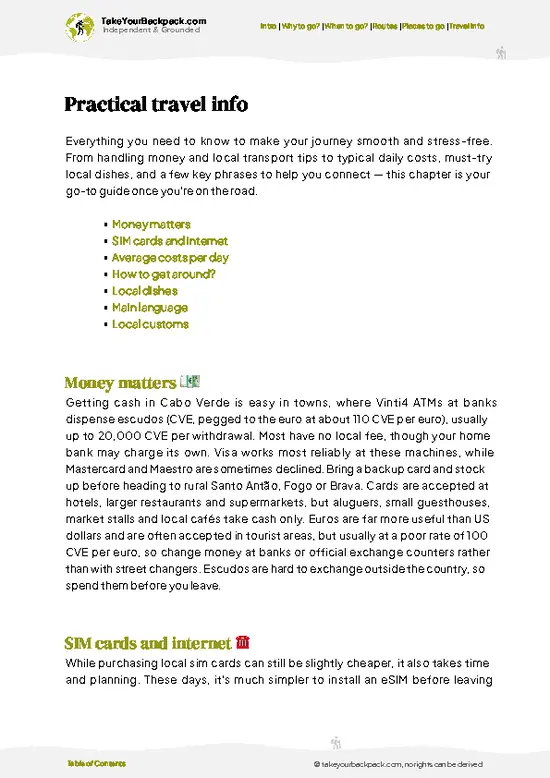
example page 0 from our offline Travel Guide for Cabo Verde
example page 1 from our offline Travel Guide for Cabo Verde
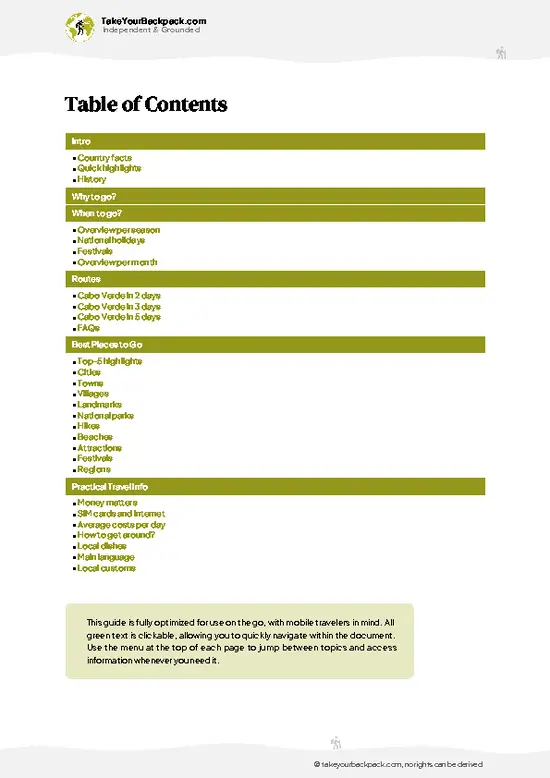
example page 2 from our offline Travel Guide for Cabo Verde
example page 3 from our offline Travel Guide for Cabo Verde
example page 4 from our offline Travel Guide for Cabo Verde
example page 5 from our offline Travel Guide for Cabo Verde
example page 6 from our offline Travel Guide for Cabo Verde
example page 7 from our offline Travel Guide for Cabo Verde
Loading the map 🌍
CLICK TO FILTER
cities
towns
villages
landmarks
national parks
hikes
beaches
attractions
festivals
regions
SHOW COUNTRY’S BESTSHOW ALL

✨ Why go?
Ranked #4 region in Cabo Verde
What sets this place apart

Santiago is the island where Cabo Verde’s African and Portuguese roots show most plainly, and you can see that without constantly changing beds. Praia’s Plateau, the old Creole quarter with its colonial façades, sits within minutes of lively street markets, while Cidade Velha, a UNESCO World Heritage site, lies a short hop along the coast. Music matters here too: batuque and funaná are rooted in Santiago’s countryside, and you hear them in bars and at village festivals rather than only on stage. Then there is the terrain. Within one island you can swim at Tarrafal, hike the cloud-fed Serra Malagueta forest and wander the farm valleys, all linked by aluguer minibuses that fill up and leave at their own pace. That flexibility lets you slow down, stay a week and use two bases rather than six.

💡 HighlightsEssential experiences to have while visiting Santiago

  1. Cidade Velha: the first European colonial settlement in the tropics, with a ruined cathedral, the Rua Banana lane and the Pelourinho pillory where enslaved people were sold. Entry to the fortress is a few euros.
  2. Forte Real de São Filipe: the hilltop fortress above Cidade Velha, with cannons and a wide view over the bay and the roofs below.
  3. Praia Plateau: the old center of the capital, with pastel colonial buildings, the Sucupira market and cafés around Praça Alexandre Albuquerque.
  4. Tarrafal Beach: a calm palm-lined bay on the north coast, with white sand and fishing boats, the island’s best swimming.
  5. Campo de Concentração do Tarrafal: the former colonial prison camp, now a sobering museum with preserved cells.
  6. Serra Malagueta Natural Park: cool, misty highlands with forest trails and sweeping valley
… read more 👉
  1. Cidade Velha: the first European colonial settlement in the tropics, with a ruined cathedral, the Rua Banana lane and the Pelourinho pillory where enslaved people were sold. Entry to the fortress is a few euros.
  2. Forte Real de São Filipe: the hilltop fortress above Cidade Velha, with cannons and a wide view over the bay and the roofs below.
  3. Praia Plateau: the old center of the capital, with pastel colonial buildings, the Sucupira market and cafés around Praça Alexandre Albuquerque.
  4. Tarrafal Beach: a calm palm-lined bay on the north coast, with white sand and fishing boats, the island’s best swimming.
  5. Campo de Concentração do Tarrafal: the former colonial prison camp, now a sobering museum with preserved cells.
  6. Serra Malagueta Natural Park: cool, misty highlands with forest trails and sweeping valley views, rarely crowded.
  7. Assomada Market: the island’s interior hub, loud and busy on market days with produce, spices and household goods.
  8. Rui Vaz: a mountain village in the highlands, known for its cool air, coffee and quiet trails. Few visitors reach it.
  9. Ribeira Principal and Pico do António: the island’s highest point, reached by walking from the village of Pico, with farms below you.
  10. São Domingos Valley: green fields of banana and sugarcane, a farming landscape locals love and tourists rarely visit.
Santiago rewards an early start at Cidade Velha, so do it first, before the heat builds and the tour groups arrive.
Spotted a mistake or missing something? Contact us.

Things to do around Santiago

Ratings based on Tripadvisor reviews. When you book through this link, you support our work at no extra cost to you.

⌛️ 5 daysHow to make the most of Santiago

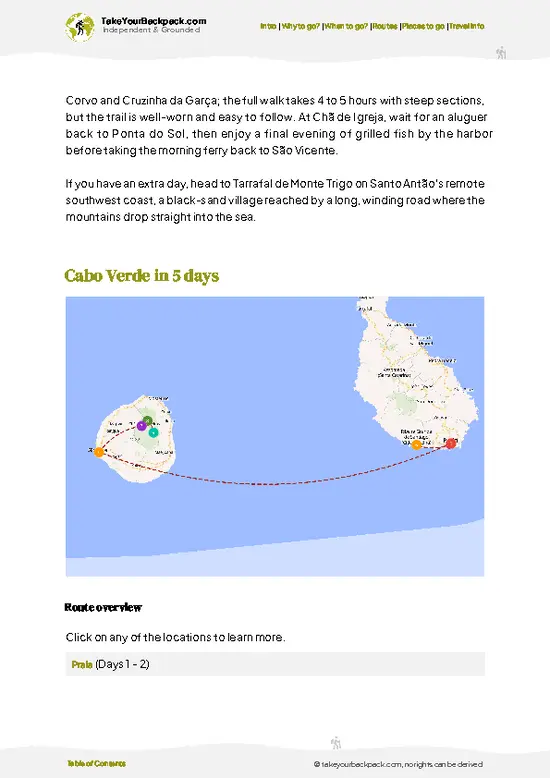
Day 1: Cidade Velha: Start here, because it is the most important site on the island and the morning light is kind to the ruins. Shared minibuses run from Praia, which sets your pace: they leave when full, so plan for waits rather than timetables.
Day 2: Praia: Spend a full day in the capital, walking the Plateau, browsing Sucupira market and eating at a local spot. Praia is where you can book onward travel and sort your cash.
Day 3: Assomada and Serra Malagueta: Head inland by minibus to Assomada, then climb into the cooler highlands. The interior moves slower, with fewer vehicles, so start early and arrange a ride back before dark. A detour to Rui Vaz adds quiet mountain scenery and costs only a few extra hours.
Day 4: Tarrafal: Continue north to the coast and settle in. Beach time here breaks … read more 👉
Day 1: Cidade Velha: Start here, because it is the most important site on the island and the morning light is kind to the ruins. Shared minibuses run from Praia, which sets your pace: they leave when full, so plan for waits rather than timetables.
Day 2: Praia: Spend a full day in the capital, walking the Plateau, browsing Sucupira market and eating at a local spot. Praia is where you can book onward travel and sort your cash.
Day 3: Assomada and Serra Malagueta: Head inland by minibus to Assomada, then climb into the cooler highlands. The interior moves slower, with fewer vehicles, so start early and arrange a ride back before dark. A detour to Rui Vaz adds quiet mountain scenery and costs only a few extra hours.
Day 4: Tarrafal: Continue north to the coast and settle in. Beach time here breaks up the hiking and the camp museum adds context.
Day 5: Tarrafal: Stay put for a slow final day, swimming and eating fresh fish by the bay.
If you can only keep one day, make it Day 1: Cidade Velha holds the story of the whole archipelago.

🌤️ When to go?Seasonal considerations and timing

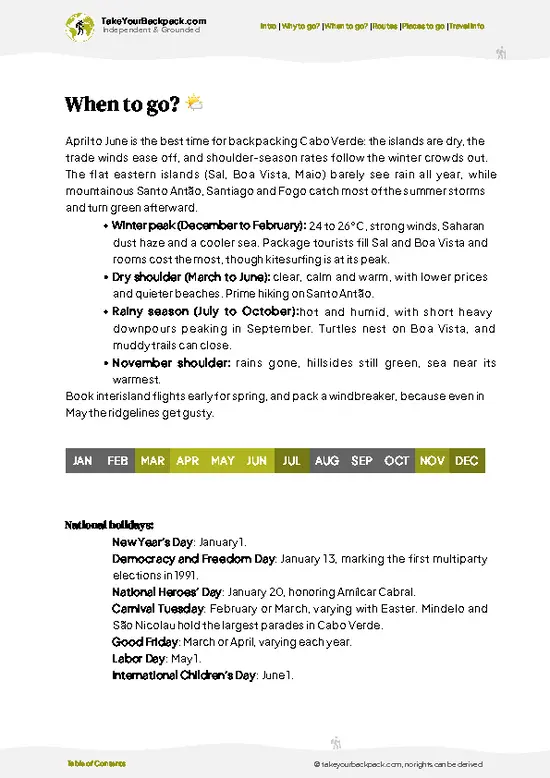
  • November to June (dry, cooler): Santiago stays mostly rain-free, with highs of 24 to 28°C (75 to 82°F) and nights around 19 to 22°C (66 to 72°F). Trade winds keep Praia and the hiking trails comfortable. Daylight runs roughly 11 to 13 hours year-round, so plan hikes for morning.
  • December to February: Europeans arrive for winter sun, and flights and beds in Praia and Tarrafal cost the most. Dust haze from the Sahara (the harmattan) can dull views and sunsets.
  • July to October (hot, wetter): Highs reach 29 to 32°C (84 to 90°F) with humidity, and most of the year’s rain falls in short, heavy bursts, mainly August and September. The interior turns green, which makes Serra Malagueta and Cidade Velha valley walks the prettiest, but dirt roads can wash out. Prices drop and crowds thin.
  • Festivals: Carnival
… read more 👉
  • November to June (dry, cooler): Santiago stays mostly rain-free, with highs of 24 to 28°C (75 to 82°F) and nights around 19 to 22°C (66 to 72°F). Trade winds keep Praia and the hiking trails comfortable. Daylight runs roughly 11 to 13 hours year-round, so plan hikes for morning.
  • December to February: Europeans arrive for winter sun, and flights and beds in Praia and Tarrafal cost the most. Dust haze from the Sahara (the harmattan) can dull views and sunsets.
  • July to October (hot, wetter): Highs reach 29 to 32°C (84 to 90°F) with humidity, and most of the year’s rain falls in short, heavy bursts, mainly August and September. The interior turns green, which makes Serra Malagueta and Cidade Velha valley walks the prettiest, but dirt roads can wash out. Prices drop and crowds thin.
  • Festivals: Carnival in February or March and the Gamboa music festival in Praia (usually May) fill rooms fast.
Book Tarrafal and Praia beds early for February, or come in November for dry trails and quieter rates.


source: climatestotravel.comJANJanuary: excellent for travelingFEBFebruary: excellent for travelingMARMarch: excellent for travelingAPRApril: highly recommended for travelingMAYMay: highly recommended for travelingJUNJune: highly recommended for travelingJULJuly: highly recommended for travelingAUGAugust: fair for travelingSEPSeptember: fair for travelingOCTOctober: fair for travelingNOVNovember: highly recommended for travelingDECDecember: excellent for traveling
when-to-go

✈️ The backpacker research shortcutCabo Verde Travel Guide

An offline-friendly backpacking guide with optimized travel routes, ranked highlights, transport advice, and the best areas to stay.
example page 0 from our offline Travel Guide for Cabo Verde
example page 1 from our offline Travel Guide for Cabo Verde
example page 2 from our offline Travel Guide for Cabo Verde
example page 3 from our offline Travel Guide for Cabo Verde
example page 4 from our offline Travel Guide for Cabo Verde
example page 5 from our offline Travel Guide for Cabo Verde
example page 6 from our offline Travel Guide for Cabo Verde
example page 7 from our offline Travel Guide for Cabo Verde
The digital guide (234 pages) contains:
✅ 57 highlights, ranked by travel appeal
✅ Optimized 2, 3 & 5-day travel routes
✅ Cities, national parks, landmarks, beaches
✅ How to get around
✅ Offline-friendly for travel without Wi-Fi
👉 Click to see all 30+ guide features

📅 Plan smarter in minutes, not weeks
✅ Month by month travel advice
✅ Festivals & national holidays
✅ Budget expectations

🗺️ Go to the right places, skip the overrated ones
✅ Honest pros & cons of destinations
✅ Top hikes, parks & viewpoints
✅ Lesser-known places most travelers miss
✅ Clear “worth it vs skip it” guidance

🛏️ Travel smoothly without rookie mistakes
✅ Best areas to stay
✅ Transport systems explained simply
✅ Common scams & safety advice
✅ SIM cards, money & practical tips

🌍 Understand the country, not just visit it
✅ Culture & traditions
✅ 52 Essential phrases & customs
✅ Festivals worth planning around
✅ Traveler-friendly historical context
✅ Insights that make places more meaningful

📱 Built for real travel conditions
✅ Fully downloadable PDF
✅ Works completely offline
✅ Optimized for phone use
✅ Useful in remote areas & buses
✅ Everything in one place
Stop searching, start planning
Get instant access to your full guide. 30‑day money-back guarantee.
+ Add another guide for just

By proceeding you agree to our terms.
Sent to your inbox immediately after payment • 100% Secure Checkout
Best Backpacking Travel Advisor 2025 tourism awardBest Backpacking
Travel Advisor
2025
What others say about Take Your Backpack Guides:
⭐⭐⭐⭐⭐
Fantastic, amazing amount of information!
⭐⭐⭐⭐⭐
My goodness this is amazing, it's what I've been looking for hats off too you!
⭐⭐⭐⭐⭐
I think this is absolutely BRILLIANT
⭐⭐⭐⭐
Very complete and informative. It's still missing places, but I gotta to commend you
⭐⭐⭐⭐⭐
This is truly amazing, thank you, can't wait to explore it with my kids!
⭐⭐⭐⭐⭐
Awesome resource, thank you!
⭐⭐⭐⭐⭐
This is amazing! Can't wait to explore the ones I haven't seen
⭐⭐⭐⭐
I love this! Well done, great idea.
⭐⭐⭐⭐⭐
Thanks for taking the time to make this gem!
⭐⭐⭐⭐⭐
This might be the best website I've ever seen.
⭐⭐⭐⭐⭐
Congratulations, and thank you so much for your work; it's incredibly valuable.
⭐⭐⭐⭐
In all seriousness I think you did a great job pointing out the important spots
⭐⭐⭐⭐⭐
10/10 very good
⭐⭐⭐⭐⭐
As someone who's only just starting to visit regularly this is awesome, thank you.
⭐⭐⭐⭐
Thank you very much! I'm going to visit my dad, it's going to be very useful!
⭐⭐⭐⭐⭐
This is really cool! We'll be travelling for the first time and this definitely come in handy.
⭐⭐⭐⭐⭐
You are now our minister of culture, congratulations 👨‍💼
⭐⭐⭐⭐⭐
Just wanted to tell you that this is a pearl! Going to follow your recommendations.
⭐⭐⭐⭐⭐
This is so cool. I'll definitely be using the resource for my travels soon.
⭐⭐⭐⭐⭐
This is very impressive! Good work.
⭐⭐⭐⭐⭐
This is an amazing and informative site. Very well done!

🛏️ Where to stay?Best areas to stay in Cabo Verde

Praia is the best base on Santiago, with the island’s widest choice of budget beds and the easiest links to every other corner. Stay in the Plateau, the old center, or around Prainha for walkable streets, cafés, live music in the evening and a good chance of meeting other travelers. Beds here start around €10 to 15 in dorms and €25 to 40 for private rooms. Nights are lively but safe enough in central areas if you stick to lit streets and take a taxi late.
Tarrafal, in the north, is the island’s laid-back beach town, and it is the most social spot for backpackers. A curved white-sand bay, small … read more 👉
Praia is the best base on Santiago, with the island’s widest choice of budget beds and the easiest links to every other corner. Stay in the Plateau, the old center, or around Prainha for walkable streets, cafés, live music in the evening and a good chance of meeting other travelers. Beds here start around €10 to 15 in dorms and €25 to 40 for private rooms. Nights are lively but safe enough in central areas if you stick to lit streets and take a taxi late.
Tarrafal, in the north, is the island’s laid-back beach town, and it is the most social spot for backpackers. A curved white-sand bay, small guesthouses and relaxed bars make it easy to stay several nights. Prices run a little lower than in Praia, roughly €15 to 35, and it is the place for swimming, snorkeling and slow evenings.
Cidade Velha suits a night or two if you want quiet. It is a small UNESCO-listed village with a handful of guesthouses, fewer people and an early bedtime. Assomada, the island’s inland market town, offers local life and cheap rooms but little traveler scene, so treat it as a stopover on the way north.

🚌 Getting aroundHow to get around Santiago

Taking a taxi for every leg, including the long hauls between Praia and Tarrafal, is the habit that drains wallets fastest on Santiago. The island’s real backbone is the shared minibus, called an alta-alta in Creole, and once you learn how to flag one, you move like a local for a fraction of the price. It is not always punctual, but on the main roads it is dependable.
  • Alta-alta minibuses: These are the best option for a backpacker. A ride from Praia to Assomada takes about 1 hour and costs around €1.50, and to Tarrafal about 2 hours for €2 to 3. They leave when full, so go early in the morning, before 10, when departures are frequent. Comfort is basic and bags go on your lap, but nothing else comes close on value.
  • City taxis: Within Praia, a short hop costs about €1 to 2 at a fixed rate, and
… read more 👉
Taking a taxi for every leg, including the long hauls between Praia and Tarrafal, is the habit that drains wallets fastest on Santiago. The island’s real backbone is the shared minibus, called an alta-alta in Creole, and once you learn how to flag one, you move like a local for a fraction of the price. It is not always punctual, but on the main roads it is dependable.
  • Alta-alta minibuses: These are the best option for a backpacker. A ride from Praia to Assomada takes about 1 hour and costs around €1.50, and to Tarrafal about 2 hours for €2 to 3. They leave when full, so go early in the morning, before 10, when departures are frequent. Comfort is basic and bags go on your lap, but nothing else comes close on value.
  • City taxis: Within Praia, a short hop costs about €1 to 2 at a fixed rate, and you can share with others going your way. Agree on the price before you get in. They make sense at night or when you carry a heavy pack, otherwise they add up quickly.
  • Aluguer to remote villages: Pickups and vans reach Serra Malagueta, Rui Vaz and mountain hamlets, usually €1 to 3. They are slow, crowded and bumpy, yet they get you to trailheads buses ignore. Ask the driver what time the last one returns.
  • Private day taxis: Hiring one for a day of sights, for example Cidade Velha, Assomada and Tarrafal, runs roughly €60 to 90. Split among three or four people, it becomes a smart choice for places the minibuses skip, with much more comfort than public rides.
  • Ferries and flights: Boats and short flights link Praia to Fogo and other islands. Ferry fares are about €20 to 40 and the schedule changes, so confirm the day before.
Carry small coins and notes, since drivers rarely have change, and ask a local at the stop which van is yours. They will happily point you to the right one.

🍲 FoodWhat to Eat & Drink

Cachupa is the dish to start with, a slow-cooked stew of hominy corn, beans, cassava and pork or fish. On Santiago, the morning-after version, cachupa frita, is pan-fried until crisp and topped with a fried egg. It is salty, smoky and deeply filling, and costs around €3 to 5.
Grilled tuna and fresh wahoo appear with rice and boiled sweet potato, and pastel, a deep-fried pastry stuffed with tuna, is the snack you will see everywhere. Look for goat stew in the interior hills, and cuscuz with butter and sugar at breakfast.
For drinking, grogue, the raw sugarcane spirit, is strong and grassy, and ponche blends it with molasses or fruit for a sweeter, smoother sip. Local beers like Strela are cheap and cold. Try the espresso and warm bread at corner cafés.
Backpackers eat best at the Sucupira market … read more 👉
Cachupa is the dish to start with, a slow-cooked stew of hominy corn, beans, cassava and pork or fish. On Santiago, the morning-after version, cachupa frita, is pan-fried until crisp and topped with a fried egg. It is salty, smoky and deeply filling, and costs around €3 to 5.
Grilled tuna and fresh wahoo appear with rice and boiled sweet potato, and pastel, a deep-fried pastry stuffed with tuna, is the snack you will see everywhere. Look for goat stew in the interior hills, and cuscuz with butter and sugar at breakfast.
For drinking, grogue, the raw sugarcane spirit, is strong and grassy, and ponche blends it with molasses or fruit for a sweeter, smoother sip. Local beers like Strela are cheap and cold. Try the espresso and warm bread at corner cafés.
Backpackers eat best at the Sucupira market in Praia, at small tasca eateries serving a set plate of the day for €4 to 7, and at beachfront shacks in Tarrafal. Lunch is the main meal, and kitchens often run out by mid-afternoon. Greet everyone when you enter, expect unhurried service, and ask for the bill, since it will not arrive by itself.

FAQFrequently asked questions about Santiago

Plan on 5 to 7 days for Santiago, the largest island in Cabo Verde. Two days in Praia cover the Plateau, the Sucupira market and the Cidade Velha fortress (entry about €4 to 5), then a day for Tarrafal’s beach in the north and a day for the Serra Malagueta hiking trails. Add a day for Assomada’s Thursday-to-Saturday market and the Rui Vaz highlands if you want a slower pace.
Santiago works well without a car thanks to the shared minibuses called “yaka” (hiaces), which run from Praia to Cidade Velha (about 30 minutes, €0.80 to 1), Assomada (1 hour, around €1.80 to 2.50) and Tarrafal (2 to 2.5 hours, around €3 to 4). They leave when full, so go early in the morning, as services thin out by late afternoon. Taxis within Praia cost roughly €1.50 to 3 for a short hop, and a private ride to the airport is about €4 to 6.
Santiago is known for Cidade Velha, the first European colonial town in the tropics and a UNESCO World Heritage Site, and for Praia, the capital of Cabo Verde. It is also the cradle of batuku and funaná, rhythms you hear at festivals and in Praia’s evening bars, and the island carries the deepest African roots in the archipelago. Beyond the culture, expect the Serra Malagueta mountain hikes at about 1,000 meters, Tarrafal’s calm white-sand bay and cachupa, the national corn-and-bean stew, served for around €3 to 5.
⚠️ Things can change over time, so always validate details locally before you go.

Other Cape Verdean regions near Santiago

Explore more nearby:

  • Sal—Salt crater floats, Santa Maria pier, kitesurf wind, flat desert interior| 192 km away
  • São Vicente—Mindelo live morna, fish market, Rua de Lisboa bars, Monte Verde views| 254 km away
  • Santo Antão—Cobbled Corda road, Paul valley descent, cane terraces, grogue distilleries| 281 km away

💡 Not sure where to go next?
Create a personalized itinerary for Cabo Verde including Santiago and the places that fit your trip.

Generate my itinerary

👉 Discover all regions

Or checkout all Cabo Verde has to offer (think cities, towns, villages, national parks, hikes, beaches, festivals)
Country photo of Cabo Verde

We 💚 feedbackIs it worth it?

Santiago trips go wrong when travelers treat the island as a Praia day trip and leave. I would sleep at least two nights in Tarrafal and one in the highlands, where the air is cool and the pace slows. Bring small bills and patience for the minibuses.

✍️ Help improve this page!
The information on this page is based on in-depth research, insights shared by experienced travelers, and feedback from the local travel community in Cabo Verde. While every effort is made to keep the information accurate and current, conditions can change — so if you spot anything incorrect or outdated, please get in touch.


🙋‍♂️ Give feedback

👋 Meet the founderWho’s Behind Take Your Backpack?

Johan, backpacker and founder of TakeYourBackpackHi, I’m Johan (Netherlands 🇳🇱), the creator of TakeYourBackpack. Over the past 3 decades, I’ve backpacked through 90+ countries across six continents, gaining extensive experience with independent travel, long-term trips, and overland routes.

This site is built on a combination of firsthand travel experience and carefully curated insights from other backpackers. Many guides are based on places I’ve personally visited, while others bring together tips, observations, and practical advice shared by trusted travelers I’ve met along the way.

The goal is to provide realistic, experience-driven guidance — not generic itineraries — so you can explore destinations with better context, clearer expectations, and more confidence.