×

Cameroon🇨🇲 | national parksMbam et Djerem National ParkDjerem and Mbam rivers, bush camps, savanna elephant sign, gallery forest | things to do and best time to go

Explore Waza National ParkExplore Faro National Park

Backpacking in Mbam et Djerem
👌 Worth visitingnational park ranked #11
By Johan Kruseman 🇳🇱 | Updated October 22, 2026

Mbam et Djerem National Park has almost no tourist infrastructure, and the nearest reliable cash machines are in towns well away from the gate, so you arrive carrying everything. It lies in the Centre Region of Cameroon, northeast of Yaoundé, where forest meets savanna along the Mbam and Djerem rivers. Expect red dust, the hum of cicadas, damp leaf smell and elephants you hear before you see. Hiking is guided, wildlife is shy, and roads turn to soup in the rains, so pad your schedule by a day and bring cash in small bills. Self-reliant travelers who like rough edges will love it. Anyone wanting lodges, set trails and certainty should skip it.

Discover everything you want to know in the 📖 Cameroon Travel Guide.


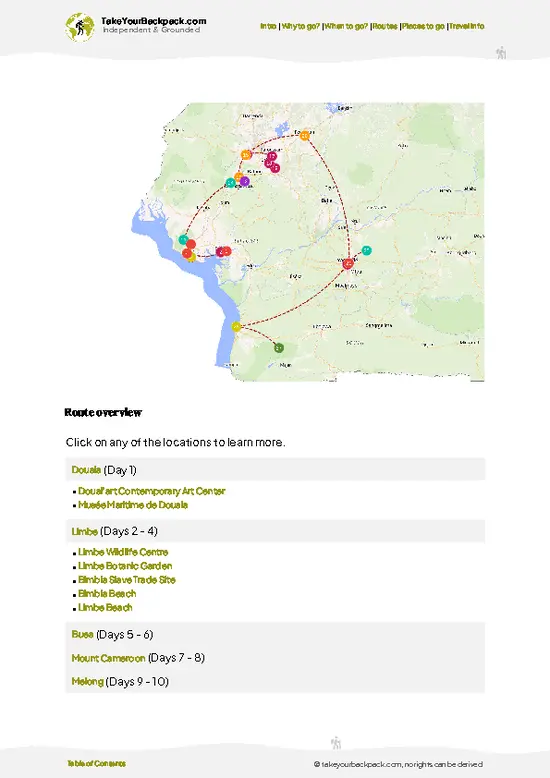
example page 0 from our offline Travel Guide for Cameroon
example page 1 from our offline Travel Guide for Cameroon
example page 2 from our offline Travel Guide for Cameroon
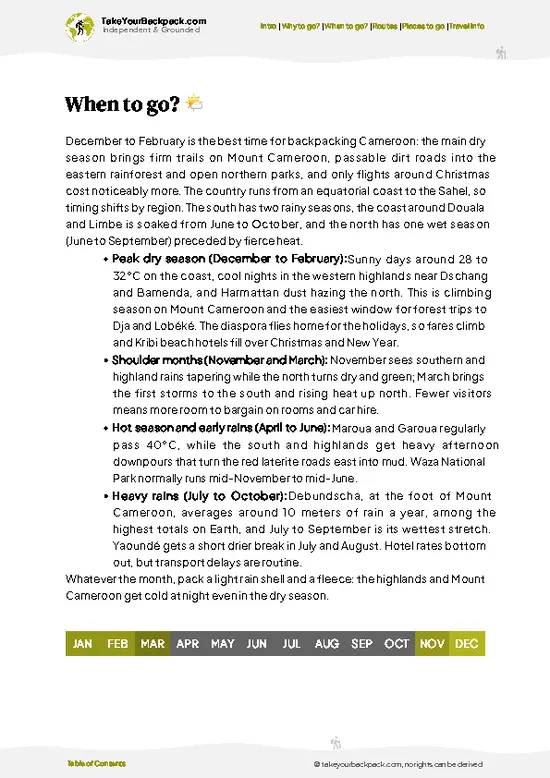
example page 3 from our offline Travel Guide for Cameroon
example page 4 from our offline Travel Guide for Cameroon
example page 5 from our offline Travel Guide for Cameroon
example page 6 from our offline Travel Guide for Cameroon
example page 7 from our offline Travel Guide for Cameroon
Loading the map 🌍
CLICK TO FILTER
cities
towns
landmarks
national parks
hikes
beaches
attractions
festivals
regions
SHOW COUNTRY’S BESTSHOW ALL

✨ Why go?
Ranked #11 national park in Cameroon
What sets this place apart

Mbam et Djerem National Park draws backpackers who want wild Cameroon without a crowd. You will likely share the savanna with rangers and villagers, not tour buses. Two reasons stand out. First, the mosaic of habitats: forest-savanna transition means one morning can take you from open grassland to gallery forest, with chances of elephants, buffalo, red-flanked duikers and several primates. Second, the Mbam and Djerem rivers shape everything, giving you water-edge walks and birding that suit slow, self-directed exploring. This is not a park for tours with fixed itineraries. It suits travelers comfortable arranging local guides, camping basics and flexible plans, and who value remoteness over polish.

💡 HighlightsWhat this place is best known for

  1. Djerem River banks: The park’s defining water, lined with gallery forest where you can watch for hippos, monitor lizards and kingfishers at the edge.
  2. Mbam River confluence area: Wide, slow water and sandy margins that attract birds and offer open views across the park’s western edge.
  3. Savanna grasslands: Tall, golden grass with scattered trees, the best habitat for buffalo and antelope, with elephant sign such as dung and flattened paths.
  4. Gallery forest walks: Shaded corridors beside the rivers, cooler and loud with insects and birds, where primates move through the canopy.
  5. Elephant tracking: Rangers read footprints and broken branches to find the park’s forest and savanna elephants. Sightings are never promised, but the tracks are fascinating.
  6. Birdwatching: Hornbills, bee-eaters and raptors work
… read more 👉
  1. Djerem River banks: The park’s defining water, lined with gallery forest where you can watch for hippos, monitor lizards and kingfishers at the edge.
  2. Mbam River confluence area: Wide, slow water and sandy margins that attract birds and offer open views across the park’s western edge.
  3. Savanna grasslands: Tall, golden grass with scattered trees, the best habitat for buffalo and antelope, with elephant sign such as dung and flattened paths.
  4. Gallery forest walks: Shaded corridors beside the rivers, cooler and loud with insects and birds, where primates move through the canopy.
  5. Elephant tracking: Rangers read footprints and broken branches to find the park’s forest and savanna elephants. Sightings are never promised, but the tracks are fascinating.
  6. Birdwatching: Hornbills, bee-eaters and raptors work the mix of forest and open ground, best in early morning.
  7. Ranger-led bush camps: Simple overnight stops that let you hear the park after dark, from frogs to distant calls.
Mbam et Djerem National Park has no ticket system for individual sights, but guides and permission from park staff should be arranged ahead of arrival.
Spotted a mistake or missing something? Contact us.

🌤️ When to go?Choosing the right time of year

  • Main Dry Season (November to February): Tracks are firmest and rivers lowest, so this is when most research teams and the rare visitors arrive. Days reach 28 to 33°C (82 to 91°F), nights 18 to 21°C (64 to 70°F), with about 12 hours of daylight. Harmattan haze can dull views.
  • Short Dry Spell (July to August): Cloudier and cooler at 22 to 28°C (72 to 82°F), with lighter rain. Doable, but mud lingers.
  • Rainy Seasons (March to June, September to October): Heavy downpours turn the laterite roads to slick clay, and river crossings can stop vehicles. Humidity is high and leeches and insects multiply.
Local guides and transport cost about the same year-round, but book a driver early for the dry months, when vehicles are scarce.

source: climatestotravel.comJANJanuary: excellent for travelingFEBFebruary: excellent for travelingMARMarch: fair for travelingAPRApril: fair for travelingMAYMay: fair for travelingJUNJune: fair for travelingJULJuly: fair for travelingAUGAugust: fair for travelingSEPSeptember: fair for travelingOCTOctober: fair for travelingNOVNovember: excellent for travelingDECDecember: excellent for traveling
when-to-go

✈️ The backpacker research shortcutCameroon Travel Guide

An offline-friendly backpacking guide with optimized travel routes, ranked highlights, transport advice, and the best areas to stay.
example page 0 from our offline Travel Guide for Cameroon
example page 1 from our offline Travel Guide for Cameroon
example page 2 from our offline Travel Guide for Cameroon
example page 3 from our offline Travel Guide for Cameroon
example page 4 from our offline Travel Guide for Cameroon
example page 5 from our offline Travel Guide for Cameroon
example page 6 from our offline Travel Guide for Cameroon
example page 7 from our offline Travel Guide for Cameroon
The digital guide (351 pages) contains:
✅ 84 highlights, ranked by travel appeal
✅ Optimized 7, 14 & 21-day travel routes
✅ Cities, national parks, landmarks, beaches
✅ How to get around
✅ Offline-friendly for travel without Wi-Fi
👉 Click to see all 30+ guide features

📅 Plan smarter in minutes, not weeks
✅ Month by month travel advice
✅ Festivals & national holidays
✅ Budget expectations

🗺️ Go to the right places, skip the overrated ones
✅ Honest pros & cons of destinations
✅ Top hikes, parks & viewpoints
✅ Lesser-known places most travelers miss
✅ Clear “worth it vs skip it” guidance

🛏️ Travel smoothly without rookie mistakes
✅ Best areas to stay
✅ Transport systems explained simply
✅ Common scams & safety advice
✅ SIM cards, money & practical tips

🌍 Understand the country, not just visit it
✅ Culture & traditions
✅ 52 Essential phrases & customs
✅ Festivals worth planning around
✅ Traveler-friendly historical context
✅ Insights that make places more meaningful

📱 Built for real travel conditions
✅ Fully downloadable PDF
✅ Works completely offline
✅ Optimized for phone use
✅ Useful in remote areas & buses
✅ Everything in one place
Stop searching, start planning
Get instant access to your full guide. 30‑day money-back guarantee.
+ Add another guide for just

By proceeding you agree to our terms.
Sent to your inbox immediately after payment • 100% Secure Checkout
Best Backpacking Travel Advisor 2025 tourism awardBest Backpacking
Travel Advisor
2025
What others say about Take Your Backpack Guides:
⭐⭐⭐⭐⭐
Fantastic, amazing amount of information!
⭐⭐⭐⭐⭐
My goodness this is amazing, it's what I've been looking for hats off too you!
⭐⭐⭐⭐⭐
I think this is absolutely BRILLIANT
⭐⭐⭐⭐
Very complete and informative. It's still missing places, but I gotta to commend you
⭐⭐⭐⭐⭐
This is truly amazing, thank you, can't wait to explore it with my kids!
⭐⭐⭐⭐⭐
Awesome resource, thank you!
⭐⭐⭐⭐⭐
This is amazing! Can't wait to explore the ones I haven't seen
⭐⭐⭐⭐
I love this! Well done, great idea.
⭐⭐⭐⭐⭐
Thanks for taking the time to make this gem!
⭐⭐⭐⭐⭐
This might be the best website I've ever seen.
⭐⭐⭐⭐⭐
Congratulations, and thank you so much for your work; it's incredibly valuable.
⭐⭐⭐⭐
In all seriousness I think you did a great job pointing out the important spots
⭐⭐⭐⭐⭐
10/10 very good
⭐⭐⭐⭐⭐
As someone who's only just starting to visit regularly this is awesome, thank you.
⭐⭐⭐⭐
Thank you very much! I'm going to visit my dad, it's going to be very useful!
⭐⭐⭐⭐⭐
This is really cool! We'll be travelling for the first time and this definitely come in handy.
⭐⭐⭐⭐⭐
You are now our minister of culture, congratulations 👨‍💼
⭐⭐⭐⭐⭐
Just wanted to tell you that this is a pearl! Going to follow your recommendations.
⭐⭐⭐⭐⭐
This is so cool. I'll definitely be using the resource for my travels soon.
⭐⭐⭐⭐⭐
This is very impressive! Good work.
⭐⭐⭐⭐⭐
This is an amazing and informative site. Very well done!

🛏️ Where to stay?Choosing the right base

No developed lodging exists inside Mbam et Djerem National Park, so most travelers sleep in Ngambe-Tikar, the town on the park’s western side, or in Tibati to the north. Both have simple guesthouses (auberges) with fan rooms and shared or basic private bathrooms, typically €6 to 15 a night. Electricity and water can be intermittent, so carry a headlamp and a water filter.

For longer visits, the park’s ecotourism setup lets you camp near the Ndjim and Mbam river areas with a local guide and your own tent, food and cooking gear. Villages around the edge sometimes arrange a spare room or a space … read more 👉
No developed lodging exists inside Mbam et Djerem National Park, so most travelers sleep in Ngambe-Tikar, the town on the park’s western side, or in Tibati to the north. Both have simple guesthouses (auberges) with fan rooms and shared or basic private bathrooms, typically €6 to 15 a night. Electricity and water can be intermittent, so carry a headlamp and a water filter.

For longer visits, the park’s ecotourism setup lets you camp near the Ndjim and Mbam river areas with a local guide and your own tent, food and cooking gear. Villages around the edge sometimes arrange a spare room or a space to pitch.

If you need more comfort, Yaoundé, the capital, is the main base for permits, supplies and cash. Bring enough cash before heading out, since ATMs in the small towns are unreliable.

👛 Costs (as of 22 October 2026)Travel costs and budget guide for Mbam et Djerem

Mbam et Djerem National Park costs roughly €38 to 70 a day for a backpacker, driven mainly by guide and transport fees.
CategoryBudget RangeLocal Reality
Entrance and guide fees€8 to 15Park fees and a mandatory local guide, paid in cash in local currency.
Accommodation (high season)€6 to 15Basic guesthouses in Ngambe-Tikar or Tibati; camping costs less but needs your own gear.
Local transport€10 to 25Shared taxis and motorbike rides on rough roads; hiring a vehicle costs much more.
Food and supplies€5 to 10Rice, plantain, grilled fish and stews in small eateries; stock up on camping food in larger towns.
Total Daily Budget€38 to 70Higher if you hire a private vehicle.
⚠️ Prices can change and everyone travels differently, so take this as a rough guide. Hope it helps you plan your adventure!

🥾 TrailsDiscover Mbam et Djerem's top trails and natural wonders

Mbam et Djerem National Park is explored on foot with rangers and local guides, since there are no signed, measured trails to follow alone. Terrain alternates between open savanna, rolling grassland, riverbank and shaded gallery forest.
  • River-edge walks: Easy, flat and usually two to four hours, following the Djerem or Mbam banks for birds, hippos and monkeys.
  • Savanna loops: Moderate, with little shade and strong sun. Allow half a day and carry plenty of water. Expect buffalo, antelope and elephant sign.
  • Forest patches: Slower going on uneven, root-laced ground, often muddy after rain. Good for primates
… read more 👉
Mbam et Djerem National Park is explored on foot with rangers and local guides, since there are no signed, measured trails to follow alone. Terrain alternates between open savanna, rolling grassland, riverbank and shaded gallery forest.
  • River-edge walks: Easy, flat and usually two to four hours, following the Djerem or Mbam banks for birds, hippos and monkeys.
  • Savanna loops: Moderate, with little shade and strong sun. Allow half a day and carry plenty of water. Expect buffalo, antelope and elephant sign.
  • Forest patches: Slower going on uneven, root-laced ground, often muddy after rain. Good for primates and butterflies.
  • Multi-day guided treks: Challenging because of heat, distance and basic camping, with the best chance of elephants.
Reaching the park takes effort. Public transport gets you to towns near the boundary, and from there you usually need a motorbike taxi or arranged vehicle on dirt tracks that worsen in the rains. Crowds are essentially absent. Entry involves a park fee payable in local currency, roughly €5 to 10, and a guide or ranger escort is expected, so ask at the conservation office or local contacts before heading in.
⚠️ Hiking info can sometimes be outdated or inaccurate. Before you hit the trail, check the latest conditions with locals. If you do spot anything that's off, I'd love to hear from you, so I can update it for fellow travelers.

🛡️ SafetyScams, Hazards, and Annoyances

Mbam et Djerem is remote and lightly managed, so self-reliance matters more than any single hazard. Go with a local guide who knows the savanna and gallery forest tracks, because trails are faint and signs are rare. Rain makes roads and river crossings the biggest trouble, so avoid the wet months and carry spare time. Heat is intense, so walk early, drink often and use a filter. Elephants, buffalo and primates live here, along with snakes and tsetse flies. Keep distance, never approach elephants, and wear long, light clothing. Malaria is present year-round, so take prophylaxis and a net. Carry a first aid kit, since clinics are far away. Check the local security situation before traveling north or east.

FAQTraveler FAQ

Plan on 3 to 5 days for Mbam et Djerem National Park, including travel time. Reaching Ngambe-Tikar or Tibati from Yaoundé takes most of a day by road, and a guided savanna and forest walk needs at least 2 days on site. Add a day in the rainy months for slow roads.
Mbam et Djerem National Park is hard to visit without a car, but not impossible. Shared taxis and minibuses run from Yaoundé to Ngambe-Tikar or Tibati, and motorbike taxis cover the last stretch toward the park edge. Inside, you travel on foot with a local guide, so a hired vehicle is mainly useful for reaching remote entry points.
Yes, Mbam et Djerem National Park charges fees, and you should arrange access through the park’s conservation service or the forestry ministry in Yaoundé. Expect roughly €8 to 15 a day for entry and a required local guide, paid in cash. Camping inside needs prior authorization, so confirm everything in Ngambe-Tikar before you set off.
⚠️ Things can change over time, so always validate details locally before you go.

Other Cameroonian national parks near Mbam et Djerem

Explore more nearby:

  • Deng Deng National Park—Lowland gorillas, Lom reservoir, forest-savanna edge, improvised trekking| 97 km away
  • Faro National Park—Faro River, gallery forest, rocky escarpments, Nigerian frontier views| 263 km away
  • Mefou National Park—Rescued apes, mandrill faces, short forest paths, caretaker feeding rounds| 276 km away

💡 Not sure where to go next?
Create a personalized itinerary for Cameroon including Mbam et Djerem and the places that fit your trip.

Generate my itinerary

👉 Discover all national parks

Or checkout all Cameroon has to offer (think cities, towns, villages, national parks, hikes, beaches, festivals)
Country photo of Cameroon

We 💚 feedbackIs it worth it?

Mbam et Djerem National Park rewards those who talk to rangers first. They know where the elephants crossed yesterday, and that beats any map. I would bring a headlamp, spare cash and patience, then walk at first light when the grass is wet and the air is still cool.

✍️ Help improve this page!
The information on this page is based on in-depth research, insights shared by experienced travelers, and feedback from the local travel community in Cameroon. While every effort is made to keep the information accurate and current, conditions can change — so if you spot anything incorrect or outdated, please get in touch.


🙋‍♂️ Give feedback

👋 Meet the founderWho’s Behind Take Your Backpack?

Johan, backpacker and founder of TakeYourBackpackHi, I’m Johan (Netherlands 🇳🇱), the creator of TakeYourBackpack. Over the past 3 decades, I’ve backpacked through 90+ countries across six continents, gaining extensive experience with independent travel, long-term trips, and overland routes.

This site is built on a combination of firsthand travel experience and carefully curated insights from other backpackers. Many guides are based on places I’ve personally visited, while others bring together tips, observations, and practical advice shared by trusted travelers I’ve met along the way.

The goal is to provide realistic, experience-driven guidance — not generic itineraries — so you can explore destinations with better context, clearer expectations, and more confidence.