×

Central African Republic🇨🇫 | attractionsPK5 MarketSmoked river fish, moto-parts stalls, money changers, treadle tailors | things to do and best time to go

Explore Bangui Central MarketExplore Bangui Riverfront

Backpacking in PK5 Market
👌 Worth visitingattraction ranked #6
By Johan Kruseman 🇳🇱 | Updated October 22, 2026

PK5 Market gives you the quickest route into how Bangui actually trades, because everything from cassava and smoked fish to phone credit and secondhand shoes sits within a few crowded lanes. It lies in the PK5 district of the Central African Republic’s capital, a short ride from the city center. The crowds are tight and loud, and you will be watched as an outsider. Prices for food and cloth are low, but taxi fares and the fee for a local guide add up, and photos without permission cause trouble. Skip souvenir hunting here, since little is made for visitors. Spend your time on the produce stalls, the tailors running treadle machines, and the music and chatter that spill from every corner. Arrive mid-morning with a local contact, walk one loop of the main lanes, eat something grilled, and be out before the afternoon heat.

Discover everything you want to know in the 📖 Central African Republic Travel Guide.
Safety warning

The current risk level for Central African Republic is high. Check the advice before going.


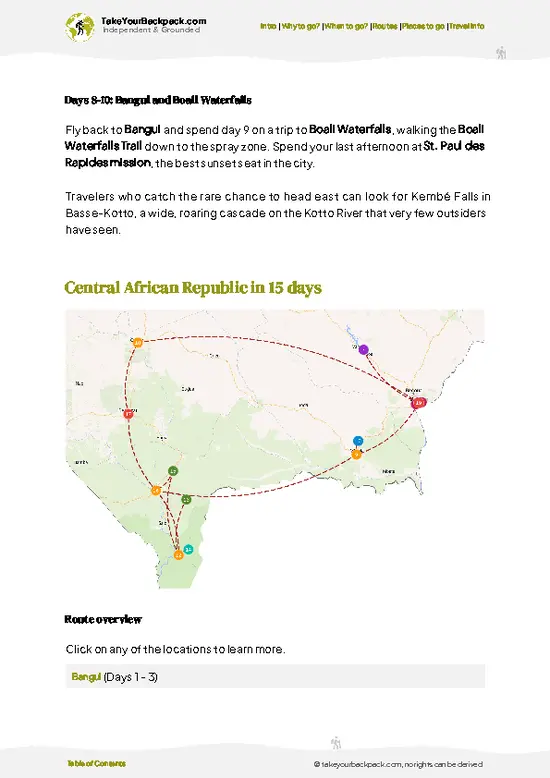
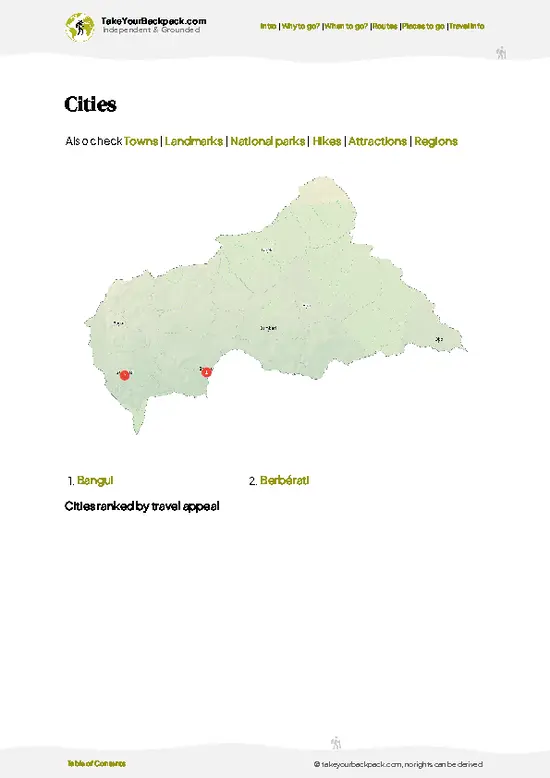
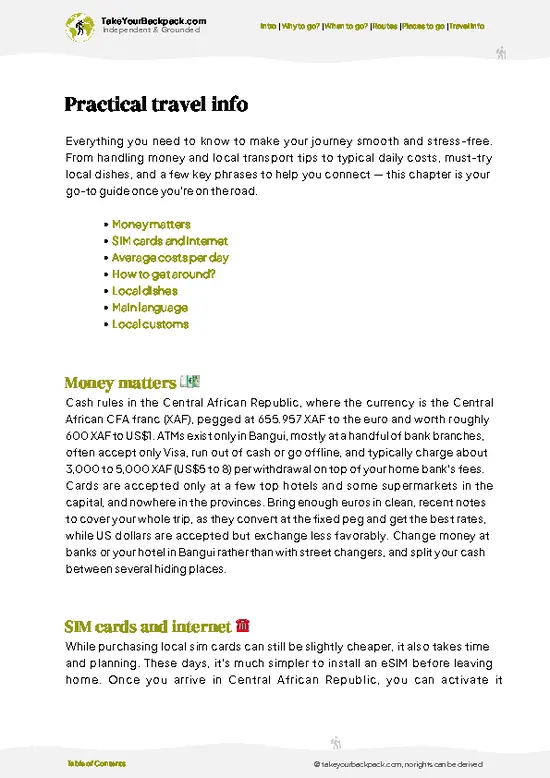
example page 0 from our offline Travel Guide for Central African Republic
example page 1 from our offline Travel Guide for Central African Republic
example page 2 from our offline Travel Guide for Central African Republic
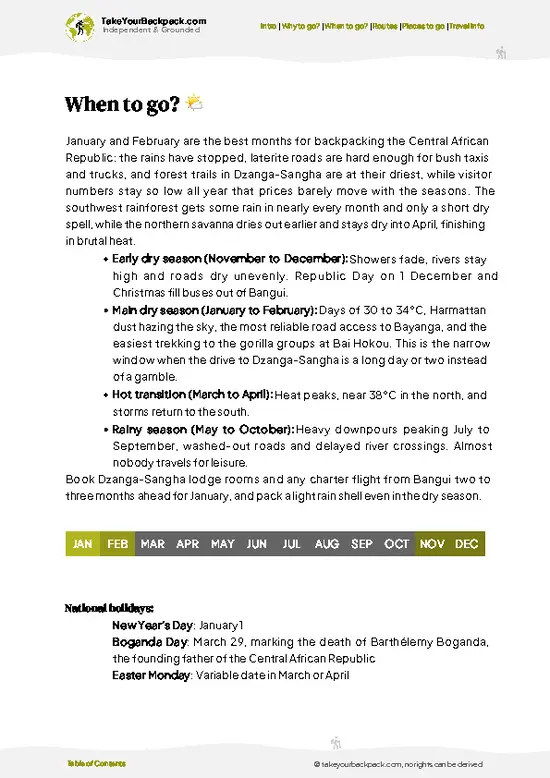
example page 3 from our offline Travel Guide for Central African Republic
example page 4 from our offline Travel Guide for Central African Republic
example page 5 from our offline Travel Guide for Central African Republic
example page 6 from our offline Travel Guide for Central African Republic
example page 7 from our offline Travel Guide for Central African Republic
Loading the map 🌍
CLICK TO FILTER
cities
towns
landmarks
national parks
hikes
attractions
regions
SHOW COUNTRY’S BESTSHOW ALL

✨ Why go?
Ranked #6 attraction in Central African Republic
What makes this attraction worth visiting

PK5 Market is the best place in Bangui to see how the country actually trades. The district grew as the capital's commercial engine, and goods from Cameroon, Chad and the river ports pass through its stalls, so you see what people really buy, sell and argue over. Bold phrases help here: wax-print cloth stalls show the colors and patterns that tailors turn into outfits within a day, and the spice and dried-fish lanes give you smell and texture you will not forget quickly. The other reason is context. Reading about Bangui's recent history is one thing, but standing among traders who have kept commerce going through hard years explains more than any headline. On a route through the country, this is the one stop that shows you the capital as a living city rather than a set of government buildings. Expect to spend a morning, not a day.

💡 HighlightsWhat this place is best known for

  1. Main market lanes: the central maze of covered and open stalls where food, clothing and household goods are packed together, and where the pace of bargaining is fastest.
  2. Wax-print fabric stalls: bolts of bold cloth stacked to the ceiling, with tailors nearby who can sew a shirt or dress quickly for a modest fee.
  3. Spice and dried-goods sellers: sacks of pepper, groundnuts, dried caterpillars and cassava products, sold by the cup and sold with commentary.
  4. Smoked and dried fish section: fish from the Ubangi River, strong-smelling and sold in stacked piles, a clear sign of how river trade feeds the city.
  5. Motorbike and spare-parts corner: mechanics and parts dealers who keep Bangui's moto-taxis running, noisy and oily and very practical.
  6. Street food and tea stands: grilled meat skewers, fried dough and
… read more 👉
  1. Main market lanes: the central maze of covered and open stalls where food, clothing and household goods are packed together, and where the pace of bargaining is fastest.
  2. Wax-print fabric stalls: bolts of bold cloth stacked to the ceiling, with tailors nearby who can sew a shirt or dress quickly for a modest fee.
  3. Spice and dried-goods sellers: sacks of pepper, groundnuts, dried caterpillars and cassava products, sold by the cup and sold with commentary.
  4. Smoked and dried fish section: fish from the Ubangi River, strong-smelling and sold in stacked piles, a clear sign of how river trade feeds the city.
  5. Motorbike and spare-parts corner: mechanics and parts dealers who keep Bangui's moto-taxis running, noisy and oily and very practical.
  6. Street food and tea stands: grilled meat skewers, fried dough and sweet tea served from roadside tables, the easiest way to sit and watch the market.
  7. Money changers and phone-credit sellers: clusters of young traders with cash and scratch cards, showing how informal finance works day to day.
Pair the fabric stalls with the street food stands for a relaxed morning, since you can order a garment, eat while it is measured and come back to collect it.
Spotted a mistake or missing something? Contact us.

🌤️ When to go?Seasonal considerations and timing

  • Dry Season (December to February): Roads are passable, mornings start around 20°C (68°F) and afternoons reach 33°C (91°F). Harmattan haze can dull the light, and dust hangs over the market lanes. Trading is busiest and produce is plentiful.
  • Transition (March to May): Heat peaks at 34°C to 36°C (93°F to 97°F) and the first storms arrive in the afternoon. Mornings are the sensible time to walk the stalls.
  • Rainy Season (June to October): Highs sit around 28°C to 31°C (82°F to 88°F) with heavy downpours that turn side streets to mud. Fewer outsiders come, and transport costs for goods and rides can rise when roads degrade.
  • Daylight: Days run close to 12 hours all year, so plan to finish market visits well before dusk.
Go in the morning on any day of the week, since stalls are fullest then and the midday heat is easier to avoid.

source: climatestotravel.comJANJanuary: excellent for travelingFEBFebruary: excellent for travelingMARMarch: excellent for travelingAPRApril: fair for travelingMAYMay: below average for travelingJUNJune: below average for travelingJULJuly: below average for travelingAUGAugust: below average for travelingSEPSeptember: fair for travelingOCTOctober: fair for travelingNOVNovember: excellent for travelingDECDecember: excellent for traveling
when-to-go

✈️ The backpacker research shortcutCentral African Republic Travel Guide

An offline-friendly backpacking guide with optimized travel routes, ranked highlights, transport advice, and the best areas to stay.
example page 0 from our offline Travel Guide for Central African Republic
example page 1 from our offline Travel Guide for Central African Republic
example page 2 from our offline Travel Guide for Central African Republic
example page 3 from our offline Travel Guide for Central African Republic
example page 4 from our offline Travel Guide for Central African Republic
example page 5 from our offline Travel Guide for Central African Republic
example page 6 from our offline Travel Guide for Central African Republic
example page 7 from our offline Travel Guide for Central African Republic
The digital guide (210 pages) contains:
✅ 42 highlights, ranked by travel appeal
✅ Optimized 5, 10 & 15-day travel routes
✅ Cities, national parks, landmarks, beaches
✅ How to get around
✅ Offline-friendly for travel without Wi-Fi
👉 Click to see all 30+ guide features

📅 Plan smarter in minutes, not weeks
✅ Month by month travel advice
✅ Festivals & national holidays
✅ Budget expectations

🗺️ Go to the right places, skip the overrated ones
✅ Honest pros & cons of destinations
✅ Top hikes, parks & viewpoints
✅ Lesser-known places most travelers miss
✅ Clear “worth it vs skip it” guidance

🛏️ Travel smoothly without rookie mistakes
✅ Best areas to stay
✅ Transport systems explained simply
✅ Common scams & safety advice
✅ SIM cards, money & practical tips

🌍 Understand the country, not just visit it
✅ Culture & traditions
✅ 52 Essential phrases & customs
✅ Festivals worth planning around
✅ Traveler-friendly historical context
✅ Insights that make places more meaningful

📱 Built for real travel conditions
✅ Fully downloadable PDF
✅ Works completely offline
✅ Optimized for phone use
✅ Useful in remote areas & buses
✅ Everything in one place
Stop searching, start planning
Get instant access to your full guide. 30‑day money-back guarantee.
+ Add another guide for just

By proceeding you agree to our terms.
Sent to your inbox immediately after payment • 100% Secure Checkout
Best Backpacking Travel Advisor 2025 tourism awardBest Backpacking
Travel Advisor
2025
What others say about Take Your Backpack Guides:
⭐⭐⭐⭐⭐
Fantastic, amazing amount of information!
⭐⭐⭐⭐⭐
My goodness this is amazing, it's what I've been looking for hats off too you!
⭐⭐⭐⭐⭐
I think this is absolutely BRILLIANT
⭐⭐⭐⭐
Very complete and informative. It's still missing places, but I gotta to commend you
⭐⭐⭐⭐⭐
This is truly amazing, thank you, can't wait to explore it with my kids!
⭐⭐⭐⭐⭐
Awesome resource, thank you!
⭐⭐⭐⭐⭐
This is amazing! Can't wait to explore the ones I haven't seen
⭐⭐⭐⭐
I love this! Well done, great idea.
⭐⭐⭐⭐⭐
Thanks for taking the time to make this gem!
⭐⭐⭐⭐⭐
This might be the best website I've ever seen.
⭐⭐⭐⭐⭐
Congratulations, and thank you so much for your work; it's incredibly valuable.
⭐⭐⭐⭐
In all seriousness I think you did a great job pointing out the important spots
⭐⭐⭐⭐⭐
10/10 very good
⭐⭐⭐⭐⭐
As someone who's only just starting to visit regularly this is awesome, thank you.
⭐⭐⭐⭐
Thank you very much! I'm going to visit my dad, it's going to be very useful!
⭐⭐⭐⭐⭐
This is really cool! We'll be travelling for the first time and this definitely come in handy.
⭐⭐⭐⭐⭐
You are now our minister of culture, congratulations 👨‍💼
⭐⭐⭐⭐⭐
Just wanted to tell you that this is a pearl! Going to follow your recommendations.
⭐⭐⭐⭐⭐
This is so cool. I'll definitely be using the resource for my travels soon.
⭐⭐⭐⭐⭐
This is very impressive! Good work.
⭐⭐⭐⭐⭐
This is an amazing and informative site. Very well done!

🛏️ Where to stay?Best areas and accommodation options

The safest bet for most backpackers is a guesthouse or small hotel in the central Bangui districts across the river-facing side of the city, such as Bas-Oubangui or the area around Avenue des Martyrs, and travel to PK5 Market by taxi with a local contact. Those areas have the most reliable water, generators and walking-distance restaurants, and they are where the few foreign aid workers and journalists sleep, so you will meet other travelers there. Another option is the neighborhoods near the airport road, where several secured compounds with gates and guards take guests, which suits solo travelers … read more 👉
The safest bet for most backpackers is a guesthouse or small hotel in the central Bangui districts across the river-facing side of the city, such as Bas-Oubangui or the area around Avenue des Martyrs, and travel to PK5 Market by taxi with a local contact. Those areas have the most reliable water, generators and walking-distance restaurants, and they are where the few foreign aid workers and journalists sleep, so you will meet other travelers there. Another option is the neighborhoods near the airport road, where several secured compounds with gates and guards take guests, which suits solo travelers who want a calm base and easy departure. Staying inside PK5 itself is not advised for visitors without a trusted host. If you have a local friend, a church mission or an NGO contact, ask about shared accommodation, which is often safer and more social than a lone hotel room. Arrange return transport before dark, as movement after nightfall is limited across the city. Book ahead, because the number of beds is small and prices vary a lot by security level.

👛 Costs (as of 22 October 2026)Typical daily expenses

A day at PK5 Market costs roughly €44 to 95 for a backpacker, mostly because of transport, a guide and a safe bed rather than the market itself. Entry is free, and you pay in Central African francs for everything.
CategoryBudget RangeLocal Reality
Entry€0No ticket; it is an open working market.
Accommodation (high season)€25 to 50Secured guesthouses in central Bangui; few cheap options exist.
Accommodation (low season)€20 to 40Slightly softer prices in the rains.
Local guide or fixer€8 to 15Strongly advised for introductions and safety.
Transport€5 to 12Private taxi hire for a round trip; shared taxis are cheaper but less secure.
Food and drink€4 to 8Grilled fish, cassava and rice at street stalls.
Purchases€2 to 10Fabric, spices, small crafts; bargaining is expected.
Total Daily Budget€44 to 95Opening
… read more 👉
A day at PK5 Market costs roughly €44 to 95 for a backpacker, mostly because of transport, a guide and a safe bed rather than the market itself. Entry is free, and you pay in Central African francs for everything.
CategoryBudget RangeLocal Reality
Entry€0No ticket; it is an open working market.
Accommodation (high season)€25 to 50Secured guesthouses in central Bangui; few cheap options exist.
Accommodation (low season)€20 to 40Slightly softer prices in the rains.
Local guide or fixer€8 to 15Strongly advised for introductions and safety.
Transport€5 to 12Private taxi hire for a round trip; shared taxis are cheaper but less secure.
Food and drink€4 to 8Grilled fish, cassava and rice at street stalls.
Purchases€2 to 10Fabric, spices, small crafts; bargaining is expected.
Total Daily Budget€44 to 95Opening estimate is the midpoint-leaning figure of about €65.


source: numbeo.com
⚠️ Prices can change and everyone travels differently, so take this as a rough guide. Hope it helps you plan your adventure!

FAQTraveler FAQ

Plan on two to three hours at PK5 Market, ideally in the morning. That is enough to walk the main lanes, see the textile and spice sections, and stop for a meal. Add time for getting there and back from central Bangui, which is usually under 30 minutes by taxi without traffic.
Entry to PK5 Market costs nothing, so the real expense is a guide and a private taxi, around €13 to 27 combined. For that you get one of the busiest trading hubs in Bangui, with fabrics, spices and everyday goods. It is worth visiting for the commerce and the people, but only with local contacts and current security advice.
Reaching PK5 Market means taking a private taxi or motorbike taxi from central Bangui, about 10 to 30 minutes depending on traffic. Expect to pay roughly €3 to 8 for a hired car each way. Bangui M'Poko airport is around 20 to 30 minutes away by road, and a local fixer can arrange the pickup.
⚠️ Things can change over time, so always validate details locally before you go.

Other Central African attractions near PK5 Market

Explore more nearby:


💡 Not sure where to go next?
Create a personalized itinerary for Central African Republic including PK5 Market and the places that fit your trip.

Generate my itinerary

👉 Discover all attractions

Or checkout all Central African Republic has to offer (think cities, towns, villages, national parks, hikes, beaches, festivals)
Country photo of Central African Republic

We 💚 feedbackWhat to keep in mind

PK5 Market works best as a morning stop paired with the riverfront and Bangui's cathedral district before you move on toward Boali Falls or the road west. I would bring small bills, skip the camera unless someone says yes, and leave before the afternoon heat and traffic build.

✍️ Help improve this page!
The information on this page is based on in-depth research, insights shared by experienced travelers, and feedback from the local travel community in Central African Republic. While every effort is made to keep the information accurate and current, conditions can change — so if you spot anything incorrect or outdated, please get in touch.


🙋‍♂️ Give feedback

👋 Meet the founderWho’s Behind Take Your Backpack?

Johan, backpacker and founder of TakeYourBackpackHi, I’m Johan (Netherlands 🇳🇱), the creator of TakeYourBackpack. Over the past 3 decades, I’ve backpacked through 90+ countries across six continents, gaining extensive experience with independent travel, long-term trips, and overland routes.

This site is built on a combination of firsthand travel experience and carefully curated insights from other backpackers. Many guides are based on places I’ve personally visited, while others bring together tips, observations, and practical advice shared by trusted travelers I’ve met along the way.

The goal is to provide realistic, experience-driven guidance — not generic itineraries — so you can explore destinations with better context, clearer expectations, and more confidence.