×

Chile🇨🇱 | regionsAtacama Desertsalt flats, lunar valleys, high-altitude lagoons | things to do and best time to go

Explore Corcovado National ParkExplore Chiloé Island

Backpacking in Atacama Desert
🏆 Top pickregion ranked #1
By Johan Kruseman 🇳🇱 | Updated June 10, 2026

Most people think the Atacama is just endless beige sand, but for backpackers the real shock is how cold it gets at night and how much altitude hits you long before you notice the scenery. The desert stretches across northern Chile, inland from the Pacific, roughly between Antofagasta and the Bolivian border, with San Pedro de Atacama as the de facto backpacker basecamp.

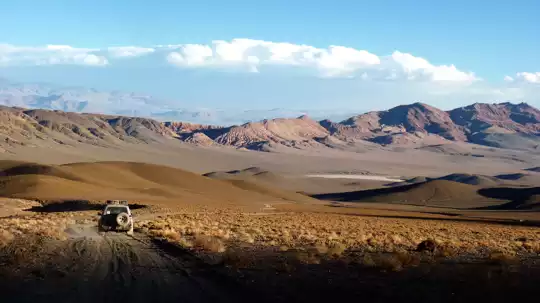
It’s visually ridiculous: salt flats, Mars-like valleys, flamingo lagoons, geysers, volcanoes. Also: tours, tours, tours. You pay for access and transport, and it adds up fast compared with, say, the Elqui Valley or coastal towns like La Serena. Public transport between small desert towns is sparse, so you’re either on pricey day tours, renting a car with new friends, or hitchhiking like it’s 2004. San Pedro itself feels half real village, half Instagram set, but step one valley away and it’s just you, the wind, and a sky that makes the Lake District or central Chile feel almost tame.

Discover everything you want to know in the 📖 Chile Travel Guide.


Get your Chile guide
120 ranked highlights, routes & tips, works offline (471 pages)
Loading the map 🌍
CLICK TO FILTER
cities
towns
villages
landmarks
national parks
hikes
beaches
attractions
festivals
regions
SHOW COUNTRY’S BESTSHOW ALL

✨ Why go?
Ranked #1 region in Chile
Why Atacama Desert should be on your travel list

In the Atacama Desert, backpackers find a playground of diverse landscapes that make every moment feel like a new adventure. You’ve got salt flats, volcanoes, and lunar-like valleys all within reach. This variety means you can soak in the sights without the hassle of constant relocation.

Transport here is surprisingly flexible. You can rent a bike, hop on a local bus, or even join a tour. This freedom lets you explore at your own pace, whether you’re chasing the sunrise at El Tatio geysers or wandering through the valley of the moon.

But it’s not just about nature; the Atacama offers a rich cultural tapestry. Spend time in San Pedro de Atacama, where you can mingle with locals, sample traditional dishes, and dive into the history of the Atacameño people.

This blend of nature and cultureread more 👉
In the Atacama Desert, backpackers find a playground of diverse landscapes that make every moment feel like a new adventure. You’ve got salt flats, volcanoes, and lunar-like valleys all within reach. This variety means you can soak in the sights without the hassle of constant relocation.

Transport here is surprisingly flexible. You can rent a bike, hop on a local bus, or even join a tour. This freedom lets you explore at your own pace, whether you’re chasing the sunrise at El Tatio geysers or wandering through the valley of the moon.

But it’s not just about nature; the Atacama offers a rich cultural tapestry. Spend time in San Pedro de Atacama, where you can mingle with locals, sample traditional dishes, and dive into the history of the Atacameño people.

This blend of nature and culture encourages slow travel, allowing you to truly absorb your surroundings. You’re not just a visitor; you’re part of the landscape. Each choice you make here—whether to splurge on a guided tour or save by exploring solo—adds depth to your experience.
Want to include Atacama Desert in your Chile route?
Create a personalized Chile itinerary that includes Atacama Desert and the places that fit your trip — based on your travel style, budget, and available time. Get your route in seconds.

Generate my trip

💡 HighlightsWhat this place is best known for

  1. Valle de la Luna (Moon Valley) — Mars-like dunes, salt spires and wind-sculpted rock that literally look otherworldly at sunset. Walk the short trails, time it for the golden hour, and you’ll understand why the desert’s light is such a big deal here. (Personal favorite — nothing beats sitting on a dune watching the colors shift.)
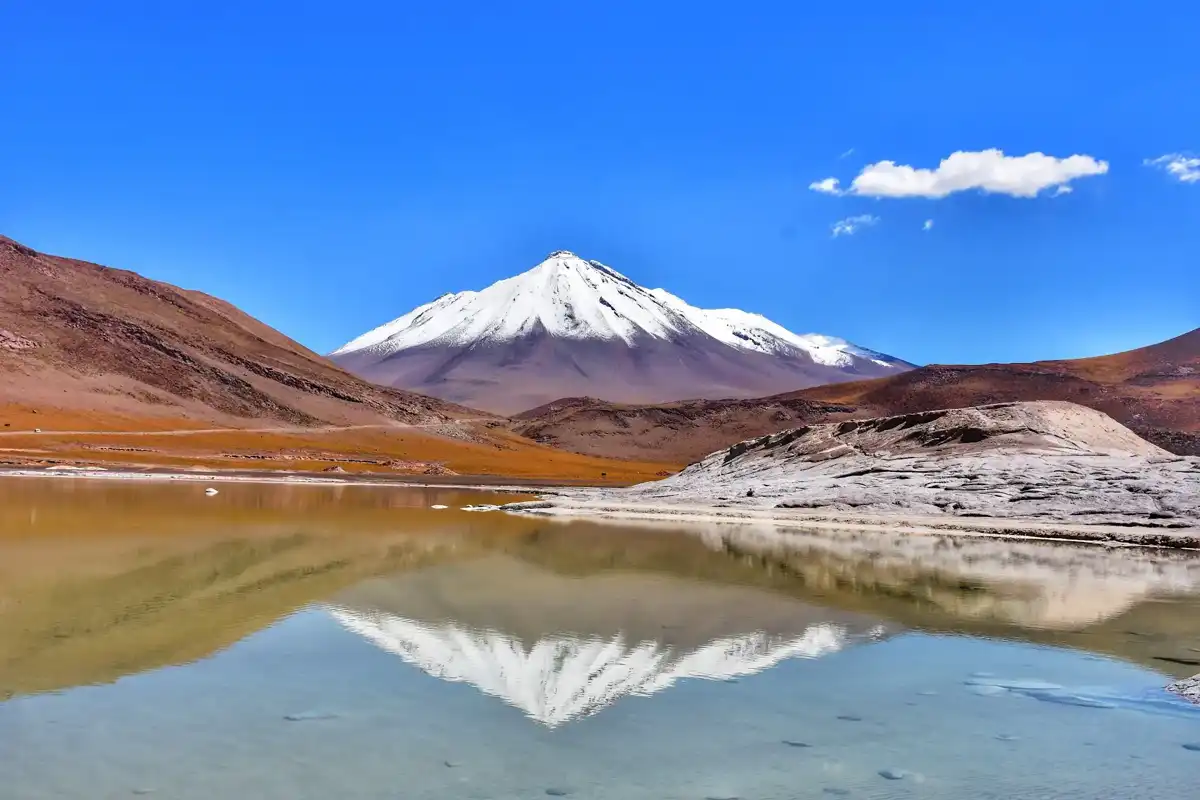
  2. Salar de Atacama & Laguna Chaxa (Los Flamencos National Reserve) — Massive salt flat fringed with bright turquoise lagoons where Andean, Chilean and James’s flamingos feed. It’s the best place in the region to watch high-altitude birdlife against a flat, reflective landscape.
  3. El Tatio Geysers — One of the highest geyser fields in the world; visit at sunrise when steam columns plume into freezing air and the ground hisses. It’s a raw, almost theatrical geothermal
read more 👉
  1. Valle de la Luna (Moon Valley) — Mars-like dunes, salt spires and wind-sculpted rock that literally look otherworldly at sunset. Walk the short trails, time it for the golden hour, and you’ll understand why the desert’s light is such a big deal here. (Personal favorite — nothing beats sitting on a dune watching the colors shift.)
  2. Salar de Atacama & Laguna Chaxa (Los Flamencos National Reserve) — Massive salt flat fringed with bright turquoise lagoons where Andean, Chilean and James’s flamingos feed. It’s the best place in the region to watch high-altitude birdlife against a flat, reflective landscape.
  3. El Tatio Geysers — One of the highest geyser fields in the world; visit at sunrise when steam columns plume into freezing air and the ground hisses. It’s a raw, almost theatrical geothermal show — bundle up and arrive very early for the full effect.
  4. Laguna Miscanti & Laguna Miñiques — Twin blue lagoons sitting at 4,000+ m with snow-capped volcanoes behind them and vicuñas grazing the shore. The isolation and alpine light make these altiplano lakes feel like a different planet — great for photography and quiet walks.
  5. Puritama Hot Springs (Ojos del Puritama) — A string of warm, stepped pools tucked into a narrow canyon fed by natural springs. Far more pleasant than crowded baths: you hike through desert, then soak in clear, mineral-rich water — perfect after a long day of trekking.
  6. Pukará de Quitor — A well-preserved pre-Columbian fortress above the Rio San Pedro with sweeping views over San Pedro and the valley. It’s a compact, tangible link to the region’s indigenous past — easy to reach and great for a short cultural stop.
  7. Tulor Archaeological Site — Hidden gem: the low, circular adobe ruins of a 3,000-year-old village that show early Atacameño life and settlement patterns. Often overlooked by day-trippers, it’s peaceful, interpretive, and gives real context to the ruins you see scattered across the desert.
  8. Laguna Cejar & Ojos del Salar — Salt-saturated turquoise pools where you can float effortlessly and snap surreal photos against a backdrop of salt crust and volcanoes. It’s an addictive, splurgy way to play in the desert and a short drive from San Pedro.
  9. Toconao village and its stone bell tower — Hidden gem: a tiny town built from volcanic rock with a distinctive bell tower, local stonemasonry, and artisan markets selling llama-felt and carved cactus wood. It’s a quiet cultural pit stop that feels authentic — try the local bread and llama cheese.
  10. Machuca hamlet and highland grazing culture — Hidden gem: a handful of adobe houses and a simple church where locals herd llamas and alpacas, sell roasted corn and squash, and live the altiplano rhythm. It’s small, real, and a quick way to see traditional high-Andean life without the tourist gloss.
Spotted a mistake or missing something? Contact us.

Things to do around Atacama Desert

Ratings based on Tripadvisor reviews. When you book through this link, you support our work at no extra cost to you.

⌛️ 5 daysHow to make the most of Atacama Desert

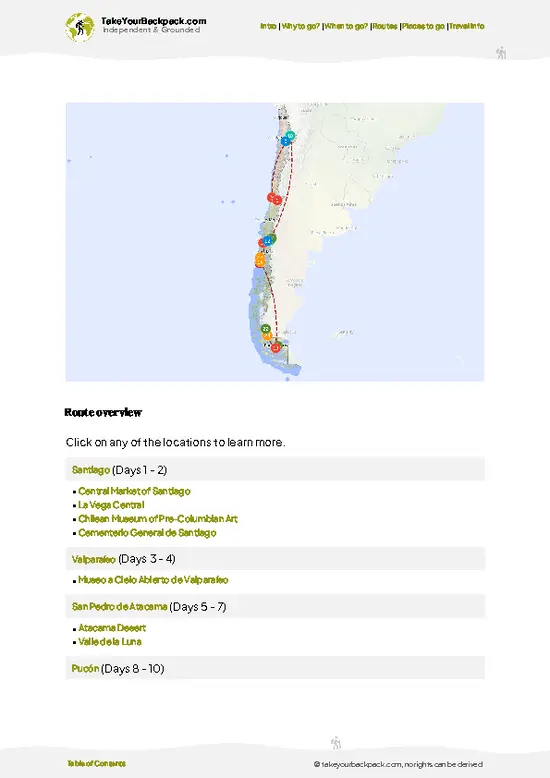
Day 1: San Pedro de Atacama
You land in San Pedro de Atacama, the gateway to the desert. This town is your base camp, and it’s where you’ll acclimatize to the altitude. Spend the day wandering the dusty streets, soaking in the local vibe. Grab a pisco sour at a cozy bar and chat with fellow travelers. The transport options here are plentiful—shared taxis and buses will be your lifeline. This is where you’ll map out your next moves.

Day 2: Valle de la Luna
Kick off your adventure with a trip to Valle de la Luna. It’s a short ride from San Pedro, and the surreal landscapes will blow your mind. Timing is key; go in the late afternoon to catch the sunset painting the mountains. The bus schedules are reliable, but don’t forget to book your return trip in advance. This is a classic experience … read more 👉
Day 1: San Pedro de Atacama
You land in San Pedro de Atacama, the gateway to the desert. This town is your base camp, and it’s where you’ll acclimatize to the altitude. Spend the day wandering the dusty streets, soaking in the local vibe. Grab a pisco sour at a cozy bar and chat with fellow travelers. The transport options here are plentiful—shared taxis and buses will be your lifeline. This is where you’ll map out your next moves.

Day 2: Valle de la Luna
Kick off your adventure with a trip to Valle de la Luna. It’s a short ride from San Pedro, and the surreal landscapes will blow your mind. Timing is key; go in the late afternoon to catch the sunset painting the mountains. The bus schedules are reliable, but don’t forget to book your return trip in advance. This is a classic experience that sets the tone for your journey.

Day 3: Geysers del Tatio
Rise before dawn for a trip to Geysers del Tatio. The early start is worth it; you’ll witness the geothermal wonders in the crisp morning air. The drive takes about two hours, so pack snacks and enjoy the ride. This is a long day, but the otherworldly scenery will keep you buzzing.

Day 4: Off-Path Reward: Puritama Hot Springs
Take a breather and head to the Puritama Hot Springs. It’s a bit off the beaten path, but the soothing waters are a perfect reward after days of exploration. The transport is a bit trickier, but you can arrange a tour or hitch a ride with locals. This detour adds a layer of relaxation to your trip.

Day 5: Salar de Atacama
Wrap up your adventure at Salar de Atacama. The vast salt flats are mesmerizing, and the wildlife is a bonus. You can easily spend a few hours here, soaking in the beauty. The transport options are flexible, allowing you to linger as long as you want.

The must-do day? Day 3 at Geysers del Tatio. It’s the quintessential Atacama experience that encapsulates the region’s raw beauty and energy. Don’t miss it.
Turn your Atacama Desert visit into an Chile adventure
Build a complete Chile route with Atacama Desert, hidden gems, must-see destinations, and realistic travel times included.

Generate my trip

🌤️ When to go?Seasonal considerations and timing


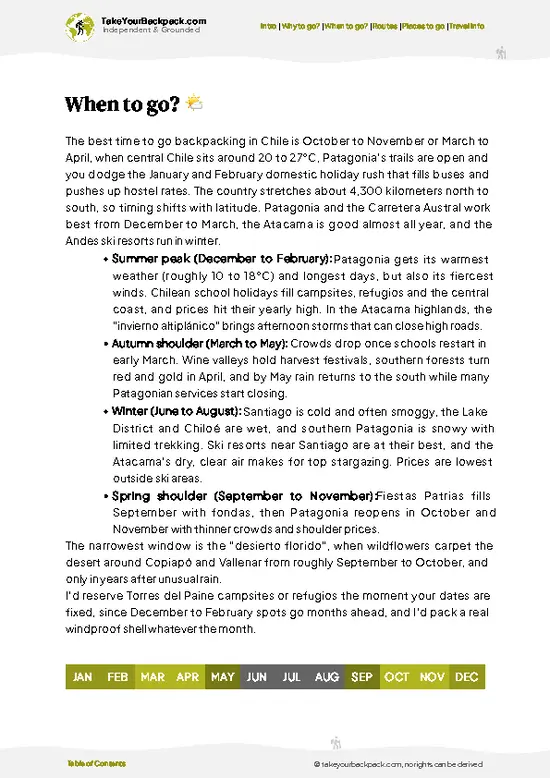
  • Weather: The Atacama Desert is a land of extremes. From October to April, expect dry, clear skies with daytime highs around 25-30°C (77-86°F). Winter months (June-August) bring colder nights, sometimes dropping below freezing, which can be brutal if you’re camping.

  • Temperature: Days are warm and pleasant during the summer, but nights can swing wildly—think 30°C (86°F) by day, plunging to near 0°C (32°F) at night. Layering is your best friend here.

  • Daylight Hours: Summer offers longer days, up to 14 hours of light, perfect for squeezing in hikes and stargazing. Winter days shrink to about 10 hours, so plan your adventures accordingly.

  • Crowds: Peak season is December through February. Expect more tourists, higher prices, and booked-out accommodations. Shoulder seasons (spring and fall)
read more 👉

  • Weather: The Atacama Desert is a land of extremes. From October to April, expect dry, clear skies with daytime highs around 25-30°C (77-86°F). Winter months (June-August) bring colder nights, sometimes dropping below freezing, which can be brutal if you’re camping.

  • Temperature: Days are warm and pleasant during the summer, but nights can swing wildly—think 30°C (86°F) by day, plunging to near 0°C (32°F) at night. Layering is your best friend here.

  • Daylight Hours: Summer offers longer days, up to 14 hours of light, perfect for squeezing in hikes and stargazing. Winter days shrink to about 10 hours, so plan your adventures accordingly.

  • Crowds: Peak season is December through February. Expect more tourists, higher prices, and booked-out accommodations. Shoulder seasons (spring and fall) offer a quieter vibe without sacrificing weather quality.

  • Seasonal Activities: Summer is prime for salt flats and geysers, while winter’s crisp air sharpens the clarity of the famous Atacama night skies—ideal for astronomy buffs.

  • Price Fluctuations: Prices spike in the summer holiday months and during local festivals. Booking in shoulder seasons can save you a bundle and still deliver excellent conditions.


Pro-tip: Arrive late September or early October—cooler nights, fewer crowds, and you’ll catch the desert waking up after winter’s chill. It’s the sweet spot where comfort meets value.


source: climatestotravel.comJANJanuary: highly recommended for travelingFEBFebruary: highly recommended for travelingMARMarch: highly recommended for travelingAPRApril: highly recommended for travelingMAYMay: good for travelingJUNJune: fair for travelingJULJuly: fair for travelingAUGAugust: fair for travelingSEPSeptember: good for travelingOCTOctober: excellent for travelingNOVNovember: highly recommended for travelingDECDecember: highly recommended for traveling
chile-region-atacama-desert
© Google | Flavinha

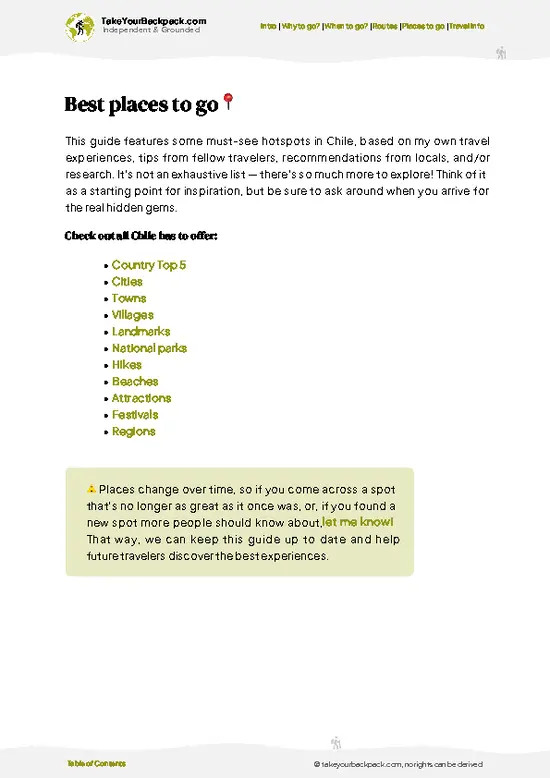
✈️ The backpacker research shortcutChile Travel Guide

An offline-friendly backpacking guide with optimized travel routes, ranked highlights, transport advice, and the best areas to stay.
example page 0 from our offline Travel Guide for Chile
example page 1 from our offline Travel Guide for Chile
example page 2 from our offline Travel Guide for Chile
example page 3 from our offline Travel Guide for Chile
example page 4 from our offline Travel Guide for Chile
example page 5 from our offline Travel Guide for Chile
example page 6 from our offline Travel Guide for Chile
example page 7 from our offline Travel Guide for Chile
The digital guide (471 pages) contains:
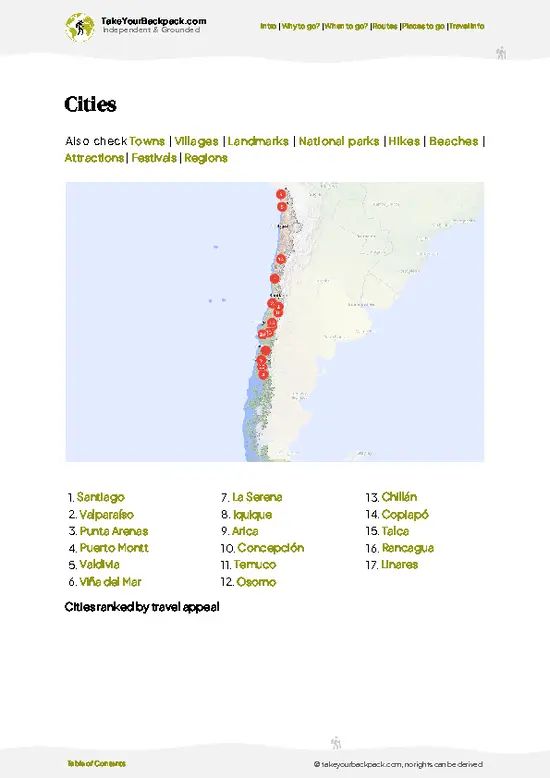
120 highlights, ranked by travel appeal
Optimized 7, 14 & 21-day travel routes
Cities, national parks, landmarks, beaches
How to get around
Offline-friendly for travel without Wi-Fi
👉 Click to see all 30+ guide features

📅 Plan smarter in minutes, not weeks
Month by month travel advice
Festivals & national holidays
Budget expectations

🗺️ Go to the right places, skip the overrated ones
Honest pros & cons of destinations
Top hikes, parks & viewpoints
Lesser-known places most travelers miss
Clear “worth it vs skip it” guidance

🛏️ Travel smoothly without rookie mistakes
Best areas to stay
Transport systems explained simply
Common scams & safety advice
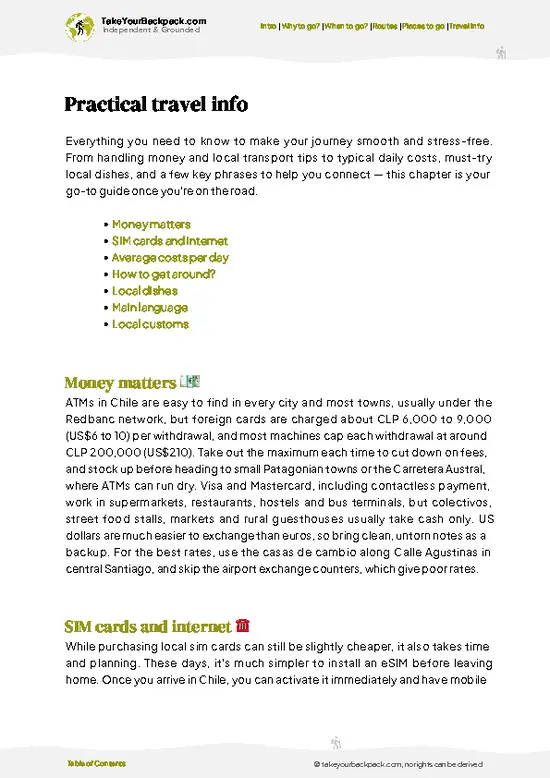
SIM cards, money & practical tips

🌍 Understand the country, not just visit it
Culture & traditions
52 Essential phrases & customs
Festivals worth planning around
Traveler-friendly historical context
Insights that make places more meaningful

📱 Built for real travel conditions
Fully downloadable PDF
Works completely offline
Optimized for phone use
Useful in remote areas & buses
Everything in one place
Save weeks of stressful planning
Get instant access to your full guide. 30‑day money-back guarantee.


By proceeding you agree to our terms.
Sent to your inbox immediately after payment • 100% Secure Checkout
Best Backpacking Travel Advisor 2025 tourism awardBest Backpacking
Travel Advisor
2025
What others say about Take Your Backpack Guides:
⭐⭐⭐⭐⭐
Fantastic, amazing amount of information!
⭐⭐⭐⭐⭐
My goodness this is amazing, it's what I've been looking for hats off too you!
⭐⭐⭐⭐⭐
I think this is absolutely BRILLIANT
⭐⭐⭐⭐
Very complete and informative. It's still missing places, but I gotta to commend you
⭐⭐⭐⭐⭐
This is truly amazing, thank you, can't wait to explore it with my kids!
⭐⭐⭐⭐⭐
Awesome resource, thank you!
⭐⭐⭐⭐⭐
This is amazing! Can't wait to explore the ones I haven't seen
⭐⭐⭐⭐
I love this! Well done, great idea.
⭐⭐⭐⭐⭐
Thanks for taking the time to make this gem!
⭐⭐⭐⭐⭐
This might be the best website I've ever seen.
⭐⭐⭐⭐⭐
Congratulations, and thank you so much for your work; it's incredibly valuable.
⭐⭐⭐⭐
In all seriousness I think you did a great job pointing out the important spots
⭐⭐⭐⭐⭐
10/10 very good
⭐⭐⭐⭐⭐
As someone who's only just starting to visit regularly this is awesome, thank you.
⭐⭐⭐⭐
Thank you very much! I'm going to visit my dad, it's going to be very useful!
⭐⭐⭐⭐⭐
This is really cool! We'll be travelling for the first time and this definitely come in handy.
⭐⭐⭐⭐⭐
You are now our minister of culture, congratulations 👨‍💼
⭐⭐⭐⭐⭐
Just wanted to tell you that this is a pearl! Going to follow your recommendations.
⭐⭐⭐⭐⭐
This is so cool. I'll definitely be using the resource for my travels soon.
⭐⭐⭐⭐⭐
This is very impressive! Good work.
⭐⭐⭐⭐⭐
This is an amazing and informative site. Very well done!

🛏️ Where to stay?Choosing the right base

In the Atacama Desert, your choice of where to stay can make or break your experience. Let’s dive into the best spots that scream “backpacker-friendly” while keeping you safe and social.

San Pedro de Atacama is the crown jewel. This town buzzes with backpackers, offering a mix of laid-back vibes and adventure. You’ll find a plethora of tour operators, making it easy to book stargazing trips or salt flat excursions. The streets are alive with cafes and markets, perfect for mingling with fellow travelers over a pisco sour.

Then there’s Calama, often overlooked but worth considering. It’s a gateway … read more 👉
In the Atacama Desert, your choice of where to stay can make or break your experience. Let’s dive into the best spots that scream “backpacker-friendly” while keeping you safe and social.

San Pedro de Atacama is the crown jewel. This town buzzes with backpackers, offering a mix of laid-back vibes and adventure. You’ll find a plethora of tour operators, making it easy to book stargazing trips or salt flat excursions. The streets are alive with cafes and markets, perfect for mingling with fellow travelers over a pisco sour.

Then there’s Calama, often overlooked but worth considering. It’s a gateway to the desert and has a more local feel. You can save some cash here, and it’s a great base for day trips. The bus connections to San Pedro are solid, so you won’t miss out on the action.

Socaire is a hidden treasure. This tiny village offers a glimpse into traditional Andean life. It’s quieter, but if you’re after authentic experiences and stunning landscapes, it’s a solid choice.

Each of these spots has its own flavor. Choose wisely based on what you want to sacrifice—time, money, or comfort—and you’ll unlock the true essence of the Atacama.

🚌 Getting aroundGetting around like a local

The Atacama Desert is a land of extremes, where the sun blazes down and the stars twinkle like diamonds in a velvet sky. Here, schedules can feel like mere suggestions. You might find yourself waiting for a bus that’s late or hopping into a shared taxi that’s just about to leave. It’s a dance of spontaneity and intuition, where the rhythm of travel is dictated more by the whims of the desert than by rigid timetables. Embrace the chaos, and you’ll discover the magic of this otherworldly landscape.


  • Shared Taxis (Colectivos): These are your best friends for getting around. They zip between towns and popular sites, leaving when they’re full. Expect to pay around CLP 3,000-5,000 for a ride, depending on distance. They’re fast and can be a bit cramped, but the local chatter makes it worth it.

read more 👉
The Atacama Desert is a land of extremes, where the sun blazes down and the stars twinkle like diamonds in a velvet sky. Here, schedules can feel like mere suggestions. You might find yourself waiting for a bus that’s late or hopping into a shared taxi that’s just about to leave. It’s a dance of spontaneity and intuition, where the rhythm of travel is dictated more by the whims of the desert than by rigid timetables. Embrace the chaos, and you’ll discover the magic of this otherworldly landscape.


  • Shared Taxis (Colectivos): These are your best friends for getting around. They zip between towns and popular sites, leaving when they’re full. Expect to pay around CLP 3,000-5,000 for a ride, depending on distance. They’re fast and can be a bit cramped, but the local chatter makes it worth it.


  • Public Buses: The backbone of budget travel in Atacama. Buses run from San Pedro to places like Calama and Antofagasta. Prices range from CLP 4,000-10,000, with departures typically starting at 7 AM and the last ones around 8 PM. They’re slower than taxis but offer a chance to soak in the scenery.


  • Rental Bikes: For the adventurous, renting a bike in San Pedro is a game-changer. Prices hover around CLP 5,000-15,000 per day. You can explore at your own pace, but be ready for some serious pedaling on those sandy roads. Just remember to hydrate!


  • Private Tours: If you’re looking to splurge a bit, consider a private tour. Prices can range from CLP 30,000 to CLP 100,000, depending on the destination and inclusions. You’ll get a guide who knows the ins and outs, but it’s a hit to your wallet. Still, the comfort and convenience can be worth it.


  • Walking: Don’t underestimate the power of your own two feet. San Pedro is small enough to explore on foot, and many attractions are within a reasonable walking distance. It’s free, and you’ll stumble upon local spots that you might miss otherwise.


For a tactical tip: always check the bus schedules the night before and arrive early. Buses can fill up fast, especially during peak season. If you’re flexible, you can often snag a seat on a colectivo that’s about to leave, saving you time and hassle. Embrace the flow, and let the desert guide you.

🍲 FoodEating & Drinking in Atacama Desert

In the Atacama Desert, food is a celebration of simplicity and local ingredients. You can’t miss empanadas, stuffed with everything from spicy llama to cheese and olives. When you bite into one, the flaky crust gives way to a burst of flavor that’s both comforting and energizing after a long day of hiking.

For a true taste of the region, seek out pisco sour, the national drink. This tangy cocktail blends pisco, lime juice, and a hint of sweetness, perfect for cooling off after a sun-soaked trek. Pair it with locro, a hearty stew made with potatoes, corn, and meat, often served at local markets. The aroma of spices wafts through the air, drawing you in like a moth to a flame.

Street food stalls are your best bet for authentic bites. Grab a choripán, a chorizo sandwich, from a vendor and enjoy … read more 👉
In the Atacama Desert, food is a celebration of simplicity and local ingredients. You can’t miss empanadas, stuffed with everything from spicy llama to cheese and olives. When you bite into one, the flaky crust gives way to a burst of flavor that’s both comforting and energizing after a long day of hiking.

For a true taste of the region, seek out pisco sour, the national drink. This tangy cocktail blends pisco, lime juice, and a hint of sweetness, perfect for cooling off after a sun-soaked trek. Pair it with locro, a hearty stew made with potatoes, corn, and meat, often served at local markets. The aroma of spices wafts through the air, drawing you in like a moth to a flame.

Street food stalls are your best bet for authentic bites. Grab a choripán, a chorizo sandwich, from a vendor and enjoy it while mingling with locals. Dining here is casual; don’t be surprised if you share a table with strangers. It’s all about community.

Remember, meals often start late, so don’t rush. Embrace the slow pace, savoring each bite and the stories shared around you. This isn’t just food; it’s a taste of life in the Atacama.

Other Chilean regions near Atacama Desert

Explore more nearby:

  • Valle del Elqui—vineyards, clear night skies, Andean foothills| 722 km away
  • Lake District—volcanic peaks, alpine lakes, temperate rainforest| 1767 km away
  • Chiloé Island—wooden churches, tidal stilt houses, misty forests| 2084 km away

💡 Not sure where to go next?
Create a personalized itinerary for Chile including Atacama Desert and the places that fit your trip.

Generate my itinerary

👉 Discover all regions

Or checkout all Chile has to offer (think cities, towns, villages, national parks, hikes, beaches, festivals)
Country photo of Chile

We 💚 feedbackSumming up the experience

The Atacama Desert is a surreal playground for the senses. Picture standing under a sky so clear, the stars feel like they’re within reach. That’s magic. But here’s the kicker: it’s remote, and getting around can be a hassle. You’ll trade comfort for authenticity, especially if you’re on a budget. Embrace the grit, and you’ll find the experience is worth every dusty mile. Just pack patience along with your sunscreen.

✈️ When did I visit Chile?
I have visited Chile, together with Argentina, in September 2012.

✍️ Help improve this page!
The information on this page is based on my own backpacking experience in Chile, supplemented with up-to-date research and feedback from other travelers. Travel details can change, so if you notice anything outdated or incomplete, feel free to let me know.


🙋‍♂️ Give feedback

👋 Meet the founderWho’s Behind Take Your Backpack?

Johan, backpacker and founder of TakeYourBackpackHi, I’m Johan (Netherlands 🇳🇱), the creator of TakeYourBackpack. Over the past decade, I’ve backpacked through 80+ countries across six continents, gaining extensive experience with independent travel, long-term trips, and overland routes.

This site is built on a combination of firsthand travel experience and carefully curated insights from other backpackers. Many guides are based on places I’ve personally visited, while others bring together tips, observations, and practical advice shared by trusted travelers I’ve met along the way.

The goal is to provide realistic, experience-driven guidance — not generic itineraries — so you can explore destinations with better context, clearer expectations, and more confidence.

Get full Chile guide •
Instant download • 120 highlights • Full Offline guide