×

Chile🇨🇱 | festivalsFiesta de La TiranaVirgen del Carmen, devil dancers, desert pilgrimage, village camps | things to do and best time to go

Explore Fiestas PatriasExplore Tapati Rapa Nui

Backpacking in Fiesta de La Tirana
🏆 Top pickfestival ranked #2
By Johan Kruseman 🇳🇱 | Updated October 19, 2026

Decades ago La Tirana was a pilgrimage for northern miners and farmers who walked in with their own food and slept in the open. Today it draws well over 200,000 people to a small desert village in the north of Chile, roughly 70 kilometers east of Iquique, for the July festival of the Virgen del Carmen. Dancers in sequined costumes and devil masks (bailes religiosos) fill the streets with brass bands for about a week. The village has almost no permanent lodging, so prices spike and rooms vanish months ahead. Book early or plan on a tent in the designated camping areas. Cash runs short because ATMs empty fast, so withdraw in Iquique. I bought a bottle of water and a folding stool at a market stall the first morning, and both saved me hours on the dusty procession route. Sit early at the plaza edge to see the dances without being crushed. A first day works best arriving by morning, pitching camp, then walking the sanctuary before the evening dances begin.

Discover everything you want to know in the 📖 Chile Travel Guide.


example page 0 from our offline Travel Guide for Chile
example page 1 from our offline Travel Guide for Chile
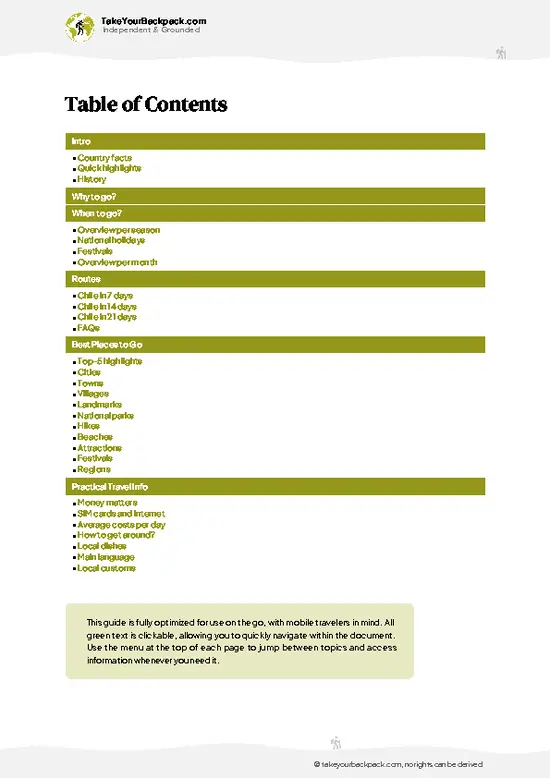
example page 2 from our offline Travel Guide for Chile
example page 3 from our offline Travel Guide for Chile
example page 4 from our offline Travel Guide for Chile
example page 5 from our offline Travel Guide for Chile
example page 6 from our offline Travel Guide for Chile
example page 7 from our offline Travel Guide for Chile
Loading the map 🌍
CLICK TO FILTER
cities
towns
villages
landmarks
national parks
hikes
beaches
attractions
festivals
regions
SHOW COUNTRY’S BESTSHOW ALL

✨ Why go?
Ranked #2 festival in Chile
What sets this place apart

Fiesta de La Tirana pulls backpackers because the whole village becomes one shared camp, and strangers end up trading food, stools and phone chargers within hours. Nobody watches from a distance here. You stand a meter from dancers who have rehearsed for months, and the brass bands play so close that you feel the drums in your chest. People sing along to the same chants through the night, and by the second evening you recognize faces in the crowd.

The other draw is how real it feels. The festival is a Catholic devotion with Andean and Afro-Chilean roots, not a show staged for visitors, and the bailes religiosos perform for the Virgen, not for cameras. Compared with a music festival of similar size, costs stay low, since entry is free and street food is plentiful.

It also fits neatly into … read more 👉
Fiesta de La Tirana pulls backpackers because the whole village becomes one shared camp, and strangers end up trading food, stools and phone chargers within hours. Nobody watches from a distance here. You stand a meter from dancers who have rehearsed for months, and the brass bands play so close that you feel the drums in your chest. People sing along to the same chants through the night, and by the second evening you recognize faces in the crowd.

The other draw is how real it feels. The festival is a Catholic devotion with Andean and Afro-Chilean roots, not a show staged for visitors, and the bailes religiosos perform for the Virgen, not for cameras. Compared with a music festival of similar size, costs stay low, since entry is free and street food is plentiful.

It also fits neatly into a northern Chile route. Combine it with the beaches of Iquique and the Atacama Desert on the way south, and you add a deeply local week to a trip otherwise built around landscapes. Plan around the mid-July peak, around the 16th of July, when the big processions happen.

💡 HighlightsTop highlights of Fiesta de La Tirana

  1. Santuario de La Tirana: The white church at the center of the village is the heart of the devotion. Pilgrims arrive here on their knees, and the dancers enter it to greet the Virgen del Carmen. Go inside to see the offerings and the painted images.
  2. Baile de los Diablos: The devil dancers wear elaborate horned masks and bright costumes, and they stomp and spin to brass music. Their moves mark the clash and surrender of evil before the Virgin, and it is the most photographed part of the festival.
  3. Procession of the Virgen del Carmen: On the main day, the statue is carried through the streets, surrounded by dancers and thousands of pilgrims. The music, incense and chanting build as it reaches the plaza, and the atmosphere is intensely emotional.
  4. The plaza in front of the sanctuary: This central square
… read more 👉
  1. Santuario de La Tirana: The white church at the center of the village is the heart of the devotion. Pilgrims arrive here on their knees, and the dancers enter it to greet the Virgen del Carmen. Go inside to see the offerings and the painted images.
  2. Baile de los Diablos: The devil dancers wear elaborate horned masks and bright costumes, and they stomp and spin to brass music. Their moves mark the clash and surrender of evil before the Virgin, and it is the most photographed part of the festival.
  3. Procession of the Virgen del Carmen: On the main day, the statue is carried through the streets, surrounded by dancers and thousands of pilgrims. The music, incense and chanting build as it reaches the plaza, and the atmosphere is intensely emotional.
  4. The plaza in front of the sanctuary: This central square is where the groups perform in turn, from afternoon until late. Arrive early for a spot with a view, and bring a stool. Each troupe has its own costume style, dance steps and band.
  5. Night vigils and the village camps: After dark, dancers practice and sing beside campfires, and food stalls sell sopaipillas and anticuchos. This is where conversations with locals happen, and you see the festival as a community rather than a spectacle.
Start with the Santuario de La Tirana on your first morning, since the crowd is thin then and it explains everything you will see in the dances later.
Spotted a mistake or missing something? Contact us.

Things to do near Fiesta de La Tirana

Ratings based on Tripadvisor reviews. When you book through this link, you support our work at no extra cost to you.

🌤️ When to go?When is the celebration of Fiesta de La Tirana?

Fiesta de La Tirana runs from July 12 to 18 every year, with the main day on July 16, in the village of La Tirana in the Atacama Desert, about 70 km east of Iquique, centered on the Santuario de la Virgen del Carmen and its plaza.
  • Best day: July 15 into 16 is the peak, when dance groups (bailes religiosos) fill the plaza through the night and the Virgen is carried out at midnight. Go on July 13 or 14 for smaller crowds and easier viewing.
  • Weather: Days reach about 20 to 24°C (68 to 75°F), nights drop to 3 to 8°C (37 to 46°F). Rain is very unlikely. Bring a warm jacket, a beanie, sunscreen, earplugs and a dust mask.
  • Booking: Reserve beds in Iquique or Pozo Almonte by early June. Prices roughly double or triple around July 16.
  • Crowds: Traffic on the Iquique road jams on the evening of July 15 and
… read more 👉
Fiesta de La Tirana runs from July 12 to 18 every year, with the main day on July 16, in the village of La Tirana in the Atacama Desert, about 70 km east of Iquique, centered on the Santuario de la Virgen del Carmen and its plaza.
  • Best day: July 15 into 16 is the peak, when dance groups (bailes religiosos) fill the plaza through the night and the Virgen is carried out at midnight. Go on July 13 or 14 for smaller crowds and easier viewing.
  • Weather: Days reach about 20 to 24°C (68 to 75°F), nights drop to 3 to 8°C (37 to 46°F). Rain is very unlikely. Bring a warm jacket, a beanie, sunscreen, earplugs and a dust mask.
  • Booking: Reserve beds in Iquique or Pozo Almonte by early June. Prices roughly double or triple around July 16.
  • Crowds: Traffic on the Iquique road jams on the evening of July 15 and after midday on July 16. Arrive before noon and leave by early morning on July 17 or stay put until the afternoon.
Arrive a day before the peak so you can watch the dancers rehearse in the streets.


source: climatestotravel.comJANJanuary: not recommended for travelingFEBFebruary: not recommended for travelingMARMarch: not recommended for travelingAPRApril: not recommended for travelingMAYMay: not recommended for travelingJUNJune: not recommended for travelingJULJuly: excellent for travelingAUGAugust: not recommended for travelingSEPSeptember: not recommended for travelingOCTOctober: not recommended for travelingNOVNovember: not recommended for travelingDECDecember: not recommended for traveling

✈️ The backpacker research shortcutChile Travel Guide

An offline-friendly backpacking guide with optimized travel routes, ranked highlights, transport advice, and the best areas to stay.
example page 0 from our offline Travel Guide for Chile
example page 1 from our offline Travel Guide for Chile
example page 2 from our offline Travel Guide for Chile
example page 3 from our offline Travel Guide for Chile
example page 4 from our offline Travel Guide for Chile
example page 5 from our offline Travel Guide for Chile
example page 6 from our offline Travel Guide for Chile
example page 7 from our offline Travel Guide for Chile
The digital guide (333 pages) contains:
✅ 107 highlights, ranked by travel appeal
✅ Optimized 7, 14 & 21-day travel routes
✅ Cities, national parks, landmarks, beaches
✅ How to get around
✅ Offline-friendly for travel without Wi-Fi
👉 Click to see all 30+ guide features

📅 Plan smarter in minutes, not weeks
✅ Month by month travel advice
✅ Festivals & national holidays
✅ Budget expectations

🗺️ Go to the right places, skip the overrated ones
✅ Honest pros & cons of destinations
✅ Top hikes, parks & viewpoints
✅ Lesser-known places most travelers miss
✅ Clear “worth it vs skip it” guidance

🛏️ Travel smoothly without rookie mistakes
✅ Best areas to stay
✅ Transport systems explained simply
✅ Common scams & safety advice
✅ SIM cards, money & practical tips

🌍 Understand the country, not just visit it
✅ Culture & traditions
✅ 52 Essential phrases & customs
✅ Festivals worth planning around
✅ Traveler-friendly historical context
✅ Insights that make places more meaningful

📱 Built for real travel conditions
✅ Fully downloadable PDF
✅ Works completely offline
✅ Optimized for phone use
✅ Useful in remote areas & buses
✅ Everything in one place
Stop searching, start planning
Get instant access to your full guide. 30‑day money-back guarantee.
+ Add another guide for just

By proceeding you agree to our terms.
Sent to your inbox immediately after payment • 100% Secure Checkout
Best Backpacking Travel Advisor 2025 tourism awardBest Backpacking
Travel Advisor
2025
What others say about Take Your Backpack Guides:
⭐⭐⭐⭐⭐
Fantastic, amazing amount of information!
⭐⭐⭐⭐⭐
My goodness this is amazing, it's what I've been looking for hats off too you!
⭐⭐⭐⭐⭐
I think this is absolutely BRILLIANT
⭐⭐⭐⭐
Very complete and informative. It's still missing places, but I gotta to commend you
⭐⭐⭐⭐⭐
This is truly amazing, thank you, can't wait to explore it with my kids!
⭐⭐⭐⭐⭐
Awesome resource, thank you!
⭐⭐⭐⭐⭐
This is amazing! Can't wait to explore the ones I haven't seen
⭐⭐⭐⭐
I love this! Well done, great idea.
⭐⭐⭐⭐⭐
Thanks for taking the time to make this gem!
⭐⭐⭐⭐⭐
This might be the best website I've ever seen.
⭐⭐⭐⭐⭐
Congratulations, and thank you so much for your work; it's incredibly valuable.
⭐⭐⭐⭐
In all seriousness I think you did a great job pointing out the important spots
⭐⭐⭐⭐⭐
10/10 very good
⭐⭐⭐⭐⭐
As someone who's only just starting to visit regularly this is awesome, thank you.
⭐⭐⭐⭐
Thank you very much! I'm going to visit my dad, it's going to be very useful!
⭐⭐⭐⭐⭐
This is really cool! We'll be travelling for the first time and this definitely come in handy.
⭐⭐⭐⭐⭐
You are now our minister of culture, congratulations 👨‍💼
⭐⭐⭐⭐⭐
Just wanted to tell you that this is a pearl! Going to follow your recommendations.
⭐⭐⭐⭐⭐
This is so cool. I'll definitely be using the resource for my travels soon.
⭐⭐⭐⭐⭐
This is very impressive! Good work.
⭐⭐⭐⭐⭐
This is an amazing and informative site. Very well done!

🛏️ Where to stay?How to pick the right area

Iquique is the best base for backpackers, with a safe, social scene and daily transport to the fiesta, which lies about 70 km inland. Stay in the Centro near Plaza Prat and the pedestrian Baquedano street, where hostels cluster, restaurants stay open late and you can meet other travelers over dinner. The area is walkable and well lit, and the bus terminals and collective taxi stands to Pozo Almonte and La Tirana are a short ride away. Playa Cavancha, a bit south, is a calmer coastal option with a beach, a lively evening promenade and plenty of food, and it suits travelers who want sea air between … read more 👉
Iquique is the best base for backpackers, with a safe, social scene and daily transport to the fiesta, which lies about 70 km inland. Stay in the Centro near Plaza Prat and the pedestrian Baquedano street, where hostels cluster, restaurants stay open late and you can meet other travelers over dinner. The area is walkable and well lit, and the bus terminals and collective taxi stands to Pozo Almonte and La Tirana are a short ride away. Playa Cavancha, a bit south, is a calmer coastal option with a beach, a lively evening promenade and plenty of food, and it suits travelers who want sea air between long festival nights. Expect dorm beds at US$15 to 30 during the fiesta, and book well ahead.
Staying in the village of La Tirana itself is the most atmospheric choice. Options are basic: pilgrim lodgings, family rooms, and campgrounds set up for the week. It is loud all night, so bring earplugs, a sleeping bag and a padlock for your gear. Pozo Almonte, the nearest town, is quieter and cheaper, but has little nightlife and few social options for solo travelers.

👛 Costs (as of 19 October 2026)Money, prices, and spending tips

A realistic budget for Fiesta de La Tirana is about US$40 to 95 per day, including a mid-range hostel bed in Iquique at festival rates.
CategoryBudget RangeLocal Reality
Festival ticketsUS$0Entry to the village, plaza and processions is free. Some grandstand seats or private viewing spots may cost a few dollars.
AccommodationUS$15 to 35Dorm beds in Iquique jump sharply around July 16. Camping in La Tirana or basic pilgrim rooms cost US$10 to 25.
Local transportUS$8 to 20Return buses or shared taxis from Iquique run about US$5 to 12. Extra costs arise at peak with longer waits and higher fares.
Food & drinksUS$12 to 25Empanadas and anticuchos cost US$2 to 5, and a full lunch plate US$6 to 10. Drinks are inexpensive at stalls.
Miscellaneous expensesUS$5 to 15Earplugs, warm layers, candles or religious
… read more 👉
A realistic budget for Fiesta de La Tirana is about US$40 to 95 per day, including a mid-range hostel bed in Iquique at festival rates.
CategoryBudget RangeLocal Reality
Festival ticketsUS$0Entry to the village, plaza and processions is free. Some grandstand seats or private viewing spots may cost a few dollars.
AccommodationUS$15 to 35Dorm beds in Iquique jump sharply around July 16. Camping in La Tirana or basic pilgrim rooms cost US$10 to 25.
Local transportUS$8 to 20Return buses or shared taxis from Iquique run about US$5 to 12. Extra costs arise at peak with longer waits and higher fares.
Food & drinksUS$12 to 25Empanadas and anticuchos cost US$2 to 5, and a full lunch plate US$6 to 10. Drinks are inexpensive at stalls.
Miscellaneous expensesUS$5 to 15Earplugs, warm layers, candles or religious souvenirs, and toilets with small fees.
Total Daily BudgetUS$40 to 95Around US$75 to 95 at high-season rates in Iquique.


source: chile.travel
⚠️ Prices can change and everyone travels differently, so take this as a rough guide. Hope it helps you plan your adventure!

🍲 FoodLocal Cuisine & Drinks

Food at Fiesta de La Tirana is pilgrim fare, served from stalls that line the streets around the sanctuary for the whole week. Expect empanadas fried or baked, anticuchos (grilled skewers) smoking over charcoal, sopaipillas and completos for quick meals. Families sell cazuela and pastel de choclo from improvised kitchens, and the almuerzo plates of rice, meat and salad are the best value for a big meal.
Drinks lean toward hot and sweet to fight the desert night chill: café con leche, mote con huesillo by day, and ponche or chicha after dark. Beer and pisco sour flow freely among the dancers and visitors, though the main religious moments are quieter. Try a late-night bowl of caldo or cazuela while the bands play, which is when the village feels most alive.
Bring cash in Chilean pesos, since … read more 👉
Food at Fiesta de La Tirana is pilgrim fare, served from stalls that line the streets around the sanctuary for the whole week. Expect empanadas fried or baked, anticuchos (grilled skewers) smoking over charcoal, sopaipillas and completos for quick meals. Families sell cazuela and pastel de choclo from improvised kitchens, and the almuerzo plates of rice, meat and salad are the best value for a big meal.
Drinks lean toward hot and sweet to fight the desert night chill: café con leche, mote con huesillo by day, and ponche or chicha after dark. Beer and pisco sour flow freely among the dancers and visitors, though the main religious moments are quieter. Try a late-night bowl of caldo or cazuela while the bands play, which is when the village feels most alive.
Bring cash in Chilean pesos, since most stalls do not take cards and ATMs run empty or have long lines. Portions are generous, so sharing a plate is normal and easy. Lines peak after the midnight procession on July 15 to 16, so eat early or snack between dances. Carry your own water bottle, as the desert air is very dry.

FAQCommon questions from travelers

Fiesta de La Tirana takes place every year from July 12 to 18, with the main day on July 16. The festival is held in the village of La Tirana, about 70 km east of Iquique in the Atacama Desert. The peak night runs from July 15 into July 16, when dance groups fill the plaza until the early morning.
Attending Fiesta de La Tirana is free, since there is no entry fee for the village, the plaza or the processions. Most of your costs are lodging and transport, with a dorm bed in Iquique at about US$15 to 35 a night and a return trip from Iquique at roughly US$5 to 12. Plan on US$75 to 95 a day in total, with food stalls charging US$2 to 10 per item.
Fiesta de La Tirana does not require tickets, because the religious celebrations, dances and processions in the village are free and open to the public. What you do need in advance is accommodation, which in Iquique and Pozo Almonte sells out by early June and rises two to three times in price around July 16. Bus seats from Iquique are best bought a day or two before the peak, and cash in Chilean pesos is useful for stalls.
⚠️ Things can change over time, so always validate details locally before you go.

Other Chilean festivals near Fiesta de La Tirana

Explore more nearby:


💡 Not sure where to go next?
Create a personalized itinerary for Chile including Fiesta de La Tirana and the places that fit your trip.

Generate my itinerary

👉 Discover all festivals

Or checkout all Chile has to offer (think cities, towns, villages, national parks, hikes, beaches, festivals)
Country photo of Chile

We 💚 feedbackSumming up the experience

Most first-timers rush to the plaza and miss the church entrance ceremonies, where dancers kneel and sing to the Virgen before the crowds fill in. Fiesta de La Tirana is loud, dusty and crowded, and sleep is scarce. I would bring earplugs and a headlamp, and I would take a spot at the sanctuary doors early.

✈️ When did I visit Chile?
I have visited Chile, together with Argentina, in September 2012.

✍️ Help improve this page!
The information on this page is based on my own backpacking experience in Chile, supplemented with up-to-date research and feedback from other travelers. Travel details can change, so if you notice anything outdated or incomplete, feel free to let me know.


🙋‍♂️ Give feedback

👋 Meet the founderWho’s Behind Take Your Backpack?

Johan, backpacker and founder of TakeYourBackpackHi, I’m Johan (Netherlands 🇳🇱), the creator of TakeYourBackpack. Over the past 3 decades, I’ve backpacked through 90+ countries across six continents, gaining extensive experience with independent travel, long-term trips, and overland routes.

This site is built on a combination of firsthand travel experience and carefully curated insights from other backpackers. Many guides are based on places I’ve personally visited, while others bring together tips, observations, and practical advice shared by trusted travelers I’ve met along the way.

The goal is to provide realistic, experience-driven guidance — not generic itineraries — so you can explore destinations with better context, clearer expectations, and more confidence.