

×

Cook Islands🇨🇰 | villagesMuriWadable lagoon, four motu, paddle hire, Muri night market | things to do and best time to go

Explore Avana PassageExplore Titikaveka Village

Backpacking in Muri
🏆 Top pickvillage ranked #1
By Johan Kruseman 🇳🇱 | Updated October 22, 2026

Muri Lagoon is shallow enough that at low tide you can wade out to the four small motu (Motutapu, Oneroa, Koromiri and Taakoka) on the reef side, and the water stays warm and almost knee-deep for much of the walk. Muri sits on the southeast coast of Rarotonga in the Cook Islands, about a 20 minute bus ride from Avarua town. The lagoon is the whole point: white sand, calm water, and Koromiri islet sitting in the middle like a green thumbprint. Mornings are the quiet window, before the kayak and snorkel tour boats start around 9 or 10 am. Evenings are mellow, with a handful of beachfront restaurants and the Muri Night Markets (Tuesday, Wednesday, Thursday and Sunday) nearby, but nothing stays loud past 10 pm. Hostel and guesthouse social life is easy, since backpackers cluster along this stretch. It can feel touristy and pricey compared with the rest of the island. Beach lovers, snorkelers and easygoing solo travelers will enjoy it most, while anyone after nightlife, big waves or rugged hiking will get bored.

Discover everything you want to know in the 📖 Cook Islands Travel Guide.


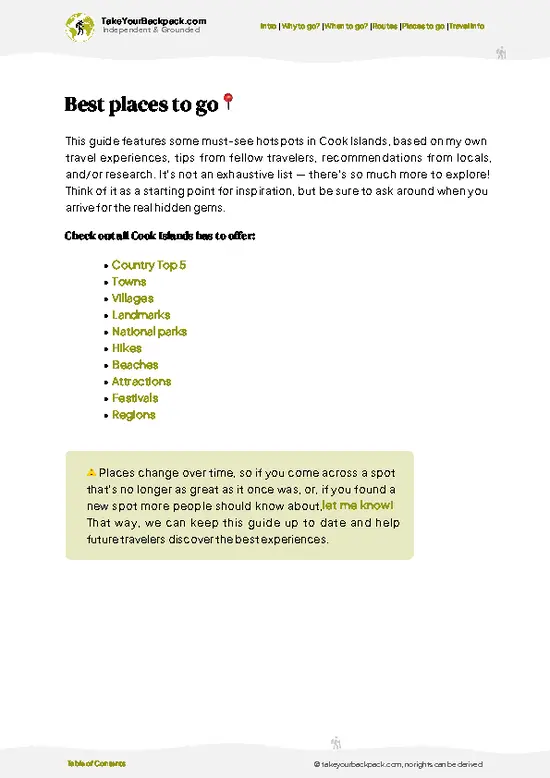
example page 0 from our offline Travel Guide for Cook Islands
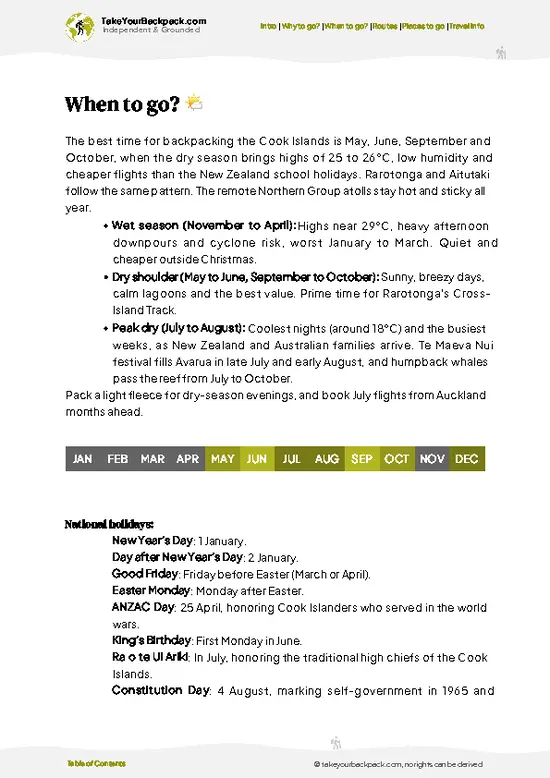
example page 1 from our offline Travel Guide for Cook Islands
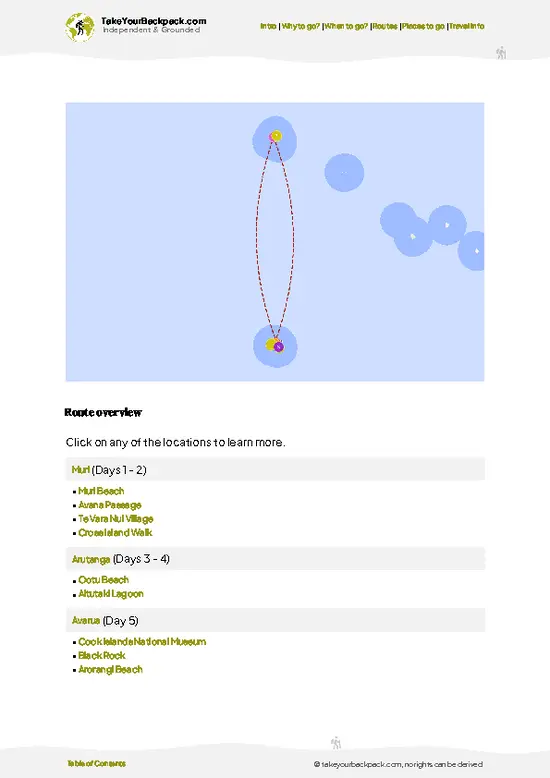
example page 2 from our offline Travel Guide for Cook Islands
example page 3 from our offline Travel Guide for Cook Islands
example page 4 from our offline Travel Guide for Cook Islands
example page 5 from our offline Travel Guide for Cook Islands
example page 6 from our offline Travel Guide for Cook Islands
example page 7 from our offline Travel Guide for Cook Islands
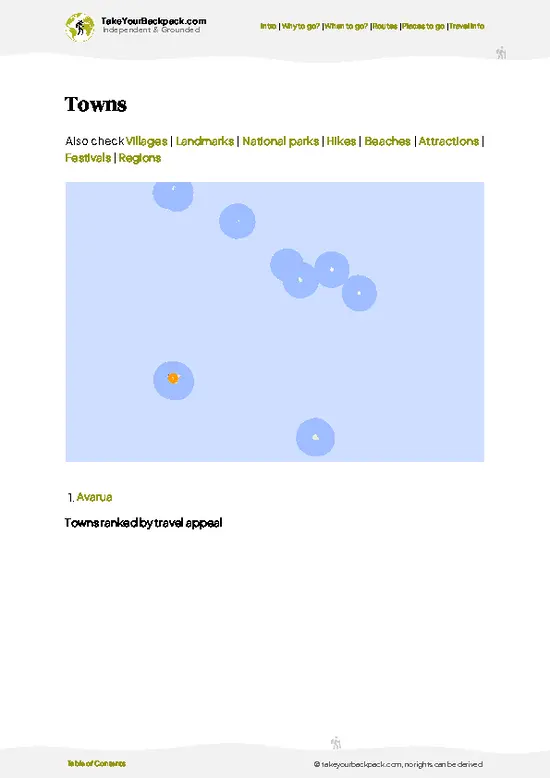
Loading the map 🌍
CLICK TO FILTER
towns
villages
landmarks
national parks
hikes
beaches
attractions
festivals
regions
SHOW COUNTRY’S BESTSHOW ALL

✨ Why go?
Ranked #1 village in Cook Islands
Why Muri should be on your travel list

Backpackers land in Muri because it has the best lagoon on Rarotonga, and the swimming here asks nothing of you. The water is shallow, clear and calm, and the reef break keeps it that way, so you can paddle a rented kayak or stand-up board out to Koromiri and the other motu without any experience. A snorkel along the lagoon edge turns up parrotfish, giant clams and the odd small ray, and you can do it right off the sand.

Most people stay three to five nights, and plenty stretch it longer because the pace is hard to leave. It works well as a pause after a few busier travel days or as a base for exploring the rest of the island by bus or scooter, since the coastal road circles back here easily. The social side is relaxed. You get chats on hostel verandas, shared kayak trips and the weekly night … read more 👉
Backpackers land in Muri because it has the best lagoon on Rarotonga, and the swimming here asks nothing of you. The water is shallow, clear and calm, and the reef break keeps it that way, so you can paddle a rented kayak or stand-up board out to Koromiri and the other motu without any experience. A snorkel along the lagoon edge turns up parrotfish, giant clams and the odd small ray, and you can do it right off the sand.

Most people stay three to five nights, and plenty stretch it longer because the pace is hard to leave. It works well as a pause after a few busier travel days or as a base for exploring the rest of the island by bus or scooter, since the coastal road circles back here easily. The social side is relaxed. You get chats on hostel verandas, shared kayak trips and the weekly night market, rather than organized parties.

This suits couples, slow travelers and solo backpackers who want calm company. Active hikers may prefer to stay elsewhere and visit the Cross-Island Track as a day outing.

💡 HighlightsEssential experiences to have while visiting Muri

  1. Muri Lagoon and Koromiri Islet: The headline sight, a wide pale-sand lagoon with four small motu just offshore. At low tide you can wade across to Koromiri, and the water is warm and clear. Go early, before 9 am, for the calmest conditions and the fewest boats. Entry is free, and a swim and wade easily fills 2 to 4 hours.
  2. Kayak or paddleboard hire on the lagoon: Hire places along the beachfront rent single and double kayaks and stand-up boards, typically around NZ$20 to 30 (about US$12 to 18) for a few hours, with prices and conditions best checked locally. Paddling out to the motu lets you land on quiet sand and snorkel away from the main beach. Mornings are best when winds are lighter. Allow 2 to 3 hours.
  3. Muri Night Markets: An evening food market near the lagoon, held on Tuesday, Wednesday,
… read more 👉
  1. Muri Lagoon and Koromiri Islet: The headline sight, a wide pale-sand lagoon with four small motu just offshore. At low tide you can wade across to Koromiri, and the water is warm and clear. Go early, before 9 am, for the calmest conditions and the fewest boats. Entry is free, and a swim and wade easily fills 2 to 4 hours.
  2. Kayak or paddleboard hire on the lagoon: Hire places along the beachfront rent single and double kayaks and stand-up boards, typically around NZ$20 to 30 (about US$12 to 18) for a few hours, with prices and conditions best checked locally. Paddling out to the motu lets you land on quiet sand and snorkel away from the main beach. Mornings are best when winds are lighter. Allow 2 to 3 hours.
  3. Muri Night Markets: An evening food market near the lagoon, held on Tuesday, Wednesday, Thursday and Sunday, where local stalls serve grilled fish, rukau (taro leaf in coconut cream), curries and fresh coconut. Meals usually cost NZ$10 to 20 (US$6 to 12), and the market is a good place to meet other travelers over shared tables. Arrive around 5:30 pm to catch the best choice, and plan on 1 to 2 hours.
If you have a day or less, skip the market and stay on the water, since the lagoon is what makes Muri worth the trip. Beyond the village, the Cross-Island Track, Wigmore’s Waterfall, Avarua town and the Punanga Nui Market on Saturday mornings make easy day outings from here.
Spotted a mistake or missing something? Contact us.

Things to do around Muri

Ratings based on Tripadvisor reviews. When you book through this link, you support our work at no extra cost to you.

🌤️ When to go?Weather, crowds, and seasonal trade-offs

  • Dry Season (May to October): Muri’s lagoon is at its most comfortable then, with days of 24 to 26°C (75 to 79°F) and nights near 18 to 20°C (64 to 68°F). Humidity drops and rain is lighter. Humpback whales pass offshore from roughly July to October.
  • Wet Season (November to April): Expect 26 to 30°C (79 to 86°F), sticky air and heavy showers that often clear within an hour. Cyclone season runs through this window, though direct hits are rare. The water is warmest for snorkeling and kayaking to the motu.
  • Daylight: Sunrise to sunset runs about 11 hours in June and about 13 hours around December.
  • Crowds and Prices: July to August and the Christmas to New Year stretch are busiest, and beachfront rooms rise by 20 to 40 percent. May, early June and October have quiet sand and lower rates.
Book Muri rooms … read more 👉
  • Dry Season (May to October): Muri’s lagoon is at its most comfortable then, with days of 24 to 26°C (75 to 79°F) and nights near 18 to 20°C (64 to 68°F). Humidity drops and rain is lighter. Humpback whales pass offshore from roughly July to October.
  • Wet Season (November to April): Expect 26 to 30°C (79 to 86°F), sticky air and heavy showers that often clear within an hour. Cyclone season runs through this window, though direct hits are rare. The water is warmest for snorkeling and kayaking to the motu.
  • Daylight: Sunrise to sunset runs about 11 hours in June and about 13 hours around December.
  • Crowds and Prices: July to August and the Christmas to New Year stretch are busiest, and beachfront rooms rise by 20 to 40 percent. May, early June and October have quiet sand and lower rates.
Book Muri rooms early for July and August, since the small beachside properties fill first.


source: climatestotravel.comJANJanuary: fair for travelingFEBFebruary: fair for travelingMARMarch: fair for travelingAPRApril: fair for travelingMAYMay: highly recommended for travelingJUNJune: highly recommended for travelingJULJuly: good for travelingAUGAugust: good for travelingSEPSeptember: highly recommended for travelingOCTOctober: highly recommended for travelingNOVNovember: fair for travelingDECDecember: fair for traveling
when-to-go

✈️ The backpacker research shortcutCook Islands Travel Guide

An offline-friendly backpacking guide with optimized travel routes, ranked highlights, transport advice, and the best areas to stay.
example page 0 from our offline Travel Guide for Cook Islands
example page 1 from our offline Travel Guide for Cook Islands
example page 2 from our offline Travel Guide for Cook Islands
example page 3 from our offline Travel Guide for Cook Islands
example page 4 from our offline Travel Guide for Cook Islands
example page 5 from our offline Travel Guide for Cook Islands
example page 6 from our offline Travel Guide for Cook Islands
example page 7 from our offline Travel Guide for Cook Islands
The digital guide (99 pages) contains:
✅ 24 highlights, ranked by travel appeal
✅ Optimized 2, 3 & 5-day travel routes
✅ Cities, national parks, landmarks, beaches
✅ How to get around
✅ Offline-friendly for travel without Wi-Fi
👉 Click to see all 30+ guide features

📅 Plan smarter in minutes, not weeks
✅ Month by month travel advice
✅ Festivals & national holidays
✅ Budget expectations

🗺️ Go to the right places, skip the overrated ones
✅ Honest pros & cons of destinations
✅ Top hikes, parks & viewpoints
✅ Lesser-known places most travelers miss
✅ Clear “worth it vs skip it” guidance

🛏️ Travel smoothly without rookie mistakes
✅ Best areas to stay
✅ Transport systems explained simply
✅ Common scams & safety advice
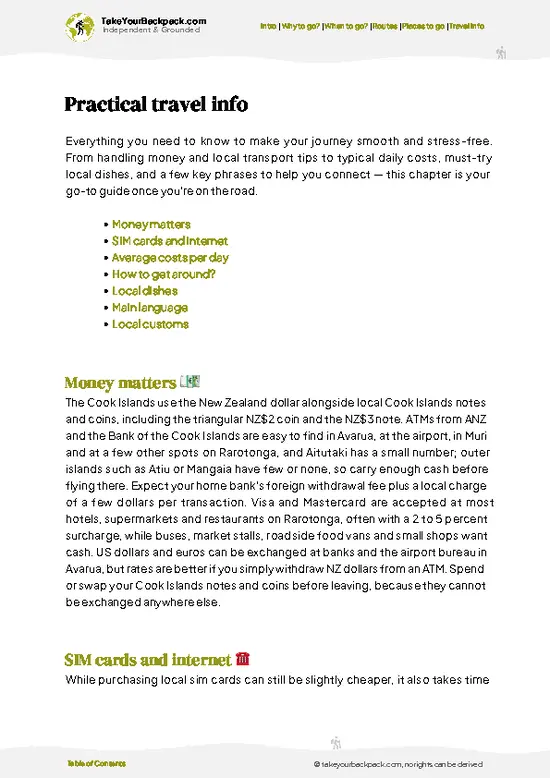
✅ SIM cards, money & practical tips

🌍 Understand the country, not just visit it
✅ Culture & traditions
✅ 52 Essential phrases & customs
✅ Festivals worth planning around
✅ Traveler-friendly historical context
✅ Insights that make places more meaningful

📱 Built for real travel conditions
✅ Fully downloadable PDF
✅ Works completely offline
✅ Optimized for phone use
✅ Useful in remote areas & buses
✅ Everything in one place
Stop searching, start planning
Get instant access to your full guide. 30‑day money-back guarantee.
+ Add another guide for just

By proceeding you agree to our terms.
Sent to your inbox immediately after payment • 100% Secure Checkout
Best Backpacking Travel Advisor 2025 tourism awardBest Backpacking
Travel Advisor
2025
What others say about Take Your Backpack Guides:
⭐⭐⭐⭐⭐
Fantastic, amazing amount of information!
⭐⭐⭐⭐⭐
My goodness this is amazing, it's what I've been looking for hats off too you!
⭐⭐⭐⭐⭐
I think this is absolutely BRILLIANT
⭐⭐⭐⭐
Very complete and informative. It's still missing places, but I gotta to commend you
⭐⭐⭐⭐⭐
This is truly amazing, thank you, can't wait to explore it with my kids!
⭐⭐⭐⭐⭐
Awesome resource, thank you!
⭐⭐⭐⭐⭐
This is amazing! Can't wait to explore the ones I haven't seen
⭐⭐⭐⭐
I love this! Well done, great idea.
⭐⭐⭐⭐⭐
Thanks for taking the time to make this gem!
⭐⭐⭐⭐⭐
This might be the best website I've ever seen.
⭐⭐⭐⭐⭐
Congratulations, and thank you so much for your work; it's incredibly valuable.
⭐⭐⭐⭐
In all seriousness I think you did a great job pointing out the important spots
⭐⭐⭐⭐⭐
10/10 very good
⭐⭐⭐⭐⭐
As someone who's only just starting to visit regularly this is awesome, thank you.
⭐⭐⭐⭐
Thank you very much! I'm going to visit my dad, it's going to be very useful!
⭐⭐⭐⭐⭐
This is really cool! We'll be travelling for the first time and this definitely come in handy.
⭐⭐⭐⭐⭐
You are now our minister of culture, congratulations 👨‍💼
⭐⭐⭐⭐⭐
Just wanted to tell you that this is a pearl! Going to follow your recommendations.
⭐⭐⭐⭐⭐
This is so cool. I'll definitely be using the resource for my travels soon.
⭐⭐⭐⭐⭐
This is very impressive! Good work.
⭐⭐⭐⭐⭐
This is an amazing and informative site. Very well done!

🛏️ Where to stay?Best areas and accommodation options

Muri has no large hostel, so backpackers choose between a few budget-leaning lodgings on the lagoon and the dorm beds elsewhere on the island. Muri Beach Club Hotel and Muri Beachcomber both sit steps from the water and offer self-catering units, which suits anyone who wants to cook and keep food costs down. Expect roughly NZ$150 to 250 (US$90 to 150) a night for a studio or bungalow, so splitting with a travel partner makes the math work. The Pacific Resort sits at the upper end and is worth the splurge only if you want a pool and the best stretch of beach.
If your budget is tighter, dorm beds … read more 👉
Muri has no large hostel, so backpackers choose between a few budget-leaning lodgings on the lagoon and the dorm beds elsewhere on the island. Muri Beach Club Hotel and Muri Beachcomber both sit steps from the water and offer self-catering units, which suits anyone who wants to cook and keep food costs down. Expect roughly NZ$150 to 250 (US$90 to 150) a night for a studio or bungalow, so splitting with a travel partner makes the math work. The Pacific Resort sits at the upper end and is worth the splurge only if you want a pool and the best stretch of beach.
If your budget is tighter, dorm beds on Rarotonga run about NZ$35 to 50 (US$21 to 30) a night. The island bus runs a full circle in both directions, with one-way fares around NZ$5 (US$3), so you can sleep elsewhere and still reach Muri in 20 to 30 minutes from Avarua. Late evenings are the weak point, because buses stop in the evening and the last ones leave early.
Within Muri, a kitchen and a nearby shop matter more than a pool. The supermarket stop in Avarua is the cheaper place to stock up before settling in, as Muri’s shops charge more. Look for rooms with a fan or air-conditioning if you come in the wet season.

🚌 Day tripsExploring the surroundings

Muri works very well as a base for day trips because the island’s single coast road and circle bus put every trailhead and market within about 45 minutes.
Cross-Island Track:
The walk from the north coast up to Te Rua Manga, the Needle, and down to Wigmore’s Waterfall is the best hike on the island. Allow 3 to 4 hours one way across the interior, longer if you climb the Needle. The bus to the trailhead costs about NZ$5 (US$3) each way, and the waterfall pool is a good place for a swim. Go in the dry season, because the clay turns slick after rain. First-timers often start after noon and run out of light, so start by 9 a.m.

Punanga Nui Market, Avarua:
The Saturday morning market in Avarua is where locals buy fruit, fish, island pareu and fresh breakfast. Plan on a 20 to 30 minute bus ride and … read more 👉
Muri works very well as a base for day trips because the island’s single coast road and circle bus put every trailhead and market within about 45 minutes.
Cross-Island Track:
The walk from the north coast up to Te Rua Manga, the Needle, and down to Wigmore’s Waterfall is the best hike on the island. Allow 3 to 4 hours one way across the interior, longer if you climb the Needle. The bus to the trailhead costs about NZ$5 (US$3) each way, and the waterfall pool is a good place for a swim. Go in the dry season, because the clay turns slick after rain. First-timers often start after noon and run out of light, so start by 9 a.m.

Punanga Nui Market, Avarua:
The Saturday morning market in Avarua is where locals buy fruit, fish, island pareu and fresh breakfast. Plan on a 20 to 30 minute bus ride and about NZ$10 to 20 (US$6 to 12) for a filling meal. It winds down by around noon, and the best stalls run out of food by 10 a.m., so arrive early. The town itself takes another hour to walk, with the library and the old cathedral.

Titikaveka Lagoon:
The beach west of Muri has calmer, emptier water than Muri itself and good snorkeling over coral heads. You can walk or cycle there in 30 to 45 minutes along the coast road, and a bike rental runs roughly NZ$15 to 20 (US$9 to 12) a day. Go at high tide or mid-morning, as shallow channels at low tide can scrape your feet. Bring reef shoes, since sea urchins sit in the rocky patches.

Aitutaki Day Tour:
The 45 minute flight to Aitutaki gets you a full day on one of the Pacific’s most striking lagoons, including a boat cruise to One Foot Island. A tour with flights costs roughly NZ$500 to 700 (US$300 to 420), so it’s a splurge, but it is the one trip I’d say is worth the money. Book ahead in July and August and before the morning flight. Cancellations in poor weather do happen, so don’t schedule it on your last day.

FAQCommon questions from travelers

Fly into Rarotonga International Airport, then take a 20 to 25 minute drive or a bus ride east to Muri. Flights come direct from Auckland (about 4 hours) and from Sydney, Brisbane and Honolulu on some schedules. A taxi from the airport costs roughly NZ$30 to 40 (US$18 to 24), while the island bus costs about NZ$5 (US$3) one way.
Yes, if you want calm, shallow water and a lagoon you can kayak across to four small islands called motu, including Taakoka. Plan on 2 to 4 days to get a feel for the beach, snorkeling and the Fruits of Rarotonga stalls and cafes nearby. It is a better base for relaxing than for nightlife, and the lagoon is best in the dry season from May to October.
Yes, it is easy to visit from anywhere on Rarotonga, since the island’s coast road is about 32 kilometers (20 miles) around. From Avarua, buses reach Muri in 20 to 30 minutes and cost about NZ$5 (US$3) each way. Spend 3 to 5 hours to swim, snorkel and paddle to Koromiri, and leave before the evening buses stop.
⚠️ Things can change over time, so always validate details locally before you go.

Other Cook Islands villages near Muri

Explore more nearby:

  • Titikaveka Village—Calm south-coast lagoon, no town center, backroad plantations, evening lagoon light| 3 km away
  • Arutanga—Aitutaki’s only town, coral-block church, reef-passage harbor, bakery run| 266 km away

💡 Not sure where to go next?
Create a personalized itinerary for Cook Islands including Muri and the places that fit your trip.

Generate my itinerary

👉 Discover all villages

Or checkout all Cook Islands has to offer (think cities, towns, villages, national parks, hikes, beaches, festivals)
Country photo of Cook Islands

We 💚 feedbackIs it worth it?

Pair Muri with the quieter west coast of Rarotonga, or add a few nights on Aitutaki for a bigger lagoon after you have seen this one. I would book the first two nights here, then use a scooter or the island bus to see the rest. Bring your own snorkel gear if you can, because rentals add up.

✍️ Help improve this page!
The information on this page is based on in-depth research, insights shared by experienced travelers, and feedback from the local travel community in Cook Islands. While every effort is made to keep the information accurate and current, conditions can change — so if you spot anything incorrect or outdated, please get in touch.


🙋‍♂️ Give feedback

👋 Meet the founderWho’s Behind Take Your Backpack?

Johan, backpacker and founder of TakeYourBackpackHi, I’m Johan (Netherlands 🇳🇱), the creator of TakeYourBackpack. Over the past 3 decades, I’ve backpacked through 90+ countries across six continents, gaining extensive experience with independent travel, long-term trips, and overland routes.

This site is built on a combination of firsthand travel experience and carefully curated insights from other backpackers. Many guides are based on places I’ve personally visited, while others bring together tips, observations, and practical advice shared by trusted travelers I’ve met along the way.

The goal is to provide realistic, experience-driven guidance — not generic itineraries — so you can explore destinations with better context, clearer expectations, and more confidence.