×

Cook Islands🇨🇰 | best villagesWhere to Find the 3 Best villages in Cook Islands

Villages in the Cook Islands are mostly coastal strings of pastel houses, whitewashed churches and taro patches, and they differ sharply by island. Rarotonga is easy, cheap to reach by local bus and busy with visitors. Aitutaki is quieter and pricier. The Outer Islands are slow, expensive to fly to and wonderfully unhurried. For independent travel, go Sunday morning for church singing, and arrive with small cash.

By Johan Kruseman 🇳🇱 | Updated October 23, 2026
Explore the best landmarks in Cook Islands

Why go?Why Travelers Love These Spots

The Cook Islands are small, volcanic or coral islands where life still organizes itself around the village, the church and family land. Land stays in family hands under customary tenure, so settlements have kept their shape rather than being swallowed by resorts. Rarotonga has one coast road of about 32 kilometers, which makes villages easy to reach, while the Outer Islands depend on limited flights and cargo ships.

Before choosing the country for its villages, know that Sunday is a day of church and rest, with most shops closed. Dress modestly away from the beach, with shoulders and knees covered. Expect Cook Islands Maori greetings, and learn “Kia orana.” Villages here are lived-in neighborhoods rather than showpieces, so a friendly hello, and asking before photographing people or private gardens, goes a long way.
Why These Made the Cut
The list of best villages in Cook Islands is created based on authenticity, scenic beauty, community spirit, traditions, and overall character. If you feel a village is missing in this list, please let us know.

When to go?Optimal Periods for Travel

Best months and the shoulder seasons: May to October is the best window for villages, because it is the dry season with daytime highs around 24 to 28°C, low humidity and steady breezes for walking between settlements. Rain falls mostly November to April, when it is hotter (28 to 31°C) and humid, and cyclones are possible, especially January to March. Expect roughly 1,800 to 2,000 millimeters of rain a year on Rarotonga, more in the wetter hills.
Crowds and prices: July and August, plus the school-holiday weeks, are peak and room rates climb, often 20 to 30 percent. May, June, September and October are the sweet spot for space and value. Late July to early August brings Te Maeva Nui celebrations, which are lively but book flights and beds early.

village hoppingOptimizing Your Multi-Stop Itinerary

How long to allow: A trip combining several villages in the Cook Islands works best with 7 to 12 days. Base on Rarotonga first, since its international airport is the gateway and its coast road takes about 45 minutes to circle by bus or scooter. Then add Aitutaki, a flight of roughly 45 minutes, before any farther Outer Islands.
Pacing and common mistakes: Give each stop half a day on Rarotonga and a full day on an outer island. The usual mistakes are cramming a flight into a tight international connection and treating islands as day trips. Flights are weather-dependent and Sundays are quiet, so leave a spare day at the end. Fly outward first, finish on Rarotonga, and keep Sunday free for staying put.

The ListMust-Visit villages in Cook Islands

1 Muri

Wadable lagoon, four motu, paddle hire, Muri night market

Wade or paddle out to Koromiri islet at low tide, then share grilled fish and rukau at the Muri night market.

2 Titikaveka Village

Calm south-coast lagoon, no town center, backroad plantations, evening lagoon light

Swim and snorkel the shallow lagoon at high tide, cycle the inland lane past gardens, then settle on the sand for sunset.

cook-islands-city-titikaveka-village
© Google | Ajeesh Kilimanoor

3 Arutanga

Aitutaki’s only town, coral-block church, reef-passage harbor, bakery run

Walk the main road past the bakery and shops, watch boats unload at the wharf, and catch Sunday hymns in the whitewashed church.

Loading the map 🌍

Expert viewPro Tips for Exploring the Best

How many to visit: I would advise four to six villages in total. That is enough to see the contrast between the busy main island and a quieter one, without turning a gentle place into a checklist. More than that costs you time on buses and flights for little new, while fewer misses the variety. Rarotonga gives the best value, since many stops cost nothing and a local bus pass is cheap.
Which kind to prioritize: Backpackers on a tight budget get the most from Rarotonga settlements, where a day costs roughly NZ$80 to 140 (US$50 to 85) including a hostel bed or basic room, bus fares of about NZ$5 per ride and market food. The Cook Islands use New Zealand dollars. Add Aitutaki if you want calm, but return flights often run NZ$400 to 600, a big jump in cost. Outer Islands such as Atiu or Mangaia … read more 👉
How many to visit: I would advise four to six villages in total. That is enough to see the contrast between the busy main island and a quieter one, without turning a gentle place into a checklist. More than that costs you time on buses and flights for little new, while fewer misses the variety. Rarotonga gives the best value, since many stops cost nothing and a local bus pass is cheap.
Which kind to prioritize: Backpackers on a tight budget get the most from Rarotonga settlements, where a day costs roughly NZ$80 to 140 (US$50 to 85) including a hostel bed or basic room, bus fares of about NZ$5 per ride and market food. The Cook Islands use New Zealand dollars. Add Aitutaki if you want calm, but return flights often run NZ$400 to 600, a big jump in cost. Outer Islands such as Atiu or Mangaia give the deepest culture and suit slower, flexible travelers who can spend NZ$150 to 250 a day.
Guides and fees: Villages are free to walk through, but cultural tours, island nights, and guided plantation or cave visits usually cost NZ$20 to 90 per person. A guide is worth paying when you want stories and access to family land.
Safety and etiquette: Crime is low, but scooter accidents are common, and a Cook Islands driver’s license test is required even if you hold a home license. Wear a helmet. Dogs roam freely. Sunday calls for modest dress, quiet streets and no laundry hung out. Ask before entering a church or photographing a funeral, and never walk onto private land or a family graveyard, since burials sit beside homes. Bring small cash because many village stalls do not take cards.


✈️ The backpacker research shortcutCook Islands Travel Guide

An offline-friendly backpacking guide with optimized travel routes, ranked highlights, transport advice, and the best areas to stay.
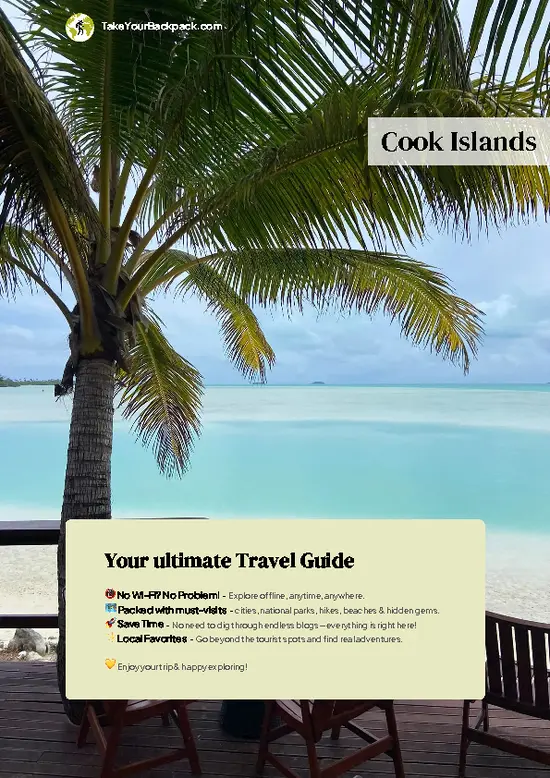
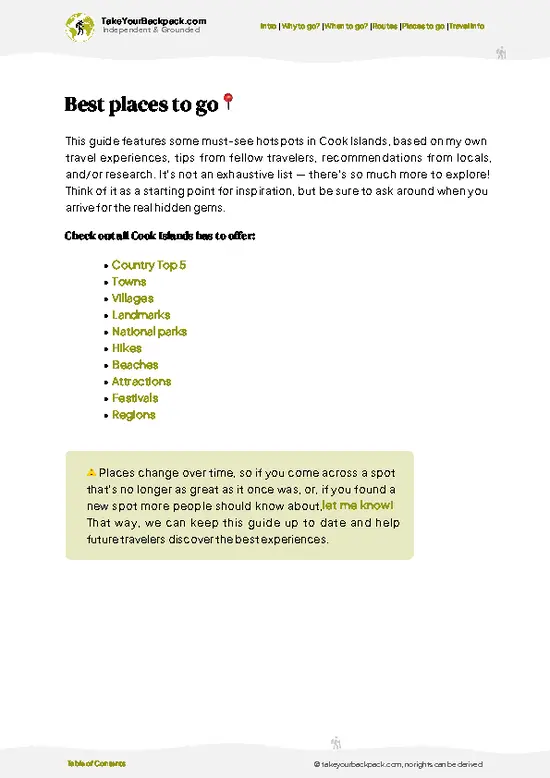
example page 0 from our offline Travel Guide for Cook Islands
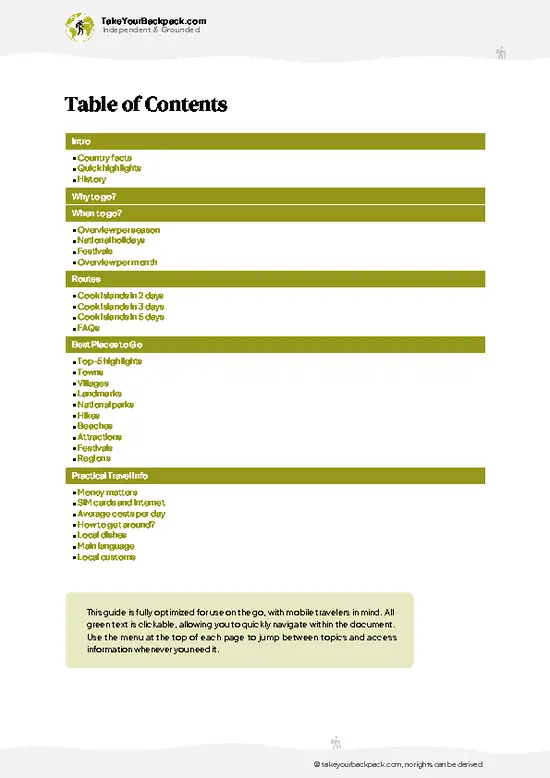
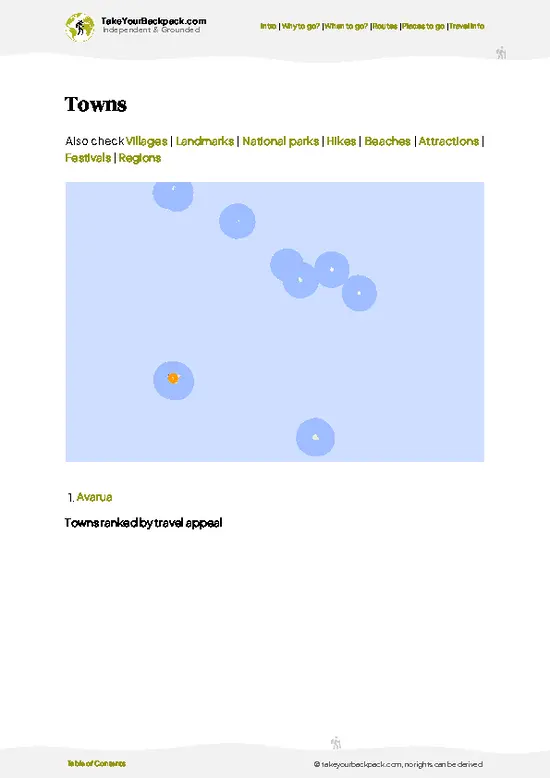
example page 1 from our offline Travel Guide for Cook Islands
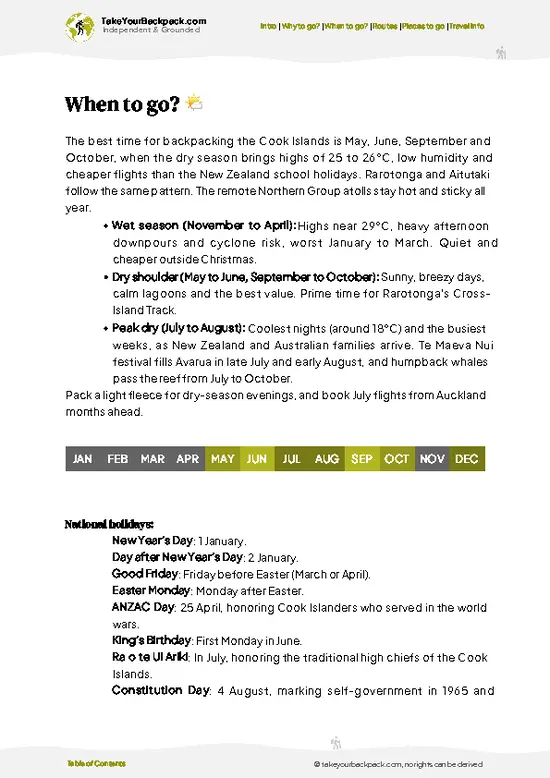
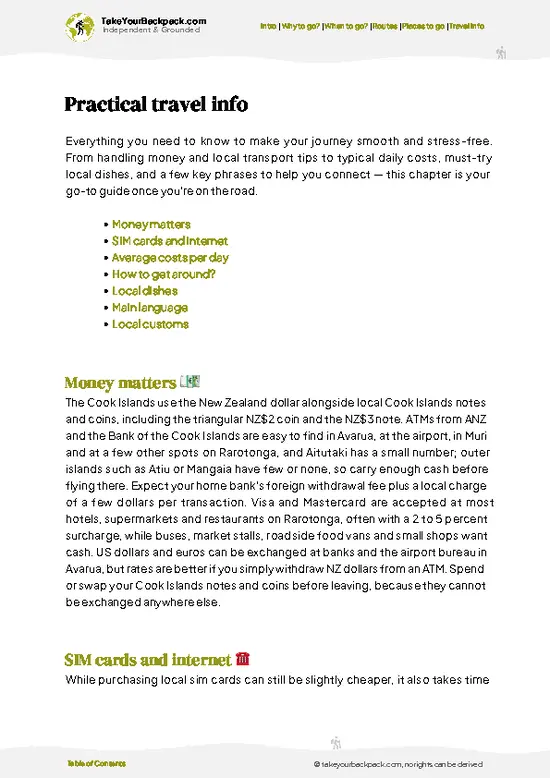
example page 2 from our offline Travel Guide for Cook Islands
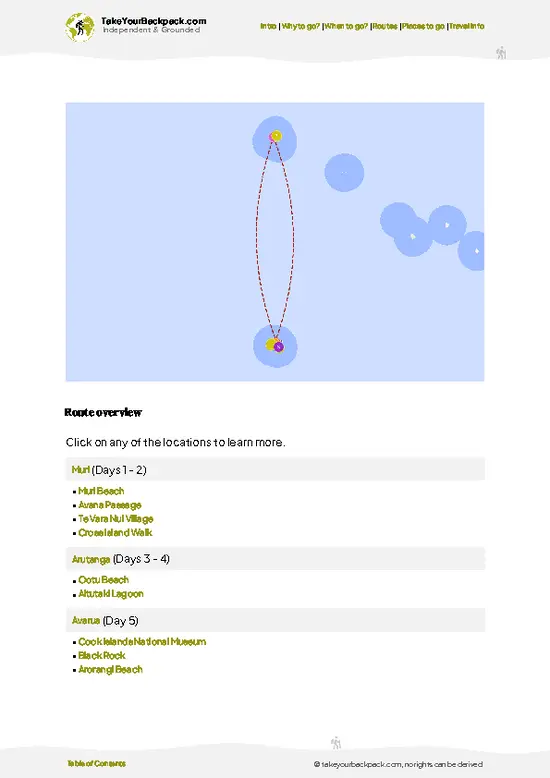
example page 3 from our offline Travel Guide for Cook Islands
example page 4 from our offline Travel Guide for Cook Islands
example page 5 from our offline Travel Guide for Cook Islands
example page 6 from our offline Travel Guide for Cook Islands
example page 7 from our offline Travel Guide for Cook Islands
The digital guide (99 pages) contains:
✅ 24 highlights, ranked by travel appeal
✅ Optimized 2, 3 & 5-day travel routes
✅ Cities, national parks, landmarks, beaches
✅ How to get around
✅ Offline-friendly for travel without Wi-Fi
👉 Click to see all 30+ guide features

📅 Plan smarter in minutes, not weeks
✅ Month by month travel advice
✅ Festivals & national holidays
✅ Budget expectations

🗺️ Go to the right places, skip the overrated ones
✅ Honest pros & cons of destinations
✅ Top hikes, parks & viewpoints
✅ Lesser-known places most travelers miss
✅ Clear “worth it vs skip it” guidance

🛏️ Travel smoothly without rookie mistakes
✅ Best areas to stay
✅ Transport systems explained simply
✅ Common scams & safety advice
✅ SIM cards, money & practical tips

🌍 Understand the country, not just visit it
✅ Culture & traditions
✅ 52 Essential phrases & customs
✅ Festivals worth planning around
✅ Traveler-friendly historical context
✅ Insights that make places more meaningful

📱 Built for real travel conditions
✅ Fully downloadable PDF
✅ Works completely offline
✅ Optimized for phone use
✅ Useful in remote areas & buses
✅ Everything in one place
Stop searching, start planning
Get instant access to your full guide. 30‑day money-back guarantee.
+ Add another guide for just

By proceeding you agree to our terms.
Sent to your inbox immediately after payment • 100% Secure Checkout
Best Backpacking Travel Advisor 2025 tourism awardBest Backpacking
Travel Advisor
2025
What others say about Take Your Backpack Guides:
⭐⭐⭐⭐⭐
Fantastic, amazing amount of information!
⭐⭐⭐⭐⭐
My goodness this is amazing, it's what I've been looking for hats off too you!
⭐⭐⭐⭐⭐
I think this is absolutely BRILLIANT
⭐⭐⭐⭐
Very complete and informative. It's still missing places, but I gotta to commend you
⭐⭐⭐⭐⭐
This is truly amazing, thank you, can't wait to explore it with my kids!
⭐⭐⭐⭐⭐
Awesome resource, thank you!
⭐⭐⭐⭐⭐
This is amazing! Can't wait to explore the ones I haven't seen
⭐⭐⭐⭐
I love this! Well done, great idea.
⭐⭐⭐⭐⭐
Thanks for taking the time to make this gem!
⭐⭐⭐⭐⭐
This might be the best website I've ever seen.
⭐⭐⭐⭐⭐
Congratulations, and thank you so much for your work; it's incredibly valuable.
⭐⭐⭐⭐
In all seriousness I think you did a great job pointing out the important spots
⭐⭐⭐⭐⭐
10/10 very good
⭐⭐⭐⭐⭐
As someone who's only just starting to visit regularly this is awesome, thank you.
⭐⭐⭐⭐
Thank you very much! I'm going to visit my dad, it's going to be very useful!
⭐⭐⭐⭐⭐
This is really cool! We'll be travelling for the first time and this definitely come in handy.
⭐⭐⭐⭐⭐
You are now our minister of culture, congratulations 👨‍💼
⭐⭐⭐⭐⭐
Just wanted to tell you that this is a pearl! Going to follow your recommendations.
⭐⭐⭐⭐⭐
This is so cool. I'll definitely be using the resource for my travels soon.
⭐⭐⭐⭐⭐
This is very impressive! Good work.
⭐⭐⭐⭐⭐
This is an amazing and informative site. Very well done!

🛏️ Where to stay?Where to Stay: Cook Islands Edition

The Cook Islands have a small but solid spread of backpacker lodges, hostels and simple guesthouses, almost all on Rarotonga, with dorm beds around NZ$35 to 50 (US$21 to 30) and private rooms from roughly NZ$70 to 120 (US$42 to 72). Avarua puts you near the airport, supermarkets, the Saturday market and the island’s few late bars, though its lagoon is poor for swimming, while Muri on the southeast coast has the best swimming lagoon, kayak rentals and night food stalls, but sleeps early and costs a little more. Arorangi on the west coast is the quietest and cheapest of the three, with sunset views and easy reef snorkeling, but you’ll lean on the round-island bus or a rented scooter for everything … read more 👉
The Cook Islands have a small but solid spread of backpacker lodges, hostels and simple guesthouses, almost all on Rarotonga, with dorm beds around NZ$35 to 50 (US$21 to 30) and private rooms from roughly NZ$70 to 120 (US$42 to 72). Avarua puts you near the airport, supermarkets, the Saturday market and the island’s few late bars, though its lagoon is poor for swimming, while Muri on the southeast coast has the best swimming lagoon, kayak rentals and night food stalls, but sleeps early and costs a little more. Arorangi on the west coast is the quietest and cheapest of the three, with sunset views and easy reef snorkeling, but you’ll lean on the round-island bus or a rented scooter for everything else, and on Aitutaki budget beds are scarce, so book well ahead.

If you enjoy meeting fellow travelers, consider choosing hostels with high ratings for atmosphere. On the other hand, if you prefer having your own space, a hotel might be a better option.

Cook IslandsExplore Beyond This Category

👋 Meet the founderWho’s Behind Take Your Backpack?

Johan, backpacker and founder of TakeYourBackpackHi, I’m Johan (Netherlands 🇳🇱), the creator of TakeYourBackpack. Over the past 3 decades, I’ve backpacked through 90+ countries across six continents, gaining extensive experience with independent travel, long-term trips, and overland routes.

This site is built on a combination of firsthand travel experience and carefully curated insights from other backpackers. Many guides are based on places I’ve personally visited, while others bring together tips, observations, and practical advice shared by trusted travelers I’ve met along the way.

The goal is to provide realistic, experience-driven guidance — not generic itineraries — so you can explore destinations with better context, clearer expectations, and more confidence.