×

Djibouti🇩🇯 | national parksAbourma Rock Art Siteprehistoric carvings, basalt cliffs, remote plateau | things to do and best time to go

Explore Moucha Island National ParkExplore Lake Abbe

Backpacking in Abourma Rock Art Site
By Johan Kruseman 🇳🇱 | Updated June 1, 2026

Most guides gloss over it, but Abourma Rock Art Site isn’t a park you stumble into—it’s a remote, wind-scoured plateau in Djibouti’s north, hours from the nearest paved road, and you’ll need a guide just to find the trailhead. The reward: ancient petroglyphs, total solitude, and a landscape that feels more lunar than African. Don’t expect marked trails, wildlife sightings, or budget lodges—just raw desert, tough hiking, and a sense of discovery you won’t get at the busier Day Forest or Lake Assal reserves.

Discover everything you want to know in the 📖 Djibouti Travel Guide.


Get your Djibouti guide
48 ranked highlights, routes & tips, works offline (205 pages)
Loading the map 🌍
CLICK TO FILTER
cities
towns
villages
landmarks
national parks
hikes
beaches
attractions
festivals
regions
SHOW COUNTRY’S BESTSHOW ALL

✨ Why go?
Ranked #99 national park in Djibouti
What sets this place apart

Backpackers flock to the Abourma Rock Art Site in Djibouti for its blend of independent exploration and rich history. The site boasts ancient rock art that tells stories of the region’s past, making it a compelling stop for those who appreciate culture and history.

Budget-conscious travelers will find camping options nearby, or affordable hostels that keep costs low while providing a base for adventure. The trails vary in difficulty, catering to both novice hikers and seasoned trekkers. You can choose your own path, which is a huge plus for those who prefer self-guided exploration over structured tours.

While some may opt for guided experiences, the park is designed for those who want to set their own pace. Just be mindful of the heat and plan your hikes accordingly. Bring plenty of water … read more 👉
Backpackers flock to the Abourma Rock Art Site in Djibouti for its blend of independent exploration and rich history. The site boasts ancient rock art that tells stories of the region’s past, making it a compelling stop for those who appreciate culture and history.

Budget-conscious travelers will find camping options nearby, or affordable hostels that keep costs low while providing a base for adventure. The trails vary in difficulty, catering to both novice hikers and seasoned trekkers. You can choose your own path, which is a huge plus for those who prefer self-guided exploration over structured tours.

While some may opt for guided experiences, the park is designed for those who want to set their own pace. Just be mindful of the heat and plan your hikes accordingly. Bring plenty of water and snacks to keep your energy up. The beauty of Abourma lies in its ability to offer a raw, authentic experience without the trappings of commercial tourism.
Want to include Abourma Rock Art Site in your Djibouti route?
Create a personalized Djibouti itinerary that includes Abourma Rock Art Site and the places that fit your trip — based on your travel style, budget, and available time. Get your route in seconds.

Generate my trip

💡 HighlightsDon't-miss highlights and experiences

  • Main rock-art panels — clusters of pecked and painted figures on sheltered cliff faces: human silhouettes, livestock and animal motifs that give a direct, ancient snapshot of life in the Horn. The scale and density of the panels are the site’s headline attraction, best seen in the cool morning light.
  • Sunset cliff viewpoint — a short scramble up a battered escarpment leads to wide-open views over the plateau and surrounding wadis. The stone turns warm orange at dusk; it’s the simplest way to feel the landscape’s size and take great photos without covering miles.
  • Wadi hiking route — a shady, seasonal gorge that cuts the park offers a compact, varied hike: stony streambeds, pockets of scrub and sudden views back up to the cliffs with panels. After rains you’ll find small pools and noticeably
read more 👉
  • Main rock-art panels — clusters of pecked and painted figures on sheltered cliff faces: human silhouettes, livestock and animal motifs that give a direct, ancient snapshot of life in the Horn. The scale and density of the panels are the site’s headline attraction, best seen in the cool morning light.
  • Sunset cliff viewpoint — a short scramble up a battered escarpment leads to wide-open views over the plateau and surrounding wadis. The stone turns warm orange at dusk; it’s the simplest way to feel the landscape’s size and take great photos without covering miles.
  • Wadi hiking route — a shady, seasonal gorge that cuts the park offers a compact, varied hike: stony streambeds, pockets of scrub and sudden views back up to the cliffs with panels. After rains you’ll find small pools and noticeably cooler air — bring sturdy shoes for the boulder sections.
  • Acacia pockets and palm groves — scattered green oases where groundwater reaches the surface; they’re small but important for local wildlife and make pleasant resting spots on long walks. Expect birds, insects and an unexpectedly lush feel compared with the open plateau.
  • Birding ridge — an exposed ridge where raptors and desert songbirds are often seen hunting and moving with the thermals. Early morning binocular time: the light and quiet make it easy to pick out species and appreciate the birdlife adapted to this dry environment.
  • Strange rock formations and terraces — wind-and water-sculpted basalt and sandstone create honeycombed cliffs, natural arches and stepped terraces that are fun to explore and photograph. Geology buffs and casual wanderers both get something out of poking around these shapes.
  • Dark-sky stargazing — far from city lights the park is superb for the Milky Way and bright constellations. Pitch a small camp (where allowed), lie back on the rocks and enjoy a spectacular, quiet night sky — bring a headlamp with a red setting so you don’t ruin others’ views.
Spotted a mistake or missing something? Contact us.
🌤️ When to go?Seasonal considerations and timing


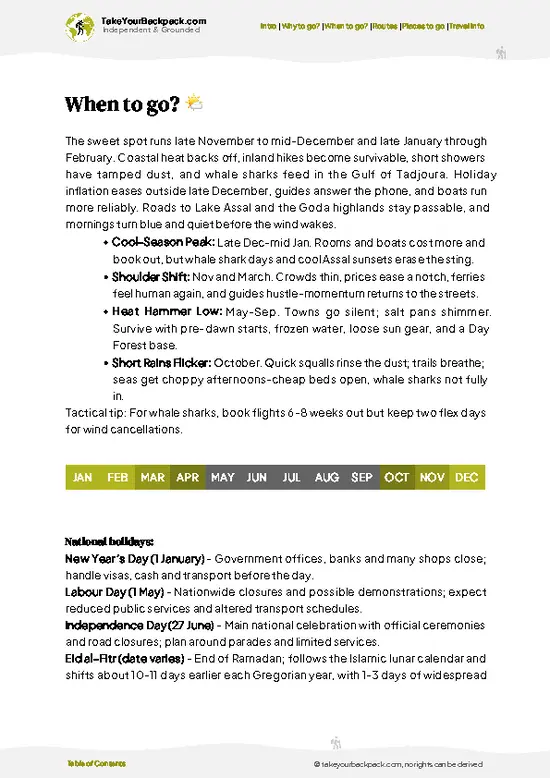
  • Weather: The best time is between October and April when Djibouti experiences its dry season. Expect minimal rain, which means easier hiking and less mud.

  • Temperature: Daytime highs range from 25°C to 35°C (77°F to 95°F) during the dry season, cooler than the scorching summer months that can hit 40°C (104°F) or more.

  • Daylight Hours: Roughly 11 to 12 hours of daylight year-round, giving you plenty of time to explore without rushing.

  • Crowds: The site sees few visitors year-round, but the dry season draws slightly more tourists, so expect a bit more company in peak months.

  • Seasonal Activities: Dry months are ideal for trekking and rock art viewing; avoid the rainy season when trails can be slippery and access limited.

  • Price Fluctuations: Accommodation and transport costs rise modestly
read more 👉

  • Weather: The best time is between October and April when Djibouti experiences its dry season. Expect minimal rain, which means easier hiking and less mud.

  • Temperature: Daytime highs range from 25°C to 35°C (77°F to 95°F) during the dry season, cooler than the scorching summer months that can hit 40°C (104°F) or more.

  • Daylight Hours: Roughly 11 to 12 hours of daylight year-round, giving you plenty of time to explore without rushing.

  • Crowds: The site sees few visitors year-round, but the dry season draws slightly more tourists, so expect a bit more company in peak months.

  • Seasonal Activities: Dry months are ideal for trekking and rock art viewing; avoid the rainy season when trails can be slippery and access limited.

  • Price Fluctuations: Accommodation and transport costs rise modestly during the dry season due to increased demand; budget accordingly.


Pro-tip: Plan your visit early in the dry season to dodge the peak crowd and enjoy cooler mornings without paying peak-season prices.


source: climatestotravel.comJANJanuary: excellent for travelingFEBFebruary: excellent for travelingMARMarch: excellent for travelingAPRApril: excellent for travelingMAYMay: good for travelingJUNJune: fair for travelingJULJuly: below average for travelingAUGAugust: below average for travelingSEPSeptember: fair for travelingOCTOctober: excellent for travelingNOVNovember: excellent for travelingDECDecember: excellent for traveling
djibouti-national-park-abourma-rock-art-site
© Google |

✈️ The backpacker research shortcutDjibouti Travel Guide

An offline-friendly backpacking guide with optimized travel routes, ranked highlights, transport advice, and the best areas to stay.
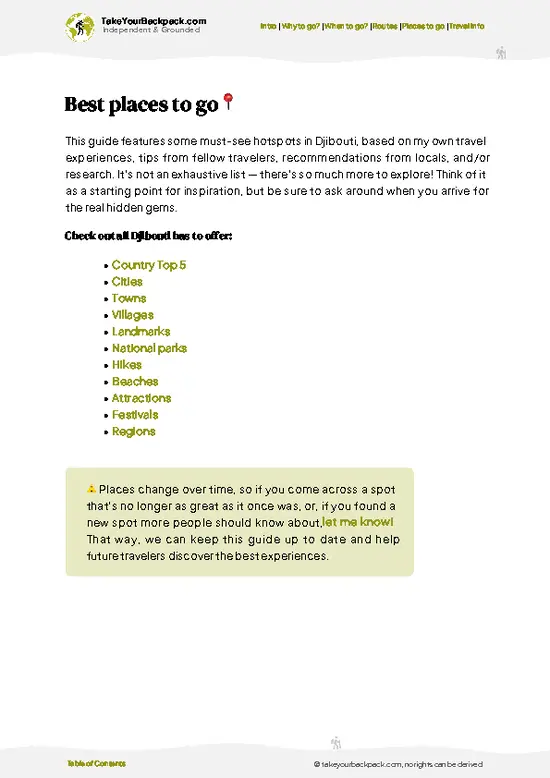
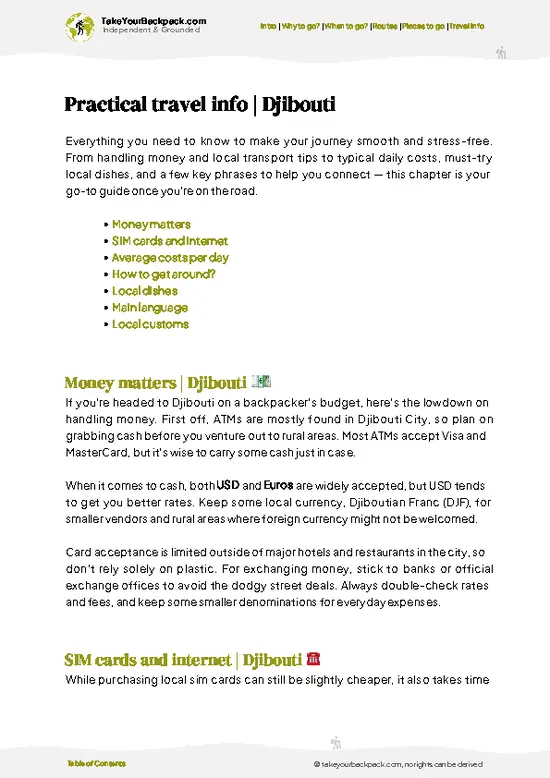
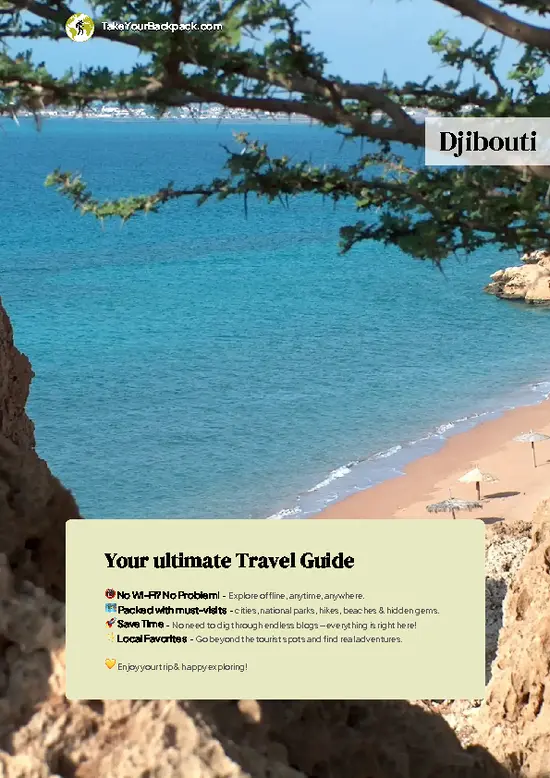
example page 0 from our offline Travel Guide for Djibouti
example page 1 from our offline Travel Guide for Djibouti
example page 2 from our offline Travel Guide for Djibouti
example page 3 from our offline Travel Guide for Djibouti
example page 4 from our offline Travel Guide for Djibouti
example page 5 from our offline Travel Guide for Djibouti
example page 6 from our offline Travel Guide for Djibouti
example page 7 from our offline Travel Guide for Djibouti
The digital guide (205 pages) contains:
48 highlights, ranked by travel appeal
Optimized 2, 3 & 5-day travel routes
Cities, national parks, landmarks, beaches
How to get around
Offline-friendly for travel without Wi-Fi
👉 Click to see all 30+ guide features

📅 Plan smarter in minutes, not weeks
Month by month travel advice
Festivals & national holidays
Budget expectations

🗺️ Go to the right places, skip the overrated ones
Honest pros & cons of destinations
Top hikes, parks & viewpoints
Lesser-known places most travelers miss
Clear “worth it vs skip it” guidance

🛏️ Travel smoothly without rookie mistakes
Best areas to stay
Transport systems explained simply
Common scams & safety advice
SIM cards, money & practical tips

🌍 Understand the country, not just visit it
Culture & traditions
52 Essential phrases & customs
Festivals worth planning around
Traveler-friendly historical context
Insights that make places more meaningful

📱 Built for real travel conditions
Fully downloadable PDF
Works completely offline
Optimized for phone use
Useful in remote areas & buses
Everything in one place
Save weeks of stressful planning
Get instant access to your full guide. 30‑day money-back guarantee.


By proceeding you agree to our terms.
Sent to your inbox immediately after payment • 100% Secure Checkout
Best Backpacking Travel Advisor 2025 tourism awardBest Backpacking
Travel Advisor
2025
What others say about Take Your Backpack Guides:
⭐⭐⭐⭐⭐
Fantastic, amazing amount of information!
⭐⭐⭐⭐⭐
My goodness this is amazing, it's what I've been looking for hats off too you!
⭐⭐⭐⭐⭐
I think this is absolutely BRILLIANT
⭐⭐⭐⭐
Very complete and informative. It's still missing places, but I gotta to commend you
⭐⭐⭐⭐⭐
This is truly amazing, thank you, can't wait to explore it with my kids!
⭐⭐⭐⭐⭐
Awesome resource, thank you!
⭐⭐⭐⭐⭐
This is amazing! Can't wait to explore the ones I haven't seen
⭐⭐⭐⭐
I love this! Well done, great idea.
⭐⭐⭐⭐⭐
Thanks for taking the time to make this gem!
⭐⭐⭐⭐⭐
This might be the best website I've ever seen.
⭐⭐⭐⭐⭐
Congratulations, and thank you so much for your work; it's incredibly valuable.
⭐⭐⭐⭐
In all seriousness I think you did a great job pointing out the important spots
⭐⭐⭐⭐⭐
10/10 very good
⭐⭐⭐⭐⭐
As someone who's only just starting to visit regularly this is awesome, thank you.
⭐⭐⭐⭐
Thank you very much! I'm going to visit my dad, it's going to be very useful!
⭐⭐⭐⭐⭐
This is really cool! We'll be travelling for the first time and this definitely come in handy.
⭐⭐⭐⭐⭐
You are now our minister of culture, congratulations 👨‍💼
⭐⭐⭐⭐⭐
Just wanted to tell you that this is a pearl! Going to follow your recommendations.
⭐⭐⭐⭐⭐
This is so cool. I'll definitely be using the resource for my travels soon.
⭐⭐⭐⭐⭐
This is very impressive! Good work.
⭐⭐⭐⭐⭐
This is an amazing and informative site. Very well done!

🛏️ Where to stay?Best areas and accommodation options

For backpackers heading to the ’Abourma Rock Art Site in Djibouti, accommodation options are limited but manageable. There aren’t any lodges or camps directly inside the national park, which means you’ll need to base yourself in nearby towns.

The closest town is Ali Sabieh, about 30 kilometers away. Here, you’ll find a few budget-friendly guesthouses. They offer basic amenities and a chance to interact with locals. It’s a good spot to recharge before heading out to the park.

Another option is Djibouti City, roughly 90 kilometers from the site. While it’s a bit of a trek, the city has a wider … read more 👉
For backpackers heading to the ’Abourma Rock Art Site in Djibouti, accommodation options are limited but manageable. There aren’t any lodges or camps directly inside the national park, which means you’ll need to base yourself in nearby towns.

The closest town is Ali Sabieh, about 30 kilometers away. Here, you’ll find a few budget-friendly guesthouses. They offer basic amenities and a chance to interact with locals. It’s a good spot to recharge before heading out to the park.

Another option is Djibouti City, roughly 90 kilometers from the site. While it’s a bit of a trek, the city has a wider range of accommodations, from hostels to mid-range hotels. Staying here gives you access to more dining options and services, but be prepared for a longer drive to the park.

Keep in mind that transportation can be tricky. Arrange your rides in advance to avoid last-minute hassles. Fuel prices can add up, so factor that into your budget. Prioritize your energy for exploring the rock art itself, not just getting there.

👛 Costs (as of 28 June 2025)Travel costs and budget guide for Abourma Rock Art Site

Visiting the Abourma Rock Art Site in Djibouti requires some planning to avoid unexpected costs. Entry fees typically range from €5 to €10. This is a small price for the chance to see ancient rock art that dates back thousands of years.

Transportation can be a significant part of your budget. If you’re traveling from Djibouti City, expect to pay around €30 to €50 for a taxi or a private driver. Public transport options are cheaper but less reliable. A local bus might cost you about €2, but be prepared for delays and limited schedules.

Guided tours are available and can enhance your experience. Prices for these tours generally range from €50 to €100, depending on the inclusions like meals or additional stops. Hiring a local guide is often worth it; they can provide context and insights that … read more 👉
Visiting the Abourma Rock Art Site in Djibouti requires some planning to avoid unexpected costs. Entry fees typically range from €5 to €10. This is a small price for the chance to see ancient rock art that dates back thousands of years.

Transportation can be a significant part of your budget. If you’re traveling from Djibouti City, expect to pay around €30 to €50 for a taxi or a private driver. Public transport options are cheaper but less reliable. A local bus might cost you about €2, but be prepared for delays and limited schedules.

Guided tours are available and can enhance your experience. Prices for these tours generally range from €50 to €100, depending on the inclusions like meals or additional stops. Hiring a local guide is often worth it; they can provide context and insights that enrich your visit.

Don’t forget about water and snacks. Bring your own, as options on-site are limited. Budget around €5 to €10 for supplies if you need to buy anything.

Overall, a day trip to Abourma can cost between €50 and €150, depending on your choices. Planning ahead will help you focus on the experience rather than the expenses.
⚠️ Prices can change and everyone travels differently, so take this as a rough guide. Hope it helps you plan your adventure!

🥾 TrailsBest hikes in Abourma Rock Art Site national park

The ’Abourma Rock Art Site’ in Djibouti is a hidden gem for hikers and history buffs alike. The terrain is a mix of rocky outcrops and rolling hills, making for some stunning views, especially at sunrise or sunset. You’ll find yourself surrounded by ancient rock art, which adds a unique twist to your hike. Wildlife is relatively sparse, but keep an eye out for the occasional lizard or bird flitting about.

There are a few designated trails, with the most notable being Abourma Trail. Here are the details:
  • Length: 5 km
  • Estimated Duration: 2-3 hours
  • Difficulty Level: Moderate
  • Key Features: Ancient rock
read more 👉
The ’Abourma Rock Art Site’ in Djibouti is a hidden gem for hikers and history buffs alike. The terrain is a mix of rocky outcrops and rolling hills, making for some stunning views, especially at sunrise or sunset. You’ll find yourself surrounded by ancient rock art, which adds a unique twist to your hike. Wildlife is relatively sparse, but keep an eye out for the occasional lizard or bird flitting about.

There are a few designated trails, with the most notable being Abourma Trail. Here are the details:
  • Length: 5 km
  • Estimated Duration: 2-3 hours
  • Difficulty Level: Moderate
  • Key Features: Ancient rock art, panoramic views, unique geological formations
  • Terrain: Rocky paths, some steep sections, and loose gravel

Reaching the park isn’t too tricky; you can hop on a local bus from Djibouti City, but be prepared for a bit of a wait as they can be infrequent. It’s generally not crowded, so you might have the place mostly to yourself, which is a nice bonus. As for the entrance fee, it’s pretty minimal, making it a great option for budget travelers looking to soak in some culture and nature without breaking the bank.
⚠️ Hiking info can sometimes be outdated or inaccurate. Before you hit the trail, check the latest conditions with locals. If you do spot anything that's off, I'd love to hear from you, so I can update it for fellow travelers.

🛡️ SafetySafety Tips and Common Scams in Abourma Rock Art Site

Abourma Rock Art Site in Djibouti offers a straightforward hiking experience, but a few practical considerations can enhance your adventure. The weather can shift quickly; mornings are often cooler, but afternoons can heat up significantly. Dress in layers and carry plenty of water to stay hydrated.

The terrain is generally manageable, though some sections may be steep or rocky. Good footwear is essential—opt for sturdy hiking boots with solid grip. Navigation is usually clear, but a map or GPS can be helpful, especially if you wander off the main paths.

Wildlife encounters are rare, but if you spot any animals, keep your distance. Respect their space and avoid feeding them. Lastly, be mindful of your pace. Take breaks to soak in the surroundings; this isn’t just about reaching the destination, but enjoying the journey.

Other Djiboutian national parks near Abourma Rock Art Site

Explore more nearby:


💡 Not sure where to go next?
Create a personalized itinerary for Djibouti including Abourma Rock Art Site and the places that fit your trip.

Generate my itinerary

👉 Discover all national parks

Or checkout all Djibouti has to offer (think cities, towns, villages, national parks, hikes, beaches, festivals)
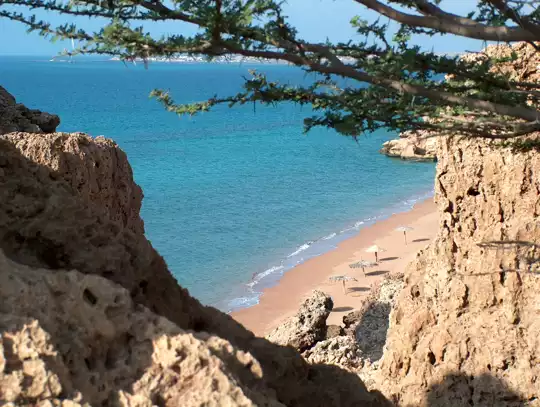
Country photo of Djibouti

We 💚 feedbackKey takeaways before you go

Abourma Rock Art Site is a treasure trove of ancient stories etched into stone. The vibe? Quiet reverence, with the occasional breeze whispering through the landscape. You might be surprised by how accessible the site is, but don’t underestimate the sun; bring plenty of water and a good hat. The real magic happens when you take a moment to sit and absorb the history around you. It’s a reminder that sometimes, the journey is as enriching as the destination.

✍️ Help improve this page!
The information on this page is based on in-depth research, insights shared by experienced travelers, and feedback from the local travel community in Djibouti. While every effort is made to keep the information accurate and current, conditions can change — so if you spot anything incorrect or outdated, please get in touch.


🙋‍♂️ Give feedback

👋 Meet the founderWho’s Behind Take Your Backpack?

Johan, backpacker and founder of TakeYourBackpackHi, I’m Johan (Netherlands 🇳🇱), the creator of TakeYourBackpack. Over the past decade, I’ve backpacked through 80+ countries across six continents, gaining extensive experience with independent travel, long-term trips, and overland routes.

This site is built on a combination of firsthand travel experience and carefully curated insights from other backpackers. Many guides are based on places I’ve personally visited, while others bring together tips, observations, and practical advice shared by trusted travelers I’ve met along the way.

The goal is to provide realistic, experience-driven guidance — not generic itineraries — so you can explore destinations with better context, clearer expectations, and more confidence.

Get full Djibouti guide •
Instant download • 48 highlights • Full Offline guide