×

Djibouti🇩🇯 | citiesDjibouti CityColonial arcades, Place Mahmoud Harbi, Yemeni-style lanes, Gulf waterfront | things to do and best time to go

Explore Ali SabiehExplore Eid al-Adha

Backpacking in Djibouti City
🏆 Top pickcity ranked #1
By Johan Kruseman 🇳🇱 | Updated October 22, 2026

Djibouti City is not a beach resort and not a port town you can read in an afternoon; most of what travelers expect from the Red Sea coast sits elsewhere, and the capital is a working, deeply hot city of roughly a million people. It lies in the east of Djibouti, on a peninsula at the southern mouth of the Gulf of Tadjoura. Its center is a grid of French-era arcades, Yemeni-style houses and market streets, and it suits travelers who like watching a place go about its day, who can tolerate heat and humidity, and who treat it as a logistics hub. The Place Mahmoud Harbi area, the central market and the old Ethiopian-style cafés repay a visit. The port zone, the embassies and the new-build districts do not. Prices are high for the region and nightlife is limited. Compared with Hargeisa in Somaliland, which is cooler and cheaper, Djibouti City is more cosmopolitan, more expensive and far more oriented to the sea.

Discover everything you want to know in the 📖 Djibouti Travel Guide.


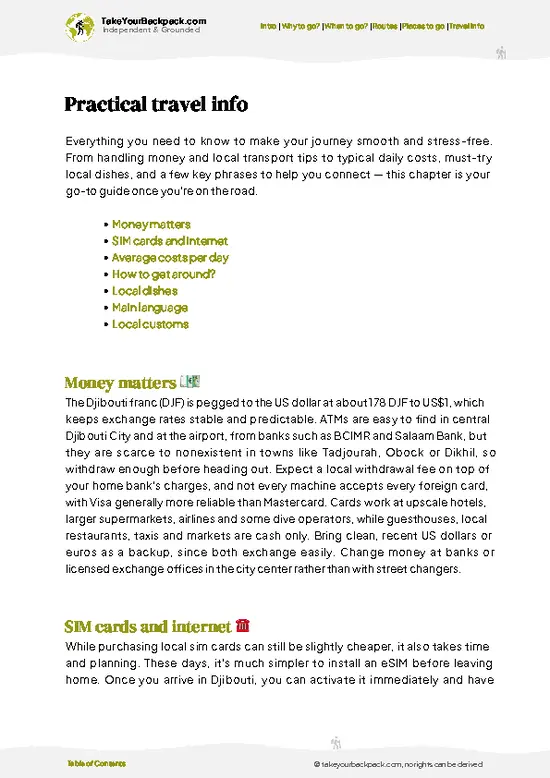
example page 0 from our offline Travel Guide for Djibouti
example page 1 from our offline Travel Guide for Djibouti
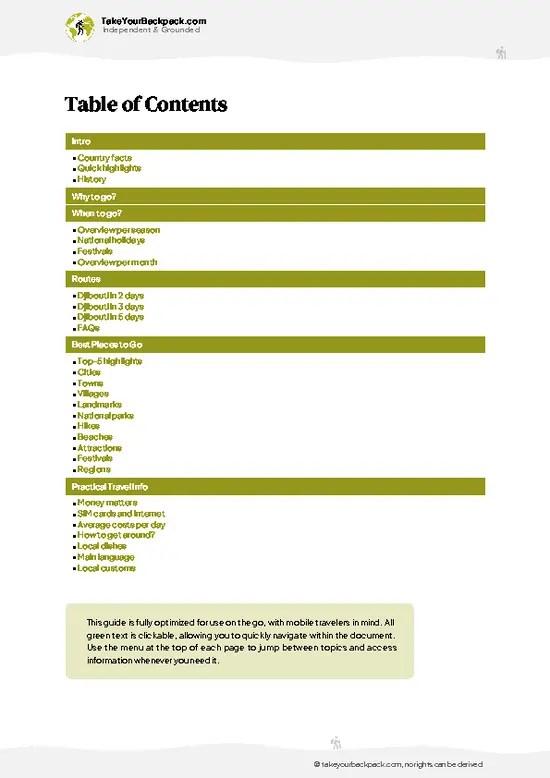
example page 2 from our offline Travel Guide for Djibouti
example page 3 from our offline Travel Guide for Djibouti
example page 4 from our offline Travel Guide for Djibouti
example page 5 from our offline Travel Guide for Djibouti
example page 6 from our offline Travel Guide for Djibouti
example page 7 from our offline Travel Guide for Djibouti
Loading the map 🌍
CLICK TO FILTER
cities
towns
villages
landmarks
national parks
hikes
beaches
attractions
festivals
regions
SHOW COUNTRY’S BESTSHOW ALL

✨ Why go?
Ranked #1 city in Djibouti
Why visitors keep coming back

Djibouti City works as the gateway to a country where nearly every landscape is a long drive away, so most backpackers arrive to organize permits, tours and onward travel rather than to linger. The city gives you the only real choice of guesthouses and hotels in the country, plus the agencies that run trips to Lake Assal, Lake Abbe and the whale shark waters. Food is a genuine reason to stay a night or two: Yemeni fish grilled in a clay oven, Somali camel dishes and French-style pastries sit within a few blocks of each other, and the center is compact enough to cover on foot once the heat eases. Ferries leave from the port for Tadjoura and Obock, and the Ethiopia-bound road and rail corridor starts here, which makes the city a natural pivot between East Africa and the Arabian Peninsula. Expect … read more 👉
Djibouti City works as the gateway to a country where nearly every landscape is a long drive away, so most backpackers arrive to organize permits, tours and onward travel rather than to linger. The city gives you the only real choice of guesthouses and hotels in the country, plus the agencies that run trips to Lake Assal, Lake Abbe and the whale shark waters. Food is a genuine reason to stay a night or two: Yemeni fish grilled in a clay oven, Somali camel dishes and French-style pastries sit within a few blocks of each other, and the center is compact enough to cover on foot once the heat eases. Ferries leave from the port for Tadjoura and Obock, and the Ethiopia-bound road and rail corridor starts here, which makes the city a natural pivot between East Africa and the Arabian Peninsula. Expect a short stop of two or three days. It is pricey, hot and not a place to idle, but it makes everything else in Djibouti possible.

💡 HighlightsThe experiences that define the visit

  1. Place Mahmoud Harbi: the central square with its arcaded colonial buildings, cafés and the oldest street life in town. Come at dusk, when the shade returns and locals take over the benches. Free, 45 minutes to 1 hour.
  2. Central Market (Marché Central): a maze of stalls selling spices, khat, fabrics, incense and fruit. Go in the morning before the heat peaks and keep your phone out of sight. Free, 1 to 1.5 hours.
  3. Hamoudi Mosque: a white mosque with a slender minaret near the main square, one of the city’s best known landmarks. Visit outside prayer times and dress modestly. Exterior viewing is free, 20 to 30 minutes.
  4. Quartier 1 and the Ethiopian-style quarter: narrow lanes of old Yemeni-style houses with wooden shutters, a good place to see how the city looked before its expansion. Walk in the morning,
… read more 👉
  1. Place Mahmoud Harbi: the central square with its arcaded colonial buildings, cafés and the oldest street life in town. Come at dusk, when the shade returns and locals take over the benches. Free, 45 minutes to 1 hour.
  2. Central Market (Marché Central): a maze of stalls selling spices, khat, fabrics, incense and fruit. Go in the morning before the heat peaks and keep your phone out of sight. Free, 1 to 1.5 hours.
  3. Hamoudi Mosque: a white mosque with a slender minaret near the main square, one of the city’s best known landmarks. Visit outside prayer times and dress modestly. Exterior viewing is free, 20 to 30 minutes.
  4. Quartier 1 and the Ethiopian-style quarter: narrow lanes of old Yemeni-style houses with wooden shutters, a good place to see how the city looked before its expansion. Walk in the morning, free, about 1 hour.
  5. Plage des Roches Noires: a rocky waterfront with a few seaside restaurants serving grilled fish, popular with residents at weekends. Best at sunset for the breeze, meals cost roughly US$10 to 20, 1.5 to 2 hours.
  6. Port and Boulevard de la République waterfront: a promenade of old government buildings and dhows. Good for photos from outside the port gate only. Free, 30 to 45 minutes.
  7. Palmier en Zinc: a long-running café and restaurant that remains a social meeting point for locals and expats, with strong coffee and simple French and Djiboutian dishes. Best at breakfast, US$5 to 15, 1 hour.
For a day trip, Lake Assal, Lake Abbe, Tadjoura, the Day Forest and Moucha Island can all be reached with a local operator. Djibouti City is the best base for them. Start with Place Mahmoud Harbi on a first visit, since it puts the architecture, the cafés and the pace of the city in one walk.
Spotted a mistake or missing something? Contact us.

Things to do near Djibouti City

Ratings based on Tripadvisor reviews. When you book through this link, you support our work at no extra cost to you.

🏘️ NeighborhoodsKey areas and districts to know

Djibouti City is compact, and most of what a backpacker needs sits within a few square kilometers on a peninsula-like grid beside the Gulf of Tadjoura. Here is where your time is worth spending.
  • Place Mahmoud Harbi and the center (Plateau du Serpent edge): The old colonial core around the square has arcaded buildings, cafés, money changers and the main market streets. It is flat and walkable, and it is the best place to start. Go in the morning, when shops are open and the streets are busy but manageable.
  • Quartier 1 and the Ottoman-influenced older blocks: Narrow lanes with small restaurants serving Yemeni-style fish and grilled meat. It is calm by day and livelier after dark. Worth an evening, and easy to cover on foot.
  • Plateau du Serpent: A formal district of embassies, hotels and wide avenues.
… read more 👉
Djibouti City is compact, and most of what a backpacker needs sits within a few square kilometers on a peninsula-like grid beside the Gulf of Tadjoura. Here is where your time is worth spending.
  • Place Mahmoud Harbi and the center (Plateau du Serpent edge): The old colonial core around the square has arcaded buildings, cafés, money changers and the main market streets. It is flat and walkable, and it is the best place to start. Go in the morning, when shops are open and the streets are busy but manageable.
  • Quartier 1 and the Ottoman-influenced older blocks: Narrow lanes with small restaurants serving Yemeni-style fish and grilled meat. It is calm by day and livelier after dark. Worth an evening, and easy to cover on foot.
  • Plateau du Serpent: A formal district of embassies, hotels and wide avenues. Tidy and quiet, with little to see. Pass through, but do not plan a visit around it.
  • Heron and the Haramous coast: Seafront restaurants, upscale cafés and a few beach clubs a short taxi ride out. Pleasant for sunset and seafood, but it is spread out, so you will not walk between points comfortably in the heat.
  • Balbala: The large, dense district on the city’s edge, mostly residential and with few sights. Skip it unless a local invites you.
  • Ambouli and the airport side: Practical rather than interesting. Mostly traffic, workshops and the road to the airport. Not a place to linger.

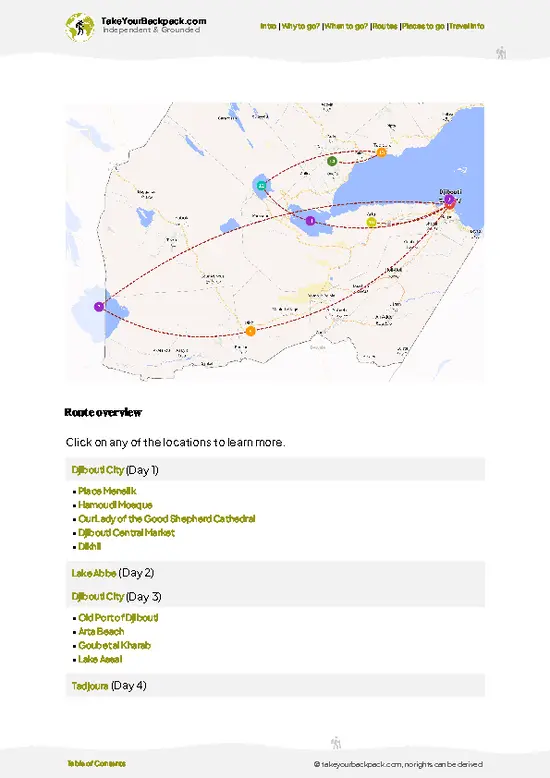
⌛️ 1 dayWhat you can realistically do in a day

The day runs on foot in the cool hours and by blue-and-white taxi for everything else, with a long indoor break when the heat peaks around midday. Agree the fare before you get in; short hops across the center cost roughly US$2 to 4.
7:00 AM: Place Menelik Start at the square where the old arcaded European quarter meets the Ethiopian-style cafés. Order a short, strong coffee and a pastry at one of the terraces and watch the city wake up. The plaza is flat, shaded in patches and easy to cross on foot.
8:30 AM: Central Market (Marché Central) Walk ten minutes to the covered market. Stalls sell spices, frankincense, fabric, fruit and the mild stimulant khat, which is a daily ritual here. Keep your bag in front of you, ask before photographing anyone, and give it an hour.
10:00 AM: Hamoudi Mosque … read more 👉
The day runs on foot in the cool hours and by blue-and-white taxi for everything else, with a long indoor break when the heat peaks around midday. Agree the fare before you get in; short hops across the center cost roughly US$2 to 4.
7:00 AM: Place Menelik Start at the square where the old arcaded European quarter meets the Ethiopian-style cafés. Order a short, strong coffee and a pastry at one of the terraces and watch the city wake up. The plaza is flat, shaded in patches and easy to cross on foot.
8:30 AM: Central Market (Marché Central) Walk ten minutes to the covered market. Stalls sell spices, frankincense, fabric, fruit and the mild stimulant khat, which is a daily ritual here. Keep your bag in front of you, ask before photographing anyone, and give it an hour.
10:00 AM: Hamoudi Mosque and the Boulevard de la République Stroll to the mosque with its tall slim minaret, then along the old colonial boulevard, where faded pastel facades show how the French port once looked. Step inside shaded passages when the sun climbs.
12:00 PM: Lunch and rest Take a taxi to a Yemeni restaurant and order fish with flatbread and fresh juice, eaten with your hand from a shared platter. Stay indoors until the worst heat eases, and use the time to rest or write postcards.
3:30 PM: Heron Port and the Corniche fishing quarter Head to the fishing area, a corner few people include on a day in town. Boats unload the catch, men mend nets and kids dive off the concrete. Stay at the edge, keep your camera discreet and avoid anything near the military and port gates.
5:30 PM: Plateau du Serpent seafront Finish by taxi on the waterfront, where locals gather as the light softens over the Gulf of Tadjoura. Order grilled fish or a plate of rice and goat at a simple seaside place, then return by taxi after dark rather than walking.

🌤️ When to go?When to go for the best experience

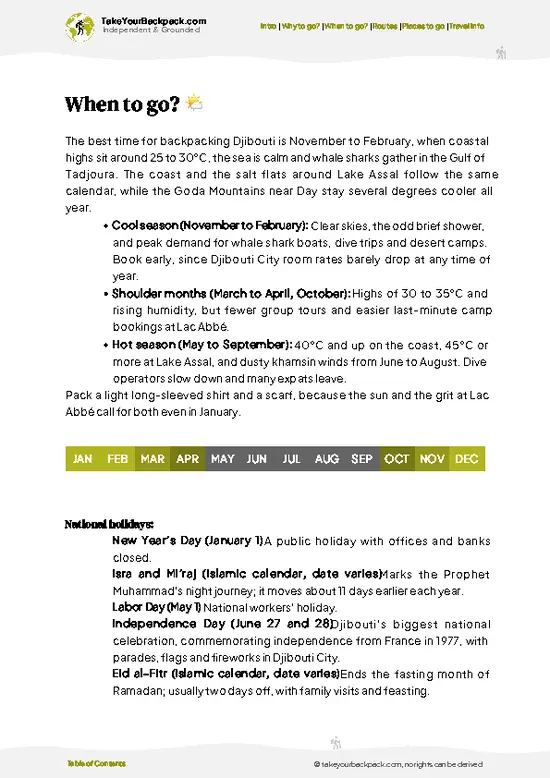
Djibouti City is most comfortable from November to March, when daytime highs sit around 28 to 32°C (82 to 90°F) and the sea is pleasant for swimming.
  • Cool Season (November to March): Highs of 28 to 32°C (82 to 90°F), nights around 22 to 25°C (72 to 77°F). Daylight stays close to 11 to 12 hours. This is peak season for visitors, so beds and tours cost the most, and whale shark trips run from roughly November to February.
  • Shoulder Months (April and October): Highs of 33 to 37°C (91 to 99°F), with humidity building. Fewer visitors and softer prices, though midday is hard going.
  • Hot Season (May to September): Highs of 38 to 43°C (100 to 109°F) and heavy humidity, with hot winds from the interior. Few travelers come, hotels discount, and walking outside between noon and mid-afternoon is miserable.
… read more 👉
Djibouti City is most comfortable from November to March, when daytime highs sit around 28 to 32°C (82 to 90°F) and the sea is pleasant for swimming.
  • Cool Season (November to March): Highs of 28 to 32°C (82 to 90°F), nights around 22 to 25°C (72 to 77°F). Daylight stays close to 11 to 12 hours. This is peak season for visitors, so beds and tours cost the most, and whale shark trips run from roughly November to February.
  • Shoulder Months (April and October): Highs of 33 to 37°C (91 to 99°F), with humidity building. Fewer visitors and softer prices, though midday is hard going.
  • Hot Season (May to September): Highs of 38 to 43°C (100 to 109°F) and heavy humidity, with hot winds from the interior. Few travelers come, hotels discount, and walking outside between noon and mid-afternoon is miserable. Rain is scarce in every season.
Book your whale shark and Lac Assal excursions for the first weeks of your stay, before heat or sea conditions can interfere.


source: climatestotravel.comJANJanuary: excellent for travelingFEBFebruary: excellent for travelingMARMarch: highly recommended for travelingAPRApril: highly recommended for travelingMAYMay: fair for travelingJUNJune: below average for travelingJULJuly: below average for travelingAUGAugust: below average for travelingSEPSeptember: fair for travelingOCTOctober: good for travelingNOVNovember: highly recommended for travelingDECDecember: excellent for traveling
when-to-go

✈️ The backpacker research shortcutDjibouti Travel Guide

An offline-friendly backpacking guide with optimized travel routes, ranked highlights, transport advice, and the best areas to stay.
example page 0 from our offline Travel Guide for Djibouti
example page 1 from our offline Travel Guide for Djibouti
example page 2 from our offline Travel Guide for Djibouti
example page 3 from our offline Travel Guide for Djibouti
example page 4 from our offline Travel Guide for Djibouti
example page 5 from our offline Travel Guide for Djibouti
example page 6 from our offline Travel Guide for Djibouti
example page 7 from our offline Travel Guide for Djibouti
The digital guide (186 pages) contains:
✅ 44 highlights, ranked by travel appeal
✅ Optimized 2, 3 & 5-day travel routes
✅ Cities, national parks, landmarks, beaches
✅ How to get around
✅ Offline-friendly for travel without Wi-Fi
👉 Click to see all 30+ guide features

📅 Plan smarter in minutes, not weeks
✅ Month by month travel advice
✅ Festivals & national holidays
✅ Budget expectations

🗺️ Go to the right places, skip the overrated ones
✅ Honest pros & cons of destinations
✅ Top hikes, parks & viewpoints
✅ Lesser-known places most travelers miss
✅ Clear “worth it vs skip it” guidance

🛏️ Travel smoothly without rookie mistakes
✅ Best areas to stay
✅ Transport systems explained simply
✅ Common scams & safety advice
✅ SIM cards, money & practical tips

🌍 Understand the country, not just visit it
✅ Culture & traditions
✅ 52 Essential phrases & customs
✅ Festivals worth planning around
✅ Traveler-friendly historical context
✅ Insights that make places more meaningful

📱 Built for real travel conditions
✅ Fully downloadable PDF
✅ Works completely offline
✅ Optimized for phone use
✅ Useful in remote areas & buses
✅ Everything in one place
Stop searching, start planning
Get instant access to your full guide. 30‑day money-back guarantee.
+ Add another guide for just

By proceeding you agree to our terms.
Sent to your inbox immediately after payment • 100% Secure Checkout
Best Backpacking Travel Advisor 2025 tourism awardBest Backpacking
Travel Advisor
2025
What others say about Take Your Backpack Guides:
⭐⭐⭐⭐⭐
Fantastic, amazing amount of information!
⭐⭐⭐⭐⭐
My goodness this is amazing, it's what I've been looking for hats off too you!
⭐⭐⭐⭐⭐
I think this is absolutely BRILLIANT
⭐⭐⭐⭐
Very complete and informative. It's still missing places, but I gotta to commend you
⭐⭐⭐⭐⭐
This is truly amazing, thank you, can't wait to explore it with my kids!
⭐⭐⭐⭐⭐
Awesome resource, thank you!
⭐⭐⭐⭐⭐
This is amazing! Can't wait to explore the ones I haven't seen
⭐⭐⭐⭐
I love this! Well done, great idea.
⭐⭐⭐⭐⭐
Thanks for taking the time to make this gem!
⭐⭐⭐⭐⭐
This might be the best website I've ever seen.
⭐⭐⭐⭐⭐
Congratulations, and thank you so much for your work; it's incredibly valuable.
⭐⭐⭐⭐
In all seriousness I think you did a great job pointing out the important spots
⭐⭐⭐⭐⭐
10/10 very good
⭐⭐⭐⭐⭐
As someone who's only just starting to visit regularly this is awesome, thank you.
⭐⭐⭐⭐
Thank you very much! I'm going to visit my dad, it's going to be very useful!
⭐⭐⭐⭐⭐
This is really cool! We'll be travelling for the first time and this definitely come in handy.
⭐⭐⭐⭐⭐
You are now our minister of culture, congratulations 👨‍💼
⭐⭐⭐⭐⭐
Just wanted to tell you that this is a pearl! Going to follow your recommendations.
⭐⭐⭐⭐⭐
This is so cool. I'll definitely be using the resource for my travels soon.
⭐⭐⭐⭐⭐
This is very impressive! Good work.
⭐⭐⭐⭐⭐
This is an amazing and informative site. Very well done!

🛏️ Where to stay?Best areas and accommodation options

The best area for a budget stay is the center around Place Mahmoud Harbi, where the few hostels and guesthouses cluster within walking distance of restaurants and minibus stops. Prices are not as low as in neighboring East African countries, and dorm beds are limited, so expect rooms to run around US$15 to 30 a night for a bed or a basic private room.
The center works because you can walk to cafés, money changers and the port, and taxis are easy to find at any hour. Street noise is moderate, with traffic and call to prayer early in the morning, so bring earplugs. After dark the main squares remain … read more 👉
The best area for a budget stay is the center around Place Mahmoud Harbi, where the few hostels and guesthouses cluster within walking distance of restaurants and minibus stops. Prices are not as low as in neighboring East African countries, and dorm beds are limited, so expect rooms to run around US$15 to 30 a night for a bed or a basic private room.
The center works because you can walk to cafés, money changers and the port, and taxis are easy to find at any hour. Street noise is moderate, with traffic and call to prayer early in the morning, so bring earplugs. After dark the main squares remain active and are comfortable to cross on foot, though a short taxi ride is sensible once the streets empty.
The second option is Quartier 1 and the nearby older blocks, which have a handful of simple guesthouses and are quieter in the evenings. Rooms there may lack air conditioning in cheaper categories, which matters from April to October, so confirm it before paying. Transport links are good, since taxis and minibuses pass nearby.
Avoid Balbala and the airport side for a short stay. Prices are lower but there is little to do, and you will spend more on taxis than you save. Book ahead from November to March, since the limited stock fills with aid workers and tour groups.

🚌 Getting aroundTransportation options and practical tips

From the main bus stops near Place Mahmoud Harbi and the Stade area, the center is a flat 5 to 15 minute walk or a short taxi ride costing about US$2 to 4. Djibouti City is small enough that you will rely on your feet for the core, and on taxis for anything further, because public transport is limited and the heat discourages long walks.
  • Walking: Good in the colonial center, the market streets and Quartier 1, all within roughly 2 kilometers. Pavements are uneven and shade is thin, so walk in the morning and evening and take a taxi at midday.
  • Shared minibuses: Colorful minibuses run set routes to Balbala, Ambouli and other districts for about US$0.20 to 0.50. They are cheap and the best way to see local life, but routes are unmarked in English and they fill up. Service runs from early morning
… read more 👉
From the main bus stops near Place Mahmoud Harbi and the Stade area, the center is a flat 5 to 15 minute walk or a short taxi ride costing about US$2 to 4. Djibouti City is small enough that you will rely on your feet for the core, and on taxis for anything further, because public transport is limited and the heat discourages long walks.
  • Walking: Good in the colonial center, the market streets and Quartier 1, all within roughly 2 kilometers. Pavements are uneven and shade is thin, so walk in the morning and evening and take a taxi at midday.
  • Shared minibuses: Colorful minibuses run set routes to Balbala, Ambouli and other districts for about US$0.20 to 0.50. They are cheap and the best way to see local life, but routes are unmarked in English and they fill up. Service runs from early morning to roughly 9 pm.
  • Taxis: Yellow and white taxis are the practical choice for Haramous, Heron, the port or the airport. There are no meters, so agree the fare first: US$2 to 5 within the city, US$5 to 8 to the airport. Short rides in the center are fine, and a shared taxi is cheaper than a private one if you accept a stranger in the car.
  • Intercity buses and shared 4x4s: Departures to Tadjoura, Obock and Ali Sabieh leave from stops near the center. Fares range from about US$3 to 10 depending on the destination, and most go when full, so expect waits in the morning. For Lac Assal or the Gulf of Tadjoura day trips, hiring a driver is often easier.
  • Ferries: Boats cross the gulf to Tadjoura, usually costing about US$3 to 5 and taking roughly 1.5 to 2 hours. They sell out less often than buses and give a pleasant cooler journey, so they deserve a place in your plans if your timing fits.
Rideshare apps are not established, so carry small bills for fares and settle the price before you sit down. Evening taxis cost slightly more, and the one real saving is to share rides with other travelers heading in the same direction.

👛 Costs (as of 22 October 2026)Travel costs and budget guide for Djibouti City

Djibouti City costs about US$70 to 135 a day for a backpacker, making it one of the pricier destinations in East Africa because most goods are imported. The table below shows typical independent traveler costs.
CategoryBudget RangeLocal Reality
Dorm accommodation (high season)US$20 to 35Beds are few, so a basic private room is often the real option from November to March.
Dorm accommodation (off-season)US$15 to 25Discounts appear in the hot months, and air conditioning is worth confirming.
MealsUS$12 to 25Fish and rice at local places costs US$4 to 8; Western-style cafés are higher.
Local transportUS$3 to 10Taxis with agreed fares are the main option; minibuses are cheaper.
City transport passUS$0No pass exists; you pay per ride.
Basic activities and entry feesUS$10 to 30Markets and the waterfront
… read more 👉
Djibouti City costs about US$70 to 135 a day for a backpacker, making it one of the pricier destinations in East Africa because most goods are imported. The table below shows typical independent traveler costs.
CategoryBudget RangeLocal Reality
Dorm accommodation (high season)US$20 to 35Beds are few, so a basic private room is often the real option from November to March.
Dorm accommodation (off-season)US$15 to 25Discounts appear in the hot months, and air conditioning is worth confirming.
MealsUS$12 to 25Fish and rice at local places costs US$4 to 8; Western-style cafés are higher.
Local transportUS$3 to 10Taxis with agreed fares are the main option; minibuses are cheaper.
City transport passUS$0No pass exists; you pay per ride.
Basic activities and entry feesUS$10 to 30Markets and the waterfront are free; boat trips and snorkeling cost more.
MiscellaneousUS$5 to 10Water, SIM data and small tips.
Total Daily BudgetUS$70 to 135Lower end is for sharing rooms and eating locally.
Eat your main meal at lunch in a local restaurant, when portions are large and prices lower, then keep dinner light. Pay in local francs or US dollars, and carry small bills.
⚠️ Prices can change and everyone travels differently, so take this as a rough guide. Hope it helps you plan your adventure!

🚌 Day tripsExploring the surroundings

Djibouti City works well as a base because the country’s main landscapes sit within a few hours, though you will often need a hired driver or shared 4x4, and overnight stays are not necessary.
Lac Assal:
Salt flats, black lava and a turquoise lake 155 meters below sea level make this the signature excursion. It takes about 2 hours each way by road. Shared 4x4 or driver costs roughly US$40 to 80 per person, depending on group size. Go in the cooler months and bring water and sandals for the salt crust. First-timers often leave too late and reach it in midday heat.

Lac Abbé:
Smoking limestone chimneys and flamingos on a moonlike plain. Most visitors do it as an overnight, but a long day trip is possible with a very early start, about 4 to 5 hours each way. Expect around US$80 to 150 per person … read more 👉
Djibouti City works well as a base because the country’s main landscapes sit within a few hours, though you will often need a hired driver or shared 4x4, and overnight stays are not necessary.
Lac Assal:
Salt flats, black lava and a turquoise lake 155 meters below sea level make this the signature excursion. It takes about 2 hours each way by road. Shared 4x4 or driver costs roughly US$40 to 80 per person, depending on group size. Go in the cooler months and bring water and sandals for the salt crust. First-timers often leave too late and reach it in midday heat.

Lac Abbé:
Smoking limestone chimneys and flamingos on a moonlike plain. Most visitors do it as an overnight, but a long day trip is possible with a very early start, about 4 to 5 hours each way. Expect around US$80 to 150 per person in a shared vehicle. The sunrise light is the draw, so the day version is a compromise.

Île du Diable and Moucha Island:
Short boat rides from the coast take you to snorkeling, reefs and quiet beaches. Boats leave from the harbor area and take about 30 to 60 minutes, with day trips costing US$30 to 60. Visibility is best in the cooler months.

Arta Plage and Arta:
A cooler escape inland, with beach and mountain scenery, about 45 minutes to an hour by road. Shared transport or taxi costs US$5 to 20. A comfortable half-day with fewer tourists.

Ghoubet and Devil’s Island:
A strange windy bay with black rocks and a sea that shifts color. About 1.5 hours by road and manageable with a driver for US$25 to 50. Winds are strong, so bring a layer.

🍲 FoodLocal Flavors for Backpackers

Djibouti City eats from the sea and from Yemeni kitchens, so the standout order is grilled fish, often red snapper or kingfish, served whole with rice, sauce and flatbread. Many local restaurants roast it in a clay tandoor-style oven, a Yemeni habit that is more visible here than elsewhere in the region.
Look for fahsa, a thick stew of shredded meat, and skoudehkaris, the spiced rice and lamb dish that has local variants worth comparing. Mukbasa, a sweet fried dough, is a breakfast staple, and lahoh, a spongy pancake, is often eaten with honey or stew.
For cheap meals, use the stalls and small restaurants near Place Mahmoud Harbi and the market streets, where a plate of fish and rice costs roughly US$4 to 8. Seafront places in Haramous and Heron serve lobster and prawns at higher prices, around … read more 👉
Djibouti City eats from the sea and from Yemeni kitchens, so the standout order is grilled fish, often red snapper or kingfish, served whole with rice, sauce and flatbread. Many local restaurants roast it in a clay tandoor-style oven, a Yemeni habit that is more visible here than elsewhere in the region.
Look for fahsa, a thick stew of shredded meat, and skoudehkaris, the spiced rice and lamb dish that has local variants worth comparing. Mukbasa, a sweet fried dough, is a breakfast staple, and lahoh, a spongy pancake, is often eaten with honey or stew.
For cheap meals, use the stalls and small restaurants near Place Mahmoud Harbi and the market streets, where a plate of fish and rice costs roughly US$4 to 8. Seafront places in Haramous and Heron serve lobster and prawns at higher prices, around US$12 to 25. French influence shows in the bakeries, where croissants and baguettes appear at dawn alongside strong tea.
For drinks, try spiced tea and fresh juices such as mango and tamarind. Alcohol is available in some hotels and French-style bars but is not part of everyday life. Meals are often eaten from shared plates by hand, so wash first and use your right hand.

🛡️ SafetySafety Tips and Common Scams in Djibouti City

Djibouti City is broadly safe for travelers, and most problems are small. Petty theft happens in crowded markets and near the port, so keep your phone and wallet in front pockets and carry only what you need. The center is fine to walk in the evening, but take a taxi once streets empty, and avoid the outskirts, including parts of Balbala, after dark. Solo travelers, women included, should dress modestly in line with local custom, which also brings warmer responses. Photography near the port, military sites and government buildings is restricted, so ask before pointing a camera at anything official. Taxi drivers may quote high fares to visitors, so agree the price first. Khat, chewed widely in the afternoon, is legal locally, but ignore pressure to buy it. The heat is a bigger risk than crime: drink water regularly and rest at midday.

FAQFrequently asked questions about Djibouti City

Two to three days is enough for Djibouti City itself, with a third or fourth day for Lac Assal (about 2 hours each way) or a boat trip to Moucha Island. The center, markets and waterfront take one day, and a seafood evening in Haramous fills another. Add two more days if you want Lac Abbé or the Gulf of Tadjoura.
Djibouti City is broadly safe for solo backpackers, with petty theft in markets and near the port being the main issue. Walk in the center in the evening, but take a taxi after dark and agree the fare first, usually US$2 to 5 across the city. Dress modestly, avoid photographing military or port sites, and drink water often, since the heat is the larger risk.
Djibouti City is known for its location on the Gulf of Tadjoura, its colonial-era center around Place Mahmoud Harbi, and its role as a gateway to Lac Assal, Lac Abbé and whale shark trips from about November to February. It is also a major port and military hub. Food-wise, it is known for grilled fish and Yemeni-influenced dishes, usually US$4 to 8 a plate.
⚠️ Things can change over time, so always validate details locally before you go.

Ideas for continuing your journey

Djibouti City isn’t the only highlight in Djibouti. Explore all what Djibouti has to offer.
Country photo of Djibouti

We 💚 feedbackWhat to keep in mind

Djibouti City suits travelers who enjoy odd, hybrid places and are happy with a two-day stop on the way to somewhere wilder. Eat the grilled fish, walk the old center in the morning, and arrange your Lake Assal or whale shark trip here. I would skip any plan for a long beach stay and carry a hat, a refillable bottle and small bills.

✍️ Help improve this page!
The information on this page is based on in-depth research, insights shared by experienced travelers, and feedback from the local travel community in Djibouti. While every effort is made to keep the information accurate and current, conditions can change — so if you spot anything incorrect or outdated, please get in touch.


🙋‍♂️ Give feedback

👋 Meet the founderWho’s Behind Take Your Backpack?

Johan, backpacker and founder of TakeYourBackpackHi, I’m Johan (Netherlands 🇳🇱), the creator of TakeYourBackpack. Over the past 3 decades, I’ve backpacked through 90+ countries across six continents, gaining extensive experience with independent travel, long-term trips, and overland routes.

This site is built on a combination of firsthand travel experience and carefully curated insights from other backpackers. Many guides are based on places I’ve personally visited, while others bring together tips, observations, and practical advice shared by trusted travelers I’ve met along the way.

The goal is to provide realistic, experience-driven guidance — not generic itineraries — so you can explore destinations with better context, clearer expectations, and more confidence.