×

Djibouti🇩🇯 | landmarksLake AssalAfrica's lowest point, salt crust, camel caravans, lava shoreline | things to do and best time to go

Explore DamerjogExplore Djibouti Railway

Backpacking in Lake Assal
🏆 Top pickunique site ranked #1
By Johan Kruseman 🇳🇱 | Updated October 22, 2026

Most people come for the salt: Lake Assal sits about 155 meters below sea level, the lowest point in Africa and one of the saltiest bodies of water on Earth, with a white crust that crunches like old snow against black volcanic rock. What gets overlooked is the road. The drive west from the capital crosses the Ghoubet area and the Gulf of Tadjoura shoreline, and the lava fields along the way are as strange as the lake. Lake Assal lies in the west of Djibouti, a few hours by road from Djibouti City. Crowds are thin, mostly 4x4 tour groups that stop for an hour. Costs are the real hurdle, since a vehicle with a driver is pricey and public transport barely exists. The heat is severe and shade is almost absent. Still, the color of the water, the salt workers loading camels and trucks, and the silence make the effort sensible. It suits travelers who like stark geology and long drives. It will disappoint anyone wanting activities, comfort or a quick stop.

Discover everything you want to know in the 📖 Djibouti Travel Guide.
Best time to go: October - March
Daily cost: US$65
Duration: 2 to 3 days
Distance: 20 kilometers
Total ascent: 200 meters


example page 0 from our offline Travel Guide for Djibouti
example page 1 from our offline Travel Guide for Djibouti
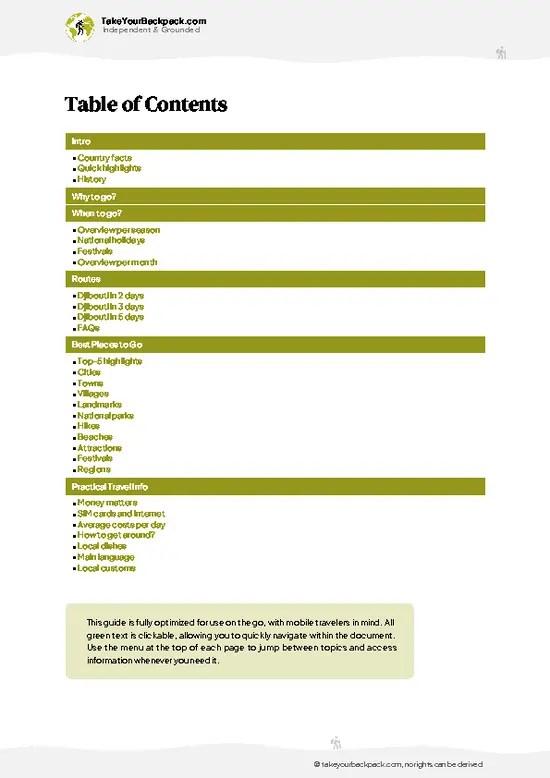
example page 2 from our offline Travel Guide for Djibouti
example page 3 from our offline Travel Guide for Djibouti
example page 4 from our offline Travel Guide for Djibouti
example page 5 from our offline Travel Guide for Djibouti
example page 6 from our offline Travel Guide for Djibouti
example page 7 from our offline Travel Guide for Djibouti
Loading the map 🌍
CLICK TO FILTER
cities
towns
villages
landmarks
national parks
hikes
beaches
attractions
festivals
regions
SHOW COUNTRY’S BESTSHOW ALL

✨ Why go?
Ranked #1 unique site in Djibouti
The unique appeal for travelers

Lake Assal is one of the few places on the continent where you can stand on the lowest dry land in Africa, and the setting is more specific than the label suggests. The shore is a salt crust several meters thick, the water is a deep turquoise, and the surrounding Ardoukoba and Gaet Ali volcanic terrain is black, sharp and young in geological terms. Nothing else in the region looks like this, so the journey is justified by the landscape alone.

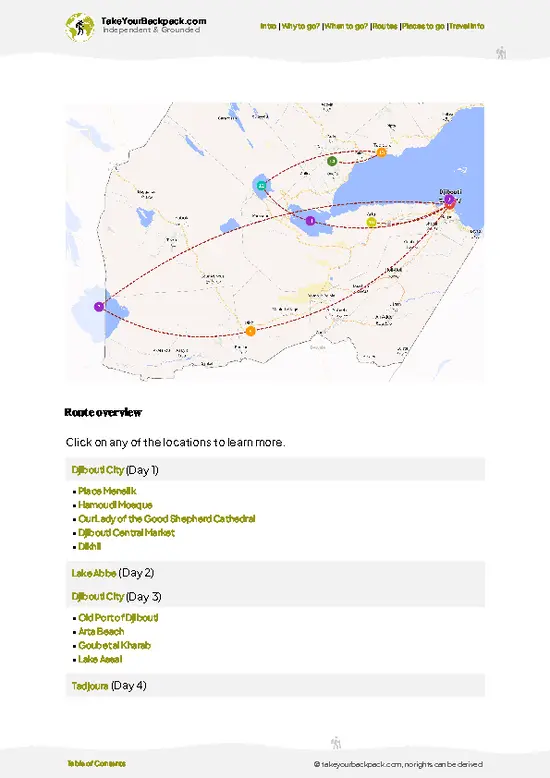
The effort is real, because there is no reliable public bus to the shore, and most travelers arrange a driver or a shared 4x4. That works in your favor if you plan a loop. The route fits neatly with Djibouti City on one end and the whale shark waters near Tadjoura or the flamingo-lined shallows of Lac Abbé at the other. You can also pair the lake with … read more 👉
Lake Assal is one of the few places on the continent where you can stand on the lowest dry land in Africa, and the setting is more specific than the label suggests. The shore is a salt crust several meters thick, the water is a deep turquoise, and the surrounding Ardoukoba and Gaet Ali volcanic terrain is black, sharp and young in geological terms. Nothing else in the region looks like this, so the journey is justified by the landscape alone.

The effort is real, because there is no reliable public bus to the shore, and most travelers arrange a driver or a shared 4x4. That works in your favor if you plan a loop. The route fits neatly with Djibouti City on one end and the whale shark waters near Tadjoura or the flamingo-lined shallows of Lac Abbé at the other. You can also pair the lake with the Ghoubet al-Kharab bay, a nearly enclosed, wind-whipped inlet with black sand beaches, and combine both in a single hard day. Few trips in the Horn of Africa give so much variety for so little time on the road.

💡 HighlightsDon't-miss highlights and experiences

  1. The salt shore and crust: The main draw is the white salt flat at the water’s edge, where crystals form thick, crunchy layers over the lake bed. Walk carefully and look at the cube-shaped crystals up close.
  2. The turquoise water: The lake is roughly ten times saltier than the ocean, and the color against the black hills is the image most people travel for. Floating is possible, but the brine stings any cut.
  3. Salt caravans and workers: Salt is still cut and loaded here by hand, and camel trains and trucks carry it out toward Ethiopia. Watching the work gives the lake a human scale.
  4. The lowest point viewpoint: A roadside lookout above the lake gives the widest view over the basin, with the salt, water and volcanic ridges in one frame. It is the best spot for photographs.
  5. Ghoubet al-Kharab: Known as
… read more 👉
  1. The salt shore and crust: The main draw is the white salt flat at the water’s edge, where crystals form thick, crunchy layers over the lake bed. Walk carefully and look at the cube-shaped crystals up close.
  2. The turquoise water: The lake is roughly ten times saltier than the ocean, and the color against the black hills is the image most people travel for. Floating is possible, but the brine stings any cut.
  3. Salt caravans and workers: Salt is still cut and loaded here by hand, and camel trains and trucks carry it out toward Ethiopia. Watching the work gives the lake a human scale.
  4. The lowest point viewpoint: A roadside lookout above the lake gives the widest view over the basin, with the salt, water and volcanic ridges in one frame. It is the best spot for photographs.
  5. Ghoubet al-Kharab: Known as the Devil’s Cauldron, this nearly landlocked bay beside the lake has black volcanic sand and strong winds. The dark shoreline contrasts sharply with the pale salt nearby.
  6. Ardoukoba volcanic fields: The rift here is pulling Africa apart, and fresh lava flows from the late 1970s eruption can be seen from the road. The rough black rock is easy to walk on near the verge.
  7. Hot springs at the shore: Small thermal seeps run into the lake, and the warm water feels odd against the baking air. They are modest, but they show the volcanic activity under the basin.
Lake Assal needs no ticket, though you should book a driver or tour a day ahead because transport is limited.
Spotted a mistake or missing something? Contact us.

Things to do near Lake Assal

Ratings based on Tripadvisor reviews. When you book through this link, you support our work at no extra cost to you.

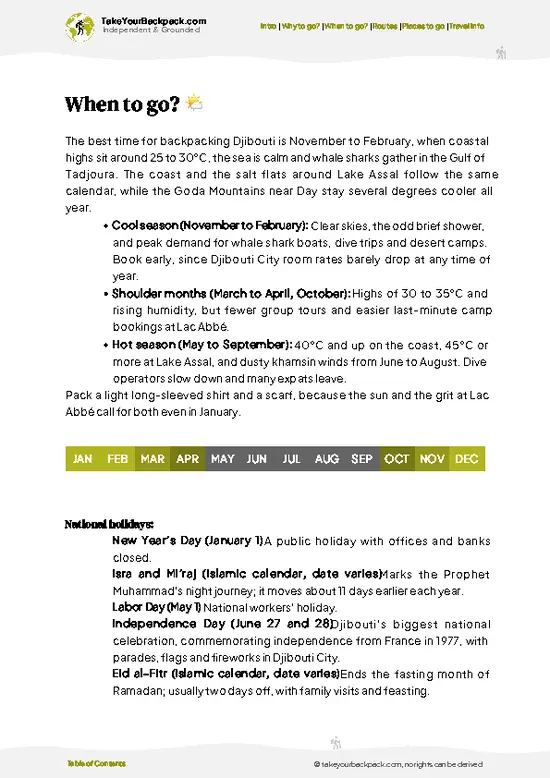
🌤️ When to go?Weather, crowds, and seasonal trade-offs

  • Cool Season (October to April): Lake Assal is bearable, with daytime highs of 30 to 36°C (86 to 97°F) and nights around 23 to 26°C (73 to 79°F). Daylight runs about 11 to 12 hours. This is peak season, with the most tour groups and the highest prices for 4x4 hire and guesthouses in Djibouti City.
  • Shoulder Months (May and September): Highs climb to 38 to 41°C (100 to 106°F). Crowds thin and drivers will often haggle down a little. Midday on the salt flats is punishing, so plan short visits.
  • Hot Season (June to August): Expect 40 to 45°C (104 to 113°F) at the lake, which sits 155 meters (509 feet) below sea level, so the heat feels trapped. Few travelers come, rates dip, and the hot khamsin wind blows. Swimming in the dense, salty water is comfortable only at the edge of the day.
  • Rare Rain: Rainfall
… read more 👉
  • Cool Season (October to April): Lake Assal is bearable, with daytime highs of 30 to 36°C (86 to 97°F) and nights around 23 to 26°C (73 to 79°F). Daylight runs about 11 to 12 hours. This is peak season, with the most tour groups and the highest prices for 4x4 hire and guesthouses in Djibouti City.
  • Shoulder Months (May and September): Highs climb to 38 to 41°C (100 to 106°F). Crowds thin and drivers will often haggle down a little. Midday on the salt flats is punishing, so plan short visits.
  • Hot Season (June to August): Expect 40 to 45°C (104 to 113°F) at the lake, which sits 155 meters (509 feet) below sea level, so the heat feels trapped. Few travelers come, rates dip, and the hot khamsin wind blows. Swimming in the dense, salty water is comfortable only at the edge of the day.
  • Rare Rain: Rainfall is tiny, under 150 mm (6 in) a year, mostly November to March. Brief showers can still wash out the dirt track from the Ghoubet side.
Schedule your visit for the cool season, and aim to reach the shore before 9 am to have the white salt crust to yourself.


source: climatestotravel.comJANJanuary: excellent for travelingFEBFebruary: excellent for travelingMARMarch: good for travelingAPRApril: fair for travelingMAYMay: fair for travelingJUNJune: below average for travelingJULJuly: below average for travelingAUGAugust: below average for travelingSEPSeptember: fair for travelingOCTOctober: good for travelingNOVNovember: excellent for travelingDECDecember: excellent for traveling
when-to-go

✈️ The backpacker research shortcutDjibouti Travel Guide

An offline-friendly backpacking guide with optimized travel routes, ranked highlights, transport advice, and the best areas to stay.
example page 0 from our offline Travel Guide for Djibouti
example page 1 from our offline Travel Guide for Djibouti
example page 2 from our offline Travel Guide for Djibouti
example page 3 from our offline Travel Guide for Djibouti
example page 4 from our offline Travel Guide for Djibouti
example page 5 from our offline Travel Guide for Djibouti
example page 6 from our offline Travel Guide for Djibouti
example page 7 from our offline Travel Guide for Djibouti
The digital guide (186 pages) contains:
✅ 44 highlights, ranked by travel appeal
✅ Optimized 2, 3 & 5-day travel routes
✅ Cities, national parks, landmarks, beaches
✅ How to get around
✅ Offline-friendly for travel without Wi-Fi
👉 Click to see all 30+ guide features

📅 Plan smarter in minutes, not weeks
✅ Month by month travel advice
✅ Festivals & national holidays
✅ Budget expectations

🗺️ Go to the right places, skip the overrated ones
✅ Honest pros & cons of destinations
✅ Top hikes, parks & viewpoints
✅ Lesser-known places most travelers miss
✅ Clear “worth it vs skip it” guidance

🛏️ Travel smoothly without rookie mistakes
✅ Best areas to stay
✅ Transport systems explained simply
✅ Common scams & safety advice
✅ SIM cards, money & practical tips

🌍 Understand the country, not just visit it
✅ Culture & traditions
✅ 52 Essential phrases & customs
✅ Festivals worth planning around
✅ Traveler-friendly historical context
✅ Insights that make places more meaningful

📱 Built for real travel conditions
✅ Fully downloadable PDF
✅ Works completely offline
✅ Optimized for phone use
✅ Useful in remote areas & buses
✅ Everything in one place
Stop searching, start planning
Get instant access to your full guide. 30‑day money-back guarantee.
+ Add another guide for just

By proceeding you agree to our terms.
Sent to your inbox immediately after payment • 100% Secure Checkout
Best Backpacking Travel Advisor 2025 tourism awardBest Backpacking
Travel Advisor
2025
What others say about Take Your Backpack Guides:
⭐⭐⭐⭐⭐
Fantastic, amazing amount of information!
⭐⭐⭐⭐⭐
My goodness this is amazing, it's what I've been looking for hats off too you!
⭐⭐⭐⭐⭐
I think this is absolutely BRILLIANT
⭐⭐⭐⭐
Very complete and informative. It's still missing places, but I gotta to commend you
⭐⭐⭐⭐⭐
This is truly amazing, thank you, can't wait to explore it with my kids!
⭐⭐⭐⭐⭐
Awesome resource, thank you!
⭐⭐⭐⭐⭐
This is amazing! Can't wait to explore the ones I haven't seen
⭐⭐⭐⭐
I love this! Well done, great idea.
⭐⭐⭐⭐⭐
Thanks for taking the time to make this gem!
⭐⭐⭐⭐⭐
This might be the best website I've ever seen.
⭐⭐⭐⭐⭐
Congratulations, and thank you so much for your work; it's incredibly valuable.
⭐⭐⭐⭐
In all seriousness I think you did a great job pointing out the important spots
⭐⭐⭐⭐⭐
10/10 very good
⭐⭐⭐⭐⭐
As someone who's only just starting to visit regularly this is awesome, thank you.
⭐⭐⭐⭐
Thank you very much! I'm going to visit my dad, it's going to be very useful!
⭐⭐⭐⭐⭐
This is really cool! We'll be travelling for the first time and this definitely come in handy.
⭐⭐⭐⭐⭐
You are now our minister of culture, congratulations 👨‍💼
⭐⭐⭐⭐⭐
Just wanted to tell you that this is a pearl! Going to follow your recommendations.
⭐⭐⭐⭐⭐
This is so cool. I'll definitely be using the resource for my travels soon.
⭐⭐⭐⭐⭐
This is very impressive! Good work.
⭐⭐⭐⭐⭐
This is an amazing and informative site. Very well done!

🛏️ Where to stay?Where staying makes the most sense

Djibouti City is the practical place to sleep, because Lake Assal has no real accommodation and sits roughly 120 km (75 miles) west, about two hours by road. Nearly every backpacker visits on a tour or shared 4x4 that leaves from the capital, so the question is which neighborhood suits you.
The city center around Place Mahamoud Harbi and the nearby Plateau du Serpent area is the most useful base. Budget guesthouses and small hotels cluster here, restaurants and cafés are a short walk away, and it is where you meet other travelers to split a 4x4 and driver, which cuts the cost per person sharply. … read more 👉
Djibouti City is the practical place to sleep, because Lake Assal has no real accommodation and sits roughly 120 km (75 miles) west, about two hours by road. Nearly every backpacker visits on a tour or shared 4x4 that leaves from the capital, so the question is which neighborhood suits you.
The city center around Place Mahamoud Harbi and the nearby Plateau du Serpent area is the most useful base. Budget guesthouses and small hotels cluster here, restaurants and cafés are a short walk away, and it is where you meet other travelers to split a 4x4 and driver, which cuts the cost per person sharply. Agencies offering Lake Assal trips are also concentrated here, so you can compare prices on foot and leave at dawn.
The Heron and Haramous districts, nearer the water and the embassies, are quieter and a bit pricier. They suit people who want a calmer evening and good seafood, though you will need taxis to get around and fewer dorm-style options exist.
The Ambouli neighborhood and areas by the airport work only for a late arrival or early flight.
A few travelers go on to Tadjoura or Lake Abbe and sleep there, but Lake Assal is usually done as a long single excursion from the capital. Book your bed in the city center for at least two nights, and keep nights in the city for rest after the heat.

👛 Costs (as of 22 October 2026)What things cost and how to budget

Lake Assal costs roughly US$55 to 65 per person per day when you split a 4x4 with other travelers from Djibouti City. Djibouti is one of the pricier countries in East Africa, and a shared vehicle is the main expense, since public transport does not reach the lake.
CategoryBudget RangeLocal Reality
Accommodation (high season)US$20 to 30A basic room or dorm bed in central Djibouti City. Prices dip in the hot summer months.
Accommodation (low season)US$15 to 25Some guesthouses negotiate in June to August, when few visitors come.
Entry feeUS$0 to 5Access to the shore is generally free, though local people may ask for a small tip for parking or guiding.
TransportUS$15 to 25Your share of a 4x4 with driver for a day trip (about US$100 to 150 per vehicle when split between several people). Taxis alone
… read more 👉
Lake Assal costs roughly US$55 to 65 per person per day when you split a 4x4 with other travelers from Djibouti City. Djibouti is one of the pricier countries in East Africa, and a shared vehicle is the main expense, since public transport does not reach the lake.
CategoryBudget RangeLocal Reality
Accommodation (high season)US$20 to 30A basic room or dorm bed in central Djibouti City. Prices dip in the hot summer months.
Accommodation (low season)US$15 to 25Some guesthouses negotiate in June to August, when few visitors come.
Entry feeUS$0 to 5Access to the shore is generally free, though local people may ask for a small tip for parking or guiding.
TransportUS$15 to 25Your share of a 4x4 with driver for a day trip (about US$100 to 150 per vehicle when split between several people). Taxis alone cost more.
Food and drinksUS$8 to 12Fish or rice and meat at local restaurants in the city. Water and snacks at the lake are limited and pricier.
ExtrasUS$3 to 5Salt souvenirs, sandals for the crust, and a tip for the driver.
Total Daily BudgetUS$65Based on high-season accommodation and a shared vehicle. Traveling alone raises the figure considerably.
Travelers pay in Djiboutian francs, though US dollars and euros are accepted by many tour operators.
⚠️ Prices can change and everyone travels differently, so take this as a rough guide. Hope it helps you plan your adventure!

🛡️ SafetyScams, Hazards, and Annoyances

The hike to Lake Assal is a thrilling blend of challenge and reward. The terrain is mostly straightforward, but don’t underestimate the heat. Temperatures can soar, especially in the midday sun, so start early. Bring plenty of water—at least three liters—and wear a wide-brimmed hat.

The trail can be rocky and uneven, with some steep sections that demand attention. Watch your footing, especially on the descents. Navigation is generally clear, but a good map or GPS can save you from unnecessary detours.

Wildlife encounters are rare, but you might spot a few hardy desert creatures. If you do, keep your distance; respect their space and let them be.

As you approach the lake, the sight of its striking blue waters against the stark landscape is a well-earned reward. Take a moment to soak it … read more 👉
The hike to Lake Assal is a thrilling blend of challenge and reward. The terrain is mostly straightforward, but don’t underestimate the heat. Temperatures can soar, especially in the midday sun, so start early. Bring plenty of water—at least three liters—and wear a wide-brimmed hat.

The trail can be rocky and uneven, with some steep sections that demand attention. Watch your footing, especially on the descents. Navigation is generally clear, but a good map or GPS can save you from unnecessary detours.

Wildlife encounters are rare, but you might spot a few hardy desert creatures. If you do, keep your distance; respect their space and let them be.

As you approach the lake, the sight of its striking blue waters against the stark landscape is a well-earned reward. Take a moment to soak it in, then treat yourself to that first cold drink. You’ve earned it.

FAQFrequently asked questions about Lake Assal

Lake Assal is a crater lake in central Djibouti, and at 155 meters (509 feet) below sea level it is the lowest point in Africa. It is also one of the saltiest bodies of water on Earth, around ten times saltier than the ocean, with a bright white salt crust along its shore and turquoise water set against black volcanic rock. Salt caravans and small mining operations still work here, and people float easily in the water.
Plan on a full day, since the drive from Djibouti City takes about two hours each way and you will want 1 to 2 hours at Lake Assal itself for photos, a float, and the salt flats. Adding a stop at Ghoubet al-Kharab (the Devil’s Cauldron) on the way makes the trip 8 to 10 hours. Many travelers combine it with Lake Abbe or Day Forest over two to three days.
Most travelers reach Lake Assal from Djibouti City, about 120 km (75 miles) west, by a hired 4x4 with driver or an organized tour, which typically costs US$100 to 150 per vehicle when shared. There is no regular public bus to the lake, and a self-drive trip needs a sturdy vehicle, as part of the route is rough. Leave the capital by 7 am to avoid the worst midday heat.
⚠️ Things can change over time, so always validate details locally before you go.

Other Djiboutian landmarks near Lake Assal

Explore more nearby:

  • Goubet al Kharab—Enclosed turquoise bay, black basalt, Ardoukoba lava, wind channel| 26 km away
  • Abourma Rock Art Site—Pecked cattle panels, lyre-horned cows, dark patina, Afar track| 46 km away
  • Djibouti Railway—Colonial terminus, rusting wagons, Place Ménélik, standard-gauge line| 79 km away

💡 Not sure where to go next?
Create a personalized itinerary for Djibouti including Lake Assal and the places that fit your trip.

Generate my itinerary

👉 Discover all landmarks

Or checkout all Djibouti has to offer (think cities, towns, villages, national parks, hikes, beaches, festivals)
Country photo of Djibouti

We 💚 feedbackWhat to keep in mind

Lake Assal catches people out when they treat it as a quick photo stop and arrive at midday with one small bottle of water. Go with a driver who knows the road, carry more water than seems sensible, and wear sandals you can wet, because the salt cuts bare feet. Stay long enough to walk to the water.

✍️ Help improve this page!
The information on this page is based on in-depth research, insights shared by experienced travelers, and feedback from the local travel community in Djibouti. While every effort is made to keep the information accurate and current, conditions can change — so if you spot anything incorrect or outdated, please get in touch.


🙋‍♂️ Give feedback

👋 Meet the founderWho’s Behind Take Your Backpack?

Johan, backpacker and founder of TakeYourBackpackHi, I’m Johan (Netherlands 🇳🇱), the creator of TakeYourBackpack. Over the past 3 decades, I’ve backpacked through 90+ countries across six continents, gaining extensive experience with independent travel, long-term trips, and overland routes.

This site is built on a combination of firsthand travel experience and carefully curated insights from other backpackers. Many guides are based on places I’ve personally visited, while others bring together tips, observations, and practical advice shared by trusted travelers I’ve met along the way.

The goal is to provide realistic, experience-driven guidance — not generic itineraries — so you can explore destinations with better context, clearer expectations, and more confidence.