×

Djibouti🇩🇯 | best landmarksThe 7 Top landmarks in Djibouti

Landmarks in Djibouti are mostly natural, shaped by volcanic rifts, salt flats and arid coast rather than monuments. The Afar interior is remote, hot and reached by 4x4 on hired transport, so costs run high. The Gulf of Tadjoura coast is cooler, quieter and easier. For independent travel, expect few crowds, little signage and limited public transport.

By Johan Kruseman 🇳🇱 | Updated October 23, 2026
Explore the best national parks in Djibouti

Why go?Understanding Their Importance

Djibouti sits where three tectonic plates pull apart, so its main sights are geological: rift basins, salt lakes below sea level, hot springs and cooling lava fields. Human-made heritage is modest. Colonial-era streets and old coastal towns exist but are small in scale, and the country is better judged as a landscape destination than a monument one.

Before choosing it, know that distances are short but conditions are hard. Roads to the interior are partly unpaved, shade is scarce and midday heat is severe. Public transport rarely reaches the sights, so a hired vehicle with a driver is the norm. Prices are high for the region because almost everything is imported. Visits to the Afar areas usually involve local guides, and that is a practical requirement as much as a courtesy.
Evaluating the Top Choices
The list of best unique sites in Djibouti is created based on history or culture, wow factor, atmosphere, quirks, and memorability. If you feel a unique site is missing in this list, please let us know.

When to go?Best Time to Visit Djibouti for landmarks

Best months: The best months are November to March, when daytime highs in Djibouti City stay around 28 to 33°C instead of the 40 to 45°C of summer. Rain is minimal everywhere, roughly 130 mm a year on the coast, and falls mostly in winter downpours that can flood dry riverbeds for a day.
Shoulder and low season: October and April are workable but warmer, with highs of 34 to 38°C. From May to September the interior around the rift lakes and salt flats can exceed 45°C by midday, and the hot wind off the desert makes outdoor stops hard. Most visitors skip these months, so prices for vehicles and camps hold steady rather than rise.
Peak periods: The cool months are the busiest, yet numbers stay small. Book a driver a week ahead for December to February. Dates for Ramadan shift each year, and daytime food options narrow outside the capital.

unique site hoppingHow to Combine landmarks Into One Trip

How many days: A trip linking several landmarks in Djibouti needs 4 to 7 days, because each interior stop takes most of a day once travel is counted.
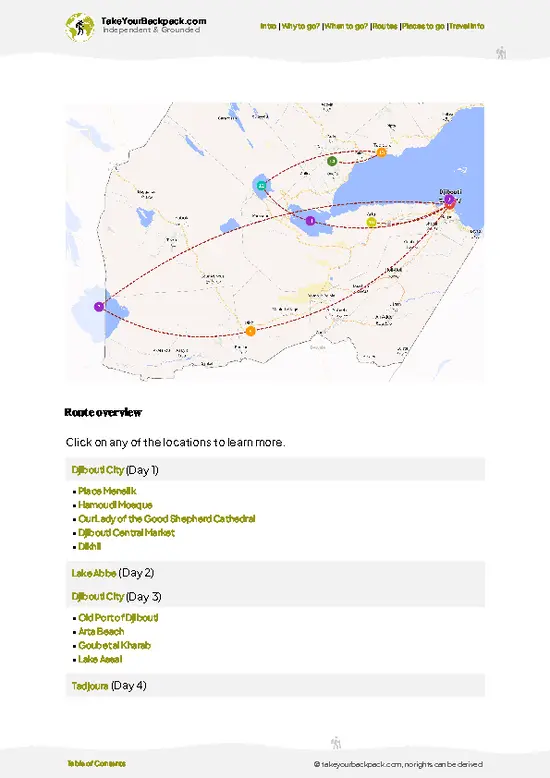
Grouping and direction: Two clusters work well. The western and southwestern interior (salt flats, then the rift lake region via Dikhil) is best done as one loop out of Djibouti City, driving outward to the farthest point first and returning slowly. The northern gulf coast around Tadjoura and the nearby islands is a separate leg, reached by ferry (about 2 hours) or a long road. Allow 2 to 5 hours of driving between the capital and each interior stop, and 3 to 4 hours per stop on site.
Common planning mistakes: Travelers often try the farthest interior stop as a same-day return, which leaves little daylight. Stay overnight instead. Others drive … read more 👉
How many days: A trip linking several landmarks in Djibouti needs 4 to 7 days, because each interior stop takes most of a day once travel is counted.
Grouping and direction: Two clusters work well. The western and southwestern interior (salt flats, then the rift lake region via Dikhil) is best done as one loop out of Djibouti City, driving outward to the farthest point first and returning slowly. The northern gulf coast around Tadjoura and the nearby islands is a separate leg, reached by ferry (about 2 hours) or a long road. Allow 2 to 5 hours of driving between the capital and each interior stop, and 3 to 4 hours per stop on site.
Common planning mistakes: Travelers often try the farthest interior stop as a same-day return, which leaves little daylight. Stay overnight instead. Others drive at midday, when heat is highest. Start at dawn and rest from 12:00 to 15:00. A third error is adding the coast to a short trip. Give it its own two days.

The ListThe Best landmarks of Djibouti

1 Lake Assal

Africa's lowest point, salt crust, camel caravans, lava shoreline

Crunch across a white salt shore beside turquoise water, watch workers load camels and trucks, and take in the basin from the roadside lookout.

2 Lake Abbe

Steaming limestone chimneys, flamingo shallows, Afar camps, open-sky nights

Wander between steaming limestone towers on a salt crust, then sleep on mats under a dense sky at a basic camp beside the lake.

3 Goubet al Kharab

Enclosed turquoise bay, black basalt, Ardoukoba lava, wind channel

Look down on a nearly closed bay of turquoise water boxed in by sharp lava shelves, with the Ardoukoba rift fields close by.

4 Ras Siyyan

Volcanic cape, Bab-el-Mandeb views, Obock, empty Red Sea coast

Drive out from Obock to a bare volcanic headland and watch tankers cross the strait, with the Yemeni coast faint on clear days.

djibouti-unique-site-ras-siyyan
© Google |

5 Old Port of Djibouti

Dhow landing, arcaded square, grilled snapper, Marché Central

Watch fishermen unload dhows, sit under the arcades of Place Menelik, then eat whole grilled snapper near the harbor and browse the loud central market.

djibouti-unique-site-old-port-of-djibouti
© Google |

6 Djibouti Railway

Colonial terminus, rusting wagons, Place Ménélik, standard-gauge line

Walk past the peeling façade of the French-built station and its rusted rolling stock, then compare it with the modern electric line to Addis Ababa.

7 Abourma Rock Art Site

Pecked cattle panels, lyre-horned cows, dark patina, Afar track

Study engraved herds, wild animals and tiny human figures on dark rock, reached by a 4x4 track inland from Tadjoura with no crowds.

djibouti-unique-site-abourma-rock-art-site
© Google |
Loading the map 🌍

Expert viewInsights from Locals and Experts

How many to visit: I would advise three to five landmarks on a first trip. The interior stops each cost a full day of driving, and heat wears down concentration after the second. Five is the limit before the days blur into one long road with a short walk at the end. The reward is time at each stop for light that changes by the hour.
Which kind to prioritize: If you want strong visuals and have a vehicle budget, choose the rift and salt landscapes. Surfaces crunch underfoot, the horizon shimmers white and the silence is total. If heat or money is tight, choose the coastal and highland sites, where shade, sea air and walking paths make for easier days and cooler sleeping. Swimming with marine life suits those who prefer water to dust, with a season of roughly October to February.
What it costs: … read more 👉
How many to visit: I would advise three to five landmarks on a first trip. The interior stops each cost a full day of driving, and heat wears down concentration after the second. Five is the limit before the days blur into one long road with a short walk at the end. The reward is time at each stop for light that changes by the hour.
Which kind to prioritize: If you want strong visuals and have a vehicle budget, choose the rift and salt landscapes. Surfaces crunch underfoot, the horizon shimmers white and the silence is total. If heat or money is tight, choose the coastal and highland sites, where shade, sea air and walking paths make for easier days and cooler sleeping. Swimming with marine life suits those who prefer water to dust, with a season of roughly October to February.
What it costs: Plan on US$70 to 150 a day if you share a hired 4x4 with driver, which runs about US$150 to 250 (roughly DJF 27,000 to 45,000) per day for the vehicle. Split between four, that is manageable. Park or site fees are low, usually under US$10, and local guides for Afar areas cost about US$20 to 40 a day. Basic camp beds or huts run US$15 to 40 a night. Meals at local restaurants cost US$5 to 12.
Safety and cultural points: Carry four liters of water per person per day and a hat, and wear closed shoes on sharp salt crusts and rough lava, where sandals cut. Djibouti is a Muslim country, so cover shoulders and knees away from the beach, and ask before photographing people, especially women. Do not photograph military sites, ports or border posts. Avoid the far north near the Eritrean border. Keep a passport copy, since checkpoints on interior roads are routine and quick when you are polite. The gain is a trip that stays calm and unhurried.

✈️ The backpacker research shortcutDjibouti Travel Guide

An offline-friendly backpacking guide with optimized travel routes, ranked highlights, transport advice, and the best areas to stay.
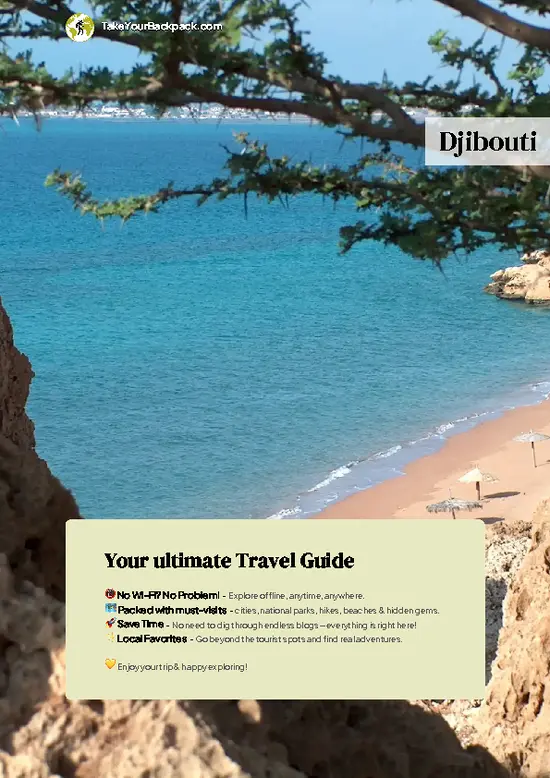
example page 0 from our offline Travel Guide for Djibouti
example page 1 from our offline Travel Guide for Djibouti
example page 2 from our offline Travel Guide for Djibouti
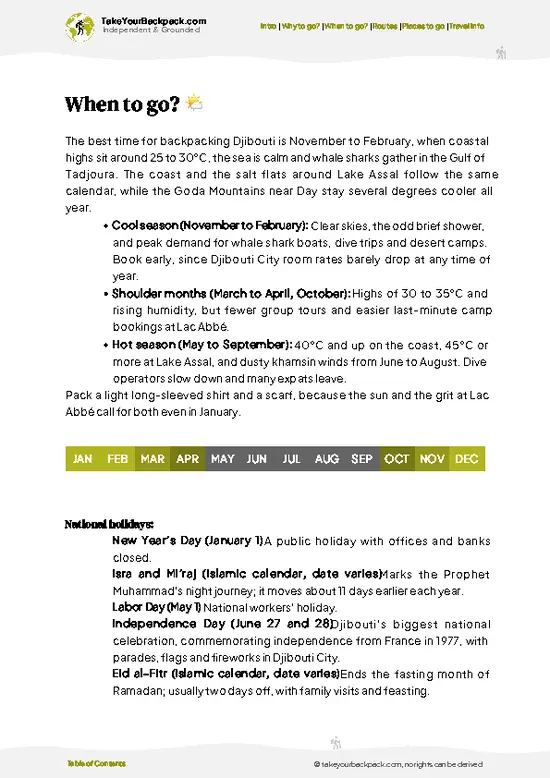
example page 3 from our offline Travel Guide for Djibouti
example page 4 from our offline Travel Guide for Djibouti
example page 5 from our offline Travel Guide for Djibouti
example page 6 from our offline Travel Guide for Djibouti
example page 7 from our offline Travel Guide for Djibouti
The digital guide (186 pages) contains:
✅ 44 highlights, ranked by travel appeal
✅ Optimized 2, 3 & 5-day travel routes
✅ Cities, national parks, landmarks, beaches
✅ How to get around
✅ Offline-friendly for travel without Wi-Fi
👉 Click to see all 30+ guide features

📅 Plan smarter in minutes, not weeks
✅ Month by month travel advice
✅ Festivals & national holidays
✅ Budget expectations

🗺️ Go to the right places, skip the overrated ones
✅ Honest pros & cons of destinations
✅ Top hikes, parks & viewpoints
✅ Lesser-known places most travelers miss
✅ Clear “worth it vs skip it” guidance

🛏️ Travel smoothly without rookie mistakes
✅ Best areas to stay
✅ Transport systems explained simply
✅ Common scams & safety advice
✅ SIM cards, money & practical tips

🌍 Understand the country, not just visit it
✅ Culture & traditions
✅ 52 Essential phrases & customs
✅ Festivals worth planning around
✅ Traveler-friendly historical context
✅ Insights that make places more meaningful

📱 Built for real travel conditions
✅ Fully downloadable PDF
✅ Works completely offline
✅ Optimized for phone use
✅ Useful in remote areas & buses
✅ Everything in one place
Stop searching, start planning
Get instant access to your full guide. 30‑day money-back guarantee.
+ Add another guide for just

By proceeding you agree to our terms.
Sent to your inbox immediately after payment • 100% Secure Checkout
Best Backpacking Travel Advisor 2025 tourism awardBest Backpacking
Travel Advisor
2025
What others say about Take Your Backpack Guides:
⭐⭐⭐⭐⭐
Fantastic, amazing amount of information!
⭐⭐⭐⭐⭐
My goodness this is amazing, it's what I've been looking for hats off too you!
⭐⭐⭐⭐⭐
I think this is absolutely BRILLIANT
⭐⭐⭐⭐
Very complete and informative. It's still missing places, but I gotta to commend you
⭐⭐⭐⭐⭐
This is truly amazing, thank you, can't wait to explore it with my kids!
⭐⭐⭐⭐⭐
Awesome resource, thank you!
⭐⭐⭐⭐⭐
This is amazing! Can't wait to explore the ones I haven't seen
⭐⭐⭐⭐
I love this! Well done, great idea.
⭐⭐⭐⭐⭐
Thanks for taking the time to make this gem!
⭐⭐⭐⭐⭐
This might be the best website I've ever seen.
⭐⭐⭐⭐⭐
Congratulations, and thank you so much for your work; it's incredibly valuable.
⭐⭐⭐⭐
In all seriousness I think you did a great job pointing out the important spots
⭐⭐⭐⭐⭐
10/10 very good
⭐⭐⭐⭐⭐
As someone who's only just starting to visit regularly this is awesome, thank you.
⭐⭐⭐⭐
Thank you very much! I'm going to visit my dad, it's going to be very useful!
⭐⭐⭐⭐⭐
This is really cool! We'll be travelling for the first time and this definitely come in handy.
⭐⭐⭐⭐⭐
You are now our minister of culture, congratulations 👨‍💼
⭐⭐⭐⭐⭐
Just wanted to tell you that this is a pearl! Going to follow your recommendations.
⭐⭐⭐⭐⭐
This is so cool. I'll definitely be using the resource for my travels soon.
⭐⭐⭐⭐⭐
This is very impressive! Good work.
⭐⭐⭐⭐⭐
This is an amazing and informative site. Very well done!

🛏️ Where to stay?Top Areas to Stay

Djibouti has no real hostel scene, so budget travel here means simple guesthouses and basic hotels in Djibouti City, where a double typically costs 7,000 to 12,000 DJF (US$40 to 70) a night. The European Quarter around Place Ménélik holds the most options, with cafés, restaurants and the few late-night bars within walking distance, though rooms there run noisier and pricier. The African Quarter just south, near the market streets, offers the cheapest rooms and lively street food but feels chaotic after dark, while Plateau du Héron is quiet and safe near the embassies and the waterfront, with few budget beds and a taxi ride to anything.

If you enjoy meeting fellow travelers, consider choosing … read more 👉
Djibouti has no real hostel scene, so budget travel here means simple guesthouses and basic hotels in Djibouti City, where a double typically costs 7,000 to 12,000 DJF (US$40 to 70) a night. The European Quarter around Place Ménélik holds the most options, with cafés, restaurants and the few late-night bars within walking distance, though rooms there run noisier and pricier. The African Quarter just south, near the market streets, offers the cheapest rooms and lively street food but feels chaotic after dark, while Plateau du Héron is quiet and safe near the embassies and the waterfront, with few budget beds and a taxi ride to anything.

If you enjoy meeting fellow travelers, consider choosing hostels with high ratings for atmosphere. On the other hand, if you prefer having your own space, a hotel might be a better option.

DjiboutiDiscover the Country

👋 Meet the founderWho’s Behind Take Your Backpack?

Johan, backpacker and founder of TakeYourBackpackHi, I’m Johan (Netherlands 🇳🇱), the creator of TakeYourBackpack. Over the past 3 decades, I’ve backpacked through 90+ countries across six continents, gaining extensive experience with independent travel, long-term trips, and overland routes.

This site is built on a combination of firsthand travel experience and carefully curated insights from other backpackers. Many guides are based on places I’ve personally visited, while others bring together tips, observations, and practical advice shared by trusted travelers I’ve met along the way.

The goal is to provide realistic, experience-driven guidance — not generic itineraries — so you can explore destinations with better context, clearer expectations, and more confidence.