×

Djibouti🇩🇯 | villagesLoyadaBorder truck yard, Somaliland crossing, roadside tea stalls | things to do and best time to go

Explore DorraExplore Djibouti Aquarium

Backpacking in Loyada
🏆 Top pickvillage ranked #1
By Johan Kruseman 🇳🇱 | Updated October 22, 2026

A line of tanker trucks idles in the heat, drivers asleep in the shade of their cabs, while a goat picks through litter beside the road to the border post and the air smells of diesel and salt. That is Loyada. It sits on the coast in the southeast of Djibouti, southeast of Djibouti City, a short way from the Somaliland frontier. Most people pass through here on the overland route toward Hargeisa and Berbera, and few stay. The good side is a working border town with no tourist polish, a flat shoreline and a rhythm set by cargo and customs. The bad side is thin infrastructure, very little to do, intense heat and almost no traveler scene, so meeting other backpackers is mostly a matter of crossing paths at the checkpoint. Evenings are quiet and end early. Plan your paperwork and your onward ride rather than your sightseeing. By dusk the only lights on the main road belong to the trucks queuing for the morning.

Discover everything you want to know in the 📖 Djibouti Travel Guide.


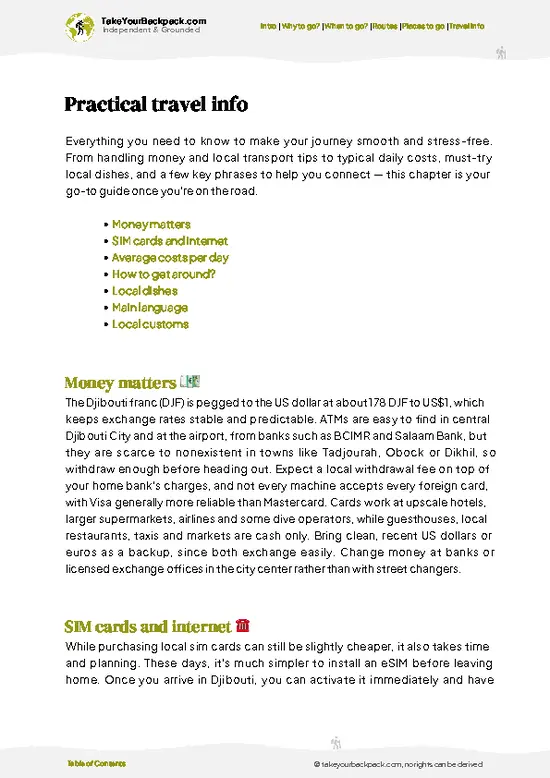
example page 0 from our offline Travel Guide for Djibouti
example page 1 from our offline Travel Guide for Djibouti
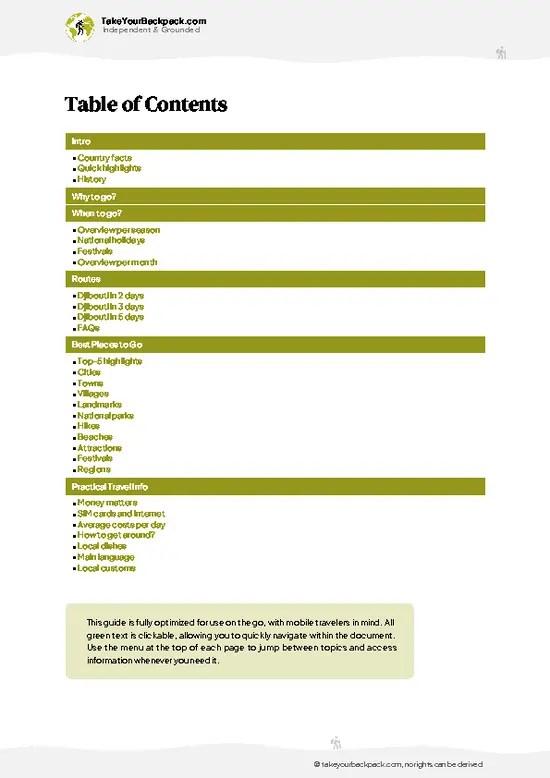
example page 2 from our offline Travel Guide for Djibouti
example page 3 from our offline Travel Guide for Djibouti
example page 4 from our offline Travel Guide for Djibouti
example page 5 from our offline Travel Guide for Djibouti
example page 6 from our offline Travel Guide for Djibouti
example page 7 from our offline Travel Guide for Djibouti
Loading the map 🌍
CLICK TO FILTER
cities
towns
villages
landmarks
national parks
hikes
beaches
attractions
festivals
regions
SHOW COUNTRY’S BESTSHOW ALL

✨ Why go?
Ranked #1 village in Djibouti
Why visitors keep coming back

Loyada earns a stop for one reason above all: it is the Somaliland border crossing on the overland route out of Djibouti, and it makes sense to arrive with daylight left to spare. Travelers who go by land rather than by air find that the village gives them a place to sort out stamps, change plans and wait for transport without the pressure of Djibouti City. The setting is a flat, hot coastal strip where trucks and traders set the pace, so you see how goods and people actually move between the two countries. It also has a small place in regional memory, because the 1976 hostage crisis involving a school bus of French children ended near this frontier, and locals know the story. Nobody lingers for days. One night at most suits experienced overlanders and curious slow travelers who like border … read more 👉
Loyada earns a stop for one reason above all: it is the Somaliland border crossing on the overland route out of Djibouti, and it makes sense to arrive with daylight left to spare. Travelers who go by land rather than by air find that the village gives them a place to sort out stamps, change plans and wait for transport without the pressure of Djibouti City. The setting is a flat, hot coastal strip where trucks and traders set the pace, so you see how goods and people actually move between the two countries. It also has a small place in regional memory, because the 1976 hostage crisis involving a school bus of French children ended near this frontier, and locals know the story. Nobody lingers for days. One night at most suits experienced overlanders and curious slow travelers who like border places for their own sake. Beach seekers, hikers and anyone wanting a social hostel scene should look to Djibouti City or the lakes instead. Treat Loyada as a practical pause with a sense of place, not a destination.

💡 HighlightsWhat this place is best known for

  1. The Loyada border crossing and truck yard: This is what Loyada is known for, and watching it work is the real experience. Heavy trucks, minibuses and porters move between Djibouti and Somaliland, and officials process papers in small offices beside the road. You can see the whole cross-border economy in one stretch of tarmac. Keep your camera away from the checkpoint and uniformed staff, and ask before photographing people. Mornings are busiest, with the queues forming early. Allow 30 minutes to 1 hour to walk the approach road and watch. Free.
  2. The Loyada shoreline: A flat, open coast of pale sand and shallow water lies just past the last houses, a quiet place to sit and look across the gulf. It is not a developed beach, so expect no shade structures or services, and the wind and heat make
… read more 👉
  1. The Loyada border crossing and truck yard: This is what Loyada is known for, and watching it work is the real experience. Heavy trucks, minibuses and porters move between Djibouti and Somaliland, and officials process papers in small offices beside the road. You can see the whole cross-border economy in one stretch of tarmac. Keep your camera away from the checkpoint and uniformed staff, and ask before photographing people. Mornings are busiest, with the queues forming early. Allow 30 minutes to 1 hour to walk the approach road and watch. Free.
  2. The Loyada shoreline: A flat, open coast of pale sand and shallow water lies just past the last houses, a quiet place to sit and look across the gulf. It is not a developed beach, so expect no shade structures or services, and the wind and heat make it better for a short walk than for a swim. Fishing boats and gulls give it some life, and the air is noticeably less stifling than in the town center. Visit close to dusk, when the heat eases and the light is soft. Free, and 30 minutes to an hour is plenty.
  3. The roadside stalls along the main road: A handful of simple stalls and tea spots serve the drivers and border traders, with sweet spiced tea, flatbread and basic snacks. Sitting at one is the easiest way to talk with people who travel the corridor daily and to hear about road conditions ahead. Prices are low, typically US$1 to 3 for tea and a snack, and a stop takes about 30 minutes. Go midday when the stalls are busiest, or in the evening when the drivers rest.
Loyada makes a base for easy side trips to Djibouti City with its markets and Place Menelik, the sandy coast at Khor Ambado, and the highland towns of the Ali Sabieh region inland. None of the sights in Loyada needs a ticket or booking ahead.
Spotted a mistake or missing something? Contact us.

Things to do near Loyada

Ratings based on Tripadvisor reviews. When you book through this link, you support our work at no extra cost to you.

🌤️ When to go?Best time to visit Loyada

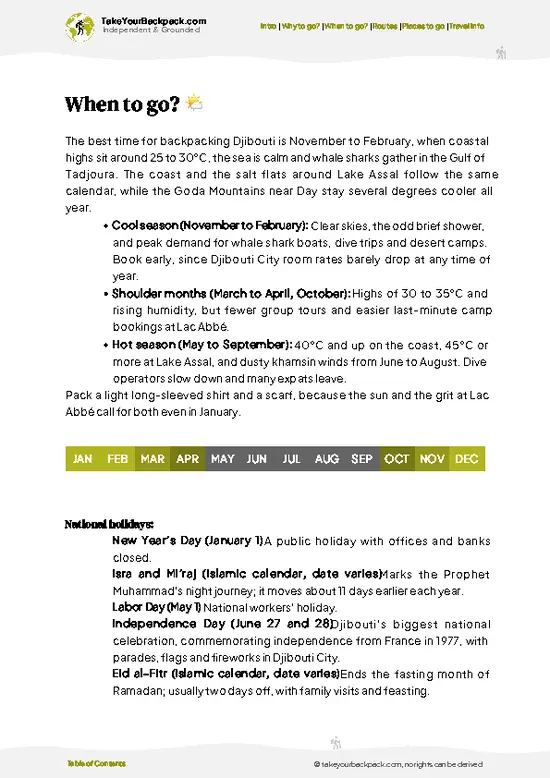
Loyada is workable from late October to March, when daytime highs sit around 28 to 34°C (82 to 93°F) and nights fall to roughly 22 to 26°C (72 to 79°F).
  • Cool Season (November to February): Highs of 28 to 33°C (82 to 91°F), a sea breeze off the Gulf of Aden, and the only months when walking the border road at midday is tolerable. Daylight runs close to 11 to 12 hours. Prices for rooms in nearby Djibouti City peak, since this is when expats and tourists arrive.
  • Shoulder (March, October): Heat builds to 34 to 38°C (93 to 100°F). Fewer visitors, and rooms are easier to bargain down.
  • Hot Season (May to September): Highs of 38 to 45°C (100 to 113°F) with humid nights above 30°C (86°F) and a dusty, hot wind. Few travelers come, shade is scarce, and trips outdoors are limited to dawn and dusk.
  • Ramadan:
… read more 👉
Loyada is workable from late October to March, when daytime highs sit around 28 to 34°C (82 to 93°F) and nights fall to roughly 22 to 26°C (72 to 79°F).
  • Cool Season (November to February): Highs of 28 to 33°C (82 to 91°F), a sea breeze off the Gulf of Aden, and the only months when walking the border road at midday is tolerable. Daylight runs close to 11 to 12 hours. Prices for rooms in nearby Djibouti City peak, since this is when expats and tourists arrive.
  • Shoulder (March, October): Heat builds to 34 to 38°C (93 to 100°F). Fewer visitors, and rooms are easier to bargain down.
  • Hot Season (May to September): Highs of 38 to 45°C (100 to 113°F) with humid nights above 30°C (86°F) and a dusty, hot wind. Few travelers come, shade is scarce, and trips outdoors are limited to dawn and dusk.
  • Ramadan: Daytime food stalls shut, and the village slows to a crawl, but evenings turn lively at sunset meals.
Aim for December or January and leave before noon, when the heat and road traffic at the border post both peak.


source: climatestotravel.comJANJanuary: excellent for travelingFEBFebruary: excellent for travelingMARMarch: good for travelingAPRApril: fair for travelingMAYMay: fair for travelingJUNJune: below average for travelingJULJuly: below average for travelingAUGAugust: below average for travelingSEPSeptember: fair for travelingOCTOctober: good for travelingNOVNovember: excellent for travelingDECDecember: excellent for traveling
when-to-go

✈️ The backpacker research shortcutDjibouti Travel Guide

An offline-friendly backpacking guide with optimized travel routes, ranked highlights, transport advice, and the best areas to stay.
example page 0 from our offline Travel Guide for Djibouti
example page 1 from our offline Travel Guide for Djibouti
example page 2 from our offline Travel Guide for Djibouti
example page 3 from our offline Travel Guide for Djibouti
example page 4 from our offline Travel Guide for Djibouti
example page 5 from our offline Travel Guide for Djibouti
example page 6 from our offline Travel Guide for Djibouti
example page 7 from our offline Travel Guide for Djibouti
The digital guide (186 pages) contains:
✅ 44 highlights, ranked by travel appeal
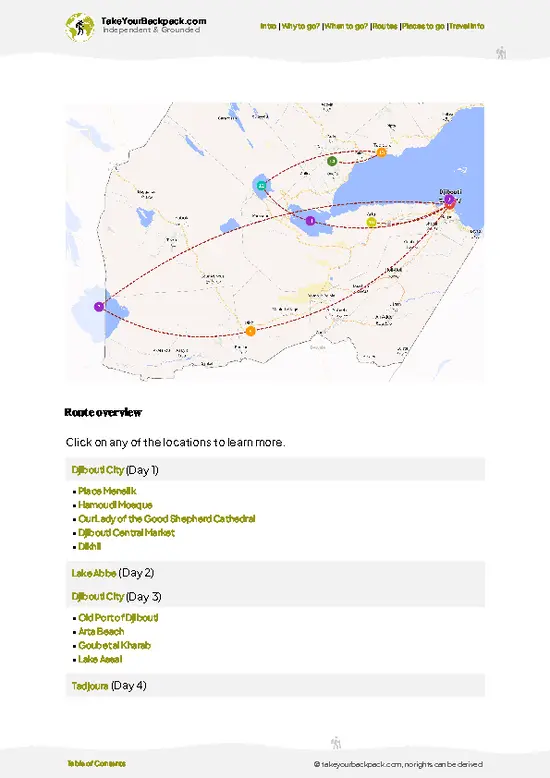
✅ Optimized 2, 3 & 5-day travel routes
✅ Cities, national parks, landmarks, beaches
✅ How to get around
✅ Offline-friendly for travel without Wi-Fi
👉 Click to see all 30+ guide features

📅 Plan smarter in minutes, not weeks
✅ Month by month travel advice
✅ Festivals & national holidays
✅ Budget expectations

🗺️ Go to the right places, skip the overrated ones
✅ Honest pros & cons of destinations
✅ Top hikes, parks & viewpoints
✅ Lesser-known places most travelers miss
✅ Clear “worth it vs skip it” guidance

🛏️ Travel smoothly without rookie mistakes
✅ Best areas to stay
✅ Transport systems explained simply
✅ Common scams & safety advice
✅ SIM cards, money & practical tips

🌍 Understand the country, not just visit it
✅ Culture & traditions
✅ 52 Essential phrases & customs
✅ Festivals worth planning around
✅ Traveler-friendly historical context
✅ Insights that make places more meaningful

📱 Built for real travel conditions
✅ Fully downloadable PDF
✅ Works completely offline
✅ Optimized for phone use
✅ Useful in remote areas & buses
✅ Everything in one place
Stop searching, start planning
Get instant access to your full guide. 30‑day money-back guarantee.
+ Add another guide for just

By proceeding you agree to our terms.
Sent to your inbox immediately after payment • 100% Secure Checkout
Best Backpacking Travel Advisor 2025 tourism awardBest Backpacking
Travel Advisor
2025
What others say about Take Your Backpack Guides:
⭐⭐⭐⭐⭐
Fantastic, amazing amount of information!
⭐⭐⭐⭐⭐
My goodness this is amazing, it's what I've been looking for hats off too you!
⭐⭐⭐⭐⭐
I think this is absolutely BRILLIANT
⭐⭐⭐⭐
Very complete and informative. It's still missing places, but I gotta to commend you
⭐⭐⭐⭐⭐
This is truly amazing, thank you, can't wait to explore it with my kids!
⭐⭐⭐⭐⭐
Awesome resource, thank you!
⭐⭐⭐⭐⭐
This is amazing! Can't wait to explore the ones I haven't seen
⭐⭐⭐⭐
I love this! Well done, great idea.
⭐⭐⭐⭐⭐
Thanks for taking the time to make this gem!
⭐⭐⭐⭐⭐
This might be the best website I've ever seen.
⭐⭐⭐⭐⭐
Congratulations, and thank you so much for your work; it's incredibly valuable.
⭐⭐⭐⭐
In all seriousness I think you did a great job pointing out the important spots
⭐⭐⭐⭐⭐
10/10 very good
⭐⭐⭐⭐⭐
As someone who's only just starting to visit regularly this is awesome, thank you.
⭐⭐⭐⭐
Thank you very much! I'm going to visit my dad, it's going to be very useful!
⭐⭐⭐⭐⭐
This is really cool! We'll be travelling for the first time and this definitely come in handy.
⭐⭐⭐⭐⭐
You are now our minister of culture, congratulations 👨‍💼
⭐⭐⭐⭐⭐
Just wanted to tell you that this is a pearl! Going to follow your recommendations.
⭐⭐⭐⭐⭐
This is so cool. I'll definitely be using the resource for my travels soon.
⭐⭐⭐⭐⭐
This is very impressive! Good work.
⭐⭐⭐⭐⭐
This is an amazing and informative site. Very well done!

🛏️ Where to stay?Where staying makes the most sense

Loyada has almost no places of its own for backpackers, so most people sleep in Djibouti City, roughly 30 km (19 miles) east, and visit the border village on a day out.
For budget travelers, the city’s center around Place Menelik has the best choice. Simple guesthouses and small hotels with fans or air conditioning run about US$25 to 45 a night for a private room. A few hostel-style places and rooms with shared bathrooms go for US$15 to 25. Air conditioning is worth paying for, because nights stay hot from spring through autumn and a fan only pushes warm air around.
Mid-range hotels near the port … read more 👉
Loyada has almost no places of its own for backpackers, so most people sleep in Djibouti City, roughly 30 km (19 miles) east, and visit the border village on a day out.
For budget travelers, the city’s center around Place Menelik has the best choice. Simple guesthouses and small hotels with fans or air conditioning run about US$25 to 45 a night for a private room. A few hostel-style places and rooms with shared bathrooms go for US$15 to 25. Air conditioning is worth paying for, because nights stay hot from spring through autumn and a fan only pushes warm air around.
Mid-range hotels near the port and along the waterfront cost US$60 to 100 and often include breakfast and reliable Wi-Fi. They suit anyone arriving late from Ethiopia or Somaliland who wants a proper shower first.
If you must sleep near Loyada, ask locally about a basic room or family guesthouse, but expect no booking sites, patchy electricity, and no guarantee. Camping is not a realistic option here, because the area is a military and border zone and wandering off the road draws attention.
Book ahead from December to February, when the city fills up. Arrive before dark, carry small US dollar notes, and keep your passport handy for checkpoints.

🚌 Day tripsEasy escapes and nearby places

Loyada is a border village, not a hub, but the road from Djibouti City and the coast nearby make a few half-day outings easy for travelers with a day to spare.Loyada Border and Coast Walk: Loyada sits right at the frontier with Somaliland, so a morning here means watching trucks, minibuses and traders cross while you drink sweet tea at a roadside stand. Allow 3 to 4 hours on site. Shared minibuses from Djibouti City take about 45 minutes to 1 hour and cost US$2 to 4 each way. Photographing the border post or soldiers is a common first-timer mistake and can end in questions, so keep your camera down. Go between November and February.
Khor Ambado: Khor Ambado is a small coastal spot west of Djibouti City with calm, shallow water and a few beachfront cafés where locals gather at weekends. It works … read more 👉
Loyada is a border village, not a hub, but the road from Djibouti City and the coast nearby make a few half-day outings easy for travelers with a day to spare.Loyada Border and Coast Walk: Loyada sits right at the frontier with Somaliland, so a morning here means watching trucks, minibuses and traders cross while you drink sweet tea at a roadside stand. Allow 3 to 4 hours on site. Shared minibuses from Djibouti City take about 45 minutes to 1 hour and cost US$2 to 4 each way. Photographing the border post or soldiers is a common first-timer mistake and can end in questions, so keep your camera down. Go between November and February.
Khor Ambado: Khor Ambado is a small coastal spot west of Djibouti City with calm, shallow water and a few beachfront cafés where locals gather at weekends. It works as a swim stop on the way back toward the city. Getting there takes about 30 to 40 minutes by taxi, and a round trip with waiting time costs roughly US$20 to 35. Go in the cool season, and bring your own sun cover because shade is limited.
👉 Explore Khor AmbadoLake Abbe Viewpoint Area Not Included: Ras Bir: Ras Bir lies at the northern entrance to the Bab-el-Mandeb strait and gives long views across to Yemen on clear days. It is a long day, around 2.5 to 3 hours each way by road, so hire a driver or join a small group. Expect US$80 to 150 per vehicle. Start before dawn and carry plenty of water. Hot months make this trip a struggle.
👉 Explore Ras Bir

FAQFrequently asked questions about Loyada

Loyada sits on the Ethiopian-road corridor at the Somaliland border, about 10 km from Djibouti City's southern edge toward Ali Sabieh, no, so plan on reaching it by road from the capital, roughly 100 to 120 km southwest, in about 2 hours by private taxi (US$60 to 100 round trip). Minibuses and shared taxis run from Djibouti City toward Loyada's direction on the coastal route via Damerjog for roughly US$3 to 6, but they may stop short, so confirm the last leg with the driver. Loyada lies near the Somaliland frontier, and a passport is needed at checkpoints along the way.
Loyada is worth the trip only if you like quiet border-country oddities and a long, empty Gulf of Aden shoreline, since it has no major sights or nightlife. The draw is the windswept coast, fishing boats and the frontier atmosphere, plus a lunch of grilled fish, usually under US$5 to 8. Most travelers see it in a few hours, so it suits a side trip for people who already enjoy Djibouti's stark landscapes rather than a headline stop.
Loyada works well as a day trip from Djibouti City, with a drive of about 2 hours each way along a road lined with flat salt plain and acacia. A private car with waiting time costs about US$60 to 100, while shared transport is far cheaper at roughly US$6 to 12 return but harder to time. Leave early, carry your passport for checkpoints, and keep about 3 to 4 hours on site, since accommodation is very limited and the return light fades by evening.
⚠️ Things can change over time, so always validate details locally before you go.

Other Djiboutian villages near Loyada

Explore more nearby:

  • Randa—Day Forest gateway, juniper woodland, cool ridge viewpoints| 81 km away
  • Dorra—Highland market lanes, acacia riverbeds, guided half-day walks| 114 km away
  • Balho—Remote Afar lanes, dry wadis, dusk tea with families| 133 km away

💡 Not sure where to go next?
Create a personalized itinerary for Djibouti including Loyada and the places that fit your trip.

Generate my itinerary

👉 Discover all villages

Or checkout all Djibouti has to offer (think cities, towns, villages, national parks, hikes, beaches, festivals)
Country photo of Djibouti

We 💚 feedbackFinal thoughts on visiting Loyada

Loyada is best in the hour before dusk, when trucks have settled, the wind off the gulf softens and the heat finally lets go. The season matters too, and the cooler winter months make waiting for a ride far easier to bear. I would arrive with Somaliland paperwork sorted, carry small bills for tea, and leave the next morning before the queues build.

✍️ Help improve this page!
The information on this page is based on in-depth research, insights shared by experienced travelers, and feedback from the local travel community in Djibouti. While every effort is made to keep the information accurate and current, conditions can change — so if you spot anything incorrect or outdated, please get in touch.


🙋‍♂️ Give feedback

👋 Meet the founderWho’s Behind Take Your Backpack?

Johan, backpacker and founder of TakeYourBackpackHi, I’m Johan (Netherlands 🇳🇱), the creator of TakeYourBackpack. Over the past 3 decades, I’ve backpacked through 90+ countries across six continents, gaining extensive experience with independent travel, long-term trips, and overland routes.

This site is built on a combination of firsthand travel experience and carefully curated insights from other backpackers. Many guides are based on places I’ve personally visited, while others bring together tips, observations, and practical advice shared by trusted travelers I’ve met along the way.

The goal is to provide realistic, experience-driven guidance — not generic itineraries — so you can explore destinations with better context, clearer expectations, and more confidence.