×

Djibouti🇩🇯 | best villagesThe 4 Top villages in Djibouti

Villages in Djibouti are small, sparse and shaped by heat. Most are Afar or Somali settlements of stone and tin houses, tied to wells, salt, fishing or herding. The north (Tadjoura, Obock) is greener on the coast and slower. The interior is harsher and costs more to reach. Independent travel works, but distances, transport and permits matter more than crowds, which are almost absent.

By Johan Kruseman 🇳🇱 | Updated October 23, 2026
Explore the best landmarks in Djibouti

Why go?Understanding Their Importance

Djibouti is a desert country of about 23,000 square kilometers where settlement follows water. Villages cluster around coastal fishing points, highland springs such as the Day Forest area, and seasonal wells used by nomadic herders. Volcanic and salt landscapes surround them, so the setting is often the draw rather than the buildings.

The Afar and Somali communities (Issa) keep long-standing customs of hospitality, clan structure and pastoral movement. Visitors should know that tourism infrastructure is thin. Public transport is limited to a few minibus and bus routes, guesthouses are basic, and prices run high for the region because most food and fuel are imported. Many northern and Afar areas need a local guide or 4x4, and some border zones with Eritrea and Ethiopia are restricted. Djibouti … read more 👉
Djibouti is a desert country of about 23,000 square kilometers where settlement follows water. Villages cluster around coastal fishing points, highland springs such as the Day Forest area, and seasonal wells used by nomadic herders. Volcanic and salt landscapes surround them, so the setting is often the draw rather than the buildings.

The Afar and Somali communities (Issa) keep long-standing customs of hospitality, clan structure and pastoral movement. Visitors should know that tourism infrastructure is thin. Public transport is limited to a few minibus and bus routes, guesthouses are basic, and prices run high for the region because most food and fuel are imported. Many northern and Afar areas need a local guide or 4x4, and some border zones with Eritrea and Ethiopia are restricted. Djibouti suits travelers who accept slow logistics in exchange for quiet and unusual places.
Evaluating the Top Choices
The list of best villages in Djibouti is created based on authenticity, scenic beauty, community spirit, traditions, and overall character. If you feel a village is missing in this list, please let us know.

When to go?Best Time to Visit Djibouti for villages

Best months: The best months for villages in Djibouti are November to March, when daytime highs fall to roughly 27 to 32°C instead of the 38 to 45°C of summer. Rain is rare everywhere, usually under 150 millimeters a year on the coast, with brief showers more likely from November to January.
Shoulder and low season: April and October are tolerable on the coast but hot inland. From June to September, the Afar lowlands and the Lake Assal basin can pass 45°C, and coastal humidity is heavy, so village visits are best limited to early morning and evening. The highland areas near Day and Mabla are cooler by several degrees all year.
Prices and crowds: Tourist numbers are low in every month. Winter brings a modest rise in demand for 4x4 hire and guesthouse beds, so booking ahead helps, while summer … read more 👉
Best months: The best months for villages in Djibouti are November to March, when daytime highs fall to roughly 27 to 32°C instead of the 38 to 45°C of summer. Rain is rare everywhere, usually under 150 millimeters a year on the coast, with brief showers more likely from November to January.
Shoulder and low season: April and October are tolerable on the coast but hot inland. From June to September, the Afar lowlands and the Lake Assal basin can pass 45°C, and coastal humidity is heavy, so village visits are best limited to early morning and evening. The highland areas near Day and Mabla are cooler by several degrees all year.
Prices and crowds: Tourist numbers are low in every month. Winter brings a modest rise in demand for 4x4 hire and guesthouse beds, so booking ahead helps, while summer rates may be negotiable. During Ramadan, daytime food options in small villages shrink.

village hoppingHow to Combine villages Into One Trip

Time needed: A trip combining several villages in Djibouti needs 5 to 8 days, because roads are slow and heat limits the hours you can move.
Grouping and direction: Group by region. The northern coast around Tadjoura and Obock connects by a ferry across the Gulf of Tadjoura (about 1 to 2 hours by boat) or by road (roughly 3 to 4 hours from Djibouti City to Tadjoura by the long route). The Afar interior and Lake Assal sit west of the capital, about 2 to 3 hours by 4x4. Starting in Djibouti City, the interior first and the north last is a practical order, since the ferry gives a clean exit.
Pacing: Allow one night per stop, two where a hike or boat trip is planned. Common mistakes are packing interior and coast into one day, driving midday in summer, and counting on public minibuses for remote … read more 👉
Time needed: A trip combining several villages in Djibouti needs 5 to 8 days, because roads are slow and heat limits the hours you can move.
Grouping and direction: Group by region. The northern coast around Tadjoura and Obock connects by a ferry across the Gulf of Tadjoura (about 1 to 2 hours by boat) or by road (roughly 3 to 4 hours from Djibouti City to Tadjoura by the long route). The Afar interior and Lake Assal sit west of the capital, about 2 to 3 hours by 4x4. Starting in Djibouti City, the interior first and the north last is a practical order, since the ferry gives a clean exit.
Pacing: Allow one night per stop, two where a hike or boat trip is planned. Common mistakes are packing interior and coast into one day, driving midday in summer, and counting on public minibuses for remote stops. Instead, fix a driver or guide for the whole loop and keep one spare day for delays.

The ListThe Best villages of Djibouti

1 Loyada

Border truck yard, Somaliland crossing, roadside tea stalls

Watch trucks, porters and officials work the Somaliland frontier, then sit at a roadside stall for sweet tea and talk with passing drivers.

2 Randa

Day Forest gateway, juniper woodland, cool ridge viewpoints

Hike with a guide into remnant juniper woodland above the village, then climb a nearby ridge for evening views over folded hills.

3 Dorra

Highland market lanes, acacia riverbeds, guided half-day walks

Stroll the main lanes where Afar households trade tea and staples, then follow dry riverbeds beyond the edge of the village with a local guide.

4 Balho

Remote Afar lanes, dry wadis, dusk tea with families

Walk sandy lanes past animal pens, follow dry watercourses into acacia scrub, then share tea with a family as the herds come home.

Loading the map 🌍

Expert viewInsights from Locals and Experts

How many to visit: Three to four villages is the number I advise. Roads are slow, the midday heat shuts down most activity, and each place rewards an overnight stay more than a quick stop. More than that turns the trip into a drive from one dusty track to the next. Fewer leaves you without the contrast between coast, highland and desert communities.
Choosing the kind: Travelers who want sea and relaxation should lean to fishing villages, where you get a plate of grilled fish and a cooler night breeze. Those after landscape and culture do better in Afar settlements, where salt, volcanic rock and camel caravans frame the day. Hikers favor the highlands, where cooler air and juniper forest make walking possible past midmorning.
What it costs: Expect US$50 to 90 a day on a stripped-down plan, higher … read more 👉
How many to visit: Three to four villages is the number I advise. Roads are slow, the midday heat shuts down most activity, and each place rewards an overnight stay more than a quick stop. More than that turns the trip into a drive from one dusty track to the next. Fewer leaves you without the contrast between coast, highland and desert communities.
Choosing the kind: Travelers who want sea and relaxation should lean to fishing villages, where you get a plate of grilled fish and a cooler night breeze. Those after landscape and culture do better in Afar settlements, where salt, volcanic rock and camel caravans frame the day. Hikers favor the highlands, where cooler air and juniper forest make walking possible past midmorning.
What it costs: Expect US$50 to 90 a day on a stripped-down plan, higher than neighboring countries. Basic guesthouse beds run about US$15 to 40, a local meal US$4 to 10, and a guide US$30 to 60 a day. A 4x4 with driver costs roughly US$100 to 200 a day, easier to split between travelers. Ferry or minibus fares between towns are typically US$2 to 10. Most villages charge no entry, but a small contribution for a community visit or a homestay is expected, often US$5 to 10.
Safety and etiquette: Djibouti is generally calm, yet border regions near Eritrea and parts of the north need current advice and sometimes permission before travel. Carry water, at least 3 to 4 liters a day, and cover shoulders and knees, as villages are mostly Muslim and conservative. Ask before photographing people, especially women. Accept tea when offered, since it is how a visit begins. Bring cash in Djiboutian francs, because cards and ATMs rarely work outside the capital.

✈️ The backpacker research shortcutDjibouti Travel Guide

An offline-friendly backpacking guide with optimized travel routes, ranked highlights, transport advice, and the best areas to stay.
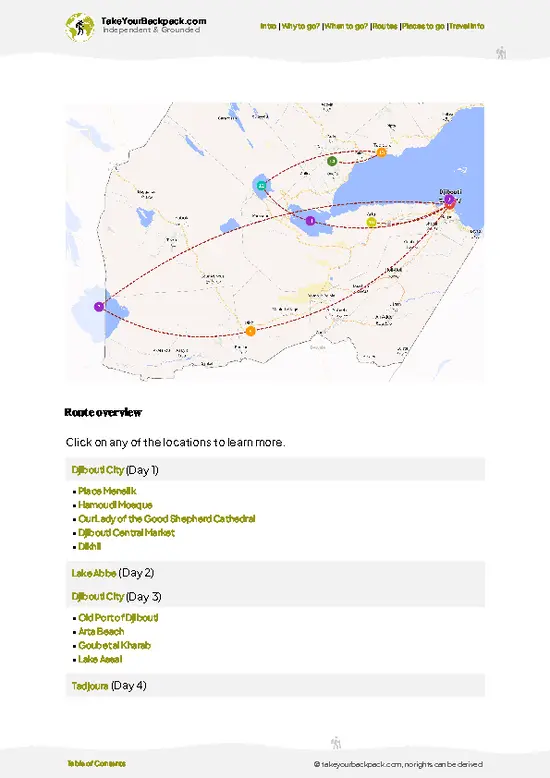
example page 0 from our offline Travel Guide for Djibouti
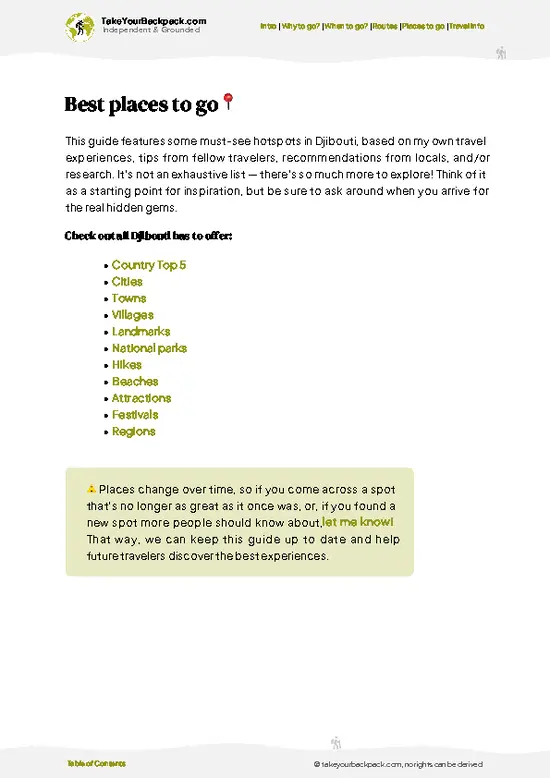
example page 1 from our offline Travel Guide for Djibouti
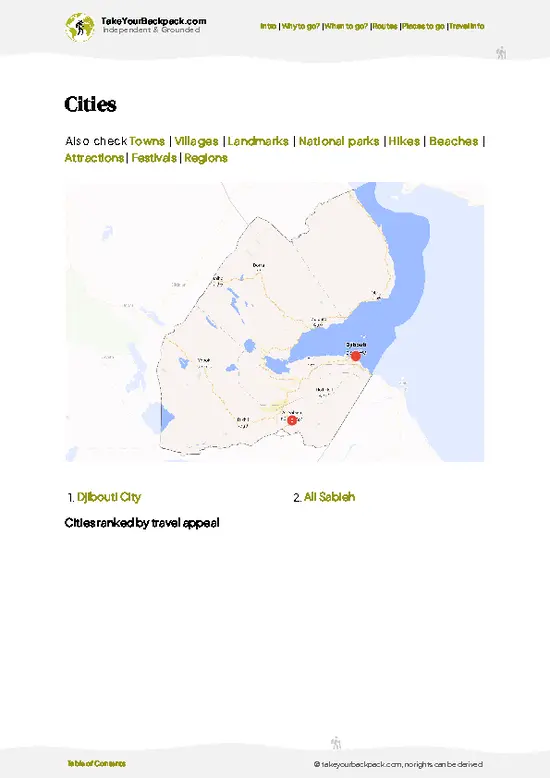
example page 2 from our offline Travel Guide for Djibouti
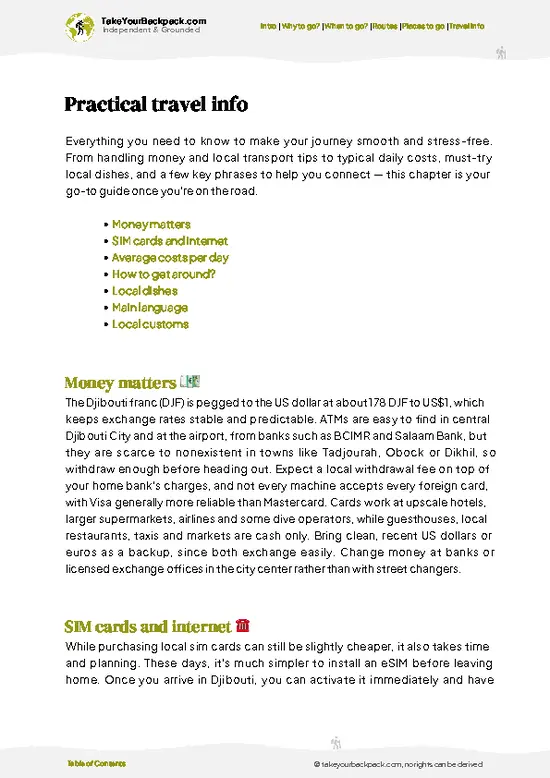
example page 3 from our offline Travel Guide for Djibouti
example page 4 from our offline Travel Guide for Djibouti
example page 5 from our offline Travel Guide for Djibouti
example page 6 from our offline Travel Guide for Djibouti
example page 7 from our offline Travel Guide for Djibouti
The digital guide (186 pages) contains:
✅ 44 highlights, ranked by travel appeal
✅ Optimized 2, 3 & 5-day travel routes
✅ Cities, national parks, landmarks, beaches
✅ How to get around
✅ Offline-friendly for travel without Wi-Fi
👉 Click to see all 30+ guide features

📅 Plan smarter in minutes, not weeks
✅ Month by month travel advice
✅ Festivals & national holidays
✅ Budget expectations

🗺️ Go to the right places, skip the overrated ones
✅ Honest pros & cons of destinations
✅ Top hikes, parks & viewpoints
✅ Lesser-known places most travelers miss
✅ Clear “worth it vs skip it” guidance

🛏️ Travel smoothly without rookie mistakes
✅ Best areas to stay
✅ Transport systems explained simply
✅ Common scams & safety advice
✅ SIM cards, money & practical tips

🌍 Understand the country, not just visit it
✅ Culture & traditions
✅ 52 Essential phrases & customs
✅ Festivals worth planning around
✅ Traveler-friendly historical context
✅ Insights that make places more meaningful

📱 Built for real travel conditions
✅ Fully downloadable PDF
✅ Works completely offline
✅ Optimized for phone use
✅ Useful in remote areas & buses
✅ Everything in one place
Stop searching, start planning
Get instant access to your full guide. 30‑day money-back guarantee.
+ Add another guide for just

By proceeding you agree to our terms.
Sent to your inbox immediately after payment • 100% Secure Checkout
Best Backpacking Travel Advisor 2025 tourism awardBest Backpacking
Travel Advisor
2025
What others say about Take Your Backpack Guides:
⭐⭐⭐⭐⭐
Fantastic, amazing amount of information!
⭐⭐⭐⭐⭐
My goodness this is amazing, it's what I've been looking for hats off too you!
⭐⭐⭐⭐⭐
I think this is absolutely BRILLIANT
⭐⭐⭐⭐
Very complete and informative. It's still missing places, but I gotta to commend you
⭐⭐⭐⭐⭐
This is truly amazing, thank you, can't wait to explore it with my kids!
⭐⭐⭐⭐⭐
Awesome resource, thank you!
⭐⭐⭐⭐⭐
This is amazing! Can't wait to explore the ones I haven't seen
⭐⭐⭐⭐
I love this! Well done, great idea.
⭐⭐⭐⭐⭐
Thanks for taking the time to make this gem!
⭐⭐⭐⭐⭐
This might be the best website I've ever seen.
⭐⭐⭐⭐⭐
Congratulations, and thank you so much for your work; it's incredibly valuable.
⭐⭐⭐⭐
In all seriousness I think you did a great job pointing out the important spots
⭐⭐⭐⭐⭐
10/10 very good
⭐⭐⭐⭐⭐
As someone who's only just starting to visit regularly this is awesome, thank you.
⭐⭐⭐⭐
Thank you very much! I'm going to visit my dad, it's going to be very useful!
⭐⭐⭐⭐⭐
This is really cool! We'll be travelling for the first time and this definitely come in handy.
⭐⭐⭐⭐⭐
You are now our minister of culture, congratulations 👨‍💼
⭐⭐⭐⭐⭐
Just wanted to tell you that this is a pearl! Going to follow your recommendations.
⭐⭐⭐⭐⭐
This is so cool. I'll definitely be using the resource for my travels soon.
⭐⭐⭐⭐⭐
This is very impressive! Good work.
⭐⭐⭐⭐⭐
This is an amazing and informative site. Very well done!

🛏️ Where to stay?Where to Base Yourself

Djibouti has no real hostel scene, so budget travel here means simple guesthouses and basic hotels in Djibouti City, where a double typically costs 7,000 to 12,000 DJF (US$40 to 70) a night. The European Quarter around Place Ménélik holds the most options, with cafés, restaurants and the few late-night bars within walking distance, though rooms there run noisier and pricier. The African Quarter just south, near the market streets, offers the cheapest rooms and lively street food but feels chaotic after dark, while Plateau du Héron is quiet and safe near the embassies and the waterfront, with few budget beds and a taxi ride to anything.

If you enjoy meeting fellow travelers, consider choosing … read more 👉
Djibouti has no real hostel scene, so budget travel here means simple guesthouses and basic hotels in Djibouti City, where a double typically costs 7,000 to 12,000 DJF (US$40 to 70) a night. The European Quarter around Place Ménélik holds the most options, with cafés, restaurants and the few late-night bars within walking distance, though rooms there run noisier and pricier. The African Quarter just south, near the market streets, offers the cheapest rooms and lively street food but feels chaotic after dark, while Plateau du Héron is quiet and safe near the embassies and the waterfront, with few budget beds and a taxi ride to anything.

If you enjoy meeting fellow travelers, consider choosing hostels with high ratings for atmosphere. On the other hand, if you prefer having your own space, a hotel might be a better option.

DjiboutiExpand Your Journey

👋 Meet the founderWho’s Behind Take Your Backpack?

Johan, backpacker and founder of TakeYourBackpackHi, I’m Johan (Netherlands 🇳🇱), the creator of TakeYourBackpack. Over the past 3 decades, I’ve backpacked through 90+ countries across six continents, gaining extensive experience with independent travel, long-term trips, and overland routes.

This site is built on a combination of firsthand travel experience and carefully curated insights from other backpackers. Many guides are based on places I’ve personally visited, while others bring together tips, observations, and practical advice shared by trusted travelers I’ve met along the way.

The goal is to provide realistic, experience-driven guidance — not generic itineraries — so you can explore destinations with better context, clearer expectations, and more confidence.