×

Dominican Republic🇩🇴 | national parksIsla Cabritos National ParkLake Enriquillo, below sea level, rhinoceros iguanas, cactus island | things to do and best time to go

Explore Parque Nacional José del Carmen RamírezExplore Jaragua National Park

Backpacking in Isla Cabritos
🌟 Highlightnational park ranked #6
By Johan Kruseman 🇳🇱 | Updated October 23, 2026

Flamingos stand in the shallows off the island’s edges, and the water around them is saltier than the sea. Isla Cabritos National Park sits in the middle of Lake Enriquillo, in the southwest of the Dominican Republic, and the lake surface lies below sea level, around 40 meters at its lowest. Getting there means a short boat ride from the park entrance near La Descubierta, with hot sun and a lot of reflected glare. The island is flat, dry and covered in cactus, so a sun hat is not optional. Trails are short, wandering among thorny scrub where rhinoceros iguanas wait for you to blink first. Crocodiles cruise offshore, and the effect is part safari, part desert. Crowds are thin, shade is scarce, and the payoff is a lizard-eye view of a strange landscape. Unlike Jaragua National Park, which is coastal and breezy, Cabritos is hot, inland and strikingly austere.

Discover everything you want to know in the 📖 Dominican Republic Travel Guide.


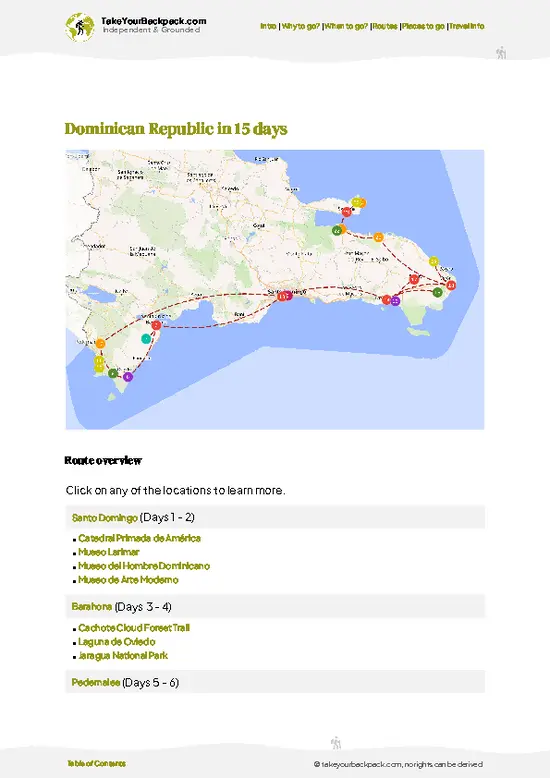
example page 0 from our offline Travel Guide for Dominican Republic
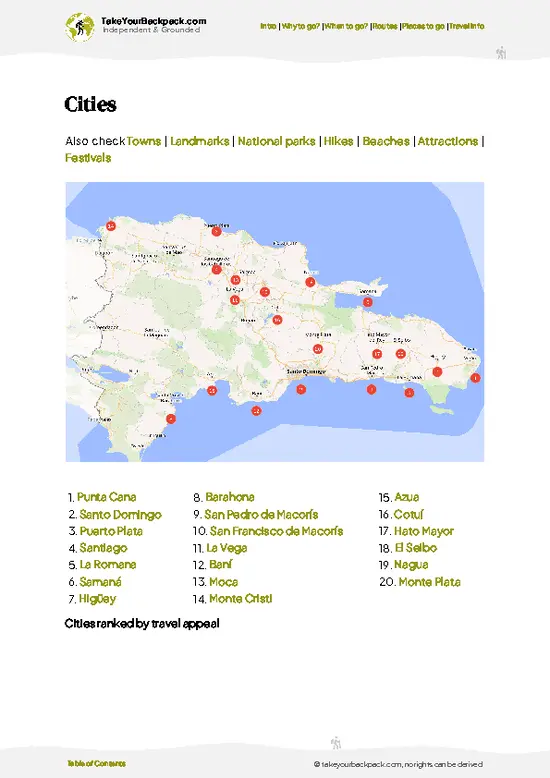
example page 1 from our offline Travel Guide for Dominican Republic
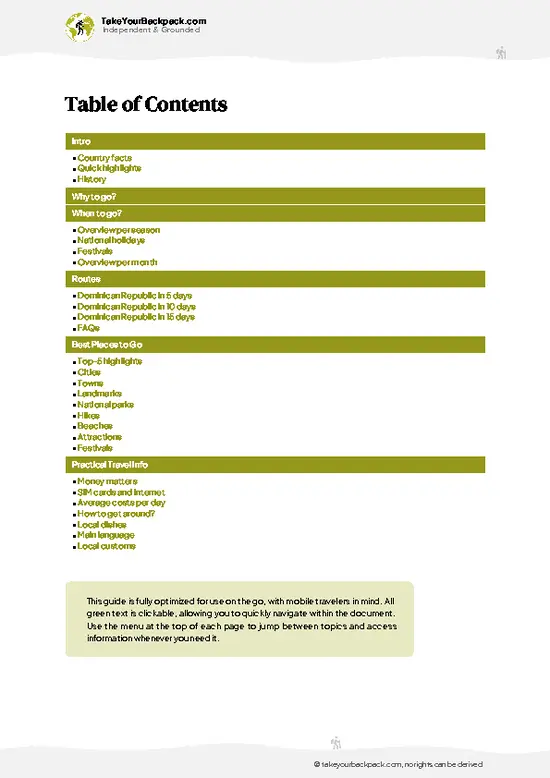
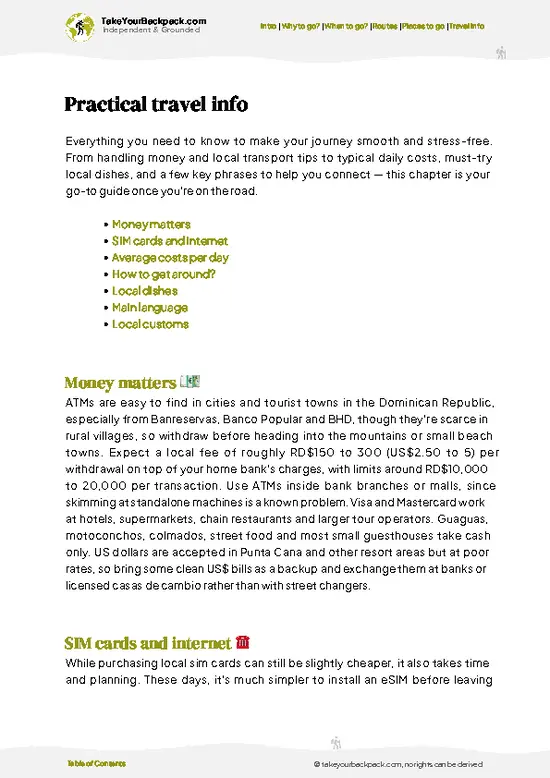
example page 2 from our offline Travel Guide for Dominican Republic
example page 3 from our offline Travel Guide for Dominican Republic
example page 4 from our offline Travel Guide for Dominican Republic
example page 5 from our offline Travel Guide for Dominican Republic
example page 6 from our offline Travel Guide for Dominican Republic
example page 7 from our offline Travel Guide for Dominican Republic
Loading the map 🌍
CLICK TO FILTER
cities
towns
landmarks
national parks
hikes
beaches
attractions
festivals
SHOW COUNTRY’S BESTSHOW ALL

✨ Why go?
Ranked #6 national park in Dominican Republic
What makes this national park worth exploring

Isla Cabritos National Park suits backpackers who want a strange, empty corner of the country without a tour bus in sight. The draw is the boat crossing of Lake Enriquillo, which you can arrange at the park entrance on the day, and the island itself is small enough to walk without a guide pushing a schedule. Nothing here requires planning weeks ahead. You show up, pay, and ride.

What keeps people coming is wildlife you cannot see in the lush north of the country. The rhinoceros iguanas that live on the island are large, unbothered and easy to photograph from a few steps away. American crocodiles live in the lake, and flamingos feed in the saline shallows. For travelers who like deserts, salt flats and odd ecosystems, the contrast with the beaches elsewhere is the entire point. It also pairs … read more 👉
Isla Cabritos National Park suits backpackers who want a strange, empty corner of the country without a tour bus in sight. The draw is the boat crossing of Lake Enriquillo, which you can arrange at the park entrance on the day, and the island itself is small enough to walk without a guide pushing a schedule. Nothing here requires planning weeks ahead. You show up, pay, and ride.

What keeps people coming is wildlife you cannot see in the lush north of the country. The rhinoceros iguanas that live on the island are large, unbothered and easy to photograph from a few steps away. American crocodiles live in the lake, and flamingos feed in the saline shallows. For travelers who like deserts, salt flats and odd ecosystems, the contrast with the beaches elsewhere is the entire point. It also pairs easily with the nearby town of Jimaní for a self-guided loop around the lake, and you can finish the visit in half a day if you prefer to keep moving.

💡 HighlightsPlaces and moments you shouldn't skip

  1. Lake Enriquillo boat crossing: The ride from the park entrance near La Descubierta to the island is the signature experience, across a saline lake that lies below sea level. Flamingos and crocodiles are often visible from the water.
  2. Rhinoceros iguanas: These large, bumpy-skinned lizards patrol the island’s trails and hold their ground when you pass. They are the best-known residents.
  3. American crocodiles: The lake supports a notable population, and spotting snouts near the shoreline from the boat is common.
  4. Flamingo flocks: Pink birds feed in the shallows around the lake, and a binocular view from the boat or shoreline is memorable.
  5. Cactus forest trails: Short walking paths run through columnar cacti and thorn scrub, a stark landscape that looks nothing like the Caribbean coast.
  6. Las Caritas: Taíno
… read more 👉
  1. Lake Enriquillo boat crossing: The ride from the park entrance near La Descubierta to the island is the signature experience, across a saline lake that lies below sea level. Flamingos and crocodiles are often visible from the water.
  2. Rhinoceros iguanas: These large, bumpy-skinned lizards patrol the island’s trails and hold their ground when you pass. They are the best-known residents.
  3. American crocodiles: The lake supports a notable population, and spotting snouts near the shoreline from the boat is common.
  4. Flamingo flocks: Pink birds feed in the shallows around the lake, and a binocular view from the boat or shoreline is memorable.
  5. Cactus forest trails: Short walking paths run through columnar cacti and thorn scrub, a stark landscape that looks nothing like the Caribbean coast.
  6. Las Caritas: Taíno rock carvings of faces sit on a limestone outcrop along the lake’s edge nearby, a worthwhile short add-on for history.
  7. Park entrance and visitor center: The park’s mainland entrance near La Descubierta has the ticket office, boat dock and a small information point, and it is the starting spot for the island visit.
Do the boat crossing first, since the early hours give calmer water and cooler walking once you reach the island.
Spotted a mistake or missing something? Contact us.

Things to do near Isla Cabritos National Park

Ratings based on Tripadvisor reviews. When you book through this link, you support our work at no extra cost to you.

🌤️ When to go?When to go for the best experience

  • December to March: Isla Cabritos National Park is at its most comfortable now, with dry days around 28 to 34°C (82 to 93°F) and nights near 20°C (68°F). Boat trips on Lago Enriquillo run reliably, and this is the busiest stretch, so book guides early.
  • April to June: Heat builds to 35 to 40°C (95 to 104°F) on the lake shore, and the island is a baking, shadeless flat. Brief afternoon storms appear. Crowds thin out.
  • July to September: The hottest months, often above 38°C (100°F). Go at first light, when the park opens, and finish before midday. Flamingos and iguanas are still easy to see.
  • October to November: Peak hurricane season brings heavy rain and occasional road disruption, and the lake level can rise. Lodging prices are lowest.
Daylight stays between roughly 11 and 13 hours all year, so plan the boat ride for the first morning slot.

source: climatestotravel.comJANJanuary: excellent for travelingFEBFebruary: excellent for travelingMARMarch: excellent for travelingAPRApril: highly recommended for travelingMAYMay: fair for travelingJUNJune: fair for travelingJULJuly: fair for travelingAUGAugust: fair for travelingSEPSeptember: fair for travelingOCTOctober: fair for travelingNOVNovember: good for travelingDECDecember: excellent for traveling
when-to-go

✈️ The backpacker research shortcutDominican Republic Travel Guide

An offline-friendly backpacking guide with optimized travel routes, ranked highlights, transport advice, and the best areas to stay.
example page 0 from our offline Travel Guide for Dominican Republic
example page 1 from our offline Travel Guide for Dominican Republic
example page 2 from our offline Travel Guide for Dominican Republic
example page 3 from our offline Travel Guide for Dominican Republic
example page 4 from our offline Travel Guide for Dominican Republic
example page 5 from our offline Travel Guide for Dominican Republic
example page 6 from our offline Travel Guide for Dominican Republic
example page 7 from our offline Travel Guide for Dominican Republic
The digital guide (336 pages) contains:
✅ 108 highlights, ranked by travel appeal
✅ Optimized 5, 10 & 15-day travel routes
✅ Cities, national parks, landmarks, beaches
✅ How to get around
✅ Offline-friendly for travel without Wi-Fi
👉 Click to see all 30+ guide features

📅 Plan smarter in minutes, not weeks
✅ Month by month travel advice
✅ Festivals & national holidays
✅ Budget expectations

🗺️ Go to the right places, skip the overrated ones
✅ Honest pros & cons of destinations
✅ Top hikes, parks & viewpoints
✅ Lesser-known places most travelers miss
✅ Clear “worth it vs skip it” guidance

🛏️ Travel smoothly without rookie mistakes
✅ Best areas to stay
✅ Transport systems explained simply
✅ Common scams & safety advice
✅ SIM cards, money & practical tips

🌍 Understand the country, not just visit it
✅ Culture & traditions
✅ 52 Essential phrases & customs
✅ Festivals worth planning around
✅ Traveler-friendly historical context
✅ Insights that make places more meaningful

📱 Built for real travel conditions
✅ Fully downloadable PDF
✅ Works completely offline
✅ Optimized for phone use
✅ Useful in remote areas & buses
✅ Everything in one place
Stop searching, start planning
Get instant access to your full guide. 30‑day money-back guarantee.
+ Add another guide for just

By proceeding you agree to our terms.
Sent to your inbox immediately after payment • 100% Secure Checkout
Best Backpacking Travel Advisor 2025 tourism awardBest Backpacking
Travel Advisor
2025
What others say about Take Your Backpack Guides:
⭐⭐⭐⭐⭐
Fantastic, amazing amount of information!
⭐⭐⭐⭐⭐
My goodness this is amazing, it's what I've been looking for hats off too you!
⭐⭐⭐⭐⭐
I think this is absolutely BRILLIANT
⭐⭐⭐⭐
Very complete and informative. It's still missing places, but I gotta to commend you
⭐⭐⭐⭐⭐
This is truly amazing, thank you, can't wait to explore it with my kids!
⭐⭐⭐⭐⭐
Awesome resource, thank you!
⭐⭐⭐⭐⭐
This is amazing! Can't wait to explore the ones I haven't seen
⭐⭐⭐⭐
I love this! Well done, great idea.
⭐⭐⭐⭐⭐
Thanks for taking the time to make this gem!
⭐⭐⭐⭐⭐
This might be the best website I've ever seen.
⭐⭐⭐⭐⭐
Congratulations, and thank you so much for your work; it's incredibly valuable.
⭐⭐⭐⭐
In all seriousness I think you did a great job pointing out the important spots
⭐⭐⭐⭐⭐
10/10 very good
⭐⭐⭐⭐⭐
As someone who's only just starting to visit regularly this is awesome, thank you.
⭐⭐⭐⭐
Thank you very much! I'm going to visit my dad, it's going to be very useful!
⭐⭐⭐⭐⭐
This is really cool! We'll be travelling for the first time and this definitely come in handy.
⭐⭐⭐⭐⭐
You are now our minister of culture, congratulations 👨‍💼
⭐⭐⭐⭐⭐
Just wanted to tell you that this is a pearl! Going to follow your recommendations.
⭐⭐⭐⭐⭐
This is so cool. I'll definitely be using the resource for my travels soon.
⭐⭐⭐⭐⭐
This is very impressive! Good work.
⭐⭐⭐⭐⭐
This is an amazing and informative site. Very well done!

🛏️ Where to stay?Best areas and accommodation options

Most backpackers sleep in Jimaní or Duvergé, since there is no lodging on the island and the park has no campground. Jimaní, about 30 minutes by road from the visitor center at La Descubierta side, has simple guesthouses and small hotels at roughly US$15 to 35 a night, plus a few fan-cooled rooms with cold showers. It sits right at the Haitian border, so it is busy with trucks and traders by day and quiet by night.

La Descubierta is the better pick for atmosphere. This small town has family-run guesthouses at about US$20 to 40, a freshwater spa called Balneario La Descubierta, and the Las Caritas … read more 👉
Most backpackers sleep in Jimaní or Duvergé, since there is no lodging on the island and the park has no campground. Jimaní, about 30 minutes by road from the visitor center at La Descubierta side, has simple guesthouses and small hotels at roughly US$15 to 35 a night, plus a few fan-cooled rooms with cold showers. It sits right at the Haitian border, so it is busy with trucks and traders by day and quiet by night.

La Descubierta is the better pick for atmosphere. This small town has family-run guesthouses at about US$20 to 40, a freshwater spa called Balneario La Descubierta, and the Las Caritas rock carvings nearby. Boat departures to the island leave from the Isla Cabritos dock on the lake, reached from the road near La Descubierta.

Neiba, the provincial capital, is larger and offers more hotels (US$25 to 50) and restaurants, plus ATMs. It works if you want better food and a reliable connection, though it is roughly an hour from the park. Book ahead around Christmas and Holy Week, when Dominican families travel.

👛 Costs (as of 23 October 2026)What things cost and how to budget

Isla Cabritos National Park costs roughly US$47 to 104 per day for a backpacker, with most of the spending on the boat trip and a guesthouse in a nearby town.
CategoryBudget RangeLocal Reality
Entrance feeUS$2 to 4Paid at the visitor center on the lake shore; foreigners pay more than Dominicans.
Boat and guideUS$15 to 30The boat is priced per group, so splitting it with others cuts your share. The trip lasts about 2 to 3 hours.
Accommodation (high season)US$15 to 35Simple guesthouses in La Descubierta, Jimaní or Neiba, with fans and cold showers. Rates rise around Christmas.
Local transportUS$5 to 15Shared minibuses (guaguas) and motorcycle taxis between Neiba, La Descubierta and Jimaní; a taxi to the dock costs more.
Food and suppliesUS$10 to 20Comedores serve rice, beans and chicken for US$3 to
… read more 👉
Isla Cabritos National Park costs roughly US$47 to 104 per day for a backpacker, with most of the spending on the boat trip and a guesthouse in a nearby town.
CategoryBudget RangeLocal Reality
Entrance feeUS$2 to 4Paid at the visitor center on the lake shore; foreigners pay more than Dominicans.
Boat and guideUS$15 to 30The boat is priced per group, so splitting it with others cuts your share. The trip lasts about 2 to 3 hours.
Accommodation (high season)US$15 to 35Simple guesthouses in La Descubierta, Jimaní or Neiba, with fans and cold showers. Rates rise around Christmas.
Local transportUS$5 to 15Shared minibuses (guaguas) and motorcycle taxis between Neiba, La Descubierta and Jimaní; a taxi to the dock costs more.
Food and suppliesUS$10 to 20Comedores serve rice, beans and chicken for US$3 to 6. Buy water and snacks in town because the island has none.
Total Daily BudgetUS$47 to 104Spend near the low end by sharing the boat and eating at comedores.
⚠️ Prices can change and everyone travels differently, so take this as a rough guide. Hope it helps you plan your adventure!

🥾 TrailsExploring Isla Cabritos: trails, terrain, and views

Isla Cabritos National Park is best explored on foot over a few short, flat paths rather than a long trek. Terrain is dry, rocky and open, with cactus, scrub and very little shade, so the heat is the main challenge, not the elevation.
  • Island loop: A short, easy walk of roughly 1 to 2 hours that circles part of the island and passes iguana habitat, cactus stands and lake views. Terrain is flat and sandy to rocky.
  • Iguana viewing area: An easy stroll near the landing point where rhinoceros iguanas gather. Allow 20 to 30 minutes, and keep a respectful distance.
  • Shoreline stretch: A gentle walk along
… read more 👉
Isla Cabritos National Park is best explored on foot over a few short, flat paths rather than a long trek. Terrain is dry, rocky and open, with cactus, scrub and very little shade, so the heat is the main challenge, not the elevation.
  • Island loop: A short, easy walk of roughly 1 to 2 hours that circles part of the island and passes iguana habitat, cactus stands and lake views. Terrain is flat and sandy to rocky.
  • Iguana viewing area: An easy stroll near the landing point where rhinoceros iguanas gather. Allow 20 to 30 minutes, and keep a respectful distance.
  • Shoreline stretch: A gentle walk along the water’s edge where birds and flamingos are often visible, suitable for any fitness level.
  • Wildlife: Rhinoceros iguanas, American crocodiles, flamingos and other waterbirds, along with native cacti and dry forest plants.
  • Difficulty: Easy overall, but heat and sun exposure make water, a hat and sunscreen essential.
Practical details: public transport reaches the area via Jimaní or Neiba, and from there a motorcycle taxi or a hired ride covers the last stretch to the park entrance. A boat is required to reach the island, and it is arranged at the entrance. Crowds are light, with the occasional tour group, and weekdays are quieter. There is an entrance fee, paid in local currency, and boat service is a separate charge.
⚠️ Hiking info can sometimes be outdated or inaccurate. Before you hit the trail, check the latest conditions with locals. If you do spot anything that's off, I'd love to hear from you, so I can update it for fellow travelers.

🛡️ SafetyScams, Hazards, and Annoyances

The main hazard at Isla Cabritos National Park is heat, not wildlife. The island is flat, saline and almost shadeless, and midday temperatures often pass 35°C (95°F), so carry at least 3 liters of water per person, a wide-brimmed hat and strong sunscreen. Start early and finish before the afternoon peak.

American crocodiles live in Lago Enriquillo, and rhinoceros iguanas roam the island. Both are used to boats. Keep a few meters from the iguanas, never feed them, and stay out of the water. Walk only the marked paths with the ranger or guide, since the salt crust and thorny scrub make footing uneven and the lake edge can be soft mud.

The lake is close to the Haitian border, so expect military checkpoints on the roads. Carry your passport. Boat rides are short, but wear the life jacket provided … read more 👉
The main hazard at Isla Cabritos National Park is heat, not wildlife. The island is flat, saline and almost shadeless, and midday temperatures often pass 35°C (95°F), so carry at least 3 liters of water per person, a wide-brimmed hat and strong sunscreen. Start early and finish before the afternoon peak.

American crocodiles live in Lago Enriquillo, and rhinoceros iguanas roam the island. Both are used to boats. Keep a few meters from the iguanas, never feed them, and stay out of the water. Walk only the marked paths with the ranger or guide, since the salt crust and thorny scrub make footing uneven and the lake edge can be soft mud.

The lake is close to the Haitian border, so expect military checkpoints on the roads. Carry your passport. Boat rides are short, but wear the life jacket provided and bring cash, as there are no shops on the island.

FAQFrequently asked questions about Isla Cabritos

One full day is enough for Isla Cabritos National Park, since the boat trip across Lago Enriquillo and the island walk take about 3 to 4 hours. Add a second day to see Las Caritas rock carvings, the La Descubierta spa and the lake viewpoints. Most people base themselves in La Descubierta or Jimaní and go early to avoid the heat.
You can reach Isla Cabritos National Park without a car, but it takes planning. Guaguas run from Santo Domingo to Neiba (about 3.5 to 4 hours), then local transport goes on to La Descubierta, roughly an hour more. From there, motorcycle taxis or a taxi cover the last stretch to the boat dock, around US$5 to 15.
Yes, Isla Cabritos National Park charges an entrance fee, about US$2 to 4 for foreigners, paid at the visitor center by the lake. No separate permit is needed for a standard visit. The boat and guide are extra, roughly US$15 to 30 per group, and you should bring cash.
⚠️ Things can change over time, so always validate details locally before you go.

Other Dominican national parks near Isla Cabritos

Explore more nearby:


💡 Not sure where to go next?
Create a personalized itinerary for Dominican Republic including Isla Cabritos and the places that fit your trip.

Generate my itinerary

👉 Discover all national parks

Or checkout all Dominican Republic has to offer (think cities, towns, villages, national parks, hikes, beaches, festivals)
Country photo of Dominican Republic

We 💚 feedbackWhat to keep in mind

Isla Cabritos National Park is best at first light, when the lake is calm, the iguanas are active and the heat has not yet turned the island into a frying pan. I would go in the cooler months and arrive early, then pack more water than seems reasonable. Skip the midday slot if you can.

✍️ Help improve this page!
The information on this page is based on in-depth research, insights shared by experienced travelers, and feedback from the local travel community in Dominican Republic. While every effort is made to keep the information accurate and current, conditions can change — so if you spot anything incorrect or outdated, please get in touch.


🙋‍♂️ Give feedback

👋 Meet the founderWho’s Behind Take Your Backpack?

Johan, backpacker and founder of TakeYourBackpackHi, I’m Johan (Netherlands 🇳🇱), the creator of TakeYourBackpack. Over the past 3 decades, I’ve backpacked through 90+ countries across six continents, gaining extensive experience with independent travel, long-term trips, and overland routes.

This site is built on a combination of firsthand travel experience and carefully curated insights from other backpackers. Many guides are based on places I’ve personally visited, while others bring together tips, observations, and practical advice shared by trusted travelers I’ve met along the way.

The goal is to provide realistic, experience-driven guidance — not generic itineraries — so you can explore destinations with better context, clearer expectations, and more confidence.