×

Ecuador🇪🇨 | national parksCotopaxi National ParkSymmetrical cone, Limpiopungo loop, scree refuge, snowline | things to do and best time to go

Explore Chimborazo National ParkExplore Cuyabeno Wildlife Reserve

Backpacking in Cotopaxi
🏆 Top picknational park ranked #3
By Johan Kruseman 🇳🇱 | Updated October 19, 2026

Gravel pops and ticks under the tires of the pickup as it grinds up toward the parking lot, and through the open window comes the sharp, resinous smell of crushed paja grass and wet volcanic dust. That smell is Cotopaxi National Park for me. The park sits in the Andes of central Ecuador, south of Quito, and its centerpiece is a near-perfect glaciated cone rising to 5,897 meters. You can walk the Limpiopungo lagoon loop with wild horses grazing nearby, grind up the scree to the José Rivas refuge, or spot Andean condors and foxes on the páramo. Roads are paved to the gate and then rough, so access is easy by tour and fiddly by bus. Weekends bring crowds to the lot, though the lagoon trails stay quiet. Unlike Chimborazo, which feels like a bare lunar plateau, Cotopaxi gives you a classic symmetrical volcano, grassland and wildlife in one frame.

Discover everything you want to know in the 📖 Ecuador Travel Guide.


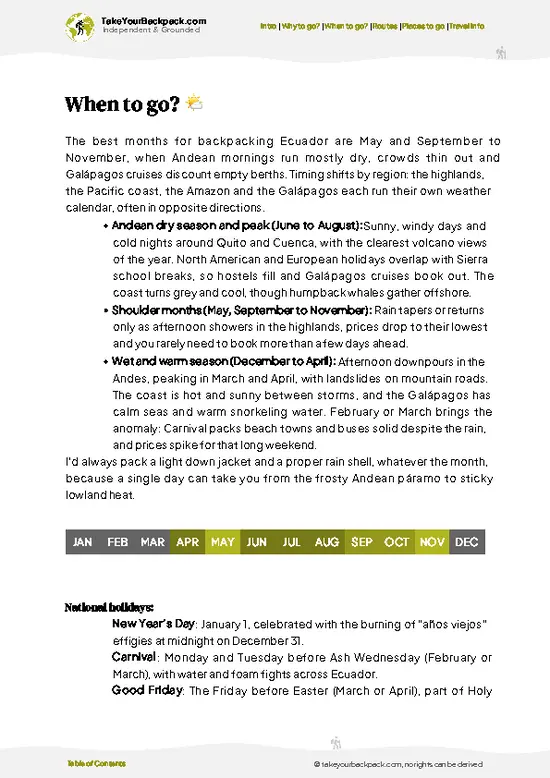
example page 0 from our offline Travel Guide for Ecuador
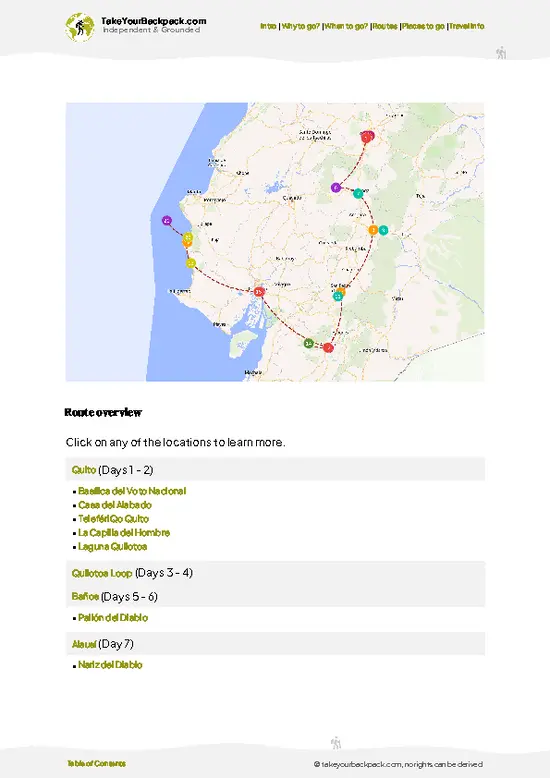
example page 1 from our offline Travel Guide for Ecuador
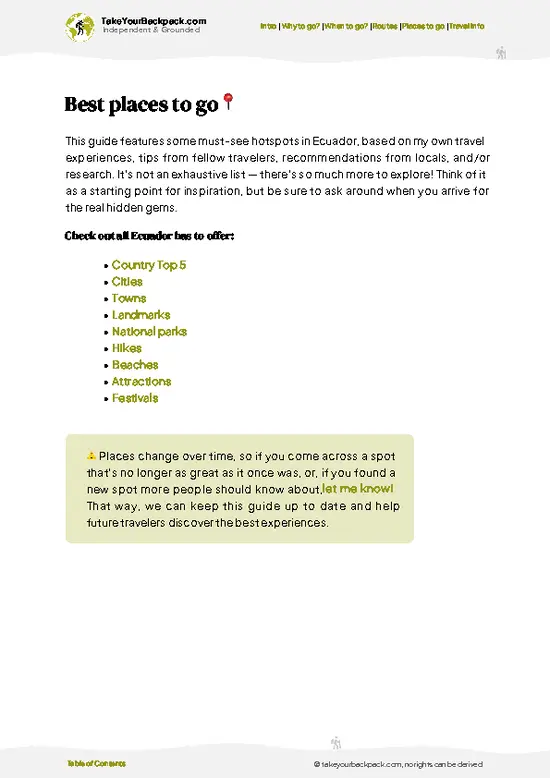
example page 2 from our offline Travel Guide for Ecuador
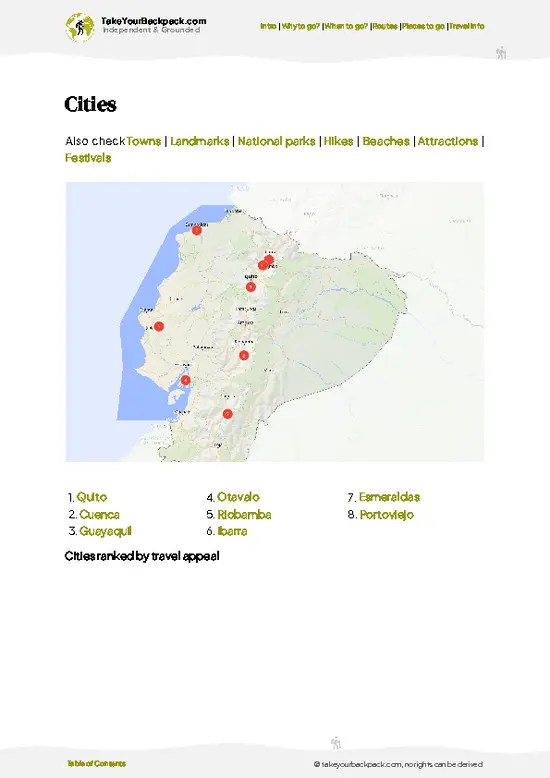
example page 3 from our offline Travel Guide for Ecuador
example page 4 from our offline Travel Guide for Ecuador
example page 5 from our offline Travel Guide for Ecuador
example page 6 from our offline Travel Guide for Ecuador
example page 7 from our offline Travel Guide for Ecuador
Loading the map 🌍
CLICK TO FILTER
cities
towns
landmarks
national parks
hikes
beaches
attractions
festivals
SHOW COUNTRY’S BESTSHOW ALL

✨ Why go?
Ranked #3 national park in Ecuador
Why Cotopaxi should be on your travel list

Cotopaxi National Park suits backpackers who like to arrange things themselves, because the route from the gate to the José Rivas refuge at 4,864 meters needs no guide, only a pair of lungs and a day with clear skies. The climb from the parking lot at about 4,500 meters is short but steep, and the payoff is a close view of the glacier line and the chance to say you reached nearly 5,000 meters under your own steam. Summit attempts to 5,897 meters do need a certified guide, so the mountain also works as a goal if you want to build toward a real mountaineering trip. The second draw is variety in a compact area. Within a few hours you can cross pine plantations, open páramo and black sand, then watch wild horses around Limpiopungo lagoon with the cone reflected behind them. Hostels and haciendas … read more 👉
Cotopaxi National Park suits backpackers who like to arrange things themselves, because the route from the gate to the José Rivas refuge at 4,864 meters needs no guide, only a pair of lungs and a day with clear skies. The climb from the parking lot at about 4,500 meters is short but steep, and the payoff is a close view of the glacier line and the chance to say you reached nearly 5,000 meters under your own steam. Summit attempts to 5,897 meters do need a certified guide, so the mountain also works as a goal if you want to build toward a real mountaineering trip. The second draw is variety in a compact area. Within a few hours you can cross pine plantations, open páramo and black sand, then watch wild horses around Limpiopungo lagoon with the cone reflected behind them. Hostels and haciendas in the surrounding valley give you cheap options to base around, and the town of Latacunga is a natural jumping-off point for onward travel along the Quilotoa Loop.

💡 HighlightsEssential experiences to have while exploring Cotopaxi

  1. Cotopaxi Volcano: One of the highest active volcanoes in the world, a snow-capped cone that dominates the skyline from the road and from Quito on clear mornings. The glacier, crevasses and steaming crater are the reason people come.
  2. José Rivas Refuge: A mountain hut at about 4,864 meters, reached by a steep scree path from the parking lot. Expect a slog in thin air, then a view straight up the glacier edge.
  3. Limpiopungo Lagoon: A flat, shallow lake at roughly 3,800 meters with a gentle loop trail. On still mornings the volcano mirrors in the water, and ducks and Andean gulls work the shoreline.
  4. Wild horses of the páramo: Herds roam the tussock grass near the lagoon and along the road, often with the volcano behind them, which makes it the park's easiest photograph.
  5. Andean condor viewing: Condors
… read more 👉
  1. Cotopaxi Volcano: One of the highest active volcanoes in the world, a snow-capped cone that dominates the skyline from the road and from Quito on clear mornings. The glacier, crevasses and steaming crater are the reason people come.
  2. José Rivas Refuge: A mountain hut at about 4,864 meters, reached by a steep scree path from the parking lot. Expect a slog in thin air, then a view straight up the glacier edge.
  3. Limpiopungo Lagoon: A flat, shallow lake at roughly 3,800 meters with a gentle loop trail. On still mornings the volcano mirrors in the water, and ducks and Andean gulls work the shoreline.
  4. Wild horses of the páramo: Herds roam the tussock grass near the lagoon and along the road, often with the volcano behind them, which makes it the park's easiest photograph.
  5. Andean condor viewing: Condors ride the thermals above the high ridges, and with patience and binoculars you may see one. Early morning gives the best odds.
  6. Páramo flora and Andean fox: The grasslands hold chuquiragua, the orange flower of the high Andes, along with rabbits, deer and the occasional fox at dusk.
  7. Museo de Sitio Mariscal Sucre: A small site museum near the entrance with displays on the geology, ecology and eruptions of the volcano, useful before you climb.
  8. Glacier walk at the snowline: From the refuge, guided groups continue over ice to the glacier edge and learn the first steps of crampon work.
Skip the museum if you only have a day, because the mountain and lagoon give you far more.
Spotted a mistake or missing something? Contact us.

Things to do around Cotopaxi National Park

Ratings based on Tripadvisor reviews. When you book through this link, you support our work at no extra cost to you.

🌤️ When to go?Choosing the right time of year

The driest, clearest window for Cotopaxi National Park runs from June to September, with a second, shorter dry spell in December and January.
  • Dry Season (June to September): Best odds of an open summit view and calm trails. Days reach 10 to 14°C (50 to 57°F) at the park lodge level, and nights at the refuge drop to -5 to 0°C (23 to 32°F). Wind is strong. Weekends fill with Ecuadorian families, and tour prices at Quito agencies firm up.
  • Short Dry Spell (December to January): Often bright mornings with cloud rolling in by noon. Temperatures match the dry season, and holiday weekends are busy.
  • Wet Season (February to May, October to November): Afternoon drizzle, fog and sleet are common, and the cone often hides for days. Trails are muddy, but crowds thin and rooms are easier to find.
  • Daylight: Close
… read more 👉
The driest, clearest window for Cotopaxi National Park runs from June to September, with a second, shorter dry spell in December and January.
  • Dry Season (June to September): Best odds of an open summit view and calm trails. Days reach 10 to 14°C (50 to 57°F) at the park lodge level, and nights at the refuge drop to -5 to 0°C (23 to 32°F). Wind is strong. Weekends fill with Ecuadorian families, and tour prices at Quito agencies firm up.
  • Short Dry Spell (December to January): Often bright mornings with cloud rolling in by noon. Temperatures match the dry season, and holiday weekends are busy.
  • Wet Season (February to May, October to November): Afternoon drizzle, fog and sleet are common, and the cone often hides for days. Trails are muddy, but crowds thin and rooms are easier to find.
  • Daylight: Close to 12 hours all year, so plan to be off the high ground by early afternoon, when clouds build.
Arrive at the gate by 8 a.m. on a weekday, since mornings are clearest and parking is easiest.


source: climatestotravel.comJANJanuary: fair for travelingFEBFebruary: fair for travelingMARMarch: fair for travelingAPRApril: fair for travelingMAYMay: fair for travelingJUNJune: highly recommended for travelingJULJuly: excellent for travelingAUGAugust: excellent for travelingSEPSeptember: highly recommended for travelingOCTOctober: fair for travelingNOVNovember: fair for travelingDECDecember: fair for traveling
ecuador-national-park-cotopaxi-national-park
© Google | Miguel Anchaluisa

✈️ The backpacker research shortcutEcuador Travel Guide

An offline-friendly backpacking guide with optimized travel routes, ranked highlights, transport advice, and the best areas to stay.
example page 0 from our offline Travel Guide for Ecuador
example page 1 from our offline Travel Guide for Ecuador
example page 2 from our offline Travel Guide for Ecuador
example page 3 from our offline Travel Guide for Ecuador
example page 4 from our offline Travel Guide for Ecuador
example page 5 from our offline Travel Guide for Ecuador
example page 6 from our offline Travel Guide for Ecuador
example page 7 from our offline Travel Guide for Ecuador
The digital guide (274 pages) contains:
✅ 87 highlights, ranked by travel appeal
✅ Optimized 5, 10 & 15-day travel routes
✅ Cities, national parks, landmarks, beaches
✅ How to get around
✅ Offline-friendly for travel without Wi-Fi
👉 Click to see all 30+ guide features

📅 Plan smarter in minutes, not weeks
✅ Month by month travel advice
✅ Festivals & national holidays
✅ Budget expectations

🗺️ Go to the right places, skip the overrated ones
✅ Honest pros & cons of destinations
✅ Top hikes, parks & viewpoints
✅ Lesser-known places most travelers miss
✅ Clear “worth it vs skip it” guidance

🛏️ Travel smoothly without rookie mistakes
✅ Best areas to stay
✅ Transport systems explained simply
✅ Common scams & safety advice
✅ SIM cards, money & practical tips

🌍 Understand the country, not just visit it
✅ Culture & traditions
✅ 52 Essential phrases & customs
✅ Festivals worth planning around
✅ Traveler-friendly historical context
✅ Insights that make places more meaningful

📱 Built for real travel conditions
✅ Fully downloadable PDF
✅ Works completely offline
✅ Optimized for phone use
✅ Useful in remote areas & buses
✅ Everything in one place
Stop searching, start planning
Get instant access to your full guide. 30‑day money-back guarantee.
+ Add another guide for just

By proceeding you agree to our terms.
Sent to your inbox immediately after payment • 100% Secure Checkout
Best Backpacking Travel Advisor 2025 tourism awardBest Backpacking
Travel Advisor
2025
What others say about Take Your Backpack Guides:
⭐⭐⭐⭐⭐
Fantastic, amazing amount of information!
⭐⭐⭐⭐⭐
My goodness this is amazing, it's what I've been looking for hats off too you!
⭐⭐⭐⭐⭐
I think this is absolutely BRILLIANT
⭐⭐⭐⭐
Very complete and informative. It's still missing places, but I gotta to commend you
⭐⭐⭐⭐⭐
This is truly amazing, thank you, can't wait to explore it with my kids!
⭐⭐⭐⭐⭐
Awesome resource, thank you!
⭐⭐⭐⭐⭐
This is amazing! Can't wait to explore the ones I haven't seen
⭐⭐⭐⭐
I love this! Well done, great idea.
⭐⭐⭐⭐⭐
Thanks for taking the time to make this gem!
⭐⭐⭐⭐⭐
This might be the best website I've ever seen.
⭐⭐⭐⭐⭐
Congratulations, and thank you so much for your work; it's incredibly valuable.
⭐⭐⭐⭐
In all seriousness I think you did a great job pointing out the important spots
⭐⭐⭐⭐⭐
10/10 very good
⭐⭐⭐⭐⭐
As someone who's only just starting to visit regularly this is awesome, thank you.
⭐⭐⭐⭐
Thank you very much! I'm going to visit my dad, it's going to be very useful!
⭐⭐⭐⭐⭐
This is really cool! We'll be travelling for the first time and this definitely come in handy.
⭐⭐⭐⭐⭐
You are now our minister of culture, congratulations 👨‍💼
⭐⭐⭐⭐⭐
Just wanted to tell you that this is a pearl! Going to follow your recommendations.
⭐⭐⭐⭐⭐
This is so cool. I'll definitely be using the resource for my travels soon.
⭐⭐⭐⭐⭐
This is very impressive! Good work.
⭐⭐⭐⭐⭐
This is an amazing and informative site. Very well done!

🛏️ Where to stay?Where staying makes the most sense

Most backpackers sleep outside Cotopaxi National Park, in Latacunga (about 1 hour from the gate) or in the haciendas and hostels along the Panamericana near Machachi and Lasso.
Inside the park, options are limited. The José Rivas refuge, at 4,864 m (15,958 ft) at the foot of the glacier, has bunk beds for roughly US$40 to 50 with dinner and breakfast, aimed at summit climbers. Near the Limpiopungo lagoon, a basic campground charges around US$5 to 10 per person, and the sites are windy and cold.
Latacunga is the practical base. It has dorm beds from US$10 to 15, private rooms at US$25 to 45, cheap … read more 👉
Most backpackers sleep outside Cotopaxi National Park, in Latacunga (about 1 hour from the gate) or in the haciendas and hostels along the Panamericana near Machachi and Lasso.
Inside the park, options are limited. The José Rivas refuge, at 4,864 m (15,958 ft) at the foot of the glacier, has bunk beds for roughly US$40 to 50 with dinner and breakfast, aimed at summit climbers. Near the Limpiopungo lagoon, a basic campground charges around US$5 to 10 per person, and the sites are windy and cold.
Latacunga is the practical base. It has dorm beds from US$10 to 15, private rooms at US$25 to 45, cheap set lunches in the market, and buses to Quilotoa and Baños. Hostels there can arrange 4x4 transport into the park.
Machachi and the nearby countryside suit people who want a quiet night with a wood stove. Rustic lodges and hacienda rooms run about US$30 to 80, and some include breakfast and horse riding.
Quito works too, but it means a 2 hour trip each way, so a night closer is better.

👛 Costs (as of 19 October 2026)What things cost and how to budget

Expect to spend about US$60 per day at Cotopaxi National Park on a lean backpacker budget, with the biggest swing coming from transport and whether you hire a guide.
CategoryBudget RangeLocal Reality
Entrance FeeUS$0 to 2Entry is free for most visitors, and small fees may apply at some sections or for camping.
Accommodation (High Season)US$10 to 25Dorm beds in Latacunga cost US$10 to 15. The José Rivas refuge costs around US$40 to 50 with meals, so it sits above this range.
CampingUS$5 to 10Basic sites near Limpiopungo, with cold nights and no comforts.
Local TransportUS$20 to 35Buses to Latacunga or Machachi cost US$2 to 4 from Quito. A shared 4x4 or taxi from town to the parking lot runs US$30 to 60 per vehicle, so split it.
Food and SuppliesUS$10 to 18Set lunches in town cost US$3 to 5. Bring
… read more 👉
Expect to spend about US$60 per day at Cotopaxi National Park on a lean backpacker budget, with the biggest swing coming from transport and whether you hire a guide.
CategoryBudget RangeLocal Reality
Entrance FeeUS$0 to 2Entry is free for most visitors, and small fees may apply at some sections or for camping.
Accommodation (High Season)US$10 to 25Dorm beds in Latacunga cost US$10 to 15. The José Rivas refuge costs around US$40 to 50 with meals, so it sits above this range.
CampingUS$5 to 10Basic sites near Limpiopungo, with cold nights and no comforts.
Local TransportUS$20 to 35Buses to Latacunga or Machachi cost US$2 to 4 from Quito. A shared 4x4 or taxi from town to the parking lot runs US$30 to 60 per vehicle, so split it.
Food and SuppliesUS$10 to 18Set lunches in town cost US$3 to 5. Bring snacks and water, as there are few options in the park beyond a small cafe at the refuge.
Guides and GearUS$0 to 150Day hikes need none. A guided glacier climb costs about US$200 to 300 and includes gear.
Total Daily BudgetUS$60Based on a dorm bed, shared transport, local meals and a free entry.


source: ecuador.travel
⚠️ Prices can change and everyone travels differently, so take this as a rough guide. Hope it helps you plan your adventure!

🥾 TrailsPlan your hike in Cotopaxi: routes, terrain, and sights

Cotopaxi National Park offers short, high-altitude walks rather than long treks, and most people finish everything in a single day.
  • Limpiopungo Lagoon Loop: About 2 to 3 km, roughly 45 minutes to 1 hour, easy. Flat ground around a lake at 3,800 meters, with wild horses, ducks and views of the cone.
  • José Rivas Refuge Climb: About 1 km one way from the parking lot, 45 minutes to 1.5 hours up, 30 minutes down, hard because of altitude. Loose volcanic sand and scree on a steep zigzag path.
  • Cotopaxi Summit Route: A two-day mountaineering climb to 5,897 meters, very hard, requiring a certified guide, crampons,
… read more 👉
Cotopaxi National Park offers short, high-altitude walks rather than long treks, and most people finish everything in a single day.
  • Limpiopungo Lagoon Loop: About 2 to 3 km, roughly 45 minutes to 1 hour, easy. Flat ground around a lake at 3,800 meters, with wild horses, ducks and views of the cone.
  • José Rivas Refuge Climb: About 1 km one way from the parking lot, 45 minutes to 1.5 hours up, 30 minutes down, hard because of altitude. Loose volcanic sand and scree on a steep zigzag path.
  • Cotopaxi Summit Route: A two-day mountaineering climb to 5,897 meters, very hard, requiring a certified guide, crampons, and an ice axe. Departures leave around midnight from the refuge.
  • Páramo Walks near the Museum: Short, easy trails through grassland, good for birds, rabbits and possible fox sightings.
Acclimatize in Quito or Latacunga for a couple of days before climbing, and bring layers because wind and sudden cloud are common above 4,000 meters. Public transport is awkward. Buses along the Panamericana drop you at the main road junction, and from there you need a pre-arranged pickup or a long walk to the gate, so many backpackers join a tour or hire a truck from Latacunga or Quito. Weekends and holidays are the busiest, with queues at the parking lot, while weekdays are calmer. Entry is free, and visitors must register at the gate. The park closes access to the refuge when volcanic activity rises, so check status before you go.
⚠️ Hiking info can sometimes be outdated or inaccurate. Before you hit the trail, check the latest conditions with locals. If you do spot anything that's off, I'd love to hear from you, so I can update it for fellow travelers.

🛡️ SafetyScams, Hazards, and Annoyances

Cotopaxi National Park is straightforward for day hikers, but altitude is the real issue. The parking lot sits near 4,500 m (14,800 ft), and the walk up to the refuge is a steep, loose volcanic slope that leaves many first-timers breathless. Spend a night or two in Quito or Latacunga first, walk slowly, drink plenty of water and turn back if a headache turns nauseating.
Weather changes quickly. Sun, wind, hail and fog can all show up within an hour, so carry a windproof shell, warm hat, gloves and sunscreen, as UV is intense. Cloud can hide the track on the lagoon loops, so keep to marked paths.
Glacier travel above the refuge needs a licensed guide, crampons and an ice axe. Do not go alone.
Wildlife is mild. You may see Andean foxes, wild horses and condors. Keep distance, never feed animals … read more 👉
Cotopaxi National Park is straightforward for day hikers, but altitude is the real issue. The parking lot sits near 4,500 m (14,800 ft), and the walk up to the refuge is a steep, loose volcanic slope that leaves many first-timers breathless. Spend a night or two in Quito or Latacunga first, walk slowly, drink plenty of water and turn back if a headache turns nauseating.
Weather changes quickly. Sun, wind, hail and fog can all show up within an hour, so carry a windproof shell, warm hat, gloves and sunscreen, as UV is intense. Cloud can hide the track on the lagoon loops, so keep to marked paths.
Glacier travel above the refuge needs a licensed guide, crampons and an ice axe. Do not go alone.
Wildlife is mild. You may see Andean foxes, wild horses and condors. Keep distance, never feed animals and carry out all trash. Leave nothing visible in parked cars.

FAQFrequently asked questions about Cotopaxi

One full day is enough for Cotopaxi National Park if you want the Limpiopungo lagoon loop and the hike from the parking lot to the José Rivas refuge, which takes about 1 to 1.5 hours up. Add a second day for horse riding, the museum and nearby haciendas, or to acclimatize before a summit attempt. Climbing the glacier takes a midnight start and 6 to 8 hours up, so allow at least 2 to 3 days in the Andes beforehand.
Cotopaxi National Park is doable without a car, but it takes planning. Take a bus from Quito to Latacunga or Machachi (1 to 1.5 hours, US$2 to 4), then hire a 4x4 or taxi to the gate for roughly US$30 to 60 per vehicle. Many backpackers join a Quito day tour for US$50 to 80, which includes transport and a guide. Public transport does not run into the park itself.
Entry to Cotopaxi National Park is generally free, and no advance permit is needed for day hiking. You register at the entrance gate, and the park is open daily during daytime hours. Camping near Limpiopungo may cost about US$5 to 10, and the refuge bunk costs around US$40 to 50. Climbing the glacier requires a certified guide, at roughly US$200 to 300.
⚠️ Things can change over time, so always validate details locally before you go.

Other Ecuadorian national parks near Cotopaxi

Explore more nearby:


💡 Not sure where to go next?
Create a personalized itinerary for Ecuador including Cotopaxi and the places that fit your trip.

Generate my itinerary

👉 Discover all national parks

Or checkout all Ecuador has to offer (think cities, towns, villages, national parks, hikes, beaches, festivals)
Country photo of Ecuador

We 💚 feedbackKey takeaways before you go

Cotopaxi National Park suits first-timers who want a real Andean volcano without committing to a technical climb, and fit hikers who see the refuge push as a warm-up for bigger peaks. I would go on a weekday, start early before the clouds close in, and carry coca tea or water for the thin air.

✈️ When did I visit Ecuador?
Ecuador I visited during my half year trip through South and Central America back in 2003

✍️ Help improve this page!
The information on this page is based on my own backpacking experience in Ecuador, supplemented with up-to-date research and feedback from other travelers. Travel details can change, so if you notice anything outdated or incomplete, feel free to let me know.


🙋‍♂️ Give feedback

👋 Meet the founderWho’s Behind Take Your Backpack?

Johan, backpacker and founder of TakeYourBackpackHi, I’m Johan (Netherlands 🇳🇱), the creator of TakeYourBackpack. Over the past 3 decades, I’ve backpacked through 90+ countries across six continents, gaining extensive experience with independent travel, long-term trips, and overland routes.

This site is built on a combination of firsthand travel experience and carefully curated insights from other backpackers. Many guides are based on places I’ve personally visited, while others bring together tips, observations, and practical advice shared by trusted travelers I’ve met along the way.

The goal is to provide realistic, experience-driven guidance — not generic itineraries — so you can explore destinations with better context, clearer expectations, and more confidence.