×

Equatorial Guinea🇬🇶 | best landmarksTop-Rated 5 landmarks in Equatorial Guinea

Landmarks in Equatorial Guinea are few, spread across two very different parts of the country, and mostly uncrowded. On Bioko island, colonial Spanish architecture and volcanic highlands sit close to Malabo. On the mainland of Río Muni, rainforest and coastal sites need more planning and money. Independent travel is feasible, but permits, distances and costs shape every choice.

By Johan Kruseman 🇳🇱 | Updated October 9, 2026
Explore the best national parks in Equatorial Guinea

Why go?Key Factors That Shape the Experience

Equatorial Guinea is the only Spanish-speaking country in Africa, and its landmarks reflect that mix of Spanish colonial heritage, Bantu cultural traditions and equatorial nature. Bioko sits on a volcanic chain near Cameroon, while Río Muni is a mainland enclave of dense rainforest. Annobón, a remote volcanic island far out in the Gulf of Guinea, is rarely visited.

The country is not set up for casual sightseeing. Tourism infrastructure is thin, signage is limited, and few sites have staffed ticket offices or printed information. Oil wealth has produced modern construction in Malabo and Bata, but costs are high by regional standards, and prices are often set for business travelers. Before choosing the country for landmarks, check the visa and letter-of-invitation rules, expect police checkpoints, … read more 👉
Equatorial Guinea is the only Spanish-speaking country in Africa, and its landmarks reflect that mix of Spanish colonial heritage, Bantu cultural traditions and equatorial nature. Bioko sits on a volcanic chain near Cameroon, while Río Muni is a mainland enclave of dense rainforest. Annobón, a remote volcanic island far out in the Gulf of Guinea, is rarely visited.

The country is not set up for casual sightseeing. Tourism infrastructure is thin, signage is limited, and few sites have staffed ticket offices or printed information. Oil wealth has produced modern construction in Malabo and Bata, but costs are high by regional standards, and prices are often set for business travelers. Before choosing the country for landmarks, check the visa and letter-of-invitation rules, expect police checkpoints, and plan for patchy mobile data. Spanish or French helps far more than English.
Our Approach to Ranking
The list of best unique sites in Equatorial Guinea is created based on history or culture, wow factor, atmosphere, quirks, and memorability. If you feel a unique site is missing in this list, please let us know.

When to go?Seasonal Guide to Visiting

Best months: The best months for landmarks are December to February, when rainfall is lowest across most of the country and roads and trails are most passable. Temperatures stay fairly constant year-round at roughly 22 to 30°C, with high humidity, so rainfall matters more than heat.
Regional differences: On Bioko, the drier stretch runs roughly from December to February, and the wettest months are June to September, when the southern highlands can see very heavy rain and cloud. On the mainland, rain falls in two peaks, around March to May and September to November, with a short drier spell in between. Roads on the mainland can turn to mud in those periods.
Shoulder seasons and crowds: June to August is a workable shoulder period on the mainland. Crowds are never a factor, since visitor numbers … read more 👉
Best months: The best months for landmarks are December to February, when rainfall is lowest across most of the country and roads and trails are most passable. Temperatures stay fairly constant year-round at roughly 22 to 30°C, with high humidity, so rainfall matters more than heat.
Regional differences: On Bioko, the drier stretch runs roughly from December to February, and the wettest months are June to September, when the southern highlands can see very heavy rain and cloud. On the mainland, rain falls in two peaks, around March to May and September to November, with a short drier spell in between. Roads on the mainland can turn to mud in those periods.
Shoulder seasons and crowds: June to August is a workable shoulder period on the mainland. Crowds are never a factor, since visitor numbers are low. Hotel prices follow business demand in Malabo and Bata more than the seasons, so they stay high all year.

unique site hoppingHow to Combine landmarks Into One Trip

Trip length: A trip combining several landmarks in Equatorial Guinea needs 7 to 10 days, because distances are modest but transport is slow and uncertain. Bioko and Río Muni are separate legs joined by a short flight or ferry.
Direction and grouping: Start in Malabo, which is the main arrival point, and cover the island sites first. Allow 1 to 2 days per stop on Bioko, where most places lie within 1 to 3 hours by road from the capital. Then fly to Bata, a trip of around 1 hour, and head inland or along the coast. Mainland road journeys between Bata and other towns typically take 2 to 6 hours, longer in the wet months. Allow 2 to 3 days per mainland stop.
Planning mistakes: Travelers often pack too many stops into a week, ignoring checkpoints, permit delays and unpredictable flight schedules. … read more 👉
Trip length: A trip combining several landmarks in Equatorial Guinea needs 7 to 10 days, because distances are modest but transport is slow and uncertain. Bioko and Río Muni are separate legs joined by a short flight or ferry.
Direction and grouping: Start in Malabo, which is the main arrival point, and cover the island sites first. Allow 1 to 2 days per stop on Bioko, where most places lie within 1 to 3 hours by road from the capital. Then fly to Bata, a trip of around 1 hour, and head inland or along the coast. Mainland road journeys between Bata and other towns typically take 2 to 6 hours, longer in the wet months. Allow 2 to 3 days per mainland stop.
Planning mistakes: Travelers often pack too many stops into a week, ignoring checkpoints, permit delays and unpredictable flight schedules. Leave a buffer day before any international departure. Another mistake is skipping the paperwork for internal travel, so confirm requirements in Malabo before leaving it.

The ListHighly Recommended landmarks of Equatorial Guinea

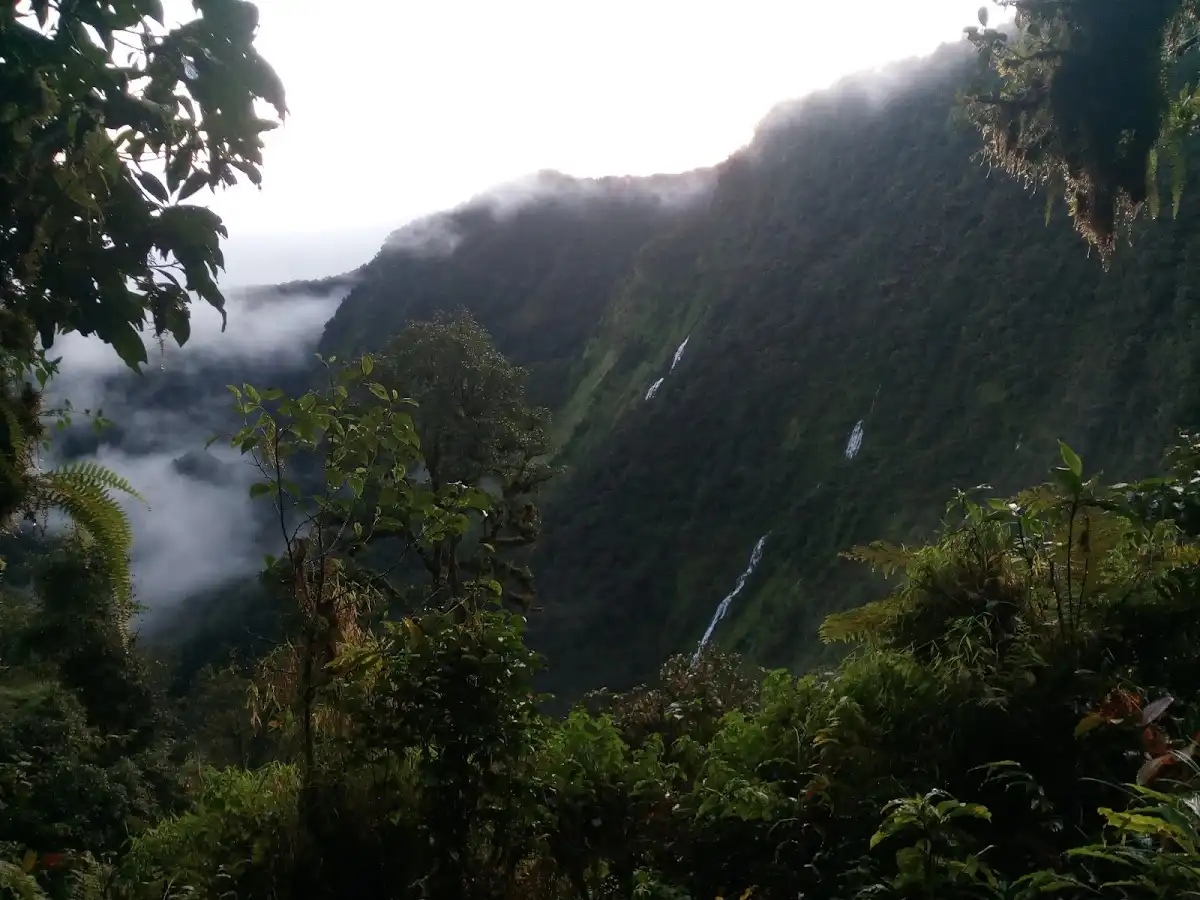
1 Cascadas de Moka

forest trails, volcanic rock pools, misty waterfalls

Follow winding footpaths through dense greenery to reach cool cascades, where volcanic boulders and forest air create a tranquil escape.

equatorial-guinea-unique-site-cascadas-de-moka
© Google |

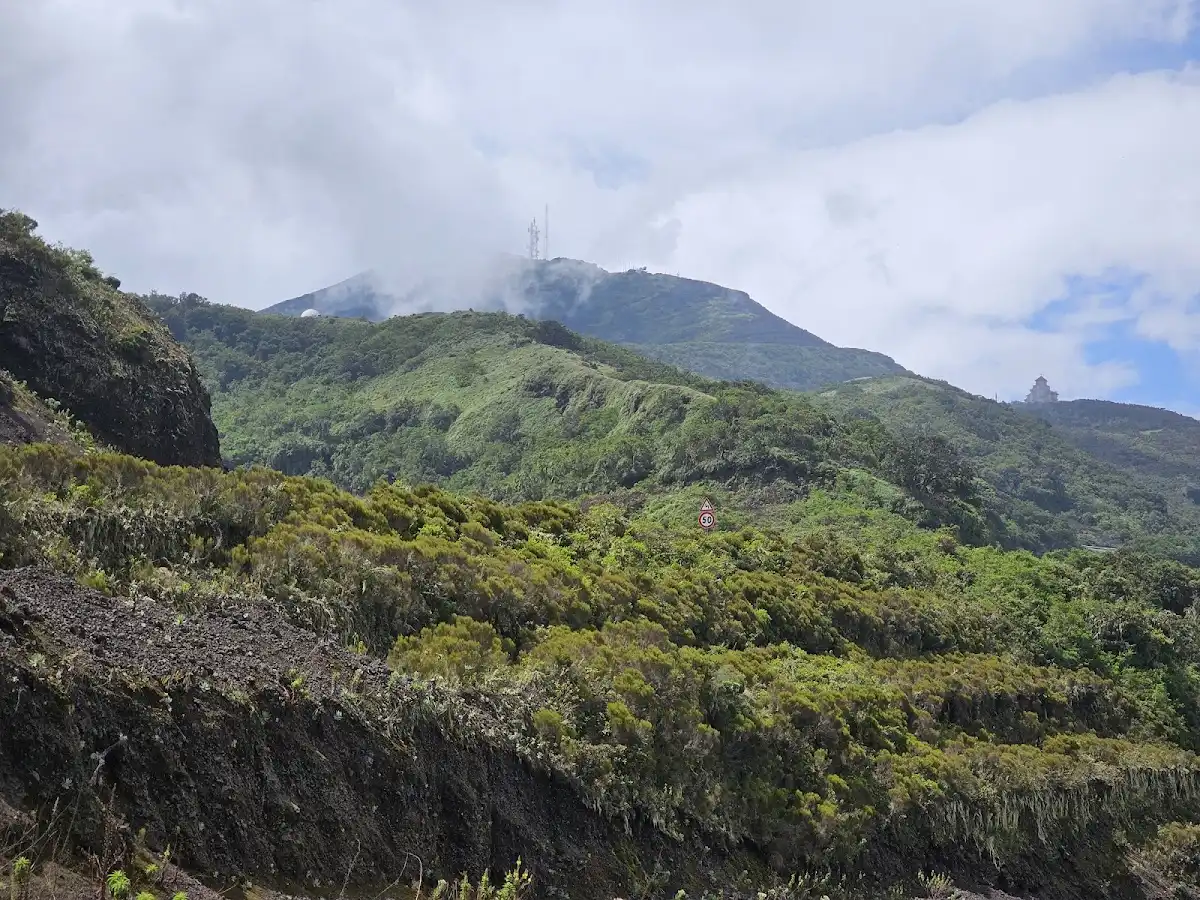
2 Pico de Santa Isabel

volcanic peak, cloud forest, challenging ascent

Trek through shifting vegetation zones to reach the island’s highest point, where changing weather and steep slopes test your endurance.

equatorial-guinea-unique-site-pico-de-santa-isabel
© Google |

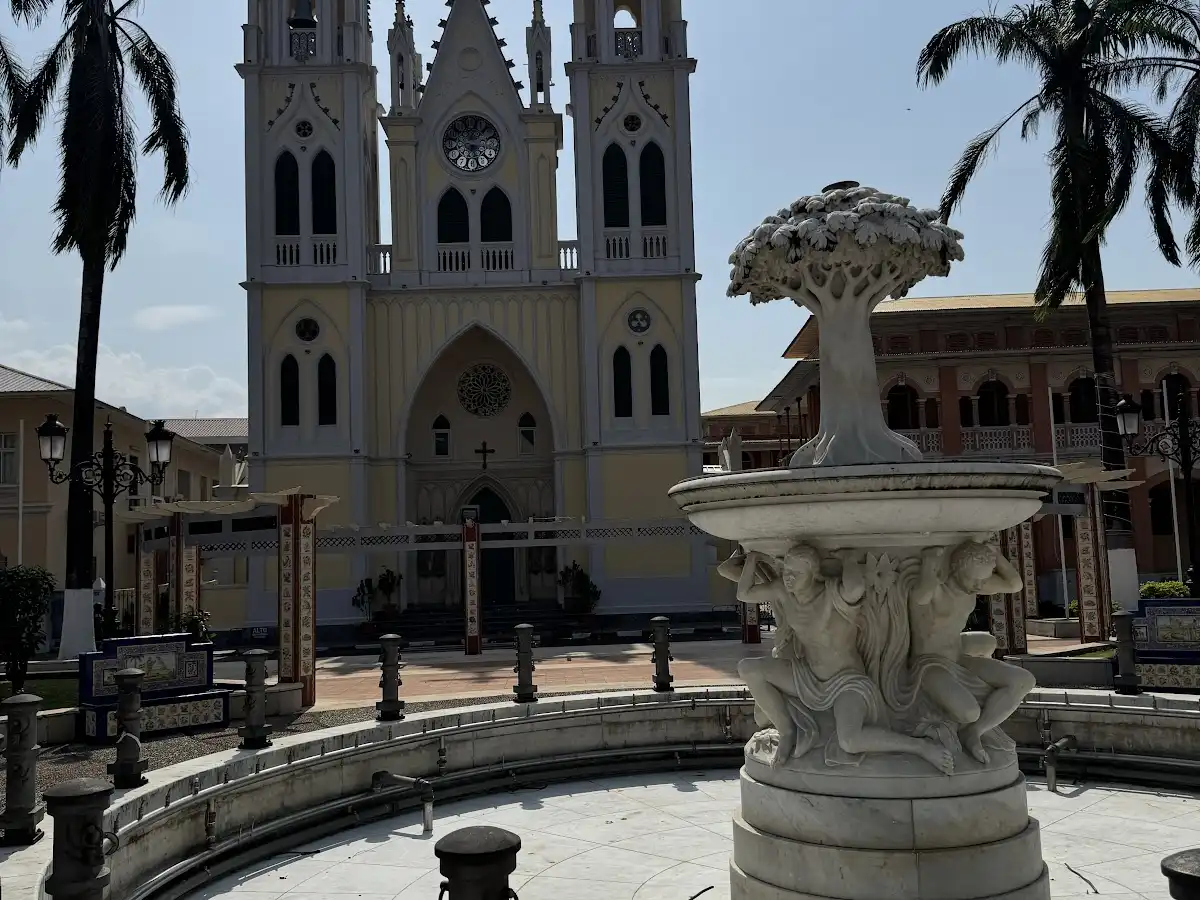
3 Catedral de Santa Isabel

neo-Gothic spires, stained glass, colonial-era architecture

Admire intricate stonework and colored windows in a landmark cathedral that anchors the city’s skyline and reflects colonial influences.

equatorial-guinea-unique-site-catedral-de-santa-isabel
© Google |

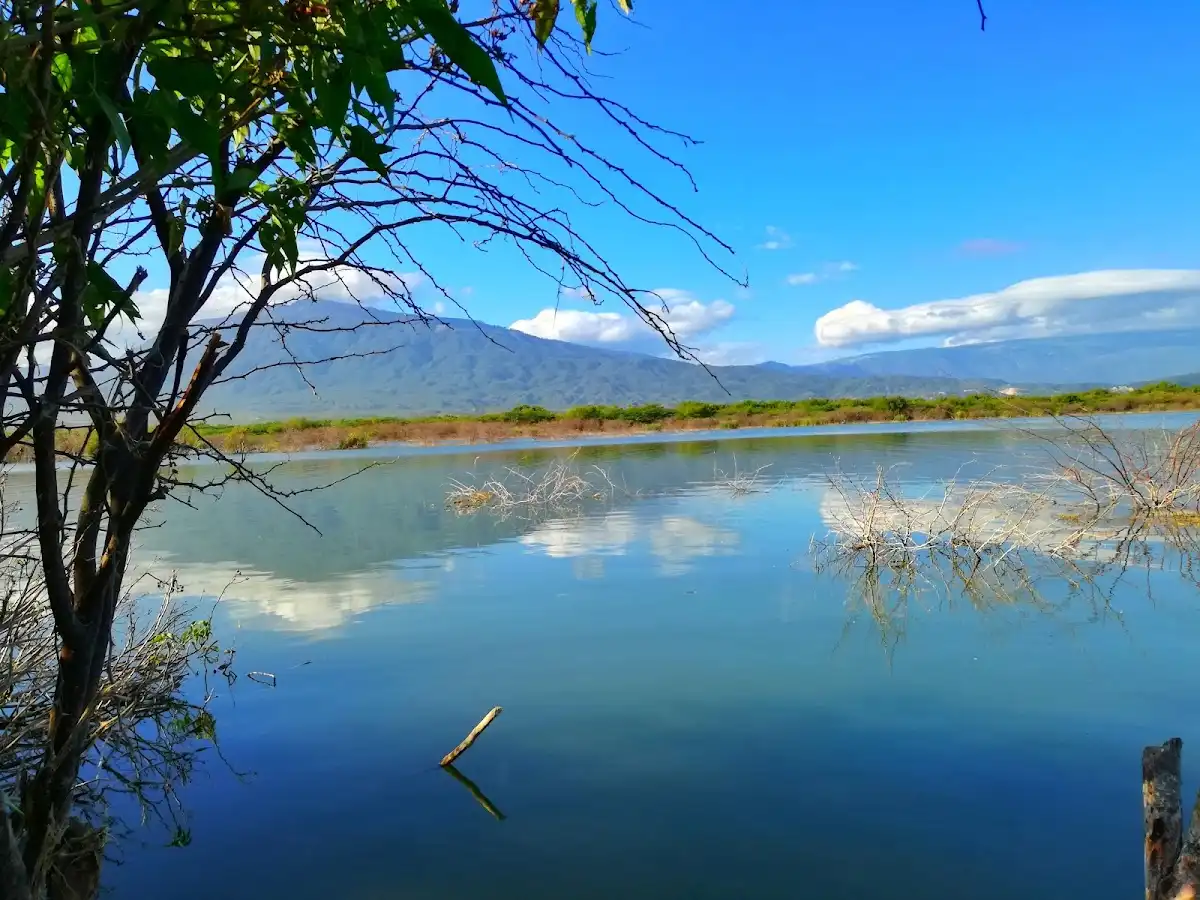
4 Laguna de Rincón

brackish lagoon, mangrove edges, birdlife habitat

Watch for herons and kingfishers along quiet shores, where mangroves and calm waters support a variety of local wildlife.

equatorial-guinea-unique-site-laguna-de-rincon
© Google |

5 Cerro de la Paz

summit views, hilltop cross, panoramic lookout

Climb to a breezy summit for sweeping island vistas, where a solitary cross marks a peaceful spot above the surrounding landscape.

Loading the map 🌍

Expert viewInsights from Locals and Experts

How many to visit: Plan on three to five landmarks in total. Transport is slow, permits and checkpoints eat time, and anything beyond five turns the trip into logistics. Two on Bioko and two or three on the mainland gives a realistic balance.
Prioritizing by travel style: Travelers interested in history and architecture should concentrate on colonial and urban sites in Malabo and Bata, which are easy to reach and need no guide. Those who want nature should choose rainforest and volcanic sites, accepting higher costs, guides and weather risk. Anyone short on time or money should keep to Bioko, where distances are shorter.
Budget: Equatorial Guinea is expensive. Budget US$80 to 150 a day for independent travel, with basic rooms in Malabo and Bata starting around US$50 to 90 a night and meals at … read more 👉
How many to visit: Plan on three to five landmarks in total. Transport is slow, permits and checkpoints eat time, and anything beyond five turns the trip into logistics. Two on Bioko and two or three on the mainland gives a realistic balance.
Prioritizing by travel style: Travelers interested in history and architecture should concentrate on colonial and urban sites in Malabo and Bata, which are easy to reach and need no guide. Those who want nature should choose rainforest and volcanic sites, accepting higher costs, guides and weather risk. Anyone short on time or money should keep to Bioko, where distances are shorter.
Budget: Equatorial Guinea is expensive. Budget US$80 to 150 a day for independent travel, with basic rooms in Malabo and Bata starting around US$50 to 90 a night and meals at local eateries around US$8 to 15. Entry fees at urban sites are low or nil. Nature sites and parks can charge permits and guide fees, typically US$10 to 50 per visit. Private car hire with driver for a day runs roughly US$80 to 150, while shared taxis cost far less but run only on fixed routes. Carry cash in euros or US dollars for exchange into Central African CFA francs, since card acceptance is unreliable outside big hotels.
Safety and culture: Carry your passport and a copy of your visa at all times, as police checkpoints are frequent and officials can be strict. Photography near government buildings, the presidential palace, military sites and airports is prohibited and can lead to detention or confiscated cameras. Ask permission before photographing people. Dress modestly at churches and in villages. Petty theft occurs in Malabo and Bata after dark, so use taxis at night. Arrange a guide for forest trails, where paths are poorly marked and there is little mobile coverage. Malaria is present, so take prophylaxis and carry insect repellent.

✈️ The backpacker research shortcutEquatorial Guinea Travel Guide

An offline-friendly backpacking guide with optimized travel routes, ranked highlights, transport advice, and the best areas to stay.
example page 0 from our offline Travel Guide for Equatorial Guinea
example page 1 from our offline Travel Guide for Equatorial Guinea
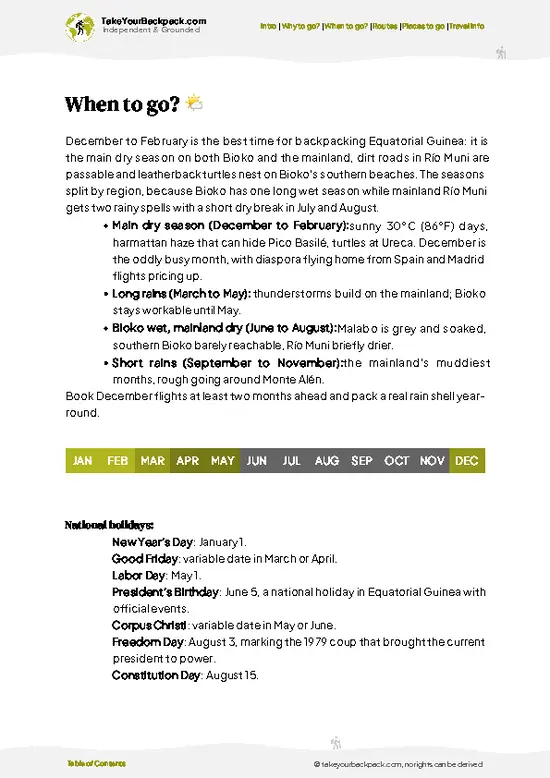
example page 2 from our offline Travel Guide for Equatorial Guinea
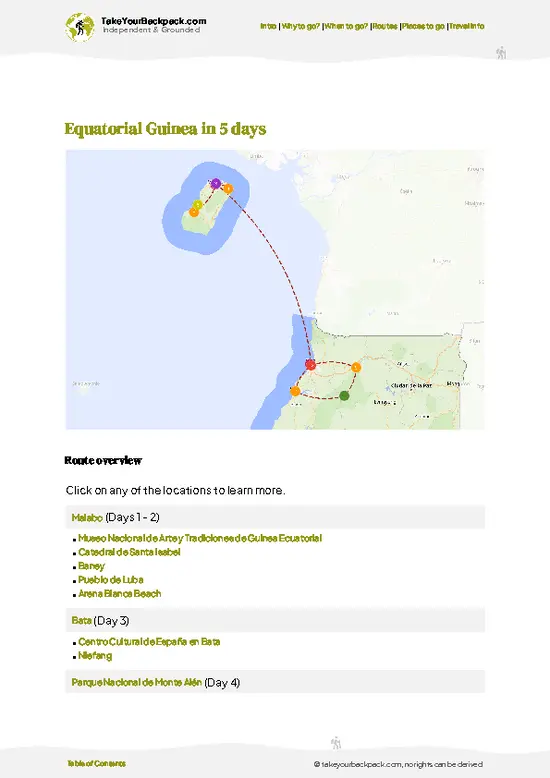
example page 3 from our offline Travel Guide for Equatorial Guinea
example page 4 from our offline Travel Guide for Equatorial Guinea
example page 5 from our offline Travel Guide for Equatorial Guinea
example page 6 from our offline Travel Guide for Equatorial Guinea
example page 7 from our offline Travel Guide for Equatorial Guinea
The digital guide (199 pages) contains:
✅ 48 highlights, ranked by travel appeal
✅ Optimized 2, 3 & 5-day travel routes
✅ Cities, national parks, landmarks, beaches
✅ How to get around
✅ Offline-friendly for travel without Wi-Fi
👉 Click to see all 30+ guide features

📅 Plan smarter in minutes, not weeks
✅ Month by month travel advice
✅ Festivals & national holidays
✅ Budget expectations

🗺️ Go to the right places, skip the overrated ones
✅ Honest pros & cons of destinations
✅ Top hikes, parks & viewpoints
✅ Lesser-known places most travelers miss
✅ Clear “worth it vs skip it” guidance

🛏️ Travel smoothly without rookie mistakes
✅ Best areas to stay
✅ Transport systems explained simply
✅ Common scams & safety advice
✅ SIM cards, money & practical tips

🌍 Understand the country, not just visit it
✅ Culture & traditions
✅ 52 Essential phrases & customs
✅ Festivals worth planning around
✅ Traveler-friendly historical context
✅ Insights that make places more meaningful

📱 Built for real travel conditions
✅ Fully downloadable PDF
✅ Works completely offline
✅ Optimized for phone use
✅ Useful in remote areas & buses
✅ Everything in one place
Save weeks of stressful planning
Get instant access to your full guide. 30‑day money-back guarantee.
+ Add another guide for just

By proceeding you agree to our terms.
Sent to your inbox immediately after payment • 100% Secure Checkout
Best Backpacking Travel Advisor 2025 tourism awardBest Backpacking
Travel Advisor
2025
What others say about Take Your Backpack Guides:
⭐⭐⭐⭐⭐
Fantastic, amazing amount of information!
⭐⭐⭐⭐⭐
My goodness this is amazing, it's what I've been looking for hats off too you!
⭐⭐⭐⭐⭐
I think this is absolutely BRILLIANT
⭐⭐⭐⭐
Very complete and informative. It's still missing places, but I gotta to commend you
⭐⭐⭐⭐⭐
This is truly amazing, thank you, can't wait to explore it with my kids!
⭐⭐⭐⭐⭐
Awesome resource, thank you!
⭐⭐⭐⭐⭐
This is amazing! Can't wait to explore the ones I haven't seen
⭐⭐⭐⭐
I love this! Well done, great idea.
⭐⭐⭐⭐⭐
Thanks for taking the time to make this gem!
⭐⭐⭐⭐⭐
This might be the best website I've ever seen.
⭐⭐⭐⭐⭐
Congratulations, and thank you so much for your work; it's incredibly valuable.
⭐⭐⭐⭐
In all seriousness I think you did a great job pointing out the important spots
⭐⭐⭐⭐⭐
10/10 very good
⭐⭐⭐⭐⭐
As someone who's only just starting to visit regularly this is awesome, thank you.
⭐⭐⭐⭐
Thank you very much! I'm going to visit my dad, it's going to be very useful!
⭐⭐⭐⭐⭐
This is really cool! We'll be travelling for the first time and this definitely come in handy.
⭐⭐⭐⭐⭐
You are now our minister of culture, congratulations 👨‍💼
⭐⭐⭐⭐⭐
Just wanted to tell you that this is a pearl! Going to follow your recommendations.
⭐⭐⭐⭐⭐
This is so cool. I'll definitely be using the resource for my travels soon.
⭐⭐⭐⭐⭐
This is very impressive! Good work.
⭐⭐⭐⭐⭐
This is an amazing and informative site. Very well done!

🛏️ Where to stay?Where to Stay: Equatorial Guinea Edition

Equatorial Guinea has almost no backpacker hostels, so budget accommodation means simple guesthouses and small hotels at roughly XAF 25,000 to 45,000 (US$40 to 75) a night. In Malabo, the old center around the cathedral and Ela Nguema offers the most affordable rooms within walking distance of the seafront and evening bars, though streets get noisy, while Malabo II is calmer and safer-feeling but pricier and car-dependent. In Bata, the center near the seafront promenade puts you close to restaurants, nightlife and shared-taxi stations, with quieter options found in the residential streets further inland.

If you enjoy meeting fellow travelers, consider choosing hostels with high ratings for atmosphere. … read more 👉
Equatorial Guinea has almost no backpacker hostels, so budget accommodation means simple guesthouses and small hotels at roughly XAF 25,000 to 45,000 (US$40 to 75) a night. In Malabo, the old center around the cathedral and Ela Nguema offers the most affordable rooms within walking distance of the seafront and evening bars, though streets get noisy, while Malabo II is calmer and safer-feeling but pricier and car-dependent. In Bata, the center near the seafront promenade puts you close to restaurants, nightlife and shared-taxi stations, with quieter options found in the residential streets further inland.

If you enjoy meeting fellow travelers, consider choosing hostels with high ratings for atmosphere. On the other hand, if you prefer having your own space, a hotel might be a better option.

Equatorial GuineaExplore Beyond This Category

👋 Meet the founderWho’s Behind Take Your Backpack?

Johan, backpacker and founder of TakeYourBackpackHi, I’m Johan (Netherlands 🇳🇱), the creator of TakeYourBackpack. Over the past 3 decades, I’ve backpacked through 90+ countries across six continents, gaining extensive experience with independent travel, long-term trips, and overland routes.

This site is built on a combination of firsthand travel experience and carefully curated insights from other backpackers. Many guides are based on places I’ve personally visited, while others bring together tips, observations, and practical advice shared by trusted travelers I’ve met along the way.

The goal is to provide realistic, experience-driven guidance — not generic itineraries — so you can explore destinations with better context, clearer expectations, and more confidence.