×

Equatorial Guinea🇬🇶 | national parksGran Caldera de Luba Scientific ReserveTurtle nesting beaches, caldera rim, southern Bioko, permit-only access | things to do and best time to go

Explore UrekaExplore Parque Nacional de Monte Alén

Backpacking in Gran Caldera de Luba Scientific Reserve
👍 Recommendednational park ranked #3
By Johan Kruseman 🇳🇱 | Updated October 22, 2026

Gran Caldera de Luba Scientific Reserve has no shops, restaurants or fuel stations inside its boundary, and entry needs a permit. It covers the southern end of Bioko Island in Equatorial Guinea, a long way down the coast road from Malabo. The permit exists because the reserve protects fragile nesting beaches and forest, so arrange it in the capital before you travel, not at the edge of the forest. Carry all your food and water treatment, because nothing can be bought once you leave Luba. The south is among the wettest parts of Africa, so pack everything in dry bags and expect mud on every trail. The scenery is a collapsed volcanic caldera under thick rain forest, with drills and several colobus species overhead. You will see almost no other visitors, which makes it quiet but also means you are on your own if something goes wrong. Black volcanic sand on the southern beaches carries turtle tracks in nesting months.

Discover everything you want to know in the 📖 Equatorial Guinea Travel Guide.


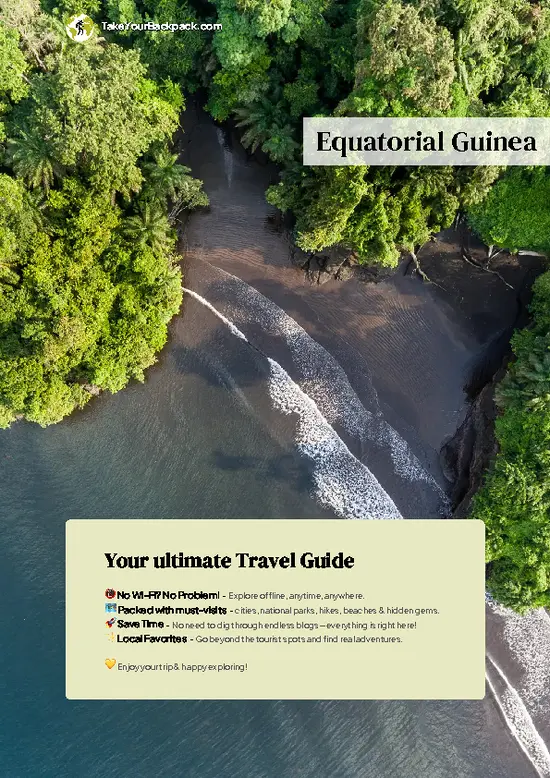
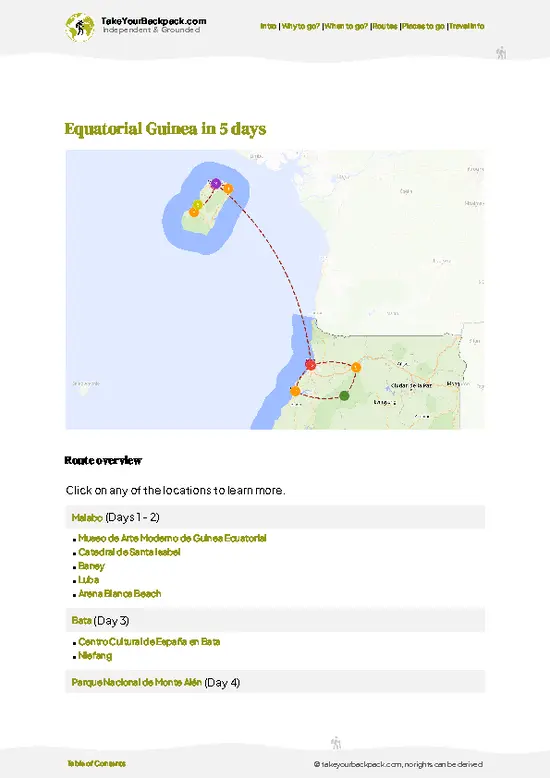
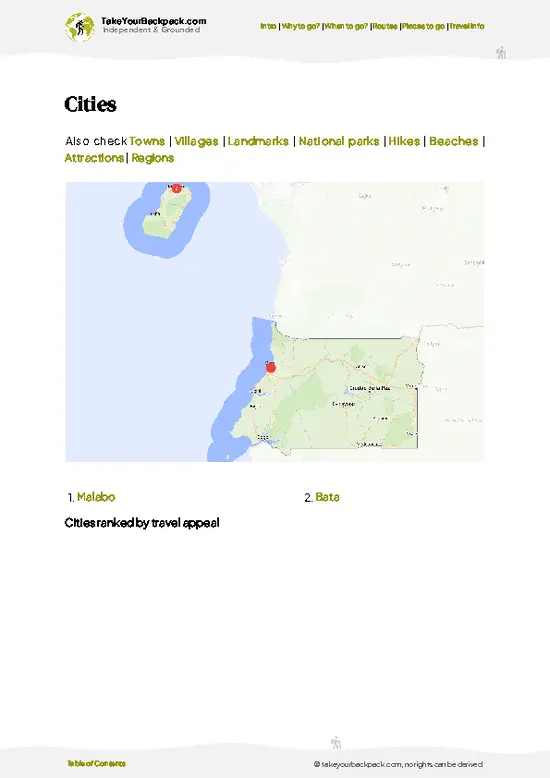
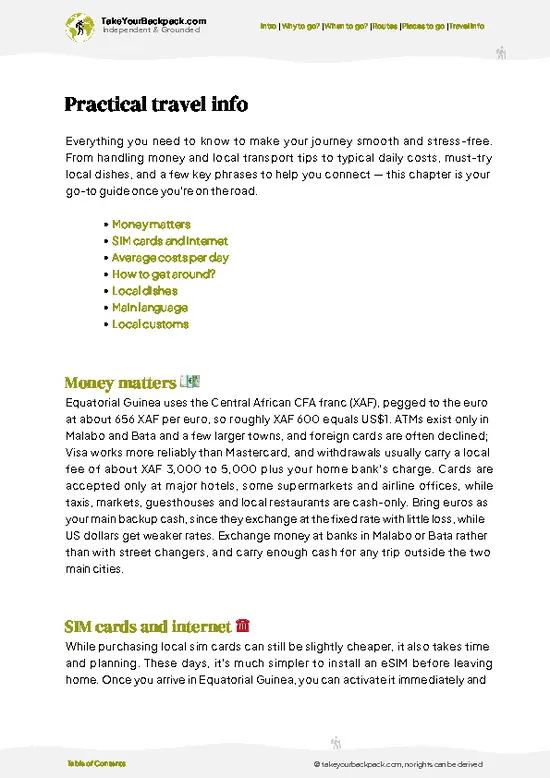
example page 0 from our offline Travel Guide for Equatorial Guinea
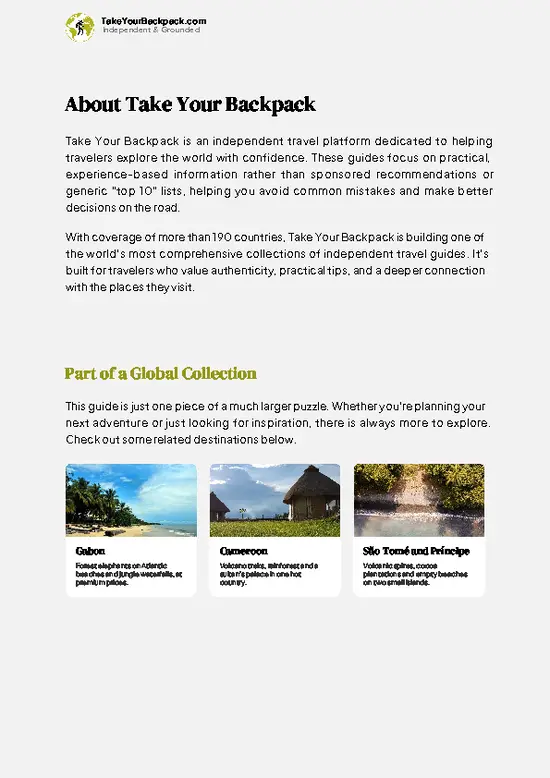
example page 1 from our offline Travel Guide for Equatorial Guinea
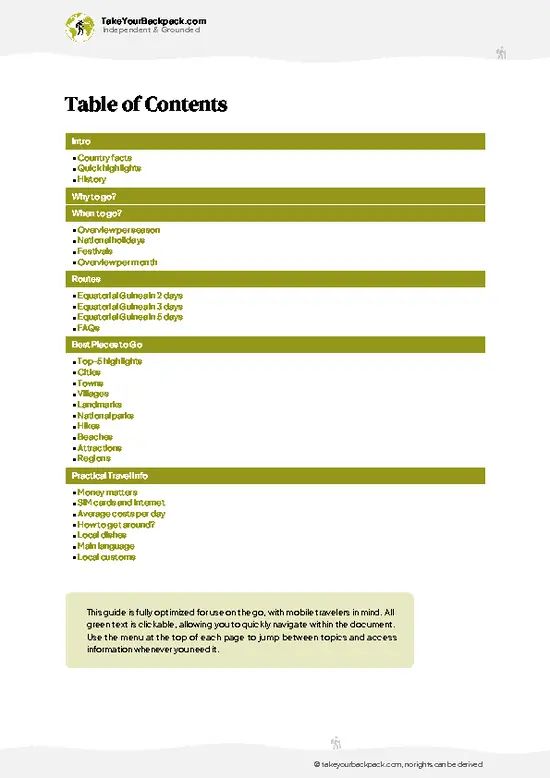
example page 2 from our offline Travel Guide for Equatorial Guinea
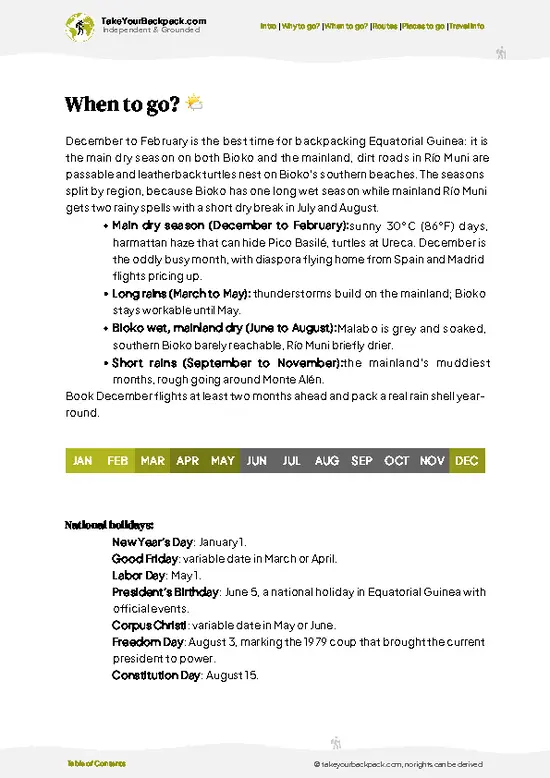
example page 3 from our offline Travel Guide for Equatorial Guinea
example page 4 from our offline Travel Guide for Equatorial Guinea
example page 5 from our offline Travel Guide for Equatorial Guinea
example page 6 from our offline Travel Guide for Equatorial Guinea
example page 7 from our offline Travel Guide for Equatorial Guinea
Loading the map 🌍
CLICK TO FILTER
cities
towns
villages
landmarks
national parks
hikes
beaches
attractions
regions
SHOW COUNTRY’S BESTSHOW ALL

✨ Why go?
Ranked #3 national park in Equatorial Guinea
The unique appeal for travelers

Gran Caldera de Luba Scientific Reserve suits backpackers who want primary forest and empty coastline without a guide company setting the pace. Most of Bioko’s visitors stay near Malabo, so the south is yours to work out. The reserve holds the black-sand nesting beaches around Moraka and Ureca, where green, olive ridley, leatherback and hawksbill turtles come ashore, mostly between November and February. That alone justifies the effort for anyone who has only seen turtles in aquariums.
The second draw is the forest itself. The caldera slopes are home to drills, Preuss’s guenons and the endemic Bioko red colobus, species you will not find on the mainland. Walking here means long, humid days on muddy tracks, which fits people who are comfortable carrying their own supplies and reading their own … read more 👉
Gran Caldera de Luba Scientific Reserve suits backpackers who want primary forest and empty coastline without a guide company setting the pace. Most of Bioko’s visitors stay near Malabo, so the south is yours to work out. The reserve holds the black-sand nesting beaches around Moraka and Ureca, where green, olive ridley, leatherback and hawksbill turtles come ashore, mostly between November and February. That alone justifies the effort for anyone who has only seen turtles in aquariums.
The second draw is the forest itself. The caldera slopes are home to drills, Preuss’s guenons and the endemic Bioko red colobus, species you will not find on the mainland. Walking here means long, humid days on muddy tracks, which fits people who are comfortable carrying their own supplies and reading their own map.
This is not a place for casual self-guided strolling. You need a permit, a plan for food, and patience with logistics. Experienced independent travelers will find that part of the appeal, and first-timers should treat it as a serious step up.

💡 HighlightsKey sights and experiences for travelers

  1. Ureca and Moraka turtle beaches: Wide black volcanic sand beaches where four sea turtle species nest, with the strongest activity between November and February. Researchers patrol at night, and tracks are visible at dawn.
  2. The caldera rim and interior forest: The rugged collapsed crater is covered in dense, mossy rain forest and is often wrapped in cloud. Climbs are steep and wet, with views opening only on clear mornings.
  3. Drill and primate encounters: The reserve shelters drills, Preuss’s guenons and Bioko red colobus. Hearing them is far more likely than seeing them, and quiet walking before mid-morning gives the best odds.
  4. Lago Biao: A crater lake in the southern highlands, ringed by forest and reached only on foot. The silence there is broken by frogs and birds.
  5. Moaba beach: A remote stretch
… read more 👉
  1. Ureca and Moraka turtle beaches: Wide black volcanic sand beaches where four sea turtle species nest, with the strongest activity between November and February. Researchers patrol at night, and tracks are visible at dawn.
  2. The caldera rim and interior forest: The rugged collapsed crater is covered in dense, mossy rain forest and is often wrapped in cloud. Climbs are steep and wet, with views opening only on clear mornings.
  3. Drill and primate encounters: The reserve shelters drills, Preuss’s guenons and Bioko red colobus. Hearing them is far more likely than seeing them, and quiet walking before mid-morning gives the best odds.
  4. Lago Biao: A crater lake in the southern highlands, ringed by forest and reached only on foot. The silence there is broken by frogs and birds.
  5. Moaba beach: A remote stretch of dark sand backed by forest, with surf too rough for casual swimming and few footprints other than animals’.
  6. The Luba to Ureca overland route: A multi-day trek across the southern highlands and coastal forest for self-sufficient hikers, crossing rivers and muddy ridges.
  7. Ureca river mouth: Where forest streams meet the Atlantic, with kingfishers, hornbills and the occasional crocodile track in the sand.
For a first visit, the Ureca and Moraka turtle beaches are the best choice, since they are the main reason the reserve is protected and the easiest highlight to enjoy without serious climbing.
Gran Caldera de Luba Scientific Reserve rewards those who arrive prepared.
Spotted a mistake or missing something? Contact us.

🌤️ When to go?Seasonal considerations and timing

  • Dry Season (December to February): Gran Caldera de Luba Scientific Reserve is easiest to walk now. Rain eases, lowland highs run 27 to 31°C (81 to 88°F), and the caldera rim is cooler at 15 to 22°C (59 to 72°F). Daylight stays near 12 hours all year. Beds in Luba are scarce and prices tick up.
  • Turtle Nesting (October to February): Leatherback and green turtles come ashore on the southern beaches, peaking around November to January. Research camps run night patrols then.
  • Wet Season (March to October): The south of Bioko is among the wettest places in Africa. Expect daily downpours, slick clay tracks, swollen streams and cloud over the crater. Temperatures hold at 23 to 29°C (73 to 84°F). Crowds are nil and guesthouse rates soften slightly.
  • Shoulder Months (March and November): Showers are shorter
… read more 👉
  • Dry Season (December to February): Gran Caldera de Luba Scientific Reserve is easiest to walk now. Rain eases, lowland highs run 27 to 31°C (81 to 88°F), and the caldera rim is cooler at 15 to 22°C (59 to 72°F). Daylight stays near 12 hours all year. Beds in Luba are scarce and prices tick up.
  • Turtle Nesting (October to February): Leatherback and green turtles come ashore on the southern beaches, peaking around November to January. Research camps run night patrols then.
  • Wet Season (March to October): The south of Bioko is among the wettest places in Africa. Expect daily downpours, slick clay tracks, swollen streams and cloud over the crater. Temperatures hold at 23 to 29°C (73 to 84°F). Crowds are nil and guesthouse rates soften slightly.
  • Shoulder Months (March and November): Showers are shorter and trails drain faster, a workable compromise.
Book a driver and guide at least a week ahead for December to February, when 4x4 hire is tightest.


source: climatestotravel.comJANJanuary: below average for travelingFEBFebruary: below average for travelingMARMarch: below average for travelingAPRApril: below average for travelingMAYMay: fair for travelingJUNJune: excellent for travelingJULJuly: excellent for travelingAUGAugust: highly recommended for travelingSEPSeptember: highly recommended for travelingOCTOctober: below average for travelingNOVNovember: below average for travelingDECDecember: below average for traveling
equatorial-guinea-national-park-gran-caldera-de-luba-scientific-reserve v1
© Google |

✈️ The backpacker research shortcutEquatorial Guinea Travel Guide

An offline-friendly backpacking guide with optimized travel routes, ranked highlights, transport advice, and the best areas to stay.
example page 0 from our offline Travel Guide for Equatorial Guinea
example page 1 from our offline Travel Guide for Equatorial Guinea
example page 2 from our offline Travel Guide for Equatorial Guinea
example page 3 from our offline Travel Guide for Equatorial Guinea
example page 4 from our offline Travel Guide for Equatorial Guinea
example page 5 from our offline Travel Guide for Equatorial Guinea
example page 6 from our offline Travel Guide for Equatorial Guinea
example page 7 from our offline Travel Guide for Equatorial Guinea
The digital guide (174 pages) contains:
✅ 36 highlights, ranked by travel appeal
✅ Optimized 2, 3 & 5-day travel routes
✅ Cities, national parks, landmarks, beaches
✅ How to get around
✅ Offline-friendly for travel without Wi-Fi
👉 Click to see all 30+ guide features

📅 Plan smarter in minutes, not weeks
✅ Month by month travel advice
✅ Festivals & national holidays
✅ Budget expectations

🗺️ Go to the right places, skip the overrated ones
✅ Honest pros & cons of destinations
✅ Top hikes, parks & viewpoints
✅ Lesser-known places most travelers miss
✅ Clear “worth it vs skip it” guidance

🛏️ Travel smoothly without rookie mistakes
✅ Best areas to stay
✅ Transport systems explained simply
✅ Common scams & safety advice
✅ SIM cards, money & practical tips

🌍 Understand the country, not just visit it
✅ Culture & traditions
✅ 52 Essential phrases & customs
✅ Festivals worth planning around
✅ Traveler-friendly historical context
✅ Insights that make places more meaningful

📱 Built for real travel conditions
✅ Fully downloadable PDF
✅ Works completely offline
✅ Optimized for phone use
✅ Useful in remote areas & buses
✅ Everything in one place
Stop searching, start planning
Get instant access to your full guide. 30‑day money-back guarantee.
+ Add another guide for just

By proceeding you agree to our terms.
Sent to your inbox immediately after payment • 100% Secure Checkout
Best Backpacking Travel Advisor 2025 tourism awardBest Backpacking
Travel Advisor
2025
What others say about Take Your Backpack Guides:
⭐⭐⭐⭐⭐
Fantastic, amazing amount of information!
⭐⭐⭐⭐⭐
My goodness this is amazing, it's what I've been looking for hats off too you!
⭐⭐⭐⭐⭐
I think this is absolutely BRILLIANT
⭐⭐⭐⭐
Very complete and informative. It's still missing places, but I gotta to commend you
⭐⭐⭐⭐⭐
This is truly amazing, thank you, can't wait to explore it with my kids!
⭐⭐⭐⭐⭐
Awesome resource, thank you!
⭐⭐⭐⭐⭐
This is amazing! Can't wait to explore the ones I haven't seen
⭐⭐⭐⭐
I love this! Well done, great idea.
⭐⭐⭐⭐⭐
Thanks for taking the time to make this gem!
⭐⭐⭐⭐⭐
This might be the best website I've ever seen.
⭐⭐⭐⭐⭐
Congratulations, and thank you so much for your work; it's incredibly valuable.
⭐⭐⭐⭐
In all seriousness I think you did a great job pointing out the important spots
⭐⭐⭐⭐⭐
10/10 very good
⭐⭐⭐⭐⭐
As someone who's only just starting to visit regularly this is awesome, thank you.
⭐⭐⭐⭐
Thank you very much! I'm going to visit my dad, it's going to be very useful!
⭐⭐⭐⭐⭐
This is really cool! We'll be travelling for the first time and this definitely come in handy.
⭐⭐⭐⭐⭐
You are now our minister of culture, congratulations 👨‍💼
⭐⭐⭐⭐⭐
Just wanted to tell you that this is a pearl! Going to follow your recommendations.
⭐⭐⭐⭐⭐
This is so cool. I'll definitely be using the resource for my travels soon.
⭐⭐⭐⭐⭐
This is very impressive! Good work.
⭐⭐⭐⭐⭐
This is an amazing and informative site. Very well done!

🛏️ Where to stay?Choosing the right base

The only practical base is Luba, the small port town on the southwest coast of Bioko, with a few basic guesthouses and hotels charging roughly €25 to 45 a night. Expect private rooms with fans or air conditioning, bucket showers and patchy electricity; book ahead through your guide, since walk-in availability is unreliable. Food comes from local eateries and the market, so bring cash in euros to exchange locally, as cards are rarely accepted.

Inside the reserve there are no commercial lodges. Simple research camps on the southern beaches, run by conservation teams, sometimes host visitors during … read more 👉
The only practical base is Luba, the small port town on the southwest coast of Bioko, with a few basic guesthouses and hotels charging roughly €25 to 45 a night. Expect private rooms with fans or air conditioning, bucket showers and patchy electricity; book ahead through your guide, since walk-in availability is unreliable. Food comes from local eateries and the market, so bring cash in euros to exchange locally, as cards are rarely accepted.

Inside the reserve there are no commercial lodges. Simple research camps on the southern beaches, run by conservation teams, sometimes host visitors during the turtle nesting months. Camping there costs roughly €5 to 15 and needs prior arrangement and a permit. Bring your own tent, filter and food.

Most travelers sleep in Malabo first, where hostels and mid-range hotels run €30 to 80 a night, and make the road trip south. The drive takes about three to four hours depending on the state of the track, so an early start leaves time to settle in Luba. Staying two nights in Luba lets you reach the crater rim and a beach without rushing.

👛 Costs (as of 22 October 2026)Typical daily expenses

A realistic daily budget for Gran Caldera de Luba Scientific Reserve is about €95, with most of that going to the guide, a bed in Luba and the long drive from Malabo. Prices are paid in Central African francs but are given here in euros.
CategoryBudget RangeLocal Reality
Entrance and permit€10 to 20Arranged through the conservation authorities or your guide; carry cash and a passport copy.
Accommodation (high season)€25 to 45Basic guesthouse in Luba; camping at research camps costs €5 to 15 with prior approval.
Guide€15 to 30Essential for crater and beach routes, as trails are unmarked.
Local transport€8 to 20Shared taxi from Malabo to Luba is around €8 to 15; a private 4x4 with driver runs €100 to 150 per day, split among passengers.
Food and supplies€8 to 15Simple meals of grilled fish, rice and
… read more 👉
A realistic daily budget for Gran Caldera de Luba Scientific Reserve is about €95, with most of that going to the guide, a bed in Luba and the long drive from Malabo. Prices are paid in Central African francs but are given here in euros.
CategoryBudget RangeLocal Reality
Entrance and permit€10 to 20Arranged through the conservation authorities or your guide; carry cash and a passport copy.
Accommodation (high season)€25 to 45Basic guesthouse in Luba; camping at research camps costs €5 to 15 with prior approval.
Guide€15 to 30Essential for crater and beach routes, as trails are unmarked.
Local transport€8 to 20Shared taxi from Malabo to Luba is around €8 to 15; a private 4x4 with driver runs €100 to 150 per day, split among passengers.
Food and supplies€8 to 15Simple meals of grilled fish, rice and plantain in Luba; stock up on snacks and water filters in Malabo.
Total Daily Budget€95Roughly €65 to 130 depending on how you travel and sleep.
⚠️ Prices can change and everyone travels differently, so take this as a rough guide. Hope it helps you plan your adventure!

🥾 TrailsTrail guide for Gran Caldera de Luba Scientific Reserve national park

Gran Caldera de Luba Scientific Reserve has no signed trail network of the kind found in European or American parks, so walks are shaped by forest tracks, river crossings and the long beaches along the south coast. Terrain is steep and slippery, with heavy rain, roots and fast-rising streams. Plan for slow progress.
  • Coastal beach walks: Flat, open and the easiest option, linking Moraka, Moaba and Ureca along black sand. A day is enough for a section. Expect soft sand, tidal river mouths and dazzling sun between showers.
  • Luba to Ureca overland route: A demanding multi-day trek through lowland forest
… read more 👉
Gran Caldera de Luba Scientific Reserve has no signed trail network of the kind found in European or American parks, so walks are shaped by forest tracks, river crossings and the long beaches along the south coast. Terrain is steep and slippery, with heavy rain, roots and fast-rising streams. Plan for slow progress.
  • Coastal beach walks: Flat, open and the easiest option, linking Moraka, Moaba and Ureca along black sand. A day is enough for a section. Expect soft sand, tidal river mouths and dazzling sun between showers.
  • Luba to Ureca overland route: A demanding multi-day trek through lowland forest and over the caldera’s southern flanks. It involves camping or staying at research sites, river fords and mud. Difficulty is high, and you should carry all your food.
  • Forest day walks: Short loops from a base camp into primary forest, where you can hear drills and colobus. They are moderate in effort but wet underfoot, with leeches and biting flies common.
  • Lago Biao approach: A strenuous climb to a crater lake via narrow forest paths. Route-finding is difficult in cloud, and a local guide is strongly advisable.
Practical matters: public transport to the far south is minimal, so most visitors arrange a vehicle from Malabo or ride shared taxis only as far as Luba, then continue on foot or by arranged transport. Permits are required and should be arranged in advance with the relevant authorities, and any fee is paid in the local currency. Crowds are practically nonexistent, which is a pleasure, though it means no one else is around for help. Bring water purification, a headlamp for turtle watching, spare dry clothes and a basic first aid kit.
⚠️ Hiking info can sometimes be outdated or inaccurate. Before you hit the trail, check the latest conditions with locals. If you do spot anything that's off, I'd love to hear from you, so I can update it for fellow travelers.

🛡️ SafetyScams, Hazards, and Annoyances

Gran Caldera de Luba Scientific Reserve is remote rather than dangerous, and the main risks are weather, footing and isolation. Rain can arrive within minutes, turning clay tracks into slides and raising stream crossings to thigh height, so start early, wear boots with real tread and carry a dry bag for your phone and documents. Cloud over the caldera makes navigation hard; hire a local guide, since trails are poorly marked and phone signal is thin.

Malaria is present, so take prophylaxis and cover up at dusk. Drink only filtered or treated water. Primates such as drills and colobus are shy after years of hunting, and you will mostly hear them. Give nesting turtles space on the beaches, keep lights low and never touch eggs or hatchlings. Do not buy bushmeat. Carry your passport copy for checkpoints … read more 👉
Gran Caldera de Luba Scientific Reserve is remote rather than dangerous, and the main risks are weather, footing and isolation. Rain can arrive within minutes, turning clay tracks into slides and raising stream crossings to thigh height, so start early, wear boots with real tread and carry a dry bag for your phone and documents. Cloud over the caldera makes navigation hard; hire a local guide, since trails are poorly marked and phone signal is thin.

Malaria is present, so take prophylaxis and cover up at dusk. Drink only filtered or treated water. Primates such as drills and colobus are shy after years of hunting, and you will mostly hear them. Give nesting turtles space on the beaches, keep lights low and never touch eggs or hatchlings. Do not buy bushmeat. Carry your passport copy for checkpoints on the road, tell your guesthouse your route, and bring a first-aid kit, since the nearest clinic is in Luba.

FAQTraveler FAQ

Two to three days is enough for Gran Caldera de Luba Scientific Reserve if you base yourself in Luba. One day covers the crater rim hike with a guide, and a second suits a southern beach visit, while a third adds a turtle night patrol between October and February. The road from Malabo takes about three to four hours each way, so add a travel day on either end.
Reaching Gran Caldera de Luba Scientific Reserve without your own car is possible but slow. Shared taxis and minibuses run from Malabo to Luba for roughly €8 to 15 and take about three to four hours. From Luba you will need a hired 4x4 or a guide with a vehicle, around €100 to 150 a day, because the tracks into the reserve are rough and there is no public transport.
Yes, Gran Caldera de Luba Scientific Reserve requires a permit, usually arranged through the national conservation authorities or your guide, at roughly €10 to 20 per person. Bring your passport and a few copies, since checkpoints on the road from Malabo are common. Camping at research stations needs separate approval, so request it at least a week before arrival.
⚠️ Things can change over time, so always validate details locally before you go.

Other Equatoguinean national parks near Gran Caldera de Luba Scientific Reserve

Explore more nearby:


💡 Not sure where to go next?
Create a personalized itinerary for Equatorial Guinea including Gran Caldera de Luba Scientific Reserve and the places that fit your trip.

Generate my itinerary

👉 Discover all national parks

Or checkout all Equatorial Guinea has to offer (think cities, towns, villages, national parks, hikes, beaches, festivals)
Country photo of Equatorial Guinea

We 💚 feedbackFinal thoughts on exploring Gran Caldera de Luba Scientific Reserve

Gran Caldera de Luba Scientific Reserve works best as a stay of three to four nights, long enough to cover a beach and a forest walk without feeling rushed by the rain. A single day trip leaves you tired and wet with little to show. I would time the stay for the turtle season and bring far more food than seems sensible.

✍️ Help improve this page!
The information on this page is based on in-depth research, insights shared by experienced travelers, and feedback from the local travel community in Equatorial Guinea. While every effort is made to keep the information accurate and current, conditions can change — so if you spot anything incorrect or outdated, please get in touch.


🙋‍♂️ Give feedback

👋 Meet the founderWho’s Behind Take Your Backpack?

Johan, backpacker and founder of TakeYourBackpackHi, I’m Johan (Netherlands 🇳🇱), the creator of TakeYourBackpack. Over the past 3 decades, I’ve backpacked through 90+ countries across six continents, gaining extensive experience with independent travel, long-term trips, and overland routes.

This site is built on a combination of firsthand travel experience and carefully curated insights from other backpackers. Many guides are based on places I’ve personally visited, while others bring together tips, observations, and practical advice shared by trusted travelers I’ve met along the way.

The goal is to provide realistic, experience-driven guidance — not generic itineraries — so you can explore destinations with better context, clearer expectations, and more confidence.