×

Eritrea🇪🇷 | regionsBarkaDry river beds, Kunama markets, railway relic, sorghum plains | things to do and best time to go

Explore DebubExplore Gash-Barka

Backpacking in Barka
👍 Recommendedregion ranked #3
By Johan Kruseman 🇳🇱 | Updated October 22, 2026

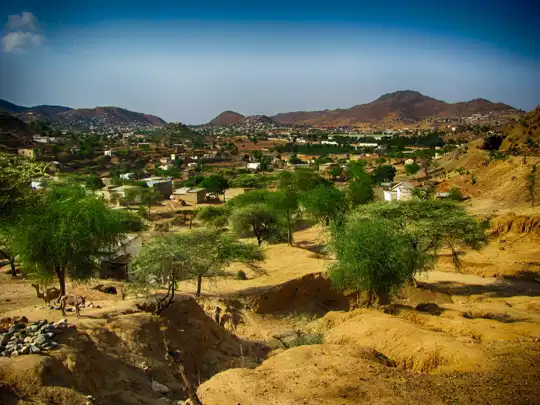
Barka is best known for its heat and its river, a seasonal watercourse that runs through the lowlands of western Eritrea and gives the Gash-Barka region its name. The towns of Agordat, Barentu and Tessenei sit on flat, dusty plains that feel nothing like the cool highlands around Asmara. Beauty here is subtle: acacia, doum palms, sorghum fields and wide sandy riverbeds. Variety comes from people, mainly Kunama, Tigre and Beni-Amer communities, rather than from famous sights. It is not touristy at all, but internal travel permits and long bus days are the price of that authenticity. If your time is short, spend it in Barentu and Agordat rather than chasing every border town, because the extra hours in a hot, slow bus buy little. Come in the cooler months and carry water. In Agordat, the old railway station still stands as a reminder of the line that once ran here.

Discover everything you want to know in the 📖 Eritrea Travel Guide.


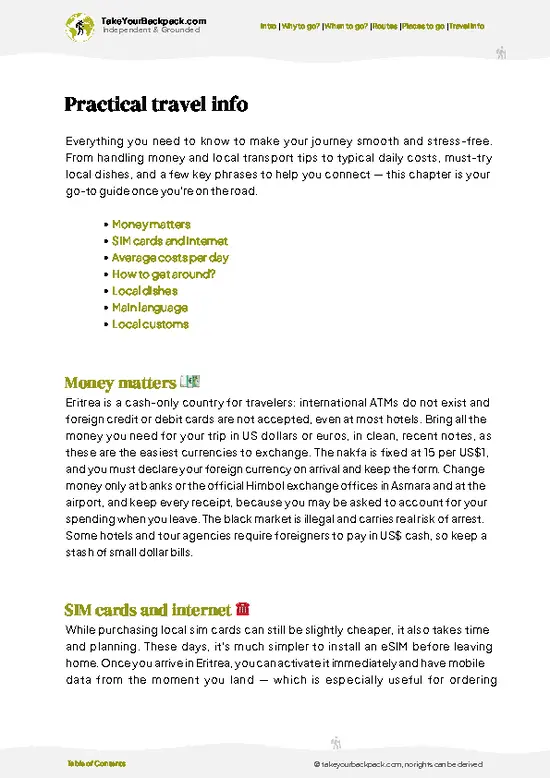
example page 0 from our offline Travel Guide for Eritrea
example page 1 from our offline Travel Guide for Eritrea
example page 2 from our offline Travel Guide for Eritrea
example page 3 from our offline Travel Guide for Eritrea
example page 4 from our offline Travel Guide for Eritrea
example page 5 from our offline Travel Guide for Eritrea
example page 6 from our offline Travel Guide for Eritrea
example page 7 from our offline Travel Guide for Eritrea
Loading the map 🌍
CLICK TO FILTER
cities
towns
villages
landmarks
national parks
hikes
beaches
attractions
festivals
regions
SHOW COUNTRY’S BESTSHOW ALL

✨ Why go?
Ranked #3 region in Eritrea
What sets this place apart

Barka rewards backpackers who want the Eritrea that sits far from the Red Sea coast and the Italian-era boulevards. The first reason is the people. Kunama villages around Barentu have their own language, matrilineal customs and farming traditions, and you meet them at markets rather than at staged shows. The second is the landscape of river and plain. The Barka and Gash riverbeds change character with the season, dry sand in winter and fast brown water after the summer rains, so the same stop looks different from one visit to the next. The third is the pace. Towns here are spread along a single main road axis, so you can work westward without doubling back, sleeping in one place for a night or two and watching daily life unfold at the central market and teahouse. Barka also gives you a counterpoint … read more 👉
Barka rewards backpackers who want the Eritrea that sits far from the Red Sea coast and the Italian-era boulevards. The first reason is the people. Kunama villages around Barentu have their own language, matrilineal customs and farming traditions, and you meet them at markets rather than at staged shows. The second is the landscape of river and plain. The Barka and Gash riverbeds change character with the season, dry sand in winter and fast brown water after the summer rains, so the same stop looks different from one visit to the next. The third is the pace. Towns here are spread along a single main road axis, so you can work westward without doubling back, sleeping in one place for a night or two and watching daily life unfold at the central market and teahouse. Barka also gives you a counterpoint to the highlands. After days of cool mountain air, the lowland heat, camel caravans and Agordat’s railway heritage show how varied this small country is, and a few nights here fill in the picture.

💡 HighlightsTop highlights of Barka

  1. Agordat: The main town on the Barka River, with a colonial-era railway station and a busy market where Beni-Amer and Tigre herders trade. It is also the site of a famous 1893 battle between Italian and Mahdist forces.
  2. Barentu: The regional capital and the best base for Kunama culture. The market is the place to see traditional dress, handmade baskets and grain sold from sacks.
  3. Tessenei: A border town on the Gash River near Sudan, with a lively trading feel, fruit orchards on the irrigated riverbanks and mixed communities.
  4. Barka River bed: A wide, sandy channel near Agordat that is dry for much of the year. Walk its banks early and you will see herders digging shallow wells.
  5. Gash River: Seasonal and silt-laden, this river waters the farmland around Tessenei. Banana and mango groves line parts of
… read more 👉
  1. Agordat: The main town on the Barka River, with a colonial-era railway station and a busy market where Beni-Amer and Tigre herders trade. It is also the site of a famous 1893 battle between Italian and Mahdist forces.
  2. Barentu: The regional capital and the best base for Kunama culture. The market is the place to see traditional dress, handmade baskets and grain sold from sacks.
  3. Tessenei: A border town on the Gash River near Sudan, with a lively trading feel, fruit orchards on the irrigated riverbanks and mixed communities.
  4. Barka River bed: A wide, sandy channel near Agordat that is dry for much of the year. Walk its banks early and you will see herders digging shallow wells.
  5. Gash River: Seasonal and silt-laden, this river waters the farmland around Tessenei. Banana and mango groves line parts of it.
  6. Kunama villages near Barentu: Small settlements of round-roofed houses and sorghum stores. A local guide and the proper permits are needed, and visits go best when arranged through someone from the community.
  7. Haykota: A small lowland town off the main road with a quiet market, less visited than the bigger towns and good for tea and conversation.
  8. Sebderat: A lowland settlement on the road toward the border, known for its crossroads market and for traders carrying goods in both directions.
  9. Kerkebet: A remote lowland town that rarely sees outsiders. Its main interest is the rural life around it, especially the livestock traffic.
  10. Gash-Barka plains at dawn: Not a single site but a daily experience. Doum palms and acacias stand out against empty fields, and the heat has not yet set in.
Barka costs the least at its markets and riverbeds, since walking the Barka River bed or the Gash banks is free.
Spotted a mistake or missing something? Contact us.

Things to do near Barka

Ratings based on Tripadvisor reviews. When you book through this link, you support our work at no extra cost to you.

⌛️ 5 daysA smart one-week plan

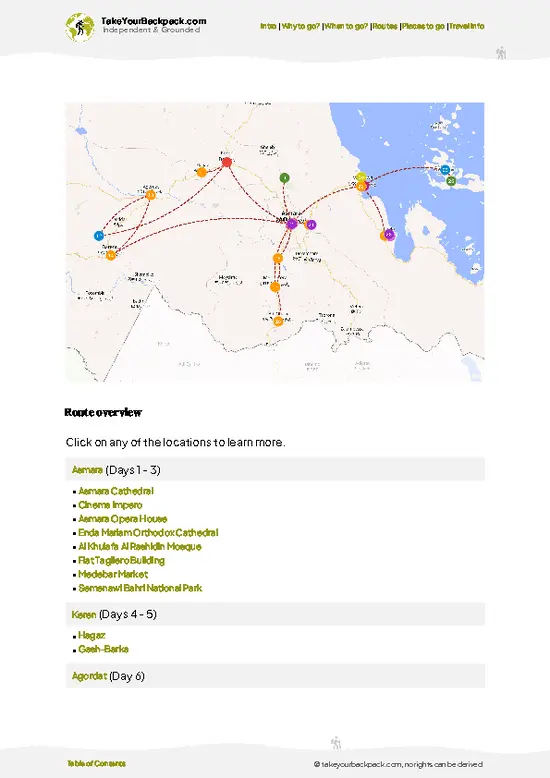
Plan around the heat, with walking in the first hours of the morning, a long pause at midday in a teahouse or guesthouse, and short outings again once the light softens. Distances between towns are big and buses run on their own schedule, so each phase below uses one town as a base and keeps moves to a minimum.
Day 1: Agordat: Start where the road and rail history meet. Spend the morning at the old railway station and the market, then walk the Barka riverbed before the sun is high. Agordat is the logical gateway because the bus connections west begin here, and one night lets you rest before a long ride.
Day 2: Barentu: Take the early bus to Barentu. The ride eats most of the day, so arrive, find a room and visit the market while it is still lively. Barentu works as the hub for the rest of the … read more 👉
Plan around the heat, with walking in the first hours of the morning, a long pause at midday in a teahouse or guesthouse, and short outings again once the light softens. Distances between towns are big and buses run on their own schedule, so each phase below uses one town as a base and keeps moves to a minimum.
Day 1: Agordat: Start where the road and rail history meet. Spend the morning at the old railway station and the market, then walk the Barka riverbed before the sun is high. Agordat is the logical gateway because the bus connections west begin here, and one night lets you rest before a long ride.
Day 2: Barentu: Take the early bus to Barentu. The ride eats most of the day, so arrive, find a room and visit the market while it is still lively. Barentu works as the hub for the rest of the trip because everything in the south-west radiates from it.
Day 3: Barentu: Stay put. Arrange a visit to a Kunama village through a local contact and keep the afternoon free. This is the day that justifies the whole trip: you see farmland, hear the Kunama language and watch how a community lives with the seasons, something no stop in the highlands can replicate.
Day 4: Tessenei: Continue west to Tessenei. Walk the Gash River banks and the orchards in the late afternoon. As a detour, stop at Sebderat on the way, where the crossroads market is worth an hour without adding a night.
Day 5: Tessenei: Use the cool morning for a last walk by the river and the market, then begin the long return east, leaving early to beat the heat.

🌤️ When to go?Choosing the right time of year

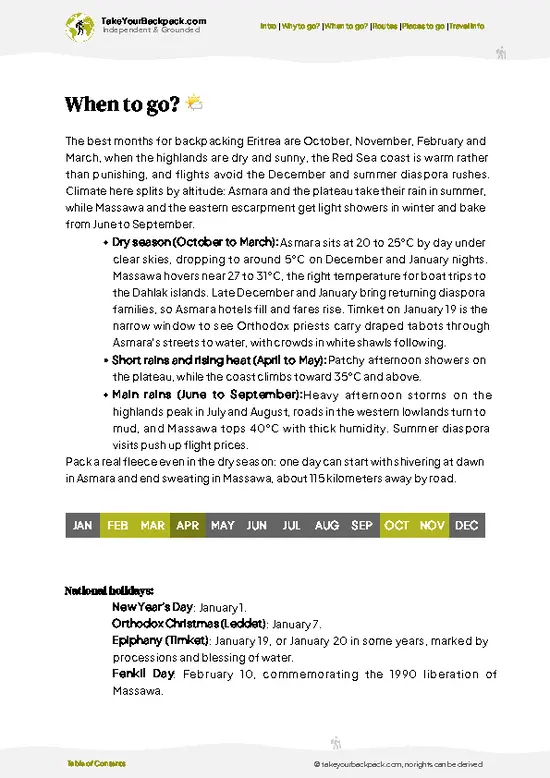
November to February is the most comfortable window for Barka, with daytime highs of roughly 30 to 35°C (86 to 95°F) and cooler nights.
  • Cool Season (November to February): Dry, dusty and workable for long days on the road. Daylight runs about 11.5 to 12 hours. Transport fills around holidays, but lodging stays cheap and rarely sells out.
  • Hot Season (March to May): Highs of 38 to 42°C (100 to 108°F) are common in the lowlands, and midday is best spent in shade. Travel early and rest through the afternoon.
  • Rainy Season (June to September): Storms arrive mostly in July and August. Seasonal riverbeds fill, dirt tracks turn to mud and some roads can close for a day or two. Farmland is green, but movement is slower and humidity is high.
  • Harvest and Festival Periods (October and around Orthodox and
… read more 👉
November to February is the most comfortable window for Barka, with daytime highs of roughly 30 to 35°C (86 to 95°F) and cooler nights.
  • Cool Season (November to February): Dry, dusty and workable for long days on the road. Daylight runs about 11.5 to 12 hours. Transport fills around holidays, but lodging stays cheap and rarely sells out.
  • Hot Season (March to May): Highs of 38 to 42°C (100 to 108°F) are common in the lowlands, and midday is best spent in shade. Travel early and rest through the afternoon.
  • Rainy Season (June to September): Storms arrive mostly in July and August. Seasonal riverbeds fill, dirt tracks turn to mud and some roads can close for a day or two. Farmland is green, but movement is slower and humidity is high.
  • Harvest and Festival Periods (October and around Orthodox and Muslim holidays): Markets are busier and more colorful. Prices barely move, but buses sell out.
Book onward transport a day early in the cool months, and keep a travel permit in hand before you leave Asmara.


source: climatestotravel.comJANJanuary: excellent for travelingFEBFebruary: excellent for travelingMARMarch: highly recommended for travelingAPRApril: fair for travelingMAYMay: fair for travelingJUNJune: below average for travelingJULJuly: below average for travelingAUGAugust: below average for travelingSEPSeptember: fair for travelingOCTOctober: excellent for travelingNOVNovember: excellent for travelingDECDecember: excellent for traveling
when-to-go

✈️ The backpacker research shortcutEritrea Travel Guide

An offline-friendly backpacking guide with optimized travel routes, ranked highlights, transport advice, and the best areas to stay.
example page 0 from our offline Travel Guide for Eritrea
example page 1 from our offline Travel Guide for Eritrea
example page 2 from our offline Travel Guide for Eritrea
example page 3 from our offline Travel Guide for Eritrea
example page 4 from our offline Travel Guide for Eritrea
example page 5 from our offline Travel Guide for Eritrea
example page 6 from our offline Travel Guide for Eritrea
example page 7 from our offline Travel Guide for Eritrea
The digital guide (245 pages) contains:
✅ 56 highlights, ranked by travel appeal
✅ Optimized 5, 10 & 15-day travel routes
✅ Cities, national parks, landmarks, beaches
✅ How to get around
✅ Offline-friendly for travel without Wi-Fi
👉 Click to see all 30+ guide features

📅 Plan smarter in minutes, not weeks
✅ Month by month travel advice
✅ Festivals & national holidays
✅ Budget expectations

🗺️ Go to the right places, skip the overrated ones
✅ Honest pros & cons of destinations
✅ Top hikes, parks & viewpoints
✅ Lesser-known places most travelers miss
✅ Clear “worth it vs skip it” guidance

🛏️ Travel smoothly without rookie mistakes
✅ Best areas to stay
✅ Transport systems explained simply
✅ Common scams & safety advice
✅ SIM cards, money & practical tips

🌍 Understand the country, not just visit it
✅ Culture & traditions
✅ 52 Essential phrases & customs
✅ Festivals worth planning around
✅ Traveler-friendly historical context
✅ Insights that make places more meaningful

📱 Built for real travel conditions
✅ Fully downloadable PDF
✅ Works completely offline
✅ Optimized for phone use
✅ Useful in remote areas & buses
✅ Everything in one place
Stop searching, start planning
Get instant access to your full guide. 30‑day money-back guarantee.
+ Add another guide for just

By proceeding you agree to our terms.
Sent to your inbox immediately after payment • 100% Secure Checkout
Best Backpacking Travel Advisor 2025 tourism awardBest Backpacking
Travel Advisor
2025
What others say about Take Your Backpack Guides:
⭐⭐⭐⭐⭐
Fantastic, amazing amount of information!
⭐⭐⭐⭐⭐
My goodness this is amazing, it's what I've been looking for hats off too you!
⭐⭐⭐⭐⭐
I think this is absolutely BRILLIANT
⭐⭐⭐⭐
Very complete and informative. It's still missing places, but I gotta to commend you
⭐⭐⭐⭐⭐
This is truly amazing, thank you, can't wait to explore it with my kids!
⭐⭐⭐⭐⭐
Awesome resource, thank you!
⭐⭐⭐⭐⭐
This is amazing! Can't wait to explore the ones I haven't seen
⭐⭐⭐⭐
I love this! Well done, great idea.
⭐⭐⭐⭐⭐
Thanks for taking the time to make this gem!
⭐⭐⭐⭐⭐
This might be the best website I've ever seen.
⭐⭐⭐⭐⭐
Congratulations, and thank you so much for your work; it's incredibly valuable.
⭐⭐⭐⭐
In all seriousness I think you did a great job pointing out the important spots
⭐⭐⭐⭐⭐
10/10 very good
⭐⭐⭐⭐⭐
As someone who's only just starting to visit regularly this is awesome, thank you.
⭐⭐⭐⭐
Thank you very much! I'm going to visit my dad, it's going to be very useful!
⭐⭐⭐⭐⭐
This is really cool! We'll be travelling for the first time and this definitely come in handy.
⭐⭐⭐⭐⭐
You are now our minister of culture, congratulations 👨‍💼
⭐⭐⭐⭐⭐
Just wanted to tell you that this is a pearl! Going to follow your recommendations.
⭐⭐⭐⭐⭐
This is so cool. I'll definitely be using the resource for my travels soon.
⭐⭐⭐⭐⭐
This is very impressive! Good work.
⭐⭐⭐⭐⭐
This is an amazing and informative site. Very well done!

🛏️ Where to stay?Best areas to stay in Eritrea

Barentu is the most practical base in Barka, as the regional capital with the widest choice of simple guesthouses, a daily market and the most reliable bus connections. It is also the easiest place to meet the few foreign travelers, aid workers and traders passing through, usually over tea or coffee in the evening. Expect basic rooms, usually US$10 to 25 a night, with fans and shared or simple private bathrooms.
Agordat is the second option, a calm railway-era town on the Barka River with a lively Monday market where the Tigre and Kunama communities trade livestock and goods. It suits a night or … read more 👉
Barentu is the most practical base in Barka, as the regional capital with the widest choice of simple guesthouses, a daily market and the most reliable bus connections. It is also the easiest place to meet the few foreign travelers, aid workers and traders passing through, usually over tea or coffee in the evening. Expect basic rooms, usually US$10 to 25 a night, with fans and shared or simple private bathrooms.
Agordat is the second option, a calm railway-era town on the Barka River with a lively Monday market where the Tigre and Kunama communities trade livestock and goods. It suits a night or two when you want to see the river lowlands and the old line toward the highlands. Rooms are similar in price and quality.
Keren, on the highland edge just outside the lowlands, is the most social and comfortable choice. It is cooler, has a famous Monday camel and livestock market, and offers more cafés and guesthouses than anywhere else nearby. Many travelers sleep there and make long excursions into Barka.
All three feel safe for solo travelers, with quiet streets after dark. Stay inside the towns named on your permit, and sleep somewhere with a ceiling fan or open courtyard, since lowland nights stay warm.

🚌 Getting aroundHow to get from A to B

In Barka, the main town of Barentu is small enough that the bus stop sits within a ten to fifteen minute walk of the market and the central street, so you rarely need a ride at all. Where you do, a shared minibus or a short taxi hop costs around US$1 to 2. Most backpackers reach the region from Asmara by bus via Keren, then rely on local buses and the occasional hired vehicle for the rest. Services are dependable on the main road but sparse elsewhere, and travel permits are checked at points along the way.
  • Intercity bus from Asmara: Runs to Agordat and Barentu for roughly US$4 to 8, taking about 5 to 6 hours to Agordat and 8 to 10 to Barentu. Seats are tight and buses leave when full or on a fixed morning schedule, but nothing else matches the price. This gives a backpacker the most for the
… read more 👉
In Barka, the main town of Barentu is small enough that the bus stop sits within a ten to fifteen minute walk of the market and the central street, so you rarely need a ride at all. Where you do, a shared minibus or a short taxi hop costs around US$1 to 2. Most backpackers reach the region from Asmara by bus via Keren, then rely on local buses and the occasional hired vehicle for the rest. Services are dependable on the main road but sparse elsewhere, and travel permits are checked at points along the way.
  • Intercity bus from Asmara: Runs to Agordat and Barentu for roughly US$4 to 8, taking about 5 to 6 hours to Agordat and 8 to 10 to Barentu. Seats are tight and buses leave when full or on a fixed morning schedule, but nothing else matches the price. This gives a backpacker the most for the money.
  • Minibus between towns: Connects Barentu, Agordat and smaller settlements for about US$1 to 4 per leg. They are quicker than the large buses on short hops but cramped, and they stop often. Good for flexibility, poor for luggage.
  • Shared or hired Land Cruiser: Reaches villages and riverside sites that buses skip. Expect about US$60 to 120 a day with a driver, and a permit that names the route. It costs far more than a bus, yet it saves hours and is the only realistic way to see remote areas.
  • Walking and bicycle taxis in town: Distances in Barentu and Agordat are short. Walking costs nothing and is comfortable early and late, though midday heat makes even a kilometer tiring.
Get your permit stamped for every town you plan to visit before leaving Asmara, and carry copies, since checkpoints read the list closely.

🍲 FoodLocal Flavors for Backpackers

Eat injera here the way locals do: sour, spongy and torn by hand to scoop up zigni, a deep red stew of beef or goat fired with berbere. Lowland kitchens also lean on tsebhi with lentils, shiro (a smooth chickpea gravy) and kitcha fit-fit, shredded flatbread tossed in spiced butter and yogurt, which makes a hearty breakfast. Goat grilled over charcoal appears at weekend gatherings and market days.
For drinking, go to the coffee ceremony: green beans roasted in a pan, smoke curling through the room and incense mixing with the aroma, followed by three small cups. Sweet shai with cardamom or cinnamon is everywhere, and Asmara beer is the cold bottle of choice at dusk. Local honey wine, mies, appears at celebrations.
Backpackers eat at small town restaurants and tea houses near the market, where … read more 👉
Eat injera here the way locals do: sour, spongy and torn by hand to scoop up zigni, a deep red stew of beef or goat fired with berbere. Lowland kitchens also lean on tsebhi with lentils, shiro (a smooth chickpea gravy) and kitcha fit-fit, shredded flatbread tossed in spiced butter and yogurt, which makes a hearty breakfast. Goat grilled over charcoal appears at weekend gatherings and market days.
For drinking, go to the coffee ceremony: green beans roasted in a pan, smoke curling through the room and incense mixing with the aroma, followed by three small cups. Sweet shai with cardamom or cinnamon is everywhere, and Asmara beer is the cold bottle of choice at dusk. Local honey wine, mies, appears at celebrations.
Backpackers eat at small town restaurants and tea houses near the market, where a plate of stew and injera costs around US$2 to 4. Early mornings bring ful (stewed fava beans) and fresh bread for under US$1.50. Street snacks are limited, so market stalls selling fruit, roasted peanuts and sweet bread fill the gaps.
Wash your right hand before eating from the shared plate, and use only that hand. Hosts may offer a gursha, a bite fed to you by hand, and refusing it politely is fine but accepting it is a warm gesture. Many Orthodox Christians fast on Wednesdays and Fridays, so restaurants then serve vegetarian dishes only.

FAQFrequently asked questions about Barka

Three to five days covers Barka if you add it to an Eritrea trip, which allows time for the long ride from Asmara, a base night in Barentu or Agordat, and a market visit. A two-day return trip is possible from Keren, but the road takes 5 to 10 hours each way depending on your destination. Add extra days if you plan a hired vehicle into remote villages.
Without a car, take an intercity bus from Asmara to Agordat or Barentu, which costs roughly US$4 to 8 and takes 5 to 10 hours depending on the stop. Within Barka, minibuses link the main towns for about US$1 to 4 a leg, and Barentu and Agordat are small enough to walk. Carry a valid travel permit listing every town on your route, because buses are stopped at checkpoints.
Barka is known for the Barka River lowlands in western Eritrea, a hot, flat region of farms and grazing land where Kunama, Tigre and other communities live. Its towns, Agordat and Barentu, hold busy weekly markets with livestock and grain. The area also carries railway history from the Italian colonial period and a landscape of seasonal rivers that flood from July to August.
⚠️ Things can change over time, so always validate details locally before you go.

Other Eritrean regions near Barka

Explore more nearby:

  • Debub—rolling hills, market towns, patchwork agriculture, distant mountain views| 32 km away
  • Dahlak Archipelago—coral reefs, remote islands, pearl diving history, turquoise shallows| 102 km away
  • Gash-Barka—agricultural plains, gold mining sites, borderland villages, Baobab trees| 193 km away

💡 Not sure where to go next?
Create a personalized itinerary for Eritrea including Barka and the places that fit your trip.

Generate my itinerary

👉 Discover all regions

Or checkout all Eritrea has to offer (think cities, towns, villages, national parks, hikes, beaches, festivals)
Country photo of Eritrea

We 💚 feedbackWhat to keep in mind

Barka deserves three nights at minimum, ideally four, because the bus days are long and the lowland heat wears you down by the second afternoon. I would base myself in Barentu, skip the farthest border towns, and carry plenty of water and small bills for tea.

✍️ Help improve this page!
The information on this page is based on in-depth research, insights shared by experienced travelers, and feedback from the local travel community in Eritrea. While every effort is made to keep the information accurate and current, conditions can change — so if you spot anything incorrect or outdated, please get in touch.


🙋‍♂️ Give feedback

👋 Meet the founderWho’s Behind Take Your Backpack?

Johan, backpacker and founder of TakeYourBackpackHi, I’m Johan (Netherlands 🇳🇱), the creator of TakeYourBackpack. Over the past 3 decades, I’ve backpacked through 90+ countries across six continents, gaining extensive experience with independent travel, long-term trips, and overland routes.

This site is built on a combination of firsthand travel experience and carefully curated insights from other backpackers. Many guides are based on places I’ve personally visited, while others bring together tips, observations, and practical advice shared by trusted travelers I’ve met along the way.

The goal is to provide realistic, experience-driven guidance — not generic itineraries — so you can explore destinations with better context, clearer expectations, and more confidence.