×

Eritrea🇪🇷 | best regionsDiscover the 4 Best regions Across Eritrea

Eritrea is divided into six administrative regions, and what separates them for a traveler is mostly altitude, heat and distance from Asmara. The central highlands are cool, compact and well served by roads, hotels and restaurants. The western lowlands are hotter, flatter and quieter, with simpler lodging. The Red Sea coast and its islands are the hottest, the most remote and the most expensive to reach. Crowds are not a factor anywhere, because visitor numbers are very low. Travel permits are the real constraint, since they control movement outside the capital. Backpacking here is independent in spirit but planned in advance.

By Johan Kruseman 🇳🇱 | Updated October 23, 2026
Explore the best cities in Eritrea

Why go?Key Factors That Shape the Experience

Eritrea packs several climates into a small area. The highland plateau sits at roughly 2,000 to 2,400 meters, then drops through a steep escarpment to a coastal plain, with the Danakil Depression falling below sea level. That vertical range is why a short drive changes the temperature, food and landscape so sharply.

History adds a second layer. Italian rule from the 1890s to 1941 left colonial architecture, paved mountain roads and a railway, while the coast carries older Ottoman and Egyptian influences. Christian and Muslim communities live side by side, and nine ethnic groups speak languages such as Tigrinya, Tigre and Afar. Independence came in 1993 after a long war.

Before choosing Eritrea, know that tourism is small and tightly managed. A visa must be arranged before arrival, and travel … read more 👉
Eritrea packs several climates into a small area. The highland plateau sits at roughly 2,000 to 2,400 meters, then drops through a steep escarpment to a coastal plain, with the Danakil Depression falling below sea level. That vertical range is why a short drive changes the temperature, food and landscape so sharply.

History adds a second layer. Italian rule from the 1890s to 1941 left colonial architecture, paved mountain roads and a railway, while the coast carries older Ottoman and Egyptian influences. Christian and Muslim communities live side by side, and nine ethnic groups speak languages such as Tigrinya, Tigre and Afar. Independence came in 1993 after a long war.

Before choosing Eritrea, know that tourism is small and tightly managed. A visa must be arranged before arrival, and travel permits are required for most trips outside Asmara. Foreign bank cards generally do not work, so you carry cash and exchange it for nakfa (officially 15 per US$1). Internet is slow and patchy. Public transport exists but is sparse and slow, and the country rewards travelers who plan with patience and low expectations of convenience. Some governments advise against travel to border areas, so check current advisories.
How the List Was Created
The list of best regions in Eritrea is created based on landscapes, local culture, attractions, vibes, and overall appeal. If you feel a region is missing in this list, please let us know.

When to go?Timing Your Visit for the Best Experience

Best months: The best months are October to March, when the highlands are dry and sunny and the coast is at its most tolerable. In Asmara, days run about 20 to 25°C, and nights from December to February can fall to 5 to 8°C, so a warm layer is needed. Skies are clear and roads are dry.

Shoulder seasons and rain: April and May are warm and dry in the highlands but already hot elsewhere. The main rains, called kremti, fall from late June to early September, peaking in July and August. The highlands receive most of the country's rainfall, often as afternoon downpours, and some dirt roads become slow or impassable. The coast sees only light, irregular rain between November and February.

Heat by region: The Red Sea coast, including Massawa and the Dahlak islands, is best from November to March, with … read more 👉
Best months: The best months are October to March, when the highlands are dry and sunny and the coast is at its most tolerable. In Asmara, days run about 20 to 25°C, and nights from December to February can fall to 5 to 8°C, so a warm layer is needed. Skies are clear and roads are dry.

Shoulder seasons and rain: April and May are warm and dry in the highlands but already hot elsewhere. The main rains, called kremti, fall from late June to early September, peaking in July and August. The highlands receive most of the country's rainfall, often as afternoon downpours, and some dirt roads become slow or impassable. The coast sees only light, irregular rain between November and February.

Heat by region: The Red Sea coast, including Massawa and the Dahlak islands, is best from November to March, with highs of 25 to 32°C. From May to September temperatures commonly reach 35 to 45°C with heavy humidity, and sea trips become punishing. The western lowlands around Gash-Barka are hottest from April to June, often above 40°C. The Danakil in the Southern Red Sea region is best avoided from June to September.

Crowds and prices: Crowds do not change travel decisions. Hotel and transport prices vary little by season, though boat charters to the islands cost more and are harder to arrange in the hot months. Timkat in January and Meskel in late September bring busy local celebrations.

region hoppingOptimizing Your Multi-Stop Itinerary

How long to allow: A trip combining several regions needs 7 to 12 days, mainly because each leg is slow and permits take time to arrange. Asmara works as the hub, with the other regions reached as separate loops rather than one continuous chain.

Grouping and direction: The highlands and the southern towns pair easily, since they sit within two to three hours of the capital by road. The western lowlands connect through Keren, about 90 kilometers and 2 to 3 hours from Asmara, and then continue on toward Agordat. The coast is reached via the descent to Massawa, roughly 115 kilometers and 2.5 to 3 hours. A sensible direction is highlands first, to adjust to the altitude and finalize permits, then the west, and the hot coast last. Allow 2 to 3 days per stop at minimum, and 3 to 4 if a boat trip … read more 👉
How long to allow: A trip combining several regions needs 7 to 12 days, mainly because each leg is slow and permits take time to arrange. Asmara works as the hub, with the other regions reached as separate loops rather than one continuous chain.

Grouping and direction: The highlands and the southern towns pair easily, since they sit within two to three hours of the capital by road. The western lowlands connect through Keren, about 90 kilometers and 2 to 3 hours from Asmara, and then continue on toward Agordat. The coast is reached via the descent to Massawa, roughly 115 kilometers and 2.5 to 3 hours. A sensible direction is highlands first, to adjust to the altitude and finalize permits, then the west, and the hot coast last. Allow 2 to 3 days per stop at minimum, and 3 to 4 if a boat trip or a longer drive is involved. Moving between the far ends of the country can take a full day.

Planning mistakes: The most common error is squeezing too many stops into too few days. Choose three or four bases and let day trips do the rest. Another is requesting permits late. Apply in Asmara as soon as you arrive and list every destination, because the permit names the places you may visit. Travelers also schedule arrivals after dark, yet checkpoints and limits on night driving make daylight departures the safer plan. Finally, buses are infrequent, so confirm return seats before leaving a town.

The ListHighly Recommended regions of Eritrea

1 Dahlak Archipelago

Coral islands, rock-cut cisterns, Kufic tombstones, reef snorkeling

Charter a boat from Massawa to snorkel off white sand, walk among ancient Arabic gravestones and see cisterns cut into coral rock.

2 Gash-Barka

Baobab roads, border trade, Gash River, thorn bush

Ride shared buses through hot western plains to coffee-scented markets, Kunama villages and Sudan-edge trading at Tessenei, where foreigners are rare.

3 Barka

Dry river beds, Kunama markets, railway relic, sorghum plains

Walk sandy riverbanks at first light, then trade tea and talk with Kunama, Tigre and Beni-Amer herders in Agordat and Barentu markets.

4 Debub

Cool plateaus, Aksumite ruins, terraced barley, Italian-era towns

Hike across Qohaito to a cliff edge above the Red Sea lowlands, then wander quiet ruins and market towns with few other visitors.

Loading the map 🌍

Expert viewPro Tips for Exploring the Best

How many regions: Three of the six regions is the sensible number for most backpackers on a stay of one to two weeks. Permits, slow transport and heat eat into the schedule, and the permit system makes constant changes of plan difficult. Visiting four is possible with 12 days or more. Five or six means long days in vehicles and little time on the ground.

Choosing by travel style: For travelers who like cities, architecture and cafe culture, the highland region around the capital should take the most time, since it is the easiest and cheapest to do independently. Hikers and history enthusiasts should add a second highland or southern area for archaeology and village walks. Those drawn to heat, markets and mixed cultures should add the western lowlands. Divers, snorkelers and anyone interested … read more 👉
How many regions: Three of the six regions is the sensible number for most backpackers on a stay of one to two weeks. Permits, slow transport and heat eat into the schedule, and the permit system makes constant changes of plan difficult. Visiting four is possible with 12 days or more. Five or six means long days in vehicles and little time on the ground.

Choosing by travel style: For travelers who like cities, architecture and cafe culture, the highland region around the capital should take the most time, since it is the easiest and cheapest to do independently. Hikers and history enthusiasts should add a second highland or southern area for archaeology and village walks. Those drawn to heat, markets and mixed cultures should add the western lowlands. Divers, snorkelers and anyone interested in the Red Sea should add the coast, but only if they can pay for boats and accept limited comfort. Combining one cool region with one hot region gives the widest contrast.

Budget: Budget travel in Eritrea costs about US$40 to 70 a day. That covers a basic room at US$20 to 40, meals at US$3 to 8, and shared buses at roughly US$2 to 6 per leg. Hiring a car and driver or guide for lowland and remote stops raises costs to about US$100 to 180 a day, though the price is split if you share. Boat trips to the islands usually run US$100 to 250 a day for the vessel, so seek a group. Entry fees at sites are typically small, often US$1 to 10, and guides at specific sites may charge US$10 to 30. A one-week trip with two regions outside the capital normally totals US$450 to 900 excluding flights and visa fees. Treat all prices as approximate and confirm them locally.

Money handling: Foreign cards do not work, so bring all your cash in clean, recent US dollars or euros. Hotels and tour operators often quote and take foreign currency, while small purchases are in nakfa. Keep spare small notes for tips and drivers.

Safety and culture: The cities are calm and street crime is low. Border zones, especially near Ethiopia and Djibouti, are restricted or hazardous, and unmarked areas may still hold landmines, so stay on established roads and tracks. Carry your passport and permit at all times, because checkpoints are frequent and officials expect to see them. Do not photograph soldiers, military sites, government buildings or the port without asking, and delete anything an official objects to. Dress modestly, particularly in the Muslim lowlands and the coast, where women should cover shoulders and knees. Ask before photographing people. During Ramadan, eating and drinking in public is discouraged in the Muslim areas. In the hot regions, carry at least 3 liters of water per person per day and plan outdoor activity before 10 a.m. Check your government's current travel advice before booking.

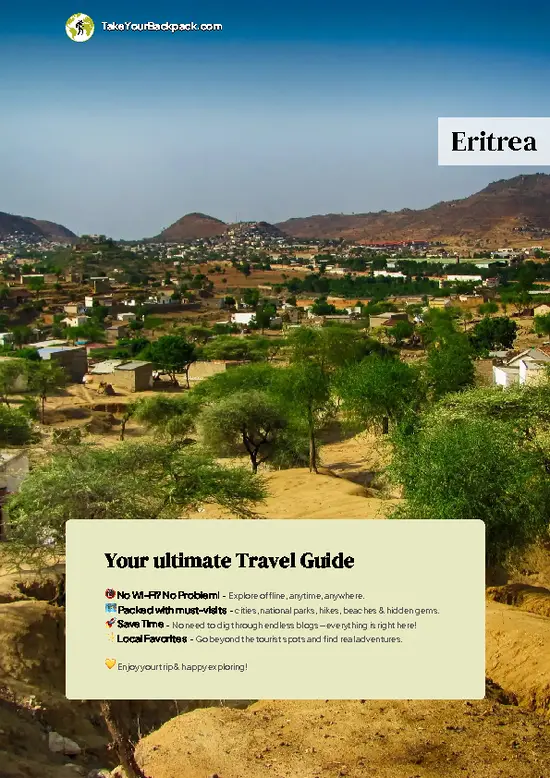
✈️ The backpacker research shortcutEritrea Travel Guide

An offline-friendly backpacking guide with optimized travel routes, ranked highlights, transport advice, and the best areas to stay.
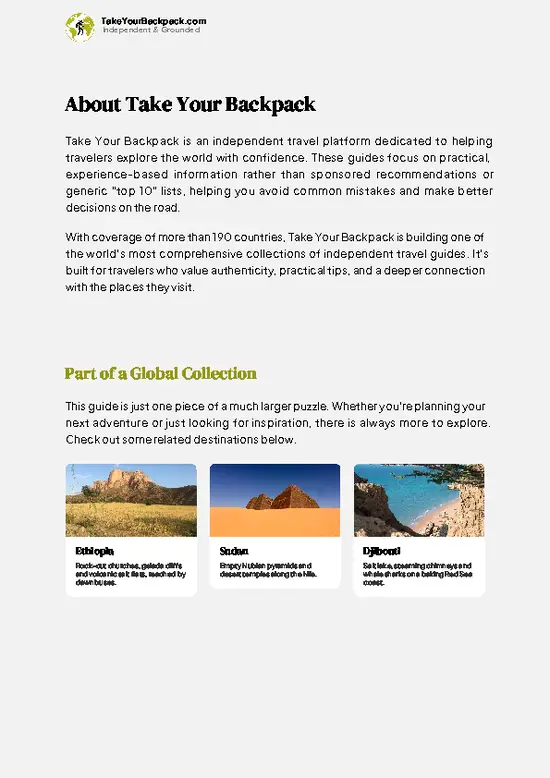
example page 0 from our offline Travel Guide for Eritrea
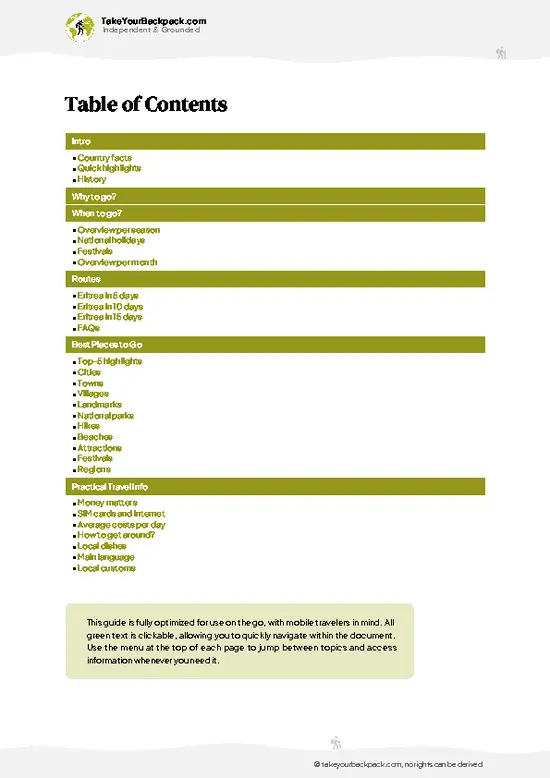
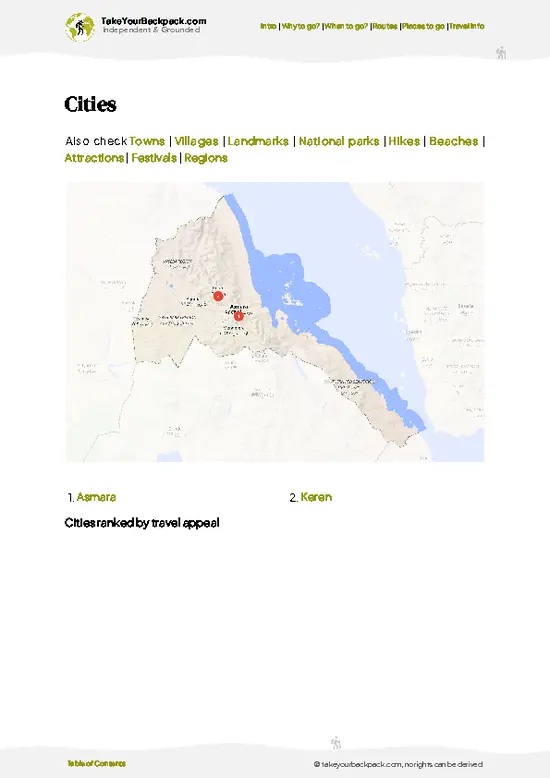
example page 1 from our offline Travel Guide for Eritrea
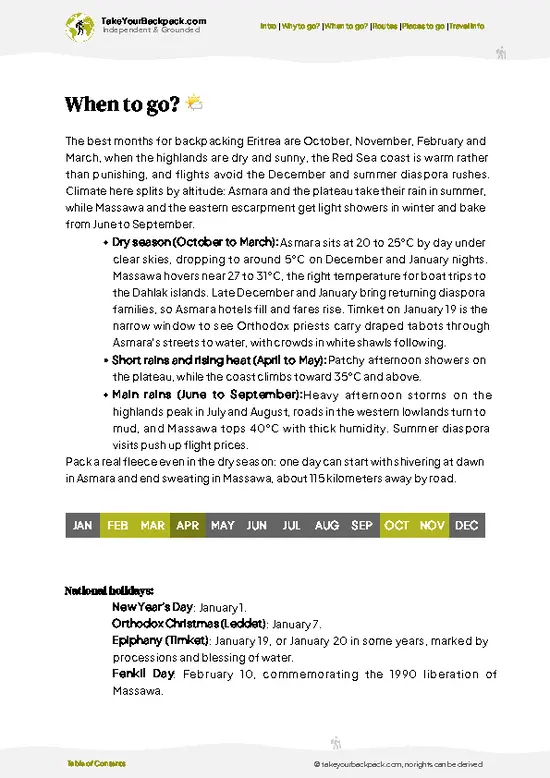
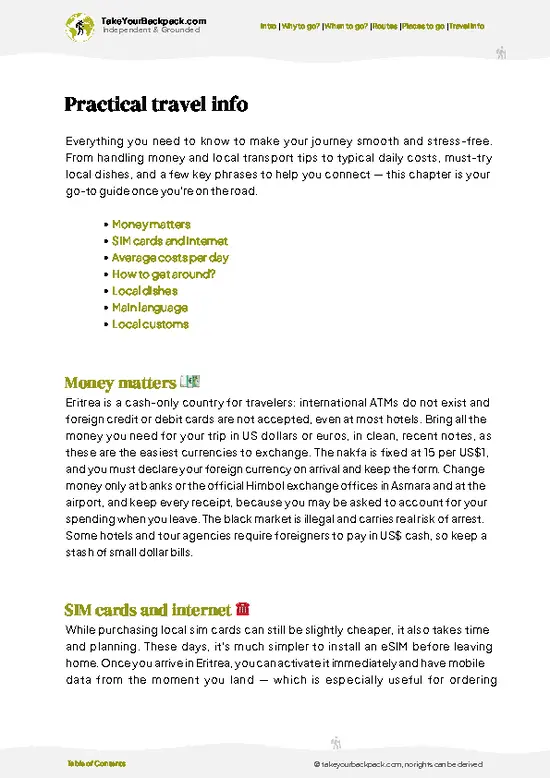
example page 2 from our offline Travel Guide for Eritrea
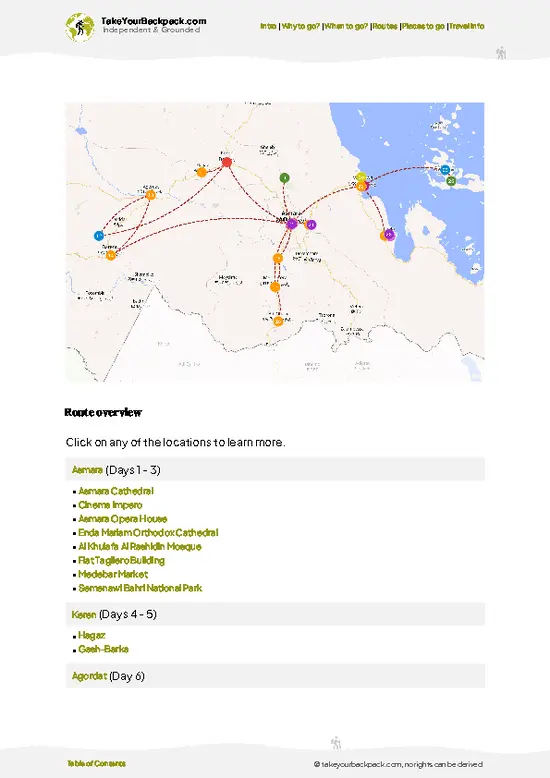
example page 3 from our offline Travel Guide for Eritrea
example page 4 from our offline Travel Guide for Eritrea
example page 5 from our offline Travel Guide for Eritrea
example page 6 from our offline Travel Guide for Eritrea
example page 7 from our offline Travel Guide for Eritrea
The digital guide (245 pages) contains:
✅ 56 highlights, ranked by travel appeal
✅ Optimized 5, 10 & 15-day travel routes
✅ Cities, national parks, landmarks, beaches
✅ How to get around
✅ Offline-friendly for travel without Wi-Fi
👉 Click to see all 30+ guide features

📅 Plan smarter in minutes, not weeks
✅ Month by month travel advice
✅ Festivals & national holidays
✅ Budget expectations

🗺️ Go to the right places, skip the overrated ones
✅ Honest pros & cons of destinations
✅ Top hikes, parks & viewpoints
✅ Lesser-known places most travelers miss
✅ Clear “worth it vs skip it” guidance

🛏️ Travel smoothly without rookie mistakes
✅ Best areas to stay
✅ Transport systems explained simply
✅ Common scams & safety advice
✅ SIM cards, money & practical tips

🌍 Understand the country, not just visit it
✅ Culture & traditions
✅ 52 Essential phrases & customs
✅ Festivals worth planning around
✅ Traveler-friendly historical context
✅ Insights that make places more meaningful

📱 Built for real travel conditions
✅ Fully downloadable PDF
✅ Works completely offline
✅ Optimized for phone use
✅ Useful in remote areas & buses
✅ Everything in one place
Stop searching, start planning
Get instant access to your full guide. 30‑day money-back guarantee.
+ Add another guide for just

By proceeding you agree to our terms.
Sent to your inbox immediately after payment • 100% Secure Checkout
Best Backpacking Travel Advisor 2025 tourism awardBest Backpacking
Travel Advisor
2025
What others say about Take Your Backpack Guides:
⭐⭐⭐⭐⭐
Fantastic, amazing amount of information!
⭐⭐⭐⭐⭐
My goodness this is amazing, it's what I've been looking for hats off too you!
⭐⭐⭐⭐⭐
I think this is absolutely BRILLIANT
⭐⭐⭐⭐
Very complete and informative. It's still missing places, but I gotta to commend you
⭐⭐⭐⭐⭐
This is truly amazing, thank you, can't wait to explore it with my kids!
⭐⭐⭐⭐⭐
Awesome resource, thank you!
⭐⭐⭐⭐⭐
This is amazing! Can't wait to explore the ones I haven't seen
⭐⭐⭐⭐
I love this! Well done, great idea.
⭐⭐⭐⭐⭐
Thanks for taking the time to make this gem!
⭐⭐⭐⭐⭐
This might be the best website I've ever seen.
⭐⭐⭐⭐⭐
Congratulations, and thank you so much for your work; it's incredibly valuable.
⭐⭐⭐⭐
In all seriousness I think you did a great job pointing out the important spots
⭐⭐⭐⭐⭐
10/10 very good
⭐⭐⭐⭐⭐
As someone who's only just starting to visit regularly this is awesome, thank you.
⭐⭐⭐⭐
Thank you very much! I'm going to visit my dad, it's going to be very useful!
⭐⭐⭐⭐⭐
This is really cool! We'll be travelling for the first time and this definitely come in handy.
⭐⭐⭐⭐⭐
You are now our minister of culture, congratulations 👨‍💼
⭐⭐⭐⭐⭐
Just wanted to tell you that this is a pearl! Going to follow your recommendations.
⭐⭐⭐⭐⭐
This is so cool. I'll definitely be using the resource for my travels soon.
⭐⭐⭐⭐⭐
This is very impressive! Good work.
⭐⭐⭐⭐⭐
This is an amazing and informative site. Very well done!

🛏️ Where to stay?Top Places to Consider Staying

Eritrea has no real backpacker hostel scene, so budget travelers sleep in simple family-run pensions and small hotels, typically 300 to 750 nakfa (US$20 to 50) for a private room with a bathroom. In Asmara, the blocks around Harnet Avenue in the city center hold the most options and put you within walking distance of the cafés, the cathedral and the evening passeggiata, though rooms facing the avenue can be noisy, while leafy Gejeret is quieter and residential but a 15 to 25 minute walk from the action. On the coast in Massawa, the old town on Massawa Island has the atmosphere and the cheapest rooms but basic facilities, whereas Taulud offers more reliable air conditioning and calmer streets … read more 👉
Eritrea has no real backpacker hostel scene, so budget travelers sleep in simple family-run pensions and small hotels, typically 300 to 750 nakfa (US$20 to 50) for a private room with a bathroom. In Asmara, the blocks around Harnet Avenue in the city center hold the most options and put you within walking distance of the cafés, the cathedral and the evening passeggiata, though rooms facing the avenue can be noisy, while leafy Gejeret is quieter and residential but a 15 to 25 minute walk from the action. On the coast in Massawa, the old town on Massawa Island has the atmosphere and the cheapest rooms but basic facilities, whereas Taulud offers more reliable air conditioning and calmer streets a short causeway walk away.

If you enjoy meeting fellow travelers, consider choosing hostels with high ratings for atmosphere. On the other hand, if you prefer having your own space, a hotel might be a better option.

EritreaMore Places Across Eritrea

👋 Meet the founderWho’s Behind Take Your Backpack?

Johan, backpacker and founder of TakeYourBackpackHi, I’m Johan (Netherlands 🇳🇱), the creator of TakeYourBackpack. Over the past 3 decades, I’ve backpacked through 90+ countries across six continents, gaining extensive experience with independent travel, long-term trips, and overland routes.

This site is built on a combination of firsthand travel experience and carefully curated insights from other backpackers. Many guides are based on places I’ve personally visited, while others bring together tips, observations, and practical advice shared by trusted travelers I’ve met along the way.

The goal is to provide realistic, experience-driven guidance — not generic itineraries — so you can explore destinations with better context, clearer expectations, and more confidence.