×

Eritrea🇪🇷 | townsSenafeMetera stela, Qohaito base, highland milk and woodsmoke | things to do and best time to go

Explore SembelExplore Teseney

Backpacking in Senafe
🌟 Highlighttown ranked #6
By Johan Kruseman 🇳🇱 | Updated October 22, 2026

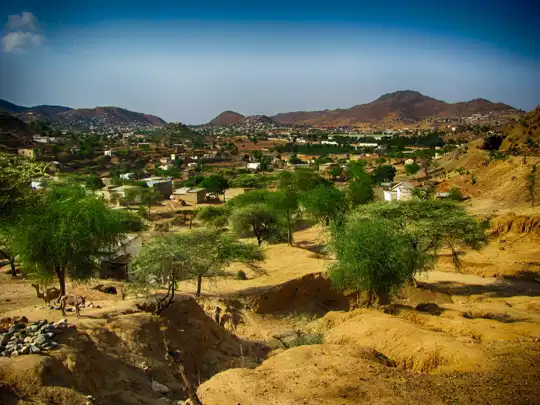
Dust rises off the road as a shared minibus rattles in, and a woman at the roadside lifts a plastic jug of fresh milk toward the window while the air smells of woodsmoke and eucalyptus. Senafe sits in the southern highlands of Eritrea, at roughly 2,500 meters, close to the Ethiopian border. It is a quiet market town, not a nightlife stop. Evenings end early, accommodation is a handful of simple guesthouses, and meeting other backpackers is unlikely because foreign visitors are few. That is the appeal. The town works best as a base for Qohaito, Metera and the Tigrinya hill villages, and the pace suits slow travelers. Roads from Asmara and Adi Keyh are paved but buses are infrequent. Eritrea requires a travel permit for trips outside Asmara, issued by the government for a fee, so arrange it in the capital first rather than expecting to sort it out at a checkpoint.

Discover everything you want to know in the 📖 Eritrea Travel Guide.


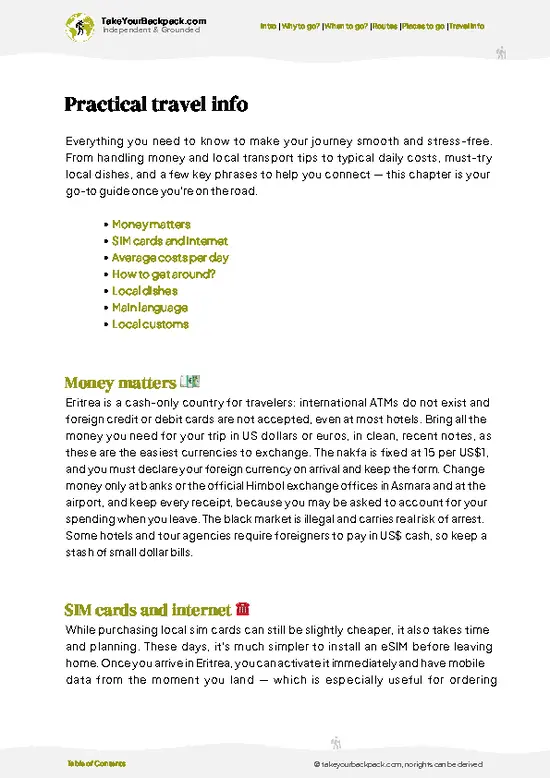
example page 0 from our offline Travel Guide for Eritrea
example page 1 from our offline Travel Guide for Eritrea
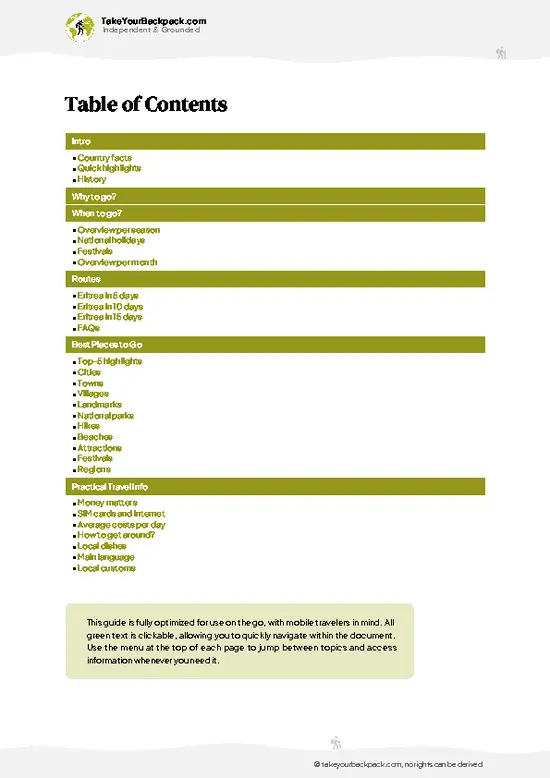
example page 2 from our offline Travel Guide for Eritrea
example page 3 from our offline Travel Guide for Eritrea
example page 4 from our offline Travel Guide for Eritrea
example page 5 from our offline Travel Guide for Eritrea
example page 6 from our offline Travel Guide for Eritrea
example page 7 from our offline Travel Guide for Eritrea
Loading the map 🌍
CLICK TO FILTER
cities
towns
villages
landmarks
national parks
hikes
beaches
attractions
festivals
regions
SHOW COUNTRY’S BESTSHOW ALL

✨ Why go?
Ranked #6 town in Eritrea
What sets this place apart

Senafe is the practical base for the ancient sites of the southern highlands, and that is the whole case for coming. Metera, the ruined Aksumite-era town with its great stela fragment, lies a short drive away, and the rock-cut churches and pre-Christian remains around the district reward anyone willing to hire a car and guide. Add the cool, thin air at altitude, with eucalyptus-lined lanes and the market on the main street, and you have a place that suits hikers, history-minded solo travelers and anyone who prefers silence to social scenes. Most visitors stay one or two nights, which is enough to see the outlying ruins, though a third night lets you walk the surrounding ridgelines without rushing. The town has a few basic guesthouses, tea and injera at small cafés, and almost no foreign crowd. … read more 👉
Senafe is the practical base for the ancient sites of the southern highlands, and that is the whole case for coming. Metera, the ruined Aksumite-era town with its great stela fragment, lies a short drive away, and the rock-cut churches and pre-Christian remains around the district reward anyone willing to hire a car and guide. Add the cool, thin air at altitude, with eucalyptus-lined lanes and the market on the main street, and you have a place that suits hikers, history-minded solo travelers and anyone who prefers silence to social scenes. Most visitors stay one or two nights, which is enough to see the outlying ruins, though a third night lets you walk the surrounding ridgelines without rushing. The town has a few basic guesthouses, tea and injera at small cafés, and almost no foreign crowd. Expect to be noticed, greeted and often invited to coffee. Not for party seekers.

💡 HighlightsWhat this place is best known for

  1. Metera ruins: The excavated Aksumite-era town site just outside Senafe holds a massive stela, broken and lying on the ground, along with foundations of the settlement that traded with the Red Sea coast. Go in the morning when light is soft. Allow 1 to 2 hours. Entry is informal and small donations or a guide fee of about US$5 to 10 are typical.
  2. Senafe market: Highland farmers bring grain, onions, spices and livestock on market days, and the lanes fill with donkeys and women in white cotton shawls. Come before noon. It is free to wander and takes about an hour.
  3. Senafe Orthodox church: The town church is a calm place to watch priests and worshippers at dawn prayers, when chanting carries across the hillside. Dress modestly and ask before photographing. Allow 30 minutes. Entry is free, though a
… read more 👉
  1. Metera ruins: The excavated Aksumite-era town site just outside Senafe holds a massive stela, broken and lying on the ground, along with foundations of the settlement that traded with the Red Sea coast. Go in the morning when light is soft. Allow 1 to 2 hours. Entry is informal and small donations or a guide fee of about US$5 to 10 are typical.
  2. Senafe market: Highland farmers bring grain, onions, spices and livestock on market days, and the lanes fill with donkeys and women in white cotton shawls. Come before noon. It is free to wander and takes about an hour.
  3. Senafe Orthodox church: The town church is a calm place to watch priests and worshippers at dawn prayers, when chanting carries across the hillside. Dress modestly and ask before photographing. Allow 30 minutes. Entry is free, though a small offering is welcome.
  4. Town viewpoint ridge: A short walk up from the center gives a wide view over terraced fields and the jagged peaks toward the Ethiopian frontier. Late afternoon is best. It costs nothing and takes about 45 minutes round trip.
  5. Tea house on the main street: Locals gather for sweet spiced tea and bread, and this is the easiest way to meet residents. Expect US$1 to 2 and an hour of conversation if your Tigrinya or your host’s English allows it.
For day trips, Senafe makes a good start for Qohaito with its Aksumite ruins and canyon edge, and for the Adi Keyh area, with Debre Libanos monastery as another option. The tea house costs the least, with the market and viewpoint ridge also free.
Spotted a mistake or missing something? Contact us.

Things to do near Senafe

Ratings based on Tripadvisor reviews. When you book through this link, you support our work at no extra cost to you.

🏘️ NeighborhoodsHow different areas shape the experience

Senafe is a compact highland town in Eritrea’s Debub region, and everything worth seeing sits within a 20-minute walk of the main street. Distances are short because the town grew along one road, so you can skip taxis entirely.
  • Main street and market area: The commercial spine, with small cafes serving sweet macchiato, shops, and a market day when farmers arrive from surrounding villages. Go in the morning, since trading thins out by afternoon. Everything is walkable.
  • Old town and church quarter: Stone houses and the Orthodox church sit on slightly higher ground. Lanes are narrow and steep in places, so wear shoes with grip. Evenings are very quiet because locals go home early.
  • Edge of town toward the escarpment: Open farmland and dramatic drops. Walk here at the cooler ends of the day. Carry
… read more 👉
Senafe is a compact highland town in Eritrea’s Debub region, and everything worth seeing sits within a 20-minute walk of the main street. Distances are short because the town grew along one road, so you can skip taxis entirely.
  • Main street and market area: The commercial spine, with small cafes serving sweet macchiato, shops, and a market day when farmers arrive from surrounding villages. Go in the morning, since trading thins out by afternoon. Everything is walkable.
  • Old town and church quarter: Stone houses and the Orthodox church sit on slightly higher ground. Lanes are narrow and steep in places, so wear shoes with grip. Evenings are very quiet because locals go home early.
  • Edge of town toward the escarpment: Open farmland and dramatic drops. Walk here at the cooler ends of the day. Carry water, as there are no shops along the paths.
  • Southern road toward Metera and Qohaito junction: Not a neighborhood, but where the Roman-era and Aksumite sites lie. Distances stretch beyond comfortable walking, so arrange a vehicle in town.
Nightlife is a few bars with beer and music, closing early. Ask permission before photographing people or anything military, because rules around photography are strictly applied.

⌛️ 1 dayWhat you can realistically do in a day

The day works on foot in town and by hired car for the ruins, with a long lunch break when the midday sun is strongest at altitude.
7:30 AM, Tea house on the main street: Start with sweet tea and bread among farmers and traders. It is cheap and the best way to learn what is happening in town.
8:30 AM, Senafe Orthodox church: Walk ten minutes uphill to catch the last of morning prayers. Stay quietly at the edge and leave a small offering.
9:30 AM, Senafe market: Wander the lanes while it is lively. Buy fruit or spices for later and watch donkeys being loaded.
11:00 AM, Metera ruins: Hire a car with a driver for the short ride out. Spend about 90 minutes at the stela and foundations while the light is still soft.
1:00 PM, Lunch back in town: Order injera with lentil or meat stew at a simple restaurant, … read more 👉
The day works on foot in town and by hired car for the ruins, with a long lunch break when the midday sun is strongest at altitude.
7:30 AM, Tea house on the main street: Start with sweet tea and bread among farmers and traders. It is cheap and the best way to learn what is happening in town.
8:30 AM, Senafe Orthodox church: Walk ten minutes uphill to catch the last of morning prayers. Stay quietly at the edge and leave a small offering.
9:30 AM, Senafe market: Wander the lanes while it is lively. Buy fruit or spices for later and watch donkeys being loaded.
11:00 AM, Metera ruins: Hire a car with a driver for the short ride out. Spend about 90 minutes at the stela and foundations while the light is still soft.
1:00 PM, Lunch back in town: Order injera with lentil or meat stew at a simple restaurant, then rest during the hot hours.
3:30 PM, Village lanes beyond the main road: Away from the usual circuit, follow the dirt tracks past terraced barley fields and stone houses on the edge of town. Farmers will likely greet you, and a few may offer coffee.
5:30 PM, Viewpoint ridge: Climb to the ridge as the light lengthens over the valleys and watch the peaks fade. Walk back before dark and finish with a quiet dinner.

🌤️ When to go?Seasonal considerations and timing

Senafe sits at roughly 2,400 meters, so it is cool and dry for much of the year, and timing mostly depends on rain.
  • Kremti (June to September): The main rains. Afternoons bring downpours, days run 18 to 23°C (64 to 73°F), and dirt roads turn slick. Fields are green, but sites are harder to reach.
  • Dry season (October to February): Sunny, with days around 20 to 25°C (68 to 77°F) and cold nights near 5 to 10°C (41 to 50°F). Daylight lasts roughly 11.5 to 12.5 hours. This suits hiking best.
  • Hot spell (March to May): Warmer, 24 to 28°C (75 to 82°F), with dust and light showers late on. Prices for rooms and rides barely change across seasons, and visitor numbers stay low.
  • Festivals: Orthodox Meskel in late September and Timket in January fill the town with processions.
Bring a warm layer for night in any month.

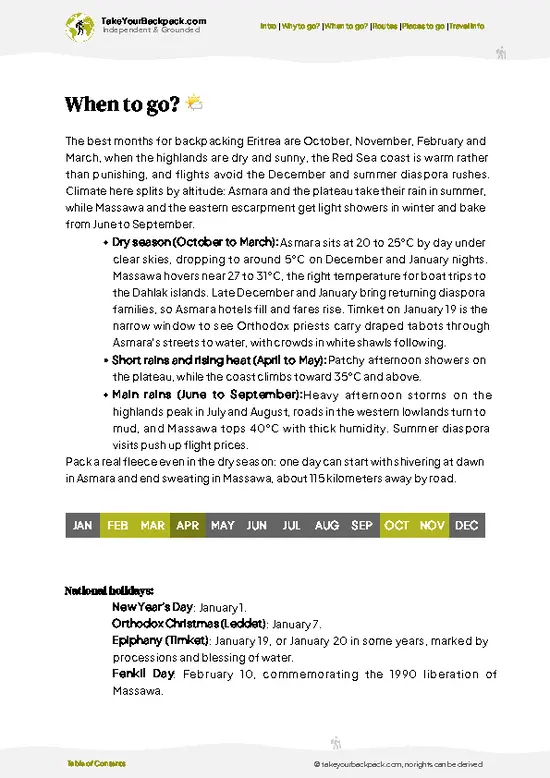
source: climatestotravel.comJANJanuary: excellent for travelingFEBFebruary: excellent for travelingMARMarch: highly recommended for travelingAPRApril: highly recommended for travelingMAYMay: highly recommended for travelingJUNJune: fair for travelingJULJuly: below average for travelingAUGAugust: below average for travelingSEPSeptember: fair for travelingOCTOctober: excellent for travelingNOVNovember: excellent for travelingDECDecember: excellent for traveling
when-to-go

✈️ The backpacker research shortcutEritrea Travel Guide

An offline-friendly backpacking guide with optimized travel routes, ranked highlights, transport advice, and the best areas to stay.
example page 0 from our offline Travel Guide for Eritrea
example page 1 from our offline Travel Guide for Eritrea
example page 2 from our offline Travel Guide for Eritrea
example page 3 from our offline Travel Guide for Eritrea
example page 4 from our offline Travel Guide for Eritrea
example page 5 from our offline Travel Guide for Eritrea
example page 6 from our offline Travel Guide for Eritrea
example page 7 from our offline Travel Guide for Eritrea
The digital guide (245 pages) contains:
✅ 56 highlights, ranked by travel appeal
✅ Optimized 5, 10 & 15-day travel routes
✅ Cities, national parks, landmarks, beaches
✅ How to get around
✅ Offline-friendly for travel without Wi-Fi
👉 Click to see all 30+ guide features

📅 Plan smarter in minutes, not weeks
✅ Month by month travel advice
✅ Festivals & national holidays
✅ Budget expectations

🗺️ Go to the right places, skip the overrated ones
✅ Honest pros & cons of destinations
✅ Top hikes, parks & viewpoints
✅ Lesser-known places most travelers miss
✅ Clear “worth it vs skip it” guidance

🛏️ Travel smoothly without rookie mistakes
✅ Best areas to stay
✅ Transport systems explained simply
✅ Common scams & safety advice
✅ SIM cards, money & practical tips

🌍 Understand the country, not just visit it
✅ Culture & traditions
✅ 52 Essential phrases & customs
✅ Festivals worth planning around
✅ Traveler-friendly historical context
✅ Insights that make places more meaningful

📱 Built for real travel conditions
✅ Fully downloadable PDF
✅ Works completely offline
✅ Optimized for phone use
✅ Useful in remote areas & buses
✅ Everything in one place
Stop searching, start planning
Get instant access to your full guide. 30‑day money-back guarantee.
+ Add another guide for just

By proceeding you agree to our terms.
Sent to your inbox immediately after payment • 100% Secure Checkout
Best Backpacking Travel Advisor 2025 tourism awardBest Backpacking
Travel Advisor
2025
What others say about Take Your Backpack Guides:
⭐⭐⭐⭐⭐
Fantastic, amazing amount of information!
⭐⭐⭐⭐⭐
My goodness this is amazing, it's what I've been looking for hats off too you!
⭐⭐⭐⭐⭐
I think this is absolutely BRILLIANT
⭐⭐⭐⭐
Very complete and informative. It's still missing places, but I gotta to commend you
⭐⭐⭐⭐⭐
This is truly amazing, thank you, can't wait to explore it with my kids!
⭐⭐⭐⭐⭐
Awesome resource, thank you!
⭐⭐⭐⭐⭐
This is amazing! Can't wait to explore the ones I haven't seen
⭐⭐⭐⭐
I love this! Well done, great idea.
⭐⭐⭐⭐⭐
Thanks for taking the time to make this gem!
⭐⭐⭐⭐⭐
This might be the best website I've ever seen.
⭐⭐⭐⭐⭐
Congratulations, and thank you so much for your work; it's incredibly valuable.
⭐⭐⭐⭐
In all seriousness I think you did a great job pointing out the important spots
⭐⭐⭐⭐⭐
10/10 very good
⭐⭐⭐⭐⭐
As someone who's only just starting to visit regularly this is awesome, thank you.
⭐⭐⭐⭐
Thank you very much! I'm going to visit my dad, it's going to be very useful!
⭐⭐⭐⭐⭐
This is really cool! We'll be travelling for the first time and this definitely come in handy.
⭐⭐⭐⭐⭐
You are now our minister of culture, congratulations 👨‍💼
⭐⭐⭐⭐⭐
Just wanted to tell you that this is a pearl! Going to follow your recommendations.
⭐⭐⭐⭐⭐
This is so cool. I'll definitely be using the resource for my travels soon.
⭐⭐⭐⭐⭐
This is very impressive! Good work.
⭐⭐⭐⭐⭐
This is an amazing and informative site. Very well done!

🛏️ Where to stay?Best areas and accommodation options

The best budget option in Senafe is a simple room on or just off the main street. Accommodation here is limited to a handful of small guesthouses and basic hotels, and there are no hostels or dorms, so expect private rooms with shared or basic bathrooms. Booking ahead is difficult, but rooms are rarely full outside festival dates.
Staying near the center puts you within a short walk of cafes, food stalls, and the bus stop, which matters because buses leave very early. You can reach morning departures without arranging transport. Evenings are quiet, so noise is rarely a problem, though a generator … read more 👉
The best budget option in Senafe is a simple room on or just off the main street. Accommodation here is limited to a handful of small guesthouses and basic hotels, and there are no hostels or dorms, so expect private rooms with shared or basic bathrooms. Booking ahead is difficult, but rooms are rarely full outside festival dates.
Staying near the center puts you within a short walk of cafes, food stalls, and the bus stop, which matters because buses leave very early. You can reach morning departures without arranging transport. Evenings are quiet, so noise is rarely a problem, though a generator or a neighbor’s music can occasionally be heard.
The second option is the quieter old quarter near the church. It is a calmer place to sleep and still within a ten-minute walk of the main road, though lanes are dark at night and a flashlight helps. Nights are cold at this altitude, so check for extra blankets. Hot water is not guaranteed.

🚌 Getting aroundMoving around without the hassle

Senafe punishes anyone who assumes a taxi or bus will show up whenever needed. Services are infrequent and run on fixed morning schedules, so missing the early departure often costs a full day. Eritrea also requires travel permits for trips outside Asmara, and checkpoints turn back anyone without the right paper, so arrange it before you set out. The town itself is small and walkable.
  • Walking: Free and the best way to cover the center, church area, and market. Allow 20 minutes end to end. Paths toward the escarpment are rough, so wear boots.
  • Intercity bus: The main link to Asmara and Adi Keih, roughly US$2 to 4 for a trip of 3 to 4 hours toward Asmara depending on the route. Buses leave early in the morning, often before 7 am, and fill quickly, so buy a seat the day before at the station.
  • Shared
… read more 👉
Senafe punishes anyone who assumes a taxi or bus will show up whenever needed. Services are infrequent and run on fixed morning schedules, so missing the early departure often costs a full day. Eritrea also requires travel permits for trips outside Asmara, and checkpoints turn back anyone without the right paper, so arrange it before you set out. The town itself is small and walkable.
  • Walking: Free and the best way to cover the center, church area, and market. Allow 20 minutes end to end. Paths toward the escarpment are rough, so wear boots.
  • Intercity bus: The main link to Asmara and Adi Keih, roughly US$2 to 4 for a trip of 3 to 4 hours toward Asmara depending on the route. Buses leave early in the morning, often before 7 am, and fill quickly, so buy a seat the day before at the station.
  • Shared minibus: Smaller vans link villages and nearby towns, about US$1 to 3. They depart when full, which means waiting. Afternoon departures are rare.
  • Hired car with driver: The practical choice for ancient sites, such as Metera and Qohaito area, at roughly US$60 to 120 a day, split between passengers. Bargain in town the evening before and confirm the permit covers your route.
  • Bicycle or donkey cart: Occasional on local tracks, mainly for farmers. Do not count on them for tourists.
Fuel is rationed nationwide, which is why private vehicles are scarce and drivers charge firmly. Travel early, carry small bills, and keep daylight margins, since roads between towns are winding and unlit.

👛 Costs (as of 22 October 2026)Money, prices, and spending tips

Senafe costs roughly US$30 to 54 a day for a backpacker on a tight budget, since dorm-style beds are rare and simple rooms are the norm. Prices are paid in nakfa, and the figures below are converted to dollars.
CategoryBudget RangeLocal Reality
Dorm accommodationUS$12 to 20 (low season US$10 to 15)Basic guesthouse rooms with shared bathrooms, as there are few true dorms.
MealsUS$8 to 12Injera with stew, eggs and bread at small local restaurants.
Local transportUS$2 to 5Shared minibuses and short taxi rides; the town is walkable.
Basic activities/entry feesUS$5 to 12Site tips, small guide fees and church donations.
Miscellaneous expensesUS$3 to 5Water, tea, coffee and mobile credit.
Total Daily BudgetUS$30 to 54Roughly US$42 for a typical day.
Carry small bills and eat where locals eat, as that keeps meals near the bottom of the range.
⚠️ Prices can change and everyone travels differently, so take this as a rough guide. Hope it helps you plan your adventure!

🚌 Day tripsExploring the surroundings

Senafe works well as a base for day trips, because the highlights lie within an hour or two of town along the dirt and paved roads of the southern highlands. Travel permits for Eritrea cover the region, so check the permit lists the route before you go, and plan on hiring a driver or sharing a 4x4.
Qohaito Plateau and Lake Qohaito:
The plateau sits on the edge of a deep escarpment with sweeping views toward the Red Sea lowlands, and holds the ruins of an ancient Aksumite-era settlement, a rock-cut tomb and a dam. Allow 2 to 3 hours each way by 4x4 on a mix of paved and rough roads. A shared vehicle or hired car costs roughly US$80 to 130 for the day, so splitting it matters. Go between October and March, when haze is lighter. First-timers often leave too late and lose the afternoon light on … read more 👉
Senafe works well as a base for day trips, because the highlights lie within an hour or two of town along the dirt and paved roads of the southern highlands. Travel permits for Eritrea cover the region, so check the permit lists the route before you go, and plan on hiring a driver or sharing a 4x4.
Qohaito Plateau and Lake Qohaito:
The plateau sits on the edge of a deep escarpment with sweeping views toward the Red Sea lowlands, and holds the ruins of an ancient Aksumite-era settlement, a rock-cut tomb and a dam. Allow 2 to 3 hours each way by 4x4 on a mix of paved and rough roads. A shared vehicle or hired car costs roughly US$80 to 130 for the day, so splitting it matters. Go between October and March, when haze is lighter. First-timers often leave too late and lose the afternoon light on the cliff edge.
👉 Explore Qohaito
Metera:
This ruined Aksumite town is close to Senafe, with a tall stone obelisk, an inscribed stela and scattered foundations in open farmland. It takes about 30 to 45 minutes by car, so it fits easily into a morning, and a local guide explains the layout for a small tip of US$3 to 5. Skip the heat of midday in April and May. Many visitors expect a fenced site with signs, but it is a rural field, so wear sturdy shoes.

Debre Libanos Monastery road and Tokonda area:
The drive through the Senafe highlands passes terraced fields, rock towers and small stone villages, with clifftop churches along the way. Half a day is enough, and a driver for the loop costs roughly US$40 to 70. Visit after the rains, from October to November, when fields are green. Dress modestly and ask before photographing priests or people.

Adi Keyh:
This highland town, perched on a ridge with cool air and old Italian-era buildings, is reachable by bus or shared taxi in about 1.5 to 2 hours from Senafe for US$2 to 4 each way. Go on a market day for the liveliest streets. Leave by early afternoon, since the last onward transport thins out before dark.
👉 Explore Adi Keyh

🛡️ SafetyTraveler Safety Guide

Senafe is calm and low in crime, and most problems come from paperwork rather than people. Carry your passport and travel permit at all times, since checkpoints along the highlands roads are frequent and officials expect to see them. Do not photograph military installations, officials, or checkpoints, as this causes real trouble. Walking at night in town is generally safe, but streets are dark, so bring a flashlight and watch for uneven ground and stray dogs. Solo travelers, including women, attract curiosity but rarely hostility. Dress modestly. Scams are uncommon, though drivers may quote high prices for site visits, so agree the fare and route before leaving. Keep valuables out of sight in the market.

FAQFrequently asked questions about Senafe

Senafe is worth a stop of its own for its highland air and nearby Aksumite ruins, so it is more than a stopover on the Asmara to Ethiopia border road. Metera lies about 30 to 45 minutes away, and Qohaito about 2 to 3 hours by 4x4. Expect simple facilities and a quiet pace.
Two days suit Senafe well, with a day for Metera and the town and another for the Qohaito plateau. Add a third day if you want the Adi Keyh road or a slower walk through the surrounding villages. A hired vehicle for a full day runs roughly US$80 to 130.
Senafe can be reached from Asmara in a long day, but the trip is rushed, since the road takes roughly 3 to 4 hours each way by bus or car. Buses run for about US$3 to 6 each way. An overnight stay lets you see Metera and the escarpment views without driving after dark.
⚠️ Things can change over time, so always validate details locally before you go.

Other Eritrean towns near Senafe

Explore more nearby:

  • Adi Keyh—Qohaito ruins, high plateau, Saho culture| 17 km away
  • Tsorona—borderland hills, military history, scattered hamlets| 26 km away
  • Segeneiti—fruit orchards, river valley, roadside markets| 46 km away

💡 Not sure where to go next?
Create a personalized itinerary for Eritrea including Senafe and the places that fit your trip.

Generate my itinerary

👉 Discover all towns

Or checkout all Eritrea has to offer (think cities, towns, villages, national parks, hikes, beaches, festivals)
Country photo of Eritrea

We 💚 feedbackIs it worth it?

Senafe deserves two nights: one to reach it and see Metera, a second to wander the lanes without a schedule. A single night feels rushed, and three is only worthwhile if you plan to push on toward Qohaito. Bring a warm layer for the cold evenings and cash in small notes.

✍️ Help improve this page!
The information on this page is based on in-depth research, insights shared by experienced travelers, and feedback from the local travel community in Eritrea. While every effort is made to keep the information accurate and current, conditions can change — so if you spot anything incorrect or outdated, please get in touch.


🙋‍♂️ Give feedback

👋 Meet the founderWho’s Behind Take Your Backpack?

Johan, backpacker and founder of TakeYourBackpackHi, I’m Johan (Netherlands 🇳🇱), the creator of TakeYourBackpack. Over the past 3 decades, I’ve backpacked through 90+ countries across six continents, gaining extensive experience with independent travel, long-term trips, and overland routes.

This site is built on a combination of firsthand travel experience and carefully curated insights from other backpackers. Many guides are based on places I’ve personally visited, while others bring together tips, observations, and practical advice shared by trusted travelers I’ve met along the way.

The goal is to provide realistic, experience-driven guidance — not generic itineraries — so you can explore destinations with better context, clearer expectations, and more confidence.