×

Estonia🇪🇪 | best attractionsThe 9 Top attractions in Estonia

Attractions in Estonia are compact, uncrowded and cheap by northern European standards, shaped by a population of 1.3 million. Tallinn concentrates medieval sights and cruise-ship crowds, while Tartu offers a student-town pace. The islands and national parks are quiet but depend on buses or a car. Independent travel works well, since distances are short and entry fees mostly run €5 to 15.

By Johan Kruseman 🇳🇱 | Updated October 18, 2026
Explore the best festivals in Estonia

Why go?Why Travelers Love These Spots

Estonia’s appeal comes from geography and history working together. Roughly half the country is forest and bog, and the population is small, so nature sites are rarely crowded and are often free to enter. Centuries of Danish, German, Swedish and Russian rule left a layered built heritage, and the Soviet period left a legacy that museums now interpret frankly.

Before choosing Estonia, know that everything is spread thin outside Tallinn. Rural bus services are sparse and often drop to a few departures a day, so transport shapes what you can see. The country is also digitally efficient: tickets, parking and bus fares are routinely handled online or by card, and English is widely spoken. Expect low-key presentation rather than polished spectacle, which suits travelers who prefer space over spectacle.
Our Approach to Ranking
The list of best attractions in Estonia is created based on cultural significance or entertainment value. If you feel a attraction is missing in this list, please let us know.

When to go?Seasonal Guide to Visiting

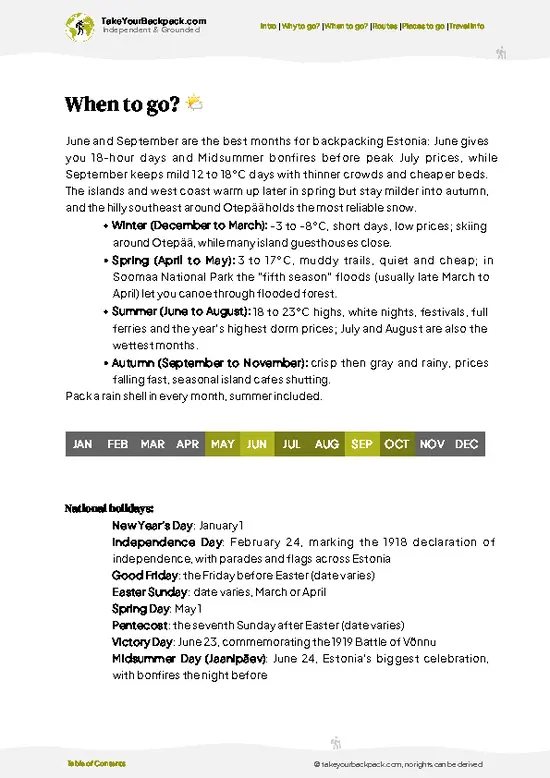
Best months and why: June to August are the best months for most attractions in Estonia, because days last up to 18 hours around the solstice and daytime highs sit at roughly 18 to 24°C. Everything is open, including island ferries and outdoor sites.
Shoulder seasons and winter: May and September bring 10 to 17°C, fewer visitors and accommodation often 15 to 30 percent cheaper than July. Rain is steady year-round, with August and autumn the wettest, so a light waterproof matters. From November to March temperatures hover around -8 to 2°C, daylight shrinks to about six hours in December, and some rural museums and seasonal sites shorten hours or close. Bogs and coastal areas can freeze and be walkable, which suits winter travelers with the right gear. Late June, around Midsummer, brings a national … read more 👉
Best months and why: June to August are the best months for most attractions in Estonia, because days last up to 18 hours around the solstice and daytime highs sit at roughly 18 to 24°C. Everything is open, including island ferries and outdoor sites.
Shoulder seasons and winter: May and September bring 10 to 17°C, fewer visitors and accommodation often 15 to 30 percent cheaper than July. Rain is steady year-round, with August and autumn the wettest, so a light waterproof matters. From November to March temperatures hover around -8 to 2°C, daylight shrinks to about six hours in December, and some rural museums and seasonal sites shorten hours or close. Bogs and coastal areas can freeze and be walkable, which suits winter travelers with the right gear. Late June, around Midsummer, brings a national holiday when shops close and transport thins out, and Tallinn’s Old Town fills when cruise ships dock in summer.

attraction hoppingPlanning Your Route Efficiently

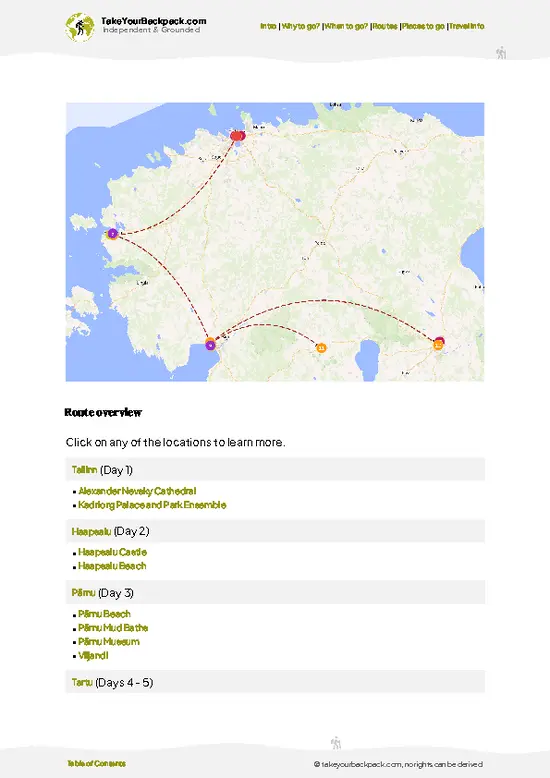
How many days to plan: A trip combining several attractions in Estonia needs 5 to 8 days, since distances are short but rural transport is slow.
Grouping and direction: Northern Estonia (Tallinn and the coastal national parks) clusters together, as do the south (Tartu and the uplands). Starting in Tallinn, then heading south through Tartu, and finishing in the southeast or along the west coast, avoids backtracking. Tallinn to Tartu takes about 2.5 hours by bus, Tallinn to Pärnu about 2 hours, and Tallinn to the island ferries at Virtsu or Rohuküla roughly 1.5 to 2 hours plus a 30 to 90 minute crossing.
Pacing and mistakes: Allow a half day to two days per stop, with Tallinn needing two. A common error is trying islands and southern uplands in the same short trip. Another is relying on infrequent … read more 👉
How many days to plan: A trip combining several attractions in Estonia needs 5 to 8 days, since distances are short but rural transport is slow.
Grouping and direction: Northern Estonia (Tallinn and the coastal national parks) clusters together, as do the south (Tartu and the uplands). Starting in Tallinn, then heading south through Tartu, and finishing in the southeast or along the west coast, avoids backtracking. Tallinn to Tartu takes about 2.5 hours by bus, Tallinn to Pärnu about 2 hours, and Tallinn to the island ferries at Virtsu or Rohuküla roughly 1.5 to 2 hours plus a 30 to 90 minute crossing.
Pacing and mistakes: Allow a half day to two days per stop, with Tallinn needing two. A common error is trying islands and southern uplands in the same short trip. Another is relying on infrequent buses to reach national park trailheads. Pick one or two regions, check timetables a day ahead, and rent a car for remote areas.

The ListHighly Recommended attractions of Estonia

1 Seaplane Harbour

historic hangars, maritime technology, submarine tours

Board a Cold War submarine, explore interactive maritime displays, and walk beneath soaring concrete domes by the harbor.

estonia-attraction-seaplane-harbour
© Google |

2 Kadriorg Palace and Park Ensemble

baroque palace, formal gardens, imperial art collection

Stroll through manicured grounds and ornate halls built for a Russian empress, with changing exhibitions and peaceful green spaces.

estonia-attraction-kadriorg-palace-and-park-ensemble
© Google |

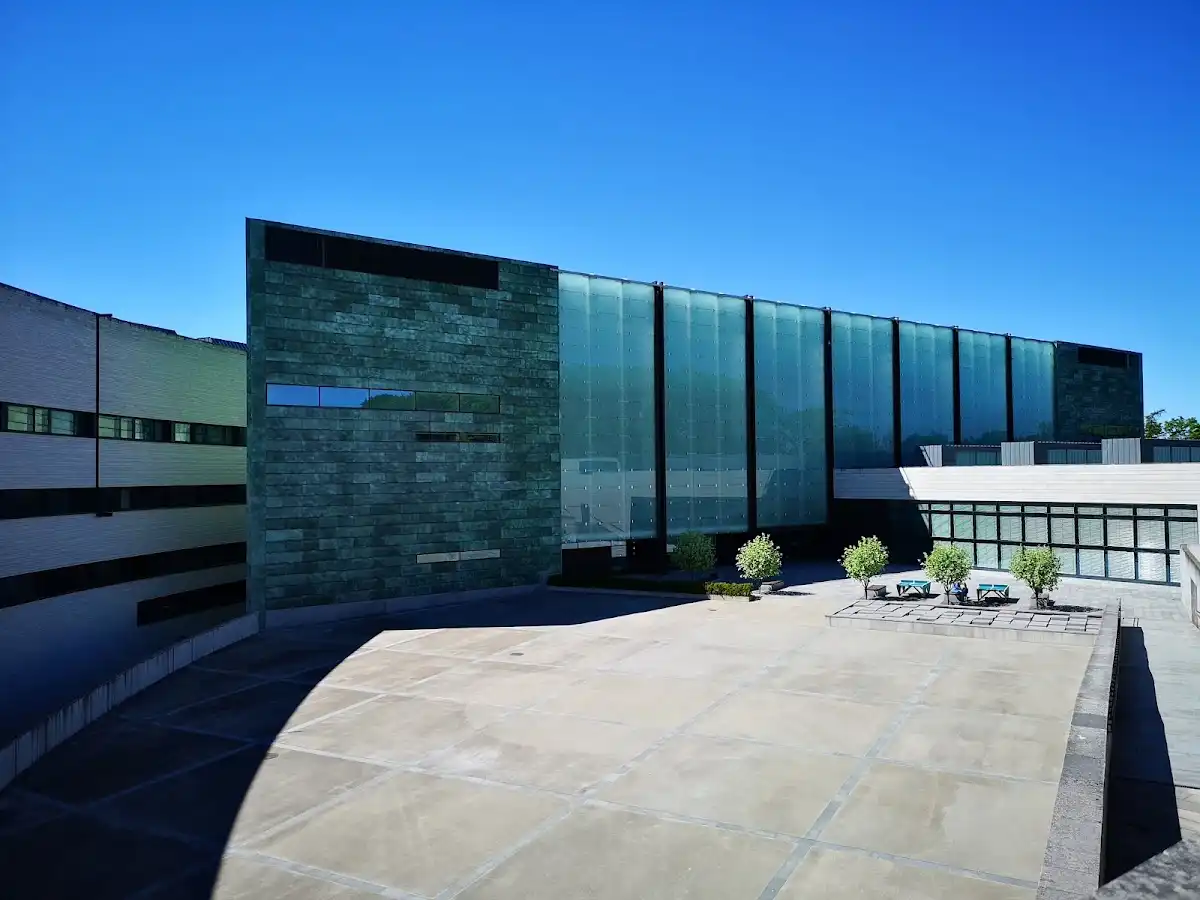
3 Kumu Art Museum

modern galleries, Estonian art, sculptural architecture

Discover works from Baltic classics to contemporary installations in a light-filled space that blends into the surrounding parkland.

estonia-attraction-kumu-art-museum
© Google |

4 Estonian National Museum

contemporary architecture, Finno-Ugric cultures, interactive exhibits

Trace the story of Estonia’s people through immersive displays, folk artifacts, and modern design in a striking riverside building.

estonia-attraction-estonian-national-museum
© Google |

5 Estonian Open Air Museum

historic farmsteads, windmills, coastal fishing village

Wander between relocated wooden buildings and windmills, experiencing rural life as it was lived across Estonia’s diverse regions.

estonia-attraction-estonian-open-air-museum
© Google |

6 Alexander Nevsky Cathedral

onion domes, Orthodox icons, hilltop silhouette

Admire ornate mosaics and gilded iconostasis inside Tallinn’s most prominent Orthodox church, set atop Toompea with city views.

estonia-attraction-alexander-nevsky-cathedral
© Google |

7 Narva Castle

riverside fortress, border views, medieval towers

Climb stone ramparts overlooking Russia, explore centuries-old towers, and learn about the region’s shifting frontiers.

8 A. H. Tammsaare Museum in Vargamäe

rural homestead, literary heritage, peat bog landscapes

Step into the rural world that inspired Estonia’s most famous novel, surrounded by traditional farm buildings and quiet northern marshland.

estonia-attraction-a-h-tammsaare-museum-in-vargamae
© Google |

9 Pärnu Museum

local archaeology, spa town history, Hanseatic trade

Follow Pärnu’s transformation from medieval port to seaside resort through archaeological finds and stories of Baltic trade.

estonia-attraction-parnu-museum
© Google |
Loading the map 🌍

Expert viewPro Tips for Exploring the Best

How many to visit: Plan on one or two major attractions per day, and about 8 to 12 over a week. Distances are short, but rural buses are infrequent, so more than that turns the trip into waiting at stops.
Prioritizing by travel style: History and museum lovers should spend their time in Tallinn and Tartu, where sights are walkable and indoor options cover rainy days. Nature-focused travelers should put national parks, bogs and coast first, since they are mostly free or cheap and suit self-guided walking. Photographers and slow travelers get the most from the islands. Mixed groups can pair one city with one wild area.
Budget: Budget about US$35 to 60 a day (€30 to 55) for hostels, food and sights, plus roughly US$10 to 20 for transport on busier days. Museum entry typically runs €6 to 18, with … read more 👉
How many to visit: Plan on one or two major attractions per day, and about 8 to 12 over a week. Distances are short, but rural buses are infrequent, so more than that turns the trip into waiting at stops.
Prioritizing by travel style: History and museum lovers should spend their time in Tallinn and Tartu, where sights are walkable and indoor options cover rainy days. Nature-focused travelers should put national parks, bogs and coast first, since they are mostly free or cheap and suit self-guided walking. Photographers and slow travelers get the most from the islands. Mixed groups can pair one city with one wild area.
Budget: Budget about US$35 to 60 a day (€30 to 55) for hostels, food and sights, plus roughly US$10 to 20 for transport on busier days. Museum entry typically runs €6 to 18, with Tallinn’s major sights at the upper end. Park entry and many trails are free, although parking or guided bog walks may cost €10 to 25. Guided tours average €15 to 40 per person. Combined city cards in Tallinn and Tartu can pay off if you plan three or more paid visits.
Safety and culture: Estonia is very safe, with low violent crime. Watch for ticks in forest and bog areas from spring to autumn, and wear long trousers and check your skin. Mosquitoes are heavy in summer. Boardwalk bogs require staying on marked paths, both for safety and to protect the ecosystem. Estonians value personal space and quiet, so keep voices low in nature areas and museums. Soviet-era sites deal with painful history, so photography with jokes or poses is poorly received. Carry a card, since cash is rarely needed, and book cruise-day Old Town visits early or late to avoid crowds.

✈️ The backpacker research shortcutEstonia Travel Guide

An offline-friendly backpacking guide with optimized travel routes, ranked highlights, transport advice, and the best areas to stay.
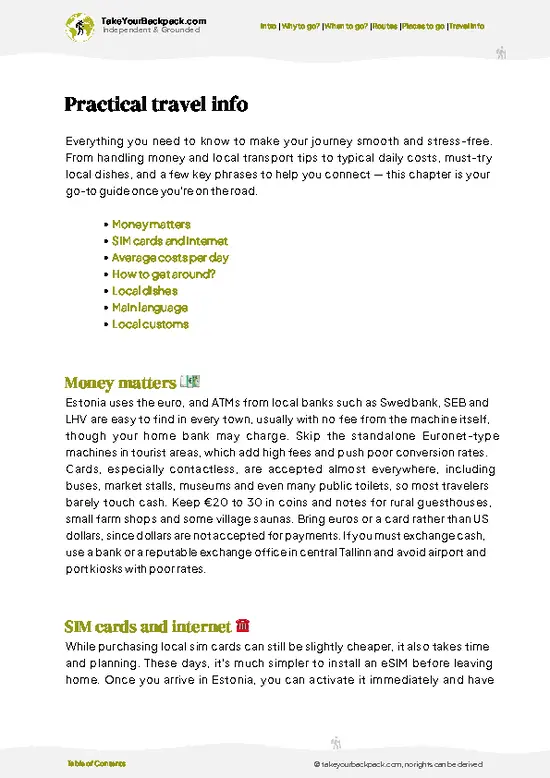
example page 0 from our offline Travel Guide for Estonia
example page 1 from our offline Travel Guide for Estonia
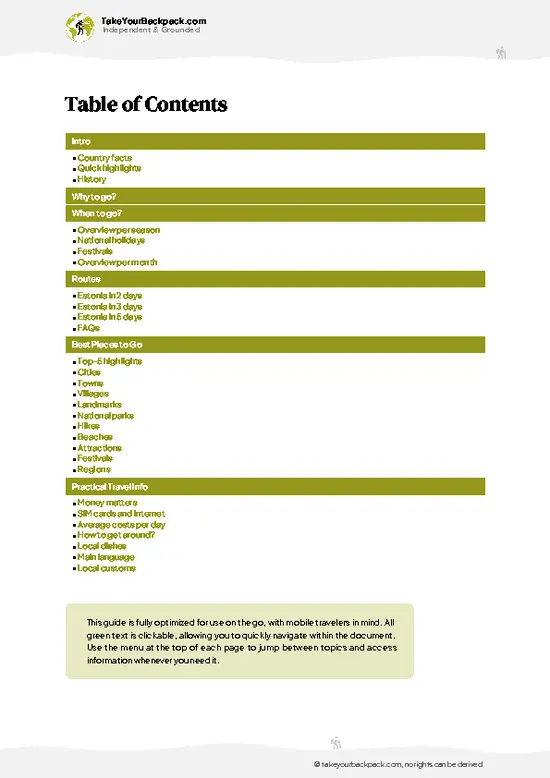
example page 2 from our offline Travel Guide for Estonia
example page 3 from our offline Travel Guide for Estonia
example page 4 from our offline Travel Guide for Estonia
example page 5 from our offline Travel Guide for Estonia
example page 6 from our offline Travel Guide for Estonia
example page 7 from our offline Travel Guide for Estonia
The digital guide (267 pages) contains:
✅ 70 highlights, ranked by travel appeal
✅ Optimized 2, 3 & 5-day travel routes
✅ Cities, national parks, landmarks, beaches
✅ How to get around
✅ Offline-friendly for travel without Wi-Fi
👉 Click to see all 30+ guide features

📅 Plan smarter in minutes, not weeks
✅ Month by month travel advice
✅ Festivals & national holidays
✅ Budget expectations

🗺️ Go to the right places, skip the overrated ones
✅ Honest pros & cons of destinations
✅ Top hikes, parks & viewpoints
✅ Lesser-known places most travelers miss
✅ Clear “worth it vs skip it” guidance

🛏️ Travel smoothly without rookie mistakes
✅ Best areas to stay
✅ Transport systems explained simply
✅ Common scams & safety advice
✅ SIM cards, money & practical tips

🌍 Understand the country, not just visit it
✅ Culture & traditions
✅ 52 Essential phrases & customs
✅ Festivals worth planning around
✅ Traveler-friendly historical context
✅ Insights that make places more meaningful

📱 Built for real travel conditions
✅ Fully downloadable PDF
✅ Works completely offline
✅ Optimized for phone use
✅ Useful in remote areas & buses
✅ Everything in one place
Stop searching, start planning
Get instant access to your full guide. 30‑day money-back guarantee.
+ Add another guide for just

By proceeding you agree to our terms.
Sent to your inbox immediately after payment • 100% Secure Checkout
Best Backpacking Travel Advisor 2025 tourism awardBest Backpacking
Travel Advisor
2025
What others say about Take Your Backpack Guides:
⭐⭐⭐⭐⭐
Fantastic, amazing amount of information!
⭐⭐⭐⭐⭐
My goodness this is amazing, it's what I've been looking for hats off too you!
⭐⭐⭐⭐⭐
I think this is absolutely BRILLIANT
⭐⭐⭐⭐
Very complete and informative. It's still missing places, but I gotta to commend you
⭐⭐⭐⭐⭐
This is truly amazing, thank you, can't wait to explore it with my kids!
⭐⭐⭐⭐⭐
Awesome resource, thank you!
⭐⭐⭐⭐⭐
This is amazing! Can't wait to explore the ones I haven't seen
⭐⭐⭐⭐
I love this! Well done, great idea.
⭐⭐⭐⭐⭐
Thanks for taking the time to make this gem!
⭐⭐⭐⭐⭐
This might be the best website I've ever seen.
⭐⭐⭐⭐⭐
Congratulations, and thank you so much for your work; it's incredibly valuable.
⭐⭐⭐⭐
In all seriousness I think you did a great job pointing out the important spots
⭐⭐⭐⭐⭐
10/10 very good
⭐⭐⭐⭐⭐
As someone who's only just starting to visit regularly this is awesome, thank you.
⭐⭐⭐⭐
Thank you very much! I'm going to visit my dad, it's going to be very useful!
⭐⭐⭐⭐⭐
This is really cool! We'll be travelling for the first time and this definitely come in handy.
⭐⭐⭐⭐⭐
You are now our minister of culture, congratulations 👨‍💼
⭐⭐⭐⭐⭐
Just wanted to tell you that this is a pearl! Going to follow your recommendations.
⭐⭐⭐⭐⭐
This is so cool. I'll definitely be using the resource for my travels soon.
⭐⭐⭐⭐⭐
This is very impressive! Good work.
⭐⭐⭐⭐⭐
This is an amazing and informative site. Very well done!

🛏️ Where to stay?Where to Stay: Estonia Edition

Estonia has plenty of hostels and guesthouses, with dorm beds typically around €15 to €30 a night, and most of them cluster in Tallinn. Tallinn’s Old Town puts you within walking distance of the main sights but gets loud on weekend nights with bar crowds and stag parties, while Kalamaja and the area around Telliskivi are quieter and cheaper, with a creative-district cafe scene about 10 to 15 minutes on foot from the walls. In Tartu, the compact center near the university keeps you close to student nightlife, and wooden-house districts like Karlova and Supilinn trade a short walk for calmer, safe streets, whereas Pärnu fills up fast and gets pricier in its short summer beach season.

If you enjoy … read more 👉
Estonia has plenty of hostels and guesthouses, with dorm beds typically around €15 to €30 a night, and most of them cluster in Tallinn. Tallinn’s Old Town puts you within walking distance of the main sights but gets loud on weekend nights with bar crowds and stag parties, while Kalamaja and the area around Telliskivi are quieter and cheaper, with a creative-district cafe scene about 10 to 15 minutes on foot from the walls. In Tartu, the compact center near the university keeps you close to student nightlife, and wooden-house districts like Karlova and Supilinn trade a short walk for calmer, safe streets, whereas Pärnu fills up fast and gets pricier in its short summer beach season.

If you enjoy meeting fellow travelers, consider choosing hostels with high ratings for atmosphere. On the other hand, if you prefer having your own space, a hotel might be a better option.

EstoniaExplore Beyond This Category

👋 Meet the founderWho’s Behind Take Your Backpack?

Johan, backpacker and founder of TakeYourBackpackHi, I’m Johan (Netherlands 🇳🇱), the creator of TakeYourBackpack. Over the past 3 decades, I’ve backpacked through 90+ countries across six continents, gaining extensive experience with independent travel, long-term trips, and overland routes.

This site is built on a combination of firsthand travel experience and carefully curated insights from other backpackers. Many guides are based on places I’ve personally visited, while others bring together tips, observations, and practical advice shared by trusted travelers I’ve met along the way.

The goal is to provide realistic, experience-driven guidance — not generic itineraries — so you can explore destinations with better context, clearer expectations, and more confidence.