×

Estonia🇪🇪 | best regionsThe 6 Top regions in Estonia

Estonia is small enough that its regions differ less by distance than by character: the islands and coast run quiet and seasonal, the capital area is the most crowded and priciest, and the inland south is cheapest and emptiest. Buses link them all, but frequency thins away from the main roads, so independent travel works best when you match region type to your pace and budget.

By Johan Kruseman 🇳🇱 | Updated October 18, 2026
Explore the best cities in Estonia

Why go?Why Travelers Love These Spots

Estonia suits regional travel because it is compact, flat and low in population, with about 1.3 million people across roughly 45,000 square kilometers. Distances stay short, and an unusually reliable digital and transport infrastructure means bus timetables, tickets and payments work on a phone almost everywhere. Centuries of Danish, German, Swedish and Russian rule left distinct cultural layers that show up in architecture, food and dialect from one area to the next, while the Baltic Sea climate shapes what each place offers by season.

Before choosing Estonia, know that it rewards nature and quiet more than nightlife or mountains. Peaks are low (the highest point is about 318 meters), public transport thins sharply in rural areas and on islands, and many small guesthouses and sights run … read more 👉
Estonia suits regional travel because it is compact, flat and low in population, with about 1.3 million people across roughly 45,000 square kilometers. Distances stay short, and an unusually reliable digital and transport infrastructure means bus timetables, tickets and payments work on a phone almost everywhere. Centuries of Danish, German, Swedish and Russian rule left distinct cultural layers that show up in architecture, food and dialect from one area to the next, while the Baltic Sea climate shapes what each place offers by season.

Before choosing Estonia, know that it rewards nature and quiet more than nightlife or mountains. Peaks are low (the highest point is about 318 meters), public transport thins sharply in rural areas and on islands, and many small guesthouses and sights run on short summer schedules. English is widely spoken, especially among younger people.
Behind the Scenes of Selection
The list of best regions in Estonia is created based on landscapes, local culture, attractions, vibes, and overall appeal. If you feel a region is missing in this list, please let us know.

When to go?Seasonal Guide to Visiting

Best months and why: The best months for regions in Estonia are June to August, when daytime highs reach 18 to 23°C, daylight stretches past 18 hours and nearly all seasonal ferries, guesthouses and sights are open. Rain is moderate, roughly 60 to 90 millimeters a month in summer, usually in short showers.

Shoulder seasons and winter: May and September bring 10 to 17°C, fewer visitors and lower accommodation prices, often 10 to 25 percent below July rates. Some island and coastal businesses open only partly in these months. Late September also suits forest walking and berry and mushroom season.

From November to March temperatures hover around -8 to 2°C, daylight shrinks to about 6 hours in December, and many rural guesthouses close. Snow and frozen bogs open winter options in the inland … read more 👉
Best months and why: The best months for regions in Estonia are June to August, when daytime highs reach 18 to 23°C, daylight stretches past 18 hours and nearly all seasonal ferries, guesthouses and sights are open. Rain is moderate, roughly 60 to 90 millimeters a month in summer, usually in short showers.

Shoulder seasons and winter: May and September bring 10 to 17°C, fewer visitors and lower accommodation prices, often 10 to 25 percent below July rates. Some island and coastal businesses open only partly in these months. Late September also suits forest walking and berry and mushroom season.

From November to March temperatures hover around -8 to 2°C, daylight shrinks to about 6 hours in December, and many rural guesthouses close. Snow and frozen bogs open winter options in the inland and northern areas, but island ferry schedules shrink. Midsummer around June 23 to 24 fills accommodation and empties the cities.

region hoppingPlanning Your Route Efficiently

How long and in what order: A trip combining several regions in Estonia needs 7 to 10 days, because the country is small but rural bus links make every transfer slower than the map suggests. Enter through Tallinn, then move in one loop rather than doubling back, typically heading south or west first and finishing at Tallinn or Tartu to match your flight.

Allow 2 to 3 days in the capital area and the university city of Tartu, and 1 to 3 days for each rural or island stop. Main intercity buses between Tallinn and Tartu take about 2.5 hours, and Tallinn to Pärnu about 2 hours. Island and remote coastal transfers take 3 to 5 hours including a ferry.

Planning mistakes: Travelers often cram five or six regions into a week and spend half of it on buses. Choose three or four instead. Others ignore … read more 👉
How long and in what order: A trip combining several regions in Estonia needs 7 to 10 days, because the country is small but rural bus links make every transfer slower than the map suggests. Enter through Tallinn, then move in one loop rather than doubling back, typically heading south or west first and finishing at Tallinn or Tartu to match your flight.

Allow 2 to 3 days in the capital area and the university city of Tartu, and 1 to 3 days for each rural or island stop. Main intercity buses between Tallinn and Tartu take about 2.5 hours, and Tallinn to Pärnu about 2 hours. Island and remote coastal transfers take 3 to 5 hours including a ferry.

Planning mistakes: Travelers often cram five or six regions into a week and spend half of it on buses. Choose three or four instead. Others ignore ferry bookings in summer, so reserve vehicle or foot passages ahead, and check Sunday and holiday timetables, which are much sparser.

The ListHighly Recommended regions of Estonia

1 Saaremaa Island

windmills, meteorite craters, juniper groves

Travel across Estonia’s largest island to find ancient stone churches, unique geological sites, and a landscape shaped by centuries of isolation.

2 Ruhnu Island

timber church, sandy beaches, lighthouse

Arrive by boat to an isolated island where Swedish heritage lingers, forest paths cross open meadows, and the sea is never far away.

estonia-region-ruhnu-island
© Google |

3 Kihnu Island

matriarchal traditions, striped skirts, coastal meadows

Experience a living folk culture where women steer daily life, ancient customs persist, and the landscape blends sea, pine, and pasture.

estonia-region-kihnu-island
© Google | Virve Pihelgas

4 Prangli Island

pine forests, sandy beaches, wooden villages

Discover a small island where forest tracks lead to Baltic shores, and local life moves at a pace set by weather and ferry schedules.

5 Võru County

rolling hills, Seto culture, lakeside saunas

Venture into southern Estonia for a region defined by dialect, layered folk traditions, and a patchwork of lakes and wooded highlands.

6 Osmussaar Island

limestone cliffs, wartime ruins, migratory birds

Walk windswept trails past abandoned bunkers and rare flora, with Baltic views and seasonal birdlife shaping the island’s quiet mood.

estonia-region-osmussaar-island
© Google | Urmas Lekk
Loading the map 🌍

Expert viewPro Tips for Exploring the Best

How many regions to visit: Plan on three to four regions in a week to ten days. Rural buses run only a few times a day, so each transfer costs half a day, and fewer stops leave time for the walking, cycling and sauna stops that define Estonia.

Choosing by travel style: Pick urban regions if you want museums, nightlife and the most frequent transport. Pick coastal and island regions for beaches, cycling and quiet, but accept seasonal opening and a need for a bike or rental car. Pick inland forest and bog areas for hiking and the lowest prices, where lodging is often farmstays or state-run forest huts. Hikers can use free RMK campsites and cooking shelters across the country.

What it costs: Budget €40 to 60 a day for hostels or simple guesthouses, self-catering and buses, and €70 to 110 for … read more 👉
How many regions to visit: Plan on three to four regions in a week to ten days. Rural buses run only a few times a day, so each transfer costs half a day, and fewer stops leave time for the walking, cycling and sauna stops that define Estonia.

Choosing by travel style: Pick urban regions if you want museums, nightlife and the most frequent transport. Pick coastal and island regions for beaches, cycling and quiet, but accept seasonal opening and a need for a bike or rental car. Pick inland forest and bog areas for hiking and the lowest prices, where lodging is often farmstays or state-run forest huts. Hikers can use free RMK campsites and cooking shelters across the country.

What it costs: Budget €40 to 60 a day for hostels or simple guesthouses, self-catering and buses, and €70 to 110 for private rooms and restaurant meals. Hostel dorms run €15 to 30, a guesthouse double €40 to 80. Intercity buses cost roughly €5 to 15 per leg, island ferries around €2 to 10 per person on short crossings, and national park entry is mostly free. Museum tickets typically cost €8 to 15. Guided bog walks run about €15 to 30, and bike rental €10 to 20 a day.

Safety and cultural notes: Estonia is very safe, with low violent crime. The real hazards are natural: ticks in forests from spring to autumn (wear long trousers, check skin, consider the tick-borne encephalitis vaccine), cold-water swimming, and thin ice in winter. Bog walking is only safe on marked boardwalks or with a guide. Estonians value personal space and quiet, so keep voices low on public transport and avoid forced small talk. Sauna etiquette matters: shower first and follow local nudity norms at private saunas. Carry a card, since cash is rarely needed, and expect poor mobile signal in remote forest areas.

✈️ The backpacker research shortcutEstonia Travel Guide

An offline-friendly backpacking guide with optimized travel routes, ranked highlights, transport advice, and the best areas to stay.
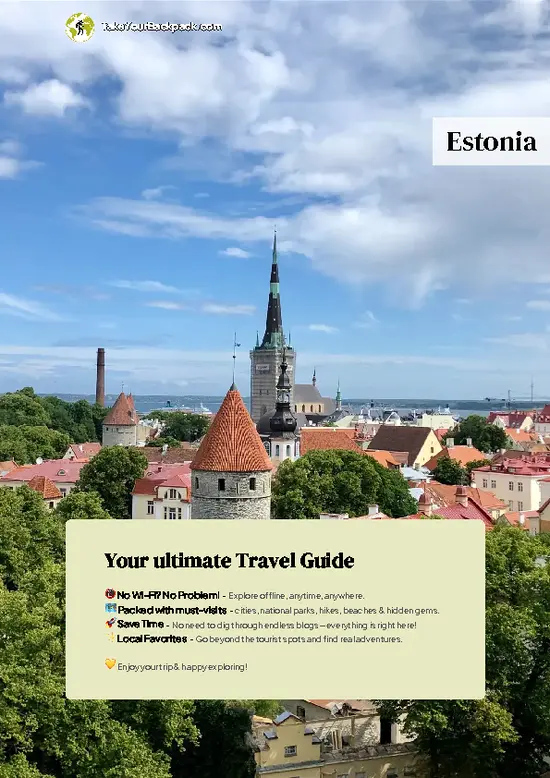
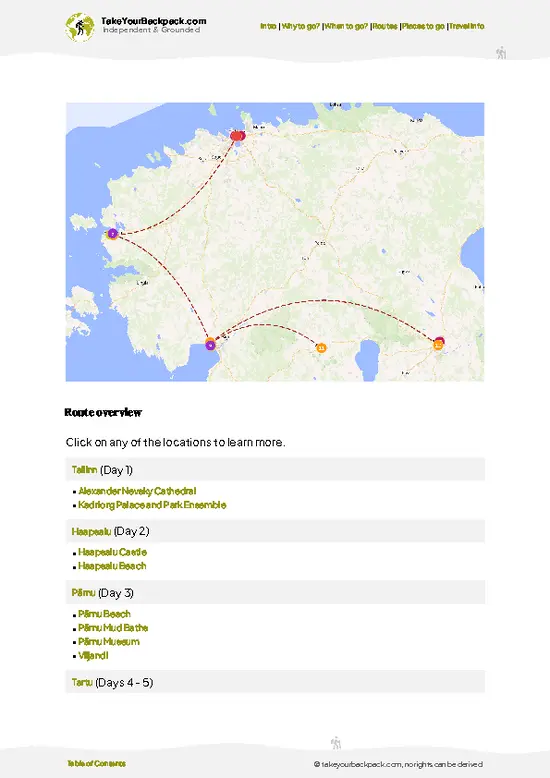
example page 0 from our offline Travel Guide for Estonia
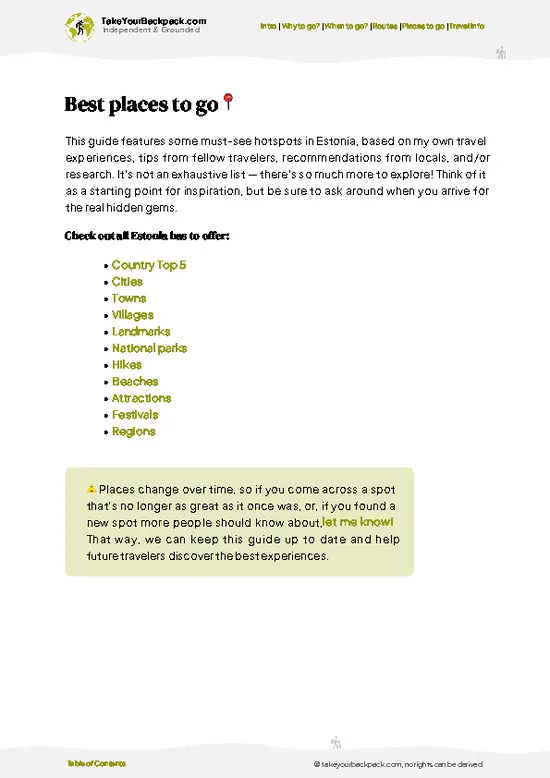
example page 1 from our offline Travel Guide for Estonia
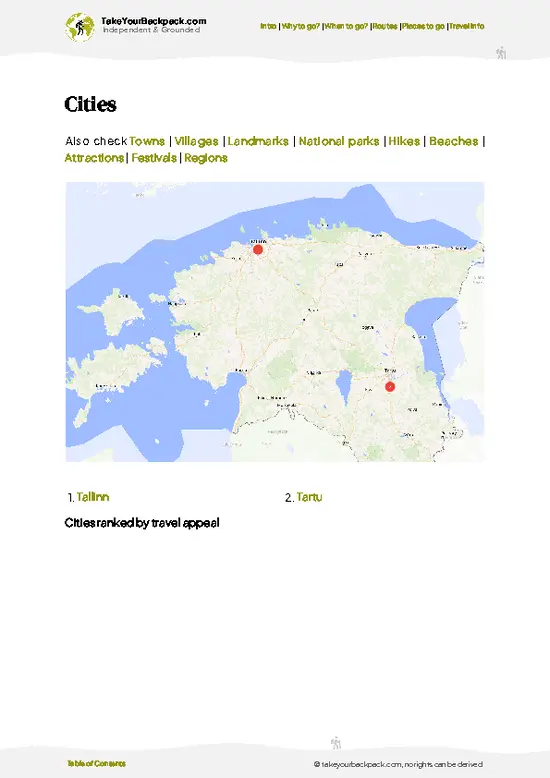
example page 2 from our offline Travel Guide for Estonia
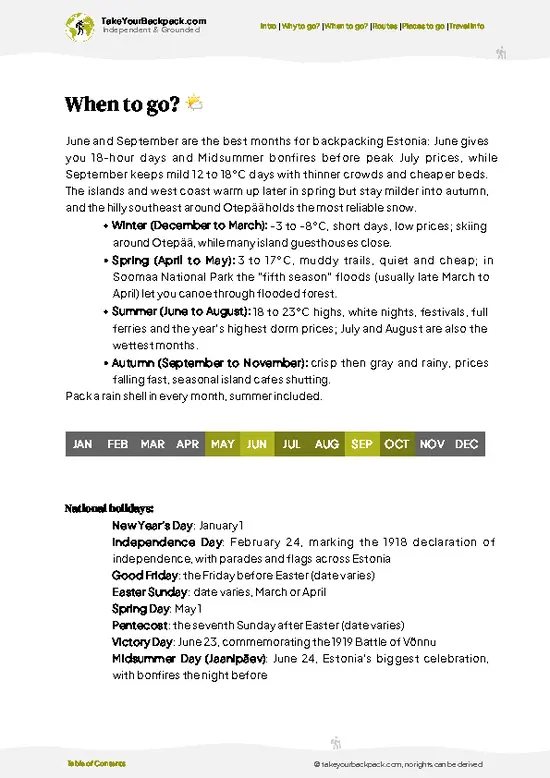
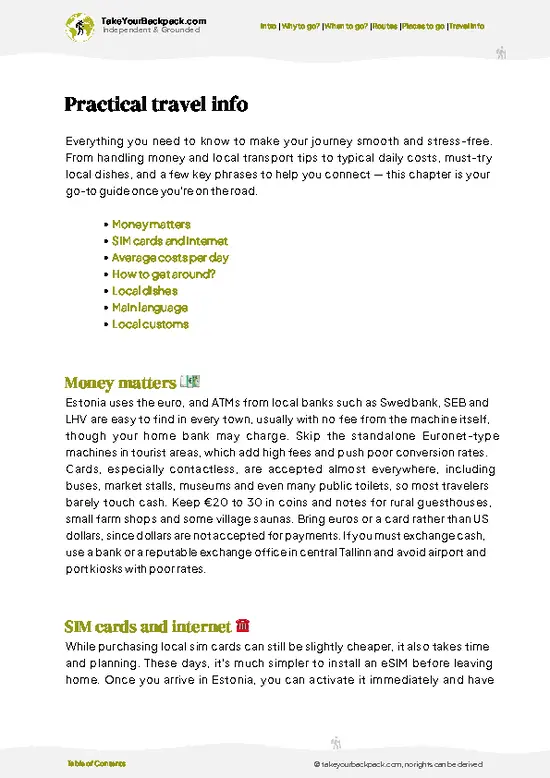
example page 3 from our offline Travel Guide for Estonia
example page 4 from our offline Travel Guide for Estonia
example page 5 from our offline Travel Guide for Estonia
example page 6 from our offline Travel Guide for Estonia
example page 7 from our offline Travel Guide for Estonia
The digital guide (267 pages) contains:
✅ 70 highlights, ranked by travel appeal
✅ Optimized 2, 3 & 5-day travel routes
✅ Cities, national parks, landmarks, beaches
✅ How to get around
✅ Offline-friendly for travel without Wi-Fi
👉 Click to see all 30+ guide features

📅 Plan smarter in minutes, not weeks
✅ Month by month travel advice
✅ Festivals & national holidays
✅ Budget expectations

🗺️ Go to the right places, skip the overrated ones
✅ Honest pros & cons of destinations
✅ Top hikes, parks & viewpoints
✅ Lesser-known places most travelers miss
✅ Clear “worth it vs skip it” guidance

🛏️ Travel smoothly without rookie mistakes
✅ Best areas to stay
✅ Transport systems explained simply
✅ Common scams & safety advice
✅ SIM cards, money & practical tips

🌍 Understand the country, not just visit it
✅ Culture & traditions
✅ 52 Essential phrases & customs
✅ Festivals worth planning around
✅ Traveler-friendly historical context
✅ Insights that make places more meaningful

📱 Built for real travel conditions
✅ Fully downloadable PDF
✅ Works completely offline
✅ Optimized for phone use
✅ Useful in remote areas & buses
✅ Everything in one place
Stop searching, start planning
Get instant access to your full guide. 30‑day money-back guarantee.
+ Add another guide for just

By proceeding you agree to our terms.
Sent to your inbox immediately after payment • 100% Secure Checkout
Best Backpacking Travel Advisor 2025 tourism awardBest Backpacking
Travel Advisor
2025
What others say about Take Your Backpack Guides:
⭐⭐⭐⭐⭐
Fantastic, amazing amount of information!
⭐⭐⭐⭐⭐
My goodness this is amazing, it's what I've been looking for hats off too you!
⭐⭐⭐⭐⭐
I think this is absolutely BRILLIANT
⭐⭐⭐⭐
Very complete and informative. It's still missing places, but I gotta to commend you
⭐⭐⭐⭐⭐
This is truly amazing, thank you, can't wait to explore it with my kids!
⭐⭐⭐⭐⭐
Awesome resource, thank you!
⭐⭐⭐⭐⭐
This is amazing! Can't wait to explore the ones I haven't seen
⭐⭐⭐⭐
I love this! Well done, great idea.
⭐⭐⭐⭐⭐
Thanks for taking the time to make this gem!
⭐⭐⭐⭐⭐
This might be the best website I've ever seen.
⭐⭐⭐⭐⭐
Congratulations, and thank you so much for your work; it's incredibly valuable.
⭐⭐⭐⭐
In all seriousness I think you did a great job pointing out the important spots
⭐⭐⭐⭐⭐
10/10 very good
⭐⭐⭐⭐⭐
As someone who's only just starting to visit regularly this is awesome, thank you.
⭐⭐⭐⭐
Thank you very much! I'm going to visit my dad, it's going to be very useful!
⭐⭐⭐⭐⭐
This is really cool! We'll be travelling for the first time and this definitely come in handy.
⭐⭐⭐⭐⭐
You are now our minister of culture, congratulations 👨‍💼
⭐⭐⭐⭐⭐
Just wanted to tell you that this is a pearl! Going to follow your recommendations.
⭐⭐⭐⭐⭐
This is so cool. I'll definitely be using the resource for my travels soon.
⭐⭐⭐⭐⭐
This is very impressive! Good work.
⭐⭐⭐⭐⭐
This is an amazing and informative site. Very well done!

🛏️ Where to stay?Best Places to Stay in Estonia

Estonia has plenty of hostels and guesthouses, with dorm beds typically around €15 to €30 a night, and most of them cluster in Tallinn. Tallinn’s Old Town puts you within walking distance of the main sights but gets loud on weekend nights with bar crowds and stag parties, while Kalamaja and the area around Telliskivi are quieter and cheaper, with a creative-district cafe scene about 10 to 15 minutes on foot from the walls. In Tartu, the compact center near the university keeps you close to student nightlife, and wooden-house districts like Karlova and Supilinn trade a short walk for calmer, safe streets, whereas Pärnu fills up fast and gets pricier in its short summer beach season.

If you enjoy … read more 👉
Estonia has plenty of hostels and guesthouses, with dorm beds typically around €15 to €30 a night, and most of them cluster in Tallinn. Tallinn’s Old Town puts you within walking distance of the main sights but gets loud on weekend nights with bar crowds and stag parties, while Kalamaja and the area around Telliskivi are quieter and cheaper, with a creative-district cafe scene about 10 to 15 minutes on foot from the walls. In Tartu, the compact center near the university keeps you close to student nightlife, and wooden-house districts like Karlova and Supilinn trade a short walk for calmer, safe streets, whereas Pärnu fills up fast and gets pricier in its short summer beach season.

If you enjoy meeting fellow travelers, consider choosing hostels with high ratings for atmosphere. On the other hand, if you prefer having your own space, a hotel might be a better option.

EstoniaExplore Estonia

👋 Meet the founderWho’s Behind Take Your Backpack?

Johan, backpacker and founder of TakeYourBackpackHi, I’m Johan (Netherlands 🇳🇱), the creator of TakeYourBackpack. Over the past 3 decades, I’ve backpacked through 90+ countries across six continents, gaining extensive experience with independent travel, long-term trips, and overland routes.

This site is built on a combination of firsthand travel experience and carefully curated insights from other backpackers. Many guides are based on places I’ve personally visited, while others bring together tips, observations, and practical advice shared by trusted travelers I’ve met along the way.

The goal is to provide realistic, experience-driven guidance — not generic itineraries — so you can explore destinations with better context, clearer expectations, and more confidence.