×

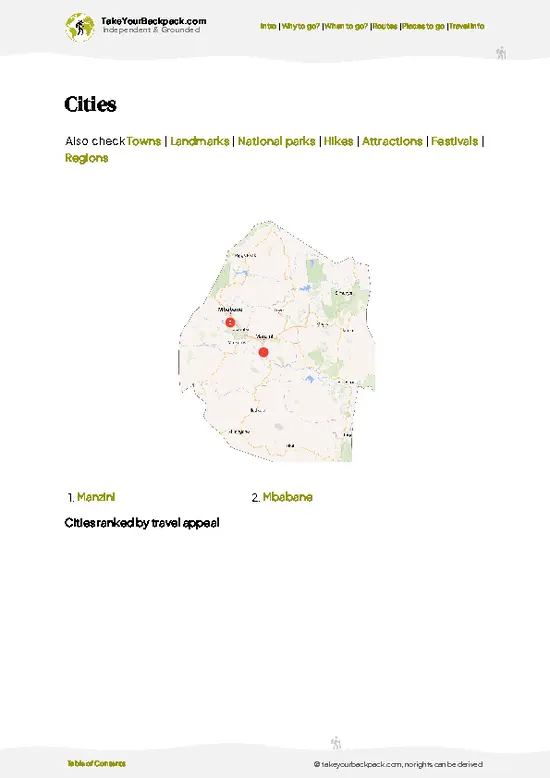
Eswatini🇸🇿 | citiesManziniMinibus hub, Matsapha commuters, produce and herbal market, ATMs | things to do and best time to go

Explore Malolotja Canopy TourExplore Mbabane

Backpacking in Manzini
🏆 Top pickcity ranked #1
By Johan Kruseman 🇳🇱 | Updated October 22, 2026

Manzini is the easiest place in Eswatini to change transport, because its main bus rank sends minibuses in every direction on fixed-fare routes. It sits in the Middle Veld, southeast of Mbabane, and works as the country’s commercial center rather than a capital. Sights are few. The city exists for trade and light industry, so people come for supplies, banks and connections. Cash machines and supermarkets are plentiful here and thin in villages, so withdraw money and stock up before you head out. Minibuses leave when full, not on a timetable, so reach the rank early in the morning and accept a wait. Weekday traffic is heavy because workers from the nearby Matsapha industrial estate pour in, so move before the morning rush or after it. It suits travelers building a route and bores anyone chasing scenery. At the market, vendors sell heaps of tomatoes, onions and sweet potatoes priced by the pile.

Discover everything you want to know in the 📖 Eswatini Travel Guide.


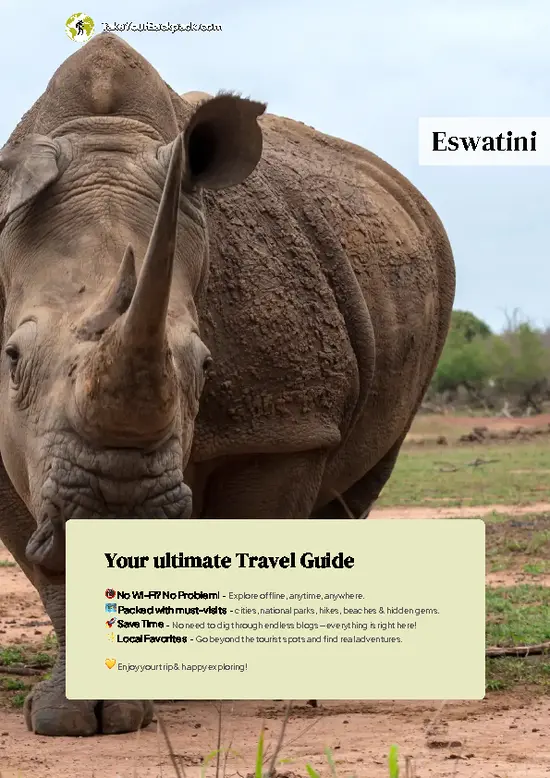
example page 0 from our offline Travel Guide for Eswatini
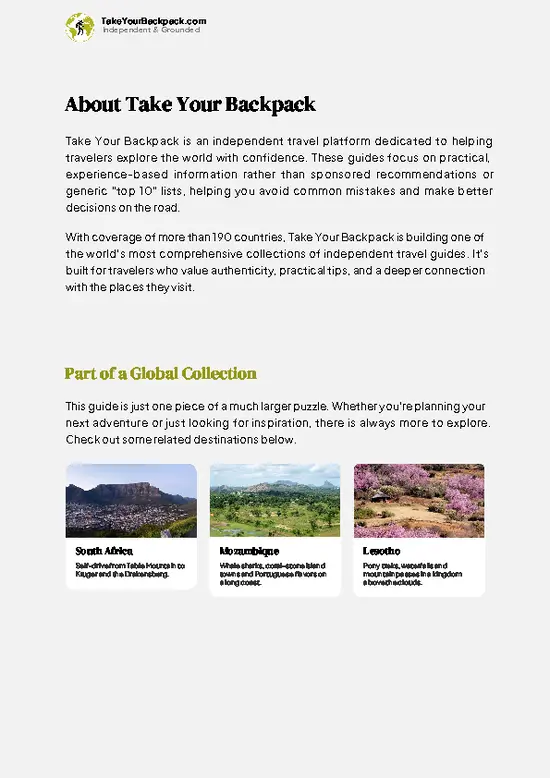
example page 1 from our offline Travel Guide for Eswatini
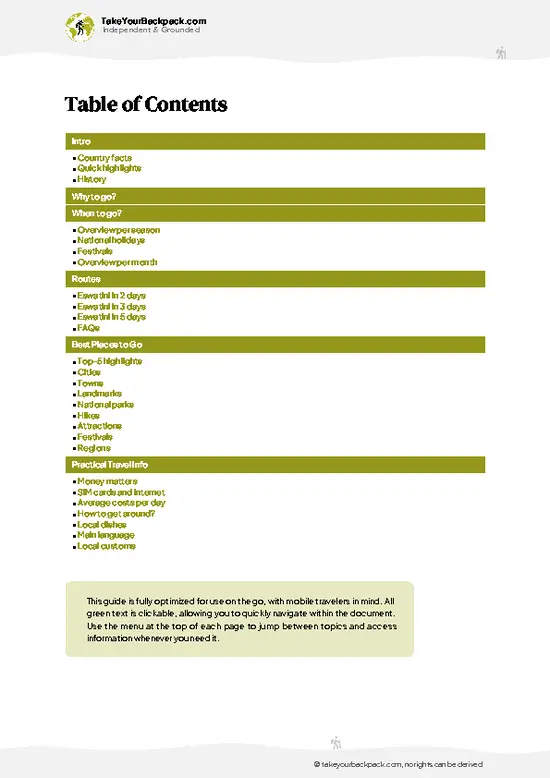
example page 2 from our offline Travel Guide for Eswatini
example page 3 from our offline Travel Guide for Eswatini
example page 4 from our offline Travel Guide for Eswatini
example page 5 from our offline Travel Guide for Eswatini
example page 6 from our offline Travel Guide for Eswatini
example page 7 from our offline Travel Guide for Eswatini
Loading the map 🌍
CLICK TO FILTER
cities
towns
landmarks
national parks
hikes
attractions
festivals
regions
SHOW COUNTRY’S BESTSHOW ALL

✨ Why go?
Ranked #1 city in Eswatini
What makes it a must-see city

Manzini earns its place in a backpacking route as the junction where Eswatini’s roads meet. Mbabane, the Malkerns valley, the Lubombo lowlands and the southern border towns all connect through the Manzini Bus Rank, so you can reach most of the country without backtracking. That makes it a practical base for day trips, especially if you want to avoid the pricier lodges near the big parks. The city also has the country’s widest choice of ordinary, unfiltered local food, from grilled meat to sishwala and stew at counters where few foreigners eat. Hostel and guesthouse beds are limited, so book ahead, and note that the best-known backpacker lodges sit in the valleys outside town. Nightlife is local, loud on Friday and Saturday, and mostly in bars and clubs rather than tourist venues. Walking works … read more 👉
Manzini earns its place in a backpacking route as the junction where Eswatini’s roads meet. Mbabane, the Malkerns valley, the Lubombo lowlands and the southern border towns all connect through the Manzini Bus Rank, so you can reach most of the country without backtracking. That makes it a practical base for day trips, especially if you want to avoid the pricier lodges near the big parks. The city also has the country’s widest choice of ordinary, unfiltered local food, from grilled meat to sishwala and stew at counters where few foreigners eat. Hostel and guesthouse beds are limited, so book ahead, and note that the best-known backpacker lodges sit in the valleys outside town. Nightlife is local, loud on Friday and Saturday, and mostly in bars and clubs rather than tourist venues. Walking works in the compact center but not after dark. Treat it as a one-night stop to restock, change money and catch an early minibus, not a destination to linger in for a week.

💡 HighlightsEssential experiences to have while visiting Manzini

  1. Manzini Market: The city’s best-known sight is a sprawl of produce stalls, secondhand clothes and a craft section selling grass baskets, woodcarvings and beadwork at lower prices than the tourist shops. A section of herbal and traditional-medicine sellers shows how many Swazis still mix modern and traditional health care. Go between 8 and 11 a.m. when stocks are fresh and heat is mild. Entry is free, allow 1 to 2 hours, and bargain gently.
  2. Manzini Bus Rank: Hundreds of minibuses queue here, each with a conductor calling the destination. It is noisy, chaotic and oddly orderly once you spot the route boards. Spend 30 to 45 minutes watching vendors sell airtime, fruit and snacks through the windows. Visit before 9 a.m. when the first rush peaks. It costs nothing to look, and you will see more
… read more 👉
  1. Manzini Market: The city’s best-known sight is a sprawl of produce stalls, secondhand clothes and a craft section selling grass baskets, woodcarvings and beadwork at lower prices than the tourist shops. A section of herbal and traditional-medicine sellers shows how many Swazis still mix modern and traditional health care. Go between 8 and 11 a.m. when stocks are fresh and heat is mild. Entry is free, allow 1 to 2 hours, and bargain gently.
  2. Manzini Bus Rank: Hundreds of minibuses queue here, each with a conductor calling the destination. It is noisy, chaotic and oddly orderly once you spot the route boards. Spend 30 to 45 minutes watching vendors sell airtime, fruit and snacks through the windows. Visit before 9 a.m. when the first rush peaks. It costs nothing to look, and you will see more daily life here than in any museum.
  3. Bhunu Mall: This is the city’s main shopping center, and it matters because it holds banks, ATMs, supermarkets and pharmacies in one place. Come mid-morning on a weekday for short queues. Entry is free and an errand run takes 1 to 2 hours. It also gives a clear view of the middle-class Swazi side of life, with office workers on lunch breaks and families shopping on Saturday mornings.
  4. Manzini’s craft and food stalls on the main streets: Around the center, street vendors grill corn, sell fat cakes called magwinya and prepare cheap plates of pap and meat. Late morning and lunchtime are best. A snack stop takes 30 to 60 minutes and costs US$1 to 3 per item. Eat where there is a queue of locals, which is the best safeguard for freshness.
From Manzini you can reach Mlilwane Wildlife Sanctuary, the Malkerns valley with its craft studios and the Mantenga Cultural Village, while Hlane Royal National Park suits a long day trip. Everything listed here is free to enter, so nothing needs a ticket or advance booking.
Spotted a mistake or missing something? Contact us.

🏘️ NeighborhoodsUnderstanding the local layout

Manzini is a compact commercial city, and the parts that matter to a backpacker fit within a few kilometers, so most of it can be covered with a mix of walking and short minibus hops.
  • City Center: The grid around the bus rank and Manzini Market is the working heart of the city. Streets are loud, crowded and cash-based, which is why mornings are the best time to explore, before midday heat and the afternoon rush. Walk it on foot, keep a small bag in front of you and carry small notes for stalls.
  • Manzini Market and Craft Area: The fresh produce hall, the secondhand clothing rows and the crafts section sit side by side. Prices are negotiable because tourists are not the main customers, so ask first and pay what feels fair. Roasted corn, fried fish and sweet potatoes are sold nearby. It is walkable
… read more 👉
Manzini is a compact commercial city, and the parts that matter to a backpacker fit within a few kilometers, so most of it can be covered with a mix of walking and short minibus hops.
  • City Center: The grid around the bus rank and Manzini Market is the working heart of the city. Streets are loud, crowded and cash-based, which is why mornings are the best time to explore, before midday heat and the afternoon rush. Walk it on foot, keep a small bag in front of you and carry small notes for stalls.
  • Manzini Market and Craft Area: The fresh produce hall, the secondhand clothing rows and the crafts section sit side by side. Prices are negotiable because tourists are not the main customers, so ask first and pay what feels fair. Roasted corn, fried fish and sweet potatoes are sold nearby. It is walkable from the bus rank, but the lanes get tight on Thursdays and Fridays.
  • Ngwane Park and Fonteyn: Fonteyn is a quieter residential and light-commercial area with a few cafés and guesthouse streets. Distances between places are longer than they look, so a short minibus or taxi ride saves time, particularly after dark when sidewalks are poorly lit.
  • Matsapha: Eswatini’s main industrial zone lies a short ride west. It has little to see, but the Gone Rural craft studio and the Ngwenya Glass area are reached through it, and the highway minibuses run frequently. Treat it as a pass-through rather than a place to wander.
  • Mhobodleni and Moneni: These residential outskirts show everyday life, with small shebeens and church groups. Visit by day with a local contact, as there is no signage for visitors and walking between them is slow.

⌛️ 1 dayA smart one-day plan

A market morning that ends with a slow afternoon in the surrounding hills.

7:30 AM: Manzini Bus Rank. Start where the day begins for local people. Watch the minibuses fill and vendors work the queues, then walk about 10 minutes to the market, keeping valuables zipped and phones out of sight.

8:30 AM: Manzini Market. Walk the produce rows first, then the craft section, where baskets and carvings cost less than in roadside shops. Bargain politely and buy something small to carry. The traditional medicine section is interesting to look at but not to photograph without permission.

10:30 AM: Street snack stop. Pick a stall near the market with a line, order magwinya or grilled meat and eat standing. This is cheaper and more filling than any café, and it will keep you going until lunch.

11:30 AM: Bhunu … read more 👉
A market morning that ends with a slow afternoon in the surrounding hills.

7:30 AM: Manzini Bus Rank. Start where the day begins for local people. Watch the minibuses fill and vendors work the queues, then walk about 10 minutes to the market, keeping valuables zipped and phones out of sight.

8:30 AM: Manzini Market. Walk the produce rows first, then the craft section, where baskets and carvings cost less than in roadside shops. Bargain politely and buy something small to carry. The traditional medicine section is interesting to look at but not to photograph without permission.

10:30 AM: Street snack stop. Pick a stall near the market with a line, order magwinya or grilled meat and eat standing. This is cheaper and more filling than any café, and it will keep you going until lunch.

11:30 AM: Bhunu Mall. Use the ATMs, buy a local SIM or airtime and restock water. It is the practical part of the day, but the mall also shows a different side of the city, with offices, banks and weekend shoppers.

1:00 PM: Residential streets away from the center. Skip the usual tourist loop and walk the quieter neighborhoods on the edge of the center, where small spaza shops, barbers and church halls show the daily rhythm of the city. Stay on main roads and keep it to an hour.

3:00 PM: Minibus out to the hills. Take a minibus toward the Malkerns valley for a late afternoon of craft studios and cooler air, or stay in town and rest before an early start.

6:00 PM: Early dinner and return. Eat before dark and take a taxi back to your bed rather than walking.

🌤️ When to go?Choosing the right time of year

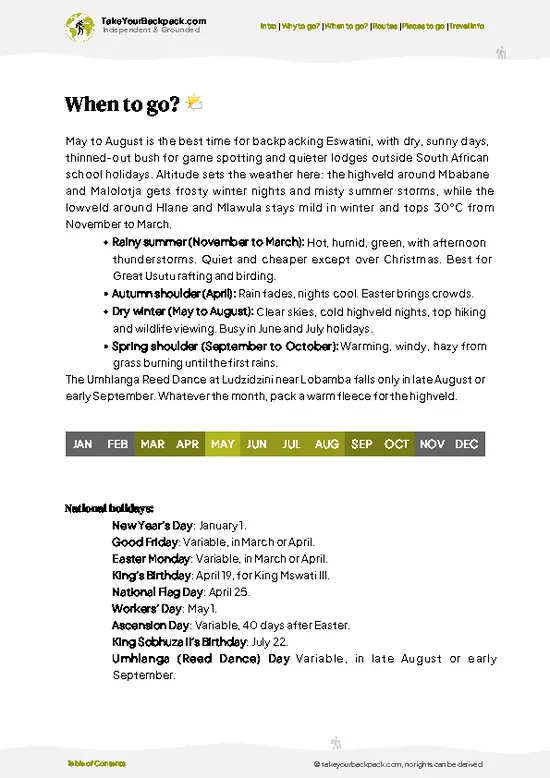
May to September is the easiest stretch for backpacking in Manzini, with dry, sunny days and cool nights.
  • Winter (May to August): Days reach 20 to 25°C (68 to 77°F), while nights can fall to 3 to 8°C (37 to 46°F). Rain is rare, daylight is shorter at roughly 10.5 to 11 hours, and crowds stay light. Bring a warm layer for evenings.
  • Spring (September to November): Temperatures climb to 22 to 30°C (72 to 86°F). Jacaranda trees bloom, and the first thunderstorms arrive in late spring. Prices stay steady.
  • Summer (December to February): Hot and humid, with highs of 28 to 35°C (82 to 95°F) and afternoon storms that flood low roads. Daylight stretches to about 14 hours. Local holidays push up minibus demand and some guesthouse rates.
  • Autumn (March to April): Warm days of 24 to 28°C (75 to 82°F), falling
… read more 👉
May to September is the easiest stretch for backpacking in Manzini, with dry, sunny days and cool nights.
  • Winter (May to August): Days reach 20 to 25°C (68 to 77°F), while nights can fall to 3 to 8°C (37 to 46°F). Rain is rare, daylight is shorter at roughly 10.5 to 11 hours, and crowds stay light. Bring a warm layer for evenings.
  • Spring (September to November): Temperatures climb to 22 to 30°C (72 to 86°F). Jacaranda trees bloom, and the first thunderstorms arrive in late spring. Prices stay steady.
  • Summer (December to February): Hot and humid, with highs of 28 to 35°C (82 to 95°F) and afternoon storms that flood low roads. Daylight stretches to about 14 hours. Local holidays push up minibus demand and some guesthouse rates.
  • Autumn (March to April): Warm days of 24 to 28°C (75 to 82°F), falling humidity and green hills. It is a calm shoulder season.
Time your visit for the Umhlanga reed dance in late August or early September if you want ceremonies, but book beds early because the whole country moves toward it.


source: climatestotravel.comJANJanuary: fair for travelingFEBFebruary: fair for travelingMARMarch: good for travelingAPRApril: highly recommended for travelingMAYMay: highly recommended for travelingJUNJune: excellent for travelingJULJuly: excellent for travelingAUGAugust: excellent for travelingSEPSeptember: highly recommended for travelingOCTOctober: highly recommended for travelingNOVNovember: fair for travelingDECDecember: fair for traveling
when-to-go

✈️ The backpacker research shortcutEswatini Travel Guide

An offline-friendly backpacking guide with optimized travel routes, ranked highlights, transport advice, and the best areas to stay.
example page 0 from our offline Travel Guide for Eswatini
example page 1 from our offline Travel Guide for Eswatini
example page 2 from our offline Travel Guide for Eswatini
example page 3 from our offline Travel Guide for Eswatini
example page 4 from our offline Travel Guide for Eswatini
example page 5 from our offline Travel Guide for Eswatini
example page 6 from our offline Travel Guide for Eswatini
example page 7 from our offline Travel Guide for Eswatini
The digital guide (151 pages) contains:
✅ 33 highlights, ranked by travel appeal
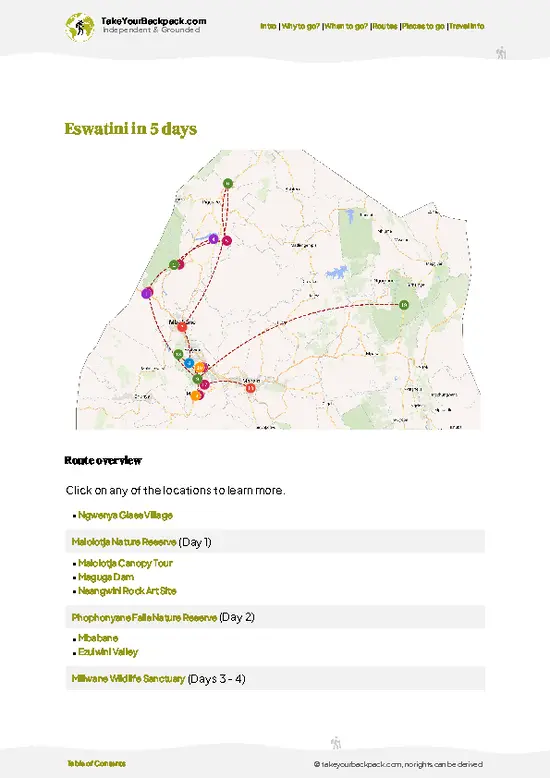
✅ Optimized 2, 3 & 5-day travel routes
✅ Cities, national parks, landmarks, beaches
✅ How to get around
✅ Offline-friendly for travel without Wi-Fi
👉 Click to see all 30+ guide features

📅 Plan smarter in minutes, not weeks
✅ Month by month travel advice
✅ Festivals & national holidays
✅ Budget expectations

🗺️ Go to the right places, skip the overrated ones
✅ Honest pros & cons of destinations
✅ Top hikes, parks & viewpoints
✅ Lesser-known places most travelers miss
✅ Clear “worth it vs skip it” guidance

🛏️ Travel smoothly without rookie mistakes
✅ Best areas to stay
✅ Transport systems explained simply
✅ Common scams & safety advice
✅ SIM cards, money & practical tips

🌍 Understand the country, not just visit it
✅ Culture & traditions
✅ 52 Essential phrases & customs
✅ Festivals worth planning around
✅ Traveler-friendly historical context
✅ Insights that make places more meaningful

📱 Built for real travel conditions
✅ Fully downloadable PDF
✅ Works completely offline
✅ Optimized for phone use
✅ Useful in remote areas & buses
✅ Everything in one place
Stop searching, start planning
Get instant access to your full guide. 30‑day money-back guarantee.
+ Add another guide for just

By proceeding you agree to our terms.
Sent to your inbox immediately after payment • 100% Secure Checkout
Best Backpacking Travel Advisor 2025 tourism awardBest Backpacking
Travel Advisor
2025
What others say about Take Your Backpack Guides:
⭐⭐⭐⭐⭐
Fantastic, amazing amount of information!
⭐⭐⭐⭐⭐
My goodness this is amazing, it's what I've been looking for hats off too you!
⭐⭐⭐⭐⭐
I think this is absolutely BRILLIANT
⭐⭐⭐⭐
Very complete and informative. It's still missing places, but I gotta to commend you
⭐⭐⭐⭐⭐
This is truly amazing, thank you, can't wait to explore it with my kids!
⭐⭐⭐⭐⭐
Awesome resource, thank you!
⭐⭐⭐⭐⭐
This is amazing! Can't wait to explore the ones I haven't seen
⭐⭐⭐⭐
I love this! Well done, great idea.
⭐⭐⭐⭐⭐
Thanks for taking the time to make this gem!
⭐⭐⭐⭐⭐
This might be the best website I've ever seen.
⭐⭐⭐⭐⭐
Congratulations, and thank you so much for your work; it's incredibly valuable.
⭐⭐⭐⭐
In all seriousness I think you did a great job pointing out the important spots
⭐⭐⭐⭐⭐
10/10 very good
⭐⭐⭐⭐⭐
As someone who's only just starting to visit regularly this is awesome, thank you.
⭐⭐⭐⭐
Thank you very much! I'm going to visit my dad, it's going to be very useful!
⭐⭐⭐⭐⭐
This is really cool! We'll be travelling for the first time and this definitely come in handy.
⭐⭐⭐⭐⭐
You are now our minister of culture, congratulations 👨‍💼
⭐⭐⭐⭐⭐
Just wanted to tell you that this is a pearl! Going to follow your recommendations.
⭐⭐⭐⭐⭐
This is so cool. I'll definitely be using the resource for my travels soon.
⭐⭐⭐⭐⭐
This is very impressive! Good work.
⭐⭐⭐⭐⭐
This is an amazing and informative site. Very well done!

🛏️ Where to stay?Best areas and accommodation options

Central Manzini and the quieter Fonteyn area are the two best bases for a budget stay, though dorm beds are limited, so expect a mix of small guesthouses, backpacker rooms and basic lodges. Dorm beds usually run about US$10 to 18, and private rooms start near US$25 to 40.
The center puts you within walking distance of the bus rank, the market and the minibus routes to Mbabane and the borders. That is the main reason to choose it. The trade-off is noise: traffic, music and early market activity begin before dawn, so pack earplugs and ask for a room facing away from the main road. After dark, the … read more 👉
Central Manzini and the quieter Fonteyn area are the two best bases for a budget stay, though dorm beds are limited, so expect a mix of small guesthouses, backpacker rooms and basic lodges. Dorm beds usually run about US$10 to 18, and private rooms start near US$25 to 40.
The center puts you within walking distance of the bus rank, the market and the minibus routes to Mbabane and the borders. That is the main reason to choose it. The trade-off is noise: traffic, music and early market activity begin before dawn, so pack earplugs and ask for a room facing away from the main road. After dark, the streets empty out and are poorly lit, so take a taxi for any late return even if the distance seems short.
Fonteyn and the leafier residential streets nearby are calmer and more secure, with walled compounds and gated guesthouses that include parking and a quiet night. You will need a minibus or short taxi ride to reach the center, usually 5 to 10 minutes. This suits travelers who value sleep and a kitchen over convenience.
Because beds are scarce, book ahead around the Reed Dance period and public holidays, when rooms across the region fill. If dorms are full, Matsapha has a few budget rooms with easy highway minibus access, though it is less pleasant after working hours.

🚌 Getting aroundGetting around like a local

Minibus taxis are the easiest way for a backpacker to get around Manzini, because they run on fixed routes from the main bus rank, cost very little and leave constantly through the day. Traffic can clog the center at rush hours, and there is no formal city bus network, so the minibus system carries nearly everything. Reliability is good on main corridors and weaker on side roads.
  • Minibus taxis: Fares within town run around US$0.30 to 0.60, and runs to Mbabane cost roughly US$1.50 to 2.50 for a 45 to 60 minute trip. Vehicles leave when full, so there is no timetable, and services thin out after about 7 or 8 pm. Carry small notes, since drivers rarely make change for large ones, and state your destination to the conductor before boarding.
  • Walking: The center is flat and small enough that you can
… read more 👉
Minibus taxis are the easiest way for a backpacker to get around Manzini, because they run on fixed routes from the main bus rank, cost very little and leave constantly through the day. Traffic can clog the center at rush hours, and there is no formal city bus network, so the minibus system carries nearly everything. Reliability is good on main corridors and weaker on side roads.
  • Minibus taxis: Fares within town run around US$0.30 to 0.60, and runs to Mbabane cost roughly US$1.50 to 2.50 for a 45 to 60 minute trip. Vehicles leave when full, so there is no timetable, and services thin out after about 7 or 8 pm. Carry small notes, since drivers rarely make change for large ones, and state your destination to the conductor before boarding.
  • Walking: The center is flat and small enough that you can cross it in 15 to 20 minutes. Pavements break up away from the main streets, and afternoon heat in summer tires you quickly, so go early and carry water. After dark, avoid unlit side roads and take a taxi instead.
  • Metered and booked taxis: Sedan taxis wait around the center and hotels. Many have no meter, so agree the price before you get in. Local rides typically run US$3 to 8, with airport trips costing more. Ask your guesthouse for a driver they trust, as that is cheaper and safer than flagging one late at night.
  • Intercity coaches and buses: Larger buses link Manzini with Johannesburg, Maputo and Durban, with fares generally between US$15 and 40 depending on route. These leave from set points, and early departures are the norm, so confirm the pickup spot the evening before.
  • Hitchhiking and informal lifts: Locals sometimes share rides with pickups or private cars on rural roads for a small contribution. It works because public transport is sparse beyond main corridors, but wait only in daylight and travel with another person where possible.

👛 Costs (as of 22 October 2026)How expensive it really is

Manzini costs a backpacker about US$43 to 45 per day if you use dorms, local minibuses and market meals.
CategoryBudget RangeLocal Reality
Dorm accommodation (high season)US$12 to 18Few true hostels, so beds are limited and sell out around holidays and the Reed Dance.
Dorm accommodation (off-season)US$9 to 14Prices drop slightly from February to April and in the cooler weekdays.
MealsUS$8 to 14Market plates cost US$2 to 5, while café meals run US$6 to 10.
Local transportUS$2 to 4Minibus rides cost US$0.30 to 0.60 each, with taxis for late returns.
City transport passNot availableNo pass exists, and you pay each minibus driver or conductor in cash.
Basic activities and entry feesUS$5 to 12Cultural village or reserve entries run US$8 to 12, and markets are free.
MiscellaneousUS$3 to 6Water, SIM data,
… read more 👉
Manzini costs a backpacker about US$43 to 45 per day if you use dorms, local minibuses and market meals.
CategoryBudget RangeLocal Reality
Dorm accommodation (high season)US$12 to 18Few true hostels, so beds are limited and sell out around holidays and the Reed Dance.
Dorm accommodation (off-season)US$9 to 14Prices drop slightly from February to April and in the cooler weekdays.
MealsUS$8 to 14Market plates cost US$2 to 5, while café meals run US$6 to 10.
Local transportUS$2 to 4Minibus rides cost US$0.30 to 0.60 each, with taxis for late returns.
City transport passNot availableNo pass exists, and you pay each minibus driver or conductor in cash.
Basic activities and entry feesUS$5 to 12Cultural village or reserve entries run US$8 to 12, and markets are free.
MiscellaneousUS$3 to 6Water, SIM data, snacks and small tips.
Total Daily BudgetUS$43 to 45Based on high-season dorm, market meals and minibuses.
Buy lunch at the market and cook or buy fruit for dinner, because that cuts the daily food bill by about half.
⚠️ Prices can change and everyone travels differently, so take this as a rough guide. Hope it helps you plan your adventure!

🚌 Day tripsEasy escapes and nearby places

Manzini sits in the middle of Eswatini, so most worthwhile day trips are 30 to 90 minutes away by minibus or a short taxi hop.
Mantenga Cultural Village and Falls:
The reconstructed Swazi beehive homestead and a short walk to Mantenga Falls make this the easiest cultural outing. Count on 40 to 60 minutes by minibus toward Mbabane, then a short taxi from the road. Entry costs about US$8 to 12, with dance performances at set times, and the full trip works out to US$15 to 25. Go between April and October, when the paths stay dry. First-timers often arrive after the last show, so aim for late morning.
👉 Explore Mantenga Nature Reserve
Malolotja Nature Reserve:
High grassland, waterfalls and zebra, blesbok and wildebeest make this the best hiking day close by. It lies about 1.5 hours northwest, and … read more 👉
Manzini sits in the middle of Eswatini, so most worthwhile day trips are 30 to 90 minutes away by minibus or a short taxi hop.
Mantenga Cultural Village and Falls:
The reconstructed Swazi beehive homestead and a short walk to Mantenga Falls make this the easiest cultural outing. Count on 40 to 60 minutes by minibus toward Mbabane, then a short taxi from the road. Entry costs about US$8 to 12, with dance performances at set times, and the full trip works out to US$15 to 25. Go between April and October, when the paths stay dry. First-timers often arrive after the last show, so aim for late morning.
👉 Explore Mantenga Nature Reserve
Malolotja Nature Reserve:
High grassland, waterfalls and zebra, blesbok and wildebeest make this the best hiking day close by. It lies about 1.5 hours northwest, and without a car you will likely need a taxi or a shared lift for the last stretch, so budget US$30 to 50 in total with the entry fee. Winter offers clear views, while summer mist and storms limit visibility. Many people underestimate the size of the park and try to cover too much, so choose a single trail such as the Silotfwane route.
👉 Explore Malolotja Nature Reserve
Hlane Royal National Park:
Hlane is about 1 to 1.5 hours northeast and is one of the few places to see white rhinos and lions in the open. A half-day game drive costs roughly US$25 to 45, and with transport the day totals around US$50 to 75. Dry winter months make animals easier to spot at waterholes. Book the drive ahead, since walk-ups can miss the morning slot.
👉 Explore Hlane Royal National Park
Ezulwini Valley:
Candle and glass workshops, the Lobamba cultural sites and the Sibebe-style rock views along the road create an easy loop. Minibuses cost US$1 to 3 each way, and entrance fees are small, so US$10 to 20 covers the day. Weekdays are quieter, and the valley is pleasant year-round.
👉 Explore Ezulwini Valley

🍲 FoodWhat to Eat & Drink

The market in Manzini is the best place to eat like a local, with stalls selling roasted maize, fried fish and sweet potatoes, and the smell of charcoal hangs over the rows from late morning. Look for emasi, soured milk that locals drink or mix into porridge, and sishwala, a thick maize porridge served with beef stew or greens, which is the everyday plate in Eswatini and often comes with emasi on the side. Mpholo and slow-cooked beef cuts appear at roadside grills, and a plate usually costs US$2 to 5. For something distinctly Swazi, try marula products. The fruit ripens in summer, and the fermented drink buganu is made from it, usually sold at gatherings rather than shops. Bottled Mpumalanga-style juices are not needed, because fresh fruit stalls sell mango and pineapple in season for under … read more 👉
The market in Manzini is the best place to eat like a local, with stalls selling roasted maize, fried fish and sweet potatoes, and the smell of charcoal hangs over the rows from late morning. Look for emasi, soured milk that locals drink or mix into porridge, and sishwala, a thick maize porridge served with beef stew or greens, which is the everyday plate in Eswatini and often comes with emasi on the side. Mpholo and slow-cooked beef cuts appear at roadside grills, and a plate usually costs US$2 to 5. For something distinctly Swazi, try marula products. The fruit ripens in summer, and the fermented drink buganu is made from it, usually sold at gatherings rather than shops. Bottled Mpumalanga-style juices are not needed, because fresh fruit stalls sell mango and pineapple in season for under US$1.
Casual eateries near the bus rank serve takeaway meals in plastic trays, and a few cafés around Fonteyn offer coffee and quieter seating. Evenings are social at shebeens and small bars, where beer is shared in rounds, and it is polite to accept a small offering with your right hand. Eat early, since many stalls close by late afternoon.

🛡️ SafetySafety Tips and Common Scams in Manzini

Manzini is broadly safe for backpackers, and most problems are petty theft rather than anything violent. The busiest spots for opportunists are the bus rank and the market area around the main streets, where crowds are thick and phones and bags are easy to snatch. Carry only the cash you need for the day, keep your phone out of back pockets, and wear your daypack on your front while you move through the crush.

Daylight hours are comfortable for walking around the center. After dark, the quieter streets empty out quickly, so solo travelers do better arranging a taxi or a lift from the venue than walking between bars. Women traveling alone will mostly get attention in the form of friendly calls or persistent offers of help, and a polite, firm no usually ends it.

The everyday annoyances are … read more 👉
Manzini is broadly safe for backpackers, and most problems are petty theft rather than anything violent. The busiest spots for opportunists are the bus rank and the market area around the main streets, where crowds are thick and phones and bags are easy to snatch. Carry only the cash you need for the day, keep your phone out of back pockets, and wear your daypack on your front while you move through the crush.

Daylight hours are comfortable for walking around the center. After dark, the quieter streets empty out quickly, so solo travelers do better arranging a taxi or a lift from the venue than walking between bars. Women traveling alone will mostly get attention in the form of friendly calls or persistent offers of help, and a polite, firm no usually ends it.

The everyday annoyances are small. Minibus drivers and touts may quote inflated fares to visitors, so ask a fellow passenger what the fare is before you board. Keep valuables out of sight in parked cars, and avoid flashing a camera or laptop at the rank.

FAQCommon questions from travelers

Two days is enough for Manzini itself, and four to five days works better if you add day trips. The market and center take half a day, while Mantenga, Malolotja and Hlane each fill a full day from US$15 to 75 depending on transport and entry fees. Manzini is a practical hub for them, since minibuses to Mbabane take 45 to 60 minutes.
Manzini is reasonably safe for solo backpackers who use common sense. Petty theft at the market and bus rank is the main risk, so keep bags in front and phones out of sight. The center empties after dark, so a taxi costing about US$3 to 8 is worth it for evening trips. Women traveling solo generally report no major problems.
Manzini is known as Eswatini’s main commercial and transport hub, with a busy market selling produce, crafts and secondhand goods. It sits between the Ezulwini Valley and Matsapha industrial zone, and it is the gateway to places like Mantenga, Malolotja and Hlane. Minibus links connect it to Mbabane, the borders and South Africa, with fares from US$0.30 locally to about US$15 to 40 for long-distance coaches.
⚠️ Things can change over time, so always validate details locally before you go.

More places to explore across Eswatini

Manzini isn’t the only highlight in Eswatini. Explore all what Eswatini has to offer.
Country photo of Eswatini

We 💚 feedbackKey takeaways before you go

Manzini rewards anyone who pays attention to the bus rank, because the route boards and conductors’ calls tell you more about the country than any map. I would arrive with small notes for fares, leave bags at your lodging while you wander, and plan your exit before 9 a.m., since the best minibuses fill early. Skip nights out in the center unless you go with locals.

✍️ Help improve this page!
The information on this page is based on in-depth research, insights shared by experienced travelers, and feedback from the local travel community in Eswatini. While every effort is made to keep the information accurate and current, conditions can change — so if you spot anything incorrect or outdated, please get in touch.


🙋‍♂️ Give feedback

👋 Meet the founderWho’s Behind Take Your Backpack?

Johan, backpacker and founder of TakeYourBackpackHi, I’m Johan (Netherlands 🇳🇱), the creator of TakeYourBackpack. Over the past 3 decades, I’ve backpacked through 90+ countries across six continents, gaining extensive experience with independent travel, long-term trips, and overland routes.

This site is built on a combination of firsthand travel experience and carefully curated insights from other backpackers. Many guides are based on places I’ve personally visited, while others bring together tips, observations, and practical advice shared by trusted travelers I’ve met along the way.

The goal is to provide realistic, experience-driven guidance — not generic itineraries — so you can explore destinations with better context, clearer expectations, and more confidence.