×

Ethiopia🇪🇹 | national parksAwash National ParkFilwoha pools, Awash gorge, Fentale crater, oryx plains | things to do and best time to go

Explore Guassa Plateau TrekExplore Bale Mountains National Park

Backpacking in Awash
🏆 Top picknational park ranked #4
By Johan Kruseman 🇳🇱 | Updated October 22, 2026

Awash National Park has a wild hot spring pool, Filwoha, where you can swim among doum palms for a tiny fee, and most first-timers arrive expecting only dry savanna. The park lies in the Afar region of Ethiopia, east of Addis Ababa along the road to Djibouti, with Mount Fentale rising as a sleeping volcano above the plains. Hiking here means short ranger-escorted walks, not long treks, and the gorge and crater views are excellent. Oryx, kudu and hundreds of bird species are common, though crowds are nil and the vibe is dusty and quiet. The big mistake is arriving without cash or a ranger plan: no ATMs work nearby, and scouts are mandatory, so carry small bills. I still hear the baboons barking across the Awash gorge and smell wet, sulfur-tinged stone. Arrive early, register at the gate, then walk to the falls and finish in the pools.

Discover everything you want to know in the 📖 Ethiopia Travel Guide.
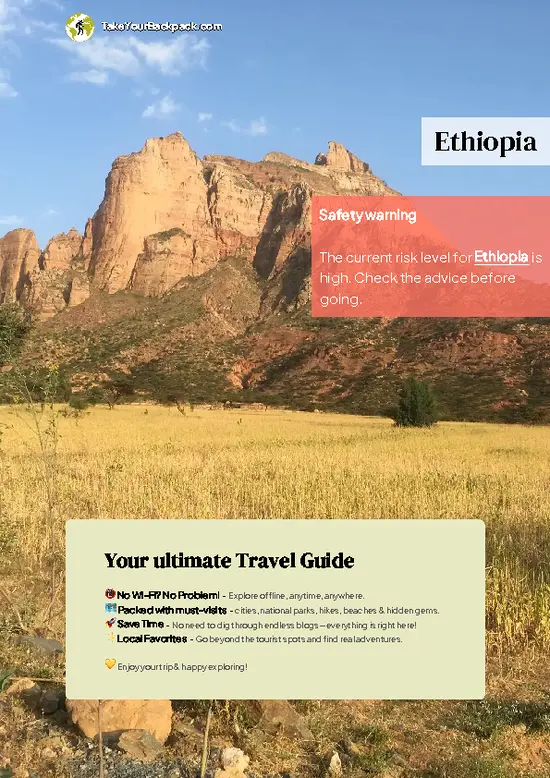
Safety warning

The current risk level for Ethiopia is high. Check the advice before going.


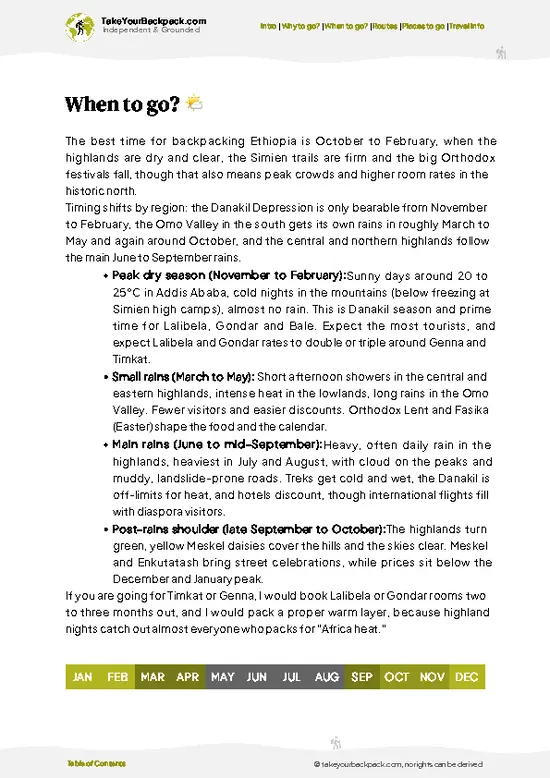
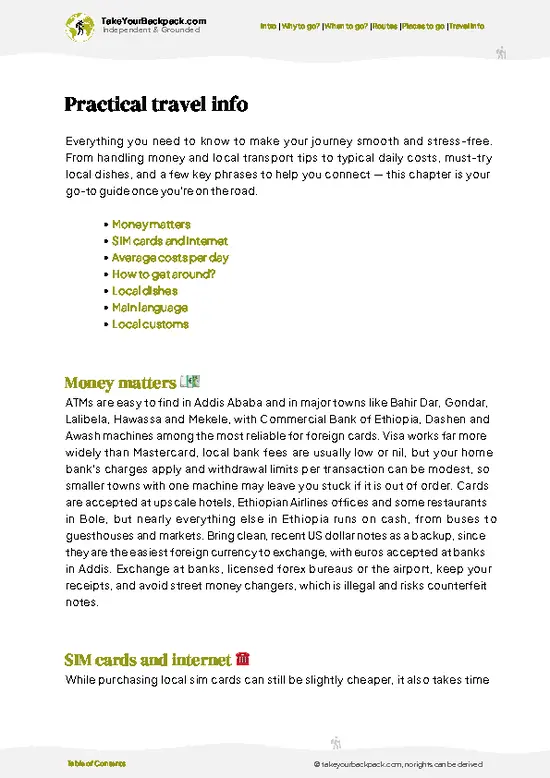
example page 0 from our offline Travel Guide for Ethiopia
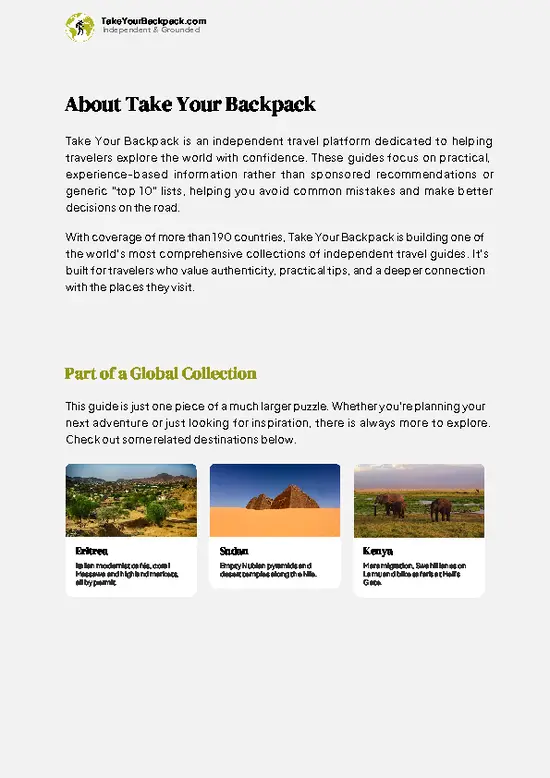
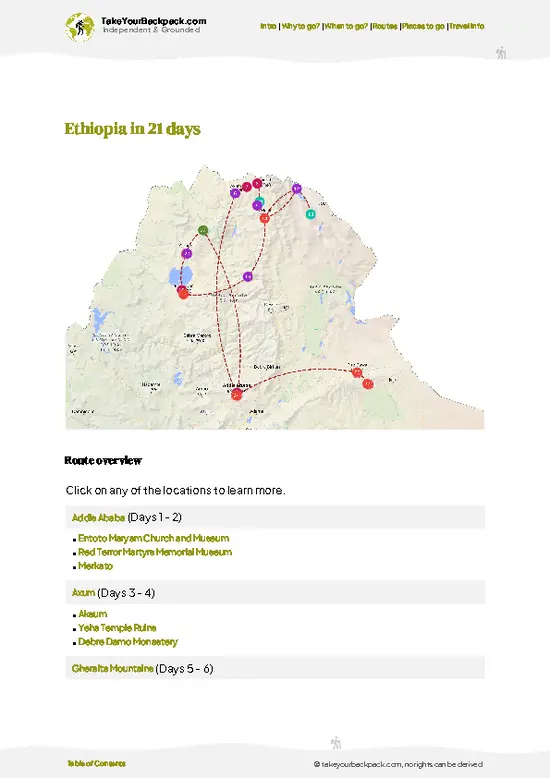
example page 1 from our offline Travel Guide for Ethiopia
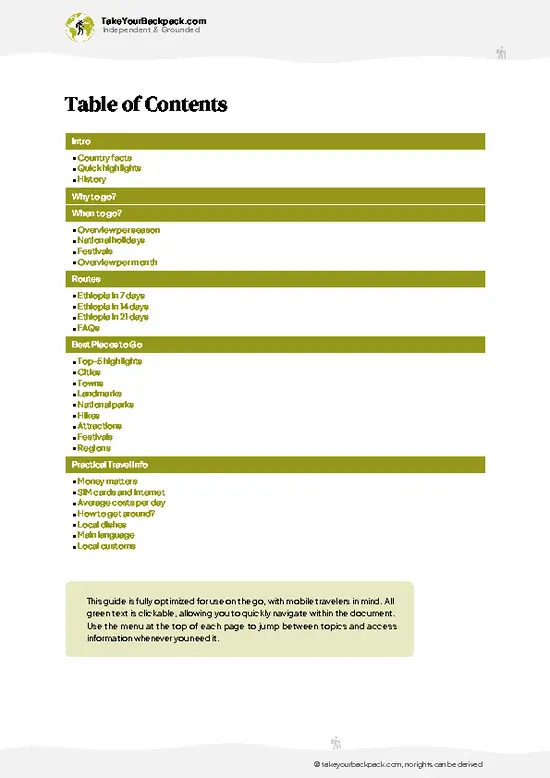
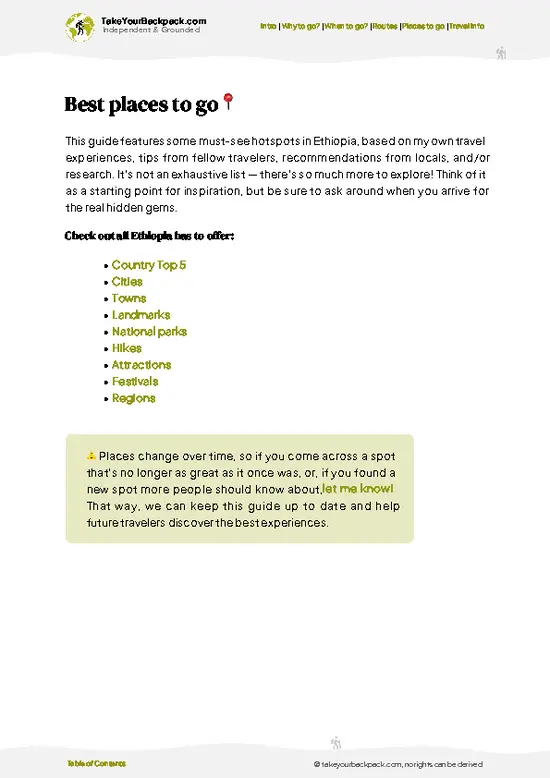
example page 2 from our offline Travel Guide for Ethiopia
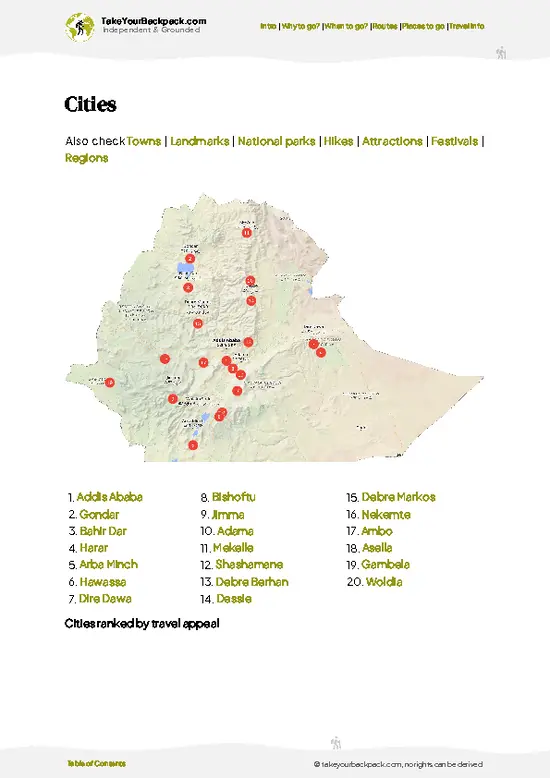
example page 3 from our offline Travel Guide for Ethiopia
example page 4 from our offline Travel Guide for Ethiopia
example page 5 from our offline Travel Guide for Ethiopia
example page 6 from our offline Travel Guide for Ethiopia
example page 7 from our offline Travel Guide for Ethiopia
Loading the map 🌍
CLICK TO FILTER
cities
towns
landmarks
national parks
hikes
attractions
festivals
regions
SHOW COUNTRY’S BESTSHOW ALL

✨ Why go?
Ranked #4 national park in Ethiopia
The unique appeal for travelers

Awash National Park suits backpackers who like making their own plan without a tour company taking the decisions. The gate is right beside the main highway, so you can reach it on a bus heading toward Dire Dawa and walk or hitch the final stretch, then hire a ranger-guide on the spot for the day. That independence is the real draw. The second reason is the geology. Climbing the rim of Mount Fentale crater puts you on a volcano with steam vents and a view across Afar, something very few Ethiopian parks offer on foot. Then there is the water: the Filwoha hot springs give you a warm, clear swim at the end of a dusty day, which beats any hostel shower. Wildlife is the third pull, with beisa oryx, Soemmerring’s gazelle and the odd greater kudu easy to spot from the track. Camping keeps costs low, … read more 👉
Awash National Park suits backpackers who like making their own plan without a tour company taking the decisions. The gate is right beside the main highway, so you can reach it on a bus heading toward Dire Dawa and walk or hitch the final stretch, then hire a ranger-guide on the spot for the day. That independence is the real draw. The second reason is the geology. Climbing the rim of Mount Fentale crater puts you on a volcano with steam vents and a view across Afar, something very few Ethiopian parks offer on foot. Then there is the water: the Filwoha hot springs give you a warm, clear swim at the end of a dusty day, which beats any hostel shower. Wildlife is the third pull, with beisa oryx, Soemmerring’s gazelle and the odd greater kudu easy to spot from the track. Camping keeps costs low, and the lack of crowds means a campsite to yourself.

💡 HighlightsWhat this place is best known for

  1. Awash Falls: The river drops into a gorge near the park headquarters, and the viewpoint is a short walk from the lodge. The brown, loud water cutting through red rock is the sight most travelers come for.
  2. Filwoha Hot Springs: Clear, warm pools ringed by doum palms and fed by underground springs. Locals and baboons share the area, and a swim here after a hot drive is perfect.
  3. Mount Fentale: A dormant volcano on the park’s edge with a crater more than 2 kilometers across. Steam still seeps from the ground, and the rim walk gives broad views over the savanna.
  4. Awash River Gorge: Steep walls and crocodile pools below the falls. Look for colobus and vervet monkeys in the riverside trees.
  5. Beisa Oryx and Kudu Plains: The Illala Sala plains are where you are most likely to see long-horned oryx grazing,
… read more 👉
  1. Awash Falls: The river drops into a gorge near the park headquarters, and the viewpoint is a short walk from the lodge. The brown, loud water cutting through red rock is the sight most travelers come for.
  2. Filwoha Hot Springs: Clear, warm pools ringed by doum palms and fed by underground springs. Locals and baboons share the area, and a swim here after a hot drive is perfect.
  3. Mount Fentale: A dormant volcano on the park’s edge with a crater more than 2 kilometers across. Steam still seeps from the ground, and the rim walk gives broad views over the savanna.
  4. Awash River Gorge: Steep walls and crocodile pools below the falls. Look for colobus and vervet monkeys in the riverside trees.
  5. Beisa Oryx and Kudu Plains: The Illala Sala plains are where you are most likely to see long-horned oryx grazing, plus Swayne’s hartebeest and gazelles in open grass.
  6. Birdwatching: More than 400 species have been recorded, including Abyssinian roller, carmine bee-eater and ostrich. Early morning near the river is best.
  7. Ardoukoba Acacia Savanna Drive: Ranger-led tracks through thorny acacia scrub reveal dik-dik, warthog and hyena tracks in the dust, with Fentale as a backdrop.
At Awash National Park, start with the hot springs or falls at first light, because animals and birds are most active then and the heat has not yet built up.
Spotted a mistake or missing something? Contact us.

Things to do near Awash National Park

Ratings based on Tripadvisor reviews. When you book through this link, you support our work at no extra cost to you.

🌤️ When to go?Best time to explore Awash

  • Cool Dry Season (October to February): Awash National Park is at its easiest now. Days reach 28 to 33°C (82 to 91°F), nights drop to 14 to 18°C (57 to 64°F), and roads and tracks stay firm. Daylight runs close to 12 hours. Birdlife peaks with migrants, and Ethiopian holidays like Timkat in January fill Addis-bound lodges on weekends.
  • Hot Dry Season (March to May): Lowland heat climbs to 35 to 40°C (95 to 104°F) by afternoon. Waterbucks and oryx gather near the Awash River and springs, so sightings are good, but hiking midday is punishing. Start at dawn.
  • Main Rains (June to September): Showers are heavy in the highlands and send the river brown, and black cotton soil turns to sticky mud. Temperatures ease to 30 to 35°C (86 to 95°F). Crowds are thin and lodge rates are often negotiable.
Aim for … read more 👉
  • Cool Dry Season (October to February): Awash National Park is at its easiest now. Days reach 28 to 33°C (82 to 91°F), nights drop to 14 to 18°C (57 to 64°F), and roads and tracks stay firm. Daylight runs close to 12 hours. Birdlife peaks with migrants, and Ethiopian holidays like Timkat in January fill Addis-bound lodges on weekends.
  • Hot Dry Season (March to May): Lowland heat climbs to 35 to 40°C (95 to 104°F) by afternoon. Waterbucks and oryx gather near the Awash River and springs, so sightings are good, but hiking midday is punishing. Start at dawn.
  • Main Rains (June to September): Showers are heavy in the highlands and send the river brown, and black cotton soil turns to sticky mud. Temperatures ease to 30 to 35°C (86 to 95°F). Crowds are thin and lodge rates are often negotiable.
Aim for November or December, and book Fantale crater and Filwoha hot spring walks for early morning.


source: climatestotravel.comJANJanuary: excellent for travelingFEBFebruary: excellent for travelingMARMarch: highly recommended for travelingAPRApril: highly recommended for travelingMAYMay: good for travelingJUNJune: below average for travelingJULJuly: below average for travelingAUGAugust: below average for travelingSEPSeptember: fair for travelingOCTOctober: excellent for travelingNOVNovember: excellent for travelingDECDecember: excellent for traveling
ethiopia-national-park-awash-national-park v1
© Google |

✈️ The backpacker research shortcutEthiopia Travel Guide

An offline-friendly backpacking guide with optimized travel routes, ranked highlights, transport advice, and the best areas to stay.
example page 0 from our offline Travel Guide for Ethiopia
example page 1 from our offline Travel Guide for Ethiopia
example page 2 from our offline Travel Guide for Ethiopia
example page 3 from our offline Travel Guide for Ethiopia
example page 4 from our offline Travel Guide for Ethiopia
example page 5 from our offline Travel Guide for Ethiopia
example page 6 from our offline Travel Guide for Ethiopia
example page 7 from our offline Travel Guide for Ethiopia
The digital guide (380 pages) contains:
✅ 98 highlights, ranked by travel appeal
✅ Optimized 7, 14 & 21-day travel routes
✅ Cities, national parks, landmarks, beaches
✅ How to get around
✅ Offline-friendly for travel without Wi-Fi
👉 Click to see all 30+ guide features

📅 Plan smarter in minutes, not weeks
✅ Month by month travel advice
✅ Festivals & national holidays
✅ Budget expectations

🗺️ Go to the right places, skip the overrated ones
✅ Honest pros & cons of destinations
✅ Top hikes, parks & viewpoints
✅ Lesser-known places most travelers miss
✅ Clear “worth it vs skip it” guidance

🛏️ Travel smoothly without rookie mistakes
✅ Best areas to stay
✅ Transport systems explained simply
✅ Common scams & safety advice
✅ SIM cards, money & practical tips

🌍 Understand the country, not just visit it
✅ Culture & traditions
✅ 52 Essential phrases & customs
✅ Festivals worth planning around
✅ Traveler-friendly historical context
✅ Insights that make places more meaningful

📱 Built for real travel conditions
✅ Fully downloadable PDF
✅ Works completely offline
✅ Optimized for phone use
✅ Useful in remote areas & buses
✅ Everything in one place
Stop searching, start planning
Get instant access to your full guide. 30‑day money-back guarantee.
+ Add another guide for just

By proceeding you agree to our terms.
Sent to your inbox immediately after payment • 100% Secure Checkout
Best Backpacking Travel Advisor 2025 tourism awardBest Backpacking
Travel Advisor
2025
What others say about Take Your Backpack Guides:
⭐⭐⭐⭐⭐
Fantastic, amazing amount of information!
⭐⭐⭐⭐⭐
My goodness this is amazing, it's what I've been looking for hats off too you!
⭐⭐⭐⭐⭐
I think this is absolutely BRILLIANT
⭐⭐⭐⭐
Very complete and informative. It's still missing places, but I gotta to commend you
⭐⭐⭐⭐⭐
This is truly amazing, thank you, can't wait to explore it with my kids!
⭐⭐⭐⭐⭐
Awesome resource, thank you!
⭐⭐⭐⭐⭐
This is amazing! Can't wait to explore the ones I haven't seen
⭐⭐⭐⭐
I love this! Well done, great idea.
⭐⭐⭐⭐⭐
Thanks for taking the time to make this gem!
⭐⭐⭐⭐⭐
This might be the best website I've ever seen.
⭐⭐⭐⭐⭐
Congratulations, and thank you so much for your work; it's incredibly valuable.
⭐⭐⭐⭐
In all seriousness I think you did a great job pointing out the important spots
⭐⭐⭐⭐⭐
10/10 very good
⭐⭐⭐⭐⭐
As someone who's only just starting to visit regularly this is awesome, thank you.
⭐⭐⭐⭐
Thank you very much! I'm going to visit my dad, it's going to be very useful!
⭐⭐⭐⭐⭐
This is really cool! We'll be travelling for the first time and this definitely come in handy.
⭐⭐⭐⭐⭐
You are now our minister of culture, congratulations 👨‍💼
⭐⭐⭐⭐⭐
Just wanted to tell you that this is a pearl! Going to follow your recommendations.
⭐⭐⭐⭐⭐
This is so cool. I'll definitely be using the resource for my travels soon.
⭐⭐⭐⭐⭐
This is very impressive! Good work.
⭐⭐⭐⭐⭐
This is an amazing and informative site. Very well done!

🛏️ Where to stay?Choosing the right base

The most convenient bed for backpackers is inside Awash National Park itself: Awash Falls Lodge sits on the gorge rim near the main waterfall, with simple rooms at roughly US$25 to 45 and a basic restaurant overlooking the water. Camping is allowed at designated sites such as those near Filwoha hot springs and at the Kereyou area, for a small fee of about US$5 to 10 per tent plus ranger or scout charges. Bring your own tent, stove and most food, since supplies inside are thin.
Outside the park, Awash Town (Awash Sebat Kilo) is the practical base on the main road and rail line to Djibouti. Guesthouses … read more 👉
The most convenient bed for backpackers is inside Awash National Park itself: Awash Falls Lodge sits on the gorge rim near the main waterfall, with simple rooms at roughly US$25 to 45 and a basic restaurant overlooking the water. Camping is allowed at designated sites such as those near Filwoha hot springs and at the Kereyou area, for a small fee of about US$5 to 10 per tent plus ranger or scout charges. Bring your own tent, stove and most food, since supplies inside are thin.
Outside the park, Awash Town (Awash Sebat Kilo) is the practical base on the main road and rail line to Djibouti. Guesthouses there cost about US$8 to 20 a night with fan rooms and bucket or basic shower, and the town has small cafes for injera and pasta. Metehara, about 50 km west, is larger and has more hotels, including options around Lake Basaka. Addis Ababa is a long day trip rather than a base. Arrive before dark, as lodges in town fill with truckers.

👛 Costs (as of 22 October 2026)Typical daily expenses

A realistic budget for Awash National Park is about US$62 to 75 a day, counting park entry, scout, camping or a simple room, shared transport and basic meals. Foreign visitors pay in Ethiopian birr, though prices below are shown in US dollars.
CategoryBudget RangeLocal Reality
Entrance feeUS$10 to 15Foreign adult rate per 24 hours, paid at the gate; vehicle fee extra at roughly US$1 to 3.
Scout and guideUS$10 to 20Armed scout is required for walks and is paid per day.
Accommodation (high season)US$8 to 25Camping costs less, around US$5 to 10; Awash Town guesthouses and the lodge cost more.
Local transportUS$10 to 25Bus from Addis Ababa costs about US$5 to 8 each way; hiring a vehicle inside the park costs more.
Food and suppliesUS$6 to 12Injera and pasta meals in Awash Town are cheap; bring water
… read more 👉
A realistic budget for Awash National Park is about US$62 to 75 a day, counting park entry, scout, camping or a simple room, shared transport and basic meals. Foreign visitors pay in Ethiopian birr, though prices below are shown in US dollars.
CategoryBudget RangeLocal Reality
Entrance feeUS$10 to 15Foreign adult rate per 24 hours, paid at the gate; vehicle fee extra at roughly US$1 to 3.
Scout and guideUS$10 to 20Armed scout is required for walks and is paid per day.
Accommodation (high season)US$8 to 25Camping costs less, around US$5 to 10; Awash Town guesthouses and the lodge cost more.
Local transportUS$10 to 25Bus from Addis Ababa costs about US$5 to 8 each way; hiring a vehicle inside the park costs more.
Food and suppliesUS$6 to 12Injera and pasta meals in Awash Town are cheap; bring water and snacks for the park.
Total Daily BudgetUS$62 to 75Per person, shared costs lower the figure.


source: ethiopia.travel
⚠️ Prices can change and everyone travels differently, so take this as a rough guide. Hope it helps you plan your adventure!

🥾 TrailsBest hikes in Awash national park

Awash National Park has no waymarked, numbered trail network, so hiking here means short guided walks from the main gate and lodge area, led by park scouts who are mandatory. Plan on walking with an armed scout, since buffalo, hyenas and the occasional lion roam the acacia savanna.
  • Awash Falls Viewpoint walk: The most popular outing, about 1 to 2 hours round trip on easy, flat to gently sloping ground. You follow a dirt track through thorn scrub to the rim of the gorge, where the Awash River drops over a basalt ledge in a brown, roaring curtain. Doum palms and fig trees line the banks, and colobus
… read more 👉
Awash National Park has no waymarked, numbered trail network, so hiking here means short guided walks from the main gate and lodge area, led by park scouts who are mandatory. Plan on walking with an armed scout, since buffalo, hyenas and the occasional lion roam the acacia savanna.
  • Awash Falls Viewpoint walk: The most popular outing, about 1 to 2 hours round trip on easy, flat to gently sloping ground. You follow a dirt track through thorn scrub to the rim of the gorge, where the Awash River drops over a basalt ledge in a brown, roaring curtain. Doum palms and fig trees line the banks, and colobus and vervet monkeys work the canopy.
  • Filwoha Hot Springs: A flat stroll of roughly 30 to 60 minutes from the road across open grassland to a pool of clear, warm blue water ringed with doum palms. The ground can be muddy and slippery near the water. Baboons loiter around the pools, so keep food in your bag.
  • Fantale Crater rim: A tough half-day to full-day climb on loose volcanic rock and dry grass on the park’s northern side. Expect a steep, sun-exposed ascent of several hours with no shade, rewarded by views across the Rift floor and a wide, steaming caldera. Go with a scout and carry at least 3 liters of water.
  • Kudu Valley and savanna scouting walks: Guided walks of 2 to 3 hours across open plains and dry riverbeds, easy underfoot. Oryx, Swayne’s hartebeest, Soemmerring’s gazelle, greater and lesser kudu and dik-dik are the usual sightings, and the park lists over 400 bird species, including Abyssinian ground hornbill and carmine bee-eaters.
Terrain across the park is hot, dry and mostly flat, with tracks that turn to sticky clay after rain. Start at dawn, when animals are active and the ground is cool, and wear closed shoes, a hat and long, light sleeves against thorns.
Reaching Awash National Park is straightforward with public buses on the main highway east of Addis Ababa toward Dire Dawa. Ask to be dropped at the park turnoff, then arrange a lift or walk to the headquarters, since there is no regular transport inside. Crowds are minimal, and you may go hours without seeing another visitor. The entrance fee is charged per person, plus extra for a vehicle and a mandatory scout, so bring cash and agree on the scout’s rate beforehand.
⚠️ Hiking info can sometimes be outdated or inaccurate. Before you hit the trail, check the latest conditions with locals. If you do spot anything that's off, I'd love to hear from you, so I can update it for fellow travelers.

🛡️ SafetyScams, Hazards, and Annoyances

Awash National Park is straightforward for prepared travelers, with heat as the main problem. Afternoon temperatures can pass 38°C (100°F), so walk at dawn, carry at least 3 liters of water per person, and wear a hat and sun cover. Trails around Fantale crater are rocky and loose, so sturdy shoes matter more than poles. Wildlife includes baboons, which grab food from picnic spots, plus warthogs, crocodiles in the Awash River and hippos in some stretches, so never swim and keep clear of banks at dusk. Walk with an assigned park scout, which is mandatory and also solves navigation on unmarked tracks. The area borders the Afar region, where local tensions flare occasionally, so check current advice and avoid driving after dark because livestock and trucks fill the highway. Bring a stocked first-aid … read more 👉
Awash National Park is straightforward for prepared travelers, with heat as the main problem. Afternoon temperatures can pass 38°C (100°F), so walk at dawn, carry at least 3 liters of water per person, and wear a hat and sun cover. Trails around Fantale crater are rocky and loose, so sturdy shoes matter more than poles. Wildlife includes baboons, which grab food from picnic spots, plus warthogs, crocodiles in the Awash River and hippos in some stretches, so never swim and keep clear of banks at dusk. Walk with an assigned park scout, which is mandatory and also solves navigation on unmarked tracks. The area borders the Afar region, where local tensions flare occasionally, so check current advice and avoid driving after dark because livestock and trucks fill the highway. Bring a stocked first-aid kit, and a spare tire if driving, since help is far away.

FAQCommon questions from travelers

Two days with one night is enough for Awash National Park. That lets you see Awash Falls and the gorge, soak in Filwoha hot springs, and join a dawn game drive for oryx and kudu. Add a third day if you want to climb Fantale crater, a rim walk of about 3 to 4 hours.
Reaching Awash National Park without a car is possible but slow. Buses from Addis Ababa to Awash Town take about 3.5 to 4 hours and cost roughly US$5 to 8, then you hire a local vehicle or share a ride to the gate, about 25 km on. Moving inside the park on foot is limited, so expect to pay around US$20 to 50 a day for a hired vehicle.
Yes, Awash National Park charges entry and requires a scout. Foreign adults pay about US$10 to 15 per 24 hours, plus a vehicle fee of roughly US$1 to 3 and camping charges of around US$5 to 10. A scout costs about US$10 to 20 a day, and no advance permit is needed, only payment at the gate.
⚠️ Things can change over time, so always validate details locally before you go.

Other Ethiopian national parks near Awash

Explore more nearby:


💡 Not sure where to go next?
Create a personalized itinerary for Ethiopia including Awash and the places that fit your trip.

Generate my itinerary

👉 Discover all national parks

Or checkout all Ethiopia has to offer (think cities, towns, villages, national parks, hikes, beaches, festivals)
Country photo of Ethiopia

We 💚 feedbackSumming up the experience

Awash National Park is best in the cool early morning, and in the drier months when tracks are firm and animals gather near water. I would hit the falls and gorge at first light, rest through the harsh midday, then take the hot springs late afternoon. Bring cash, a hat and a headlamp. Facilities are basic, and wildlife is not guaranteed.

✈️ When did I visit Ethiopia?
Ethiopia I visited back in October 2017. I combined the trip with a visit to Sudan. Ethiopia was a pure surprise with the magical scenery like the Danakil Depression and the Simien Mountains.

✍️ Help improve this page!
The information on this page is based on my own backpacking experience in Ethiopia, supplemented with up-to-date research and feedback from other travelers. Travel details can change, so if you notice anything outdated or incomplete, feel free to let me know.


🙋‍♂️ Give feedback

👋 Meet the founderWho’s Behind Take Your Backpack?

Johan, backpacker and founder of TakeYourBackpackHi, I’m Johan (Netherlands 🇳🇱), the creator of TakeYourBackpack. Over the past 3 decades, I’ve backpacked through 90+ countries across six continents, gaining extensive experience with independent travel, long-term trips, and overland routes.

This site is built on a combination of firsthand travel experience and carefully curated insights from other backpackers. Many guides are based on places I’ve personally visited, while others bring together tips, observations, and practical advice shared by trusted travelers I’ve met along the way.

The goal is to provide realistic, experience-driven guidance — not generic itineraries — so you can explore destinations with better context, clearer expectations, and more confidence.