×

Ethiopia🇪🇹 | national parksBale Mountains National ParkEthiopian wolves, Sanetti plateau, Harenna mist, Afroalpine moorland | things to do and best time to go

Explore Awash National ParkExplore Kafa Biosphere Reserve

Backpacking in Bale Mountains
UNESCO World Heritage site
🏆 Top picknational park ranked #2
By Johan Kruseman 🇳🇱 | Updated October 22, 2026

You can see an Ethiopian wolf or a mountain nyala at Bale Mountains National Park without a long trek, because the animals live right along the road and the Dinsho headquarters area. The park sits in the Oromia highlands, southeast of Addis Ababa in Ethiopia. Public transport stops in Dinsho and Goba, so you reach trailheads by hired vehicle or horse, since the plateau roads are unpaved and unserved. Scouts are required on walks, which is why you arrange one at the headquarters instead of wandering alone. The air thins above 3,500 m, so climb gradually. On the Sanetti Plateau the curry-like smell of helichrysum rose off the grass each time I crushed a stem underfoot, and I still connect it with the place. Unlike the flamingo lakes of Abijatta-Shalla, Bale is cold, high, wet moorland and forest.

Discover everything you want to know in the 📖 Ethiopia Travel Guide.
Safety warning

The current risk level for Ethiopia is high. Check the advice before going.


example page 0 from our offline Travel Guide for Ethiopia
example page 1 from our offline Travel Guide for Ethiopia
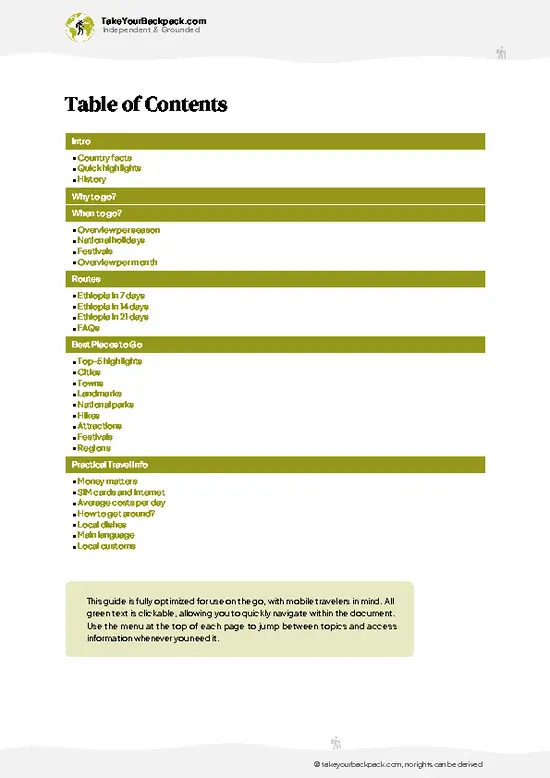
example page 2 from our offline Travel Guide for Ethiopia
example page 3 from our offline Travel Guide for Ethiopia
example page 4 from our offline Travel Guide for Ethiopia
example page 5 from our offline Travel Guide for Ethiopia
example page 6 from our offline Travel Guide for Ethiopia
example page 7 from our offline Travel Guide for Ethiopia
Loading the map 🌍
CLICK TO FILTER
cities
towns
landmarks
national parks
hikes
attractions
festivals
regions
SHOW COUNTRY’S BESTSHOW ALL

✨ Why go?
Ranked #2 national park in Ethiopia
The unique appeal for travelers

Bale Mountains National Park suits backpackers who want wild highland country without a package tour. The reason is the layout. The park splits into three zones you can string together on your own: the juniper woodland around Dinsho, the high plateau, and the forest on the southern escarpment. A local scout and a pack horse cost little next to a Simien or Serengeti-style itinerary, and the people running them are mostly from nearby Oromo communities, so you pay the people who know the ground. The second draw is the wildlife density. The park holds roughly half of the world's Ethiopian wolves, and on the plateau you can watch them hunt giant mole rats in daylight, which is rare for any wolf. The third is trekking freedom. The Web Valley to Sanetti Plateau route lets you camp in a cold glacial … read more 👉
Bale Mountains National Park suits backpackers who want wild highland country without a package tour. The reason is the layout. The park splits into three zones you can string together on your own: the juniper woodland around Dinsho, the high plateau, and the forest on the southern escarpment. A local scout and a pack horse cost little next to a Simien or Serengeti-style itinerary, and the people running them are mostly from nearby Oromo communities, so you pay the people who know the ground. The second draw is the wildlife density. The park holds roughly half of the world's Ethiopian wolves, and on the plateau you can watch them hunt giant mole rats in daylight, which is rare for any wolf. The third is trekking freedom. The Web Valley to Sanetti Plateau route lets you camp in a cold glacial landscape, with horses carrying the heavy gear. Dinsho and Goba both have cheap rooms and food, so you resupply as you go instead of hauling everything in.

💡 HighlightsKey sights and experiences for travelers

  1. Ethiopian wolf on the Sanetti Plateau: The rarest canid in Africa, rust-red with a white chest, trots across the open Afroalpine grass hunting rodents. Dawn and mid-morning give the best odds, and you can often watch from the roadside.
  2. Tullu Deemtu: At 4,377 m, this is the second highest peak in Ethiopia. A rough track runs almost to the summit, where a radio mast stands among frost-shattered rock and the view runs for kilometers.
  3. Harenna Forest: South of the plateau, the road drops through a wall of mist-soaked forest hung with moss and giant heather. Colobus monkeys, bushpigs and the occasional lion live here, and the birdsong is loud at first light.
  4. Mountain nyala at Dinsho: This large, spiral-horned antelope lives only in Ethiopia. Grazing herds wander the juniper meadows by the park headquarters,
… read more 👉
  1. Ethiopian wolf on the Sanetti Plateau: The rarest canid in Africa, rust-red with a white chest, trots across the open Afroalpine grass hunting rodents. Dawn and mid-morning give the best odds, and you can often watch from the roadside.
  2. Tullu Deemtu: At 4,377 m, this is the second highest peak in Ethiopia. A rough track runs almost to the summit, where a radio mast stands among frost-shattered rock and the view runs for kilometers.
  3. Harenna Forest: South of the plateau, the road drops through a wall of mist-soaked forest hung with moss and giant heather. Colobus monkeys, bushpigs and the occasional lion live here, and the birdsong is loud at first light.
  4. Mountain nyala at Dinsho: This large, spiral-horned antelope lives only in Ethiopia. Grazing herds wander the juniper meadows by the park headquarters, close enough to photograph without any hiking.
  5. Finch Habera Waterfall: A tall, narrow fall drops into a forested gorge near Goba. The walk in passes bamboo and tree ferns, and the mist from the base soaks you if you walk right up.
  6. Web Valley: A broad, glaciated valley with grazing horses, clear streams and campsites. Giant mole rats pop out of their burrows, and wolves patrol the slopes.
  7. Garba Guracha Lake: A small, cold lake near Dinsho, ringed by grassland and reeds. Waterfowl gather on it, and a short walk from the road is enough to reach the shore.
  8. Gaysay Valley: Open grassland threaded with a river, often visited for the nyala, warthogs and baboons that feed out in the open, with a flat track for easy walking.
Bale Mountains National Park charges a daily entrance fee paid at Dinsho or at the gate, and the scout and any horse trek are best booked a day ahead at the headquarters.
Spotted a mistake or missing something? Contact us.

🌤️ When to go?Seasonal considerations and timing

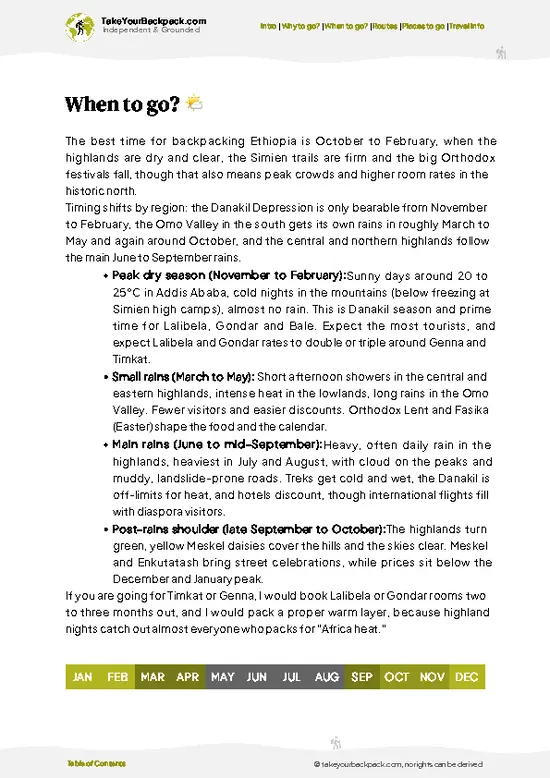
The dry months from November to February are the most reliable window for trekking Bale Mountains National Park, with firm trails and clear mornings on the Sanetti Plateau.
  • Dry Season (November to February): Days reach 15 to 20°C (59 to 68°F) at Dinsho and stay cooler on the plateau at 3,800 to 4,300 m. Nights drop to around 0 to -5°C (32 to 23°F), with frost at the Gaysay and Sanetti camps. Daylight runs roughly 11.5 to 12.5 hours. Crowds peak at Christmas and Timkat in January, and guides and horses book up.
  • Short Rains (March to May): Showers build, trails turn muddy and cloud sits on the heights. Prices soften and the park is quiet.
  • Main Rains (June to September): Cold, wet and foggy, with 8 to 14°C (46 to 57°F) by day. The Harenna Forest becomes slippery and some tracks are hard to pass.
… read more 👉
The dry months from November to February are the most reliable window for trekking Bale Mountains National Park, with firm trails and clear mornings on the Sanetti Plateau.
  • Dry Season (November to February): Days reach 15 to 20°C (59 to 68°F) at Dinsho and stay cooler on the plateau at 3,800 to 4,300 m. Nights drop to around 0 to -5°C (32 to 23°F), with frost at the Gaysay and Sanetti camps. Daylight runs roughly 11.5 to 12.5 hours. Crowds peak at Christmas and Timkat in January, and guides and horses book up.
  • Short Rains (March to May): Showers build, trails turn muddy and cloud sits on the heights. Prices soften and the park is quiet.
  • Main Rains (June to September): Cold, wet and foggy, with 8 to 14°C (46 to 57°F) by day. The Harenna Forest becomes slippery and some tracks are hard to pass. Lodges offer the lowest rates.
  • October: Meadows flower after the rains, birding is good and the park is still green with little traffic.
Book scouts, guides and horses a few days ahead if you arrive at the end of December or in January.


source: climatestotravel.comJANJanuary: highly recommended for travelingFEBFebruary: highly recommended for travelingMARMarch: excellent for travelingAPRApril: excellent for travelingMAYMay: highly recommended for travelingJUNJune: fair for travelingJULJuly: fair for travelingAUGAugust: fair for travelingSEPSeptember: fair for travelingOCTOctober: highly recommended for travelingNOVNovember: excellent for travelingDECDecember: highly recommended for traveling
when-to-go

✈️ The backpacker research shortcutEthiopia Travel Guide

An offline-friendly backpacking guide with optimized travel routes, ranked highlights, transport advice, and the best areas to stay.
example page 0 from our offline Travel Guide for Ethiopia
example page 1 from our offline Travel Guide for Ethiopia
example page 2 from our offline Travel Guide for Ethiopia
example page 3 from our offline Travel Guide for Ethiopia
example page 4 from our offline Travel Guide for Ethiopia
example page 5 from our offline Travel Guide for Ethiopia
example page 6 from our offline Travel Guide for Ethiopia
example page 7 from our offline Travel Guide for Ethiopia
The digital guide (380 pages) contains:
✅ 98 highlights, ranked by travel appeal
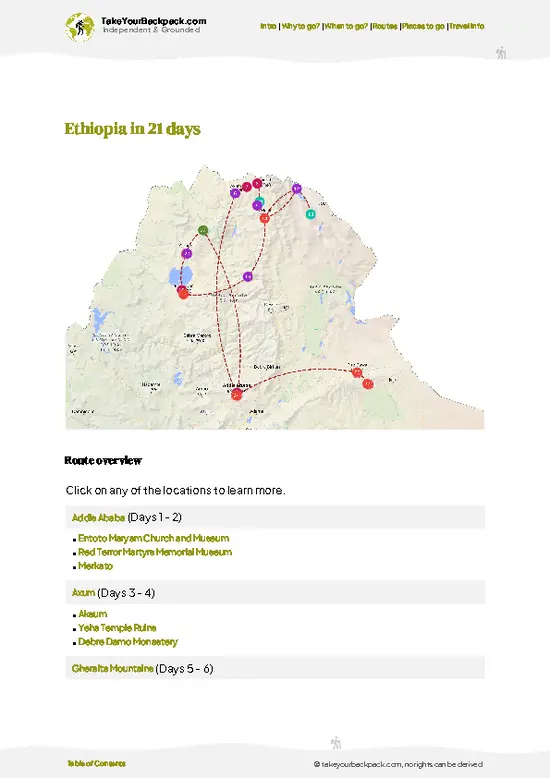
✅ Optimized 7, 14 & 21-day travel routes
✅ Cities, national parks, landmarks, beaches
✅ How to get around
✅ Offline-friendly for travel without Wi-Fi
👉 Click to see all 30+ guide features

📅 Plan smarter in minutes, not weeks
✅ Month by month travel advice
✅ Festivals & national holidays
✅ Budget expectations

🗺️ Go to the right places, skip the overrated ones
✅ Honest pros & cons of destinations
✅ Top hikes, parks & viewpoints
✅ Lesser-known places most travelers miss
✅ Clear “worth it vs skip it” guidance

🛏️ Travel smoothly without rookie mistakes
✅ Best areas to stay
✅ Transport systems explained simply
✅ Common scams & safety advice
✅ SIM cards, money & practical tips

🌍 Understand the country, not just visit it
✅ Culture & traditions
✅ 52 Essential phrases & customs
✅ Festivals worth planning around
✅ Traveler-friendly historical context
✅ Insights that make places more meaningful

📱 Built for real travel conditions
✅ Fully downloadable PDF
✅ Works completely offline
✅ Optimized for phone use
✅ Useful in remote areas & buses
✅ Everything in one place
Stop searching, start planning
Get instant access to your full guide. 30‑day money-back guarantee.
+ Add another guide for just

By proceeding you agree to our terms.
Sent to your inbox immediately after payment • 100% Secure Checkout
Best Backpacking Travel Advisor 2025 tourism awardBest Backpacking
Travel Advisor
2025
What others say about Take Your Backpack Guides:
⭐⭐⭐⭐⭐
Fantastic, amazing amount of information!
⭐⭐⭐⭐⭐
My goodness this is amazing, it's what I've been looking for hats off too you!
⭐⭐⭐⭐⭐
I think this is absolutely BRILLIANT
⭐⭐⭐⭐
Very complete and informative. It's still missing places, but I gotta to commend you
⭐⭐⭐⭐⭐
This is truly amazing, thank you, can't wait to explore it with my kids!
⭐⭐⭐⭐⭐
Awesome resource, thank you!
⭐⭐⭐⭐⭐
This is amazing! Can't wait to explore the ones I haven't seen
⭐⭐⭐⭐
I love this! Well done, great idea.
⭐⭐⭐⭐⭐
Thanks for taking the time to make this gem!
⭐⭐⭐⭐⭐
This might be the best website I've ever seen.
⭐⭐⭐⭐⭐
Congratulations, and thank you so much for your work; it's incredibly valuable.
⭐⭐⭐⭐
In all seriousness I think you did a great job pointing out the important spots
⭐⭐⭐⭐⭐
10/10 very good
⭐⭐⭐⭐⭐
As someone who's only just starting to visit regularly this is awesome, thank you.
⭐⭐⭐⭐
Thank you very much! I'm going to visit my dad, it's going to be very useful!
⭐⭐⭐⭐⭐
This is really cool! We'll be travelling for the first time and this definitely come in handy.
⭐⭐⭐⭐⭐
You are now our minister of culture, congratulations 👨‍💼
⭐⭐⭐⭐⭐
Just wanted to tell you that this is a pearl! Going to follow your recommendations.
⭐⭐⭐⭐⭐
This is so cool. I'll definitely be using the resource for my travels soon.
⭐⭐⭐⭐⭐
This is very impressive! Good work.
⭐⭐⭐⭐⭐
This is an amazing and informative site. Very well done!

🛏️ Where to stay?How to pick the right area

The easiest base is Dinsho, where the park headquarters sits and basic rooms are available right at the gate. Inside the park, you can stay at the Dinsho lodge-style guesthouse near the headquarters (US$10 to 20 for a simple room) and at campsites at Dinsho, Gaysay, Rira, Web Valley and along the Sanetti Plateau. Bring your own tent, sleeping bag rated to -5°C (23°F) and stove, because facilities are minimal. Hire a mule or horse for gear on multi-day treks. Hikers on the classic Rira to Web Valley route use the community-run huts and campsites that scouts arrange.
Outside the park, Goba is the … read more 👉
The easiest base is Dinsho, where the park headquarters sits and basic rooms are available right at the gate. Inside the park, you can stay at the Dinsho lodge-style guesthouse near the headquarters (US$10 to 20 for a simple room) and at campsites at Dinsho, Gaysay, Rira, Web Valley and along the Sanetti Plateau. Bring your own tent, sleeping bag rated to -5°C (23°F) and stove, because facilities are minimal. Hire a mule or horse for gear on multi-day treks. Hikers on the classic Rira to Web Valley route use the community-run huts and campsites that scouts arrange.
Outside the park, Goba is the main town, about an hour from Dinsho by road. It has the most guesthouses and hotels (US$8 to 30 a night), restaurants, ATMs and the minibus stage. Robe, the bigger town to the north, has more hotels and onward buses. Dinsho has a handful of cheap local guesthouses and small eateries.
In the south, Rira Lodge and the community lodge at Adaba and Dodola offer another option. The Bale Mountain Lodge at Rira in the Harenna Forest is the only upscale choice, at well over US$200 a night.

👛 Costs (as of 22 October 2026)What things cost and how to budget

A realistic budget for Bale Mountains National Park is about US$50 to 103 a day, with guides and scouts as the biggest extra. The table covers typical costs for one day of trekking.
CategoryBudget RangeLocal Reality
Park entranceUS$3 to 10Charged per person per day for foreign visitors, plus a small vehicle fee if you drive in.
Scout and guideUS$10 to 25An armed scout and a guide are needed for most treks, with fees paid per day at the Dinsho office.
CampingUS$3 to 8Basic campsites with little more than flat ground and water; you carry your own tent.
Accommodation (low season)US$8 to 20Simple guesthouses in Dinsho and Goba, with cold showers common.
Accommodation (high season)US$10 to 25Rates rise slightly from December to January, so book ahead in Goba.
Horse or mule hireUS$8 to 15Per animal per
… read more 👉
A realistic budget for Bale Mountains National Park is about US$50 to 103 a day, with guides and scouts as the biggest extra. The table covers typical costs for one day of trekking.
CategoryBudget RangeLocal Reality
Park entranceUS$3 to 10Charged per person per day for foreign visitors, plus a small vehicle fee if you drive in.
Scout and guideUS$10 to 25An armed scout and a guide are needed for most treks, with fees paid per day at the Dinsho office.
CampingUS$3 to 8Basic campsites with little more than flat ground and water; you carry your own tent.
Accommodation (low season)US$8 to 20Simple guesthouses in Dinsho and Goba, with cold showers common.
Accommodation (high season)US$10 to 25Rates rise slightly from December to January, so book ahead in Goba.
Horse or mule hireUS$8 to 15Per animal per day, optional, with a handler included.
Local transportUS$2 to 8Minibuses between Goba, Dinsho and Robe. Charter vehicles to the plateau cost much more.
Food and suppliesUS$6 to 12Local meals cost US$2 to 4, and trekkers stock up on snacks and fuel in Goba.
Total Daily BudgetUS$50 to 103Per person, per day, in high season.
⚠️ Prices can change and everyone travels differently, so take this as a rough guide. Hope it helps you plan your adventure!

🥾 TrailsHiking Bale Mountains national park: highlights and difficulty

Bale Mountains National Park offers short forest walks, long plateau treks and multi-day horse trips, and almost all of them need a scout from the park. Trails are unmarked in places, mist drops fast, and the scout knows where the wolves den, so skipping one is a false economy.
  • Finch Habera Waterfall Trail: Roughly 3 to 4 hours round trip, moderate. Forest track with some muddy, steep sections, ending at a tall waterfall. Colobus monkeys are common in the canopy.
  • Web Valley and Sanetti Plateau Trek: Usually 3 to 5 days on foot or horseback. Difficult because of altitude, cold nights and rocky ground,
… read more 👉
Bale Mountains National Park offers short forest walks, long plateau treks and multi-day horse trips, and almost all of them need a scout from the park. Trails are unmarked in places, mist drops fast, and the scout knows where the wolves den, so skipping one is a false economy.
  • Finch Habera Waterfall Trail: Roughly 3 to 4 hours round trip, moderate. Forest track with some muddy, steep sections, ending at a tall waterfall. Colobus monkeys are common in the canopy.
  • Web Valley and Sanetti Plateau Trek: Usually 3 to 5 days on foot or horseback. Difficult because of altitude, cold nights and rocky ground, with camping near streams. Expect wolves, mole rats and several rare birds.
  • Garba Guracha Loop: A short, easy walk of about 1 to 2 hours from the Dinsho area, over grassland and juniper with nyala and bushbuck sightings.
  • Gaysay Valley Walk: Easy and flat, about 2 hours, across open grassland with a river and plenty of grazing animals.
  • Harenna Forest Walks: Short or half-day walks from the road in damp, dark forest. Paths are muddy and slippery, and the birdlife is best early.
Public transport only goes as far as the towns of Dinsho and Goba, a long day by bus from Addis Ababa. From there you hire a vehicle or horse to reach the plateau and valleys. The park is quiet, with few other visitors even in the busiest months, and weekends bring more local day-trippers to Dinsho and Gaysay. Travelers pay an entrance fee in local currency at the gate, roughly US$ 5 to 10 per person per day, plus extras for vehicles, scouts and camping. Carry cash, since cards are not accepted. Bring warm, waterproof layers, even if the lowlands feel mild.
⚠️ Hiking info can sometimes be outdated or inaccurate. Before you hit the trail, check the latest conditions with locals. If you do spot anything that's off, I'd love to hear from you, so I can update it for fellow travelers.

🛡️ SafetyStaying Safe: What Travelers Should Know

Bale Mountains National Park is straightforward for prepared hikers, and the real challenges are altitude, cold and weather. The Sanetti Plateau sits above 4,000 m, so headaches and fatigue are common on day one. Ascend gradually, drink plenty and pace yourself. Temperatures can fall below freezing at night and cloud and rain arrive quickly, so carry a waterproof shell, warm layers and gloves. Trails are not well signed, so hire a scout and a guide; they are required for many routes and they know the paths through the fog. Footing is rocky and boggy in the wet months. Wildlife is mostly shy: Ethiopian wolves, Menelik’s bushbuck and mountain nyala are best viewed from a distance, so keep dogs away and do not feed animals. Spotted hyenas and baboons occur and can visit camps, so store food securely. … read more 👉
Bale Mountains National Park is straightforward for prepared hikers, and the real challenges are altitude, cold and weather. The Sanetti Plateau sits above 4,000 m, so headaches and fatigue are common on day one. Ascend gradually, drink plenty and pace yourself. Temperatures can fall below freezing at night and cloud and rain arrive quickly, so carry a waterproof shell, warm layers and gloves. Trails are not well signed, so hire a scout and a guide; they are required for many routes and they know the paths through the fog. Footing is rocky and boggy in the wet months. Wildlife is mostly shy: Ethiopian wolves, Menelik’s bushbuck and mountain nyala are best viewed from a distance, so keep dogs away and do not feed animals. Spotted hyenas and baboons occur and can visit camps, so store food securely. Bring all supplies, since shops are scarce, and treat or filter all water. Carry a charged phone and tell someone your route.

FAQTraveler FAQ

Plan on 3 to 5 days for Bale Mountains National Park if you want both the Sanetti Plateau and the Harenna Forest. A short visit of 2 days covers Dinsho and the plateau by vehicle. The classic Web Valley to Rira trek takes around 4 to 5 days on foot or horseback, and Goba is the usual starting point.
Yes, it is possible to visit Bale Mountains National Park by public transport, though a car saves time. Buses run from Addis Ababa to Goba in about 9 to 11 hours, and minibuses continue to Dinsho (around 1 hour). The road across the Sanetti Plateau has little traffic, so most visitors hire a vehicle or trek with horses from Dinsho or Rira.
Yes, Bale Mountains National Park charges a daily entrance fee for foreign visitors, roughly US$3 to 10 per person. A scout and guide are required for most treks and cost about US$10 to 25 a day, arranged at the Dinsho headquarters. Camping adds a few dollars per night, and no advance permit is needed for ordinary visits.
⚠️ Things can change over time, so always validate details locally before you go.

Other Ethiopian national parks near Bale Mountains

Explore more nearby:


💡 Not sure where to go next?
Create a personalized itinerary for Ethiopia including Bale Mountains and the places that fit your trip.

Generate my itinerary

👉 Discover all national parks

Or checkout all Ethiopia has to offer (think cities, towns, villages, national parks, hikes, beaches, festivals)
Country photo of Ethiopia

We 💚 feedbackParting advice and final tips

Bale Mountains National Park is easy to underestimate. Travelers often rush the Sanetti Plateau in a single day trip, step out of the vehicle at 4,000 m and feel dizzy within minutes. Give yourself two nights near Dinsho or Goba first, then go up slowly. I would book a scout and horse early, bring a warm jacket, and spend the afternoon watching wolves instead of chasing the summit.

✈️ When did I visit Ethiopia?
Ethiopia I visited back in October 2017. I combined the trip with a visit to Sudan. Ethiopia was a pure surprise with the magical scenery like the Danakil Depression and the Simien Mountains.

✍️ Help improve this page!
The information on this page is based on my own backpacking experience in Ethiopia, supplemented with up-to-date research and feedback from other travelers. Travel details can change, so if you notice anything outdated or incomplete, feel free to let me know.


🙋‍♂️ Give feedback

👋 Meet the founderWho’s Behind Take Your Backpack?

Johan, backpacker and founder of TakeYourBackpackHi, I’m Johan (Netherlands 🇳🇱), the creator of TakeYourBackpack. Over the past 3 decades, I’ve backpacked through 90+ countries across six continents, gaining extensive experience with independent travel, long-term trips, and overland routes.

This site is built on a combination of firsthand travel experience and carefully curated insights from other backpackers. Many guides are based on places I’ve personally visited, while others bring together tips, observations, and practical advice shared by trusted travelers I’ve met along the way.

The goal is to provide realistic, experience-driven guidance — not generic itineraries — so you can explore destinations with better context, clearer expectations, and more confidence.