×

Ethiopia🇪🇹 | attractionsDire Dawa Kefira Marketopen-air stalls, regional produce, textile trading | things to do and best time to go

Explore Hyena Feeding SiteExplore Debre Damo Monastery

Backpacking in Dire Dawa Kefira Market
👀 For curious travelersattraction ranked #18
By Johan Kruseman 🇳🇱 | Updated June 3, 2026

Forget the Instagram fantasy of Dire Dawa Kefira Market as some untouched, photogenic bazaar where you’ll float through clouds of incense and snap perfect shots of colorfully dressed vendors. The reality? This is Ethiopia’s second city, and the market is a living, breathing organism—chaotic, loud, and absolutely unapologetic. You’ll find it in the heart of Dire Dawa, eastern Ethiopia, where the old railway meets the modern sprawl. Backpackers who crave authenticity over curated experiences will get a jolt here: the market is a sensory overload, with donkey carts weaving through crowds, spices stinging your nose, and haggling that’s more sport than transaction. Yes, it’s crowded—especially on weekends—and you’ll get stared at, but not hustled like in Addis or Lalibela. Prices are refreshingly local, but don’t expect tourist polish or English menus. Compared to Ethiopia’s headline acts, Kefira Market is rawer, grittier, and—if you’re open to it—far more rewarding.

Discover everything you want to know in the 📖 Ethiopia Travel Guide.
Safety warning

The current risk level for Ethiopia is high. Check the advice before going.


Get your Ethiopia guide
101 ranked highlights, routes & tips, works offline (395 pages)
Loading the map 🌍
CLICK TO FILTER
cities
towns
landmarks
national parks
hikes
attractions
festivals
regions
SHOW COUNTRY’S BESTSHOW ALL

✨ Why go?
Ranked #18 attraction in Ethiopia
Why Dire Dawa Kefira Market should be on your travel list

Dire Dawa Kefira Market isn’t some polished tourist stop with Instagram-perfect stalls. It’s raw, chaotic, and unapologetically real—exactly why backpackers carve out time here. This market is a living snapshot of Ethiopia’s diverse cultures, where Somali, Oromo, and Harari traders converge, each bringing their own flavor to the mix. You won’t find sanitized souvenirs here; instead, you’ll encounter authentic crafts, spices, and textiles that tell stories centuries old.

Yes, it’s crowded and noisy—expect a sensory overload that can feel overwhelming if you’re not ready. But that’s the point. The market’s energy is a pulse of the region’s history and economy, a place where tradition meets daily hustle. It’s a major milestone on the route through eastern Ethiopia, marking a shift from the highlands … read more 👉
Dire Dawa Kefira Market isn’t some polished tourist stop with Instagram-perfect stalls. It’s raw, chaotic, and unapologetically real—exactly why backpackers carve out time here. This market is a living snapshot of Ethiopia’s diverse cultures, where Somali, Oromo, and Harari traders converge, each bringing their own flavor to the mix. You won’t find sanitized souvenirs here; instead, you’ll encounter authentic crafts, spices, and textiles that tell stories centuries old.

Yes, it’s crowded and noisy—expect a sensory overload that can feel overwhelming if you’re not ready. But that’s the point. The market’s energy is a pulse of the region’s history and economy, a place where tradition meets daily hustle. It’s a major milestone on the route through eastern Ethiopia, marking a shift from the highlands to the lowlands, and offering a rare glimpse into the country’s commercial heart outside Addis Ababa.

The effort to navigate the market’s maze-like alleys pays off with moments of genuine connection—whether bargaining over a handwoven basket or sharing a laugh with a vendor. For backpackers chasing more than just sights, Kefira Market delivers an unfiltered, adrenaline-charged experience that’s as educational as it is exhilarating.
Want to include Dire Dawa Kefira Market in your Ethiopia route?
Create a personalized Ethiopia itinerary that includes Dire Dawa Kefira Market and the places that fit your trip — based on your travel style, budget, and available time. Get your route in seconds.

Generate my trip

💡 HighlightsPlaces and moments you shouldn't skip

The Goat and Camel Auction
Forget the sanitized, Instagram-friendly “market” shots. The Kefira Market’s livestock section is a full-on sensory assault—bleating goats, haggling herders, and the kind of dust that clings to your boots for days. You’ll see camels traded with the same nonchalance as a bag of onions. This isn’t a show for tourists; it’s the real engine of local commerce. If you want to understand Dire Dawa’s pulse, stand here for twenty minutes and watch the negotiations. The drama is unscripted, the stakes are real, and the animals are—let’s be honest—sometimes more charismatic than the people.


The Spices and Incense Alley
You’ll smell it before you see it: a corridor of burlap sacks overflowing with berbere, turmeric, and cardamom, plus frankincense that’s so fresh it still carries … read more 👉
The Goat and Camel Auction
Forget the sanitized, Instagram-friendly “market” shots. The Kefira Market’s livestock section is a full-on sensory assault—bleating goats, haggling herders, and the kind of dust that clings to your boots for days. You’ll see camels traded with the same nonchalance as a bag of onions. This isn’t a show for tourists; it’s the real engine of local commerce. If you want to understand Dire Dawa’s pulse, stand here for twenty minutes and watch the negotiations. The drama is unscripted, the stakes are real, and the animals are—let’s be honest—sometimes more charismatic than the people.


The Spices and Incense Alley
You’ll smell it before you see it: a corridor of burlap sacks overflowing with berbere, turmeric, and cardamom, plus frankincense that’s so fresh it still carries the scent of the highlands. This is where the city’s cooks and coffee ceremony hosts come to stock up. The sellers are quick with a joke and even quicker with a sample. Don’t expect neat labels or English explanations—half the fun is guessing what’s what, and the other half is realizing you’ve just bought a handful of something that will blow your next stew out of the water.


The Tailor’s Row
Dire Dawa’s market isn’t just about food. There’s a whole stretch where tailors set up shop with ancient Singer machines, sewing everything from school uniforms to wedding dresses. The speed and precision are mesmerizing. If you want a shirt made to measure, you can have it done in a couple of hours—no appointment, no fuss. The patterns are bold, the colors unapologetic, and the craftsmanship is the kind you’ll brag about back home.


The Street Food Gauntlet
This is my personal favorite. Skip breakfast and come hungry. The market’s food stalls serve up sambusas, chechebsa, and spicy lentil stews that will make you rethink everything you know about “market food.” There’s no pretension here—just plastic stools, chipped enamel plates, and flavors that punch way above their weight. The best stalls are the ones with the longest lines and the loudest laughter. If you’re squeamish about hygiene, bring your own wipes and get over it. The reward is worth the risk.


The Coffee Corners
Ethiopia invented coffee culture, and Kefira Market is where you see it stripped of all hipster nonsense. Here, coffee is roasted over charcoal, ground by hand, and served in tiny cups with a side of conversation. You’ll be invited to join, whether you buy anything or not. The ritual is slow, the coffee is strong, and the hospitality is the real deal. If you want to understand why Ethiopians take their coffee seriously, this is the place to learn—no latte art, just pure, unfiltered tradition.
Spotted a mistake or missing something? Contact us.

Things to do around Dire Dawa Kefira Market

Ratings based on Tripadvisor reviews. When you book through this link, you support our work at no extra cost to you.

🌤️ When to go?When to go for the best experience


  • Weather: Dire Dawa’s dry season from October to February offers the most comfortable conditions for wandering the Kefira Market. Expect clear skies and minimal rain, unlike the heavy showers from June to September that can turn the dusty paths into mud traps.

  • Temperature: Daytime highs hover around 28-32°C (82-90°F) during the dry months, which is warm but manageable with shade and water. The wet season cools things down slightly but brings humidity that can sap your energy fast.

  • Daylight Hours: From October to February, you get roughly 11 to 12 hours of daylight, enough time to explore the market’s maze of stalls without rushing. The sun rises around 6:30 AM and sets close to 6:30 PM, giving you a solid window for discovery.

  • Crowds: The market is busiest on weekends and during local
read more 👉

  • Weather: Dire Dawa’s dry season from October to February offers the most comfortable conditions for wandering the Kefira Market. Expect clear skies and minimal rain, unlike the heavy showers from June to September that can turn the dusty paths into mud traps.

  • Temperature: Daytime highs hover around 28-32°C (82-90°F) during the dry months, which is warm but manageable with shade and water. The wet season cools things down slightly but brings humidity that can sap your energy fast.

  • Daylight Hours: From October to February, you get roughly 11 to 12 hours of daylight, enough time to explore the market’s maze of stalls without rushing. The sun rises around 6:30 AM and sets close to 6:30 PM, giving you a solid window for discovery.

  • Crowds: The market is busiest on weekends and during local holidays, especially in December and January when traders stock up for Ethiopian Christmas. If you want fewer elbows in your ribs, aim for weekdays in November or early February.

  • Seasonal Activities: Harvest season in October and November means fresh produce floods the market, making it a sensory overload of colors and smells. This is when you’ll see the market at its most vibrant and authentic, beyond the usual tourist snapshots.

  • Price Fluctuations: Prices tend to spike during the dry season’s peak months (December-January) due to higher demand from locals and visitors alike. Bargaining power improves in the shoulder months like October and February when the market is less crowded.


Pro-tip: Visit just after the rainy season ends in October—cooler, less crowded, and bursting with fresh harvest goods. It’s the sweet spot where the market’s real character shines without the tourist circus.


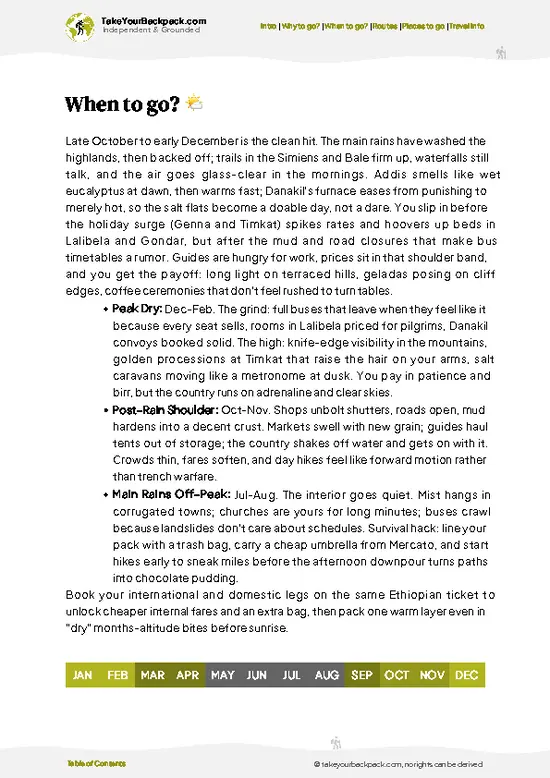
source: climatestotravel.comJANJanuary: highly recommended for travelingFEBFebruary: highly recommended for travelingMARMarch: fair for travelingAPRApril: fair for travelingMAYMay: fair for travelingJUNJune: below average for travelingJULJuly: below average for travelingAUGAugust: below average for travelingSEPSeptember: below average for travelingOCTOctober: excellent for travelingNOVNovember: excellent for travelingDECDecember: highly recommended for traveling
when-to-go

✈️ The backpacker research shortcutEthiopia Travel Guide

An offline-friendly backpacking guide with optimized travel routes, ranked highlights, transport advice, and the best areas to stay.
example page 0 from our offline Travel Guide for Ethiopia
example page 1 from our offline Travel Guide for Ethiopia
example page 2 from our offline Travel Guide for Ethiopia
example page 3 from our offline Travel Guide for Ethiopia
example page 4 from our offline Travel Guide for Ethiopia
example page 5 from our offline Travel Guide for Ethiopia
example page 6 from our offline Travel Guide for Ethiopia
example page 7 from our offline Travel Guide for Ethiopia
The digital guide (395 pages) contains:
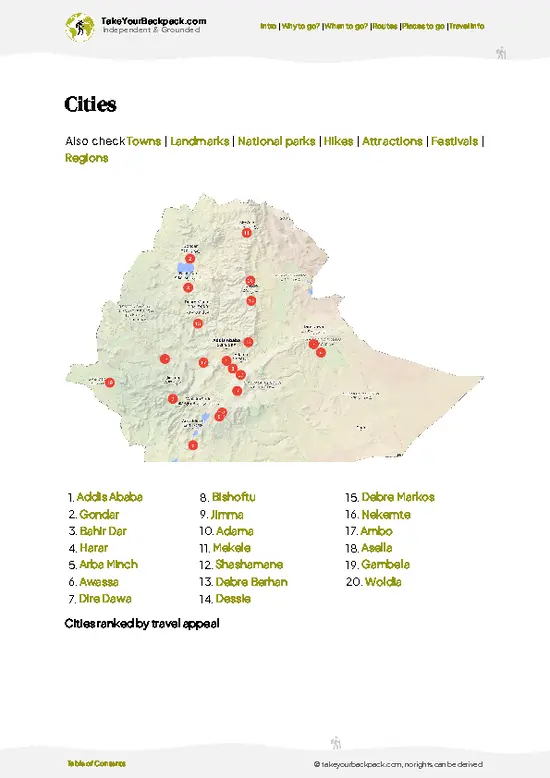
101 highlights, ranked by travel appeal
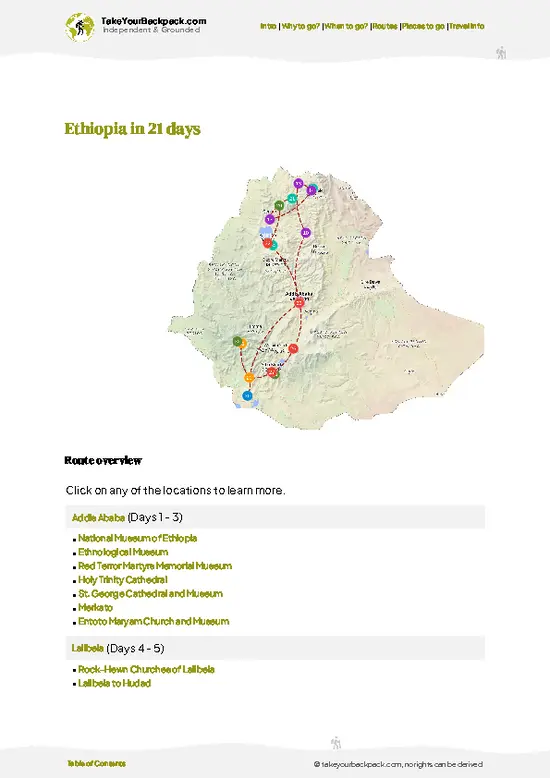
Optimized 7, 14 & 21-day travel routes
Cities, national parks, landmarks, beaches
How to get around
Offline-friendly for travel without Wi-Fi
👉 Click to see all 30+ guide features

📅 Plan smarter in minutes, not weeks
Month by month travel advice
Festivals & national holidays
Budget expectations

🗺️ Go to the right places, skip the overrated ones
Honest pros & cons of destinations
Top hikes, parks & viewpoints
Lesser-known places most travelers miss
Clear “worth it vs skip it” guidance

🛏️ Travel smoothly without rookie mistakes
Best areas to stay
Transport systems explained simply
Common scams & safety advice
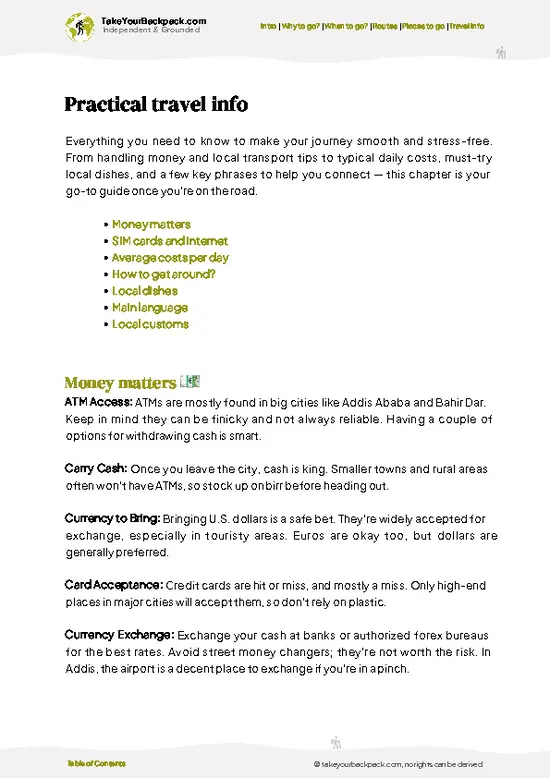
SIM cards, money & practical tips

🌍 Understand the country, not just visit it
Culture & traditions
52 Essential phrases & customs
Festivals worth planning around
Traveler-friendly historical context
Insights that make places more meaningful

📱 Built for real travel conditions
Fully downloadable PDF
Works completely offline
Optimized for phone use
Useful in remote areas & buses
Everything in one place
Save weeks of stressful planning
Get instant access to your full guide. 30‑day money-back guarantee.


By proceeding you agree to our terms.
Sent to your inbox immediately after payment • 100% Secure Checkout
Best Backpacking Travel Advisor 2025 tourism awardBest Backpacking
Travel Advisor
2025
What others say about Take Your Backpack Guides:
⭐⭐⭐⭐⭐
Fantastic, amazing amount of information!
⭐⭐⭐⭐⭐
My goodness this is amazing, it's what I've been looking for hats off too you!
⭐⭐⭐⭐⭐
I think this is absolutely BRILLIANT
⭐⭐⭐⭐
Very complete and informative. It's still missing places, but I gotta to commend you
⭐⭐⭐⭐⭐
This is truly amazing, thank you, can't wait to explore it with my kids!
⭐⭐⭐⭐⭐
Awesome resource, thank you!
⭐⭐⭐⭐⭐
This is amazing! Can't wait to explore the ones I haven't seen
⭐⭐⭐⭐
I love this! Well done, great idea.
⭐⭐⭐⭐⭐
Thanks for taking the time to make this gem!
⭐⭐⭐⭐⭐
This might be the best website I've ever seen.
⭐⭐⭐⭐⭐
Congratulations, and thank you so much for your work; it's incredibly valuable.
⭐⭐⭐⭐
In all seriousness I think you did a great job pointing out the important spots
⭐⭐⭐⭐⭐
10/10 very good
⭐⭐⭐⭐⭐
As someone who's only just starting to visit regularly this is awesome, thank you.
⭐⭐⭐⭐
Thank you very much! I'm going to visit my dad, it's going to be very useful!
⭐⭐⭐⭐⭐
This is really cool! We'll be travelling for the first time and this definitely come in handy.
⭐⭐⭐⭐⭐
You are now our minister of culture, congratulations 👨‍💼
⭐⭐⭐⭐⭐
Just wanted to tell you that this is a pearl! Going to follow your recommendations.
⭐⭐⭐⭐⭐
This is so cool. I'll definitely be using the resource for my travels soon.
⭐⭐⭐⭐⭐
This is very impressive! Good work.
⭐⭐⭐⭐⭐
This is an amazing and informative site. Very well done!

🛏️ Where to stay?Where staying makes the most sense

Dire Dawa’s Kefira Market is a sensory overload—colors, smells, and sounds collide in a way that’s both chaotic and captivating. But here’s the truth: it’s not a polished tourist trap. It’s raw, crowded, and can feel overwhelming if you’re not prepared. That’s why where you stay matters more than you might think.

Forget the idea that you need to be right on top of the market. The best spots for backpackers are in the neighborhoods just a short walk away—places where you can catch your breath after the market’s intensity. These areas are safer, quieter, and have a more authentic vibe. You’ll find … read more 👉
Dire Dawa’s Kefira Market is a sensory overload—colors, smells, and sounds collide in a way that’s both chaotic and captivating. But here’s the truth: it’s not a polished tourist trap. It’s raw, crowded, and can feel overwhelming if you’re not prepared. That’s why where you stay matters more than you might think.

Forget the idea that you need to be right on top of the market. The best spots for backpackers are in the neighborhoods just a short walk away—places where you can catch your breath after the market’s intensity. These areas are safer, quieter, and have a more authentic vibe. You’ll find local cafés and small eateries where you can connect with other travelers and locals without the pressure of the market’s hustle.

Social spots here aren’t flashy; they’re about genuine interaction. Budget travelers and solo backpackers gravitate toward these pockets because they offer a balance: easy access to Kefira Market during the day, and a chance to unwind in a community that feels lived-in, not staged. Safety is a real concern in Dire Dawa, so these neighborhoods have a better reputation among seasoned travelers who know the city’s rhythms.

If you want to experience Kefira Market without feeling like you’re trapped in a tourist circus or risking your peace of mind, pick your base wisely. Stay close enough to dive into the market’s madness but far enough to enjoy a calm, social atmosphere when the day ends. That’s where the real magic of Dire Dawa lives.

👛 Costs (as of 7 June 2026)Money, prices, and spending tips

As of the most recent estimates, visiting the Kefira Market in Dire Dawa, Ethiopia, does not require an entrance fee. The market is open to the public without charge. While there are no specific ticket prices, visitors should budget for purchases, food, and transportation. Most shops open around 8:00 AM or 9:00 AM and stay open until early evening, around 7:00 PM. However, due to the afternoon heat, many businesses close for a lunch break between 1:00 PM and 3:00 PM. Cash is essential, as credit cards are rarely accepted outside of major hotels. ([kupi.com](https://www.kupi.com/en-ae/explore/ethiopia/dire-dawa?utm_source=openai))

source: kupi.com
⚠️ Prices can change and everyone travels differently, so take this as a rough guide. Hope it helps you plan your adventure!

Other Ethiopian attractions near Dire Dawa Kefira Market

Explore more nearby:


💡 Not sure where to go next?
Create a personalized itinerary for Ethiopia including Dire Dawa Kefira Market and the places that fit your trip.

Generate my itinerary

👉 Discover all attractions

Or checkout all Ethiopia has to offer (think cities, towns, villages, national parks, hikes, beaches, festivals)
Country photo of Ethiopia

We 💚 feedbackSumming up the experience

Dire Dawa Kefira Market isn’t your polished tourist stop—it’s chaotic, loud, and packed with locals hustling hard. If you’re after a sanitized souvenir run, skip it. But if you want to feel the pulse of real Ethiopian trade, hear the bartering rhythms, and see raw, unfiltered life, this market delivers. Just brace yourself for the crowds and the sensory overload—it’s not for the faint-hearted, but that’s exactly why it’s worth the trip.

✈️ When did I visit Ethiopia?
Ethiopia I visited back in October 2017. I combined the trip with a visit to Sudan. Ethiopia was a pure suprise with the magical scenery like the Danikal Depression and the Simien Mountains.

✍️ Help improve this page!
The information on this page is based on my own backpacking experience in Ethiopia, supplemented with up-to-date research and feedback from other travelers. Travel details can change, so if you notice anything outdated or incomplete, feel free to let me know.


🙋‍♂️ Give feedback

👋 Meet the founderWho’s Behind Take Your Backpack?

Johan, backpacker and founder of TakeYourBackpackHi, I’m Johan (Netherlands 🇳🇱), the creator of TakeYourBackpack. Over the past decade, I’ve backpacked through 80+ countries across six continents, gaining extensive experience with independent travel, long-term trips, and overland routes.

This site is built on a combination of firsthand travel experience and carefully curated insights from other backpackers. Many guides are based on places I’ve personally visited, while others bring together tips, observations, and practical advice shared by trusted travelers I’ve met along the way.

The goal is to provide realistic, experience-driven guidance — not generic itineraries — so you can explore destinations with better context, clearer expectations, and more confidence.

Get full Ethiopia guide •
Instant download • 101 highlights • Full Offline guide