×

Ethiopia🇪🇹 | best attractionsBest 10 attractions in Ethiopia

Attractions in Ethiopia sit at altitude, and that shapes everything. Most of the country’s draws are rock-hewn churches, mountain parks, ancient stone ruins and living festivals, reached by dusty roads where roasting coffee, woodsmoke and incense hang in the thin, bright air. The northern highlands are the classic circuit: cool mornings, church drums and chanting at dawn, long bus days and the most foreign visitors. The south is hotter and rougher, with market days, river valleys and fewer travelers, and it often needs hired vehicles. The east around Harar is walled-city lanes and khat-scented stalls, easy on foot. The Danakil in the northeast is sulfur-yellow and brutally hot, and only visited on escorted tours at a premium. For independent travel and backpacking, the north and Addis Ababa are cheapest and easiest. Expect entry fees that are paid in cash, often in dollars or birr, and journeys that take hours rather than minutes.

By Johan Kruseman 🇳🇱 | Updated November 3, 2026
Explore the best festivals in Ethiopia

Why go?Why Travelers Love These Spots

Ethiopia is unlike its neighbors because it was never colonized in the usual way, and that continuity shows. Orthodox Christianity dates back to the fourth century, so churches are working places, not museums: you remove your shoes onto cool stone, smell beeswax and frankincense, and hear priests chant in Ge’ez. Alongside it, Muslim, Indigenous and Jewish-descended communities keep separate calendars, which means the country runs on its own clock, with its own calendar and a 12-hour day that starts at dawn.

The land does the rest. The Rift Valley and the highland plateau create sharp contrasts, from cold ridgelines above 3,000 meters to salt flats below sea level. That variety is real, but so is the effort. Roads wind through switchbacks, buses leave when full, and distances that look short … read more 👉
Ethiopia is unlike its neighbors because it was never colonized in the usual way, and that continuity shows. Orthodox Christianity dates back to the fourth century, so churches are working places, not museums: you remove your shoes onto cool stone, smell beeswax and frankincense, and hear priests chant in Ge’ez. Alongside it, Muslim, Indigenous and Jewish-descended communities keep separate calendars, which means the country runs on its own clock, with its own calendar and a 12-hour day that starts at dawn.

The land does the rest. The Rift Valley and the highland plateau create sharp contrasts, from cold ridgelines above 3,000 meters to salt flats below sea level. That variety is real, but so is the effort. Roads wind through switchbacks, buses leave when full, and distances that look short on a map take a full day.

Before choosing Ethiopia, know that infrastructure is uneven. Major sites have guides and ticket offices, but many places have basic lodging, cold showers and patchy power. Altitude is a factor: Addis Ababa sits around 2,350 meters, and some trekking goes far higher, so headaches in the first days are common. Foreign visitors pay a higher price than locals at most sites, and fees are often listed in birr with a separate rate for foreigners. Bring cash, since ATMs run dry and cards are rarely accepted outside Addis.

Security also matters. Conflict and unrest have affected some northern regions and border areas in recent years, so check current government advisories and local conditions before committing. When conditions are calm, Ethiopia offers depth and texture few places can match.
Why These Made the Cut
The list of best attractions in Ethiopia is created based on cultural significance or entertainment value. If you feel a attraction is missing in this list, please let us know.

When to go?Optimal Periods for Travel

Best months for attractions: The best months are October to March, when the highlands are dry, the sky is a hard clean blue and trails and roads are passable. Days in the northern highlands and around Addis Ababa run roughly 20 to 26°C, while nights at altitude can drop to 5 to 10°C, and higher mountain camps can fall near freezing. Pack for both.

Rainy season and shoulder months: The main rains, the kiremt, fall from about June to mid-September. In the highlands, July and August can bring 200 to 300 mm a month, turning dirt tracks to red mud, hiding mountain views in cloud and slowing buses. Green hillsides and fewer visitors are the upside, and lodging prices can be negotiable. October and early November are a good shoulder window: the land is still green and the air washed clean. April … read more 👉
Best months for attractions: The best months are October to March, when the highlands are dry, the sky is a hard clean blue and trails and roads are passable. Days in the northern highlands and around Addis Ababa run roughly 20 to 26°C, while nights at altitude can drop to 5 to 10°C, and higher mountain camps can fall near freezing. Pack for both.

Rainy season and shoulder months: The main rains, the kiremt, fall from about June to mid-September. In the highlands, July and August can bring 200 to 300 mm a month, turning dirt tracks to red mud, hiding mountain views in cloud and slowing buses. Green hillsides and fewer visitors are the upside, and lodging prices can be negotiable. October and early November are a good shoulder window: the land is still green and the air washed clean. April and May bring shorter rains in many areas and rising heat, so they suit trips that stick to the cooler highlands.

Regional differences: The south, including the Omo Valley, has two wetter periods, roughly April to May and October to November, and roads can become impassable in heavy rain. The Danakil Depression in the northeast is only practical from about November to March, since temperatures elsewhere in the year can exceed 40°C, and tours usually operate only in the cooler months. Harar and the east are warm and comfortable for much of the year.

Peak periods and prices: Peak demand comes around Timkat (January 19 or 20 in most years), Genna (January 7) and Meskel (September 27). Rooms in festival towns fill early and prices can rise by 30 to 100 percent, so book ahead. Outside these dates, hotels are easier to find, and Addis Ababa has steady availability year-round.

attraction hoppingOptimizing Your Multi-Stop Itinerary

How long to allow: A trip combining several of Ethiopia’s main attractions needs 10 to 21 days, with two weeks a realistic minimum for covering more than one region without exhaustion. Distances are long, roads are slow, and an average bus day covers far less ground than the map suggests.

Which regions group well: The northern historic circuit works as a block: Bahir Dar, Gondar, the Simien Mountains area, Axum and Lalibela form a natural loop, and the cool highland air makes the long days easier. The south, including the Rift Valley lakes and the Omo region, groups with Addis Ababa and Arba Minch. Harar and Dire Dawa pair together in the east. The Danakil is usually a short separate leg, run from Mekele on organized tours of three to four days.

Direction and pacing: Most travelers start … read more 👉
How long to allow: A trip combining several of Ethiopia’s main attractions needs 10 to 21 days, with two weeks a realistic minimum for covering more than one region without exhaustion. Distances are long, roads are slow, and an average bus day covers far less ground than the map suggests.

Which regions group well: The northern historic circuit works as a block: Bahir Dar, Gondar, the Simien Mountains area, Axum and Lalibela form a natural loop, and the cool highland air makes the long days easier. The south, including the Rift Valley lakes and the Omo region, groups with Addis Ababa and Arba Minch. Harar and Dire Dawa pair together in the east. The Danakil is usually a short separate leg, run from Mekele on organized tours of three to four days.

Direction and pacing: Most travelers start in Addis Ababa, then fly or bus to the north and work through the circuit before returning. Allow 2 to 3 nights at larger stops and 1 to 2 nights at smaller ones. Bus journeys between northern hubs commonly take 6 to 10 hours on winding roads, with dust, crowded seats and roadside stops for coffee and injera. The Addis to Bahir Dar road takes around 9 to 11 hours, while domestic flights take about an hour and are often worth the cost for the longer gaps.

Planning mistakes to avoid: The most common error is packing in too many regions. Cramming north, south and east into ten days means spending most of it on buses. Pick two regions and give each real time. Another mistake is ignoring road conditions in the rainy months, when schedules slip by half a day or more. Build in a spare day before any international flight, because delays are common. Finally, many travelers underestimate altitude fatigue in the first days. Start with a gentle stop in Addis Ababa to adjust before long drives or high-altitude walking.

The ListMust-Visit attractions in Ethiopia

1 Harar Jugol

Walled alleys, Feres Magala market, Jamia Mosque, Rimbaud’s house

Follow the 16th-century wall through lanes of painted houses, mosques and coffee-scented market stalls, with a few small museums along the way.

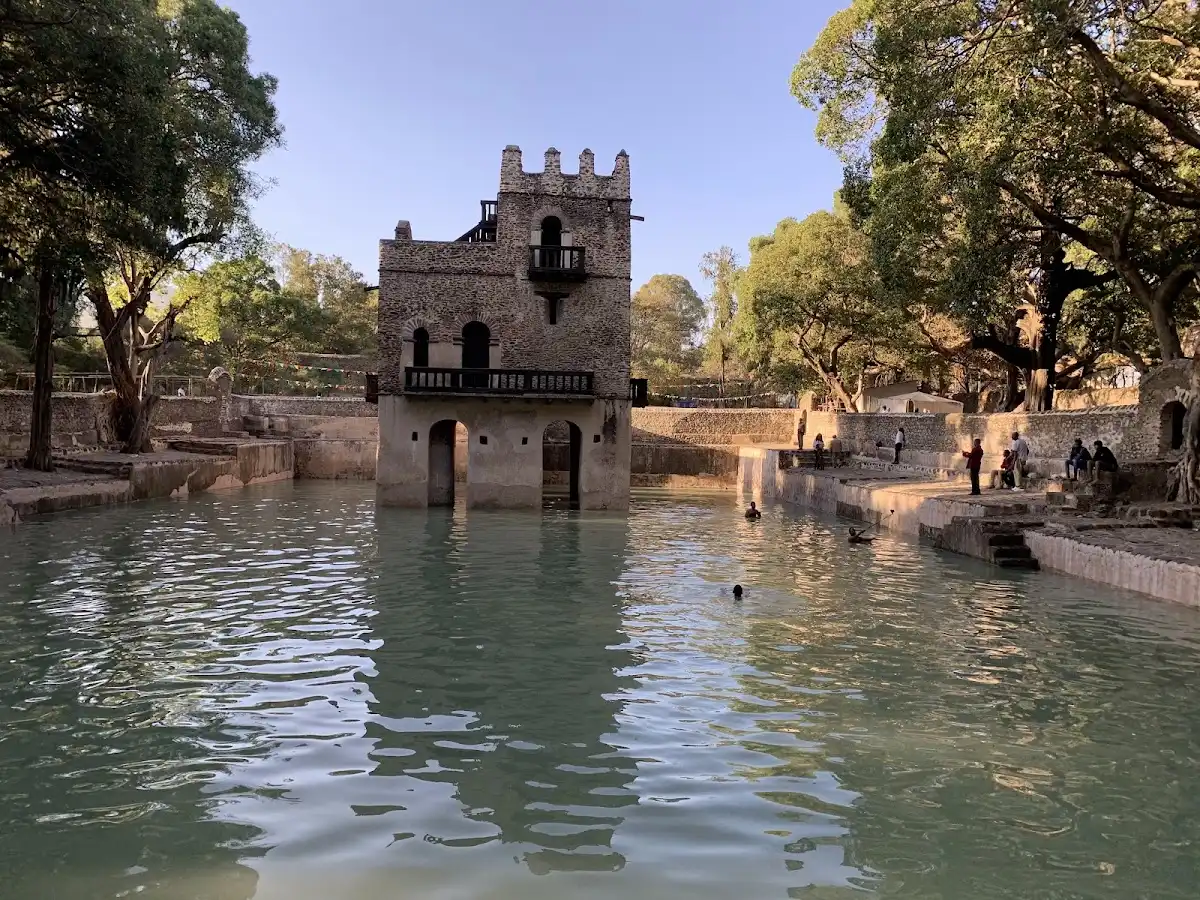
2 Fasilides’ Bath

Dry pool, fig-root walls, Timkat water, island pavilion

Walk the floor of an empty basin, climb the pavilion’s narrow stairs, and see where January crowds splash during the blessing.

ethiopia-attraction-fasilides-bath
© Google |

3 Ura Kidane Mehret

Round church murals, Zege boat ride, coffee forest path, papyrus canoes

Cross Lake Tana by boat, walk shaded coffee paths, and look up at wide-eyed saints painted around a thatched circular sanctuary.

4 Debre Damo Monastery

Leather rope climb, Aksumite stonework, women-free summit, Tigray amba

Haul yourself up a 15-meter cliff on a braided hide rope to reach monks’ cells, cisterns and a carved wooden ceiling.

ethiopia-attraction-debre-damo-monastery
© Google |

5 Debre Berhan Selassie Church

Winged-face ceiling, wall-to-beam murals, circular stone wall, Gondar hillside

Stand beneath 80 painted cherub faces, then trace saints, devils and Bible scenes across the walls inside a fortified compound.

ethiopia-attraction-debre-berhan-selassie-church
© Google |

6 National Museum of Ethiopia

Lucy skeleton, Aksumite inscriptions, Afewerk Tekle canvases, human origins

Trace human origins from Lucy and Ardi through Aksumite stonework to imperial thrones and the paintings of Ethiopia’s best-known modern artist.

ethiopia-attraction-national-museum-of-ethiopia
© Google |

7 Tiya Stelae Field

Carved stelae, sword symbols, burial field, Rift Valley farmland

Trace faint swords and T-shaped symbols on leaning stone slabs, with village guides explaining burial theories beside teff fields.

8 Ethnological Museum

Haile Selassie’s bedroom, imperial robes, life-cycle galleries, campus palace

Walk through the emperor’s preserved private rooms, then follow galleries of crosses, icons and instruments from birth to burial across Ethiopia’s peoples.

ethiopia-attraction-ethnological-museum
© Google |

9 Holy Trinity Cathedral

Imperial tomb, stained glass nave, patriots’ graves, neo-baroque towers

Visit Haile Selassie’s sarcophagus, then find the graves of resistance fighters and Sylvia Pankhurst in the grounds beside the domed cathedral.

10 St. George Cathedral and Museum

Judgment Day mosaic, octagonal cathedral, coronation memorabilia, patriots’ tombs

Study Afewerk Tekle’s glass and mosaics, then step into the courtyard graves and a small museum of crowns and ceremonial drums.

11 Entoto Maryam Church and Museum

Octagonal church, Menelik II ruins, eucalyptus ridge, imperial crowns

Climb above the capital to an octagonal church, a small museum of regalia, and forest trails with open views over the city.

12 Yeha Temple Ruins

Mortarless limestone temple, Sabaean script, Grat Beal Gebri ruins, Tigray highlands

Touch mortarless limestone walls roughly 2,700 years old, then find South Arabian inscriptions and a nearby tomb complex among terraced hills.

ethiopia-attraction-yeha-temple-ruins
© Google |

13 Red Terror Martyrs Memorial Museum

Derg-era memorial, survivor guides, victims’ photographs, Meskel Square

Hear firsthand accounts from former prisoners as you pass skull displays, torn clothing and recreated cells documenting the Red Terror.

14 Merkato

Spice market, tin workshops, coffee rows, Anwar Mosque

Push through alleys of berbere sacks, roasting beans, shamma cloth and hammering metalworkers, with the green-and-white mosque as a landmark.

15 Hyena Feeding Site

Night hyena feeding, meat on sticks, glowing eyes, handler families

Watch wild spotted hyenas appear from the dark at the call of local handlers, and feed them scraps from a stick.

16 Kefira Market

Moorish arches, spice sacks, khat bundles, Megala lanes

Walk under the entrance arches into aisles of berbere, coffee beans, cloth and household goods, then finish with sambusa and sweet tea at a corner stall.

17 Melka Kunture Prehistoric Site

Oldowan layers, hand axes, Awash gorge, dig shelter

Look down at stone tools lying where they fell, then match hand axes and fossil casts in the museum to each occupation period.

18 Addis Ababa Museum

Ras Biru mansion, carved balconies, painted ceilings, early Addis photographs

Climb through a late-19th-century mansion to study imperial furniture, painted beams and old photographs of Addis before its towers, then step onto the upper balcony.

Think you know Ethiopia?

Prove you’re a true local — uncover 8 lesser-known attractions in Ethiopia that locals tend to keep to themselves.
Loading the map 🌍

Expert viewExpert Commentary on attractions

How many attractions to visit: I would advise 6 to 10 attractions in a two to three week trip. Ethiopia’s travel days are long and slow, with winding roads, dust in your teeth and engines grinding up escarpments. Any more and you spend your time in minibuses, not at the sites. The right number gives you time to linger over a church floor, a market or a ridge walk, and still recover.

Prioritizing by travel style: If you love history and religion, focus on the northern sites, where churches, ancient monuments and festival traditions cluster, and you get to hear chanting and drums in dim, incense-heavy interiors. If you prefer hiking and wildlife, choose mountain parks, where cold dawns and big escarpment views repay early starts. If culture and people matter most, the south and east offer market … read more 👉
How many attractions to visit: I would advise 6 to 10 attractions in a two to three week trip. Ethiopia’s travel days are long and slow, with winding roads, dust in your teeth and engines grinding up escarpments. Any more and you spend your time in minibuses, not at the sites. The right number gives you time to linger over a church floor, a market or a ridge walk, and still recover.

Prioritizing by travel style: If you love history and religion, focus on the northern sites, where churches, ancient monuments and festival traditions cluster, and you get to hear chanting and drums in dim, incense-heavy interiors. If you prefer hiking and wildlife, choose mountain parks, where cold dawns and big escarpment views repay early starts. If culture and people matter most, the south and east offer market days, coffee ceremonies and walled-city lanes, though southern trips often cost more because of vehicle hire. For extreme landscapes, the Danakil gives acid-yellow pools and salt flats, but it is hot, harsh and expensive. Mixing one or two of each kind keeps the trip varied.

What it costs: A backpacker can manage on roughly US$25 to 45 a day in the north, covering a basic room (US$8 to 15), local meals (US$3 to 8) and buses. Add more for domestic flights, which commonly run US$80 to 200 one way. Foreigner entry fees vary widely: many town sites and churches charge about US$5 to 50, national parks charge daily fees plus compulsory scout and guide costs, and trekking packages in the mountains often run US$60 to 120 a day all in. Danakil tours generally cost US$400 to 700 for several days. Local guides at heritage sites usually charge US$10 to 30 for a half-day, and their stories add a lot when you’re standing in a dark chamber with no signage. Carry plenty of cash in small notes, since cards rarely work outside Addis Ababa and ATMs often run dry.

Safety and conditions: Check current government advisories before you go. Some northern and border areas have seen conflict or unrest, and access can change quickly, so ask locally for the latest word. Petty theft happens in busy markets and bus stations, so keep valuables close. Taking a guide to remote areas is wise. You’ll also find that road travel after dark is best avoided, because of livestock, poor lighting and unpredictable traffic.

Cultural etiquette: At churches and monasteries, remove shoes before entering, dress modestly with covered shoulders and knees, and ask before photographing priests, paintings or ceremonies. Women may be restricted from certain monastery areas, and this is a rule you simply follow. During festivals, crowds are dense and joyful, and your patience is repaid with a front-row view of processions in white cotton robes. Fasting days are frequent, so restaurants often serve vegan food, which suits budgets nicely. Always ask before photographing people, and expect some to ask for a small payment. In rural areas, children may follow you asking for gifts, and a smile and a polite no works better than giving money.

Altitude and health: Most attractions sit above 2,000 meters, and some far higher. Spend your first days gently, drink plenty of water and avoid raw salads and unpeeled fruit. Carry a warm layer, a headlamp for power cuts and any medication you need, since pharmacies outside cities may not stock it. These small precautions let you enjoy the cold sunrise and the quiet of a hilltop in comfort.

✈️ The backpacker research shortcutEthiopia Travel Guide

What the free pages can't give you: ready-made routes, every place ranked, and it works offline. All in 1 guide.
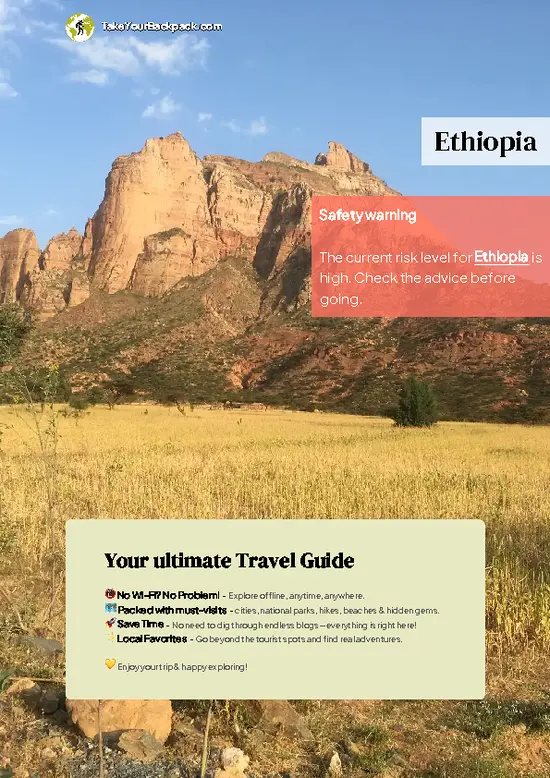
example page 0 from our offline Travel Guide for Ethiopia
example page 1 from our offline Travel Guide for Ethiopia
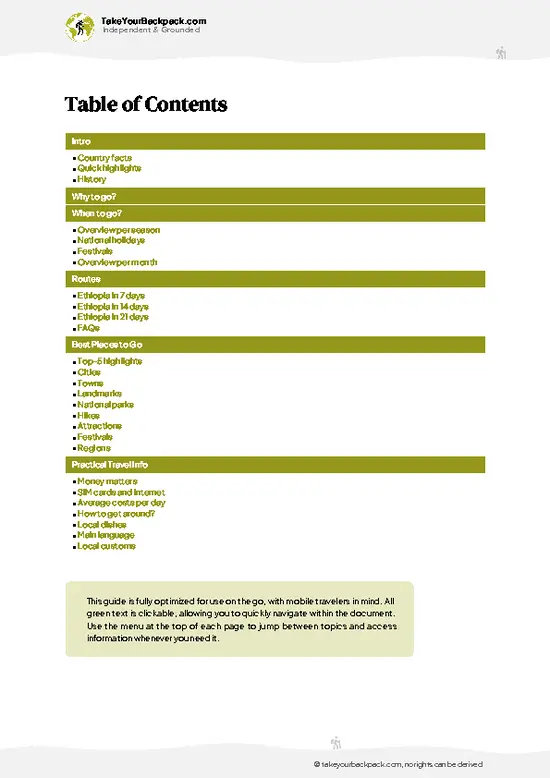
example page 2 from our offline Travel Guide for Ethiopia
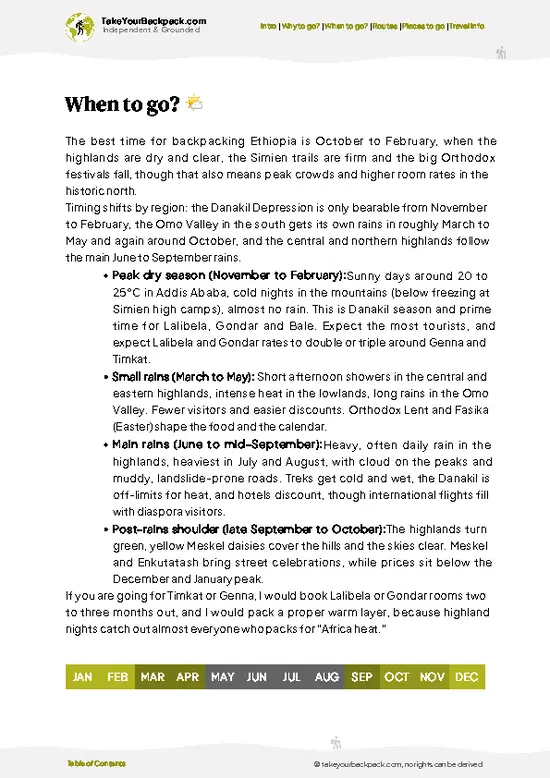
example page 3 from our offline Travel Guide for Ethiopia
example page 4 from our offline Travel Guide for Ethiopia
example page 5 from our offline Travel Guide for Ethiopia
example page 6 from our offline Travel Guide for Ethiopia
example page 7 from our offline Travel Guide for Ethiopia
The digital guide (304 pages) contains:-page digital guide:
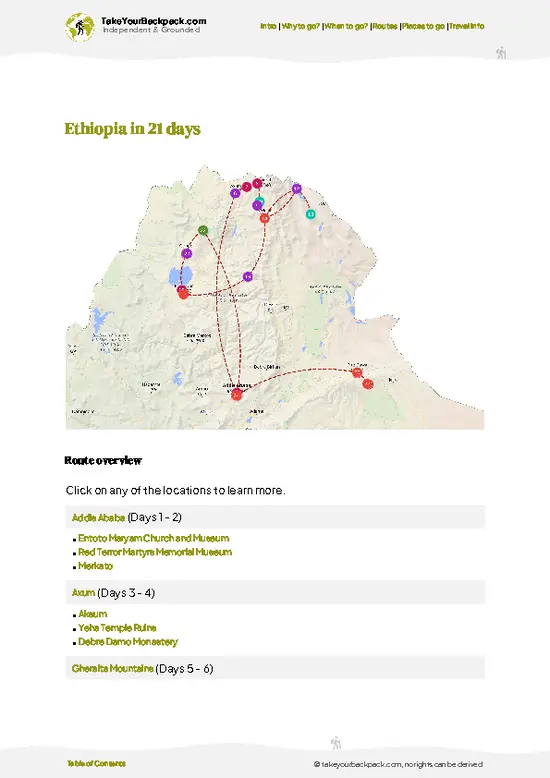
✅ Ready-made 7, 14 & 21-day routes
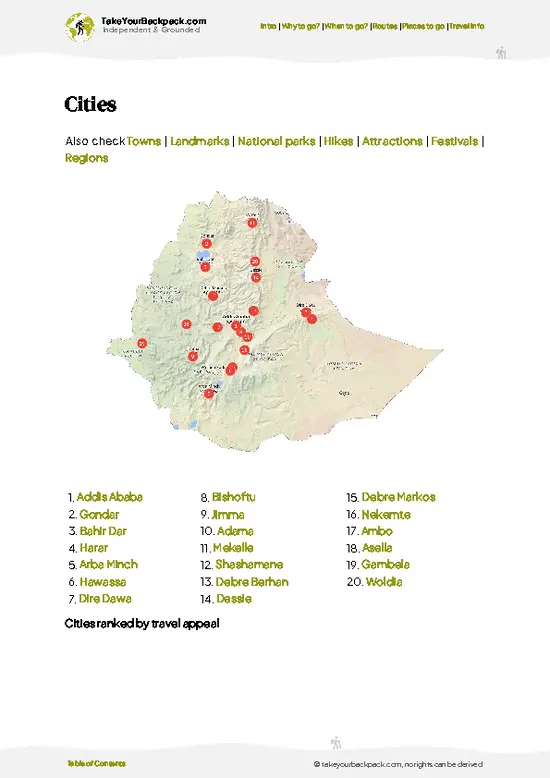
✅ All 98 places ranked, so you skip the overrated ones
✅ Works offline, all in 1 guide
✅ Cities, national parks, landmarks, beaches
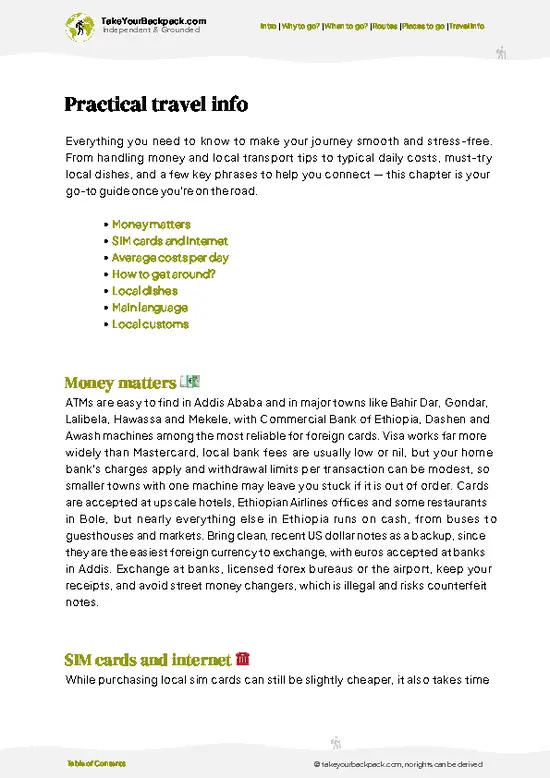
✅ How to get around
👉 Click to see all 30+ guide features

📅 Plan smarter in minutes, not weeks
✅ Month by month travel advice
✅ Festivals & national holidays
✅ Budget expectations

🗺️ Go to the right places, skip the overrated ones
✅ Honest pros & cons of destinations
✅ Top hikes, parks & viewpoints
✅ Lesser-known places most travelers miss
✅ Clear “worth it vs skip it” guidance

🛏️ Travel smoothly without rookie mistakes
✅ Best areas to stay
✅ Transport systems explained simply
✅ Common scams & safety advice
✅ SIM cards, money & practical tips

🌍 Understand the country, not just visit it
✅ Culture & traditions
✅ 52 Essential phrases & customs
✅ Festivals worth planning around
✅ Traveler-friendly historical context
✅ Insights that make places more meaningful

📱 Built for real travel conditions
✅ Fully downloadable PDF
✅ Works completely offline
✅ Optimized for phone use
✅ Useful in remote areas & buses
✅ All in 1 guide
Stop searching, start planning
Get instant access to your full guide. 30‑day money-back guarantee.


By proceeding you agree to our terms.
Sent to your inbox immediately after payment • 100% Secure Checkout
Best Backpacking Travel Advisor 2025 tourism awardBest Backpacking
Travel Advisor
2025
What others say about Take Your Backpack Guides:
⭐⭐⭐⭐⭐
Fantastic, amazing amount of information!
⭐⭐⭐⭐⭐
My goodness this is amazing, it's what I've been looking for hats off too you!
⭐⭐⭐⭐⭐
I think this is absolutely BRILLIANT
⭐⭐⭐⭐
Very complete and informative. It's still missing places, but I gotta to commend you
⭐⭐⭐⭐⭐
This is truly amazing, thank you, can't wait to explore it with my kids!
⭐⭐⭐⭐⭐
Awesome resource, thank you!
⭐⭐⭐⭐⭐
This is amazing! Can't wait to explore the ones I haven't seen
⭐⭐⭐⭐
I love this! Well done, great idea.
⭐⭐⭐⭐⭐
Thanks for taking the time to make this gem!
⭐⭐⭐⭐⭐
This might be the best website I've ever seen.
⭐⭐⭐⭐⭐
Congratulations, and thank you so much for your work; it's incredibly valuable.
⭐⭐⭐⭐
In all seriousness I think you did a great job pointing out the important spots
⭐⭐⭐⭐⭐
10/10 very good
⭐⭐⭐⭐⭐
As someone who's only just starting to visit regularly this is awesome, thank you.
⭐⭐⭐⭐
Thank you very much! I'm going to visit my dad, it's going to be very useful!
⭐⭐⭐⭐⭐
This is really cool! We'll be travelling for the first time and this definitely come in handy.
⭐⭐⭐⭐⭐
You are now our minister of culture, congratulations 👨‍💼
⭐⭐⭐⭐⭐
Just wanted to tell you that this is a pearl! Going to follow your recommendations.
⭐⭐⭐⭐⭐
This is so cool. I'll definitely be using the resource for my travels soon.
⭐⭐⭐⭐⭐
This is very impressive! Good work.
⭐⭐⭐⭐⭐
This is an amazing and informative site. Very well done!

🛏️ Where to stay?Top Places to Consider Staying

Ethiopia has only a handful of true dorm hostels, but budget guesthouses and simple hotels are everywhere, with private rooms typically costing ETB 1,500 to 3,000 (US$9 to 19) a night. In Addis Ababa, Bole has the widest choice, the best cafés and nightlife, and easy airport access, though rooms cost more, while Piassa is the cheapest and most atmospheric old quarter but gets hassle and pickpocketing after dark, and Kazanchis sits in between as a central, quieter compromise. Outside the capital, Lalibela, Gondar and Bahir Dar have plenty of family-run guesthouses within walking distance of the main sights, with lakeside Bahir Dar the calmest of the three.

If you enjoy meeting fellow travelers, … read more 👉
Ethiopia has only a handful of true dorm hostels, but budget guesthouses and simple hotels are everywhere, with private rooms typically costing ETB 1,500 to 3,000 (US$9 to 19) a night. In Addis Ababa, Bole has the widest choice, the best cafés and nightlife, and easy airport access, though rooms cost more, while Piassa is the cheapest and most atmospheric old quarter but gets hassle and pickpocketing after dark, and Kazanchis sits in between as a central, quieter compromise. Outside the capital, Lalibela, Gondar and Bahir Dar have plenty of family-run guesthouses within walking distance of the main sights, with lakeside Bahir Dar the calmest of the three.

If you enjoy meeting fellow travelers, consider choosing hostels with high ratings for atmosphere. On the other hand, if you prefer having your own space, a hotel might be a better option.

EthiopiaMore Places Across Ethiopia

👋 Meet the founderWho’s Behind Take Your Backpack?

Johan, backpacker and founder of TakeYourBackpackHi, I’m Johan (Netherlands 🇳🇱), the creator of TakeYourBackpack. Over the past 30 years, I’ve backpacked through 88 countries across six continents, gaining extensive experience with independent travel, long-term trips, and overland routes.

This site is built on a combination of firsthand travel experience and carefully curated insights from other backpackers. Many guides are based on places I’ve personally visited, while others bring together tips, observations, and practical advice shared by trusted travelers I’ve met along the way.

The goal is to provide realistic, experience-driven guidance — not generic itineraries — so you can explore destinations with better context, clearer expectations, and more confidence.