×

Fiji🇫🇯 | national parksSovi BasinRainforest bowl, rim viewpoint, Sovi Gorge, guided trekking | things to do and best time to go

Explore Waisali Rainforest ReserveExplore Vatu-i-Ra Conservation Park

Backpacking in Sovi Basin
👌 Worth visitingnational park ranked #7
By Johan Kruseman 🇳🇱 | Updated October 15, 2026

Your boots sink into red clay while a guide’s machete clears a vine, and somewhere above a parrot calls. Sovi Basin sits in the interior of Viti Levu, in Fiji, inland from Suva and northwest of the capital’s sprawl. It is a bowl of lowland rainforest, and it is wild in a way the resort coast is not. Hiking is muddy, slow and guided by landowners from nearby villages, so spontaneity is limited. Roads are rough and crowds are almost nonexistent, which suits quiet-seekers. Start early, because the cool morning air keeps the climb to the rim bearable. The last stretch rewards you with a view over an unbroken green bowl and the Sovi Gorge’s brown river.

Discover everything you want to know in the 📖 Fiji Travel Guide.


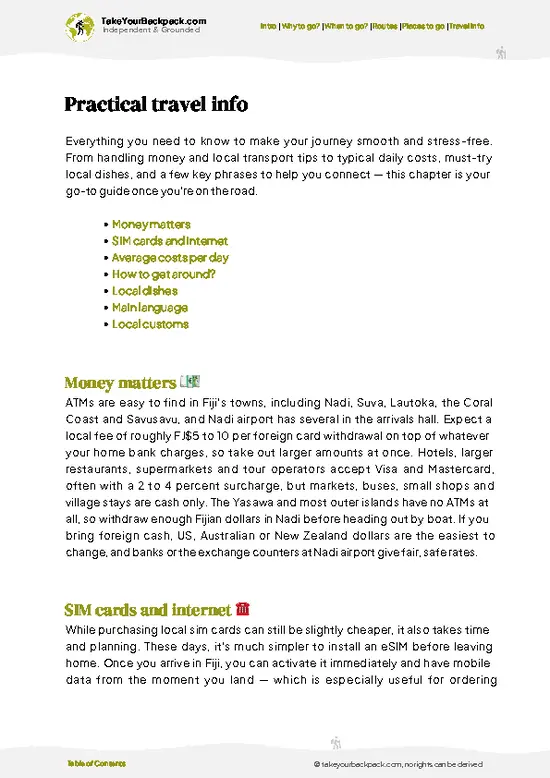
example page 0 from our offline Travel Guide for Fiji
example page 1 from our offline Travel Guide for Fiji
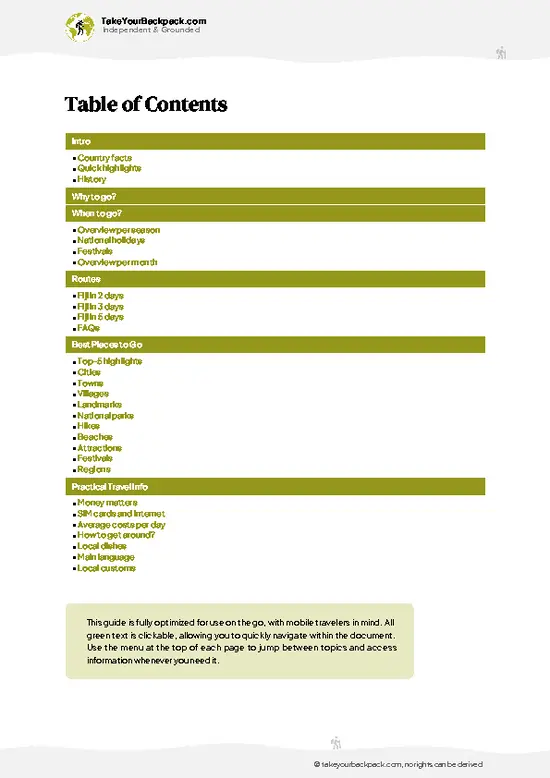
example page 2 from our offline Travel Guide for Fiji
example page 3 from our offline Travel Guide for Fiji
example page 4 from our offline Travel Guide for Fiji
example page 5 from our offline Travel Guide for Fiji
example page 6 from our offline Travel Guide for Fiji
example page 7 from our offline Travel Guide for Fiji
Loading the map 🌍
CLICK TO FILTER
cities
towns
villages
landmarks
national parks
hikes
beaches
attractions
festivals
regions
SHOW COUNTRY’S BESTSHOW ALL

✨ Why go?
Ranked #7 national park in Fiji
What makes it a must-see national park

Sovi Basin appeals to backpackers who want forest without a tour bus parked beside it. The reserve protects roughly 16,000 hectares of lowland rainforest, one of the largest intact tracts on Viti Levu, and it was set aside through an agreement with the landowning communities. Visits run through local villages, so your hosts are the people who own the land, and your fee supports them directly. That shapes the trip: you hike with a village guide, sleep simply, and eat what the village cooks. It is self-guided in spirit (you choose your pace and pack) but not in practice, since trails are unmarked and the forest is dense. Birders come for the collared lory and other forest birds, and the Sovi River gives paddlers and swimmers a reason to linger. Expect mud, leeches and silence.

💡 HighlightsThe experiences that define the visit

  1. Sovi Basin Rim Viewpoint: the climb to the ridge opens a panorama over the forested bowl, the sight most visitors come for.
  2. Lowland Rainforest Walk: giant buttressed trees, tree ferns and epiphytes crowd a trail that stays shaded and humid all day.
  3. Sovi Gorge: the river narrows between rock walls, with pools good for a cooling swim after the hike.
  4. Birdwatching for the collared lory: dawn gives the best chance of hearing parrots and honeyeaters before they vanish into the canopy.
  5. Village visit and kava ceremony: your guides’ community welcomes you with a sevusevu offering, which is how permission to enter the forest is formally given.
  6. Night forest sounds: after dark the canopy fills with frogs and insects, and a headlamp shows spiders and glowing fungi along the track.
For a first visit, the rim … read more 👉
  1. Sovi Basin Rim Viewpoint: the climb to the ridge opens a panorama over the forested bowl, the sight most visitors come for.
  2. Lowland Rainforest Walk: giant buttressed trees, tree ferns and epiphytes crowd a trail that stays shaded and humid all day.
  3. Sovi Gorge: the river narrows between rock walls, with pools good for a cooling swim after the hike.
  4. Birdwatching for the collared lory: dawn gives the best chance of hearing parrots and honeyeaters before they vanish into the canopy.
  5. Village visit and kava ceremony: your guides’ community welcomes you with a sevusevu offering, which is how permission to enter the forest is formally given.
  6. Night forest sounds: after dark the canopy fills with frogs and insects, and a headlamp shows spiders and glowing fungi along the track.
For a first visit, the rim viewpoint is the one to choose, because it gives the whole basin in one hard, rewarding morning.
Spotted a mistake or missing something? Contact us.

Things to do near Sovi Basin

Ratings based on Tripadvisor reviews. When you book through this link, you support our work at no extra cost to you.

🌤️ When to go?Weather, crowds, and seasonal trade-offs

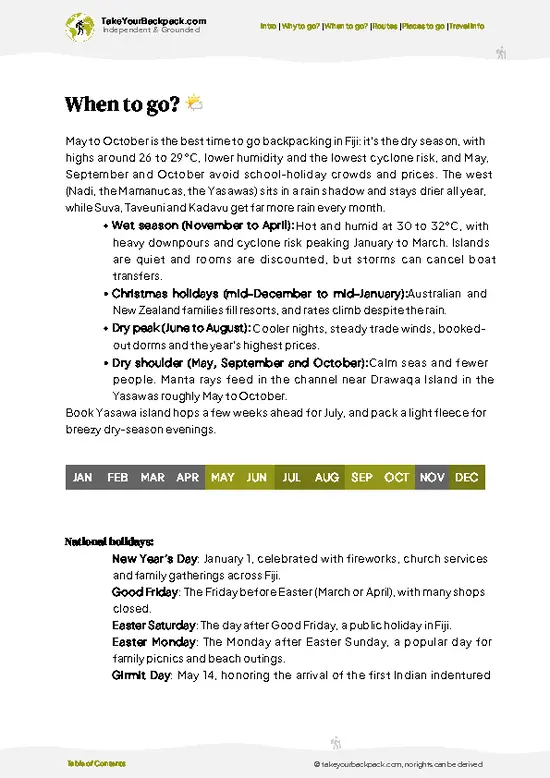
May to October is the window for Sovi Basin, when rain eases and the trails to the Sovi River are most passable.
  • Dry Season (May to October): Days run 24 to 29°C (75 to 84°F), nights drop to 18 to 21°C (64 to 70°F). Showers still happen on this windward side of Viti Levu. Daylight lasts roughly 11 to 12 hours, sunset near 5:30 to 6 pm.
  • Wet Season (November to April): Expect 26 to 32°C (79 to 90°F), heavy humidity and downpours that swell rivers and turn clay tracks to grease. Cyclones are possible, mainly January to March. Daylight stretches to about 13 hours.
  • Crowds and Prices: Sovi Basin sees very few visitors in any month, and Suva guesthouse rates barely move. Tour operators may charge more around July and August school holidays.
Book any guided trip at least a week ahead, as access depends on local landowners and river levels.

source: climatestotravel.comJANJanuary: fair for travelingFEBFebruary: fair for travelingMARMarch: fair for travelingAPRApril: fair for travelingMAYMay: highly recommended for travelingJUNJune: excellent for travelingJULJuly: highly recommended for travelingAUGAugust: highly recommended for travelingSEPSeptember: highly recommended for travelingOCTOctober: excellent for travelingNOVNovember: fair for travelingDECDecember: fair for traveling
when-to-go

✈️ The backpacker research shortcutFiji Travel Guide

An offline-friendly backpacking guide with optimized travel routes, ranked highlights, transport advice, and the best areas to stay.
example page 0 from our offline Travel Guide for Fiji
example page 1 from our offline Travel Guide for Fiji
example page 2 from our offline Travel Guide for Fiji
example page 3 from our offline Travel Guide for Fiji
example page 4 from our offline Travel Guide for Fiji
example page 5 from our offline Travel Guide for Fiji
example page 6 from our offline Travel Guide for Fiji
example page 7 from our offline Travel Guide for Fiji
The digital guide (159 pages) contains:
✅ 41 highlights, ranked by travel appeal
✅ Optimized 2, 3 & 5-day travel routes
✅ Cities, national parks, landmarks, beaches
✅ How to get around
✅ Offline-friendly for travel without Wi-Fi
👉 Click to see all 30+ guide features

📅 Plan smarter in minutes, not weeks
✅ Month by month travel advice
✅ Festivals & national holidays
✅ Budget expectations

🗺️ Go to the right places, skip the overrated ones
✅ Honest pros & cons of destinations
✅ Top hikes, parks & viewpoints
✅ Lesser-known places most travelers miss
✅ Clear “worth it vs skip it” guidance

🛏️ Travel smoothly without rookie mistakes
✅ Best areas to stay
✅ Transport systems explained simply
✅ Common scams & safety advice
✅ SIM cards, money & practical tips

🌍 Understand the country, not just visit it
✅ Culture & traditions
✅ 52 Essential phrases & customs
✅ Festivals worth planning around
✅ Traveler-friendly historical context
✅ Insights that make places more meaningful

📱 Built for real travel conditions
✅ Fully downloadable PDF
✅ Works completely offline
✅ Optimized for phone use
✅ Useful in remote areas & buses
✅ Everything in one place
Stop searching, start planning
Get instant access to your full guide. 30‑day money-back guarantee.
+ Add another guide for just

By proceeding you agree to our terms.
Sent to your inbox immediately after payment • 100% Secure Checkout
Best Backpacking Travel Advisor 2025 tourism awardBest Backpacking
Travel Advisor
2025
What others say about Take Your Backpack Guides:
⭐⭐⭐⭐⭐
Fantastic, amazing amount of information!
⭐⭐⭐⭐⭐
My goodness this is amazing, it's what I've been looking for hats off too you!
⭐⭐⭐⭐⭐
I think this is absolutely BRILLIANT
⭐⭐⭐⭐
Very complete and informative. It's still missing places, but I gotta to commend you
⭐⭐⭐⭐⭐
This is truly amazing, thank you, can't wait to explore it with my kids!
⭐⭐⭐⭐⭐
Awesome resource, thank you!
⭐⭐⭐⭐⭐
This is amazing! Can't wait to explore the ones I haven't seen
⭐⭐⭐⭐
I love this! Well done, great idea.
⭐⭐⭐⭐⭐
Thanks for taking the time to make this gem!
⭐⭐⭐⭐⭐
This might be the best website I've ever seen.
⭐⭐⭐⭐⭐
Congratulations, and thank you so much for your work; it's incredibly valuable.
⭐⭐⭐⭐
In all seriousness I think you did a great job pointing out the important spots
⭐⭐⭐⭐⭐
10/10 very good
⭐⭐⭐⭐⭐
As someone who's only just starting to visit regularly this is awesome, thank you.
⭐⭐⭐⭐
Thank you very much! I'm going to visit my dad, it's going to be very useful!
⭐⭐⭐⭐⭐
This is really cool! We'll be travelling for the first time and this definitely come in handy.
⭐⭐⭐⭐⭐
You are now our minister of culture, congratulations 👨‍💼
⭐⭐⭐⭐⭐
Just wanted to tell you that this is a pearl! Going to follow your recommendations.
⭐⭐⭐⭐⭐
This is so cool. I'll definitely be using the resource for my travels soon.
⭐⭐⭐⭐⭐
This is very impressive! Good work.
⭐⭐⭐⭐⭐
This is an amazing and informative site. Very well done!

🛏️ Where to stay?Best areas to stay in Fiji

Suva is the most practical base for Sovi Basin, roughly 2 to 3 hours away by road, with no regular accommodation inside the conservation area itself.
Suva has the widest backpacker choice: dorm beds at hostels such as Raintree Lodge (a bit out of the center) and Suva Motor Inn style budget rooms run about FJ$35 to 60 (US$16 to 27), with private rooms from FJ$90 to 150 (US$40 to 68). Many hostels arrange transfers and guides.
Closer to the basin, Nausori (near the airport, about 1.5 to 2 hours away) has basic motels and guesthouses at FJ$80 to 130 (US$36 to 59). Navua, on the road toward Pacific … read more 👉
Suva is the most practical base for Sovi Basin, roughly 2 to 3 hours away by road, with no regular accommodation inside the conservation area itself.
Suva has the widest backpacker choice: dorm beds at hostels such as Raintree Lodge (a bit out of the center) and Suva Motor Inn style budget rooms run about FJ$35 to 60 (US$16 to 27), with private rooms from FJ$90 to 150 (US$40 to 68). Many hostels arrange transfers and guides.
Closer to the basin, Nausori (near the airport, about 1.5 to 2 hours away) has basic motels and guesthouses at FJ$80 to 130 (US$36 to 59). Navua, on the road toward Pacific Harbour, offers river-based lodges and homestays.
For an overnight in the basin itself, guided trips are run with local village communities, and sleeping happens in simple camps or village homestays, usually arranged through a Suva operator in advance. Bring your own sleeping bag and mosquito protection.

👛 Costs (as of 15 October 2026)Money, prices, and spending tips

A day at Sovi Basin runs about US$95 to 130 per person once you count the guided-trek fee, village stay, food and transport. Sovi Basin is a conservation area on Viti Levu managed by local landowning communities, so access is by arranged trek rather than a ticketed gate. Everything is paid in Fijian dollars, with prices below converted to US dollars.
CategoryBudget RangeLocal Reality
Entrance/Conservation FeesUS$10 to 20Paid to the landowning villages or the tour operator, often folded into a package. There is no standalone park booth.
Guide and Trek PackageUS$40 to 60Guides from local communities are required. Group bookings split the cost, solo travelers pay more.
AccommodationUS$15 to 25Village homestay or basic shared hut in high season (May to October). Expect a mattress, mosquito net and
… read more 👉
A day at Sovi Basin runs about US$95 to 130 per person once you count the guided-trek fee, village stay, food and transport. Sovi Basin is a conservation area on Viti Levu managed by local landowning communities, so access is by arranged trek rather than a ticketed gate. Everything is paid in Fijian dollars, with prices below converted to US dollars.
CategoryBudget RangeLocal Reality
Entrance/Conservation FeesUS$10 to 20Paid to the landowning villages or the tour operator, often folded into a package. There is no standalone park booth.
Guide and Trek PackageUS$40 to 60Guides from local communities are required. Group bookings split the cost, solo travelers pay more.
AccommodationUS$15 to 25Village homestay or basic shared hut in high season (May to October). Expect a mattress, mosquito net and shared bathroom.
Food and SuppliesUS$10 to 15Village meals of root crops, fish or chicken and greens are usually included in packages. Stock up on snacks and water purification in Nausori or Suva beforehand.
Local TransportUS$10 to 15Bus from Suva to Nausori, then carrier or hired 4WD on rough roads to the trailhead. Transfers are costly for a single traveler.
Total Daily BudgetUS$95 to 130Per person, per day, in high season.
⚠️ Prices can change and everyone travels differently, so take this as a rough guide. Hope it helps you plan your adventure!

🥾 TrailsScenic routes and wildlife spotting in Sovi Basin

Hiking in Sovi Basin is organized through the landowning villages, and the walks are shaped by your guide rather than by signposts. Most visitors do a day or overnight trek from a village base into the forest, climbing to the ridge and returning along a stream.
  • Rim climb: a steep, muddy ascent of several hours that ends on a ridge with the best view over the basin. Difficulty is moderate to hard, and footing is slippery after rain.
  • Forest floor loop: a flatter walk of about two to four hours through tall lowland forest, crossing small creeks. Expect leeches, so bring gaiters or long socks.
  • Gorge
… read more 👉
Hiking in Sovi Basin is organized through the landowning villages, and the walks are shaped by your guide rather than by signposts. Most visitors do a day or overnight trek from a village base into the forest, climbing to the ridge and returning along a stream.
  • Rim climb: a steep, muddy ascent of several hours that ends on a ridge with the best view over the basin. Difficulty is moderate to hard, and footing is slippery after rain.
  • Forest floor loop: a flatter walk of about two to four hours through tall lowland forest, crossing small creeks. Expect leeches, so bring gaiters or long socks.
  • Gorge walk: a river-side route to the Sovi Gorge, where wading and swimming are part of the outing. Waterproof boots or sandals with grip work best.
  • Wildlife: parrots, honeyeaters and the occasional Pacific boa are the likeliest sightings.
Practical details: the basin is not served by regular public transport, so most travelers arrange transfers through a village contact or an operator from Suva or Nadi. The last stretch is on unsealed, often rutted roads that can be impassable after heavy rain. Crowds are essentially absent, and you may be the only visitors. There is a fee paid to the community and guides, and a sevusevu gift of kava root is customary on arrival. Bring insect repellent, a rain jacket and a dry set of clothes for the evening.
⚠️ Hiking info can sometimes be outdated or inaccurate. Before you hit the trail, check the latest conditions with locals. If you do spot anything that's off, I'd love to hear from you, so I can update it for fellow travelers.

🛡️ SafetySafety Tips and Common Scams in Sovi Basin

Sovi Basin is remote, wet and unmarked, so go with a local guide rather than solo. Trails are muddy, steep in sections and cross streams that can rise within an hour of heavy rain, so turn back or wait if water turns brown and fast. Footing is slippery clay and roots, and trekking shoes with real tread matter more than anything else you pack. Mobile signal is patchy to absent, so tell your hostel your return plan. Leeches and mosquitoes are common; long sleeves and repellent help. There are no dangerous large animals, though you may meet wild pigs or snakes that are shy and nonvenomous in most cases. Carry 2 to 3 liters of water, a rain jacket and dry socks in a waterproof bag. Respect village protocol, including a sevusevu (kava gift) offering to the chief.

FAQTraveler FAQ

Plan on 1 to 2 days for Sovi Basin, as a single guided day trip from Suva covers the main forest and river sections. An overnight in a village or camp lets you reach deeper areas, and the road in takes 2 to 3 hours each way, so a day trip is long.
Going without a car is realistic only through a guide or tour operator, since there is no public transport to the basin. Buses from Suva reach Nausori and Navua for FJ$2 to 5, but the final stretch on rough tracks needs a 4WD or local transfer, often included in trips of FJ$70 to 130.
No formal park gate fee exists, but access is controlled by the local landowning communities, so you need permission through an operator or village. Expect to pay roughly FJ$70 to 130 per person for a guided visit, and bring a sevusevu gift of kava root worth about FJ$20 to 30 for the chief.
⚠️ Things can change over time, so always validate details locally before you go.

Other Fijian national parks near Sovi Basin

Explore more nearby:


💡 Not sure where to go next?
Create a personalized itinerary for Fiji including Sovi Basin and the places that fit your trip.

Generate my itinerary

👉 Discover all national parks

Or checkout all Fiji has to offer (think cities, towns, villages, national parks, hikes, beaches, festivals)
Country photo of Fiji

We 💚 feedbackSumming up the experience

Pair Sovi Basin with a few nights on the Coral Coast or in Suva, so you swing from sealed beaches to red mud and back. I would book the trek early in the week and keep a spare day for rain, because the road decides everything. Pack extra socks, and bring kava root as your gift.

✍️ Help improve this page!
The information on this page is based on in-depth research, insights shared by experienced travelers, and feedback from the local travel community in Fiji. While every effort is made to keep the information accurate and current, conditions can change — so if you spot anything incorrect or outdated, please get in touch.


🙋‍♂️ Give feedback

👋 Meet the founderWho’s Behind Take Your Backpack?

Johan, backpacker and founder of TakeYourBackpackHi, I’m Johan (Netherlands 🇳🇱), the creator of TakeYourBackpack. Over the past 3 decades, I’ve backpacked through 90+ countries across six continents, gaining extensive experience with independent travel, long-term trips, and overland routes.

This site is built on a combination of firsthand travel experience and carefully curated insights from other backpackers. Many guides are based on places I’ve personally visited, while others bring together tips, observations, and practical advice shared by trusted travelers I’ve met along the way.

The goal is to provide realistic, experience-driven guidance — not generic itineraries — so you can explore destinations with better context, clearer expectations, and more confidence.