v2.webp)
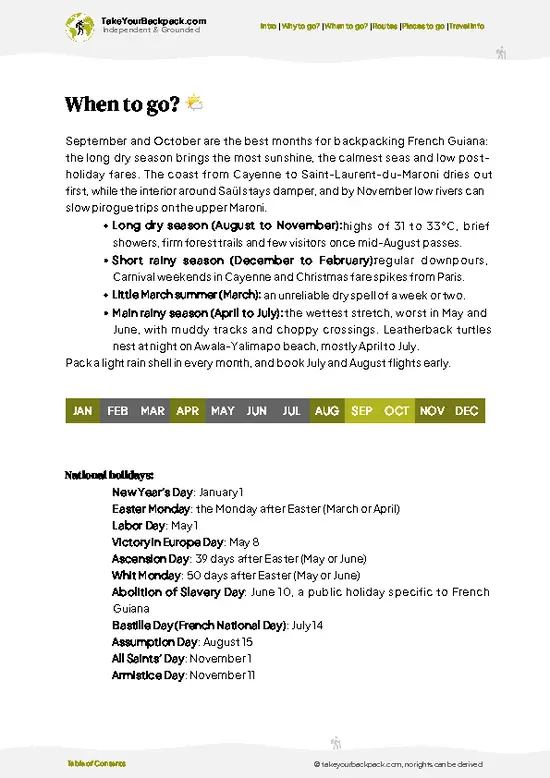
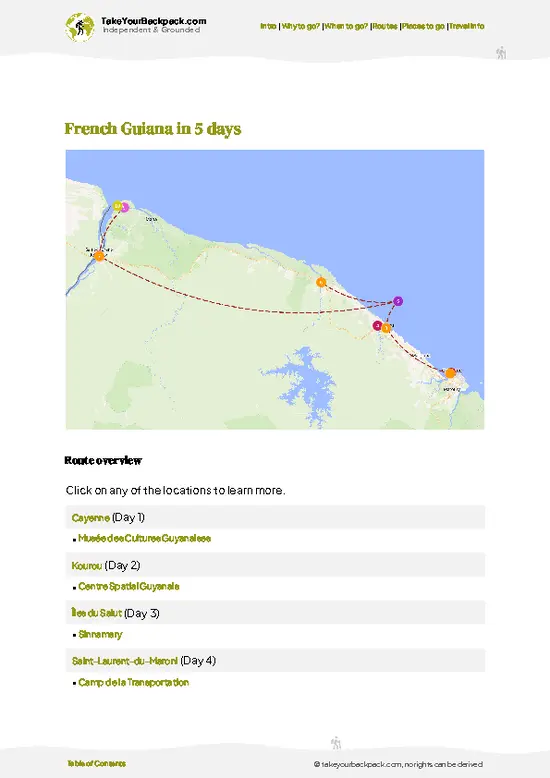
- Pointe Combi turtle and bird area: A coastal stretch of beach and mangrove where leatherback turtles come ashore to nest in the nesting season, roughly spring to early summer, at night. Guided night walks usually cost about €10 to 20 and run 2 to 3 hours. Go by day for birds, free, 1 hour.
- Pripris de Yiyi trail: A flat savanna and wetland walk with herons, ibis and caimans in the ponds. Free, 1 to 2 hours, best at dawn when it is cooler and the birds are active.
- Sinnamary river and mangrove boat trip: Local operators run pirogue outings among mangroves, with monkeys and kingfishers overhead. Expect about €25 to 50 per person, 2 to 3 hours, best in the morning.
- Notre-Dame des Douleurs church and town center: A modest church and a quiet main street of wooden Creole houses, good for a short wander.
- Pointe Combi turtle and bird area: A coastal stretch of beach and mangrove where leatherback turtles come ashore to nest in the nesting season, roughly spring to early summer, at night. Guided night walks usually cost about €10 to 20 and run 2 to 3 hours. Go by day for birds, free, 1 hour.
- Pripris de Yiyi trail: A flat savanna and wetland walk with herons, ibis and caimans in the ponds. Free, 1 to 2 hours, best at dawn when it is cooler and the birds are active.
- Sinnamary river and mangrove boat trip: Local operators run pirogue outings among mangroves, with monkeys and kingfishers overhead. Expect about €25 to 50 per person, 2 to 3 hours, best in the morning.
- Notre-Dame des Douleurs church and town center: A modest church and a quiet main street of wooden Creole houses, good for a short wander. Free, 30 to 45 minutes, nicest in late afternoon.
- Riverfront and quay: Fishing boats unload here and the waterfront is the place to watch evening light fall over the river. Free, 30 to 60 minutes, best at dusk with a cold drink.
Spotted a mistake or missing something? Contact us.

 Best Backpacking
.jpg) Hi, I’m Johan (Netherlands 🇳🇱), the creator of TakeYourBackpack. Over the past 3 decades, I’ve backpacked through 90+ countries across six continents, gaining extensive experience with independent travel, long-term trips, and overland routes.
Hi, I’m Johan (Netherlands 🇳🇱), the creator of TakeYourBackpack. Over the past 3 decades, I’ve backpacked through 90+ countries across six continents, gaining extensive experience with independent travel, long-term trips, and overland routes.