×

French Guiana🇬🇫 | townsSaint-Laurent-du-MaroniConvict camp, Maroni landing, wooden old town | things to do and best time to go

Explore RouraExplore Sinnamary

Backpacking in Saint-Laurent-du-Maroni
🌟 Highlighttown ranked #3
By Johan Kruseman 🇳🇱 | Updated October 19, 2026

The pirogue engine cuts out and the only sound left is water slapping the concrete landing, with a smell of diesel, river mud and frying beignets drifting up from the quay. Saint-Laurent-du-Maroni sits in the northwest of French Guiana, on the Maroni River facing Albina in Suriname. It is slow, hot and a little worn, and that is much of its appeal. The old penal colony buildings are the main sights, and the town has few other attractions. Nightlife is mostly a terrace beer. Cayenne is a long road trip away, so the smarter move is to arrive by day, because shared taxis thin out by afternoon. Cross to Suriname only after getting your exit stamp, since the pirogue captains will not remind you. Hostels are scarce, so you meet other travelers on the waterfront. The evening ends with the loud frogs along the river.

Discover everything you want to know in the 📖 French Guiana Travel Guide.


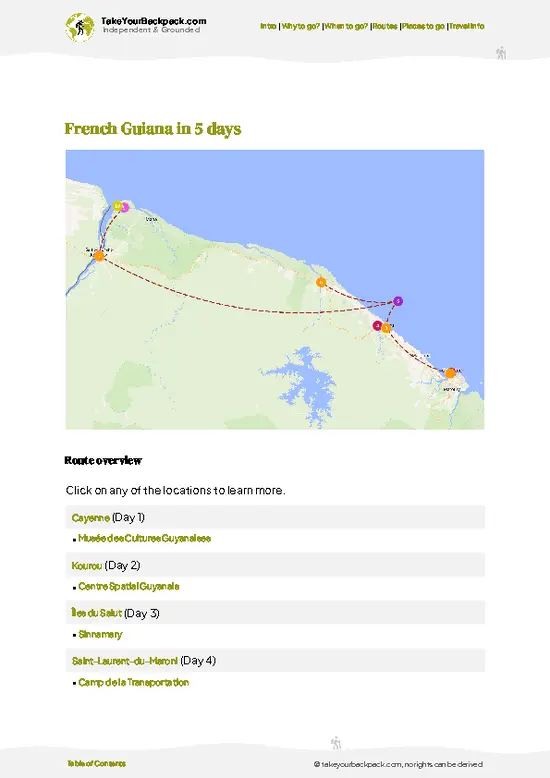
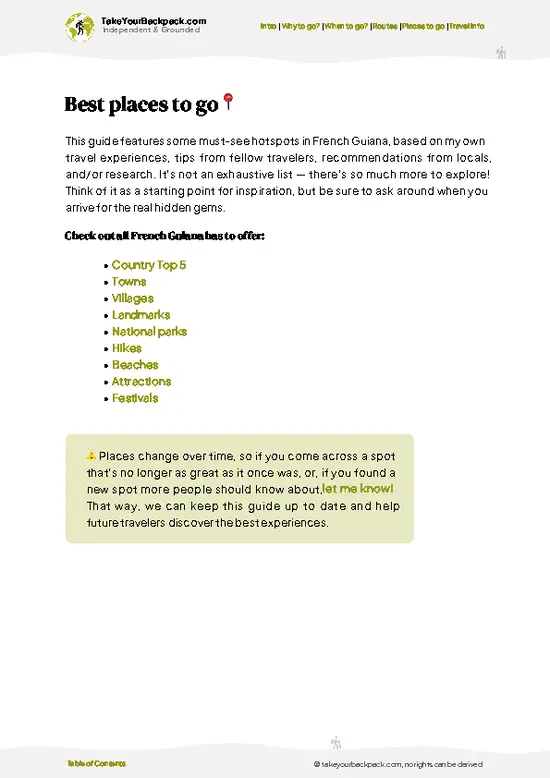
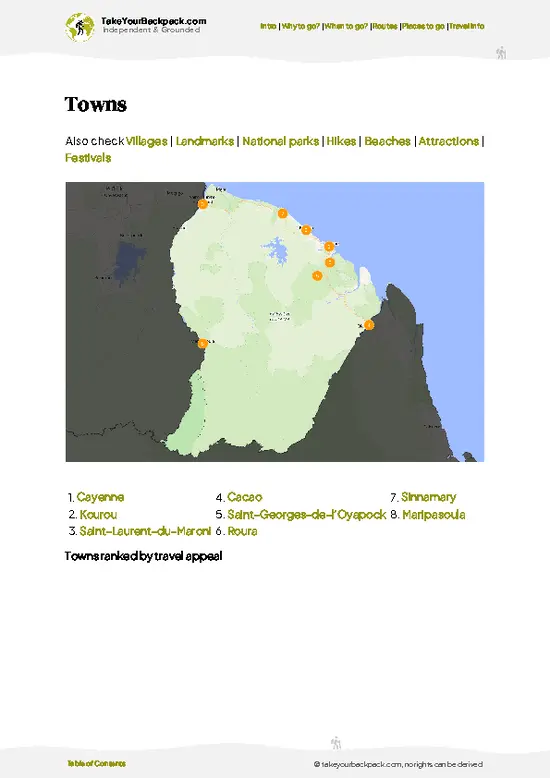
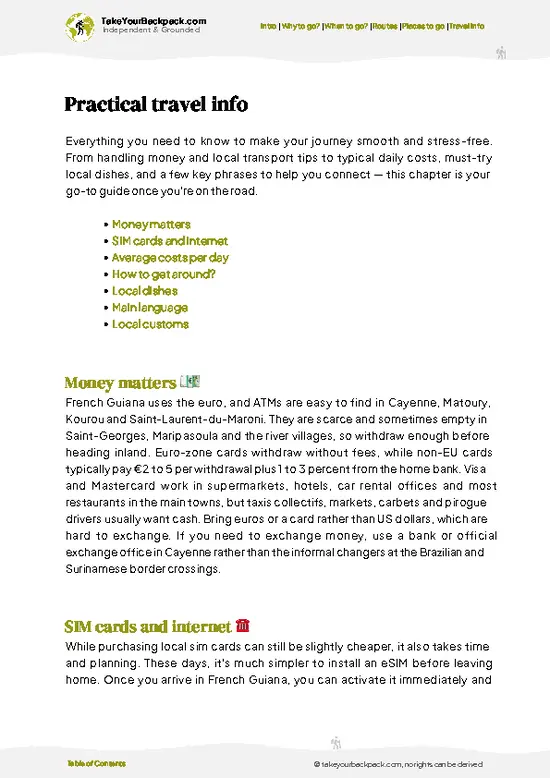
example page 0 from our offline Travel Guide for French Guiana
example page 1 from our offline Travel Guide for French Guiana
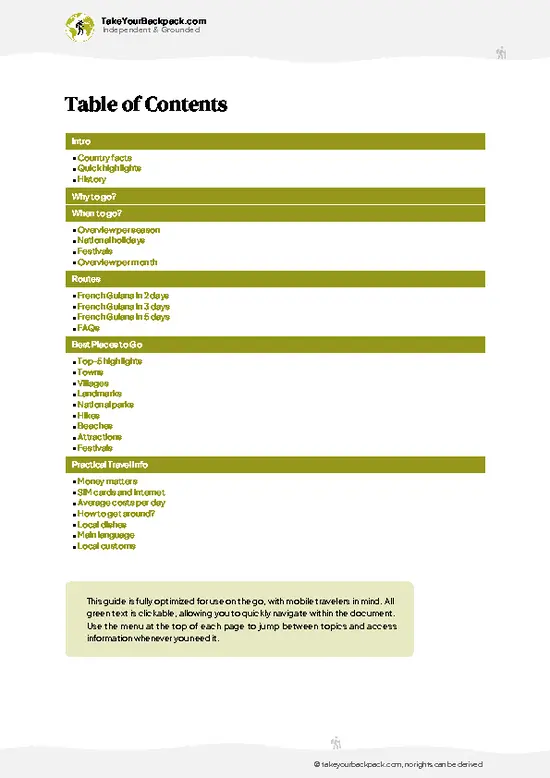
example page 2 from our offline Travel Guide for French Guiana
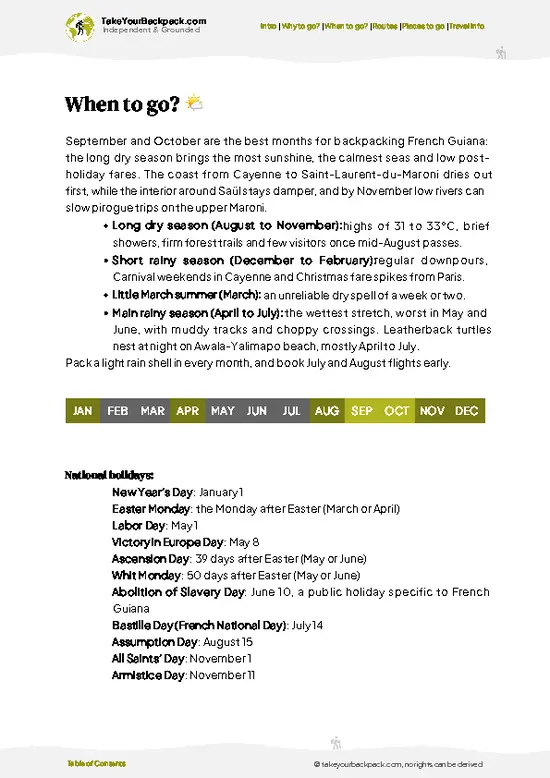
example page 3 from our offline Travel Guide for French Guiana
example page 4 from our offline Travel Guide for French Guiana
example page 5 from our offline Travel Guide for French Guiana
example page 6 from our offline Travel Guide for French Guiana
example page 7 from our offline Travel Guide for French Guiana
Loading the map 🌍
CLICK TO FILTER
towns
villages
landmarks
national parks
hikes
beaches
attractions
festivals
SHOW COUNTRY’S BESTSHOW ALL

✨ Why go?
Ranked #3 town in French Guiana
What makes this town worth visiting

Saint-Laurent-du-Maroni works as the hinge between French Guiana and Suriname, which is why backpackers pass through even when they have no plans to stay. Most linger one or two nights, long enough to walk the grid of colonial streets, see the Camp de la Transportation and eat at the Saturday market, where Maroon, Hmong and Creole sellers share the same aisles. It suits slow travelers and history-minded solo backpackers who like a place with texture more than polish. Evenings are quiet, with a few riverside bars and little organized social life, so you meet people over cheap Chinese-Guianese takeaways or while waiting for the border pirogue. Families of Maroon boatmen have worked this river for generations, and you can feel that in how the waterfront runs. If you want beaches, hiking trails … read more 👉
Saint-Laurent-du-Maroni works as the hinge between French Guiana and Suriname, which is why backpackers pass through even when they have no plans to stay. Most linger one or two nights, long enough to walk the grid of colonial streets, see the Camp de la Transportation and eat at the Saturday market, where Maroon, Hmong and Creole sellers share the same aisles. It suits slow travelers and history-minded solo backpackers who like a place with texture more than polish. Evenings are quiet, with a few riverside bars and little organized social life, so you meet people over cheap Chinese-Guianese takeaways or while waiting for the border pirogue. Families of Maroon boatmen have worked this river for generations, and you can feel that in how the waterfront runs. If you want beaches, hiking trails or nightlife, keep going. If you want a real frontier town with a dark past and a calm pace, it fits well.

💡 HighlightsWhat this place is best known for

  1. Camp de la Transportation (Bagne des forçats). This is the main reason travelers come: the penal colony where convicts bound for the Guiana penal settlements, Henri Charrière (“Papillon”) among them, were processed from the 1850s. Guided visits take you into the cell blocks, the chapel and Charrière’s cell (number 47). Go in the morning, before the heat builds, and book the guided tour through the tourism office. Expect about €6 to 8 and 1.5 to 2 hours.
  2. Ancien Camp de la Transportation, cellule des condamnés à mort. Inside the same compound, the dark wing for prisoners awaiting execution is the part that sticks with you. It is covered on the standard tour, so no extra ticket. Allow 20 to 30 minutes if you linger to read the graffiti scratched into the walls.
  3. Marché de Saint-Laurent. The covered
… read more 👉
  1. Camp de la Transportation (Bagne des forçats). This is the main reason travelers come: the penal colony where convicts bound for the Guiana penal settlements, Henri Charrière (“Papillon”) among them, were processed from the 1850s. Guided visits take you into the cell blocks, the chapel and Charrière’s cell (number 47). Go in the morning, before the heat builds, and book the guided tour through the tourism office. Expect about €6 to 8 and 1.5 to 2 hours.
  2. Ancien Camp de la Transportation, cellule des condamnés à mort. Inside the same compound, the dark wing for prisoners awaiting execution is the part that sticks with you. It is covered on the standard tour, so no extra ticket. Allow 20 to 30 minutes if you linger to read the graffiti scratched into the walls.
  3. Marché de Saint-Laurent. The covered market by the waterfront is busiest on Saturday mornings, when Maroni River communities, Hmong farmers and Creole cooks sell in the same aisles. Look for fresh fish, cassava products, pimento sauces and tropical fruit. Entry is free, a snack costs about €2 to 5, and an hour is plenty. Arrive before 10 AM.
  4. Maroni riverfront and pirogue landing. Long wooden pirogues cross to Albina in Suriname from the quay, and watching them load is a fine way to spend a late afternoon, when the light softens and the river traffic peaks. Walking the quay is free and takes 30 to 45 minutes. Border formalities apply if you actually cross.
  5. Village Chinois and the old town streets. Colonial wooden houses with shutters and verandas line the grid behind the Hôtel de Ville, mixed with Creole, Chinese-run shops and small bars. Walk it in the early evening, once the sun drops and doors open. It costs nothing and takes about an hour.
Beyond town, the Awala-Yalimapo beaches, where leatherback turtles nest from roughly April to July, the Mana rice fields and the Javouhey village make rewarding day trips. The Hmong market village of Javouhey is the one many people overlook, and its Sunday market with Laotian-style dishes is worth planning around.
Spotted a mistake or missing something? Contact us.

🏘️ NeighborhoodsNeighborhood guide to Saint-Laurent-du-Maroni

Saint-Laurent-du-Maroni is small enough to cover on foot, and the smart move is to walk it in the early morning or after 4 pm, because midday heat flattens everything and shutters close for a long lunch.
  • Camp de la Transportation (historic center): The old penal colony quarter sits a few blocks from the river, with ochre-walled cells, cracked courtyards and the smell of warm stone and mango leaves. Guided visits run through the tourist office, since the site is not freely open, so book a slot the day before rather than turning up and hoping. Everything here is flat and walkable.
  • Riverfront and the Maroni docks: Pirogues thump against the quay, diesel hangs in the air and boat touts call out the Albina crossing to Suriname. Come at dusk, when the light softens and the river turns the color of
… read more 👉
Saint-Laurent-du-Maroni is small enough to cover on foot, and the smart move is to walk it in the early morning or after 4 pm, because midday heat flattens everything and shutters close for a long lunch.
  • Camp de la Transportation (historic center): The old penal colony quarter sits a few blocks from the river, with ochre-walled cells, cracked courtyards and the smell of warm stone and mango leaves. Guided visits run through the tourist office, since the site is not freely open, so book a slot the day before rather than turning up and hoping. Everything here is flat and walkable.
  • Riverfront and the Maroni docks: Pirogues thump against the quay, diesel hangs in the air and boat touts call out the Albina crossing to Suriname. Come at dusk, when the light softens and the river turns the color of milky tea. Stalls and a few snack bars sell grilled skewers and cold drinks. Experienced travelers check the boat operator before paying, since fares and departures are loosely fixed.
  • Market and main streets: The covered market hums with Creole, Hmong and Maroon sellers, with piles of papaya, cassava, chili and river fish. Go before 9 am, when produce is freshest and the tin roof is not yet an oven. Pharmacies, ATMs and bakeries line the grid nearby.
  • Charbonnière and outer districts: Quieter residential streets with frogs chorusing after rain, dim lighting and few services. These are too spread out and badly lit to enjoy on foot at night. Take a taxi or skip them.

⌛️ 1 dayHow to make the most of one day

7:30 AM, Saturday market: Start with coffee and a pastry, then walk the stalls for fruit, smoked fish and Hmong greens. The best produce goes early and the heat is manageable. Walk toward the center when you are done.
9:30 AM, Hôtel de Ville and old streets: Stroll the colonial streets, looking at the wooden façades and shaded verandas. It is a short, flat walk and a good way to get your bearings before the heat builds.
10:30 AM, Camp de la Transportation: Take the guided tour of the cells and courtyards. The guides explain how convicts were processed, which makes the empty rooms mean something. Allow about two hours.
12:30 PM, Lunch near the center: Choose a Creole or Chinese-Guianese spot for a plate of rice, fish or chicken. Long lunches are normal in the midday heat, so rest until the light … read more 👉
7:30 AM, Saturday market: Start with coffee and a pastry, then walk the stalls for fruit, smoked fish and Hmong greens. The best produce goes early and the heat is manageable. Walk toward the center when you are done.
9:30 AM, Hôtel de Ville and old streets: Stroll the colonial streets, looking at the wooden façades and shaded verandas. It is a short, flat walk and a good way to get your bearings before the heat builds.
10:30 AM, Camp de la Transportation: Take the guided tour of the cells and courtyards. The guides explain how convicts were processed, which makes the empty rooms mean something. Allow about two hours.
12:30 PM, Lunch near the center: Choose a Creole or Chinese-Guianese spot for a plate of rice, fish or chicken. Long lunches are normal in the midday heat, so rest until the light drops.
3:00 PM, Maison du Patrimoine: A quieter stop most backpackers skip. It adds context on Maroon culture and local history, and you can see it in under an hour. Walk back toward the river afterward.
4:30 PM, Maroni riverfront: Sit by the landing and watch pirogues come and go as the light mellows. Order a cold drink at a riverside spot. If you plan to cross to Albina, check the exit rules at the immigration post first.
7:00 PM, Dinner on the waterfront: Finish with grilled fish or a snack stall meal, then walk slowly back as the frogs and insects start up.

🌤️ When to go?Choosing the right time of year

The dry season from August to November is the easiest window for backpacking Saint-Laurent-du-Maroni, with the least rain and the best river conditions.
  • Dry Season (Aug to Nov): Around 24 to 33°C (75 to 91°F), clear skies and low mud. Pirogue trips and walking tours are at their most comfortable, and prices for rooms stay modest.
  • Short Dry Spell (Feb to Mar): A brief lull in the rains, with similar heat and patchy showers. Fewer visitors, easy to find a bed.
  • Wet Season (Apr to Jul): Heavy downpours, humidity above 80 percent and highs near 30°C (86°F). Roads flood, mosquitoes multiply and some river excursions cancel, but the landscape is intensely green and quiet.
  • Daylight and Crowds: Days run about 12 hours all year. Crowds are thin throughout, with a small bump around French school holidays
… read more 👉
The dry season from August to November is the easiest window for backpacking Saint-Laurent-du-Maroni, with the least rain and the best river conditions.
  • Dry Season (Aug to Nov): Around 24 to 33°C (75 to 91°F), clear skies and low mud. Pirogue trips and walking tours are at their most comfortable, and prices for rooms stay modest.
  • Short Dry Spell (Feb to Mar): A brief lull in the rains, with similar heat and patchy showers. Fewer visitors, easy to find a bed.
  • Wet Season (Apr to Jul): Heavy downpours, humidity above 80 percent and highs near 30°C (86°F). Roads flood, mosquitoes multiply and some river excursions cancel, but the landscape is intensely green and quiet.
  • Daylight and Crowds: Days run about 12 hours all year. Crowds are thin throughout, with a small bump around French school holidays and Carnival in January to February, when rooms tighten.
Book Carnival-period beds a few weeks ahead, and carry a light rain jacket whatever the month.


source: climatestotravel.comJANJanuary: fair for travelingFEBFebruary: fair for travelingMARMarch: fair for travelingAPRApril: fair for travelingMAYMay: fair for travelingJUNJune: fair for travelingJULJuly: fair for travelingAUGAugust: highly recommended for travelingSEPSeptember: excellent for travelingOCTOctober: excellent for travelingNOVNovember: excellent for travelingDECDecember: highly recommended for traveling
when-to-go

✈️ The backpacker research shortcutFrench Guiana Travel Guide

An offline-friendly backpacking guide with optimized travel routes, ranked highlights, transport advice, and the best areas to stay.
example page 0 from our offline Travel Guide for French Guiana
example page 1 from our offline Travel Guide for French Guiana
example page 2 from our offline Travel Guide for French Guiana
example page 3 from our offline Travel Guide for French Guiana
example page 4 from our offline Travel Guide for French Guiana
example page 5 from our offline Travel Guide for French Guiana
example page 6 from our offline Travel Guide for French Guiana
example page 7 from our offline Travel Guide for French Guiana
The digital guide (130 pages) contains:
✅ 31 highlights, ranked by travel appeal
✅ Optimized 2, 3 & 5-day travel routes
✅ Cities, national parks, landmarks, beaches
✅ How to get around
✅ Offline-friendly for travel without Wi-Fi
👉 Click to see all 30+ guide features

📅 Plan smarter in minutes, not weeks
✅ Month by month travel advice
✅ Festivals & national holidays
✅ Budget expectations

🗺️ Go to the right places, skip the overrated ones
✅ Honest pros & cons of destinations
✅ Top hikes, parks & viewpoints
✅ Lesser-known places most travelers miss
✅ Clear “worth it vs skip it” guidance

🛏️ Travel smoothly without rookie mistakes
✅ Best areas to stay
✅ Transport systems explained simply
✅ Common scams & safety advice
✅ SIM cards, money & practical tips

🌍 Understand the country, not just visit it
✅ Culture & traditions
✅ 52 Essential phrases & customs
✅ Festivals worth planning around
✅ Traveler-friendly historical context
✅ Insights that make places more meaningful

📱 Built for real travel conditions
✅ Fully downloadable PDF
✅ Works completely offline
✅ Optimized for phone use
✅ Useful in remote areas & buses
✅ Everything in one place
Stop searching, start planning
Get instant access to your full guide. 30‑day money-back guarantee.
+ Add another guide for just

By proceeding you agree to our terms.
Sent to your inbox immediately after payment • 100% Secure Checkout
Best Backpacking Travel Advisor 2025 tourism awardBest Backpacking
Travel Advisor
2025
What others say about Take Your Backpack Guides:
⭐⭐⭐⭐⭐
Fantastic, amazing amount of information!
⭐⭐⭐⭐⭐
My goodness this is amazing, it's what I've been looking for hats off too you!
⭐⭐⭐⭐⭐
I think this is absolutely BRILLIANT
⭐⭐⭐⭐
Very complete and informative. It's still missing places, but I gotta to commend you
⭐⭐⭐⭐⭐
This is truly amazing, thank you, can't wait to explore it with my kids!
⭐⭐⭐⭐⭐
Awesome resource, thank you!
⭐⭐⭐⭐⭐
This is amazing! Can't wait to explore the ones I haven't seen
⭐⭐⭐⭐
I love this! Well done, great idea.
⭐⭐⭐⭐⭐
Thanks for taking the time to make this gem!
⭐⭐⭐⭐⭐
This might be the best website I've ever seen.
⭐⭐⭐⭐⭐
Congratulations, and thank you so much for your work; it's incredibly valuable.
⭐⭐⭐⭐
In all seriousness I think you did a great job pointing out the important spots
⭐⭐⭐⭐⭐
10/10 very good
⭐⭐⭐⭐⭐
As someone who's only just starting to visit regularly this is awesome, thank you.
⭐⭐⭐⭐
Thank you very much! I'm going to visit my dad, it's going to be very useful!
⭐⭐⭐⭐⭐
This is really cool! We'll be travelling for the first time and this definitely come in handy.
⭐⭐⭐⭐⭐
You are now our minister of culture, congratulations 👨‍💼
⭐⭐⭐⭐⭐
Just wanted to tell you that this is a pearl! Going to follow your recommendations.
⭐⭐⭐⭐⭐
This is so cool. I'll definitely be using the resource for my travels soon.
⭐⭐⭐⭐⭐
This is very impressive! Good work.
⭐⭐⭐⭐⭐
This is an amazing and informative site. Very well done!

🛏️ Where to stay?How to pick the right area

The center near the market and riverfront is the best area for a budget bed in Saint-Laurent-du-Maroni, since you can walk to food, ATMs and the boat docks. Budget options are limited. Expect a handful of basic guesthouses and small inns rather than a hostel scene, with private rooms around €35 to 60 and dorm-style beds rare. In practice, backpackers book ahead by message, especially around Carnival and French holidays, because the few cheap rooms fill quickly.

The riverfront edge suits people who want the Maroni breeze and an early start for pirogue crossings, though generators, boat engines … read more 👉
The center near the market and riverfront is the best area for a budget bed in Saint-Laurent-du-Maroni, since you can walk to food, ATMs and the boat docks. Budget options are limited. Expect a handful of basic guesthouses and small inns rather than a hostel scene, with private rooms around €35 to 60 and dorm-style beds rare. In practice, backpackers book ahead by message, especially around Carnival and French holidays, because the few cheap rooms fill quickly.

The riverfront edge suits people who want the Maroni breeze and an early start for pirogue crossings, though generators, boat engines and roosters can start the day before 6 am. Bring earplugs. The streets here are lively with families until about 10 pm and then quiet, and walking back after dark along the main lit roads is generally fine.

The second option is the area close to the bus and shared-taxi stand on the town edge. It is handy for early departures to Cayenne, and rooms tend to cost a little less, but the surroundings are duller and sparsely lit at night. Air conditioning is worth paying for in either area, since nights stay warm and humid.

🚌 Getting aroundHow to get from A to B

Saint-Laurent-du-Maroni has no train station and no real bus terminal, so you arrive either by shared taxi (taxi collectif) from Cayenne, which drops you near the river and the old Camp de la Transportation, or by boat from Albina in Suriname at the embarkation quay. From either spot the center is a 5 to 10 minute walk along flat, sun-baked streets that smell of diesel, river mud and grilled fish. Public transport is thin, traffic is light, and the town is small enough that most travelers never need a vehicle.
  • Walking: Free, and the best way to cover the colonial center, the market and the riverfront promenade, all within about 1.5 km (1 mile). Shade is patchy, so skip the midday hours. Carry water, since small shops close during the lunch break.
  • Cycling: Rentals are scarce and rarely advertised,
… read more 👉
Saint-Laurent-du-Maroni has no train station and no real bus terminal, so you arrive either by shared taxi (taxi collectif) from Cayenne, which drops you near the river and the old Camp de la Transportation, or by boat from Albina in Suriname at the embarkation quay. From either spot the center is a 5 to 10 minute walk along flat, sun-baked streets that smell of diesel, river mud and grilled fish. Public transport is thin, traffic is light, and the town is small enough that most travelers never need a vehicle.
  • Walking: Free, and the best way to cover the colonial center, the market and the riverfront promenade, all within about 1.5 km (1 mile). Shade is patchy, so skip the midday hours. Carry water, since small shops close during the lunch break.
  • Cycling: Rentals are scarce and rarely advertised, so ask at your accommodation, where a bike typically runs €8 to 15 a day. The terrain is flat and the roads are quiet, which makes it a smart choice for reaching the outskirts. Sudden downpours turn the roadside into slick red mud, so keep a rain jacket handy.
  • Shared taxi to Cayenne: Minivans leave when full, mostly in the morning, and cost around €40 to 50 for the 3.5 to 4 hour run along the coastal road (N1). Departures thin out by mid-afternoon, so book the evening before through your host or by phone. Expect loud radio, strong air-conditioning and a stop or two for fuel.
  • Local taxi: There is no meter culture and no app, so agree the fare before you get in. Short hops in town usually cost €6 to 12, while a run to the airstrip or Mana area costs more. Calling a driver through your host beats flagging one on the street, because cars are few and idle ones gather mostly near the market.
  • Pirogue to Albina (Suriname): Wooden riverboats cross the Maroni in about 20 to 30 minutes for roughly €6 to 10 each way, running through the day until late afternoon. You get exit and entry stamps at both banks, so keep your passport handy and arrive before 4 pm. Water spray is constant, so wrap your phone and bag in a plastic sack.

👛 Costs (as of 19 October 2026)Travel costs and budget guide for Saint-Laurent-du-Maroni

Backpacking in Saint-Laurent-du-Maroni costs about €83 a day at high season rates, mostly because accommodation is limited and French Guiana prices run higher than elsewhere in the region.
CategoryBudget RangeLocal Reality
Dorm accommodation€35 to 50 (basic private room, high season)Few hostels exist, so a simple guesthouse room is the norm. Low season can drop to €30 to 40.
Meals€18 to 28Bakery breakfast about €3 to 5, market snacks and Creole or Chinese takeaway plates €8 to 12, a restaurant dinner €15 to 25.
Local transport€3 to 10Mostly walking. Short taxis €8 to 15, pirogue to Albina €6 to 8.
Basic activities/entry fees€5 to 15Guided visit of the Camp de la Transportation is a few euros, and many riverfront sights are free.
Miscellaneous expenses€5 to 10Water, repellent, SIM data and the occasional
… read more 👉
Backpacking in Saint-Laurent-du-Maroni costs about €83 a day at high season rates, mostly because accommodation is limited and French Guiana prices run higher than elsewhere in the region.
CategoryBudget RangeLocal Reality
Dorm accommodation€35 to 50 (basic private room, high season)Few hostels exist, so a simple guesthouse room is the norm. Low season can drop to €30 to 40.
Meals€18 to 28Bakery breakfast about €3 to 5, market snacks and Creole or Chinese takeaway plates €8 to 12, a restaurant dinner €15 to 25.
Local transport€3 to 10Mostly walking. Short taxis €8 to 15, pirogue to Albina €6 to 8.
Basic activities/entry fees€5 to 15Guided visit of the Camp de la Transportation is a few euros, and many riverfront sights are free.
Miscellaneous expenses€5 to 10Water, repellent, SIM data and the occasional beer at €3 to 5.
Total Daily Budget€66 to 113About €83 for a typical day at the midpoint.
Buy fruit, bread and cooked food at the morning market instead of eating at restaurants, which can cut your food spend by almost half.
⚠️ Prices can change and everyone travels differently, so take this as a rough guide. Hope it helps you plan your adventure!

🚌 Day tripsEasy escapes and nearby places

Saint-Laurent-du-Maroni works well as a base for day trips, though public transport is thin, so sharing a rental car or taxi makes most outings practical.
Albina, Suriname: Crossing the Maroni by pirogue takes 10 to 15 minutes and costs about €6 to 8 each way. Albina has a different feel, with Dutch-language signs, Javanese and Maroon food stalls and cheaper beer. First-timers forget to get stamped out of French Guiana and back in, which causes trouble later. Go any time except heavy rain, and pack your passport.

Mana: The quiet riverside village is about 40 minutes away by road and is the starting point for the Awala-Yalimapo beaches. Shared taxis cost roughly €5 to 10, and a rented car split between travelers is easier. Mana is known for its rice fields and the Sisters of Saint Joseph heritage. … read more 👉
Saint-Laurent-du-Maroni works well as a base for day trips, though public transport is thin, so sharing a rental car or taxi makes most outings practical.
Albina, Suriname: Crossing the Maroni by pirogue takes 10 to 15 minutes and costs about €6 to 8 each way. Albina has a different feel, with Dutch-language signs, Javanese and Maroon food stalls and cheaper beer. First-timers forget to get stamped out of French Guiana and back in, which causes trouble later. Go any time except heavy rain, and pack your passport.

Mana: The quiet riverside village is about 40 minutes away by road and is the starting point for the Awala-Yalimapo beaches. Shared taxis cost roughly €5 to 10, and a rented car split between travelers is easier. Mana is known for its rice fields and the Sisters of Saint Joseph heritage. Visit in the dry season, when tracks stay firm.

Awala-Yalimapo: This Indigenous Kali’na village and its long beaches, about 1 hour from town by car, are the main nesting grounds for giant leatherback turtles, mainly from April to July. A day visit works, but turtle watching happens at night, so you need a car for the late return. Budget about €20 to 50 per person including fuel. Do not use flashlights on the beach.
👉 Explore Awala-Yalimapo
Saint-Jean-du-Maroni: This former penal settlement lies about 20 minutes away and has crumbling prison-era buildings overgrown with vines. Reaching it needs a taxi (€15 to 25 return) or a rental car. Mornings are best for the light and the cooler air.

🛡️ SafetyStaying Safe: What Travelers Should Know

Saint-Laurent-du-Maroni is generally calm for backpackers, but it has more petty crime than most visitors expect, so keep your habits tidy. Walk the center and riverfront in daylight and early evening, and take a taxi after dark, since many outer streets are poorly lit. Phone snatching and bag theft happen occasionally near the docks and market, so keep valuables in a front pocket and out of sight. Solo travelers, women included, generally manage fine with normal awareness, but avoid isolated stretches late at night. Boat touts at the quay can be pushy and quote inflated fares, so agree the price before boarding. Cross the Maroni only through the official immigration posts, because unofficial crossings cause real problems. Mosquitoes are the daily annoyance, so use repellent in the evening.

FAQCommon questions from travelers

Saint-Laurent-du-Maroni is worth visiting for more than a stopover if you care about history and the Maroni river. The restored Camp de la Transportation tells the penal colony story, the market is lively before 9 am, and a pirogue to Albina in Suriname costs about €6 to 8. It also works as the launch point for the leatherback turtle beaches at Awala-Yalimapo, about an hour away.
Two days is enough in Saint-Laurent-du-Maroni for the Camp de la Transportation, the market, the riverfront and a quick hop over to Albina. Add a third day if you want Mana and Awala-Yalimapo by car, or a night for turtle nesting from April to July. Budget about €65 to 115 a day.
Saint-Laurent-du-Maroni is a poor fit for a day trip from Cayenne, since the shared taxi takes roughly 3 to 3.5 hours each way and costs about €15 to 25 per seat. A return the same day leaves only a few hours on the ground, and afternoon departures are scarce. Staying at least one night lets you see the Camp de la Transportation tour and the riverfront at dusk.
⚠️ Things can change over time, so always validate details locally before you go.

Other French Guianese towns near Saint-Laurent-du-Maroni

Explore more nearby:

  • Sinnamary—Nesting turtles, savanna ponds, mangrove pirogues| 119 km away
  • Kourou—Spaceport tours, island ferries, seafront grill| 158 km away
  • Cayenne—Palm-lined square, Creole market, hilltop fort| 198 km away

💡 Not sure where to go next?
Create a personalized itinerary for French Guiana including Saint-Laurent-du-Maroni and the places that fit your trip.

Generate my itinerary

👉 Discover all towns

Or checkout all French Guiana has to offer (think cities, towns, villages, national parks, hikes, beaches, festivals)
Country photo of French Guiana

We 💚 feedbackWhat to keep in mind

Saint-Laurent-du-Maroni pairs best with a hop across the river to Suriname on one side and the turtle beaches of Awala-Yalimapo on the other. Give it one full day, not a rushed hour between taxis. I would bring small bills and a light long-sleeved shirt for the mosquitoes at dusk, and I would skip trying to cross borders late in the day.

✍️ Help improve this page!
The information on this page is based on in-depth research, insights shared by experienced travelers, and feedback from the local travel community in French Guiana. While every effort is made to keep the information accurate and current, conditions can change — so if you spot anything incorrect or outdated, please get in touch.


🙋‍♂️ Give feedback

👋 Meet the founderWho’s Behind Take Your Backpack?

Johan, backpacker and founder of TakeYourBackpackHi, I’m Johan (Netherlands 🇳🇱), the creator of TakeYourBackpack. Over the past 3 decades, I’ve backpacked through 90+ countries across six continents, gaining extensive experience with independent travel, long-term trips, and overland routes.

This site is built on a combination of firsthand travel experience and carefully curated insights from other backpackers. Many guides are based on places I’ve personally visited, while others bring together tips, observations, and practical advice shared by trusted travelers I’ve met along the way.

The goal is to provide realistic, experience-driven guidance — not generic itineraries — so you can explore destinations with better context, clearer expectations, and more confidence.