×

Gabon🇬🇦 | best national parksTop-Rated 9 national parks in Gabon

National parks in Gabon are rainforest, savanna and coastline protected on a scale few countries match, and they feel remote because they are. Thirteen parks cover roughly 11 percent of the land, and most are reached by boat, train or small plane rather than paved road. Coastal parks smell of salt, wet sand and woodsmoke, and sound like surf and hornbill wingbeats. Inland parks smell of damp leaf litter and are loud with insects at dusk. Costs run high near the oil-linked coast and drop on the railway line. Crowds barely exist, so independent travel works if you plan ahead and carry cash.

By Johan Kruseman 🇳🇱 | Updated October 19, 2026
Explore the best hikes in Gabon

Why go?Why Travelers Love These Spots

Gabon has kept about 88 percent of its land under forest, thanks to a small population (roughly 2.4 million people), oil income that long replaced logging pressure on the interior, and a 2002 decision to create thirteen national parks in one stroke. The result is an equatorial landscape where the canopy hums with cicadas, the air sits at 80 to 90 percent humidity, and the red clay roads turn to grease after rain. Wildlife is the draw: forest elephants, western lowland gorillas, mandrills and chimpanzees live here in numbers that are hard to find elsewhere in Central Africa.

But Gabon is an expert’s destination, not an easy one. Tourism infrastructure is thin, prices are among the highest in Africa, and sightings are never guaranteed. Dense forest swallows animals fifty meters away, and you … read more 👉
Gabon has kept about 88 percent of its land under forest, thanks to a small population (roughly 2.4 million people), oil income that long replaced logging pressure on the interior, and a 2002 decision to create thirteen national parks in one stroke. The result is an equatorial landscape where the canopy hums with cicadas, the air sits at 80 to 90 percent humidity, and the red clay roads turn to grease after rain. Wildlife is the draw: forest elephants, western lowland gorillas, mandrills and chimpanzees live here in numbers that are hard to find elsewhere in Central Africa.

But Gabon is an expert’s destination, not an easy one. Tourism infrastructure is thin, prices are among the highest in Africa, and sightings are never guaranteed. Dense forest swallows animals fifty meters away, and you will often hear a gorilla chest-beat or smell elephant dung before you see anything. Park access is managed by the national parks agency (ANPN), so many visits require advance permits and registered guides. Expect French as the working language, an e-visa before arrival, and a yellow fever certificate. Come for quiet, patience and the rare chance to walk where no one else is walking.
Behind the Scenes of Selection
The list of best national parks in Gabon is created based on landscapes, wildlife, adventure opportunities, facilities, and overall experience. If you feel a national park is missing in this list, please let us know.

When to go?Best Time to Visit Gabon for national parks

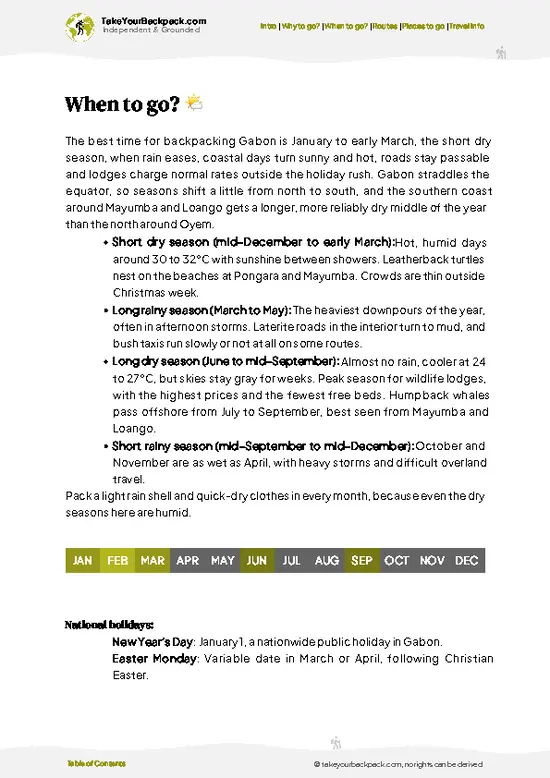
Best months: the long dry season: June to August is the best window for Gabon’s national parks, because rain drops to a trickle (often under 20 mm a month), forest trails firm up, and animals gather near water and fruiting trees. Days sit around 27 to 30°C with a milky overcast sky that keeps the heat softer than you expect, and nights fall to 21 to 23°C. Humidity never really leaves, so shirts stay damp.
Shoulder seasons and the short dry spell: A shorter dry season runs from mid-December to February. It is hotter, 30 to 33°C on the coast, with sharper sun and some afternoon showers, but trails are generally passable and prices stay similar. September and March to May are shoulder months, with rain increasing and rivers rising. October to mid-December is the wettest stretch, with heavy storms … read more 👉
Best months: the long dry season: June to August is the best window for Gabon’s national parks, because rain drops to a trickle (often under 20 mm a month), forest trails firm up, and animals gather near water and fruiting trees. Days sit around 27 to 30°C with a milky overcast sky that keeps the heat softer than you expect, and nights fall to 21 to 23°C. Humidity never really leaves, so shirts stay damp.
Shoulder seasons and the short dry spell: A shorter dry season runs from mid-December to February. It is hotter, 30 to 33°C on the coast, with sharper sun and some afternoon showers, but trails are generally passable and prices stay similar. September and March to May are shoulder months, with rain increasing and rivers rising. October to mid-December is the wettest stretch, with heavy storms that can exceed 300 mm a month in places. Sand tracks flood, boat transfers get rough, and red clay roads can stop vehicles for hours.
Crowds and prices: Gabon has no true tourist peak, only a thin rise in July and August when lodges, boats and guides fill earlier. Book at least four to six weeks ahead then. Lodge rates change little by season, but wet-season bargains and flexible bookings are easier to find from October to December. Coastal parks have a marine season for humpback whales roughly from July to September, which adds to dry-season demand.

national park hoppingTips for Visiting Multiple Destinations

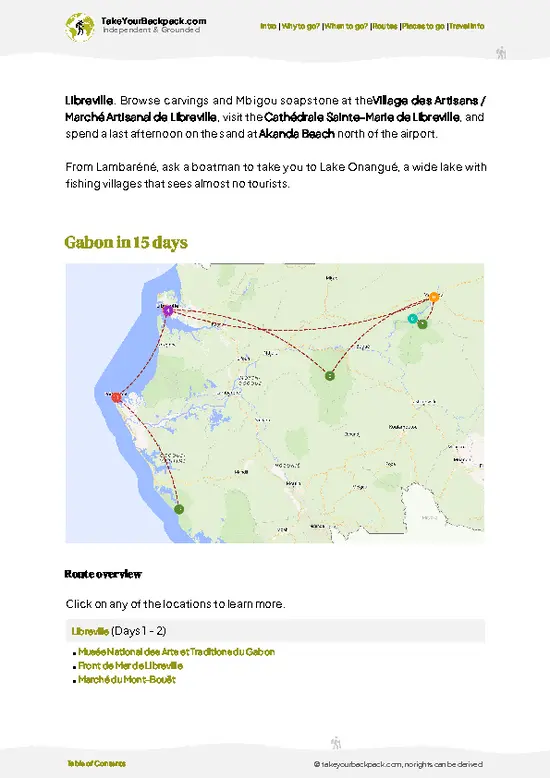
How long a multi-park trip needs: A trip combining several national parks in Gabon needs 10 to 14 days, because distances are long and every transfer eats half a day. Libreville is the hub. From there the country splits into three practical clusters: the railway corridor running east on the Trans-Gabon line, the southwest coast reached via Port-Gentil, and the northeast interior that needs long river or road legs. Most travelers do best pairing the rail corridor with one coastal region instead of trying all three.
Direction and pacing: Start with the coast near Libreville or Port-Gentil to adjust to heat and humidity, then go inland by train, or reverse it if flights are cheaper that way. Allow three to four nights per stop, since the first day mostly goes to transfers and the best forest walks … read more 👉
How long a multi-park trip needs: A trip combining several national parks in Gabon needs 10 to 14 days, because distances are long and every transfer eats half a day. Libreville is the hub. From there the country splits into three practical clusters: the railway corridor running east on the Trans-Gabon line, the southwest coast reached via Port-Gentil, and the northeast interior that needs long river or road legs. Most travelers do best pairing the rail corridor with one coastal region instead of trying all three.
Direction and pacing: Start with the coast near Libreville or Port-Gentil to adjust to heat and humidity, then go inland by train, or reverse it if flights are cheaper that way. Allow three to four nights per stop, since the first day mostly goes to transfers and the best forest walks happen at dawn. Libreville to the rail corridor takes about 5 to 8 hours by train, and Libreville to Port-Gentil is a 45 minute flight or a long boat and road combination. Reaching the far southwest often means a flight plus a 1 to 3 hour boat or 4x4 transfer.
Common planning mistakes: The biggest mistake is reading the map by distance. A 150 km stretch on a laterite road can take six hours in rain. Leave a buffer day before international flights, book guides and permits before arriving, and carry enough CFA francs in cash, since ATMs vanish outside Libreville and Port-Gentil. Do not stack four parks in a week; two or three done slowly produce better sightings and less exhaustion.

The ListMust-Visit national parks in Gabon

1 Loango National Park

coastal lagoons, savanna, surfing hippos

Experience the meeting of ocean and savanna, where elephants cross beaches and wildlife appears unexpectedly along the water’s edge.

gabon-national-park-loango-national-park
© Google |

2 Lopé National Park

ancient savanna, archaeological sites, mandrill troops

Trace the transition from open grasslands to forest, discovering ancient rock art and watching primates move through shifting habitats.

gabon-national-park-lope-national-park
© Google |

3 Ivindo National Park

waterfalls, rainforest interior, forest elephants

Follow winding trails to remote waterfalls, where dense rainforest conceals elusive wildlife and the sounds of the forest dominate every step.

gabon-national-park-ivindo-national-park
© Google |

4 Akanda National Park

mangrove forests, tidal estuaries, migratory birds

Watch tidal rhythms shape a landscape where rare birds gather, and mangroves shelter both wildlife and the rhythms of local fishing life.

gabon-national-park-akanda-national-park
© Google |

5 Pongara National Park

sea turtle nesting, coastal forest, river delta

Walk quiet beaches at dusk as turtles nest, then explore riverine forests where saltwater and freshwater environments overlap.

6 Mayumba National Park

Atlantic coastline, leatherback turtles, surf zone

Stand at the edge of the continent, where powerful waves meet nesting turtles and the open beach stretches toward the Congo border.

7 Moukalaba-Doudou National Park

lowland gorillas, rolling hills, secondary forest

Venture into hilly terrain where gorilla families roam, and secondary forests reveal signs of regeneration and diverse animal tracks.

8 Birougou National Park

cloud forest, montane ridges, endemic plants

Ascend misty slopes to encounter rare plant life and panoramic views, with cool air and unique species found only in these highlands.

9 Waka National Park

steep escarpments, dense rainforest, river gorges

Navigate rugged terrain marked by deep gorges and thick forest, where few trails exist and the landscape feels truly remote.

gabon-national-park-waka-national-park
© Google |
Loading the map 🌍

Expert viewWhat You Should Know

How many parks to visit: Plan on two or three parks, and three only if you have two weeks. Forest wildlife is shy, and a single park needs three or four nights before the animals stop hiding from your boots. Two parks done properly beat five rushed ones, and you spend your money on guides and boat time rather than on lost days. What you get is a morning when an elephant steps out of the tree line, because you have learned to be still.
Which kind to prioritize: Choose by what you want to see. Coastal and lagoon parks suit travelers who want open light, beach walks, boat trips and the chance of whales, hippos and elephants on sand, but they cost the most. Savanna-forest parks along the railway are the budget-friendly option, with hiking, forest walks, birdlife and primates, plus cheaper guesthouses … read more 👉
How many parks to visit: Plan on two or three parks, and three only if you have two weeks. Forest wildlife is shy, and a single park needs three or four nights before the animals stop hiding from your boots. Two parks done properly beat five rushed ones, and you spend your money on guides and boat time rather than on lost days. What you get is a morning when an elephant steps out of the tree line, because you have learned to be still.
Which kind to prioritize: Choose by what you want to see. Coastal and lagoon parks suit travelers who want open light, beach walks, boat trips and the chance of whales, hippos and elephants on sand, but they cost the most. Savanna-forest parks along the railway are the budget-friendly option, with hiking, forest walks, birdlife and primates, plus cheaper guesthouses and public transport. Deep interior parks suit experienced travelers with big budgets and time, as they need expeditions, camping and long river legs. For a first Gabon trip, I would pick one coastal park and one rail-corridor park, and skip the deepest interior unless you have a specialist operator.
What it costs: Gabon is not a cheap country. Budget US$70 to 120 a day if you camp or use basic guesthouses, eat local food and use trains and shared taxis. Mid-range trips with lodges and guided activities run US$200 to 350 a day, and top lodges go well above that. Park entry is usually roughly 5,000 to 10,000 XAF (about US$8 to 17) per person, and guides generally cost 15,000 to 40,000 XAF (US$25 to 65) a day. Boat transfers can run 50,000 to 200,000 XAF (US$85 to 330) per boat, so split them with others. Per park visit, budget US$250 to 600 for three nights at the cheaper end, including entry, guide, transport and food. You get the forest without the lodge price tag.
Safety and culture: Malaria is present everywhere, so take prophylaxis and wear long sleeves at dusk when mosquitoes whine around your ears. Carry your yellow fever certificate and a passport copy for checkpoints. Forest elephants and buffalo are dangerous at close range, so follow your guide’s instructions without argument, and never walk off trails alone. Lagoon and ocean currents are strong, so avoid swimming where guides do not. In villages near the parks, greet people with a clear “bonjour” before asking anything, and ask permission before taking photographs of people. Bushmeat is still sold in some places and discussed openly, so keep your response calm. You get warmth and local goodwill in return, which makes a long forest day easier.

✈️ The backpacker research shortcutGabon Travel Guide

An offline-friendly backpacking guide with optimized travel routes, ranked highlights, transport advice, and the best areas to stay.
example page 0 from our offline Travel Guide for Gabon
example page 1 from our offline Travel Guide for Gabon
example page 2 from our offline Travel Guide for Gabon
example page 3 from our offline Travel Guide for Gabon
example page 4 from our offline Travel Guide for Gabon
example page 5 from our offline Travel Guide for Gabon
example page 6 from our offline Travel Guide for Gabon
example page 7 from our offline Travel Guide for Gabon
The digital guide (209 pages) contains:
✅ 47 highlights, ranked by travel appeal
✅ Optimized 5, 10 & 15-day travel routes
✅ Cities, national parks, landmarks, beaches
✅ How to get around
✅ Offline-friendly for travel without Wi-Fi
👉 Click to see all 30+ guide features

📅 Plan smarter in minutes, not weeks
✅ Month by month travel advice
✅ Festivals & national holidays
✅ Budget expectations

🗺️ Go to the right places, skip the overrated ones
✅ Honest pros & cons of destinations
✅ Top hikes, parks & viewpoints
✅ Lesser-known places most travelers miss
✅ Clear “worth it vs skip it” guidance

🛏️ Travel smoothly without rookie mistakes
✅ Best areas to stay
✅ Transport systems explained simply
✅ Common scams & safety advice
✅ SIM cards, money & practical tips

🌍 Understand the country, not just visit it
✅ Culture & traditions
✅ 52 Essential phrases & customs
✅ Festivals worth planning around
✅ Traveler-friendly historical context
✅ Insights that make places more meaningful

📱 Built for real travel conditions
✅ Fully downloadable PDF
✅ Works completely offline
✅ Optimized for phone use
✅ Useful in remote areas & buses
✅ Everything in one place
Stop searching, start planning
Get instant access to your full guide. 30‑day money-back guarantee.
+ Add another guide for just

By proceeding you agree to our terms.
Sent to your inbox immediately after payment • 100% Secure Checkout
Best Backpacking Travel Advisor 2025 tourism awardBest Backpacking
Travel Advisor
2025
What others say about Take Your Backpack Guides:
⭐⭐⭐⭐⭐
Fantastic, amazing amount of information!
⭐⭐⭐⭐⭐
My goodness this is amazing, it's what I've been looking for hats off too you!
⭐⭐⭐⭐⭐
I think this is absolutely BRILLIANT
⭐⭐⭐⭐
Very complete and informative. It's still missing places, but I gotta to commend you
⭐⭐⭐⭐⭐
This is truly amazing, thank you, can't wait to explore it with my kids!
⭐⭐⭐⭐⭐
Awesome resource, thank you!
⭐⭐⭐⭐⭐
This is amazing! Can't wait to explore the ones I haven't seen
⭐⭐⭐⭐
I love this! Well done, great idea.
⭐⭐⭐⭐⭐
Thanks for taking the time to make this gem!
⭐⭐⭐⭐⭐
This might be the best website I've ever seen.
⭐⭐⭐⭐⭐
Congratulations, and thank you so much for your work; it's incredibly valuable.
⭐⭐⭐⭐
In all seriousness I think you did a great job pointing out the important spots
⭐⭐⭐⭐⭐
10/10 very good
⭐⭐⭐⭐⭐
As someone who's only just starting to visit regularly this is awesome, thank you.
⭐⭐⭐⭐
Thank you very much! I'm going to visit my dad, it's going to be very useful!
⭐⭐⭐⭐⭐
This is really cool! We'll be travelling for the first time and this definitely come in handy.
⭐⭐⭐⭐⭐
You are now our minister of culture, congratulations 👨‍💼
⭐⭐⭐⭐⭐
Just wanted to tell you that this is a pearl! Going to follow your recommendations.
⭐⭐⭐⭐⭐
This is so cool. I'll definitely be using the resource for my travels soon.
⭐⭐⭐⭐⭐
This is very impressive! Good work.
⭐⭐⭐⭐⭐
This is an amazing and informative site. Very well done!

🛏️ Where to stay?Top Areas to Stay

Gabon has almost no true hostels, so budget travelers rely on simple guesthouses, small auberges and church mission rooms, which typically run 15,000 to 30,000 XAF (about US$25 to 50) a night in Libreville. Quartier Louis has the liveliest bars, restaurants and nightlife at somewhat higher prices, while the Centre-ville along the seafront puts you close to the markets and ministries but goes quiet after dark. Mont-Bouët has the cheapest rooms and sits next to the big market and bush-taxi departures, though its crowds call for extra watchfulness with your bag, especially at night.

If you enjoy meeting fellow travelers, consider choosing hostels with high ratings for atmosphere. On the other hand, … read more 👉
Gabon has almost no true hostels, so budget travelers rely on simple guesthouses, small auberges and church mission rooms, which typically run 15,000 to 30,000 XAF (about US$25 to 50) a night in Libreville. Quartier Louis has the liveliest bars, restaurants and nightlife at somewhat higher prices, while the Centre-ville along the seafront puts you close to the markets and ministries but goes quiet after dark. Mont-Bouët has the cheapest rooms and sits next to the big market and bush-taxi departures, though its crowds call for extra watchfulness with your bag, especially at night.

If you enjoy meeting fellow travelers, consider choosing hostels with high ratings for atmosphere. On the other hand, if you prefer having your own space, a hotel might be a better option.

GabonDiscover the Country

👋 Meet the founderWho’s Behind Take Your Backpack?

Johan, backpacker and founder of TakeYourBackpackHi, I’m Johan (Netherlands 🇳🇱), the creator of TakeYourBackpack. Over the past 3 decades, I’ve backpacked through 90+ countries across six continents, gaining extensive experience with independent travel, long-term trips, and overland routes.

This site is built on a combination of firsthand travel experience and carefully curated insights from other backpackers. Many guides are based on places I’ve personally visited, while others bring together tips, observations, and practical advice shared by trusted travelers I’ve met along the way.

The goal is to provide realistic, experience-driven guidance — not generic itineraries — so you can explore destinations with better context, clearer expectations, and more confidence.