×

Gabon🇬🇦 | best citiesTop-Rated 3 cities in Gabon

Cities in Gabon are small, green and expensive, and none of them feels like the dense capitals of West Africa. Salt air, wet asphalt and woodsmoke mix with the hum of taxis and the roar of afternoon downpours. The coast carries the money, the oil and the French-style supermarkets, so prices run high. Inland forest and savanna towns are quieter, rougher on the roads and far cheaper for a meal. For backpackers and other independent travelers, the real choice is between polished comfort on the Atlantic and slow, muddy, rewarding frontier towns where a shared taxi may wait until it fills.

By Johan Kruseman 🇳🇱 | Updated October 19, 2026
Explore the best towns in Gabon

Why go?Why Travelers Love These Spots

Gabon is one of the most urbanized countries in Africa, yet it has under 3 million people, and roughly 85 percent of them live in towns. That tension shapes everything. Oil wealth built coastal infrastructure, paved boulevards and a French-speaking, Francophone café culture, while dense equatorial rainforest covering around 88 percent of the country walls cities off from one another. Few roads link them, and in the wet months red mud can swallow a bus for hours.

That isolation gives Gabonese towns a distinct character. Forest edges press against the streets, humidity clings to your shirt, and the smell of grilled fish, diesel and damp earth hangs in the evening air. Cities here are gateways to national parks rather than sights in themselves, so museums and monuments are modest.

Before choosing … read more 👉
Gabon is one of the most urbanized countries in Africa, yet it has under 3 million people, and roughly 85 percent of them live in towns. That tension shapes everything. Oil wealth built coastal infrastructure, paved boulevards and a French-speaking, Francophone café culture, while dense equatorial rainforest covering around 88 percent of the country walls cities off from one another. Few roads link them, and in the wet months red mud can swallow a bus for hours.

That isolation gives Gabonese towns a distinct character. Forest edges press against the streets, humidity clings to your shirt, and the smell of grilled fish, diesel and damp earth hangs in the evening air. Cities here are gateways to national parks rather than sights in themselves, so museums and monuments are modest.

Before choosing Gabon for its cities, know that it is among the pricier destinations in Central Africa. A basic hotel room often costs 25,000 to 45,000 CFA francs (US$40 to 75), and imported food is costly. French helps enormously, English rarely works, and cash matters because card acceptance is patchy outside upscale venues. Expect police checkpoints, passport checks and slow transport. The reward is calm streets, few tourists and a country that is still easy to explore without crowds.
Our Approach to Ranking
The list of best cities in Gabon is created based on culture, vibe, attractions, transport ease, and local charm. If you feel a city is missing in this list, please let us know.

When to go?Best Time to Visit Gabon for cities

The Best Months: The best months for Gabon’s cities are June to August, the long dry season, when rain drops to a few millimeters a month, skies turn a pale, hazy gray and roads stay passable. Daytime highs sit around 25 to 29°C, with cooler, cloud-covered mornings that make walking comfortable. Humidity stays high, but the heavy, sticky pressure eases.
Shoulder Seasons: A short dry spell from mid-December to February is the second good window. It is hotter, around 29 to 32°C, with bright sun and sharp midday glare, and sudden storms are still possible. September to November and March to May form the main rainy seasons. Along the Atlantic coast, including the northwest, rainfall can reach 200 to 500 mm in a peak month, and streets flood in minutes with a roar on tin roofs. Inland and southern … read more 👉
The Best Months: The best months for Gabon’s cities are June to August, the long dry season, when rain drops to a few millimeters a month, skies turn a pale, hazy gray and roads stay passable. Daytime highs sit around 25 to 29°C, with cooler, cloud-covered mornings that make walking comfortable. Humidity stays high, but the heavy, sticky pressure eases.
Shoulder Seasons: A short dry spell from mid-December to February is the second good window. It is hotter, around 29 to 32°C, with bright sun and sharp midday glare, and sudden storms are still possible. September to November and March to May form the main rainy seasons. Along the Atlantic coast, including the northwest, rainfall can reach 200 to 500 mm in a peak month, and streets flood in minutes with a roar on tin roofs. Inland and southern areas tend to be slightly drier, though dirt roads become slick red mud.
Prices and Crowds: Gabon has no true tourist high season, so crowds stay thin year-round. Hotel prices barely move, though business travel can fill coastal rooms in the dry months, so booking ahead helps. Rainy-season travel is possible if you accept delayed transport, cancelled flights and long waits for shared taxis.

city hoppingTips for Visiting Multiple Destinations

Time and Direction: A trip linking several cities in Gabon needs 7 to 14 days, because distances are long and transport is slow. The country divides into the northwest coast, the southwest and the interior, and the coast groups most easily. Start at the main international airport near the capital, where flights, ATMs and supplies are best, then work outward. Heading toward the south or east by road usually works better than looping back, since the strongest transport hub is the capital.
Pacing and Transfers: Plan 2 to 3 nights per stop. That is enough to settle in, change money and handle checkpoints without feeling rushed. Between major regions, expect 4 to 8 hours by paved road, and 10 hours or more on stretches where rain turns laterite tracks into slurry. Domestic flights shorten the longest … read more 👉
Time and Direction: A trip linking several cities in Gabon needs 7 to 14 days, because distances are long and transport is slow. The country divides into the northwest coast, the southwest and the interior, and the coast groups most easily. Start at the main international airport near the capital, where flights, ATMs and supplies are best, then work outward. Heading toward the south or east by road usually works better than looping back, since the strongest transport hub is the capital.
Pacing and Transfers: Plan 2 to 3 nights per stop. That is enough to settle in, change money and handle checkpoints without feeling rushed. Between major regions, expect 4 to 8 hours by paved road, and 10 hours or more on stretches where rain turns laterite tracks into slurry. Domestic flights shorten the longest gaps to about an hour and are worth the money when time is tight. Buses and shared taxis leave when full, often early in the morning, with engines idling in cool, damp air.
Planning Mistakes: The most common error is cramming too many stops into a week by trusting map distances. Roads here are slow, so budget a full day for any long transfer. Another is traveling at night, which brings checkpoints, poor visibility and missed connections. Leave slack for delays, carry small CFA franc notes, and buy tickets a day ahead where possible.

The ListMust-Visit cities in Gabon

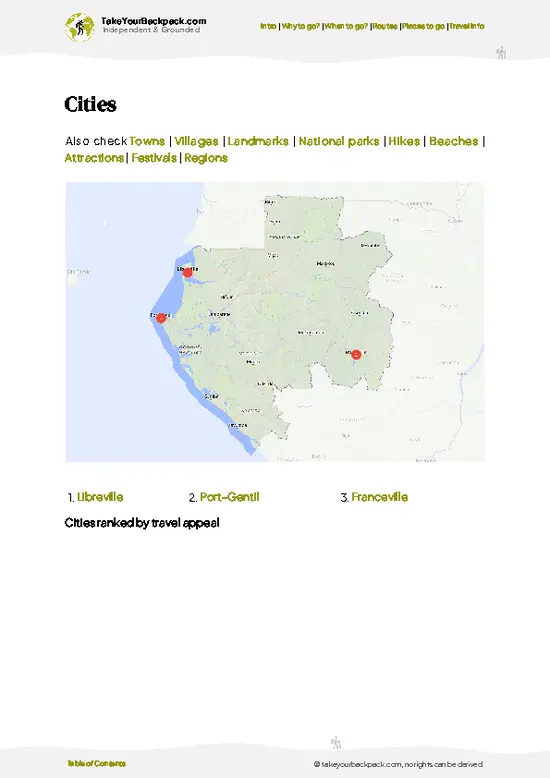
1 Libreville

Atlantic coastline, open-air markets, embassies, modern boulevards

Experience daily life along the oceanfront, where government, commerce, and street food blend with Gabon’s urban pulse and international presence.

2 Port-Gentil

oil industry hub, expat bars, sandy beaches, mangrove edges

Discover a city shaped by offshore energy, relaxed nightlife, and easy access to quiet beaches and wildlife-rich coastal wetlands.

3 Franceville

market streets, university campus, plateau views, regional transport hub

Start your journey in a lively crossroads town, where students, traders, and travelers converge amid rolling hills and busy local markets.

Loading the map 🌍

Expert viewWhat You Should Know

How Many Cities: I advise two or three cities, four at the outside if you have two weeks. Gabon’s roads are long, wet and slow, and every extra stop eats a day of red dust, checkpoints and waiting for a shared taxi to fill. Fewer stops let you actually sit in a roadside café, eat grilled fish with cassava and watch the evening light turn the streets orange.
Choosing the Kind of City: Comfort seekers should favor the coast, where paved streets, restaurants and markets make daily life easy, and where supermarkets stock cheese, bread and cold drinks. Travelers on a tight budget or wanting grit should look inland, where markets smell of smoked bushmeat, palm oil and fresh produce, and where a plate of rice and sauce costs far less. If wildlife is your goal, pick towns that serve as bases for national … read more 👉
How Many Cities: I advise two or three cities, four at the outside if you have two weeks. Gabon’s roads are long, wet and slow, and every extra stop eats a day of red dust, checkpoints and waiting for a shared taxi to fill. Fewer stops let you actually sit in a roadside café, eat grilled fish with cassava and watch the evening light turn the streets orange.
Choosing the Kind of City: Comfort seekers should favor the coast, where paved streets, restaurants and markets make daily life easy, and where supermarkets stock cheese, bread and cold drinks. Travelers on a tight budget or wanting grit should look inland, where markets smell of smoked bushmeat, palm oil and fresh produce, and where a plate of rice and sauce costs far less. If wildlife is your goal, pick towns that serve as bases for national parks, since the cities themselves have few formal sights. You come away with a more local trip and fewer wasted days.
What It Costs: Gabon is expensive. A budget traveler should plan US$50 to 90 a day: a basic room at 20,000 to 40,000 CFA francs (US$33 to 65), street meals at 2,000 to 5,000 CFA francs (US$3 to 8), and short taxi rides at 1,000 to 3,000 CFA francs (US$2 to 5) within town. Restaurant dinners run 8,000 to 20,000 CFA francs (US$13 to 33). Intercity transport varies widely, from about 5,000 to 25,000 CFA francs (US$8 to 40) by shared taxi or bus. Museum and market entries are small, usually under 5,000 CFA francs, but guides for forest day trips can run 20,000 to 50,000 CFA francs (US$33 to 80). Carry cash, as cards fail often outside upscale spots.
Safety and Culture: Gabon is generally calm, but petty theft and phone snatching happen after dark in larger towns, so use taxis at night and keep valuables out of sight. Police and gendarme checkpoints are common. Keep your passport, visa and a photocopy accessible, stay polite and patient, and you will usually pass in minutes. Photographing officials, military sites or government buildings is a bad idea. Greet people with a handshake and a bonjour before asking anything, because skipping the greeting reads as rude. Dress modestly, especially away from the coast, and carry a rain jacket and insect repellent. You will earn warmer conversations and smoother transactions.

✈️ The backpacker research shortcutGabon Travel Guide

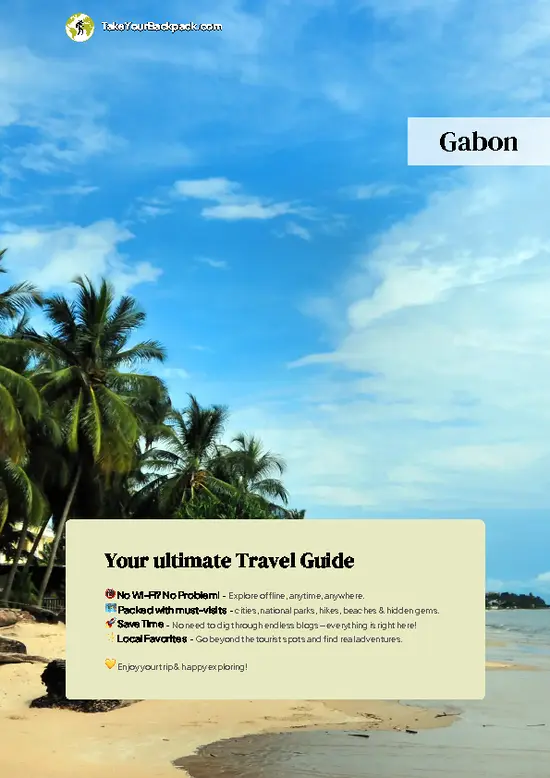
An offline-friendly backpacking guide with optimized travel routes, ranked highlights, transport advice, and the best areas to stay.
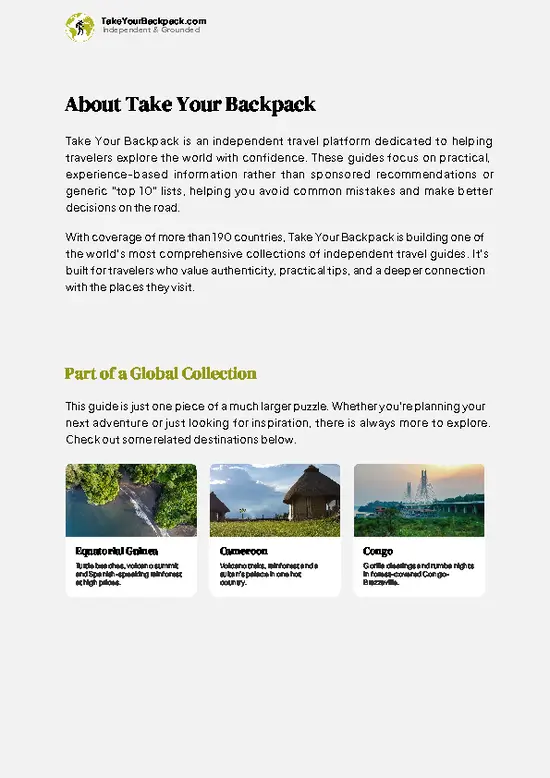
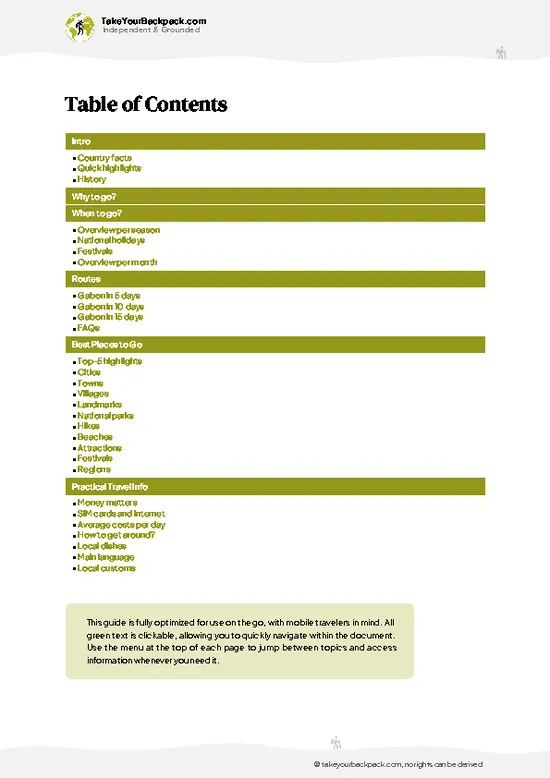
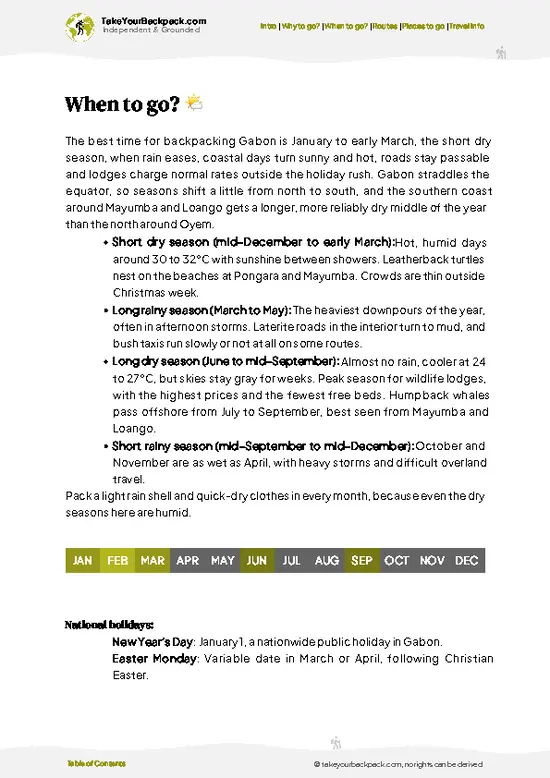
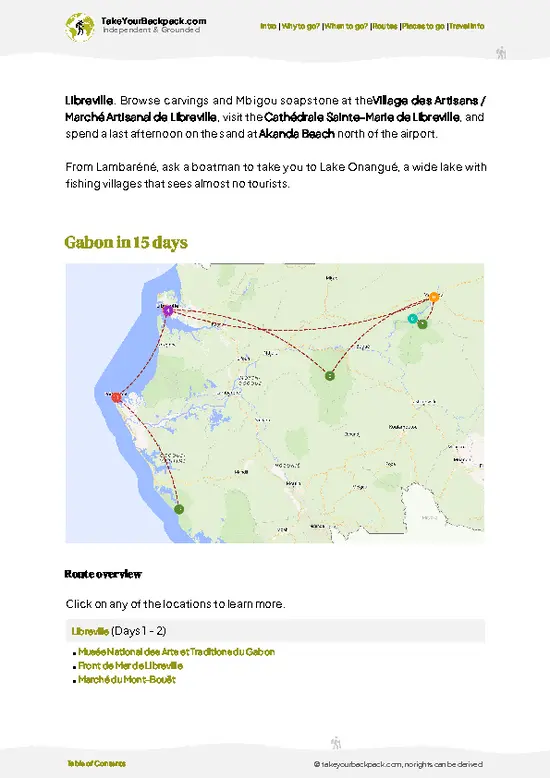
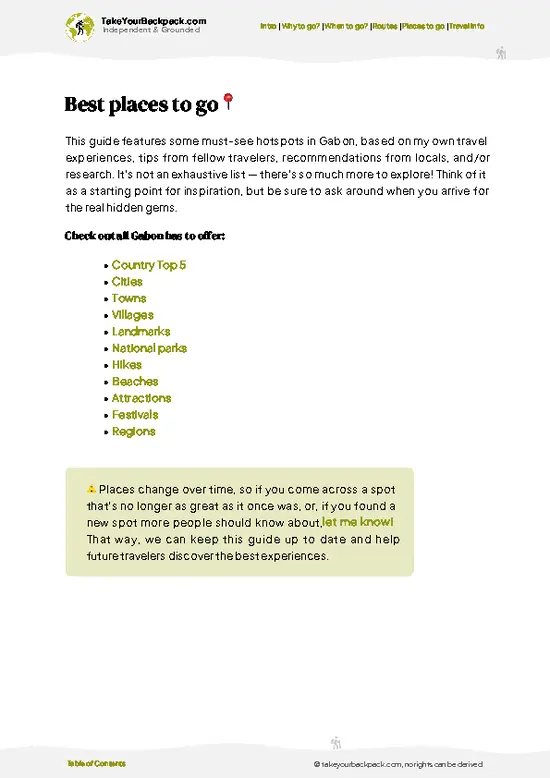
example page 0 from our offline Travel Guide for Gabon
example page 1 from our offline Travel Guide for Gabon
example page 2 from our offline Travel Guide for Gabon
example page 3 from our offline Travel Guide for Gabon
example page 4 from our offline Travel Guide for Gabon
example page 5 from our offline Travel Guide for Gabon
example page 6 from our offline Travel Guide for Gabon
example page 7 from our offline Travel Guide for Gabon
The digital guide (209 pages) contains:
✅ 47 highlights, ranked by travel appeal
✅ Optimized 5, 10 & 15-day travel routes
✅ Cities, national parks, landmarks, beaches
✅ How to get around
✅ Offline-friendly for travel without Wi-Fi
👉 Click to see all 30+ guide features

📅 Plan smarter in minutes, not weeks
✅ Month by month travel advice
✅ Festivals & national holidays
✅ Budget expectations

🗺️ Go to the right places, skip the overrated ones
✅ Honest pros & cons of destinations
✅ Top hikes, parks & viewpoints
✅ Lesser-known places most travelers miss
✅ Clear “worth it vs skip it” guidance

🛏️ Travel smoothly without rookie mistakes
✅ Best areas to stay
✅ Transport systems explained simply
✅ Common scams & safety advice
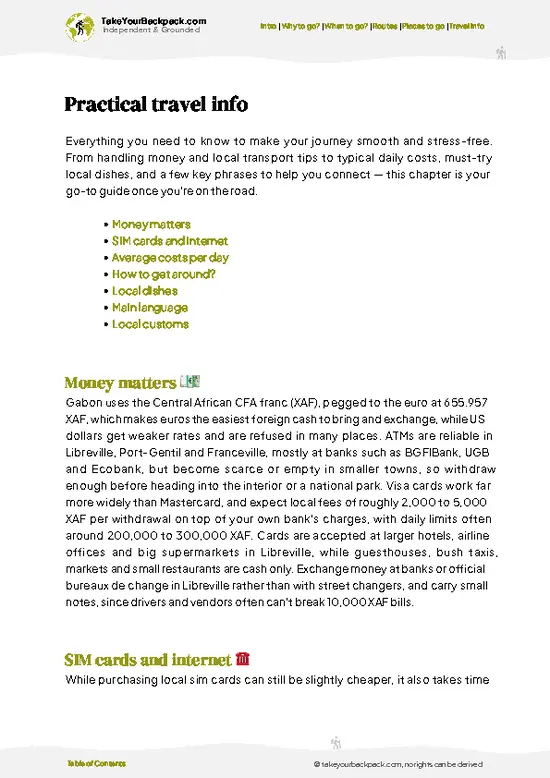
✅ SIM cards, money & practical tips

🌍 Understand the country, not just visit it
✅ Culture & traditions
✅ 52 Essential phrases & customs
✅ Festivals worth planning around
✅ Traveler-friendly historical context
✅ Insights that make places more meaningful

📱 Built for real travel conditions
✅ Fully downloadable PDF
✅ Works completely offline
✅ Optimized for phone use
✅ Useful in remote areas & buses
✅ Everything in one place
Stop searching, start planning
Get instant access to your full guide. 30‑day money-back guarantee.
+ Add another guide for just

By proceeding you agree to our terms.
Sent to your inbox immediately after payment • 100% Secure Checkout
Best Backpacking Travel Advisor 2025 tourism awardBest Backpacking
Travel Advisor
2025
What others say about Take Your Backpack Guides:
⭐⭐⭐⭐⭐
Fantastic, amazing amount of information!
⭐⭐⭐⭐⭐
My goodness this is amazing, it's what I've been looking for hats off too you!
⭐⭐⭐⭐⭐
I think this is absolutely BRILLIANT
⭐⭐⭐⭐
Very complete and informative. It's still missing places, but I gotta to commend you
⭐⭐⭐⭐⭐
This is truly amazing, thank you, can't wait to explore it with my kids!
⭐⭐⭐⭐⭐
Awesome resource, thank you!
⭐⭐⭐⭐⭐
This is amazing! Can't wait to explore the ones I haven't seen
⭐⭐⭐⭐
I love this! Well done, great idea.
⭐⭐⭐⭐⭐
Thanks for taking the time to make this gem!
⭐⭐⭐⭐⭐
This might be the best website I've ever seen.
⭐⭐⭐⭐⭐
Congratulations, and thank you so much for your work; it's incredibly valuable.
⭐⭐⭐⭐
In all seriousness I think you did a great job pointing out the important spots
⭐⭐⭐⭐⭐
10/10 very good
⭐⭐⭐⭐⭐
As someone who's only just starting to visit regularly this is awesome, thank you.
⭐⭐⭐⭐
Thank you very much! I'm going to visit my dad, it's going to be very useful!
⭐⭐⭐⭐⭐
This is really cool! We'll be travelling for the first time and this definitely come in handy.
⭐⭐⭐⭐⭐
You are now our minister of culture, congratulations 👨‍💼
⭐⭐⭐⭐⭐
Just wanted to tell you that this is a pearl! Going to follow your recommendations.
⭐⭐⭐⭐⭐
This is so cool. I'll definitely be using the resource for my travels soon.
⭐⭐⭐⭐⭐
This is very impressive! Good work.
⭐⭐⭐⭐⭐
This is an amazing and informative site. Very well done!

🛏️ Where to stay?Top Areas to Stay

Gabon has almost no true hostels, so budget travelers rely on simple guesthouses, small auberges and church mission rooms, which typically run 15,000 to 30,000 XAF (about US$25 to 50) a night in Libreville. Quartier Louis has the liveliest bars, restaurants and nightlife at somewhat higher prices, while the Centre-ville along the seafront puts you close to the markets and ministries but goes quiet after dark. Mont-Bouët has the cheapest rooms and sits next to the big market and bush-taxi departures, though its crowds call for extra watchfulness with your bag, especially at night.

If you enjoy meeting fellow travelers, consider choosing hostels with high ratings for atmosphere. On the other hand, … read more 👉
Gabon has almost no true hostels, so budget travelers rely on simple guesthouses, small auberges and church mission rooms, which typically run 15,000 to 30,000 XAF (about US$25 to 50) a night in Libreville. Quartier Louis has the liveliest bars, restaurants and nightlife at somewhat higher prices, while the Centre-ville along the seafront puts you close to the markets and ministries but goes quiet after dark. Mont-Bouët has the cheapest rooms and sits next to the big market and bush-taxi departures, though its crowds call for extra watchfulness with your bag, especially at night.

If you enjoy meeting fellow travelers, consider choosing hostels with high ratings for atmosphere. On the other hand, if you prefer having your own space, a hotel might be a better option.

GabonDiscover the Country

👋 Meet the founderWho’s Behind Take Your Backpack?

Johan, backpacker and founder of TakeYourBackpackHi, I’m Johan (Netherlands 🇳🇱), the creator of TakeYourBackpack. Over the past 3 decades, I’ve backpacked through 90+ countries across six continents, gaining extensive experience with independent travel, long-term trips, and overland routes.

This site is built on a combination of firsthand travel experience and carefully curated insights from other backpackers. Many guides are based on places I’ve personally visited, while others bring together tips, observations, and practical advice shared by trusted travelers I’ve met along the way.

The goal is to provide realistic, experience-driven guidance — not generic itineraries — so you can explore destinations with better context, clearer expectations, and more confidence.