×

Gabon🇬🇦 | best regionsTop-Rated regions in Gabon

Gabon is a country of equatorial forest, where roughly 88 percent of the land is still tree cover, and that shapes every regional choice you make. The coast smells of salt, woodsmoke and diesel, and its beach towns run on higher prices and better roads. The interior is a green hush broken by cicadas, river engines and rain drumming on tin, reached by rough tracks and the odd train. Crowds are thin everywhere, which suits independent travel, but each region costs real money to reach. Sort the options by how much mud, time and cash you will spend.

By Johan Kruseman 🇳🇱 | Updated October 19, 2026
Explore the best cities in Gabon

Why go?Why Travelers Love These Spots

Gabon is unusual because it kept its forest. Oil money in the twentieth century let the country develop slowly, with a population of only about 2.3 million, so large tracts stayed empty. In 2002 the government created 13 national parks, covering around 11 percent of the territory, and that decision still defines how travelers use the country.

The flip side is infrastructure. Paved roads are limited, many forest tracks turn to red clay in the rains, and distances take far longer than the map suggests. The Transgabonais railway is the one dependable spine, with the sticky heat of the carriage and the green wall outside the window.

Costs are high by Central African standards. Gabon is an oil economy with a dollar-linked feel to prices, so a simple room and a plate of grilled fish still add … read more 👉
Gabon is unusual because it kept its forest. Oil money in the twentieth century let the country develop slowly, with a population of only about 2.3 million, so large tracts stayed empty. In 2002 the government created 13 national parks, covering around 11 percent of the territory, and that decision still defines how travelers use the country.

The flip side is infrastructure. Paved roads are limited, many forest tracks turn to red clay in the rains, and distances take far longer than the map suggests. The Transgabonais railway is the one dependable spine, with the sticky heat of the carriage and the green wall outside the window.

Costs are high by Central African standards. Gabon is an oil economy with a dollar-linked feel to prices, so a simple room and a plate of grilled fish still add up quickly, and prices are quoted in Central African francs (CFA).

Before choosing Gabon, know that wildlife viewing is about patience, not guaranteed sightings. Forest elephants, gorillas and mandrills hide in dense canopy. Much of the best access runs through permits, park fees and arranged guides, so independent travel means planning ahead and carrying cash.
How the List Was Created
The list of best regions in Gabon is created based on landscapes, local culture, attractions, vibes, and overall appeal. If you feel a region is missing in this list, please let us know.

When to go?Best Time to Visit Gabon for regions

Best months: The best months for Gabon are June to August, the long dry season, when rain drops sharply, roads firm up and the air is drier and slightly cooler. Daytime highs sit around 27 to 30°C (81 to 86°F), with nights near 20 to 22°C (68 to 72°F), though cloud often hangs gray over the coast.
Shoulder seasons: The short dry season runs roughly mid-December to February. It is hotter and stickier, around 30 to 33°C (86 to 91°F), but walking is easier and many tracks stay passable. September to November and March to May are the wet stretches, with heavy downpours that can flood tracks and slow river crossings.
Rain and prices: Annual rainfall is high, from about 1,500 mm in the south-east to well over 2,500 mm on the coast near Libreville, and the wettest months can bring 300 mm or more in … read more 👉
Best months: The best months for Gabon are June to August, the long dry season, when rain drops sharply, roads firm up and the air is drier and slightly cooler. Daytime highs sit around 27 to 30°C (81 to 86°F), with nights near 20 to 22°C (68 to 72°F), though cloud often hangs gray over the coast.
Shoulder seasons: The short dry season runs roughly mid-December to February. It is hotter and stickier, around 30 to 33°C (86 to 91°F), but walking is easier and many tracks stay passable. September to November and March to May are the wet stretches, with heavy downpours that can flood tracks and slow river crossings.
Rain and prices: Annual rainfall is high, from about 1,500 mm in the south-east to well over 2,500 mm on the coast near Libreville, and the wettest months can bring 300 mm or more in a month. Coastal areas get the heaviest rain, while the southern interior gets slightly less.

Crowds stay small year-round, but lodges and guides in the parks fill up in the dry months, so book ahead. Prices rarely drop much in the wet season, so there is little saving to chase. Turtle nesting on the coast peaks around November to February, and whale watching runs about July to September.

region hoppingTips for Visiting Multiple Destinations

How many days: A trip combining several regions in Gabon needs 10 to 14 days, because distances are long and transport is thin. Travel eats a large share of the time, so plan for slow days rather than a long list of stops.
Direction and pacing: Start in Libreville, the main air and road hub, and move in one loop rather than doubling back. The Transgabonais railway runs from the coast toward Franceville, and a Libreville to Lopé leg takes roughly 6 to 8 hours on the overnight or day train. Domestic flights from Libreville or Port-Gentil save days where roads are poor. Roads out to the coast and south can take 4 to 8 hours or more in the rains.

Allow 2 to 4 days per stop. Park regions need at least 2 full days, since mornings are for walking and afternoons for waiting out the heat and rain. … read more 👉
How many days: A trip combining several regions in Gabon needs 10 to 14 days, because distances are long and transport is thin. Travel eats a large share of the time, so plan for slow days rather than a long list of stops.
Direction and pacing: Start in Libreville, the main air and road hub, and move in one loop rather than doubling back. The Transgabonais railway runs from the coast toward Franceville, and a Libreville to Lopé leg takes roughly 6 to 8 hours on the overnight or day train. Domestic flights from Libreville or Port-Gentil save days where roads are poor. Roads out to the coast and south can take 4 to 8 hours or more in the rains.

Allow 2 to 4 days per stop. Park regions need at least 2 full days, since mornings are for walking and afternoons for waiting out the heat and rain. Beach and lagoon areas work in 2 to 3 days.
Common mistakes: The usual error is cramming in too many stops, assuming 200 km takes 3 hours. Add a spare day on both ends for delays, since trains run late and flights get shifted. Another is arriving without cash in CFA francs, as card machines are rare outside Libreville. Book park permits and lodge transfers before leaving the capital.

The ListMust-Visit regions in Gabon

1 Ogooué-Ivindo

dense rainforest, Ivindo National Park, remote villages, rare wildlife

Venture into a region where forest trails lead to waterfalls, elusive primates, and communities living deep within Gabon's wild interior.

Loading the map 🌍

Expert viewWhat You Should Know

How many regions: I would advise two to three regions on a first trip. Gabon’s transport is slow and expensive, so each extra region costs about two travel days. Two regions let you stay long enough for forest walks at dawn, when the air is wet and loud with hornbills, and the payoff is real time with wildlife rather than hours in a vehicle.
Choosing a kind: If you want wildlife, put a forest park first and accept basic lodging and early starts. If you want rest and sea air, pick a coastal region with beaches, lagoons and surf, where days are easy but prices are higher. If culture matters most, spend time in towns and villages of the interior, where shared taxis, market stalls and local food do the talking. Gabon is not a country for a quick sampler of everything.
What it costs: Budget about … read more 👉
How many regions: I would advise two to three regions on a first trip. Gabon’s transport is slow and expensive, so each extra region costs about two travel days. Two regions let you stay long enough for forest walks at dawn, when the air is wet and loud with hornbills, and the payoff is real time with wildlife rather than hours in a vehicle.
Choosing a kind: If you want wildlife, put a forest park first and accept basic lodging and early starts. If you want rest and sea air, pick a coastal region with beaches, lagoons and surf, where days are easy but prices are higher. If culture matters most, spend time in towns and villages of the interior, where shared taxis, market stalls and local food do the talking. Gabon is not a country for a quick sampler of everything.
What it costs: Budget about US$60 to 120 a day (roughly 35,000 to 70,000 CFA francs) for independent travel, since Gabon is pricey. Simple rooms run US$25 to 50, a plate of fish and plantain US$5 to 12, and shared taxis a few dollars per hop. Park permits and guides add up: expect US$15 to 40 a day for entry and a guide, and more for boat or vehicle transfers in remote areas. A typical visit to a park region, with permits, guide, transport and lodging, can run US$200 to 500 for several days, and lodges inside parks cost more.
Safety and culture: Carry a passport copy and your visa paperwork, because police checkpoints are common on roads and you may be asked for documents. Keep valuables out of sight in Libreville, especially at night, and use registered taxis. In forests, a guide is essential: trails fork and fade in the undergrowth, and the clay turns slick. Stay clear of elephants and gorillas, keeping the distances your guide sets. Malaria is present, so take prophylaxis and use repellent at dusk, when mosquitoes rise from the standing water.

Greet people before asking questions, as French greetings matter, and ask before photographing people, officials or government buildings. In villages, small gifts like salt or sugar, or a modest payment for a guide’s help, are appreciated. Bushmeat appears on menus in some places, and the trade can be illegal for protected species, so choose carefully.

✈️ The backpacker research shortcutGabon Travel Guide

An offline-friendly backpacking guide with optimized travel routes, ranked highlights, transport advice, and the best areas to stay.
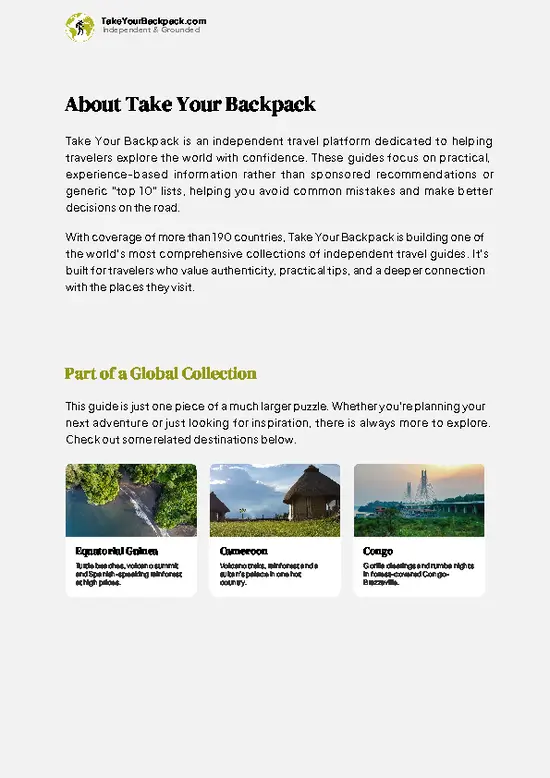
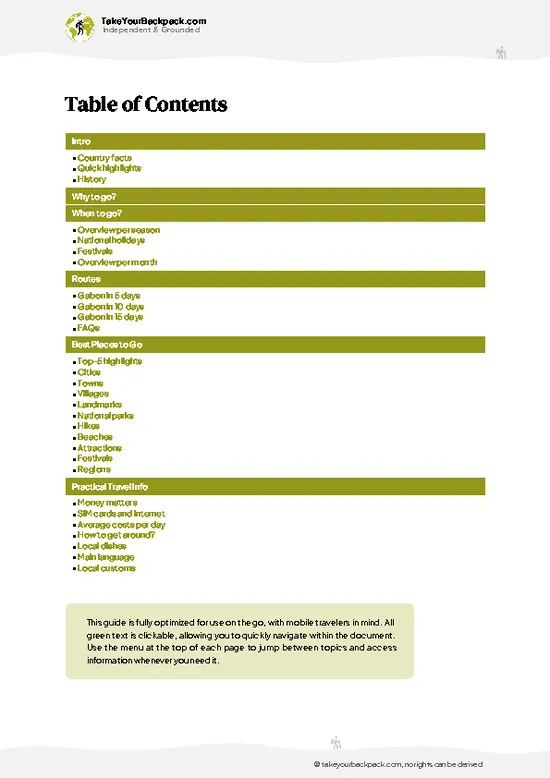
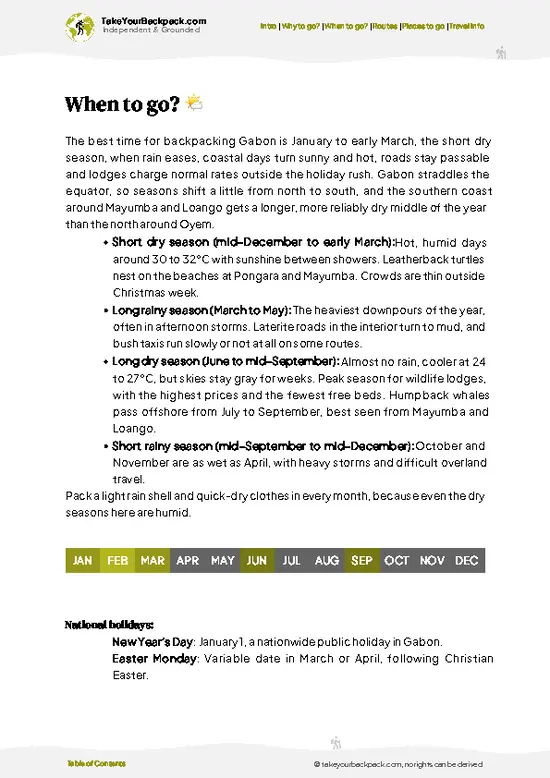
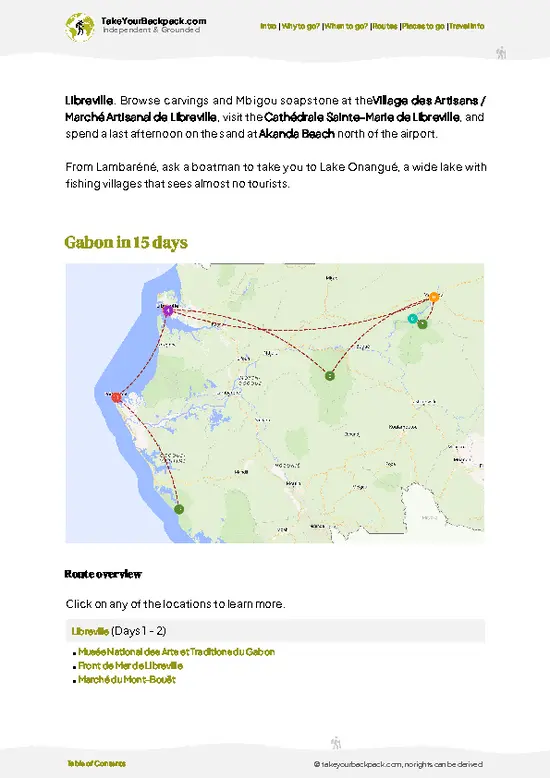
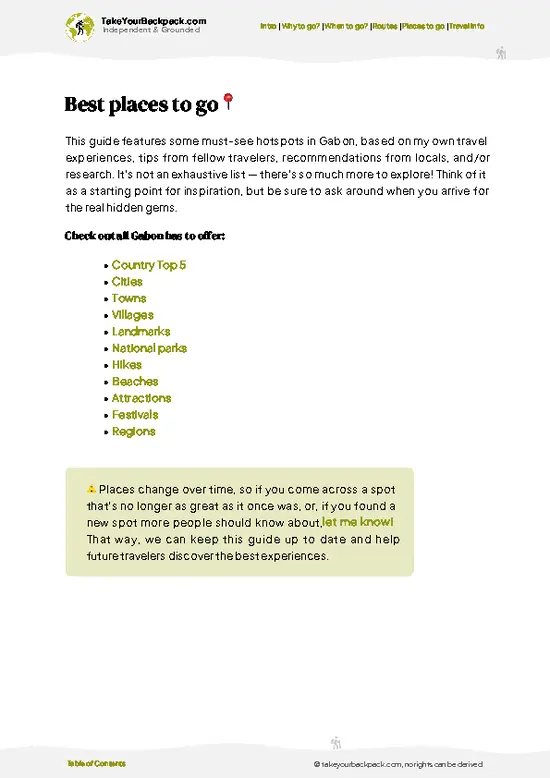
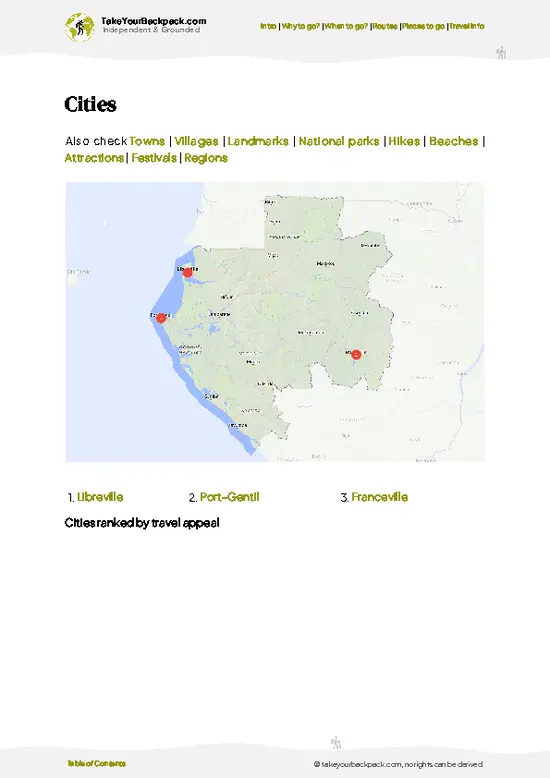
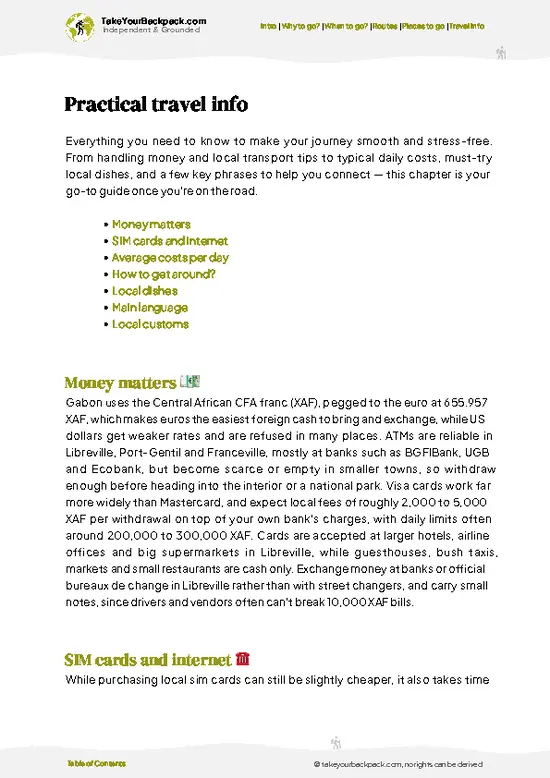
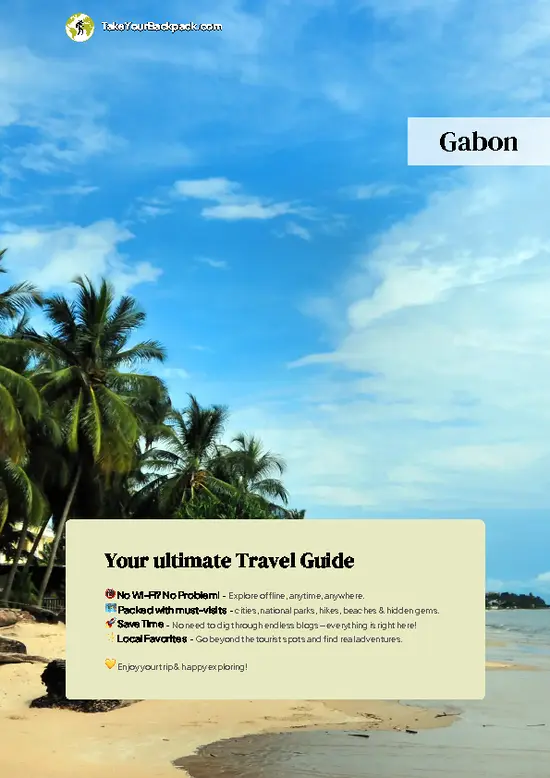
example page 0 from our offline Travel Guide for Gabon
example page 1 from our offline Travel Guide for Gabon
example page 2 from our offline Travel Guide for Gabon
example page 3 from our offline Travel Guide for Gabon
example page 4 from our offline Travel Guide for Gabon
example page 5 from our offline Travel Guide for Gabon
example page 6 from our offline Travel Guide for Gabon
example page 7 from our offline Travel Guide for Gabon
The digital guide (209 pages) contains:
✅ 47 highlights, ranked by travel appeal
✅ Optimized 5, 10 & 15-day travel routes
✅ Cities, national parks, landmarks, beaches
✅ How to get around
✅ Offline-friendly for travel without Wi-Fi
👉 Click to see all 30+ guide features

📅 Plan smarter in minutes, not weeks
✅ Month by month travel advice
✅ Festivals & national holidays
✅ Budget expectations

🗺️ Go to the right places, skip the overrated ones
✅ Honest pros & cons of destinations
✅ Top hikes, parks & viewpoints
✅ Lesser-known places most travelers miss
✅ Clear “worth it vs skip it” guidance

🛏️ Travel smoothly without rookie mistakes
✅ Best areas to stay
✅ Transport systems explained simply
✅ Common scams & safety advice
✅ SIM cards, money & practical tips

🌍 Understand the country, not just visit it
✅ Culture & traditions
✅ 52 Essential phrases & customs
✅ Festivals worth planning around
✅ Traveler-friendly historical context
✅ Insights that make places more meaningful

📱 Built for real travel conditions
✅ Fully downloadable PDF
✅ Works completely offline
✅ Optimized for phone use
✅ Useful in remote areas & buses
✅ Everything in one place
Stop searching, start planning
Get instant access to your full guide. 30‑day money-back guarantee.
+ Add another guide for just

By proceeding you agree to our terms.
Sent to your inbox immediately after payment • 100% Secure Checkout
Best Backpacking Travel Advisor 2025 tourism awardBest Backpacking
Travel Advisor
2025
What others say about Take Your Backpack Guides:
⭐⭐⭐⭐⭐
Fantastic, amazing amount of information!
⭐⭐⭐⭐⭐
My goodness this is amazing, it's what I've been looking for hats off too you!
⭐⭐⭐⭐⭐
I think this is absolutely BRILLIANT
⭐⭐⭐⭐
Very complete and informative. It's still missing places, but I gotta to commend you
⭐⭐⭐⭐⭐
This is truly amazing, thank you, can't wait to explore it with my kids!
⭐⭐⭐⭐⭐
Awesome resource, thank you!
⭐⭐⭐⭐⭐
This is amazing! Can't wait to explore the ones I haven't seen
⭐⭐⭐⭐
I love this! Well done, great idea.
⭐⭐⭐⭐⭐
Thanks for taking the time to make this gem!
⭐⭐⭐⭐⭐
This might be the best website I've ever seen.
⭐⭐⭐⭐⭐
Congratulations, and thank you so much for your work; it's incredibly valuable.
⭐⭐⭐⭐
In all seriousness I think you did a great job pointing out the important spots
⭐⭐⭐⭐⭐
10/10 very good
⭐⭐⭐⭐⭐
As someone who's only just starting to visit regularly this is awesome, thank you.
⭐⭐⭐⭐
Thank you very much! I'm going to visit my dad, it's going to be very useful!
⭐⭐⭐⭐⭐
This is really cool! We'll be travelling for the first time and this definitely come in handy.
⭐⭐⭐⭐⭐
You are now our minister of culture, congratulations 👨‍💼
⭐⭐⭐⭐⭐
Just wanted to tell you that this is a pearl! Going to follow your recommendations.
⭐⭐⭐⭐⭐
This is so cool. I'll definitely be using the resource for my travels soon.
⭐⭐⭐⭐⭐
This is very impressive! Good work.
⭐⭐⭐⭐⭐
This is an amazing and informative site. Very well done!

🛏️ Where to stay?Top Places to Consider Staying

Gabon has almost no true hostels, so budget travelers rely on simple guesthouses, small auberges and church mission rooms, which typically run 15,000 to 30,000 XAF (about US$25 to 50) a night in Libreville. Quartier Louis has the liveliest bars, restaurants and nightlife at somewhat higher prices, while the Centre-ville along the seafront puts you close to the markets and ministries but goes quiet after dark. Mont-Bouët has the cheapest rooms and sits next to the big market and bush-taxi departures, though its crowds call for extra watchfulness with your bag, especially at night.

If you enjoy meeting fellow travelers, consider choosing hostels with high ratings for atmosphere. On the other hand, … read more 👉
Gabon has almost no true hostels, so budget travelers rely on simple guesthouses, small auberges and church mission rooms, which typically run 15,000 to 30,000 XAF (about US$25 to 50) a night in Libreville. Quartier Louis has the liveliest bars, restaurants and nightlife at somewhat higher prices, while the Centre-ville along the seafront puts you close to the markets and ministries but goes quiet after dark. Mont-Bouët has the cheapest rooms and sits next to the big market and bush-taxi departures, though its crowds call for extra watchfulness with your bag, especially at night.

If you enjoy meeting fellow travelers, consider choosing hostels with high ratings for atmosphere. On the other hand, if you prefer having your own space, a hotel might be a better option.

GabonMore Places Across Gabon

👋 Meet the founderWho’s Behind Take Your Backpack?

Johan, backpacker and founder of TakeYourBackpackHi, I’m Johan (Netherlands 🇳🇱), the creator of TakeYourBackpack. Over the past 3 decades, I’ve backpacked through 90+ countries across six continents, gaining extensive experience with independent travel, long-term trips, and overland routes.

This site is built on a combination of firsthand travel experience and carefully curated insights from other backpackers. Many guides are based on places I’ve personally visited, while others bring together tips, observations, and practical advice shared by trusted travelers I’ve met along the way.

The goal is to provide realistic, experience-driven guidance — not generic itineraries — so you can explore destinations with better context, clearer expectations, and more confidence.