×

Gabon🇬🇦 | best attractionsTop-Rated 8 attractions in Gabon

Gabon’s attractions are mostly wild, not built. Equatorial forest covers roughly 88 percent of the country, so the draw is wildlife, rivers and Atlantic coast, not monuments. Expect the hiss of rain on leaves, the sour-sweet smell of rotting fruit under trees, and sand that stays cool under a canopy of palms. Costs run high. Park access is by boat or 4x4, and visitors are few. Libreville and Port-Gentil are easy but pricey, the southwest lagoons need transfers, and the interior needs time. For independent travelers, planning and patience matter more than a rigid budget.

By Johan Kruseman 🇳🇱 | Updated October 19, 2026
Explore the best festivals in Gabon

Why go?Why Travelers Love These Spots

Gabon is one of the least populated countries in Central Africa, with about 2.3 million people, and most live in cities. That leaves a huge area of intact rainforest where elephants walk onto beaches, gorillas feed under the trees, and the air is thick with the smell of wet earth and the whine of insects. In 2002 the government protected about 11 percent of the national territory as 13 national parks, which is why wild places here are so well preserved.

The flip side is infrastructure. Roads outside the main axes are red laterite that turns to soup in the rains, distances are long, and most parks have no public transport at all. Lodges, boats and guides are priced for oil-economy and expedition clients, so a day costs far more than in neighboring countries. Visitors who accept logistics as … read more 👉
Gabon is one of the least populated countries in Central Africa, with about 2.3 million people, and most live in cities. That leaves a huge area of intact rainforest where elephants walk onto beaches, gorillas feed under the trees, and the air is thick with the smell of wet earth and the whine of insects. In 2002 the government protected about 11 percent of the national territory as 13 national parks, which is why wild places here are so well preserved.

The flip side is infrastructure. Roads outside the main axes are red laterite that turns to soup in the rains, distances are long, and most parks have no public transport at all. Lodges, boats and guides are priced for oil-economy and expedition clients, so a day costs far more than in neighboring countries. Visitors who accept logistics as part of the trip are rewarded with encounters that are rare elsewhere.

Before choosing Gabon, know that wildlife sightings are never guaranteed, since animals roam freely in dense forest. Entry to parks requires advance permits arranged through the national park agency (ANPN) or an operator, and a visa and yellow fever certificate are required. French is the working language. Humid heat, mosquitoes and long boat transfers are the normal price of admission.
How the List Was Created
The list of best attractions in Gabon is created based on cultural significance or entertainment value. If you feel a attraction is missing in this list, please let us know.

When to go?Best Time to Visit Gabon for attractions

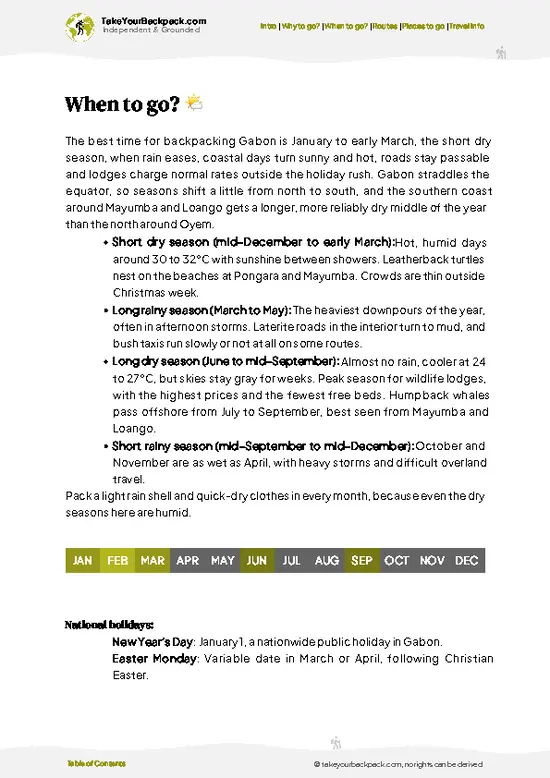
Best months and seasons: The best months for attractions in Gabon are June to August, the main dry season, when rain drops to a few millimeters a month, roads in the interior stay passable and forest trails are firmer underfoot. Skies are often overcast and gray, with a cool breeze, and temperatures sit around 22 to 28°C. Humidity stays high, so shirts never quite dry.

Shoulder seasons and the rains: A short dry spell runs roughly December to February, with brighter sun and 28 to 32°C heat. It is a useful second window, though showers can still arrive. The wet seasons, March to May and September to November, bring heavy downpours that drum on tin roofs. Libreville and the coast can see 200 to 500 mm in peak months, with October and November among the wettest. Laterite tracks become slick, … read more 👉
Best months and seasons: The best months for attractions in Gabon are June to August, the main dry season, when rain drops to a few millimeters a month, roads in the interior stay passable and forest trails are firmer underfoot. Skies are often overcast and gray, with a cool breeze, and temperatures sit around 22 to 28°C. Humidity stays high, so shirts never quite dry.

Shoulder seasons and the rains: A short dry spell runs roughly December to February, with brighter sun and 28 to 32°C heat. It is a useful second window, though showers can still arrive. The wet seasons, March to May and September to November, bring heavy downpours that drum on tin roofs. Libreville and the coast can see 200 to 500 mm in peak months, with October and November among the wettest. Laterite tracks become slick, rivers rise, and some camps and boat routes reduce access.

Crowds and prices: Gabon never has true crowds. Even in the dry season, parks are quiet, and the main effect of the busy window is that lodges and boat transfers book out earlier. Prices for lodging rarely change much by season, but wet-season bargains are limited, and the risk of cancelled transfers is higher. In the south, in the Gamba region, and along the coast, the dry months also mean calmer seas for boat trips. Booking permits and transport several weeks ahead is wise at any time of year.

attraction hoppingTips for Visiting Multiple Destinations

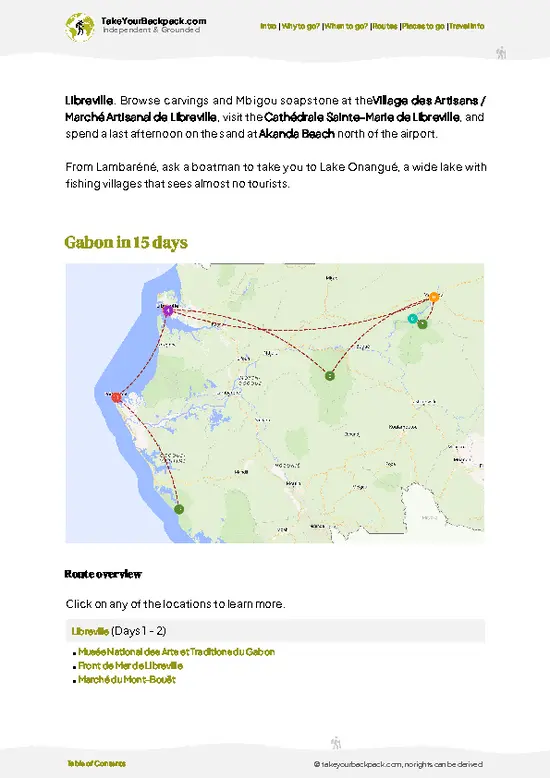
How long a combined trip takes: A trip combining several attractions in Gabon needs 10 to 16 days, because transfers eat more time than sightseeing. The country divides into three loose clusters: the Libreville and Estuaire area in the northwest, the central and eastern forest reached via the Transgabonais railway, and the southwest coast around Port-Gentil and Gamba. Port-Gentil and Gamba are mainly reached by air or boat, not road.

Direction and pacing: Start in Libreville, where permits, cash and supplies are easiest to sort out, then move inland by train or road before finishing on the coast, where salt air and a swim are a good reward after humid forest days. Plan 2 to 4 nights per stop, since arrival days are often consumed by boat or 4x4 transfers. Libreville to Lopé by train takes … read more 👉
How long a combined trip takes: A trip combining several attractions in Gabon needs 10 to 16 days, because transfers eat more time than sightseeing. The country divides into three loose clusters: the Libreville and Estuaire area in the northwest, the central and eastern forest reached via the Transgabonais railway, and the southwest coast around Port-Gentil and Gamba. Port-Gentil and Gamba are mainly reached by air or boat, not road.

Direction and pacing: Start in Libreville, where permits, cash and supplies are easiest to sort out, then move inland by train or road before finishing on the coast, where salt air and a swim are a good reward after humid forest days. Plan 2 to 4 nights per stop, since arrival days are often consumed by boat or 4x4 transfers. Libreville to Lopé by train takes roughly 6 to 8 hours, domestic flights to Port-Gentil about 40 minutes, and road journeys across the south can run 6 to 10 hours on laterite when dry, much longer in rain.

Planning mistakes: The most common error is cramming one park per day. Sightings take patience, and a missed boat can cost two days. Another is trusting road times from a map, when rain changes everything. Build in one spare day per cluster, confirm transfers by phone or WhatsApp the day before, and carry enough CFA francs in cash, because cards and ATMs are scarce outside the cities.

The ListMust-Visit attractions in Gabon

1 Musée National des Arts et Traditions du Gabon

national heritage, cultural relics, historical artifacts

Discover Gabon’s past through permanent exhibits that document the country’s social evolution and the material culture of its peoples.

2 Front de Mer de Libreville

harbor views, seaside walkway, fishing boats

Stroll along the waterfront, observing maritime activity and enjoying open views of the Atlantic coastline and Libreville’s port district.

3 Village des Artisans

handmade goods, wood carvings, local artists

Browse unique crafts and meet artisans producing jewelry, textiles, and sculpture, offering opportunities for direct cultural exchange and souvenirs.

gabon-attraction-village-des-artisans
© Google |

4 Église Saint-Michel de Nkembo

wooden columns, religious murals, urban parish

Observe the church’s distinctive carved pillars and vibrant interior, reflecting local craftsmanship and spiritual traditions within Libreville.

5 Cathédrale Sainte-Marie de Libreville

colonial architecture, stained glass, city landmark

Admire the cathedral’s historic façade and tranquil interior, offering a glimpse into Gabon’s religious heritage and architectural legacy.

6 Institut Français du Gabon

French-language library, film screenings, cultural programs

Participate in language classes or attend film nights that connect travelers with Gabon’s Francophone influences and diverse cultural offerings.

gabon-attraction-institut-francais-du-gabon
© Google |

7 Centre Culturel de Franceville

local exhibitions, performance space, community events

Attend rotating art shows or music performances that highlight regional creativity and provide insight into contemporary Gabonese culture.

8 Centre Culturel de Port-Gentil

art workshops, theater venue, modern gallery

Join interactive workshops or view curated exhibitions that showcase the evolving artistic scene and cultural life of Port-Gentil.

Loading the map 🌍

Expert viewWhat You Should Know

How many attractions to pick: Plan on two to four attractions in a trip of two weeks, because Gabon swallows time. Roads are often red laterite that turns to soup in the rains, river transfers run on pirogue schedules, and a single national park can eat three days once you count the boat, the walk in and the wait for the weather. Stack more than that and you spend the trip in the back of a 4x4 watching the rainforest blur past the window. Fewer stops mean you actually stand in the wet green dusk and hear the forest start up: tree hyraxes screaming, frogs in the thousands, the odd elephant crashing somewhere you cannot see.
Choosing the kind that fits you: Gabon splits into three experiences: rainforest and wildlife parks, Atlantic coast and beach, and city or cultural stops around Libreville … read more 👉
How many attractions to pick: Plan on two to four attractions in a trip of two weeks, because Gabon swallows time. Roads are often red laterite that turns to soup in the rains, river transfers run on pirogue schedules, and a single national park can eat three days once you count the boat, the walk in and the wait for the weather. Stack more than that and you spend the trip in the back of a 4x4 watching the rainforest blur past the window. Fewer stops mean you actually stand in the wet green dusk and hear the forest start up: tree hyraxes screaming, frogs in the thousands, the odd elephant crashing somewhere you cannot see.
Choosing the kind that fits you: Gabon splits into three experiences: rainforest and wildlife parks, Atlantic coast and beach, and city or cultural stops around Libreville and Lambaréné. Wildlife lovers should put parks first, since this is where Gabon has no real competitor in Central Africa, and forest elephants wandering onto a salt-sprayed beach is the payoff. Beach-and-surf travelers can keep the budget lower by staying near the coast and skipping the deep interior. If your interest is people and history, spend your time in towns and villages, where you get woodcarving, mask traditions of the Fang and Punu, and a plate of smoked fish with cassava wrapped in leaves. Mixing all three is possible, but the cost curve climbs steeply as soon as you add remote parks.
What it costs: Budget US$60 to 100 a day for town-based travel with basic guesthouses, shared taxis and street food, and US$150 to 300 a day once you are in the parks, where lodges, boats and guides set the price. Park entry usually runs about US$10 to 40 per person per day, plus a mandatory guide at roughly US$20 to 50. Boat transfers to coastal and river sites often cost US$50 to 200 per vessel, so splitting with other travelers saves real money. Chartered 4x4 transport can be US$100 to 200 a day with fuel. Gabon is among the pricier African countries, and a cold beer in Libreville costs more than you expect. Carry cash in Central African francs (CFA) for villages, since cards fail outside the capital.
Safety and cultural considerations: Gabon is calm by regional standards, but petty theft in Libreville and Port-Gentil is real, so keep phones out of sight after dark. In the forest, stay with your guide: elephants, buffalo and gorillas are not zoo animals, and a muddy trail at dusk is no place for improvising. Malaria is present, so bring prophylaxis, repellent and long sleeves for the evening mosquito hour. Yellow fever vaccination is required for entry. Ask before photographing people, and expect to be asked for your papers at checkpoints, so carry copies of your passport and visa. In villages, greet elders first, accept a small gift of palm wine only if you intend to drink it, and never touch masks or ritual objects uninvited. Bushmeat appears on menus; ordering protected species is both illegal and unwise. A calm greeting, a handshake and a few words of French open more doors here than any amount of money.
One practical note: Book park lodges and boats well ahead, since capacity is small and weather can shift departures by a day. Pack dry bags: a surprise downpour soaks everything, and the dry shirt you saved is the one that keeps you comfortable.

✈️ The backpacker research shortcutGabon Travel Guide

An offline-friendly backpacking guide with optimized travel routes, ranked highlights, transport advice, and the best areas to stay.
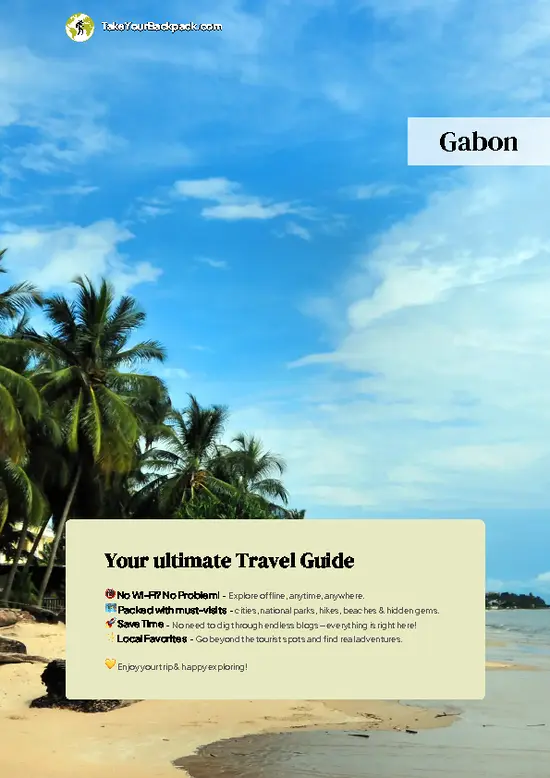
example page 0 from our offline Travel Guide for Gabon
example page 1 from our offline Travel Guide for Gabon
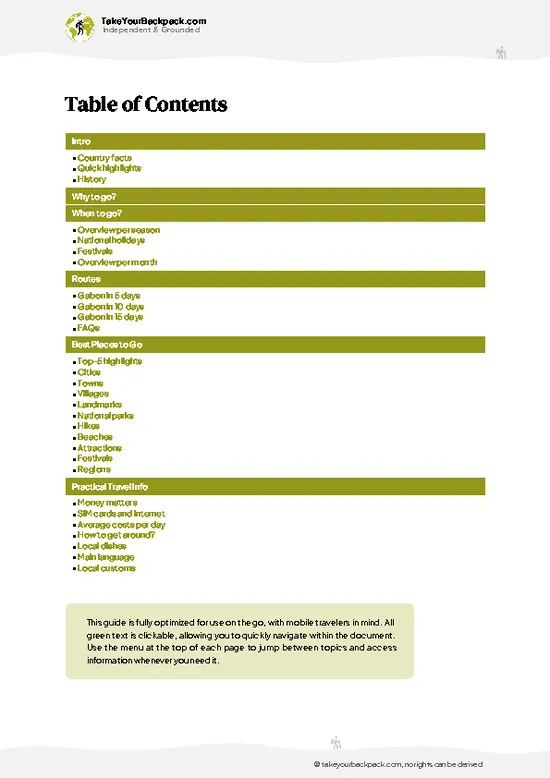
example page 2 from our offline Travel Guide for Gabon
example page 3 from our offline Travel Guide for Gabon
example page 4 from our offline Travel Guide for Gabon
example page 5 from our offline Travel Guide for Gabon
example page 6 from our offline Travel Guide for Gabon
example page 7 from our offline Travel Guide for Gabon
The digital guide (209 pages) contains:
✅ 47 highlights, ranked by travel appeal
✅ Optimized 5, 10 & 15-day travel routes
✅ Cities, national parks, landmarks, beaches
✅ How to get around
✅ Offline-friendly for travel without Wi-Fi
👉 Click to see all 30+ guide features

📅 Plan smarter in minutes, not weeks
✅ Month by month travel advice
✅ Festivals & national holidays
✅ Budget expectations

🗺️ Go to the right places, skip the overrated ones
✅ Honest pros & cons of destinations
✅ Top hikes, parks & viewpoints
✅ Lesser-known places most travelers miss
✅ Clear “worth it vs skip it” guidance

🛏️ Travel smoothly without rookie mistakes
✅ Best areas to stay
✅ Transport systems explained simply
✅ Common scams & safety advice
✅ SIM cards, money & practical tips

🌍 Understand the country, not just visit it
✅ Culture & traditions
✅ 52 Essential phrases & customs
✅ Festivals worth planning around
✅ Traveler-friendly historical context
✅ Insights that make places more meaningful

📱 Built for real travel conditions
✅ Fully downloadable PDF
✅ Works completely offline
✅ Optimized for phone use
✅ Useful in remote areas & buses
✅ Everything in one place
Stop searching, start planning
Get instant access to your full guide. 30‑day money-back guarantee.
+ Add another guide for just

By proceeding you agree to our terms.
Sent to your inbox immediately after payment • 100% Secure Checkout
Best Backpacking Travel Advisor 2025 tourism awardBest Backpacking
Travel Advisor
2025
What others say about Take Your Backpack Guides:
⭐⭐⭐⭐⭐
Fantastic, amazing amount of information!
⭐⭐⭐⭐⭐
My goodness this is amazing, it's what I've been looking for hats off too you!
⭐⭐⭐⭐⭐
I think this is absolutely BRILLIANT
⭐⭐⭐⭐
Very complete and informative. It's still missing places, but I gotta to commend you
⭐⭐⭐⭐⭐
This is truly amazing, thank you, can't wait to explore it with my kids!
⭐⭐⭐⭐⭐
Awesome resource, thank you!
⭐⭐⭐⭐⭐
This is amazing! Can't wait to explore the ones I haven't seen
⭐⭐⭐⭐
I love this! Well done, great idea.
⭐⭐⭐⭐⭐
Thanks for taking the time to make this gem!
⭐⭐⭐⭐⭐
This might be the best website I've ever seen.
⭐⭐⭐⭐⭐
Congratulations, and thank you so much for your work; it's incredibly valuable.
⭐⭐⭐⭐
In all seriousness I think you did a great job pointing out the important spots
⭐⭐⭐⭐⭐
10/10 very good
⭐⭐⭐⭐⭐
As someone who's only just starting to visit regularly this is awesome, thank you.
⭐⭐⭐⭐
Thank you very much! I'm going to visit my dad, it's going to be very useful!
⭐⭐⭐⭐⭐
This is really cool! We'll be travelling for the first time and this definitely come in handy.
⭐⭐⭐⭐⭐
You are now our minister of culture, congratulations 👨‍💼
⭐⭐⭐⭐⭐
Just wanted to tell you that this is a pearl! Going to follow your recommendations.
⭐⭐⭐⭐⭐
This is so cool. I'll definitely be using the resource for my travels soon.
⭐⭐⭐⭐⭐
This is very impressive! Good work.
⭐⭐⭐⭐⭐
This is an amazing and informative site. Very well done!

🛏️ Where to stay?Accommodation Highlights

Gabon has almost no true hostels, so budget travelers rely on simple guesthouses, small auberges and church mission rooms, which typically run 15,000 to 30,000 XAF (about US$25 to 50) a night in Libreville. Quartier Louis has the liveliest bars, restaurants and nightlife at somewhat higher prices, while the Centre-ville along the seafront puts you close to the markets and ministries but goes quiet after dark. Mont-Bouët has the cheapest rooms and sits next to the big market and bush-taxi departures, though its crowds call for extra watchfulness with your bag, especially at night.

If you enjoy meeting fellow travelers, consider choosing hostels with high ratings for atmosphere. On the other hand, … read more 👉
Gabon has almost no true hostels, so budget travelers rely on simple guesthouses, small auberges and church mission rooms, which typically run 15,000 to 30,000 XAF (about US$25 to 50) a night in Libreville. Quartier Louis has the liveliest bars, restaurants and nightlife at somewhat higher prices, while the Centre-ville along the seafront puts you close to the markets and ministries but goes quiet after dark. Mont-Bouët has the cheapest rooms and sits next to the big market and bush-taxi departures, though its crowds call for extra watchfulness with your bag, especially at night.

If you enjoy meeting fellow travelers, consider choosing hostels with high ratings for atmosphere. On the other hand, if you prefer having your own space, a hotel might be a better option.

GabonSee More of Gabon

👋 Meet the founderWho’s Behind Take Your Backpack?

Johan, backpacker and founder of TakeYourBackpackHi, I’m Johan (Netherlands 🇳🇱), the creator of TakeYourBackpack. Over the past 3 decades, I’ve backpacked through 90+ countries across six continents, gaining extensive experience with independent travel, long-term trips, and overland routes.

This site is built on a combination of firsthand travel experience and carefully curated insights from other backpackers. Many guides are based on places I’ve personally visited, while others bring together tips, observations, and practical advice shared by trusted travelers I’ve met along the way.

The goal is to provide realistic, experience-driven guidance — not generic itineraries — so you can explore destinations with better context, clearer expectations, and more confidence.