×

The Gambia🇬🇲 | townsFarafenniHighway crossroads, groundnut trade, Wednesday lumo, attaya tea | things to do and best time to go

Explore BontoExplore Jambanjelly

Backpacking in Farafenni
👍 Recommendedtown ranked #7
By Johan Kruseman 🇳🇱 | Updated October 22, 2026

Farafenni suits the traveler who likes working-town Africa as it is: diesel, groundnut sacks, and tea stalls at dusk. Anyone chasing beaches, lodges or polished sights will find it thin. It sits in the north of the Gambia, on the north bank, about 30 km short of the Senegal border at Karang, where the main road runs through town. Reaching it is easy because shared taxis and minibuses pass constantly, and that is why most people arrive mid-journey and leave within a day; a ferry crossing upriver or at Banjul sets the pace. The lumo market fills Wednesdays with cloth, spices and livestock, so plan your stay around it. Guesthouses are few and evenings are quiet, so you meet drivers and traders more than backpackers. Your first day could be a late-morning arrival, a market walk in dust and heat, grilled meat at dusk, and an early night.

Discover everything you want to know in the 📖 The Gambia Travel Guide.


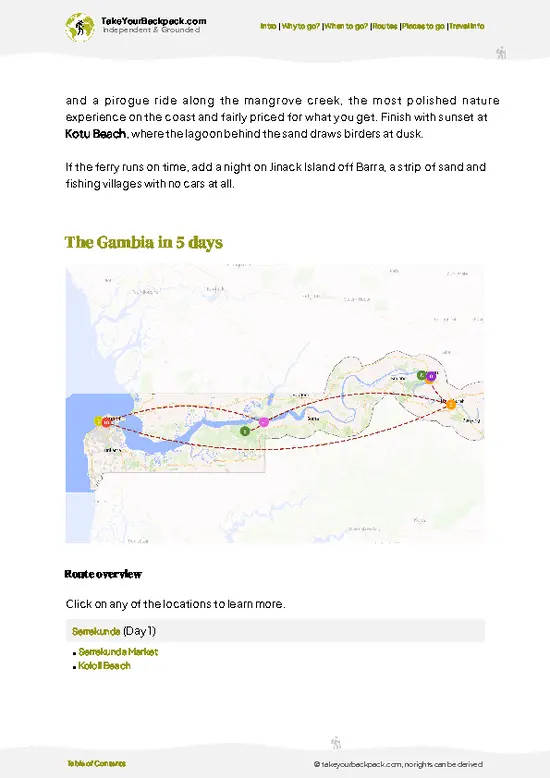
example page 0 from our offline Travel Guide for Gambia
example page 1 from our offline Travel Guide for Gambia
example page 2 from our offline Travel Guide for Gambia
example page 3 from our offline Travel Guide for Gambia
example page 4 from our offline Travel Guide for Gambia
example page 5 from our offline Travel Guide for Gambia
example page 6 from our offline Travel Guide for Gambia
example page 7 from our offline Travel Guide for Gambia
Loading the map 🌍
CLICK TO FILTER
cities
towns
villages
landmarks
national parks
beaches
attractions
festivals
SHOW COUNTRY’S BESTSHOW ALL

✨ Why go?
Ranked #7 town in The Gambia
What makes this town worth visiting

Farafenni earns its place as the junction of the north-bank road, where the route toward Senegal meets traffic from the river ferry at Yelitenda. That makes it a practical overnight stop for overland travelers heading to or from Senegal, and a rare chance to see everyday Gambian commerce without a tourist layer. The big draw is the weekly lumo market, where traders from both countries sell fabric, onions, dried fish and secondhand goods under tarps. Food is simple and good: café-style bread stalls with egg and onion sandwiches at breakfast, and charcoal-grilled meat in the evening. Most people stay one night, though slow travelers with curiosity about border-town life can happily linger two. Expect it to be quiet and unpolished, with few other backpackers and little nightlife. It suits solo … read more 👉
Farafenni earns its place as the junction of the north-bank road, where the route toward Senegal meets traffic from the river ferry at Yelitenda. That makes it a practical overnight stop for overland travelers heading to or from Senegal, and a rare chance to see everyday Gambian commerce without a tourist layer. The big draw is the weekly lumo market, where traders from both countries sell fabric, onions, dried fish and secondhand goods under tarps. Food is simple and good: café-style bread stalls with egg and onion sandwiches at breakfast, and charcoal-grilled meat in the evening. Most people stay one night, though slow travelers with curiosity about border-town life can happily linger two. Expect it to be quiet and unpolished, with few other backpackers and little nightlife. It suits solo travelers comfortable with striking up conversations and with a little French or Wolof for the border-side traders.

💡 HighlightsPlaces and moments you shouldn't skip

  1. Farafenni Lumo Market: The town’s defining sight, with cloth, spices, livestock and secondhand goods spread out under tarps, plus traders crossing from Senegal. Go on market day in the morning before the heat peaks. Entry is free, and 1 to 2 hours is plenty.
  2. Farafenni Main Road Stalls: The highway strip is the town’s social space, with tea sellers, tailors and grilled-meat stands. Late afternoon is liveliest, when the light softens. Free to wander, and a snack costs US$1 to 3 over an hour.
  3. Farafenni Central Mosque Area: A look at everyday religious life, with the call to prayer carrying across the rooftops. Visit outside prayer times and dress modestly. Free, about 20 minutes from the outside.
  4. Tailor Row: Tailors run foot-pedal machines in small shops and can sew a shirt from market fabric within
… read more 👉
  1. Farafenni Lumo Market: The town’s defining sight, with cloth, spices, livestock and secondhand goods spread out under tarps, plus traders crossing from Senegal. Go on market day in the morning before the heat peaks. Entry is free, and 1 to 2 hours is plenty.
  2. Farafenni Main Road Stalls: The highway strip is the town’s social space, with tea sellers, tailors and grilled-meat stands. Late afternoon is liveliest, when the light softens. Free to wander, and a snack costs US$1 to 3 over an hour.
  3. Farafenni Central Mosque Area: A look at everyday religious life, with the call to prayer carrying across the rooftops. Visit outside prayer times and dress modestly. Free, about 20 minutes from the outside.
  4. Tailor Row: Tailors run foot-pedal machines in small shops and can sew a shirt from market fabric within a day or two. Bring your own measurements in mind and go in the morning. Fabric and sewing together run about US$10 to 25, and the visit takes 1 hour.
  5. Sunset Teahouse Corner: Locals gather for strong sweet attaya tea poured in three rounds. Go around dusk and sit with a group. A round costs under US$1, and an hour passes quickly.
Farafenni works well as a launch point for day trips to the Gambia River crossing at Yelitenda, the Bambatenda and Kerewan areas, and the Senegalese border zone at Karang. The lumo market is the best item for a first visit.
Spotted a mistake or missing something? Contact us.

Things to do near Farafenni

Ratings based on Tripadvisor reviews. When you book through this link, you support our work at no extra cost to you.

🏘️ NeighborhoodsNeighborhood guide to Farafenni

Farafenni is small enough to read in an afternoon, and each patch has its own sound and smell. Walk it early, because by midday the heat flattens everything and shade becomes the only plan worth having.
  • Main Market and Trans-Gambia Highway strip: The commercial heart. Expect diesel fumes, shouted prices, stacked onions, dried fish, secondhand clothes and the hiss of frying dough. Trucks queue for the Senegal border, so the road is loud all day. Stay on the market side of the road and cross where the crowds do, since drivers rarely slow down for anyone.
  • Lumo (weekly market area): The big weekly market, held on Saturdays, draws traders from both sides of the border. Cloth, livestock, spices and cheap plastic goods spread across dusty ground. Arrive by mid-morning, carry small notes and keep your
… read more 👉
Farafenni is small enough to read in an afternoon, and each patch has its own sound and smell. Walk it early, because by midday the heat flattens everything and shade becomes the only plan worth having.
  • Main Market and Trans-Gambia Highway strip: The commercial heart. Expect diesel fumes, shouted prices, stacked onions, dried fish, secondhand clothes and the hiss of frying dough. Trucks queue for the Senegal border, so the road is loud all day. Stay on the market side of the road and cross where the crowds do, since drivers rarely slow down for anyone.
  • Lumo (weekly market area): The big weekly market, held on Saturdays, draws traders from both sides of the border. Cloth, livestock, spices and cheap plastic goods spread across dusty ground. Arrive by mid-morning, carry small notes and keep your bag in front, because crowded lanes are narrow and the pushing is constant.
  • Residential quarters behind the highway: Sandy lanes, compound walls, goats, women pounding millet at dawn and a call to prayer drifting over tin roofs. Evenings are quiet and unlit, so walk with a headlamp and greet people first; a hello opens doors here.
  • Ferry and river approach (Farafenni to Soma side): Rough, open and breezy near the water, with roadside stalls selling grilled meat, bread and sweet tea. It is too far to walk comfortably in the heat, so take a shared taxi.

⌛️ 1 daySeeing the highlights in 24 hours

Keep the day on foot with short shared taxi hops, and stop for a long rest when the afternoon heat hits. 8:00 AM: Bread stall breakfast Start on the main road with a hot egg-and-onion sandwich and coffee, then watch the town wake up. 9:30 AM: Lumo Market Walk to the market while it is still cool. Browse cloth, spices and dried fish, and talk to traders from across the border. 11:30 AM: Tailor Row Pick fabric, then order a shirt from one of the tailors. Their machines click steadily while you wait for measurements. 1:00 PM: Lunch and rest Eat rice and fish at a local eatery, then rest in the shade during the worst heat. 4:00 PM: Central Mosque Area Stroll the side streets behind the mosque, where compounds, goats and children playing give a view outside the usual route. 6:00 PM: Sunset Teahouse … read more 👉
Keep the day on foot with short shared taxi hops, and stop for a long rest when the afternoon heat hits. 8:00 AM: Bread stall breakfast Start on the main road with a hot egg-and-onion sandwich and coffee, then watch the town wake up. 9:30 AM: Lumo Market Walk to the market while it is still cool. Browse cloth, spices and dried fish, and talk to traders from across the border. 11:30 AM: Tailor Row Pick fabric, then order a shirt from one of the tailors. Their machines click steadily while you wait for measurements. 1:00 PM: Lunch and rest Eat rice and fish at a local eatery, then rest in the shade during the worst heat. 4:00 PM: Central Mosque Area Stroll the side streets behind the mosque, where compounds, goats and children playing give a view outside the usual route. 6:00 PM: Sunset Teahouse Corner Join the evening attaya session, three glasses of strong tea getting sweeter each round. 7:30 PM: Grilled meat dinner Finish with charcoal-grilled meat and bread from a roadside stand.

🌤️ When to go?Seasonal considerations and timing

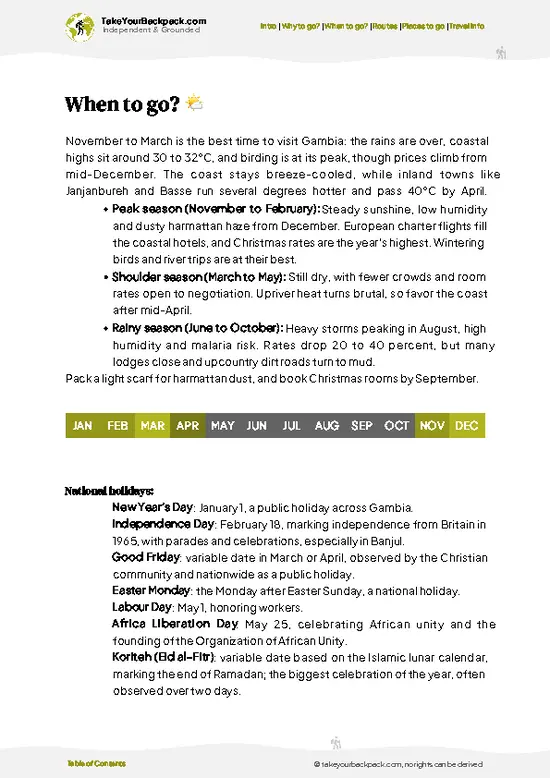
November to February is the most comfortable window for Farafenni, with dry, sunny days around 30 to 35°C (86 to 95°F) and cool nights near 16 to 20°C (61 to 68°F).
  • Cool Dry Season (Nov to Feb): Clear skies, dusty harmattan haze at times, roughly 11 hours of daylight. Roads are fully passable and prices stay steady.
  • Hot Season (Mar to May): Afternoons climb to 38 to 43°C (100 to 109°F). Shade and water set your schedule, and the market is quiet by noon.
  • Rainy Season (Jun to Oct): Humid, 30 to 35°C (86 to 95°F), with heavy storms mostly in July to September. Dirt roads turn to mud, transport slows and some fares rise.
  • Market Days: Saturday brings the biggest crowds and the best trading.
Arrive on a Friday afternoon in the cool season to catch Saturday’s market at full volume.

source: climatestotravel.comJANJanuary: excellent for travelingFEBFebruary: excellent for travelingMARMarch: excellent for travelingAPRApril: excellent for travelingMAYMay: highly recommended for travelingJUNJune: fair for travelingJULJuly: fair for travelingAUGAugust: fair for travelingSEPSeptember: fair for travelingOCTOctober: fair for travelingNOVNovember: excellent for travelingDECDecember: excellent for traveling
when-to-go

✈️ The backpacker research shortcutThe Gambia Travel Guide

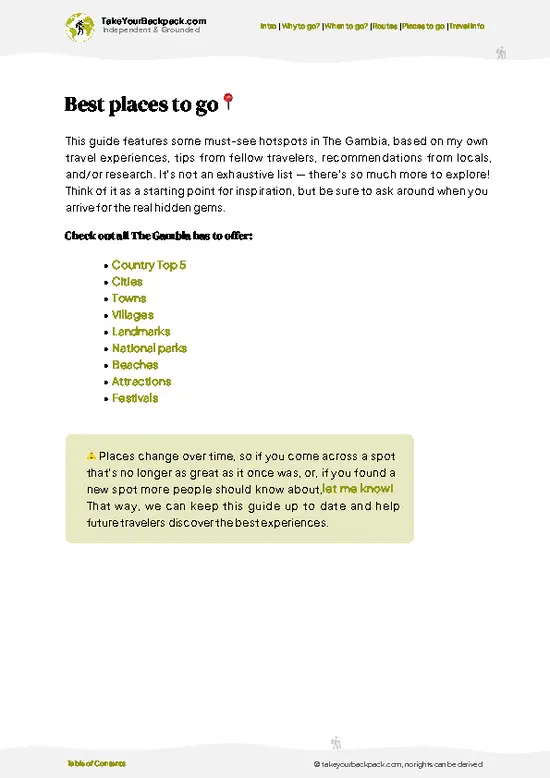
An offline-friendly backpacking guide with optimized travel routes, ranked highlights, transport advice, and the best areas to stay.
example page 0 from our offline Travel Guide for Gambia
example page 1 from our offline Travel Guide for Gambia
example page 2 from our offline Travel Guide for Gambia
example page 3 from our offline Travel Guide for Gambia
example page 4 from our offline Travel Guide for Gambia
example page 5 from our offline Travel Guide for Gambia
example page 6 from our offline Travel Guide for Gambia
example page 7 from our offline Travel Guide for Gambia
The digital guide (213 pages) contains:
✅ 50 highlights, ranked by travel appeal
✅ Optimized 2, 3 & 5-day travel routes
✅ Cities, national parks, landmarks, beaches
✅ How to get around
✅ Offline-friendly for travel without Wi-Fi
👉 Click to see all 30+ guide features

📅 Plan smarter in minutes, not weeks
✅ Month by month travel advice
✅ Festivals & national holidays
✅ Budget expectations

🗺️ Go to the right places, skip the overrated ones
✅ Honest pros & cons of destinations
✅ Top hikes, parks & viewpoints
✅ Lesser-known places most travelers miss
✅ Clear “worth it vs skip it” guidance

🛏️ Travel smoothly without rookie mistakes
✅ Best areas to stay
✅ Transport systems explained simply
✅ Common scams & safety advice
✅ SIM cards, money & practical tips

🌍 Understand the country, not just visit it
✅ Culture & traditions
✅ 52 Essential phrases & customs
✅ Festivals worth planning around
✅ Traveler-friendly historical context
✅ Insights that make places more meaningful

📱 Built for real travel conditions
✅ Fully downloadable PDF
✅ Works completely offline
✅ Optimized for phone use
✅ Useful in remote areas & buses
✅ Everything in one place
Stop searching, start planning
Get instant access to your full guide. 30‑day money-back guarantee.
+ Add another guide for just

By proceeding you agree to our terms.
Sent to your inbox immediately after payment • 100% Secure Checkout
Best Backpacking Travel Advisor 2025 tourism awardBest Backpacking
Travel Advisor
2025
What others say about Take Your Backpack Guides:
⭐⭐⭐⭐⭐
Fantastic, amazing amount of information!
⭐⭐⭐⭐⭐
My goodness this is amazing, it's what I've been looking for hats off too you!
⭐⭐⭐⭐⭐
I think this is absolutely BRILLIANT
⭐⭐⭐⭐
Very complete and informative. It's still missing places, but I gotta to commend you
⭐⭐⭐⭐⭐
This is truly amazing, thank you, can't wait to explore it with my kids!
⭐⭐⭐⭐⭐
Awesome resource, thank you!
⭐⭐⭐⭐⭐
This is amazing! Can't wait to explore the ones I haven't seen
⭐⭐⭐⭐
I love this! Well done, great idea.
⭐⭐⭐⭐⭐
Thanks for taking the time to make this gem!
⭐⭐⭐⭐⭐
This might be the best website I've ever seen.
⭐⭐⭐⭐⭐
Congratulations, and thank you so much for your work; it's incredibly valuable.
⭐⭐⭐⭐
In all seriousness I think you did a great job pointing out the important spots
⭐⭐⭐⭐⭐
10/10 very good
⭐⭐⭐⭐⭐
As someone who's only just starting to visit regularly this is awesome, thank you.
⭐⭐⭐⭐
Thank you very much! I'm going to visit my dad, it's going to be very useful!
⭐⭐⭐⭐⭐
This is really cool! We'll be travelling for the first time and this definitely come in handy.
⭐⭐⭐⭐⭐
You are now our minister of culture, congratulations 👨‍💼
⭐⭐⭐⭐⭐
Just wanted to tell you that this is a pearl! Going to follow your recommendations.
⭐⭐⭐⭐⭐
This is so cool. I'll definitely be using the resource for my travels soon.
⭐⭐⭐⭐⭐
This is very impressive! Good work.
⭐⭐⭐⭐⭐
This is an amazing and informative site. Very well done!

🛏️ Where to stay?Best areas to stay in The Gambia

The best budget stay is near the main market and highway strip, where basic guesthouses and small lodges cluster within a ten-minute walk of the shared taxi garage. Farafenni has no real hostel scene, so expect simple private rooms rather than dorm beds, usually US$8 to 20 a night with a fan and a mosquito net. Prices rise slightly in the cool season and when markets draw crowds.

The trade-off is noise. Trucks, generators and early prayers start before dawn, so ask for a room at the back of the building and bring earplugs. Power cuts are common, so a headlamp and a charged power bank matter more … read more 👉
The best budget stay is near the main market and highway strip, where basic guesthouses and small lodges cluster within a ten-minute walk of the shared taxi garage. Farafenni has no real hostel scene, so expect simple private rooms rather than dorm beds, usually US$8 to 20 a night with a fan and a mosquito net. Prices rise slightly in the cool season and when markets draw crowds.

The trade-off is noise. Trucks, generators and early prayers start before dawn, so ask for a room at the back of the building and bring earplugs. Power cuts are common, so a headlamp and a charged power bank matter more than a fancy room.

The quieter residential lanes behind the highway are a good second option. Compounds and small guesthouses there are calmer at night and cheaper, but streets are unlit and you will be walking in the dark to reach transport in the morning. Choose those if you value sleep over convenience, and reserve ahead on Friday nights before Saturday’s market, when rooms fill with traders.

🚌 Getting aroundHow to get around Farafenni

Farafenni’s center is flat and compact, so you can cross the market and highway strip on foot in 15 to 20 minutes, but walking stops making sense toward the river and outlying lanes, where sand drags at your sandals and the heat bakes the road. Traffic is mostly trucks, shared taxis and motorbikes, and everything runs on a fill-and-go basis, so schedules are loose. Expect dust, horns and the smell of hot engines.
  • Walking: Free and the best way to cover the market and nearby lanes. Go before 10 am or after 4 pm, since midday sun on bare ground is punishing. Carry water, and watch for trucks on the highway shoulder, which has no real sidewalk.
  • Shared taxis (bush taxis): Battered sedans and minibuses leave the garage once they are full, so waiting 20 to 60 minutes is normal. Local hops cost about
… read more 👉
Farafenni’s center is flat and compact, so you can cross the market and highway strip on foot in 15 to 20 minutes, but walking stops making sense toward the river and outlying lanes, where sand drags at your sandals and the heat bakes the road. Traffic is mostly trucks, shared taxis and motorbikes, and everything runs on a fill-and-go basis, so schedules are loose. Expect dust, horns and the smell of hot engines.
  • Walking: Free and the best way to cover the market and nearby lanes. Go before 10 am or after 4 pm, since midday sun on bare ground is punishing. Carry water, and watch for trucks on the highway shoulder, which has no real sidewalk.
  • Shared taxis (bush taxis): Battered sedans and minibuses leave the garage once they are full, so waiting 20 to 60 minutes is normal. Local hops cost about US$0.30 to 0.60, and longer runs along the highway to Soma or Kerewan about US$3 to 6. Ask the fare before sitting, and expect to be squeezed in. Mornings are fastest, as vehicles thin out by late afternoon.
  • Motorbike taxis: Quick for short trips across town at US$0.50 to 1.50. Agree the price first, since there are no meters. Helmets are rare, so ride slowly and hold on tight.
  • Private taxi hire: Costs more, around US$15 to 30 for a half day, but gives you control over timing and is useful for the river crossing or border runs. Negotiate firmly and fix the price before leaving.
  • Ferry and border transport: Vehicles toward the Senegal side queue for hours, so pedestrians often hop between vehicles rather than waiting.

👛 Costs (as of 22 October 2026)Travel costs and budget guide for Farafenni

Farafenni costs about US$16 to 45 a day for a backpacker, based on the high-season accommodation figure in the table. It is a market and transit town, so prices are low but comforts are basic.
CategoryBudget RangeLocal Reality
Dorm accommodationUS$8 to 20 (high season)No true dorms. Simple private rooms with a fan and net. Slightly cheaper off-season.
MealsUS$4 to 9Rice and sauce, grilled meat, bread with omelet and sweet tea at roadside stalls.
Local transportUS$1 to 5Shared taxis and motorbike rides within town and along the highway.
Basic activities/entry feesUS$0 to 5Mostly free: markets, walks and river views. Guides cost extra.
Miscellaneous expensesUS$3 to 6Water, phone data, snacks and small tips.
Total Daily BudgetUS$16 to 45Roughly US$32 on a typical comfortable budget day.
Eat where the … read more 👉
Farafenni costs about US$16 to 45 a day for a backpacker, based on the high-season accommodation figure in the table. It is a market and transit town, so prices are low but comforts are basic.
CategoryBudget RangeLocal Reality
Dorm accommodationUS$8 to 20 (high season)No true dorms. Simple private rooms with a fan and net. Slightly cheaper off-season.
MealsUS$4 to 9Rice and sauce, grilled meat, bread with omelet and sweet tea at roadside stalls.
Local transportUS$1 to 5Shared taxis and motorbike rides within town and along the highway.
Basic activities/entry feesUS$0 to 5Mostly free: markets, walks and river views. Guides cost extra.
Miscellaneous expensesUS$3 to 6Water, phone data, snacks and small tips.
Total Daily BudgetUS$16 to 45Roughly US$32 on a typical comfortable budget day.
Eat where the drivers eat, and buy bottled water in bulk at the market rather than one bottle at a time.
⚠️ Prices can change and everyone travels differently, so take this as a rough guide. Hope it helps you plan your adventure!

🚌 Day tripsWhere to go beyond the main area

Farafenni sits on the main north bank highway, so day trips work well as long as you leave early and accept that return transport thins out by late afternoon.
Kerewan and the North Bank Road:
This is the regional administrative town, a short shared taxi ride west along the highway. It is worth visiting for a look at a working Gambian market town that sees few tourists, and for onward connections. Budget US$4 to 8 return and about an hour each way. Go in the cool season, and don’t wait until late afternoon to head back.

Georgetown (Janjanbureh):
An island town on the Gambia River, reached by shared taxi in about 3 to 4 hours each way with a change or two. It has colonial-era buildings, quiet riverside streets and a slow pace that rewards the long ride. Budget US$10 to 18 return. Many first-timers … read more 👉
Farafenni sits on the main north bank highway, so day trips work well as long as you leave early and accept that return transport thins out by late afternoon.
Kerewan and the North Bank Road:
This is the regional administrative town, a short shared taxi ride west along the highway. It is worth visiting for a look at a working Gambian market town that sees few tourists, and for onward connections. Budget US$4 to 8 return and about an hour each way. Go in the cool season, and don’t wait until late afternoon to head back.

Georgetown (Janjanbureh):
An island town on the Gambia River, reached by shared taxi in about 3 to 4 hours each way with a change or two. It has colonial-era buildings, quiet riverside streets and a slow pace that rewards the long ride. Budget US$10 to 18 return. Many first-timers underestimate the road time, so start by 7 am and confirm the last vehicle back, or plan the trip as a long day.
👉 Explore Janjanbureh
Baobolong Wetland and River Views near Farafenni:
East of town the lanes lead toward creeks and floodplain edges, good for birds and quiet river air. Hire a motorbike taxi for US$5 to 10 for the day. Visit between November and February, when paths are dry and the haze softens.

Soma:
A busy junction town south of the river, reached via the ferry crossing in about 1.5 to 2 hours each way. It is useful as a transport hub and for a market day look. Budget US$5 to 9 return, and allow for ferry delays.

🛡️ SafetyStaying Safe: What Travelers Should Know

Farafenni is a calm town where the usual problems are petty. Crowded market lanes, especially on Saturday, are where pickpocketing and bag slashing happen, so carry your phone and cash in front pockets and keep a small amount of change ready. Truck traffic on the highway is the biggest everyday danger, as drivers move fast and shoulders are narrow. Streets are mostly unlit after dark, so walk with a headlamp, stay on main roads and avoid wandering alone late. Solo travelers, including women, usually find people curious and friendly, but dress modestly and expect persistent greetings. Taxi and motorbike fares are often quoted high to outsiders, so fix the price before you set off. Near the border and ferry area, touts may offer help with crossings for a fee; politely decline and deal with officials … read more 👉
Farafenni is a calm town where the usual problems are petty. Crowded market lanes, especially on Saturday, are where pickpocketing and bag slashing happen, so carry your phone and cash in front pockets and keep a small amount of change ready. Truck traffic on the highway is the biggest everyday danger, as drivers move fast and shoulders are narrow. Streets are mostly unlit after dark, so walk with a headlamp, stay on main roads and avoid wandering alone late. Solo travelers, including women, usually find people curious and friendly, but dress modestly and expect persistent greetings. Taxi and motorbike fares are often quoted high to outsiders, so fix the price before you set off. Near the border and ferry area, touts may offer help with crossings for a fee; politely decline and deal with officials directly. Keep your passport copy handy for checkpoints.

FAQTraveler FAQ

Farafenni is more of a stopover than a destination, but it suits travelers who like working market towns. Its Saturday market draws traders from both sides of the border, and it is the natural pause on the highway between the Senegal border and Kerewan. Most visitors stay one night and spend about US$30 to 45 a day.
One night is enough for Farafenni, and two nights if you want to catch the Saturday market and make a side trip to Kerewan, about an hour away. A day with a full market visit and a slow walk covers the center. Add an extra day only if you plan to head on to Georgetown, which takes 3 to 4 hours by shared taxi.
Farafenni works as a day trip only from nearby towns such as Kerewan, about an hour by shared taxi, since it lies on the north bank highway. From the Banjul side the trip involves the Barra ferry and several hours on the road, so a same-day return is tiring. A realistic approach is to overnight and catch the Saturday market the next morning.
⚠️ Things can change over time, so always validate details locally before you go.

Other Gambian towns near Farafenni

Explore more nearby:

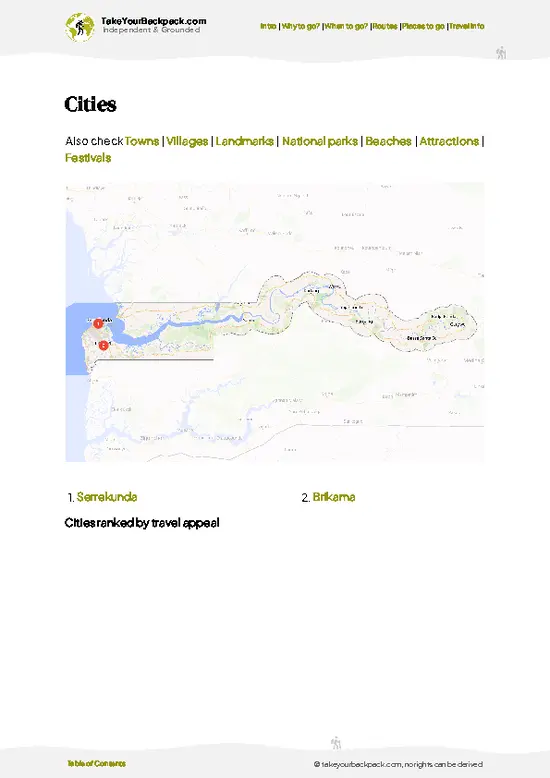
  • Kuntaur—Colonial wharf, river ferry, north bank wetlands, mangrove channels| 78 km away
  • Janjanbureh—River island, Freedom Tree, wharf ruins, chimpanzee boat trips| 90 km away
  • Kafuta—Village greetings, rice paddies, cashew trees, bantaba tea| 102 km away

💡 Not sure where to go next?
Create a personalized itinerary for The Gambia including Farafenni and the places that fit your trip.

Generate my itinerary

👉 Discover all towns

Or checkout all The Gambia has to offer (think cities, towns, villages, national parks, hikes, beaches, festivals)
Country photo of The Gambia

We 💚 feedbackParting advice and final tips

Farafenni rewards anyone who watches the road instead of looking for sights, because the trucks, ferry crowds and border traders are the show. I would arrive for market day, bring small bills for tea and sandwiches, and skip any plan that depends on after-dark entertainment.

✍️ Help improve this page!
The information on this page is based on in-depth research, insights shared by experienced travelers, and feedback from the local travel community in The Gambia. While every effort is made to keep the information accurate and current, conditions can change — so if you spot anything incorrect or outdated, please get in touch.


🙋‍♂️ Give feedback

👋 Meet the founderWho’s Behind Take Your Backpack?

Johan, backpacker and founder of TakeYourBackpackHi, I’m Johan (Netherlands 🇳🇱), the creator of TakeYourBackpack. Over the past 3 decades, I’ve backpacked through 90+ countries across six continents, gaining extensive experience with independent travel, long-term trips, and overland routes.

This site is built on a combination of firsthand travel experience and carefully curated insights from other backpackers. Many guides are based on places I’ve personally visited, while others bring together tips, observations, and practical advice shared by trusted travelers I’ve met along the way.

The goal is to provide realistic, experience-driven guidance — not generic itineraries — so you can explore destinations with better context, clearer expectations, and more confidence.