×

The Gambia🇬🇲 | townsJanjanburehRiver island, Freedom Tree, wharf ruins, chimpanzee boat trips | things to do and best time to go

Explore JambanjellyExplore Kafuta

Backpacking in Janjanbureh
🌟 Highlighttown ranked #5
By Johan Kruseman 🇳🇱 | Updated October 22, 2026

Janjanbureh sits on an island in the River Gambia, and the old name Georgetown still appears on signs and in conversation, though the two are the same place. It lies in the Central River Region of the Gambia, roughly in the middle of the country. The island is reached by ferry, and the ferry runs on its own schedule, so an experienced traveler arrives early and carries small notes for the fare. Evenings are slow: frogs and generators hum, woodsmoke drifts over red dirt lanes, and the river smells of mud and wet leaves. Guesthouses are few, so meeting other backpackers happens over a shared pirogue or a plastic table at a bar. Roads are rough and heat is heavy at midday, so plan around mornings. Come for river life, birds and history, not for nightlife. The day ends with hippos snorting somewhere out in the dark water.

Discover everything you want to know in the 📖 The Gambia Travel Guide.


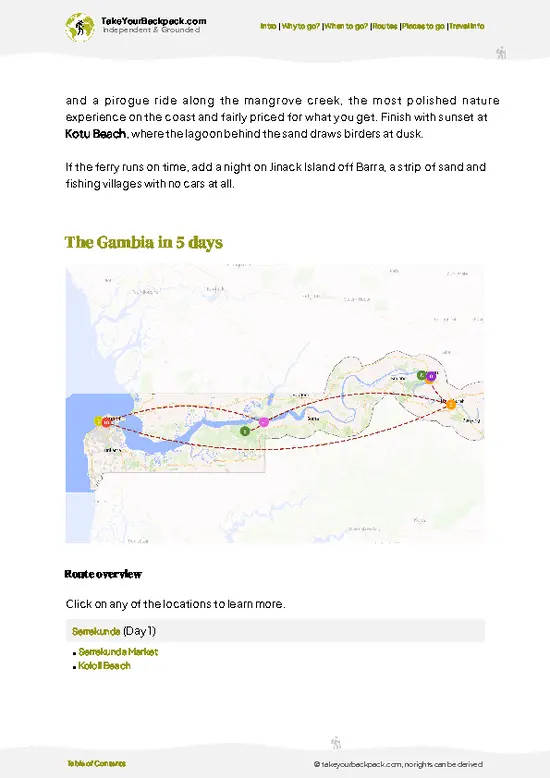
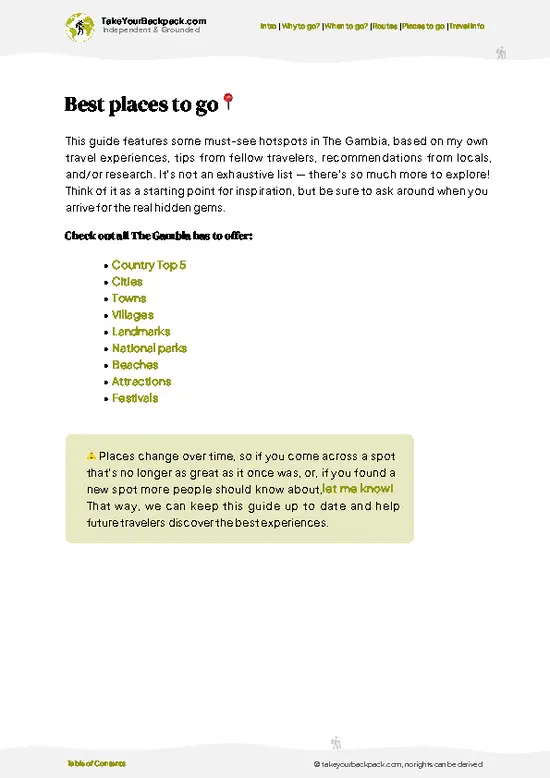
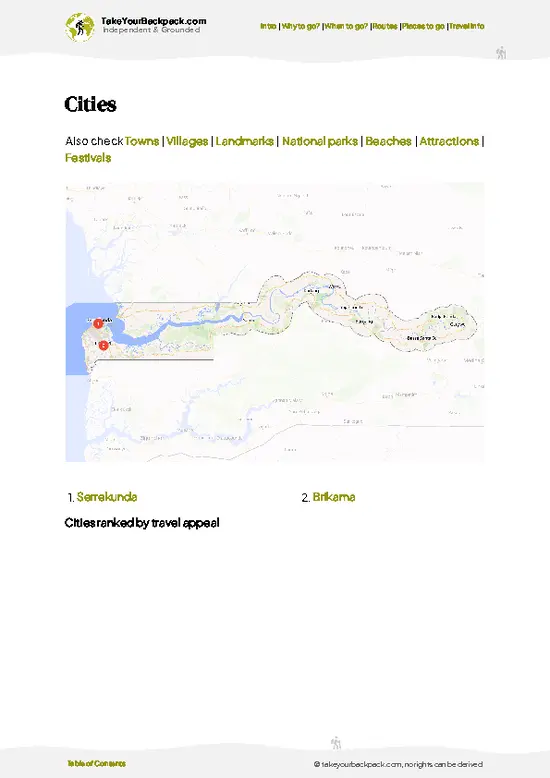
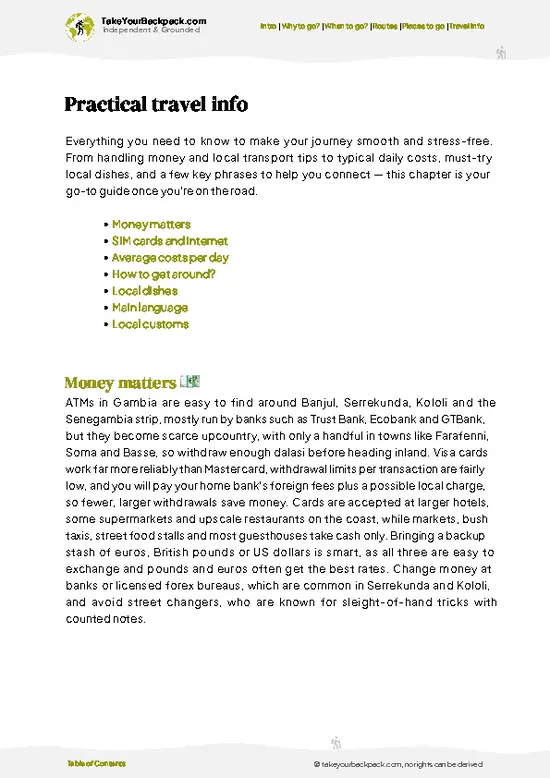
example page 0 from our offline Travel Guide for Gambia
example page 1 from our offline Travel Guide for Gambia
example page 2 from our offline Travel Guide for Gambia
example page 3 from our offline Travel Guide for Gambia
example page 4 from our offline Travel Guide for Gambia
example page 5 from our offline Travel Guide for Gambia
example page 6 from our offline Travel Guide for Gambia
example page 7 from our offline Travel Guide for Gambia
Loading the map 🌍
CLICK TO FILTER
cities
towns
villages
landmarks
national parks
beaches
attractions
festivals
SHOW COUNTRY’S BESTSHOW ALL

✨ Why go?
Ranked #5 town in The Gambia
What makes it a must-see town

Janjanbureh gives you the Gambia at river speed, and that is the draw. This is a place to break the long haul up-country, then linger for two or three days rather than rush through. The reasons that matter are specific. First, the water: boat trips reach Baboon Islands and the chimpanzee rehabilitation project, where you see primates from the river and hear hippos at dusk. Second, the history: Freedom Tree, the old slave trade and colonial buildings give the walking real weight. Third, the scale: guesthouses are small, the lanes are walkable, and a plate of rice with fish or chicken from a roadside cook costs very little. Birders, slow travelers and solo backpackers who like talking to the owner of the place they sleep in will be happiest. Anyone who needs bars, shops and fast internet should treat it as a one-night stop.

💡 HighlightsPlaces and moments you shouldn't skip

  1. Freedom Tree: the old tree is where, by local tradition, freed slaves were once set free. It is a quiet spot to stand and think. Go in the morning when it is cooler. Entry is usually free or a small donation (up to US$1), and 20 to 30 minutes is plenty.
  2. Old Slave House and Wharf Town: the ruined colonial warehouses and quay along the river show the town’s trading past. Walk with a local guide for context (around US$3 to 8). Late afternoon light is best for photos. Allow 1 to 2 hours.
  3. Kunta Kinteh and Baboon Islands boat trip: a pirogue trip from town goes to River Gambia National Park, where you may see chimpanzees, hippos and many birds. Dawn or late afternoon is best. Expect about US$25 to 60 for a boat, shared between you, plus park fees, for 3 to 4 hours.
  4. Janjanbureh Camp riverfront: sit
… read more 👉
  1. Freedom Tree: the old tree is where, by local tradition, freed slaves were once set free. It is a quiet spot to stand and think. Go in the morning when it is cooler. Entry is usually free or a small donation (up to US$1), and 20 to 30 minutes is plenty.
  2. Old Slave House and Wharf Town: the ruined colonial warehouses and quay along the river show the town’s trading past. Walk with a local guide for context (around US$3 to 8). Late afternoon light is best for photos. Allow 1 to 2 hours.
  3. Kunta Kinteh and Baboon Islands boat trip: a pirogue trip from town goes to River Gambia National Park, where you may see chimpanzees, hippos and many birds. Dawn or late afternoon is best. Expect about US$25 to 60 for a boat, shared between you, plus park fees, for 3 to 4 hours.
  4. Janjanbureh Camp riverfront: sit on the bank at the old camp area and watch fishing canoes and kingfishers. A drink costs about US$1 to 2. Sunset is the favorite time. Stay an hour or two.
  5. Georgetown Market: small and local, with vegetables, dried fish and cloth. Morning is liveliest. Entry is free and 30 to 45 minutes is enough. Bring small notes.
Day trips from Janjanbureh include the Wassu Stone Circles, the Kuntaur area and nearby river villages on the north bank. The Baboon Islands boat trip is the best choice for a first visit.
Spotted a mistake or missing something? Contact us.

Things to do near Janjanbureh

Ratings based on Tripadvisor reviews. When you book through this link, you support our work at no extra cost to you.

🏘️ NeighborhoodsWhere things are and how it's laid out

Janjanbureh sits on MacCarthy Island in the middle of the River Gambia, and the whole town is small enough to cover on foot in an hour. Distances are short because the island is only a few kilometers long, and the heat is the real obstacle, so move early and late.
  • Old Colonial Waterfront: Formerly Georgetown, this is the quiet riverside strip of weathered colonial buildings, the old Wharf Town and the Freedom Tree area. Light bounces off the river by midmorning, so walk it at first light when fishermen are launching pirogues and the air smells of woodsmoke and river mud. Few places serve food here, so eat elsewhere.
  • Main Street and Market Area: The town’s center is a dusty strip of tailors, phone-credit stalls and small shops. Mornings bring women selling vegetables, dried fish and peanuts,
… read more 👉
Janjanbureh sits on MacCarthy Island in the middle of the River Gambia, and the whole town is small enough to cover on foot in an hour. Distances are short because the island is only a few kilometers long, and the heat is the real obstacle, so move early and late.
  • Old Colonial Waterfront: Formerly Georgetown, this is the quiet riverside strip of weathered colonial buildings, the old Wharf Town and the Freedom Tree area. Light bounces off the river by midmorning, so walk it at first light when fishermen are launching pirogues and the air smells of woodsmoke and river mud. Few places serve food here, so eat elsewhere.
  • Main Street and Market Area: The town’s center is a dusty strip of tailors, phone-credit stalls and small shops. Mornings bring women selling vegetables, dried fish and peanuts, and the sound of radios and bush-taxi horns. Bring small notes, since vendors rarely have change for large ones. Cheap bean sandwiches and rice-and-sauce lunches come from simple eateries around here.
  • Riverside Lodge Strip: Along the water, the mood turns slow and green, with the evening chorus of frogs, birdsong and hippo grunts drifting from the channel. Nightlife means a cold drink on a terrace, not clubs. There are few streetlights, so carry a headlamp after dark.
  • Across the Bridge and Villages: The ferry or boat crossing leads to the mainland, where sand lanes, baobabs and compound life begin. Go on foot or by bike, and take water.

⌛️ 1 dayWhat you can realistically do in a day

8:00 AM, Georgetown Market: Start here while the day is still cool and the stalls are full. Buy fruit and bread, and see the trade that keeps the island running. Walk onward along the main lane.
9:00 AM, Freedom Tree: A short walk takes you to this old tree. Spend time here and learn the story from someone local, since signage is minimal.
10:30 AM, Old Slave House and Wharf Town: Wander the old quay and ruined warehouses with a guide. The crumbling brick tells you more about the colonial era than any plaque.
12:30 PM, Lunch by the river: Eat rice and fish or chicken at a simple local spot, then rest in the shade during the hottest hours.
3:30 PM, Armitage High School and back lanes: Off the usual track, this old school sits among quiet streets where goats and children are the main traffic. Say … read more 👉
8:00 AM, Georgetown Market: Start here while the day is still cool and the stalls are full. Buy fruit and bread, and see the trade that keeps the island running. Walk onward along the main lane.
9:00 AM, Freedom Tree: A short walk takes you to this old tree. Spend time here and learn the story from someone local, since signage is minimal.
10:30 AM, Old Slave House and Wharf Town: Wander the old quay and ruined warehouses with a guide. The crumbling brick tells you more about the colonial era than any plaque.
12:30 PM, Lunch by the river: Eat rice and fish or chicken at a simple local spot, then rest in the shade during the hottest hours.
3:30 PM, Armitage High School and back lanes: Off the usual track, this old school sits among quiet streets where goats and children are the main traffic. Say hello and take in the old buildings from outside.
5:00 PM, Janjanbureh Camp riverfront: Finish on the bank with a cold drink. Watch fishing canoes drift past, listen for hippos as the light fades, and plan a river trip for the next morning.

🌤️ When to go?Seasonal considerations and timing

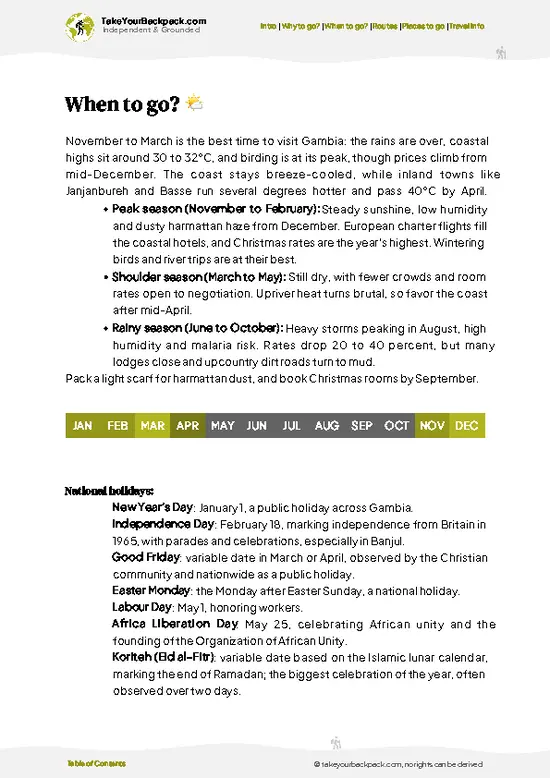
November to February is the easiest window, with dry air, cool nights near 18 to 22°C (64 to 72°F) and daytime highs around 30 to 34°C (86 to 93°F).
  • Cool Dry Season (Nov to Feb): Clear days, about 11 hours of daylight, the best birding and river trips. This is also when lodges charge their highest rates and book up around Christmas.
  • Hot Season (Mar to May): Temperatures climb to 38 to 42°C (100 to 108°F) by afternoon. Crowds vanish and prices soften, but midday is for shade only.
  • Rainy Season (Jun to Oct): Wet, humid and green, with highs of 30 to 34°C (86 to 93°F) and heavy downpours peaking in August. Dirt roads turn to mud, some lodges close, and mosquitoes multiply, though rates fall sharply.
Arrive in late November, when the landscape is still green and prices have not yet peaked.

source: climatestotravel.comJANJanuary: excellent for travelingFEBFebruary: excellent for travelingMARMarch: excellent for travelingAPRApril: excellent for travelingMAYMay: highly recommended for travelingJUNJune: fair for travelingJULJuly: fair for travelingAUGAugust: fair for travelingSEPSeptember: fair for travelingOCTOctober: fair for travelingNOVNovember: highly recommended for travelingDECDecember: excellent for traveling
when-to-go

✈️ The backpacker research shortcutThe Gambia Travel Guide

An offline-friendly backpacking guide with optimized travel routes, ranked highlights, transport advice, and the best areas to stay.
example page 0 from our offline Travel Guide for Gambia
example page 1 from our offline Travel Guide for Gambia
example page 2 from our offline Travel Guide for Gambia
example page 3 from our offline Travel Guide for Gambia
example page 4 from our offline Travel Guide for Gambia
example page 5 from our offline Travel Guide for Gambia
example page 6 from our offline Travel Guide for Gambia
example page 7 from our offline Travel Guide for Gambia
The digital guide (213 pages) contains:
✅ 50 highlights, ranked by travel appeal
✅ Optimized 2, 3 & 5-day travel routes
✅ Cities, national parks, landmarks, beaches
✅ How to get around
✅ Offline-friendly for travel without Wi-Fi
👉 Click to see all 30+ guide features

📅 Plan smarter in minutes, not weeks
✅ Month by month travel advice
✅ Festivals & national holidays
✅ Budget expectations

🗺️ Go to the right places, skip the overrated ones
✅ Honest pros & cons of destinations
✅ Top hikes, parks & viewpoints
✅ Lesser-known places most travelers miss
✅ Clear “worth it vs skip it” guidance

🛏️ Travel smoothly without rookie mistakes
✅ Best areas to stay
✅ Transport systems explained simply
✅ Common scams & safety advice
✅ SIM cards, money & practical tips

🌍 Understand the country, not just visit it
✅ Culture & traditions
✅ 52 Essential phrases & customs
✅ Festivals worth planning around
✅ Traveler-friendly historical context
✅ Insights that make places more meaningful

📱 Built for real travel conditions
✅ Fully downloadable PDF
✅ Works completely offline
✅ Optimized for phone use
✅ Useful in remote areas & buses
✅ Everything in one place
Stop searching, start planning
Get instant access to your full guide. 30‑day money-back guarantee.
+ Add another guide for just

By proceeding you agree to our terms.
Sent to your inbox immediately after payment • 100% Secure Checkout
Best Backpacking Travel Advisor 2025 tourism awardBest Backpacking
Travel Advisor
2025
What others say about Take Your Backpack Guides:
⭐⭐⭐⭐⭐
Fantastic, amazing amount of information!
⭐⭐⭐⭐⭐
My goodness this is amazing, it's what I've been looking for hats off too you!
⭐⭐⭐⭐⭐
I think this is absolutely BRILLIANT
⭐⭐⭐⭐
Very complete and informative. It's still missing places, but I gotta to commend you
⭐⭐⭐⭐⭐
This is truly amazing, thank you, can't wait to explore it with my kids!
⭐⭐⭐⭐⭐
Awesome resource, thank you!
⭐⭐⭐⭐⭐
This is amazing! Can't wait to explore the ones I haven't seen
⭐⭐⭐⭐
I love this! Well done, great idea.
⭐⭐⭐⭐⭐
Thanks for taking the time to make this gem!
⭐⭐⭐⭐⭐
This might be the best website I've ever seen.
⭐⭐⭐⭐⭐
Congratulations, and thank you so much for your work; it's incredibly valuable.
⭐⭐⭐⭐
In all seriousness I think you did a great job pointing out the important spots
⭐⭐⭐⭐⭐
10/10 very good
⭐⭐⭐⭐⭐
As someone who's only just starting to visit regularly this is awesome, thank you.
⭐⭐⭐⭐
Thank you very much! I'm going to visit my dad, it's going to be very useful!
⭐⭐⭐⭐⭐
This is really cool! We'll be travelling for the first time and this definitely come in handy.
⭐⭐⭐⭐⭐
You are now our minister of culture, congratulations 👨‍💼
⭐⭐⭐⭐⭐
Just wanted to tell you that this is a pearl! Going to follow your recommendations.
⭐⭐⭐⭐⭐
This is so cool. I'll definitely be using the resource for my travels soon.
⭐⭐⭐⭐⭐
This is very impressive! Good work.
⭐⭐⭐⭐⭐
This is an amazing and informative site. Very well done!

🛏️ Where to stay?Where staying makes the most sense

The riverside lodge strip is the best area for a budget stay in Janjanbureh, followed by the old town center for the cheapest beds. Dorm-style hostels are rare, so expect basic private rooms or campsite-style options at roughly US$12 to 30, often with fans and mosquito nets, with a few lodges offering shared rooms on request.
The riverfront has the quietest nights and the best breezes. Noise is mostly frogs, birds and the occasional hippo, though power can drop and generators may run in the evening. Lodges here often arrange boat trips and bike hire, which saves you the hassle of organizing transport. … read more 👉
The riverside lodge strip is the best area for a budget stay in Janjanbureh, followed by the old town center for the cheapest beds. Dorm-style hostels are rare, so expect basic private rooms or campsite-style options at roughly US$12 to 30, often with fans and mosquito nets, with a few lodges offering shared rooms on request.
The riverfront has the quietest nights and the best breezes. Noise is mostly frogs, birds and the occasional hippo, though power can drop and generators may run in the evening. Lodges here often arrange boat trips and bike hire, which saves you the hassle of organizing transport. Walking back after dark is usually fine, but the lanes are unlit, so bring a flashlight.
The center near the market is cheaper and more social with locals, and shared taxis leave from nearby, so you can be on the road at dawn. Expect morning noise from roosters, radios and the call to prayer. Rooms there are simpler, and water pressure can be weak.
Book ahead from November to February, when the best rooms fill. Outside those months, walking in and bargaining usually works.

🚌 Getting aroundTransportation options and practical tips

Your own two feet are the easiest way around Janjanbureh, because the island town is only a few kilometers long and flat. Streets are sandy and nearly empty of traffic, so the main sounds are roosters, goats and the odd moped. Public transport exists mostly for reaching the mainland and other towns, and it leaves when full rather than on a timetable.
  • Walking: Free, and you can cross the old town in 20 to 30 minutes. Go before 10 a.m. or after 4 p.m., when the sun is gentler and the light on the river turns golden. Sand makes sandals better than flip-flops.
  • Bicycle: Some lodges and guides rent bikes for about US$4 to 8 a day. They are ideal for village lanes and the road to the stone circles, but tire-pump and repair options are thin, so check the tires first.
  • Ferry and boat crossings: The vehicle
… read more 👉
Your own two feet are the easiest way around Janjanbureh, because the island town is only a few kilometers long and flat. Streets are sandy and nearly empty of traffic, so the main sounds are roosters, goats and the odd moped. Public transport exists mostly for reaching the mainland and other towns, and it leaves when full rather than on a timetable.
  • Walking: Free, and you can cross the old town in 20 to 30 minutes. Go before 10 a.m. or after 4 p.m., when the sun is gentler and the light on the river turns golden. Sand makes sandals better than flip-flops.
  • Bicycle: Some lodges and guides rent bikes for about US$4 to 8 a day. They are ideal for village lanes and the road to the stone circles, but tire-pump and repair options are thin, so check the tires first.
  • Ferry and boat crossings: The vehicle ferry linking the island to the mainland runs through daylight hours and costs well under US$1 for foot passengers. Queues build when trucks load, so expect a wait of 15 to 45 minutes. Small boats run when the ferry stalls.
  • Shared taxis (gelleh-gelleh and bush taxis): These are the budget way to reach Bansang, Basse or Kaur. Vehicles wait until packed, often 1 to 2 hours, then rattle off on a road with potholes. Fares run roughly US$2 to 8 depending on distance, and the last departures are mid-afternoon, so start early.
  • Private hire and tuk-tuks: Charter a car or local driver for a day when you want several sites in one go, about US$40 to 70. Agree the price and fuel before leaving, and carry cash.
Cash is the only currency that works here, and ATMs are scarce, so withdraw before you arrive.

👛 Costs (as of 22 October 2026)What things cost and how to budget

Janjanbureh costs about US$12 to 20 a day for a backpacker, and the total daily budget in high season comes to US$46. Prices rise when you add boat trips, and cash is the only way to pay.
CategoryBudget RangeLocal Reality
Dorm or basic room (high season)US$12 to 20True dorms are rare, so a simple fan room is the norm. Rates drop in the rainy season.
MealsUS$8 to 14Rice with fish or stew, bean sandwiches and fresh bread cost little at local eateries. Lodge dinners cost more.
Local transportUS$3 to 6Ferry fares are small, shared taxis run a few dollars, and walking is free.
Basic activities and entry feesUS$6 to 10Stone circle entry is about US$3 to 5, and village walks with a guide cost a little more.
MiscellaneousUS$3 to 6Water, SIM data, small tips and the occasional cold drink.
Total Daily BudgetUS$46Boat
… read more 👉
Janjanbureh costs about US$12 to 20 a day for a backpacker, and the total daily budget in high season comes to US$46. Prices rise when you add boat trips, and cash is the only way to pay.
CategoryBudget RangeLocal Reality
Dorm or basic room (high season)US$12 to 20True dorms are rare, so a simple fan room is the norm. Rates drop in the rainy season.
MealsUS$8 to 14Rice with fish or stew, bean sandwiches and fresh bread cost little at local eateries. Lodge dinners cost more.
Local transportUS$3 to 6Ferry fares are small, shared taxis run a few dollars, and walking is free.
Basic activities and entry feesUS$6 to 10Stone circle entry is about US$3 to 5, and village walks with a guide cost a little more.
MiscellaneousUS$3 to 6Water, SIM data, small tips and the occasional cold drink.
Total Daily BudgetUS$46Boat trips can add US$30 to 60.
Withdraw cash before reaching the island and eat where the locals do to keep your daily spend low.
⚠️ Prices can change and everyone travels differently, so take this as a rough guide. Hope it helps you plan your adventure!

🚌 Day tripsBest day trips from Janjanbureh

Janjanbureh works well as a base for quiet river and village excursions, mostly reached by shared taxi, boat or hired driver, and all easily done in a day.
Wassu Stone Circles:
These laterite megaliths, a UNESCO site, stand in groves of grass and shade about an hour from town by hired car or shared taxi plus a short walk. Entry is around US$3 to 5, and a local guide explains the burial purpose of the stones. Go in the cooler morning, and take water, since shade is minimal. Total cost is roughly US$8 to 15.
👉 Explore Wassu Stone Circles
Kuntaur and Baboon Islands:
Kuntaur, downriver, is the gateway for boat trips toward River Gambia National Park, where chimpanzees live on rehabilitation islands. You rarely get close, since the animals roam freely, so go for the river itself, birds and hippos. … read more 👉
Janjanbureh works well as a base for quiet river and village excursions, mostly reached by shared taxi, boat or hired driver, and all easily done in a day.
Wassu Stone Circles:
These laterite megaliths, a UNESCO site, stand in groves of grass and shade about an hour from town by hired car or shared taxi plus a short walk. Entry is around US$3 to 5, and a local guide explains the burial purpose of the stones. Go in the cooler morning, and take water, since shade is minimal. Total cost is roughly US$8 to 15.
👉 Explore Wassu Stone Circles
Kuntaur and Baboon Islands:
Kuntaur, downriver, is the gateway for boat trips toward River Gambia National Park, where chimpanzees live on rehabilitation islands. You rarely get close, since the animals roam freely, so go for the river itself, birds and hippos. A morning boat run costs about US$30 to 60 split between people, and the dry season gives the clearest views.
👉 Explore River Gambia National Park
Bansang:
This market town upriver is a plain day out, with a lively weekly market and a taste of ordinary Gambian commerce. Shared taxis cost about US$2 to 4 each way, and the trip takes around an hour. First-timers often leave late and struggle to find a return ride, so be back on the road by mid-afternoon.
👉 Explore Bansang
Local Village Walk to Lamin Koto:
A guided walk or bike ride through nearby farming villages reveals compound life, peanut fields and baobabs. Guides charge roughly US$8 to 15, and early morning or late afternoon avoids heat.

🛡️ SafetySafety Tips and Common Scams in Janjanbureh

Janjanbureh is quiet and broadly safe, and most problems are minor. Petty theft is uncommon, but keep phones and cash out of sight in the market and around the ferry. Lanes are unlit at night, so the main risks are tripping on holes, stray dogs and the odd snake in the dark, and a flashlight solves most of that. Solo travelers, including women, usually find people friendly, though persistent offers of guiding or gifts do occur. A polite no and a smile work. Bumsters, informal touts, appear mainly on the coast, but a few approach visitors here with offers of boat trips or bracelets. Agree prices up front, and book through your lodge when unsure. Do not swim in the river, since hippos and crocodiles live in the channel. Take malaria precautions, as mosquitoes are active after dusk.

FAQCommon questions from travelers

Janjanbureh is worth a stop of its own for anyone who likes river scenery, birds and slow village life. The riverside colonial quarter, hippo-spotting boat trips and the nearby Wassu Stone Circles (about an hour away) give it more to do than a typical stopover. Expect quiet evenings, basic comforts and a total daily spend around US$32 to 55.
Two to three days suit Janjanbureh well. One day covers the old town, market and river walk, and another handles the Wassu Stone Circles or a boat trip toward Kuntaur, which costs roughly US$30 to 60 shared. Add a third day if you want a village bike ride or a birding session.
Janjanbureh is hard to do as a day trip from the coast, since the drive from Banjul or Serrekunda takes roughly 4 to 6 hours each way on the South Bank or North Bank road. A better choice is to stay at least one night, so you can see the river at dawn. From towns such as Bansang or Kuntaur it is an easy return trip by shared taxi for about US$2 to 6.
⚠️ Things can change over time, so always validate details locally before you go.

Other Gambian towns near Janjanbureh

Explore more nearby:

  • Bansang—river crossing, regional hospital, market town| 16 km away
  • Kuntaur—river port, boat launch, rice fields| 20 km away
  • Basse Santa Su—eastern trading post, riverside docks, cross-border traffic| 65 km away

💡 Not sure where to go next?
Create a personalized itinerary for The Gambia including Janjanbureh and the places that fit your trip.

Generate my itinerary

👉 Discover all towns

Or checkout all The Gambia has to offer (think cities, towns, villages, national parks, hikes, beaches, festivals)
Country photo of The Gambia

We 💚 feedbackSumming up the experience

Most first-timers rush the river and skip the back lanes of Janjanbureh, but the old school area and quiet streets show the island’s real pace. I would book the boat trip for early morning, bring small notes for every fare and snack, and leave an evening free to sit on the riverbank and do nothing.

✍️ Help improve this page!
The information on this page is based on in-depth research, insights shared by experienced travelers, and feedback from the local travel community in The Gambia. While every effort is made to keep the information accurate and current, conditions can change — so if you spot anything incorrect or outdated, please get in touch.


🙋‍♂️ Give feedback

👋 Meet the founderWho’s Behind Take Your Backpack?

Johan, backpacker and founder of TakeYourBackpackHi, I’m Johan (Netherlands 🇳🇱), the creator of TakeYourBackpack. Over the past 3 decades, I’ve backpacked through 90+ countries across six continents, gaining extensive experience with independent travel, long-term trips, and overland routes.

This site is built on a combination of firsthand travel experience and carefully curated insights from other backpackers. Many guides are based on places I’ve personally visited, while others bring together tips, observations, and practical advice shared by trusted travelers I’ve met along the way.

The goal is to provide realistic, experience-driven guidance — not generic itineraries — so you can explore destinations with better context, clearer expectations, and more confidence.