×

The Gambia🇬🇲 | landmarksWassu Stone CirclesLaterite monoliths, funerary circles, touchable stones, Kerr Batch circles | things to do and best time to go

Explore TanjiExplore Juffureh

Backpacking in Wassu Stone Circles
🏆 Top pickunique site ranked #1
By Johan Kruseman 🇳🇱 | Updated October 22, 2026

The laterite is warm under your palm and rough as a cheese grater, and the only sound is a goat bell somewhere behind the trees. That is Wassu Stone Circles on a quiet morning, in the north of the Gambia, on the north bank of the River Gambia well upriver from Banjul. Be realistic about the scale. These are 11 compact circles of reddish monoliths, not a Stonehenge-sized field, and you will be done with the stones in under an hour. But they are more than a thousand years old, they are UNESCO-listed, and you can touch them and stand inside them, which you rarely get at a World Heritage site. Crowds are close to nonexistent, so photos come without strangers in frame. The small museum is worth ten minutes, and the caretaker-guides add real context. The journey eats far more time than the visit does. Combine it with other stops rather than making a special trip. The last thing you notice is the pale lichen on the shaded sides of the pillars.

Discover everything you want to know in the 📖 The Gambia Travel Guide.


example page 0 from our offline Travel Guide for Gambia
example page 1 from our offline Travel Guide for Gambia
example page 2 from our offline Travel Guide for Gambia
example page 3 from our offline Travel Guide for Gambia
example page 4 from our offline Travel Guide for Gambia
example page 5 from our offline Travel Guide for Gambia
example page 6 from our offline Travel Guide for Gambia
example page 7 from our offline Travel Guide for Gambia
Loading the map 🌍
CLICK TO FILTER
cities
towns
villages
landmarks
national parks
beaches
attractions
festivals
SHOW COUNTRY’S BESTSHOW ALL

✨ Why go?
Ranked #1 unique site in The Gambia
What sets this place apart

Wassu Stone Circles is one of the very few places in West Africa where you can walk among megaliths built by a society that left no written record. The circles are part of the Senegambian Stone Circles listing, and the site is the easiest in the whole region to reach and to understand, with a small museum and local guides on the spot.
The stones are cut from laterite and stand up to about 2.5 meters high, some weighing several tons. Standing next to a pillar, you start to wonder how people without metal-heavy machinery hauled them from a quarry and raised them in neat rings. That puzzle alone makes the stop more interesting than its size suggests.
The site also fits well on a route along the North Bank Road, where it sits between river towns and quiet villages. Pair it with nearby Kerr Batch, … read more 👉
Wassu Stone Circles is one of the very few places in West Africa where you can walk among megaliths built by a society that left no written record. The circles are part of the Senegambian Stone Circles listing, and the site is the easiest in the whole region to reach and to understand, with a small museum and local guides on the spot.
The stones are cut from laterite and stand up to about 2.5 meters high, some weighing several tons. Standing next to a pillar, you start to wonder how people without metal-heavy machinery hauled them from a quarry and raised them in neat rings. That puzzle alone makes the stop more interesting than its size suggests.
The site also fits well on a route along the North Bank Road, where it sits between river towns and quiet villages. Pair it with nearby Kerr Batch, the other circle group close by, and with the river crossings toward Janjanbureh. You get a half-day of real archaeology in a country most people know only for beaches, and you will likely have the stones to yourself.

💡 HighlightsDon't-miss highlights and experiences

  1. The Main Circles: Eleven rings of upright laterite pillars sit in a clearing, some leaning, some perfectly upright. Walk between them slowly, because the spacing and the regular rings are the whole point of the site.
  2. The Tallest Monoliths: A few pillars rise to roughly 2.5 meters, and standing beside them gives a sense of the labor involved. They were cut from laterite quarried locally and moved into place by hand.
  3. Tool Marks and Laterite Texture: Get close to the surface of a pillar. You can see the rough, pitted rock and the shaping that rounded the stones into columns, and the rust-orange color shifts to grey where lichen grows.
  4. The Site Museum: A small exhibit at the entrance displays objects found in excavations around the circles, such as pottery and beads, and explains how the stones relate
… read more 👉
  1. The Main Circles: Eleven rings of upright laterite pillars sit in a clearing, some leaning, some perfectly upright. Walk between them slowly, because the spacing and the regular rings are the whole point of the site.
  2. The Tallest Monoliths: A few pillars rise to roughly 2.5 meters, and standing beside them gives a sense of the labor involved. They were cut from laterite quarried locally and moved into place by hand.
  3. Tool Marks and Laterite Texture: Get close to the surface of a pillar. You can see the rough, pitted rock and the shaping that rounded the stones into columns, and the rust-orange color shifts to grey where lichen grows.
  4. The Site Museum: A small exhibit at the entrance displays objects found in excavations around the circles, such as pottery and beads, and explains how the stones relate to burials. It adds context before you walk out among the stones.
  5. The Excavated Burial Evidence: Archaeologists found that the circles were tied to burials, with remains placed beneath or beside the stones. Ask your guide to point out where digging took place, as it explains why the site is understood as a funerary landscape.
  6. Local Guides and Their Stories: The caretakers live nearby and can explain the theories about who built the circles and when. Their explanations bring the stones into the present, and tipping them is the fair way to say thanks.
  7. Kerr Batch: A second group of circles lies a short way away and belongs to the same World Heritage listing. Seeing both lets you compare how the stones are arranged and how well each has been preserved.
For a first visit, start with the main circles, because walking among the eleven rings is what gives Wassu Stone Circles its meaning and the museum and guides then fill in the story.
Spotted a mistake or missing something? Contact us.

Things to do near Wassu Stone Circles

Ratings based on Tripadvisor reviews. When you book through this link, you support our work at no extra cost to you.

🌤️ When to go?Weather, crowds, and seasonal trade-offs

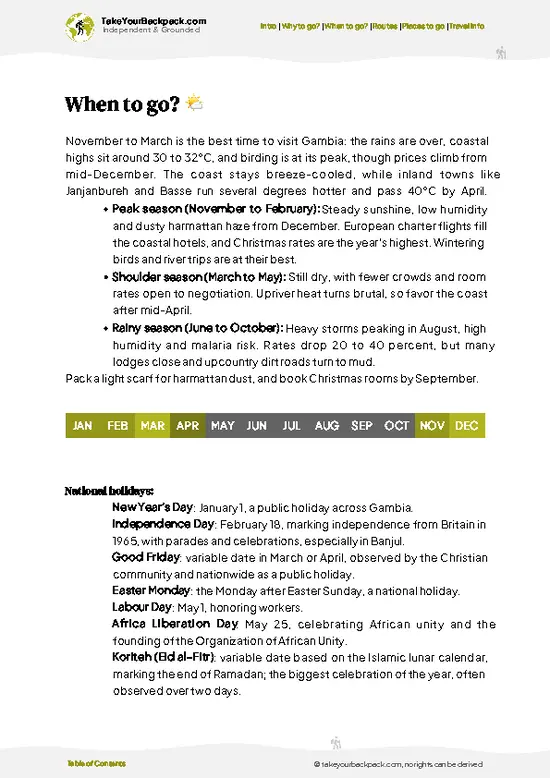
November to February is the most comfortable window for Wassu Stone Circles, with dry air and clear light on the laterite stones.
  • Cool Dry Season (November to February): Days run 30 to 34°C (86 to 93°F), nights drop to 17 to 22°C (63 to 72°F), and the harmattan haze can flatten photos. Daylight lasts roughly 11 to 12 hours. Tour groups peak here and Gambian guesthouse prices are at their highest.
  • Hot Dry Season (March to May): Afternoons climb to 36 to 41°C (97 to 106°F) on open ground with almost no shade at the site. Crowds thin and rooms get cheaper, but you will want to be there early in the morning.
  • Rainy Season (June to October): Highs sit around 31 to 35°C (88 to 95°F) with humid air, and heavy downpours turn dirt tracks to mud. The grass around the circles is bright green, mosquitoes
… read more 👉
November to February is the most comfortable window for Wassu Stone Circles, with dry air and clear light on the laterite stones.
  • Cool Dry Season (November to February): Days run 30 to 34°C (86 to 93°F), nights drop to 17 to 22°C (63 to 72°F), and the harmattan haze can flatten photos. Daylight lasts roughly 11 to 12 hours. Tour groups peak here and Gambian guesthouse prices are at their highest.
  • Hot Dry Season (March to May): Afternoons climb to 36 to 41°C (97 to 106°F) on open ground with almost no shade at the site. Crowds thin and rooms get cheaper, but you will want to be there early in the morning.
  • Rainy Season (June to October): Highs sit around 31 to 35°C (88 to 95°F) with humid air, and heavy downpours turn dirt tracks to mud. The grass around the circles is bright green, mosquitoes multiply, and you may have the stones nearly to yourself. Some lodges close or discount heavily.
Arrive within the first hour after opening, when the stones are cool and the museum is quiet.


source: climatestotravel.comJANJanuary: highly recommended for travelingFEBFebruary: highly recommended for travelingMARMarch: highly recommended for travelingAPRApril: excellent for travelingMAYMay: highly recommended for travelingJUNJune: fair for travelingJULJuly: fair for travelingAUGAugust: fair for travelingSEPSeptember: fair for travelingOCTOctober: fair for travelingNOVNovember: excellent for travelingDECDecember: highly recommended for traveling
gambia-unique-site-wassu-stone-circles v1
© Google |

✈️ The backpacker research shortcutThe Gambia Travel Guide

An offline-friendly backpacking guide with optimized travel routes, ranked highlights, transport advice, and the best areas to stay.
example page 0 from our offline Travel Guide for Gambia
example page 1 from our offline Travel Guide for Gambia
example page 2 from our offline Travel Guide for Gambia
example page 3 from our offline Travel Guide for Gambia
example page 4 from our offline Travel Guide for Gambia
example page 5 from our offline Travel Guide for Gambia
example page 6 from our offline Travel Guide for Gambia
example page 7 from our offline Travel Guide for Gambia
The digital guide (213 pages) contains:
✅ 50 highlights, ranked by travel appeal
✅ Optimized 2, 3 & 5-day travel routes
✅ Cities, national parks, landmarks, beaches
✅ How to get around
✅ Offline-friendly for travel without Wi-Fi
👉 Click to see all 30+ guide features

📅 Plan smarter in minutes, not weeks
✅ Month by month travel advice
✅ Festivals & national holidays
✅ Budget expectations

🗺️ Go to the right places, skip the overrated ones
✅ Honest pros & cons of destinations
✅ Top hikes, parks & viewpoints
✅ Lesser-known places most travelers miss
✅ Clear “worth it vs skip it” guidance

🛏️ Travel smoothly without rookie mistakes
✅ Best areas to stay
✅ Transport systems explained simply
✅ Common scams & safety advice
✅ SIM cards, money & practical tips

🌍 Understand the country, not just visit it
✅ Culture & traditions
✅ 52 Essential phrases & customs
✅ Festivals worth planning around
✅ Traveler-friendly historical context
✅ Insights that make places more meaningful

📱 Built for real travel conditions
✅ Fully downloadable PDF
✅ Works completely offline
✅ Optimized for phone use
✅ Useful in remote areas & buses
✅ Everything in one place
Stop searching, start planning
Get instant access to your full guide. 30‑day money-back guarantee.
+ Add another guide for just

By proceeding you agree to our terms.
Sent to your inbox immediately after payment • 100% Secure Checkout
Best Backpacking Travel Advisor 2025 tourism awardBest Backpacking
Travel Advisor
2025
What others say about Take Your Backpack Guides:
⭐⭐⭐⭐⭐
Fantastic, amazing amount of information!
⭐⭐⭐⭐⭐
My goodness this is amazing, it's what I've been looking for hats off too you!
⭐⭐⭐⭐⭐
I think this is absolutely BRILLIANT
⭐⭐⭐⭐
Very complete and informative. It's still missing places, but I gotta to commend you
⭐⭐⭐⭐⭐
This is truly amazing, thank you, can't wait to explore it with my kids!
⭐⭐⭐⭐⭐
Awesome resource, thank you!
⭐⭐⭐⭐⭐
This is amazing! Can't wait to explore the ones I haven't seen
⭐⭐⭐⭐
I love this! Well done, great idea.
⭐⭐⭐⭐⭐
Thanks for taking the time to make this gem!
⭐⭐⭐⭐⭐
This might be the best website I've ever seen.
⭐⭐⭐⭐⭐
Congratulations, and thank you so much for your work; it's incredibly valuable.
⭐⭐⭐⭐
In all seriousness I think you did a great job pointing out the important spots
⭐⭐⭐⭐⭐
10/10 very good
⭐⭐⭐⭐⭐
As someone who's only just starting to visit regularly this is awesome, thank you.
⭐⭐⭐⭐
Thank you very much! I'm going to visit my dad, it's going to be very useful!
⭐⭐⭐⭐⭐
This is really cool! We'll be travelling for the first time and this definitely come in handy.
⭐⭐⭐⭐⭐
You are now our minister of culture, congratulations 👨‍💼
⭐⭐⭐⭐⭐
Just wanted to tell you that this is a pearl! Going to follow your recommendations.
⭐⭐⭐⭐⭐
This is so cool. I'll definitely be using the resource for my travels soon.
⭐⭐⭐⭐⭐
This is very impressive! Good work.
⭐⭐⭐⭐⭐
This is an amazing and informative site. Very well done!

🛏️ Where to stay?Best areas to stay in The Gambia

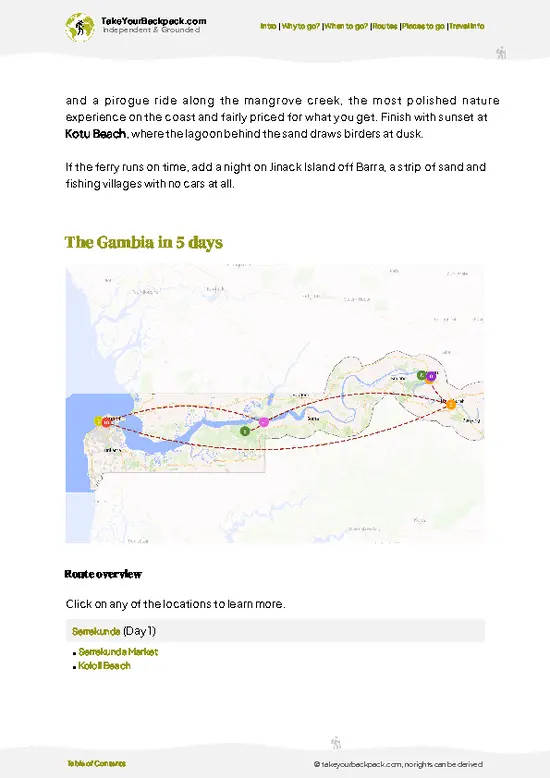
The best bases for Wassu Stone Circles are the small river towns of Janjanbureh and Georgetown-side lodges, plus Bansang and Kuntaur for those wanting something more local.

Janjanbureh, on its island in the Gambia River about 40 kilometers (25 miles) east of the site, is the most sociable choice. It has a handful of low-key guesthouses and eco-lodges, a few riverside bars where travelers swap plans, and easy hookups for boat trips, chimpanzee visits at River Gambia National Park and bird walks. Solo backpackers find it easy to team up here and split a driver for the stones, which keeps the cost … read more 👉
The best bases for Wassu Stone Circles are the small river towns of Janjanbureh and Georgetown-side lodges, plus Bansang and Kuntaur for those wanting something more local.

Janjanbureh, on its island in the Gambia River about 40 kilometers (25 miles) east of the site, is the most sociable choice. It has a handful of low-key guesthouses and eco-lodges, a few riverside bars where travelers swap plans, and easy hookups for boat trips, chimpanzee visits at River Gambia National Park and bird walks. Solo backpackers find it easy to team up here and split a driver for the stones, which keeps the cost down. It is also safe to walk around after dark in the main part of town, though a flashlight helps.

Kuntaur sits on the north bank and is quieter, with a couple of simple riverside camps and a ferry crossing. It suits travelers who like sleeping near the water and having the evening to themselves.

Bansang, a larger market town on the south bank, has basic rooms and more shops and food stalls, but little nightlife and few other foreigners.

Wassu itself has almost no accommodation, so most visitors stay in Janjanbureh and come for the morning. If you are arriving from the coast, an overnight stop in Janjanbureh makes the trip far less tiring.

👛 Costs (as of 22 October 2026)Typical daily expenses

Expect to spend about US$38 a day around Wassu Stone Circles on a backpacker budget, with the site entry itself a small part of that.
CategoryBudget RangeLocal Reality
Site entryUS$3 to 5Covers the circles and the small museum; a local guide may ask for a tip of US$2 to 4
Accommodation (high season)US$12 to 20Simple guesthouse or camp room in Janjanbureh, often with a fan and shared bathroom; off-season prices drop to US$8 to 14
FoodUS$5 to 9Rice and fish or domoda (peanut stew) at local eateries costs US$2 to 4 a plate
Local transportUS$4 to 10Shared bush taxis and minibuses along the South Bank road; a private taxi for the stones from Janjanbureh runs about US$20 to 35 round trip
Water and extrasUS$1 to 3Bottled water, snacks and a phone top-up; pay in cash, as there are no card machines nearby
Total
… read more 👉
Expect to spend about US$38 a day around Wassu Stone Circles on a backpacker budget, with the site entry itself a small part of that.
CategoryBudget RangeLocal Reality
Site entryUS$3 to 5Covers the circles and the small museum; a local guide may ask for a tip of US$2 to 4
Accommodation (high season)US$12 to 20Simple guesthouse or camp room in Janjanbureh, often with a fan and shared bathroom; off-season prices drop to US$8 to 14
FoodUS$5 to 9Rice and fish or domoda (peanut stew) at local eateries costs US$2 to 4 a plate
Local transportUS$4 to 10Shared bush taxis and minibuses along the South Bank road; a private taxi for the stones from Janjanbureh runs about US$20 to 35 round trip
Water and extrasUS$1 to 3Bottled water, snacks and a phone top-up; pay in cash, as there are no card machines nearby
Total Daily BudgetUS$38Per person per day, sharing transport where possible
⚠️ Prices can change and everyone travels differently, so take this as a rough guide. Hope it helps you plan your adventure!

FAQCommon questions from travelers

Wassu Stone Circles is a UNESCO World Heritage site in the Central River Region of the Gambia, made up of about ten circles of carved laterite pillars. The stones date from roughly 1,000 years ago and are thought to mark burial sites. A small museum on site explains the finds, and entry costs around US$3 to 5.
Wassu Stone Circles needs about 1 to 2 hours on the ground, which covers the main circles, the museum and a short chat with a guide. Allow a half day if you are coming from Janjanbureh, and a full day if you are traveling from the coast. Many travelers combine it with the nearby Kerr Batch circles or a night in Janjanbureh.
Wassu Stone Circles lies on the north bank of the Gambia River, about 150 kilometers (95 miles) from Serrekunda and 4 to 5 hours by road. Take a shared taxi or minibus to Farafenni or Kaur, then a local vehicle to Wassu. You can also hire a driver for the day, about US$60 to 100 from the coast, or cross the river by ferry at Kuntaur.
⚠️ Things can change over time, so always validate details locally before you go.

Where to go next

Wassu Stone Circles isn’t the only highlight in The Gambia. Explore all what The Gambia has to offer.
Country photo of The Gambia

We 💚 feedbackParting advice and final tips

Give Wassu Stone Circles about an hour, or ninety minutes if you want the museum and a proper chat with a guide. Staying longer will not reveal more, because the real work happens on the road around it. I would add Kerr Batch in the same morning, bring water and a hat, and carry small bills for the guide.

✍️ Help improve this page!
The information on this page is based on in-depth research, insights shared by experienced travelers, and feedback from the local travel community in The Gambia. While every effort is made to keep the information accurate and current, conditions can change — so if you spot anything incorrect or outdated, please get in touch.


🙋‍♂️ Give feedback

👋 Meet the founderWho’s Behind Take Your Backpack?

Johan, backpacker and founder of TakeYourBackpackHi, I’m Johan (Netherlands 🇳🇱), the creator of TakeYourBackpack. Over the past 3 decades, I’ve backpacked through 90+ countries across six continents, gaining extensive experience with independent travel, long-term trips, and overland routes.

This site is built on a combination of firsthand travel experience and carefully curated insights from other backpackers. Many guides are based on places I’ve personally visited, while others bring together tips, observations, and practical advice shared by trusted travelers I’ve met along the way.

The goal is to provide realistic, experience-driven guidance — not generic itineraries — so you can explore destinations with better context, clearer expectations, and more confidence.